
ANIMALIA Domain Eukarya Kingdom Animalia Linnaeus classification 2
- Slides: 41
ANIMALIA • Domain Eukarya, Kingdom Animalia • Linnaeus classification: 2 Kingdoms (mid-1700 s) • Whittaker classification: 5 Kingdoms (1959)
ANIMALIA • Woese classification: 3 Domains, many Kingdoms (1990); Figs. 26. 21, 27. 16
ANIMALIA • Eukarya: Opisthokonta: Animalia • one of many descendant clades of ancestral eukaryote • multicellular fungi and at least two unicellular protist groups are close relatives; Figs. 31. 8 • multicellularity evolved at least twice within eukaryotes
ANIMALIA • • Kingdom Animalia (= Metazoa) multicellular around 35 phyla (plural of Phylum) all but 1 invertebrates (no “backbone”) 9 phyla in this course represent major clades represent characters that include some of the major evolutionary changes
ANIMALIA • what is an animal? • monophyletic taxon; Hox genes (positional info during development: what body parts go where) • multicellular; permits large size • heterotrophic: ingestion • eat other organisms (live/dead) using a mouth • structural proteins support; not cell walls
ANIMALIA • • diploid (2 n) stage dominates life cycle motile sperm, nonmotile egg most have muscle, nerve cells incredible variations on a few basic body plans • Fig. 32. 10
ANIMALIA • deep time: major diversification between 535 -525 mya (in Cambrian Period); Table 25. 1
ANIMALIA • competing phylogenetic hypotheses • morphological (= anatomical), developmental (= embryological) characters; Fig. 32. 10 • molecular characters, some morph/dev; Fig. 32. 11
ANIMALIA • debate between Fig. 32. 10 & 32. 11: homologous vs. homoplasous • research is continuing • basic body plan characters
TISSUES • group of similar cells; common structure/function (e. g. leaf epidermal cells, cardiac muscle cells) • absence vs. presence: non-Eumetazoa vs. Eumetazoa • "Phylum" Porifera: sponges • Eumetazoa: "true animals"; us
SYMMETRY • 2 types; Fig. 32. 7 • radial: multiple planes through central axis gives mirror image • bilateral: only one plane through central axis gives mirror image • bilateral: right, left sides
SYMMETRY • Phylum Cnidaria (hydras, jellies, corals); eumetazoans with radial symmetry • Bilateria: all other Eumetazoa; us
GERM LAYERS • germ: something serving as an origin • # of germ (body) layers • 3 types: ectoderm, endoderm, mesoderm; Fig. 32. 8 • Cnidaria: 2 (diploblastic: ectoderm & endoderm) • Bilateria: 3 (triploblastic: ectoderm, endoderm, mesoderm)
BODY CAVITY • • coelom (hollow): a body cavity no coelom (acoelomates); Fig. 32. 8 Phylum Platyhelminthes (flatworms) pseudocoelom (pseudocoelomates): coelom not totally lined by mesoderm • Phylum Nematoda (roundworms) • coelom (coelomates): coelom totally lined by mesoderm • 5 other Phyla (of 9)
MOUTH ORIGIN • • early embryonic development; Fig. 32. 2 zygote initially undergoes cleavage: mitosis without cell growth blastula: hollow ball; blastocoel gastrulation: involves infolding gastrula: germ layers archenteron: embryonic gut blastopore: opening into archenteron
MOUTH ORIGIN • • • blastopore becomes mouth; Fig. 32. 9 protostome: first mouth Phylum Mollusca (clams, snails, squids) Phylum Annelida (segmented worms) Phylum Arthropoda (crustaceans, insects, spiders)
MOUTH ORIGIN • mouth from secondary opening in gastrula • deuterostome: second mouth • Phylum Echinodermata (starfish, sea urchins) • Phylum Chordata (tunicates, lancelets, vertebrates; us)
COELOM FORMATION • protostomes or deuterostomes; Fig. 32. 9 • coelom formation in gastrula; mesoderm • protostomes: schizocoelous; “split” • mesoderm splits; forms the coelomic cavities • deuterostomes: enterocoelous; “gut” • mesoderms buds off the archenteron to form coelomic cavities
CLEAVAGE TYPE • two components of cleavage; Fig. 32. 9 • 1. spiral or radial cleavage • spiral: cell division plane diagonal to embryo's vertical axis; cells offset • radial: cell division plane both parallel and perpendicular to embryo's vertical axis; cells not offset
CLEAVAGE FATE • 2. determinate or indeterminate cleavage • determinate: fate of embryonic cell determined early • indeterminate: fate of embryonic cell determined later; identical twins • protostomes: spiral, determinate • deuterostomes: radial, indeterminate
ALTERNATIVE HYPOTHESES • • Figs. 32. 10, 32. 11 some groups the same Animalia, Eumetazoa monophyletic Deuterostomia monophyletic, but differences in membership • presence/type of coelom is homoplasous in 32. 11
MOLECULAR PHYLOGENY • defined by shared derived homologous gene sequences • Lophotrochozoa; Fig. 32. 13 • lophophore: feeding structure • trochophore: larval stage • Ecdysozoa; Fig. 32. 12 • secrete exoskeletons • ecdysis: shed/molt; necessary to grow
SUMMARY • think about where the homologous characters would map; concept Fig. 32. 4 page 665 • tissues: absent or present • symmetry: radial or bilateral • germ layers: 2 or 3 • coelom type: acoelomate, pseudocoelomate, or coelomate • protostome or deuterostome – mouth origin: blastopore or secondary opening – coelom formation: schizocoelous or enterocoelous – cleavage: spiral or radial, determinate or indeterminate
ANIMAL PHYLA • • • key adaptations; structure and function acquire/distribute oxygen, water, food get rid of wastes (CO 2, metabolic) sense the environment respond to the environment – movement – protection • reproduce
PORIFERA • "Phylum" Porifera (sponges); lecture links
PORIFERA • most marine; many live with coral reefs • no fixed body shape, no symmetry • multicellular: specialized cells, but no true tissues • cellular interdependencies, but loose coordination • very successful: complexity of form not necessary for evolutionary success
PORIFERA ANATOMY • Fig. 33. 4 • choanocytes: flagellated collar cells • suspension feeders: create water currents, trap food, intracellular digestion • basic anatomy: water canal system • ostia (ostium): small pores (pore-bearing) • sequential hermaphrodites • sessile (attached to a substrate) adult • dispersing larval stage
PORIFERA • • • “alternative” animals; used to be ignored colorful: yellow, red, violet, etc; toxicity biochemical complexity biotoxins for protection, competition diversity of interest to natural products chemists, pharmacologists • sponge conservation biology important • concentrate nutrients in coral reef ecosystem
PORIFERA • what is sister group to animals? – similarity between choanocyte and choanoflagellates • Choanoflagellata: protist-like, colonial, flagellated; Fig. 32. 3 • choanocyte is the shared derived homologous character
CNIDARIA • Phylum Cnidaria; lecture links • hydras, jellies, sea anemones, coral
CNIDARIA • most marine, very successful • radial symmetry; Fig. 33. 5 • good adaptation when: – sessile – planktonic (drifting in currents) • diploblastic: 2 germ layers
CNIDARIA • tissues, but no organs – pseudomuscle tissue – nerve net tissue; Fig. 49. 2 • Fig. 33. 8: 2 body forms; taxa vary in which form is dominant • polyp form: cylindrical, mouth-up – hydras, sea anemones, corals • medusa form: bowl-like, mouth-down – jellies • cnidocyte: a cell specialized for defense, capture of prey; Fig. 33. 6
CNIDARIA • coral animals secrete calcium carbonate exoskeleton: reef • home for millions of other species • 75% of coral reefs threatened
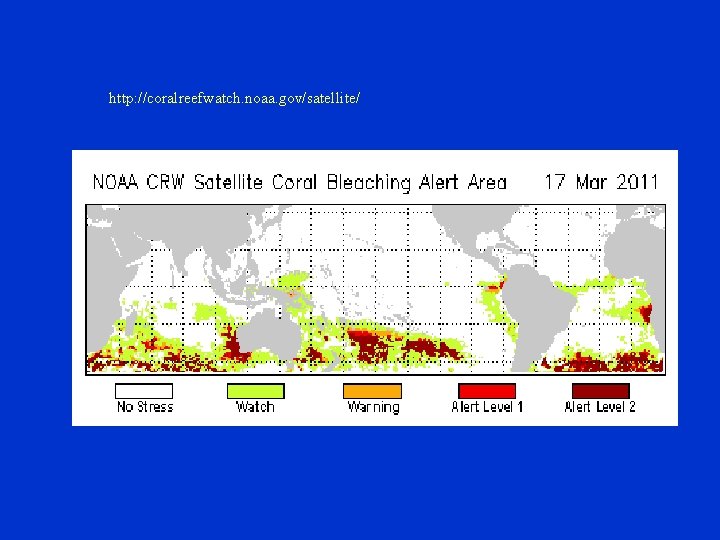
http: //coralreefwatch. noaa. gov/satellite/
CNIDARIA • photosynthetic endosymbiotic dinoflagellates; live inside coral cells
CNIDARIA • mutualism: symbiosis where both benefit • bleaching: breakdown of mutualism • global warming: burn oil, coal → CO 2 ↑ • global warming → warmer waters → bleaching
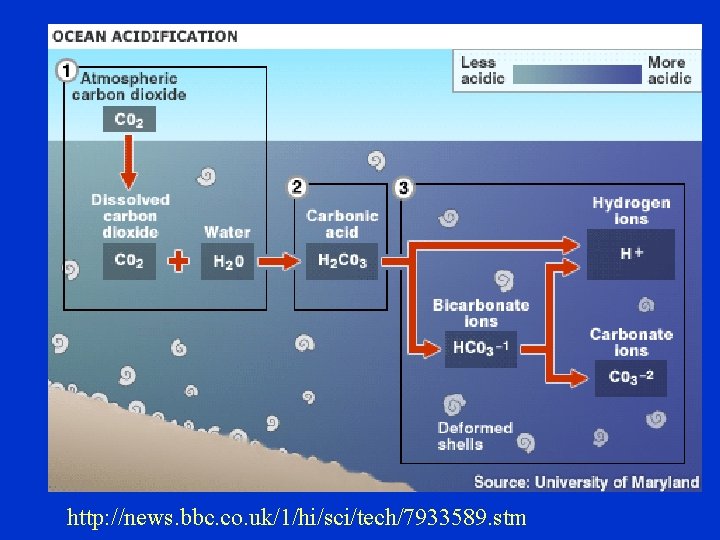
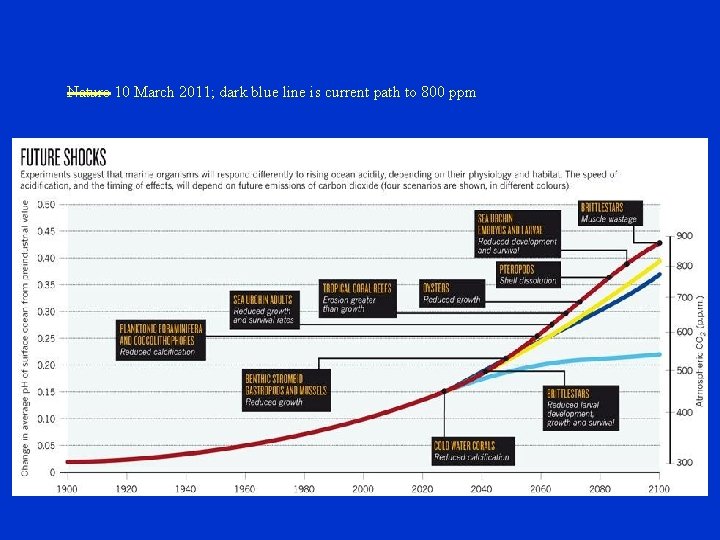
ACIDIFICATION • ocean acidification via carbonic acid • calcium carbonate shells can dissolve • reduced ability to even form calcium carbonate shells
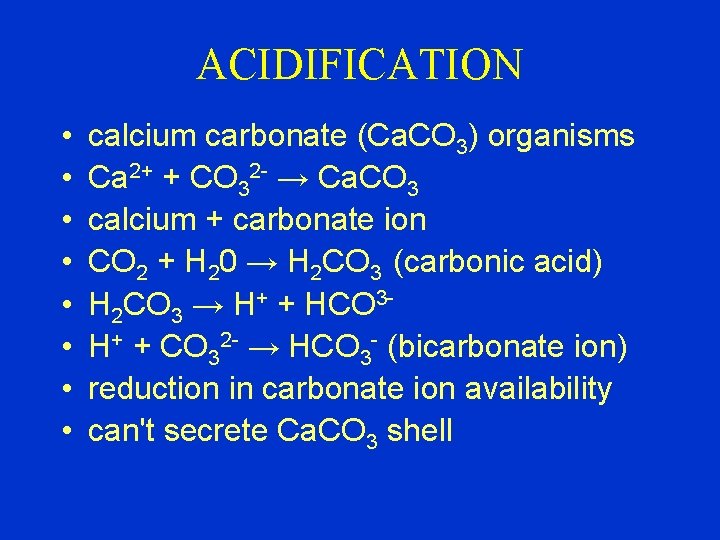
ACIDIFICATION • • calcium carbonate (Ca. CO 3) organisms Ca 2+ + CO 32 - → Ca. CO 3 calcium + carbonate ion CO 2 + H 20 → H 2 CO 3 (carbonic acid) H 2 CO 3 → H+ + HCO 3 H+ + CO 32 - → HCO 3 - (bicarbonate ion) reduction in carbonate ion availability can't secrete Ca. CO 3 shell
http: //news. bbc. co. uk/1/hi/sci/tech/7933589. stm
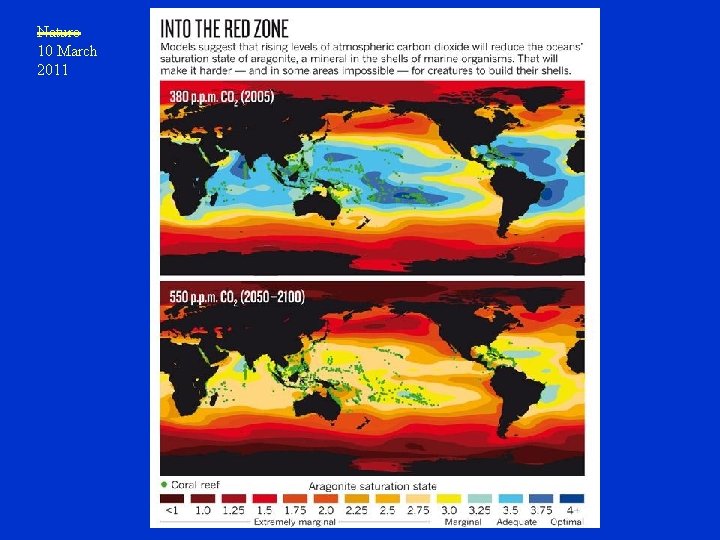
Nature 10 March 2011
Nature 10 March 2011; dark blue line is current path to 800 ppm