
Animal Testing An Introduction Lesson Objectives 1 Recognise
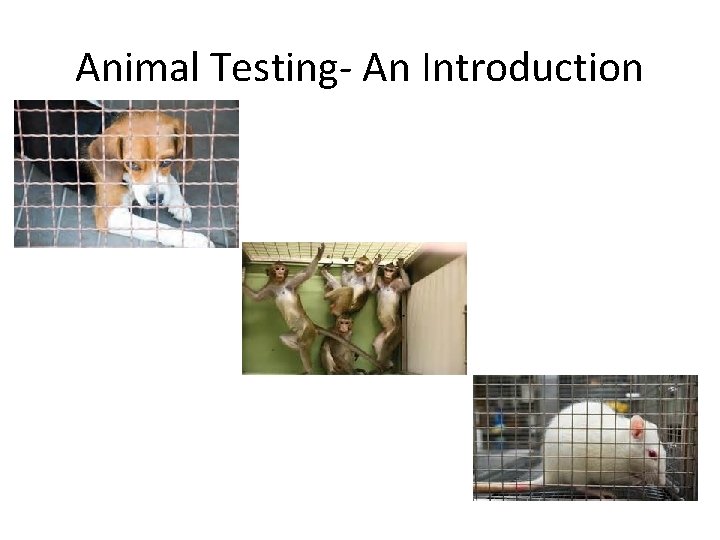
Animal Testing- An Introduction
Lesson Objectives 1. Recognise why animals are used in experiments 2. Discuss reasons for and against using animals in experiments 3. Describe and evaluate animal welfare in testing 4. Be able to discuss your own views on animal testing
UK Testing • Medical Schools • Pharmaceutical Companies • Military Establishments • Food Research Companies
To provide live tissues that will react to medications and invasive procedures Why are animals used? . . . Although it is legal to use consenting humans, there would not be enough volunteers to make data viable. Humans also have different genes to one another.
The Law • The Animal Scientific Procedures Act of 1986 governs the breeding, supplying and use of animals in experiments.
Law Update • The law was updated on January 1 st 2013. • The Act now protects: • All living vertebrates, other than man, and any living cephalopod. Fish and amphibians are protected once they can feed independently and cephalopods at the point when they hatch. Embryonic and foetal forms of mammals, birds and reptiles are protected during the last third of their gestation or incubation period.
What does the Act Protect Against • Animals from experiments which could cause pain, suffering, distress or lasting harm.
2012 Figures VS 2014 Figures • In 2012 4, 033, 310 animals were used in research throughout the UK. • In 2014 this figure decreased to 3, 867, 439.
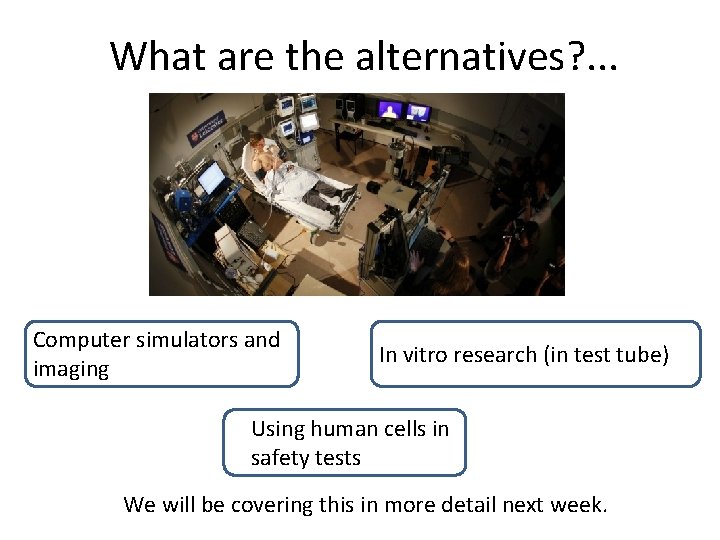
What are the alternatives? . . . Computer simulators and imaging In vitro research (in test tube) Using human cells in safety tests We will be covering this in more detail next week.
- Slides: 9