
Animal Structure and Function Chapter 40 Animal Tissues
- Slides: 56
Animal Structure and Function Chapter 40 Animal Tissues
Intoduction n n The structure correlates with the function. FORM FITS FUNCTION. All animals have to solve the same common problems. Depending on their evolution and complexity, they have devised different ways to do this. Compare them as you go along.
Response to Change n All animals respond to environmental change in two different ways n n n Long term: adaptation due to natural selection Short term: physiological response All the body systems must function as a well-coordinated unit for survival.
Animal Structure and Function: An Overview n Animals are structurally and physiologically adapted to be able to: n n Maintain internal operating conditions within some tolerable range. (maintain homeostasis) Locate and acquire nutrients and dispose of wastes. Protect themselves against injury or attack from viruses, bacteria, and other agents. Reproduce and often provide for the offspring during early development.
Hierarchy of Structure n n Complex animals exhibit levels of organization. Atoms molecules large organic molecules cell structures, e. g. , organelles cell. Unicellular organisms stop here. Multicellular organisms have further levels of organization.
Hierarchy of Structure n n In multicellular organisms Cell tissues organs systems multicellular organisms
Tissues n n n Tissue = a group of cells with common structure and function. They function in one or more specialized activities (division of labor). Cells are held together by intercellular substances that form cell junctions.
Tissues Organs Systems n n Various types of tissues can combine to form organs, such as the heart, liver, kidney. Organs may interact to form organ systems, e. g. , the digestive or respiratory system
Tissue Formation n n Germ cells in the parental gonads produce gametes (either sperm or eggs) by meiosis. Gametes have ½ the chromosome number. All other cells of the body are called somatic cells and have the full chromosome number.
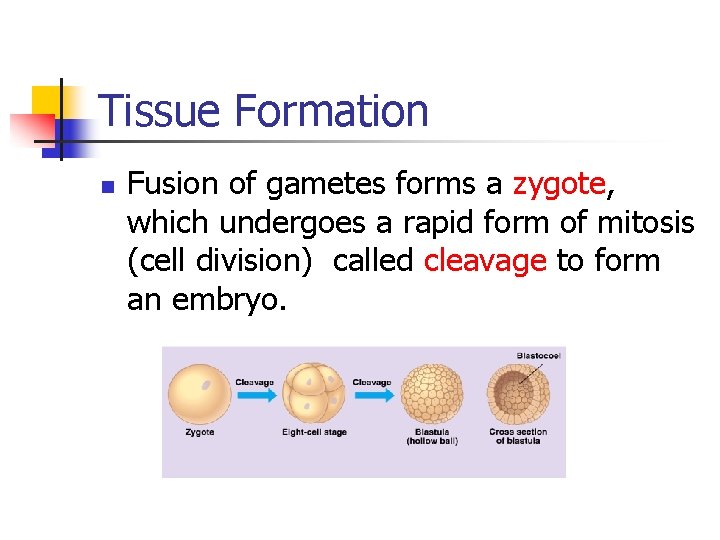
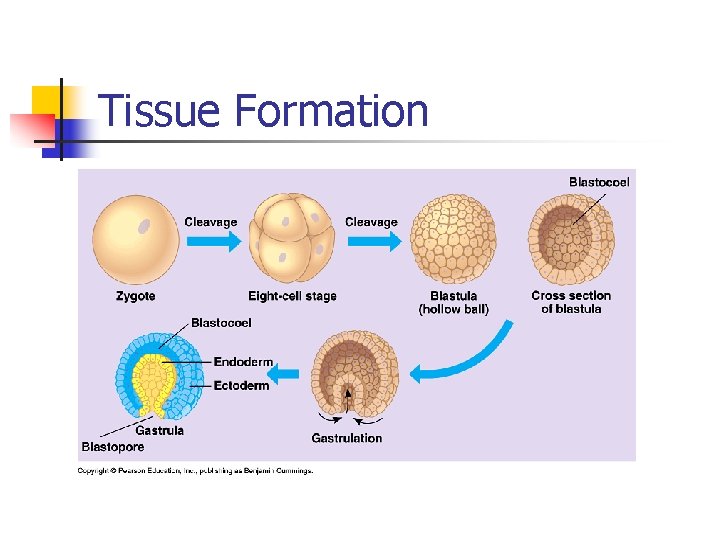
Tissue Formation n Fusion of gametes forms a zygote, which undergoes a rapid form of mitosis (cell division) called cleavage to form an embryo.
Tissue Formation n Cells in the embryo become arranged into three primary tissues: n n n Ectoderm gives rise to skin and nervous system. Mesoderm gives rise to muscle, skeleton, and the organs of circulation, reproduction, and excretion. Endoderm gives rise to the lining of the gut and its associated organs.
Tissue Formation
Categories of Tissues n In the adult animal, there are 4 main categories of tissues: n n Epithelial tissue Connective tissue Muscle tissue Nervous tissue
Epithelial Tissue n n n General Features sheets of tightly packed cells there may be one or more layers. One surface is free (may have cilia or microvilli on the surface) The other adheres to a non-cellular basement membrane
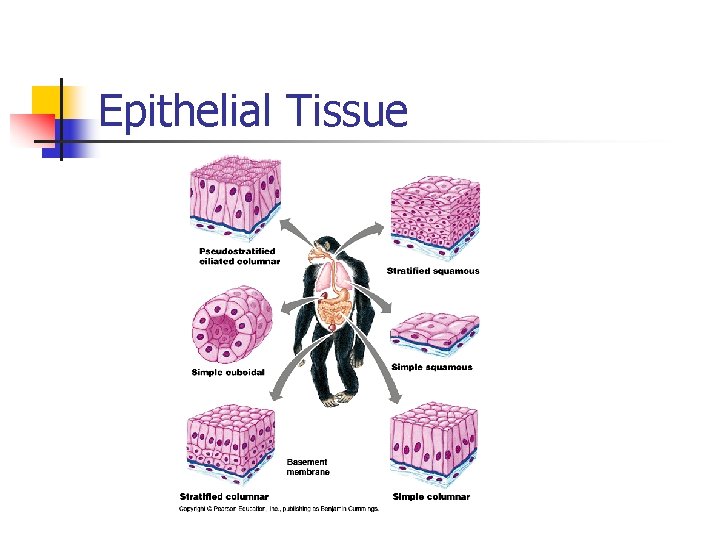
Epithelial Tissue
Epithelial Tissue n n Cells adhere tightly to one another by means of special attachment sites called cell junctions; the “tightness” of the junction determines whether the tissue prevents leakage or allows fluid to pass. The types of junctions include: tight junctions, desmosomes (like "spot welds"), and gap junctions (protein channels which permit passage).
Functions of Epithelial Tissue n n n Protection (covers outside of body; lines organs & body cavities; some ciliated) Absorption Secretion ( glands; mucous membranes of oral cavity, vagina, nasal passages
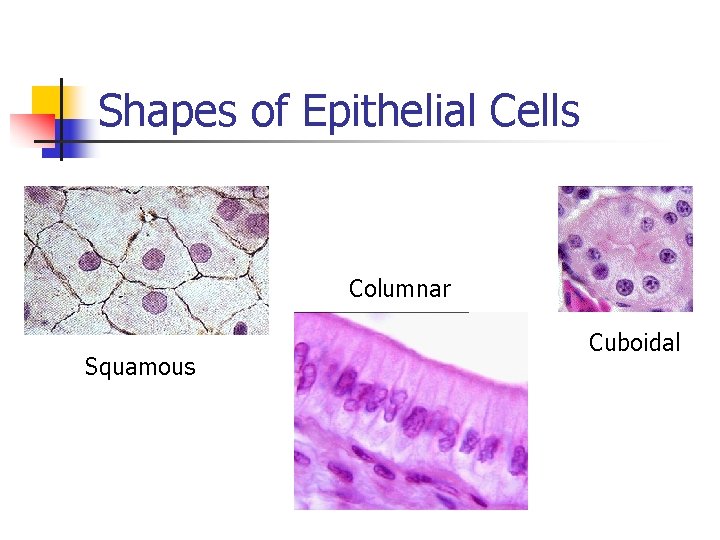
Classification n n Classification is by both shape and the number of layers Classification by Shape: n n n squamous - flat, like floor tile – may be irregular in shape cuboidal - cubed – like “dice” columnar - Taller than they are wide – like columns or “bricks on end”
Shapes of Epithelial Cells Columnar Squamous Cuboidal
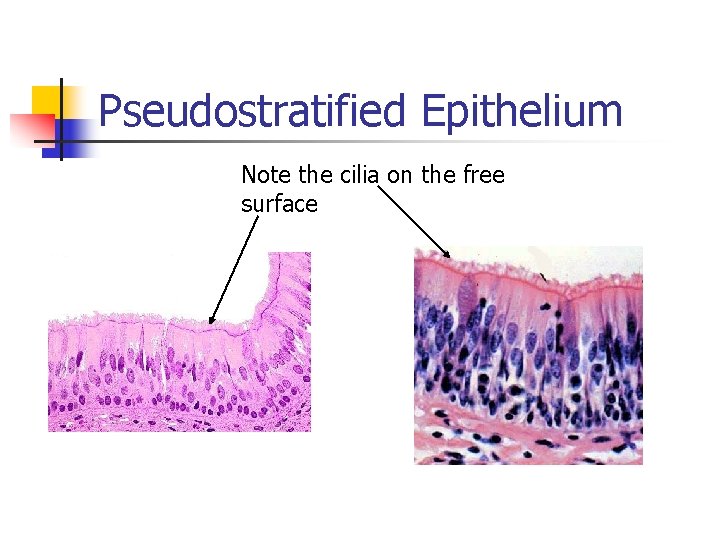
Classification by Layers n n n simple - 1 layer stratified - more than 1 layer Pseudostratified n n looks like more than 1 layer because the nuclei are staggered Only 1 layer – all cells are in contact with the basement membrane.
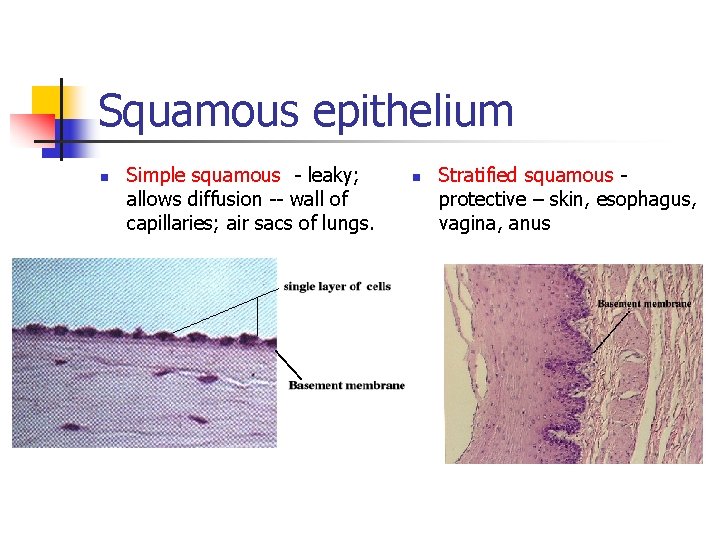
Squamous epithelium n Simple squamous - leaky; allows diffusion -- wall of capillaries; air sacs of lungs. n Stratified squamous protective – skin, esophagus, vagina, anus
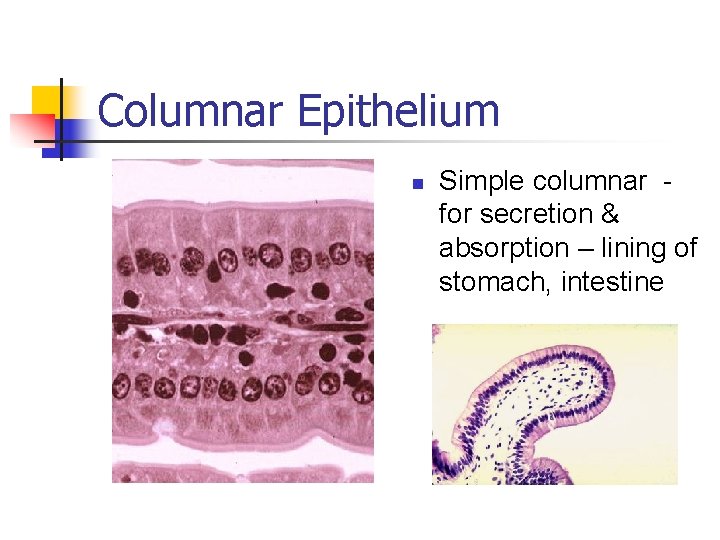
Columnar Epithelium n Simple columnar for secretion & absorption – lining of stomach, intestine
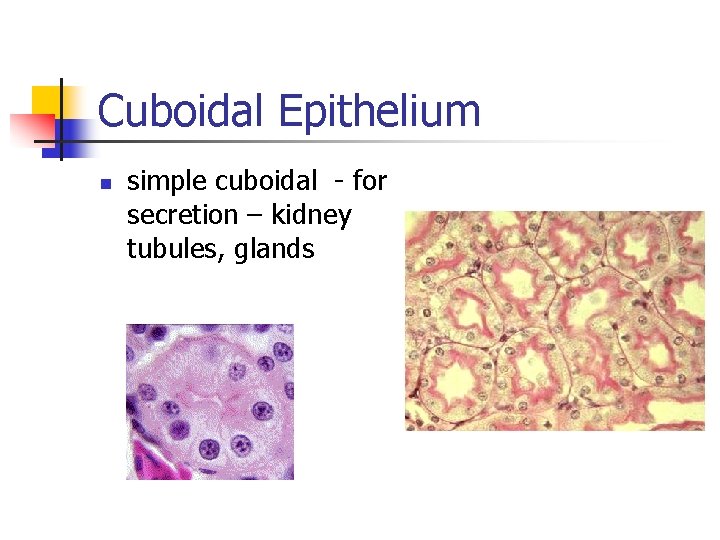
Cuboidal Epithelium n simple cuboidal - for secretion – kidney tubules, glands
Pseudostratified Epithelium Note the cilia on the free surface
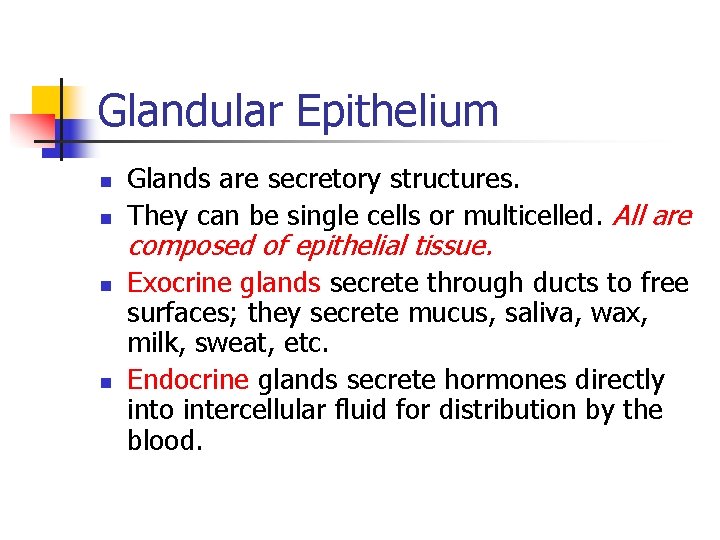
Glandular Epithelium n n Glands are secretory structures. They can be single cells or multicelled. All are composed of epithelial tissue. Exocrine glands secrete through ducts to free surfaces; they secrete mucus, saliva, wax, milk, sweat, etc. Endocrine glands secrete hormones directly into intercellular fluid for distribution by the blood.
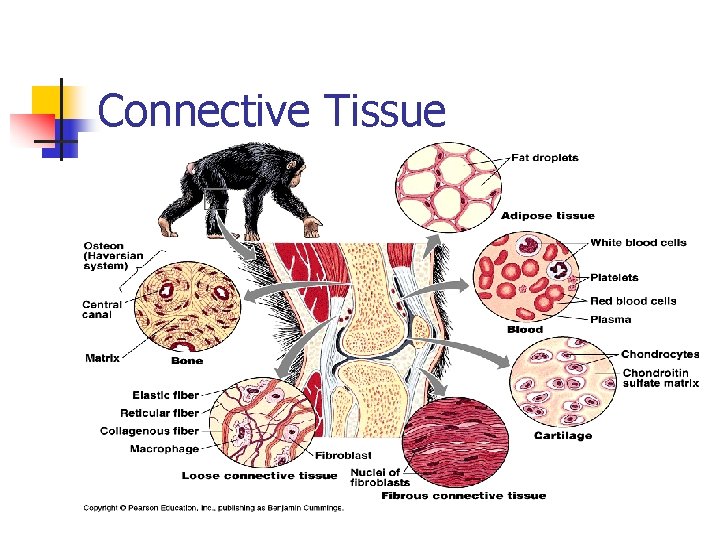
Connective Tissue
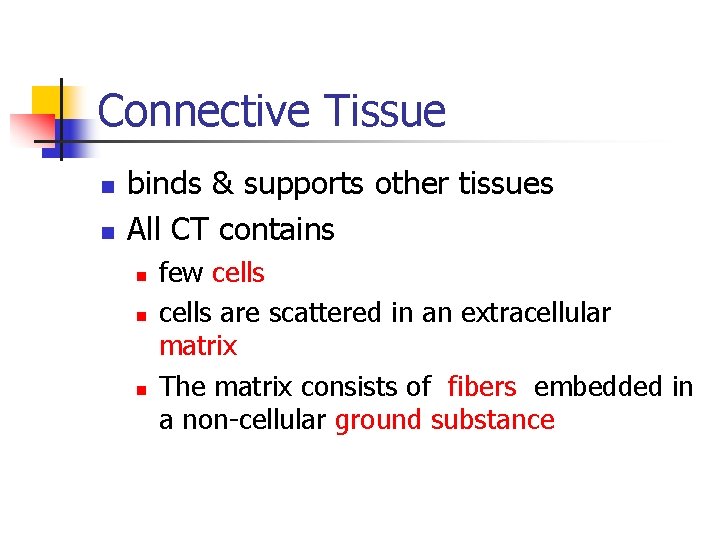
Connective Tissue n n binds & supports other tissues All CT contains n n n few cells are scattered in an extracellular matrix The matrix consists of fibers embedded in a non-cellular ground substance
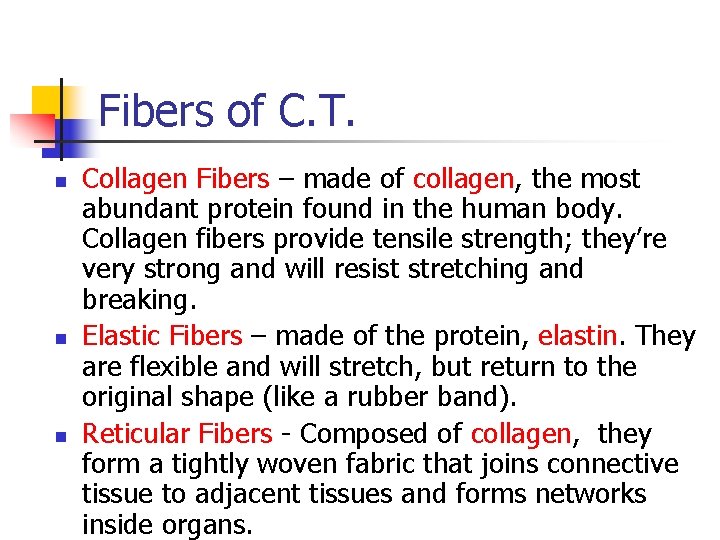
Fibers of C. T. n n n Collagen Fibers – made of collagen, the most abundant protein found in the human body. Collagen fibers provide tensile strength; they’re very strong and will resist stretching and breaking. Elastic Fibers – made of the protein, elastin. They are flexible and will stretch, but return to the original shape (like a rubber band). Reticular Fibers - Composed of collagen, they form a tightly woven fabric that joins connective tissue to adjacent tissues and forms networks inside organs.
Types of Connective Tissue n n n Loose connective tissue Fibrous (Dense) connective tissue Specialized Connective Tissue n n Cartilage Bone Adipose tissue Blood
Loose connective tissue n n n supports epithelia and organs surrounds blood vessels and nerves Fibers n n collagen -- strong; won’t stretch elastic (resilient) reticular (branched networks) Cells: n n fibroblasts - secrete the fibers & ground substance macrophages - for immune defense
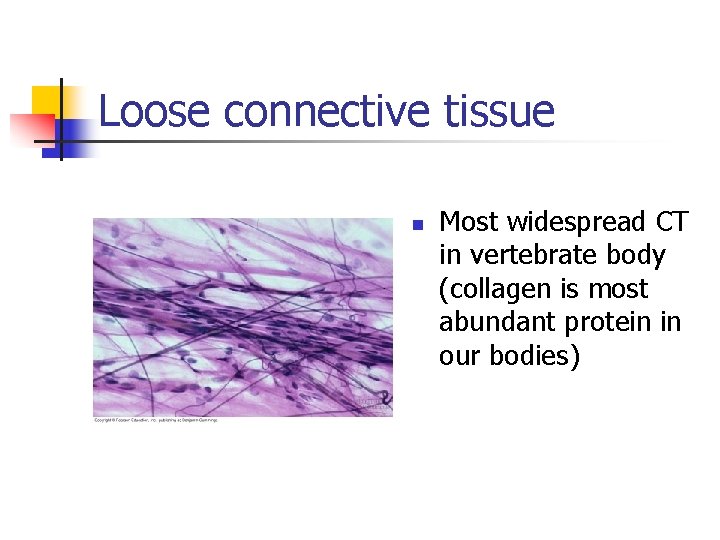
Loose connective tissue n Most widespread CT in vertebrate body (collagen is most abundant protein in our bodies)
Fibrous Connective Tissue n Dense, irregular connective tissue has thicker fibers and more of them, but fewer cells. Forms capsules around & framework inside organs; supports loose CT layers in places
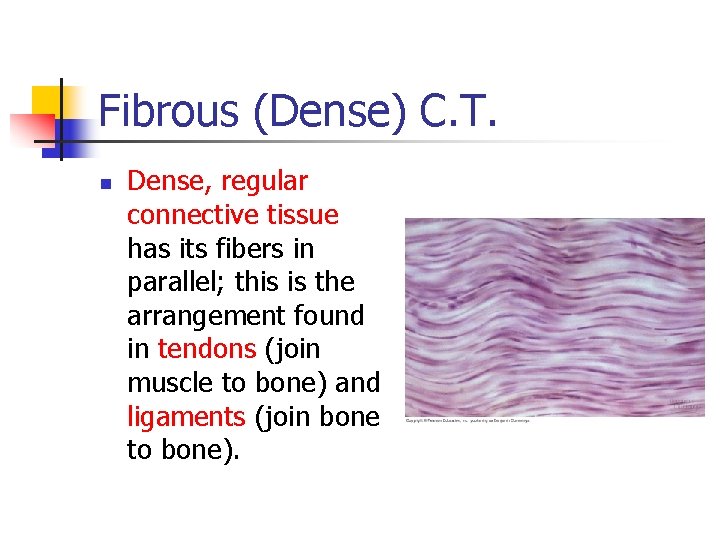
Fibrous (Dense) C. T. n Dense, regular connective tissue has its fibers in parallel; this is the arrangement found in tendons (join muscle to bone) and ligaments (join bone to bone).
Cartilage n n n Fibers – a dense array of collagen fibers Jellylike matrix composed of chondroitin sulfate Cells n n chondrocytes lie in spaces in the matrix called lacunae secrete fibers & matrix
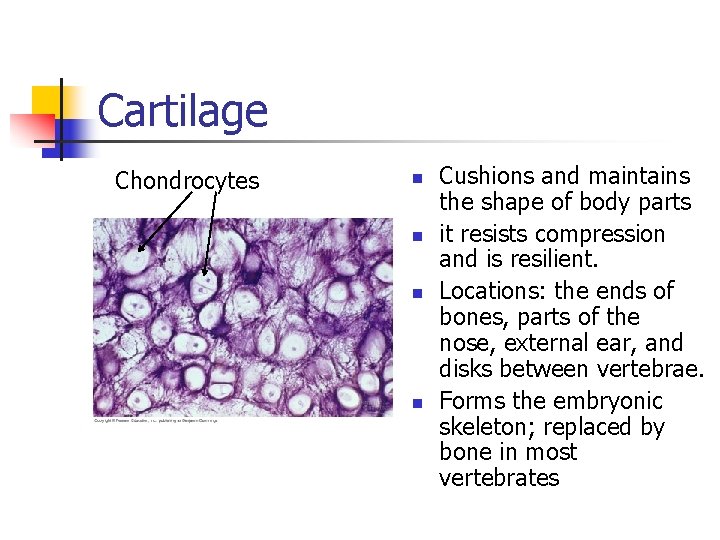
Cartilage Chondrocytes n n Cushions and maintains the shape of body parts it resists compression and is resilient. Locations: the ends of bones, parts of the nose, external ear, and disks between vertebrae. Forms the embryonic skeleton; replaced by bone in most vertebrates
Bone n n n forms the skeleton of most vertebrates stores mineral salts produces blood cells ( in bone marrow) supports and protects body tissues and organs works with muscles to perform movement.
Bone n n Cells -- osteoblasts – young bonebuilding cells -- secrete the matrix Matrix - collagen & calcium phosphate – Once secreted, it hardens into a mineral called hydroxyappatite
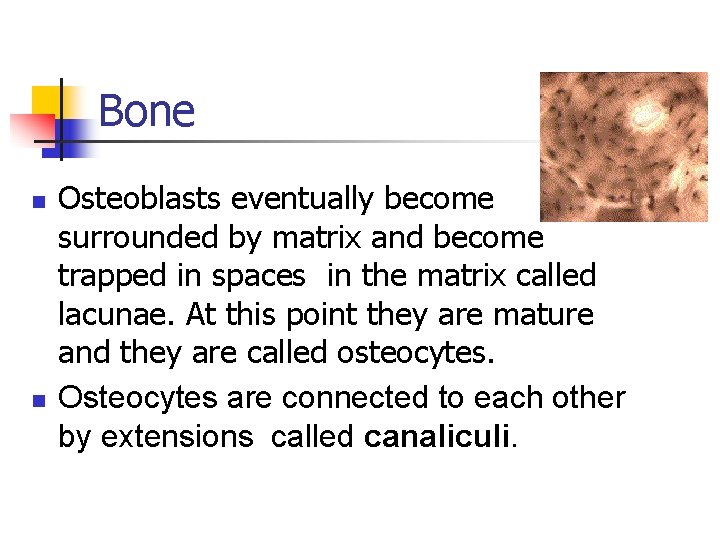
Bone n n Osteoblasts eventually become surrounded by matrix and become trapped in spaces in the matrix called lacunae. At this point they are mature and they are called osteocytes. Osteocytes are connected to each other by extensions called canaliculi.
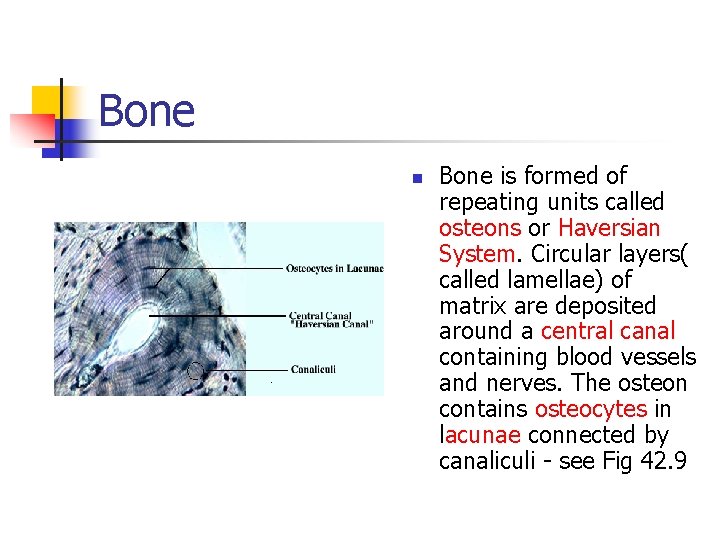
Bone n Bone is formed of repeating units called osteons or Haversian System. Circular layers( called lamellae) of matrix are deposited around a central canal containing blood vessels and nerves. The osteon contains osteocytes in lacunae connected by canaliculi - see Fig 42. 9
Bone n n n Compact bone – found in the shafts of long bones ( like the femur) Spongy bone – found in the interior & ends of long bones Bone marrow cavities are filled with bone marrow (fat & blood cells)
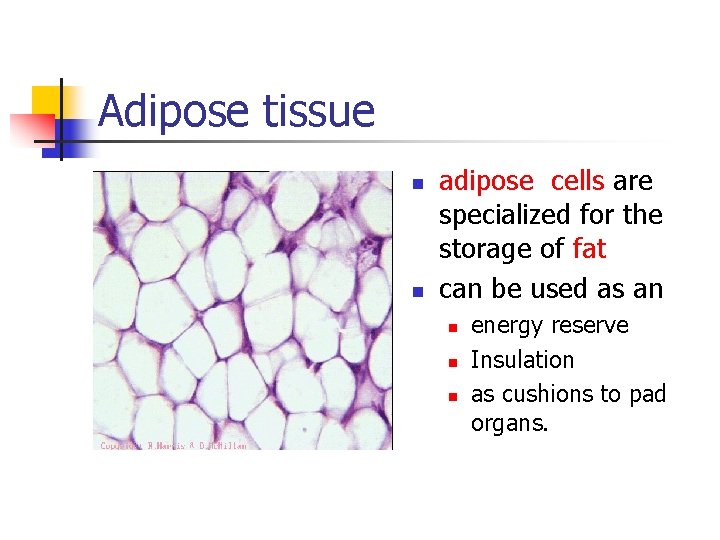
Adipose tissue n n adipose cells are specialized for the storage of fat can be used as an n energy reserve Insulation as cushions to pad organs.
Blood n n n transports oxygen, wastes, hormones, and enzymes contains clotting factors to protect against bleeding contains components to protect against disease causing agents.
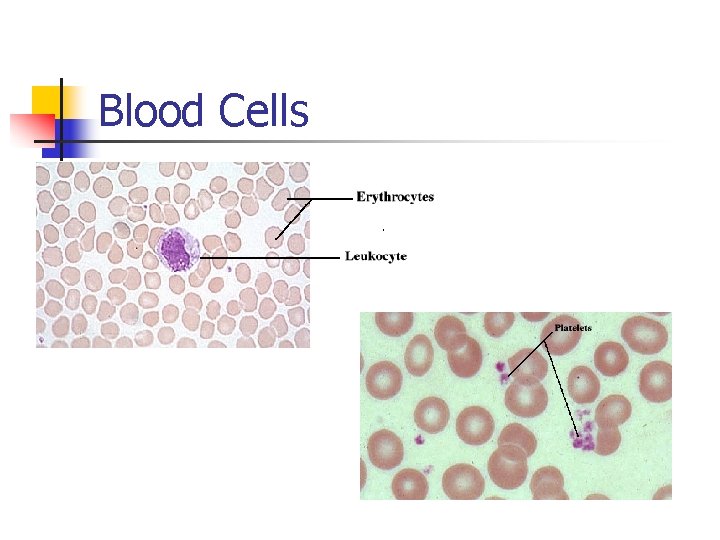
Blood n n Liquid matrix = plasma (mostly water; dissolved salts, proteins etc. Blood Cells n n n leukocytes (white blood cells) for immune defense erythrocytes (red blood cells) transport oxygen platelets for blood clotting (cells made in red marrow at ends of long bones)
Blood Cells
Muscle Tissue n n n The most abundant tissue in most animals Muscle tissue contracts in response to stimulation, then passively lengthens. There are three types of muscle: n n n Skeletal Smooth Cardiac
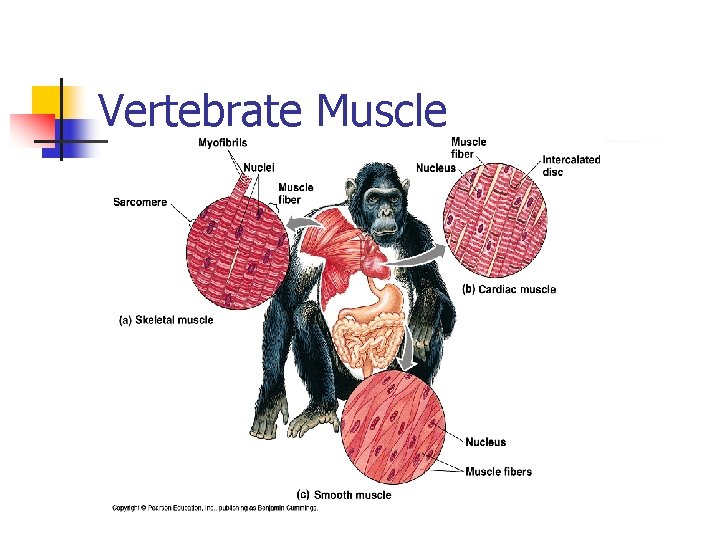
Vertebrate Muscle
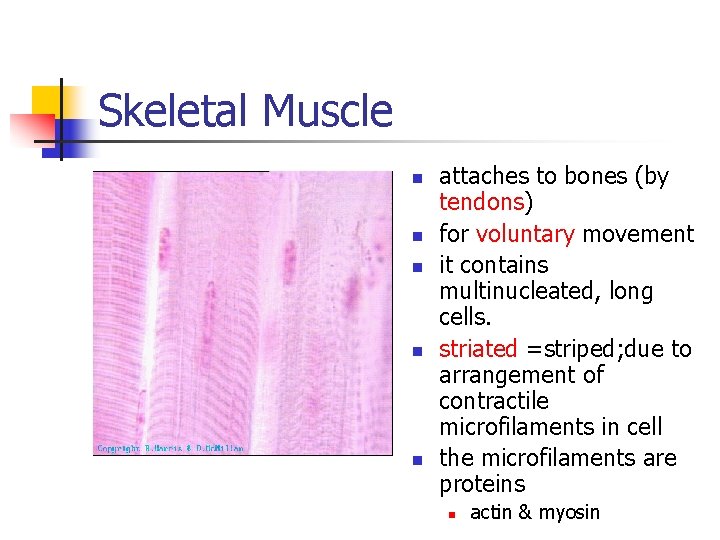
Skeletal Muscle n n n attaches to bones (by tendons) for voluntary movement it contains multinucleated, long cells. striated =striped; due to arrangement of contractile microfilaments in cell the microfilaments are proteins n actin & myosin
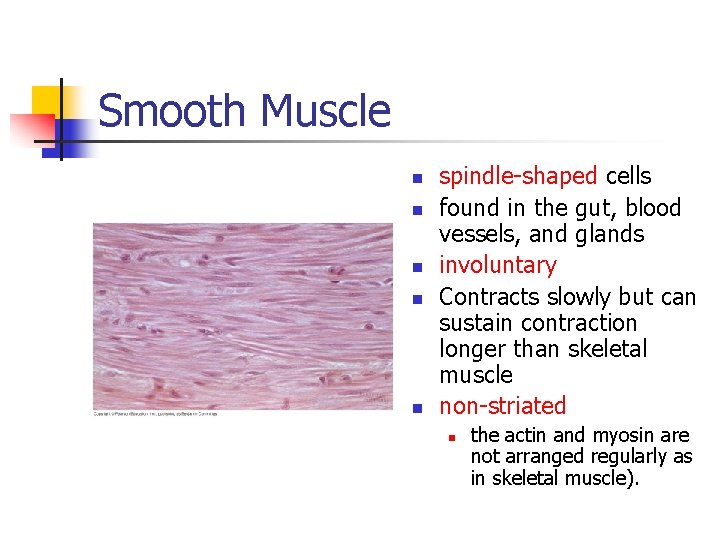
Smooth Muscle n n n spindle-shaped cells found in the gut, blood vessels, and glands involuntary Contracts slowly but can sustain contraction longer than skeletal muscle non-striated n the actin and myosin are not arranged regularly as in skeletal muscle).
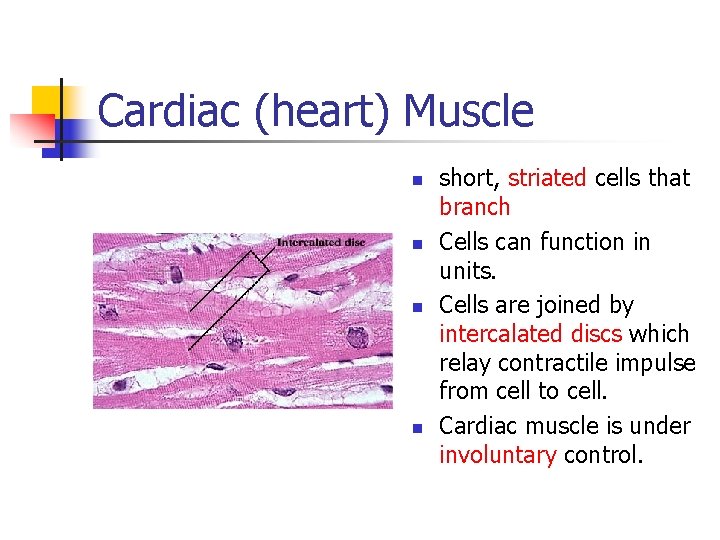
Cardiac (heart) Muscle n n short, striated cells that branch Cells can function in units. Cells are joined by intercalated discs which relay contractile impulse from cell to cell. Cardiac muscle is under involuntary control.
Nervous Tissue n n n Some types detect stimuli (receptors) Others coordinate the body's responses Others (effectors) relay signals to muscles and glands for response.
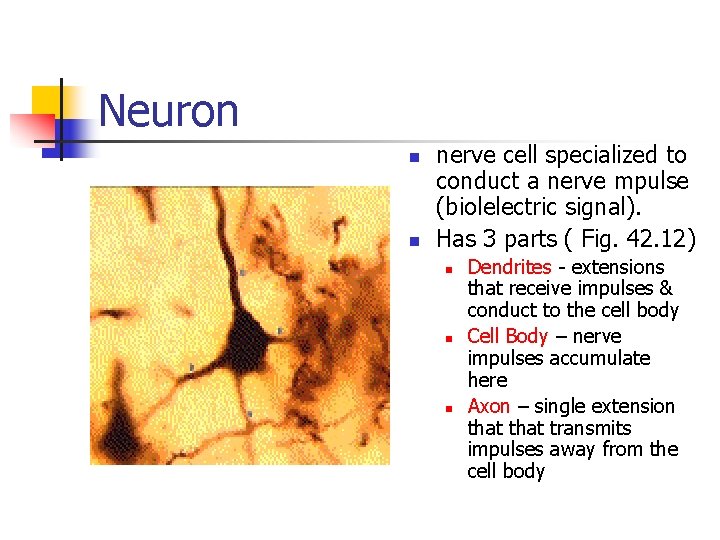
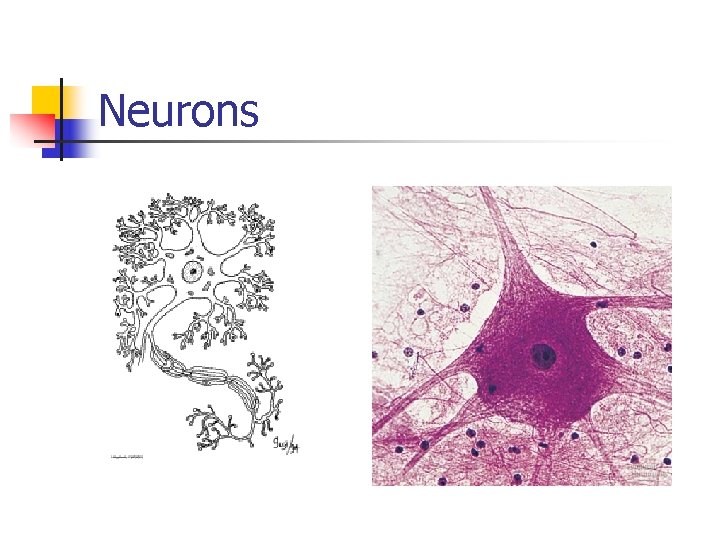
Neuron n n nerve cell specialized to conduct a nerve mpulse (biolelectric signal). Has 3 parts ( Fig. 42. 12) n n n Dendrites - extensions that receive impulses & conduct to the cell body Cell Body – nerve impulses accumulate here Axon – single extension that transmits impulses away from the cell body
Neurons
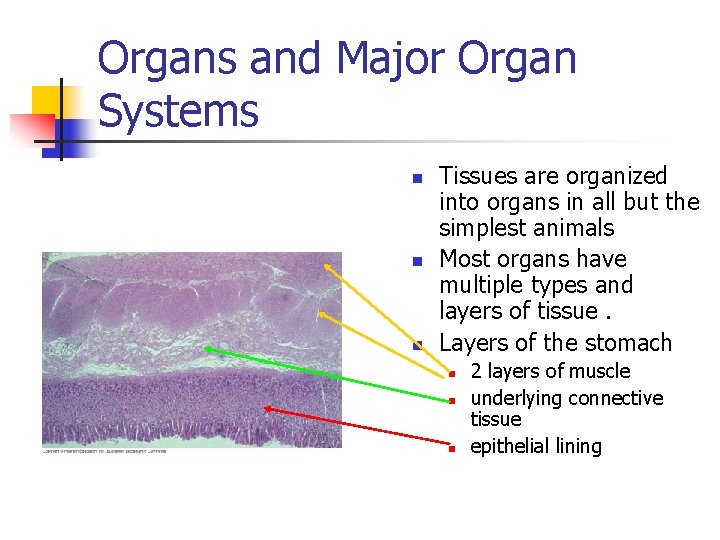
Organs and Major Organ Systems n n n Tissues are organized into organs in all but the simplest animals Most organs have multiple types and layers of tissue. Layers of the stomach n n n 2 layers of muscle underlying connective tissue epithelial lining
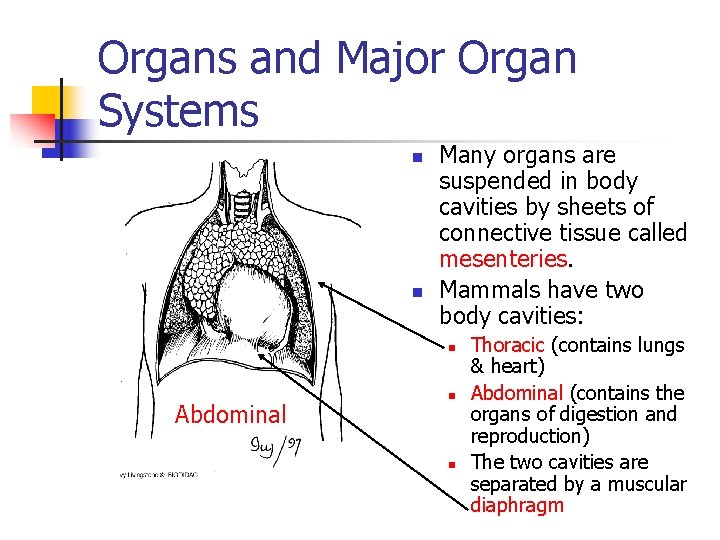
Organs and Major Organ Systems n n Many organs are suspended in body cavities by sheets of connective tissue called mesenteries. Mammals have two body cavities: n Abdominal n n Thoracic (contains lungs & heart) Abdominal (contains the organs of digestion and reproduction) The two cavities are separated by a muscular diaphragm
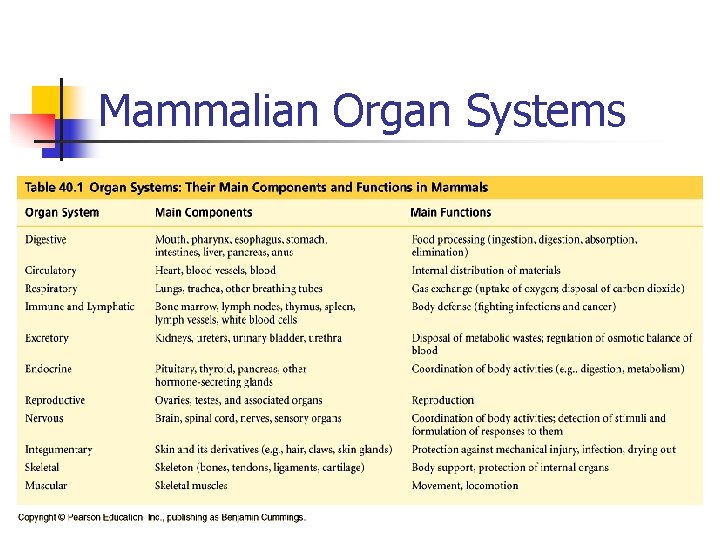
Organ Systems n n n Organs are organized into organ systems. There are 11 organ systems in vertebrates. They are: n n digestive, circulatory, respiratory, immune & lymphatic, excretory, endocrine, reproductive, nervous, integumentary , skeletal and muscular. Table 42. 1 lists the systems, their main components and their functions.
Mammalian Organ Systems