
ANIMAL SCIENCE Lesson C 7 8 The Sheep



- Slides: 72
ANIMAL SCIENCE Lesson C 7 -8 The Sheep and Goat Industry
Meat Milk Chammy Clothing And other items.
AS. 06. 02 Basic : Recognize ID and eval the effects of diseases on animals AS. 03: ID breeds of economically important species
OBJECTIVES Define terms used to describe sheep and goats, and identify the parts of sheep and goats. Compare and contrast the common breeds of sheep. Compare and contrast the types of goats.
OBJECTIVES Recognize the advantages and disadvantages of sheep and goat production. Determine the facility and equipment needs in sheep and goat production. Identify leading states and nations in sheep and goat production, and determine the major export and import markets for the United States.
OBJECTIVES Examine the impact of the sheep and goat industry on the U. S. economy. Identify common parasites and diseases that affect sheep and goats, and determine appropriate prevention and treatment methods.
Descended from wile Sheep of Asia and Europe Sheep were a source of fiber and meat and milk Sheep were domesticated about 10, 000 years ago People started using wool over 20, 000 years ago
Columbus and other Europeans carried sheep to the New World Spanish missionaries introduced sheep to Native Americans Sheep became an important part of Navajo Culture
The Navajo word for sheep translates to “ that by which we live” Merino sheep were imported to New England in 1793 What else was happening during this time? Over next 20 years, demand for Merino wool spread across Northeastern US
Development of synthetic fibers in 20 th century= decline in sheep industry Sheep / Lamb industry peaked in 1942: 56. 2 million What was happening then? 2001= 6. 9 million
Bred to produce finer wool fibers Iran began selective breeding of sheep over 6, 000 years ago Fine wool sheep used today came from Spanish Merino sheep developed over 1200 years ago
Draw a cartoon of the history of sheep Draw 6 boxes on your paper Fill in the boxes with your cartoon
WHAT FOOD AND NON-FOOD PRODUCTS ARE PRODUCED BY SHEEP AND GOATS? Sheep and goats are very versatile and offer many products for human use. These animals provide both food and non-food products. Many of the non-food products are used in the manufacturing of items that are used every day. For example, baseballs are stuffed with wool and sewn with wool thread, the rubber lining is prepared from stearic acid, and the center cork contains processed blood.
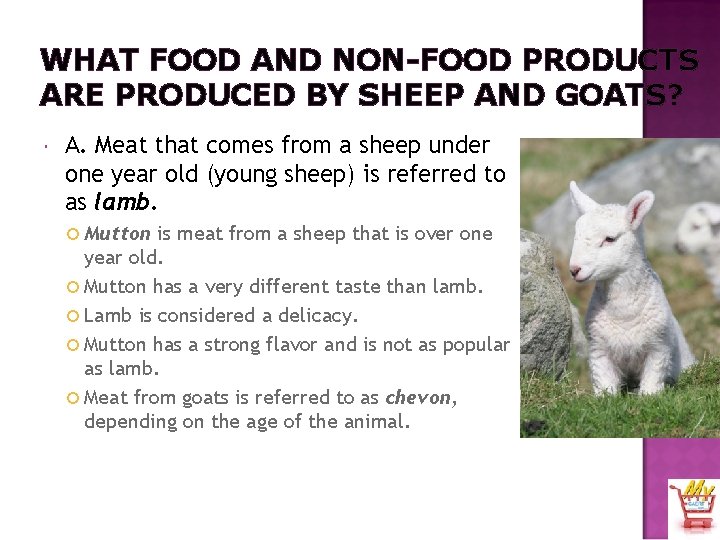
WHAT FOOD AND NON-FOOD PRODUCTS ARE PRODUCED BY SHEEP AND GOATS? A. Meat that comes from a sheep under one year old (young sheep) is referred to as lamb. Mutton is meat from a sheep that is over one year old. Mutton has a very different taste than lamb. Lamb is considered a delicacy. Mutton has a strong flavor and is not as popular as lamb. Meat from goats is referred to as chevon, depending on the age of the animal.
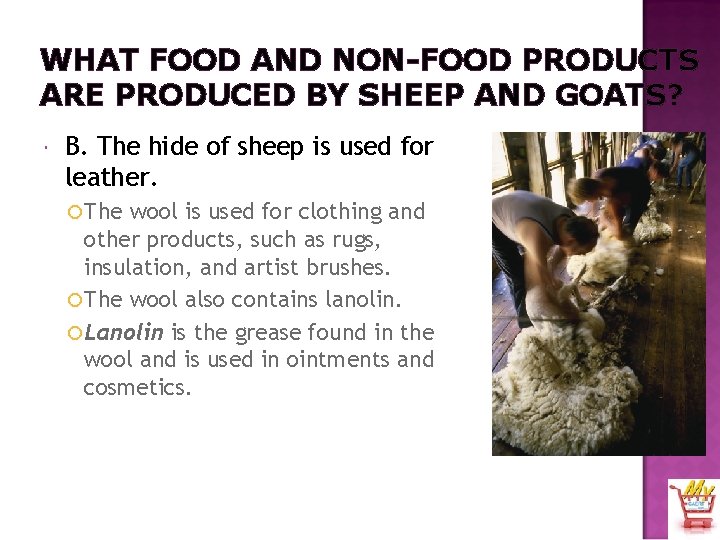
WHAT FOOD AND NON-FOOD PRODUCTS ARE PRODUCED BY SHEEP AND GOATS? B. The hide of sheep is used for leather. The wool is used for clothing and other products, such as rugs, insulation, and artist brushes. The wool also contains lanolin. Lanolin is the grease found in the wool and is used in ointments and cosmetics.
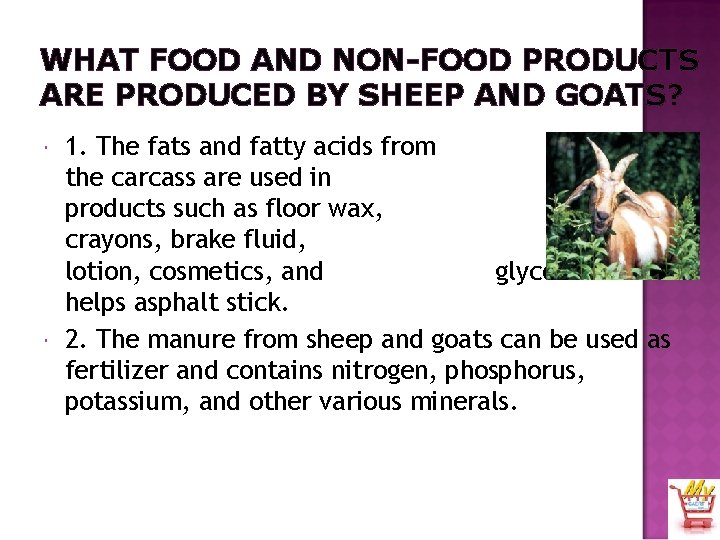
WHAT FOOD AND NON-FOOD PRODUCTS ARE PRODUCED BY SHEEP AND GOATS? 1. The fats and fatty acids from the carcass are used in products such as floor wax, candles, crayons, brake fluid, tanning lotion, cosmetics, and glycerol that helps asphalt stick. 2. The manure from sheep and goats can be used as fertilizer and contains nitrogen, phosphorus, potassium, and other various minerals.
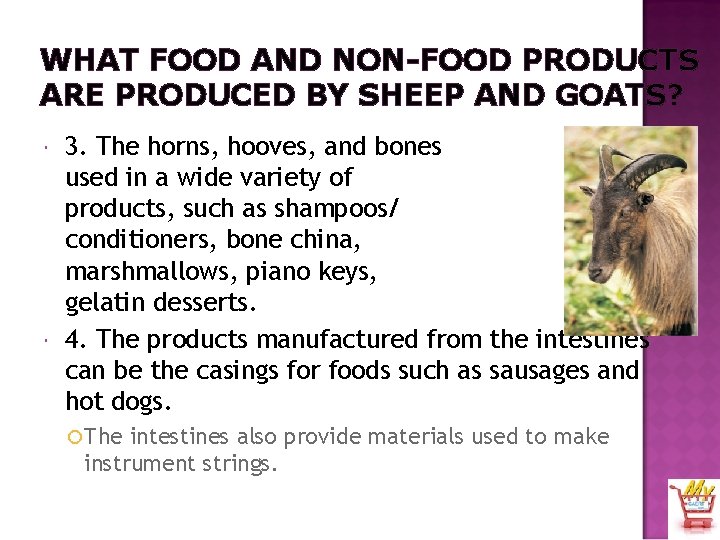
WHAT FOOD AND NON-FOOD PRODUCTS ARE PRODUCED BY SHEEP AND GOATS? 3. The horns, hooves, and bones are used in a wide variety of products, such as shampoos/ conditioners, bone china, marshmallows, piano keys, and gelatin desserts. 4. The products manufactured from the intestines can be the casings for foods such as sausages and hot dogs. The intestines also provide materials used to make instrument strings.
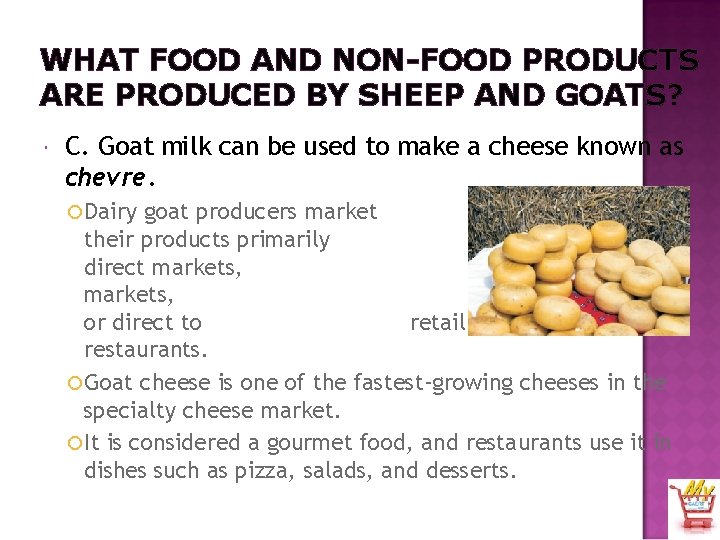
WHAT FOOD AND NON-FOOD PRODUCTS ARE PRODUCED BY SHEEP AND GOATS? C. Goat milk can be used to make a cheese known as chevre. Dairy goat producers market their products primarily through direct markets, farmers’ markets, Internet sales, or direct to retail stores and restaurants. Goat cheese is one of the fastest-growing cheeses in the specialty cheese market. It is considered a gourmet food, and restaurants use it in dishes such as pizza, salads, and desserts.
WHAT FOOD AND NON-FOOD PRODUCTS ARE PRODUCED BY SHEEP AND GOATS? D. Meat goats are marketed through slaughter facilities, auctions, or on-farm sites to private buyers. Meat goats are sold based on their size and age. 1. An easter kid is a meat goat weighing 16 to 40 pounds. It should not be castrated and is usually sold seasonally to ethnic markets. 2. A cabrito is the meat from a milk-raised kid that weighs 25 to 40 pounds and is not castrated. Chevon is the meat from goats of any age or size. Generally, chevon meat is from goats weighing over 60 pounds. 3. The price of goats is typically higher before major ethnic holidays. There is an increasing interest in goat meat in gourmet restaurants. Goat meat is often found on the menu and usually comes with a high price tag.
ANIMAL SCIENCE Lesson C 7 -8 Basic Terminology
TERMS buck cabrito cashmere chammy chevon chevre doe Easter kid ewe kidding lambing mohair
TERMS mutton ram wether wool yearling
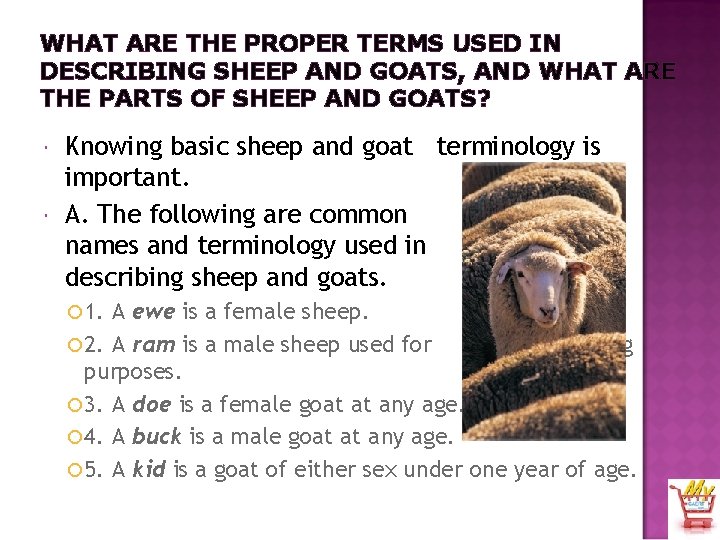
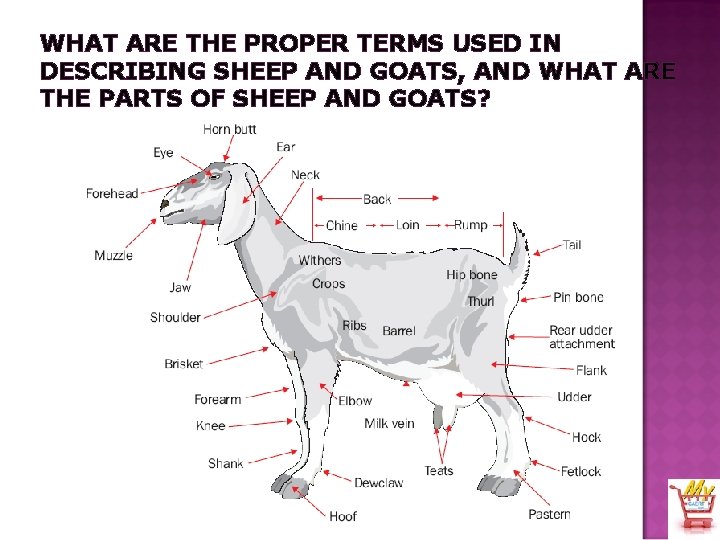
WHAT ARE THE PROPER TERMS USED IN DESCRIBING SHEEP AND GOATS, AND WHAT ARE THE PARTS OF SHEEP AND GOATS? Knowing basic sheep and goat terminology is important. A. The following are common names and terminology used in describing sheep and goats. 1. A ewe is a female sheep. 2. A ram is a male sheep used for breeding purposes. 3. A doe is a female goat at any age. 4. A buck is a male goat at any age. 5. A kid is a goat of either sex under one year of age.
WHAT ARE THE PROPER TERMS USED IN DESCRIBING SHEEP AND GOATS, AND WHAT ARE THE PARTS OF SHEEP AND GOATS? 6. A yearling is a goat of either sex one year old or older but less than two years old. 7. A wether is a male sheep or goat castrated when it was young. 8. Lambing is the process of a sheep giving birth. 9. Kidding is the process of a goat giving birth. 10. Wool is a sheep’s coat used as a fiber for products such as clothing. 11. Chammy is leather made from sheep or goats.
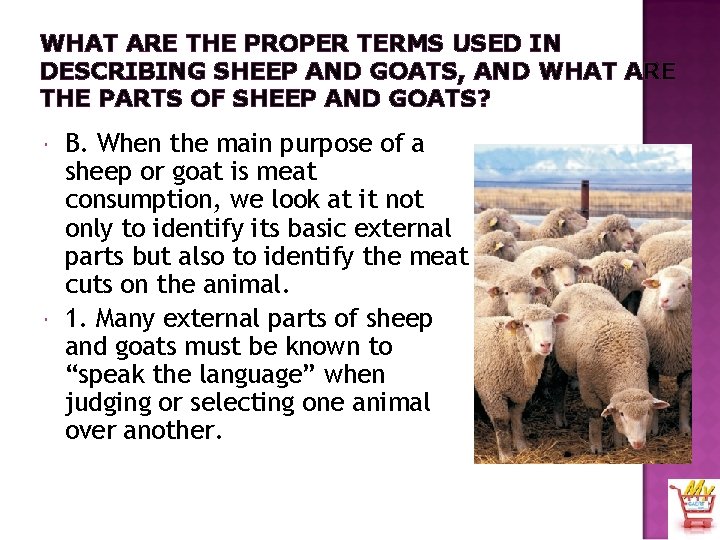
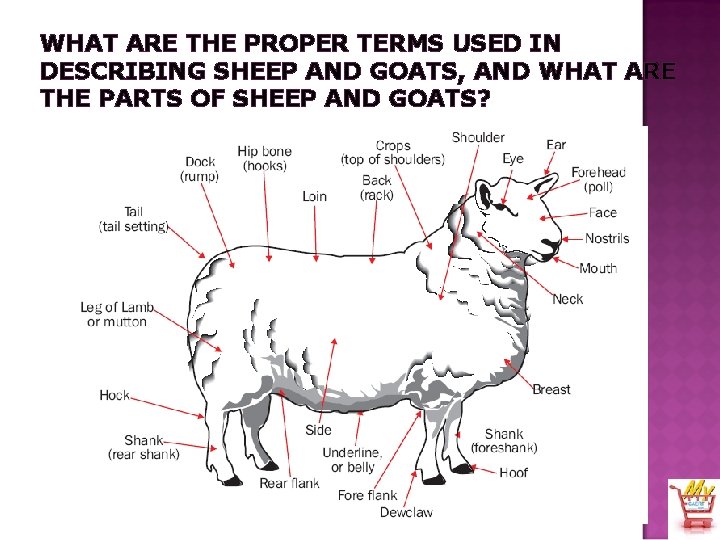
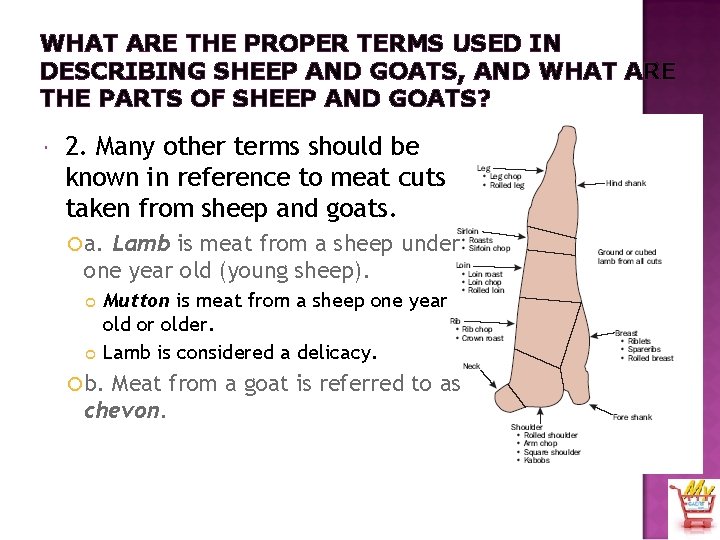
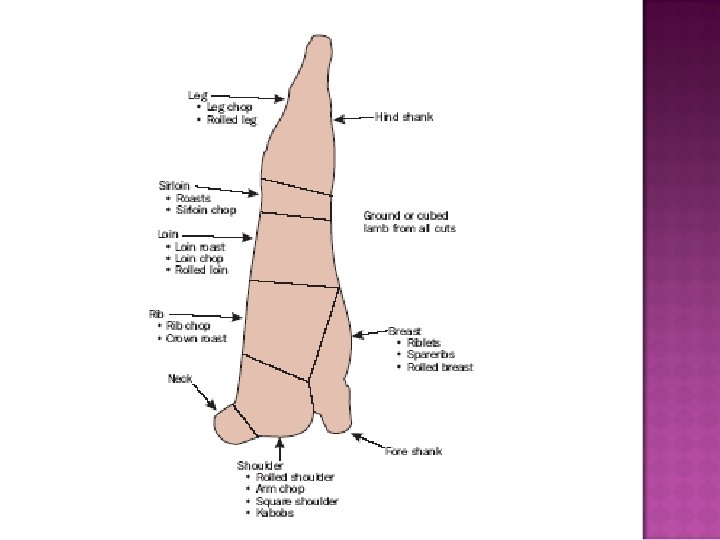
WHAT ARE THE PROPER TERMS USED IN DESCRIBING SHEEP AND GOATS, AND WHAT ARE THE PARTS OF SHEEP AND GOATS? B. When the main purpose of a sheep or goat is meat consumption, we look at it not only to identify its basic external parts but also to identify the meat cuts on the animal. 1. Many external parts of sheep and goats must be known to “speak the language” when judging or selecting one animal over another.
WHAT ARE THE PROPER TERMS USED IN DESCRIBING SHEEP AND GOATS, AND WHAT ARE THE PARTS OF SHEEP AND GOATS?
WHAT ARE THE PROPER TERMS USED IN DESCRIBING SHEEP AND GOATS, AND WHAT ARE THE PARTS OF SHEEP AND GOATS?
WHAT ARE THE PROPER TERMS USED IN DESCRIBING SHEEP AND GOATS, AND WHAT ARE THE PARTS OF SHEEP AND GOATS? 2. Many other terms should be known in reference to meat cuts taken from sheep and goats. a. Lamb is meat from a sheep under one year old (young sheep). Mutton is meat from a sheep one year old or older. Lamb is considered a delicacy. b. Meat from a goat is referred to as chevon.
WHAT ARE THE ADVANTAGES AND DISADVANTAGES OF SHEEP AND GOAT PRODUCTION? Sheep and goat production has several advantages and disadvantages. A. The advantages of raising sheep and goats are: 1. Sheep and goats are good grazers, and some do well on range environments. 2. Compared with beef animals, sheep and goats are efficient eaters of forage. 3. Sheep and goats are used for more than one purpose. 4. Lambs and goats have a fast growing rate, and return on investment can be seen in a short time. 5. Sheep and goats can be raised together. 6. Sheep are used in public and private areas to control plants like poison ivy and honeysuckle. 7. Sheep and goats are very popular for young children to raise as 4 -H and FFA projects.
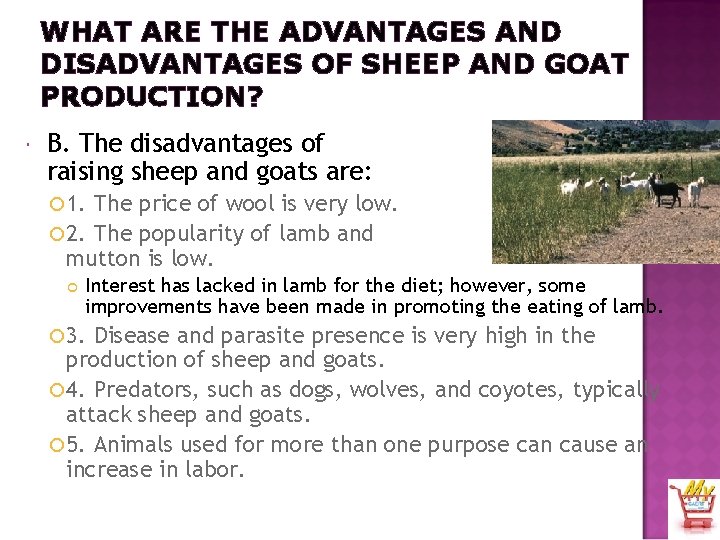
WHAT ARE THE ADVANTAGES AND DISADVANTAGES OF SHEEP AND GOAT PRODUCTION? B. The disadvantages of raising sheep and goats are: 1. The price of wool is very low. 2. The popularity of lamb and mutton is low. Interest has lacked in lamb for the diet; however, some improvements have been made in promoting the eating of lamb. 3. Disease and parasite presence is very high in the production of sheep and goats. 4. Predators, such as dogs, wolves, and coyotes, typically attack sheep and goats. 5. Animals used for more than one purpose can cause an increase in labor.
Make an advertisement for a sheep product Be convincing! Explain why your product made from sheep is better than a synthetic or comparable product.
ANIMAL SCIENCE Lesson C 7 -8 The Sheep and Goat Industry
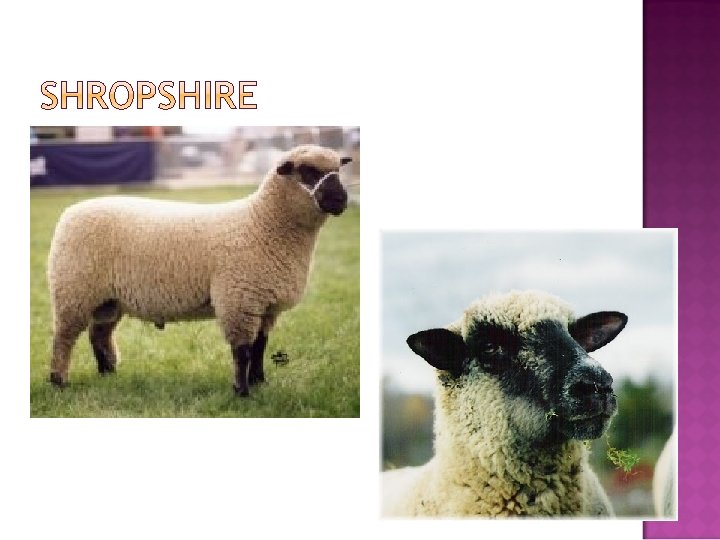
1000 distinct breeds 50 in North America Many breeds are endanger of extinction In the US 4 breeds account for 2/3+ of the population
Sheep are raised for wool and meat Breeds of Sheep can be classified by wool type Fine Wool Lang Wool Crossbred wool Hair sheep
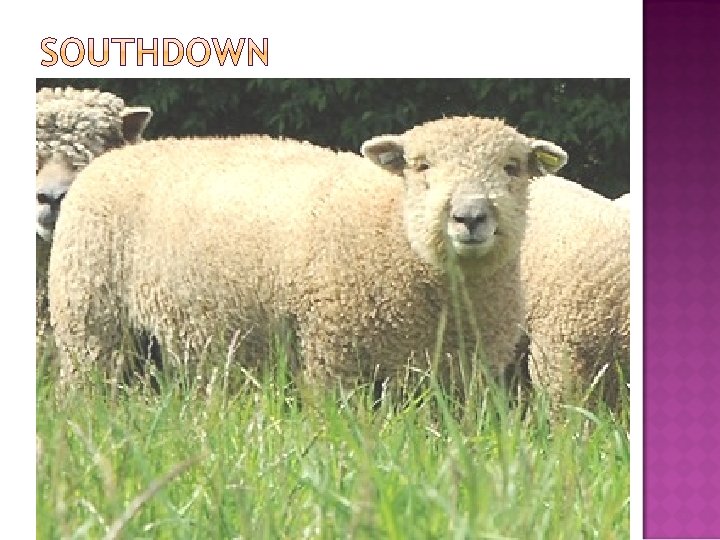
Medium-small in size Polled Raised primarily for meat Early maturing Ewes have good lambing ability
Large medium wool breed Mild disposition Polled Rapid growth and efficient feed conversion
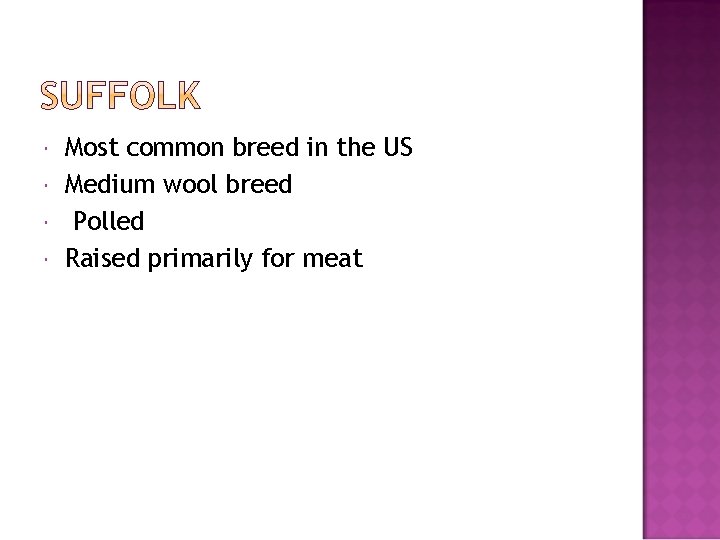
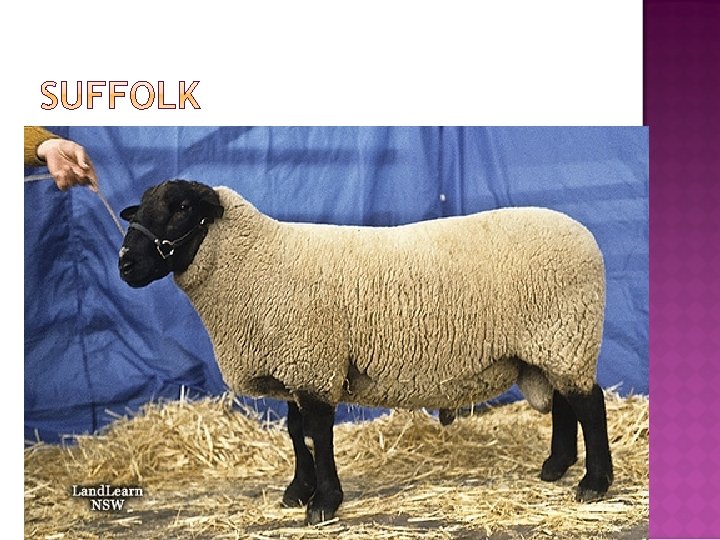
Most common breed in the US Medium wool breed Polled Raised primarily for meat
Heaviest wool producers Medium wool grade Medium sized Dual Purpose breed (meat and wool)
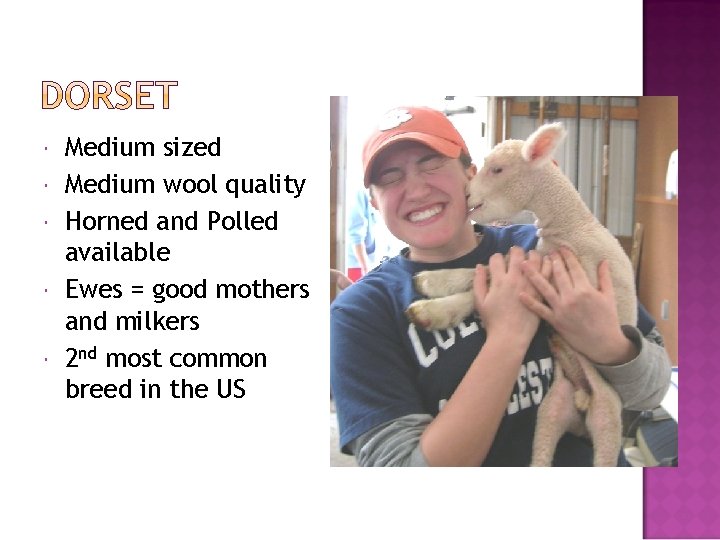
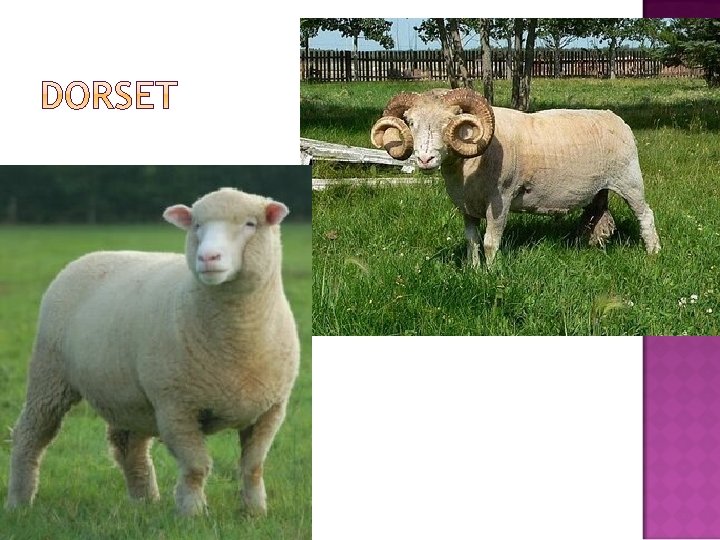
Medium sized Medium wool quality Horned and Polled available Ewes = good mothers and milkers 2 nd most common breed in the US
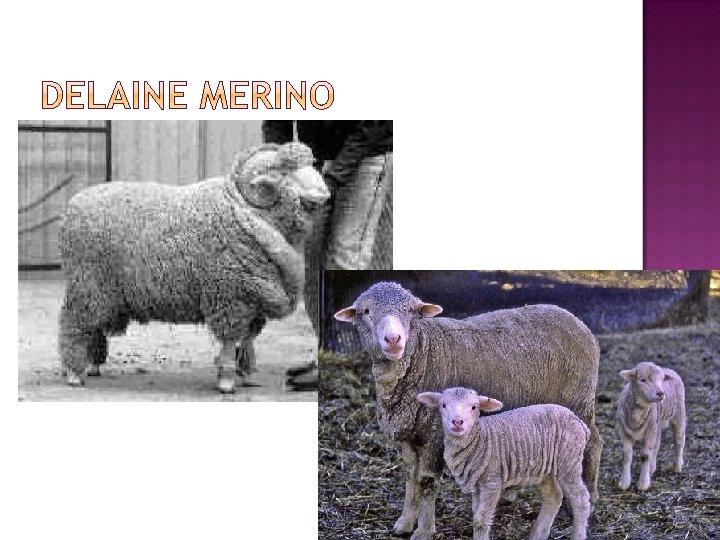
Medium sized Fine Wool breed From Spain Produces “best wool in the world”
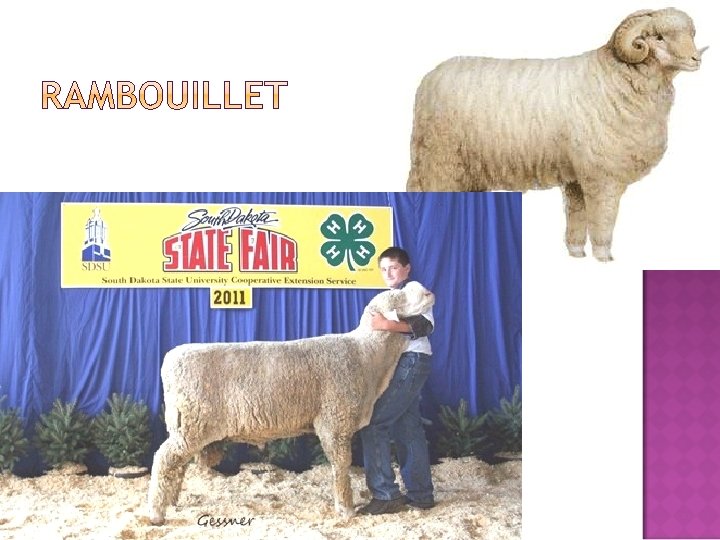
Medium Sized Fine Wool breed Dual Purpose breed Descendent of Merino from France High quality wool producer
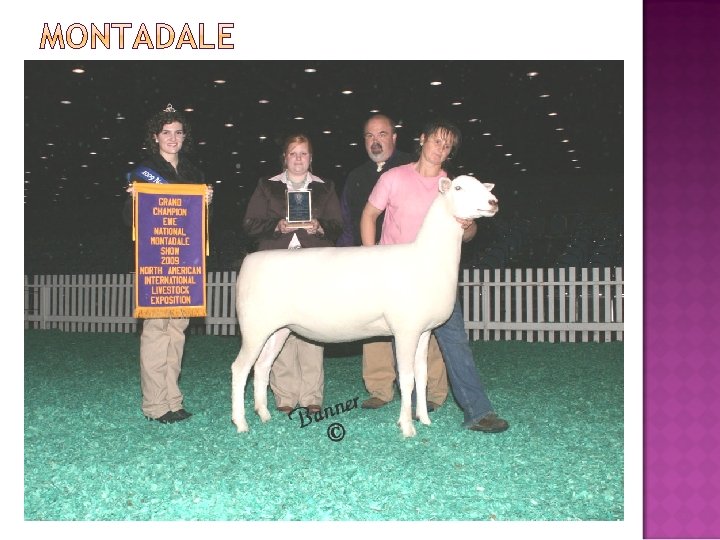
Medium wool Dual Purpose Very white wool, good carcasses
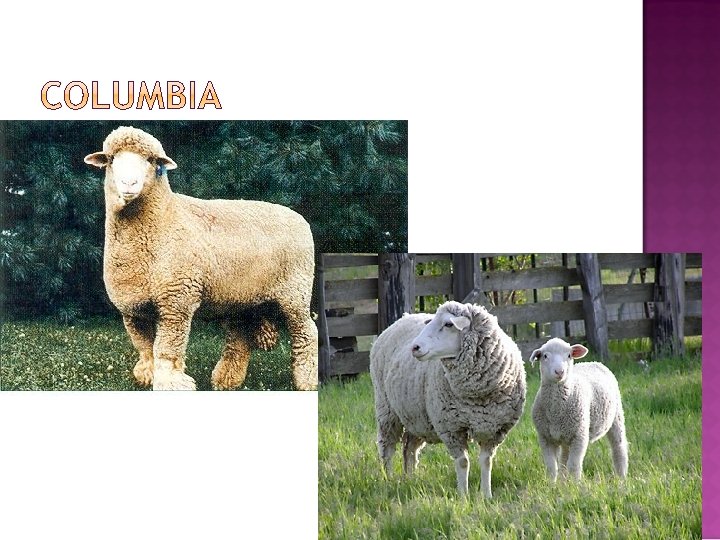
Crossbred Wool Breed Developed by the USDA in 1912 Large ewes with Large lambs with good wool yield Survive well on range conditions of western US
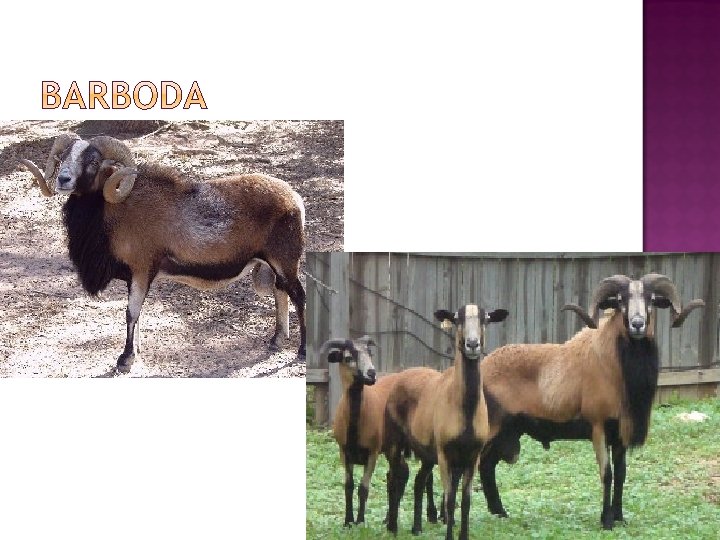
Hair Sheep from TX Males-horns Females-polled Usually tan-brown in color with dark belly
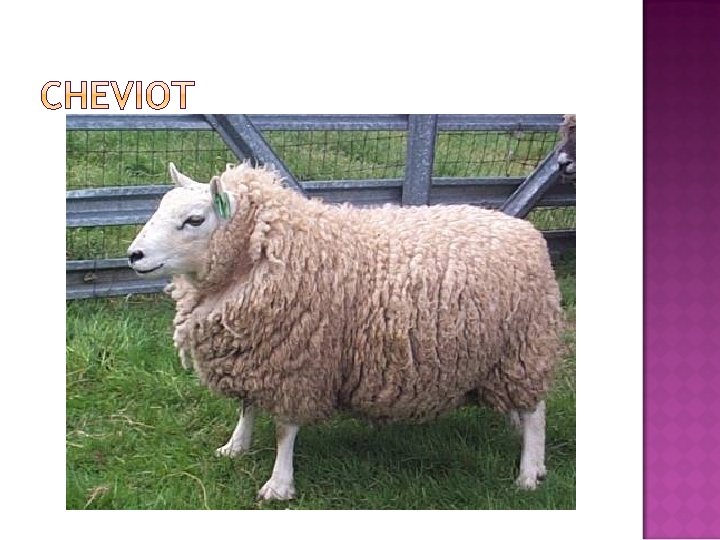
Small breed Medium wool quality Raised for meat, high quality lamb carcass Hardy sheep Developed in Scotland
Questions to answer while viewing What anatomical parts are evaluated while judging lamb? Why are these parts evaluated? What qualities would a good market lamb possess? After viewing, sketch a profile, front, and back view a good lamb vs. a bad market lamb and explain what is good/bad about each.
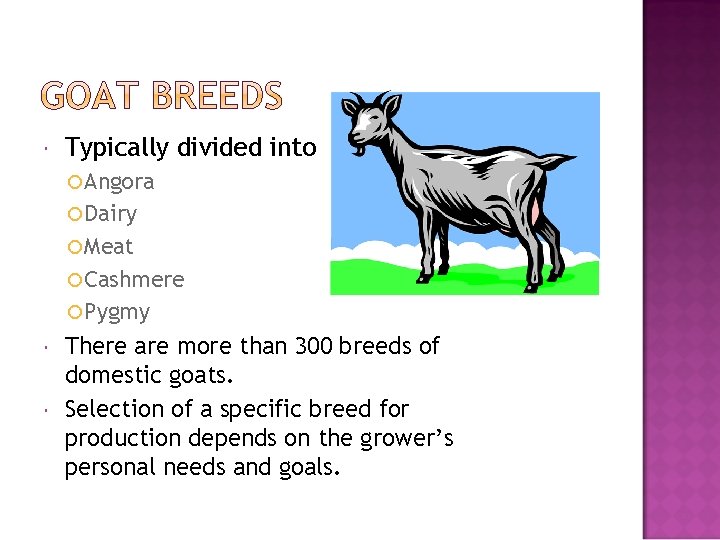
Typically divided into Angora Dairy Meat Cashmere Pygmy There are more than 300 breeds of domestic goats. Selection of a specific breed for production depends on the grower’s personal needs and goals.
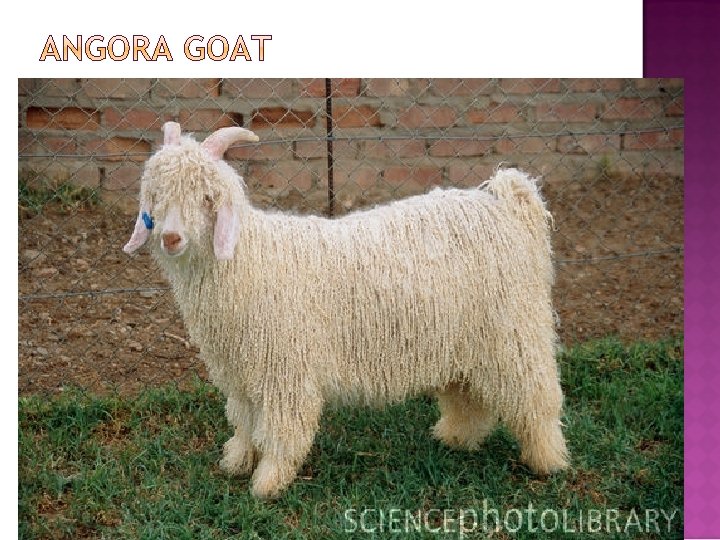
WHAT ARE COMMON TYPES OF GOATS, AND HOW DO THEY DIFFER? A. Angora goats originated in Turkey and are well adapted to areas not fit for other livestock. Angoras are almost totally white at maturity and produce up to 7 pounds of mohair each year. Angora goats are horned, with long, droopy ears. At maturity a buck weighs between 125 and 175 pounds, and a doe weighs between 80 and 90 pounds.
WHAT ARE COMMON TYPES OF GOATS, AND HOW DO THEY DIFFER? B. Dairy goats can produce 5 pounds of milk per day. They supply 1. 8 percent of the milk supply in the world. Goat milk has more minerals than cow milk and is easier for small children and elderly people to digest. The most common breeds raised in the United States, in order of their popularity, are French Alpine, La. Mancha, Nubian, Saanen, and Toggenburg.
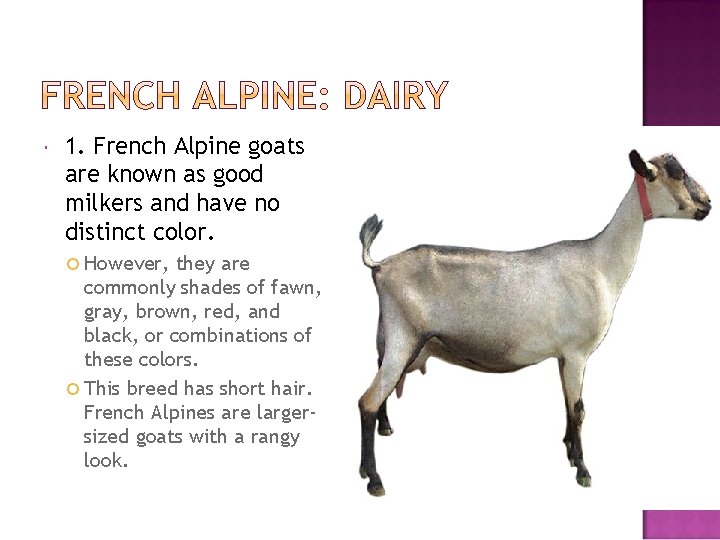
1. French Alpine goats are known as good milkers and have no distinct color. However, they are commonly shades of fawn, gray, brown, red, and black, or combinations of these colors. This breed has short hair. French Alpines are largersized goats with a rangy look.
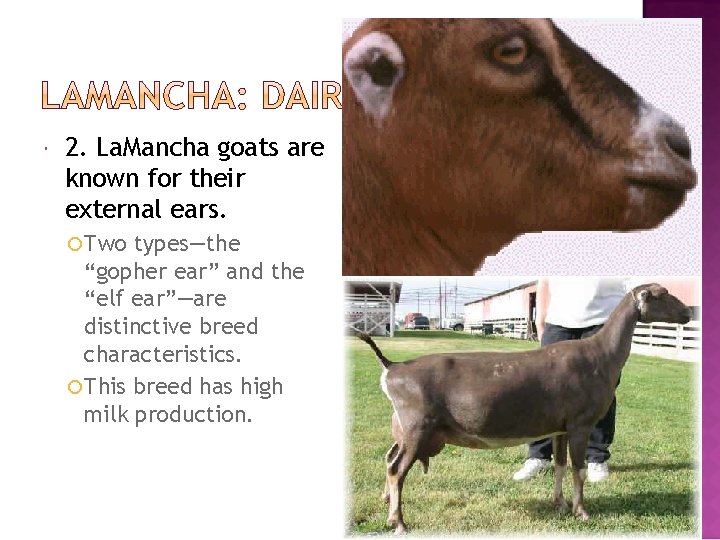
2. La. Mancha goats are known for their external ears. Two types—the “gopher ear” and the “elf ear”—are distinctive breed characteristics. This breed has high milk production.
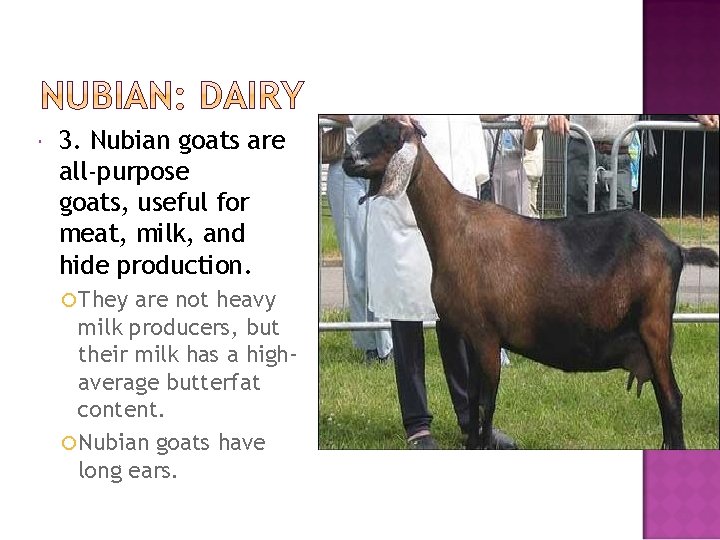
3. Nubian goats are all-purpose goats, useful for meat, milk, and hide production. They are not heavy milk producers, but their milk has a highaverage butterfat content. Nubian goats have long ears.
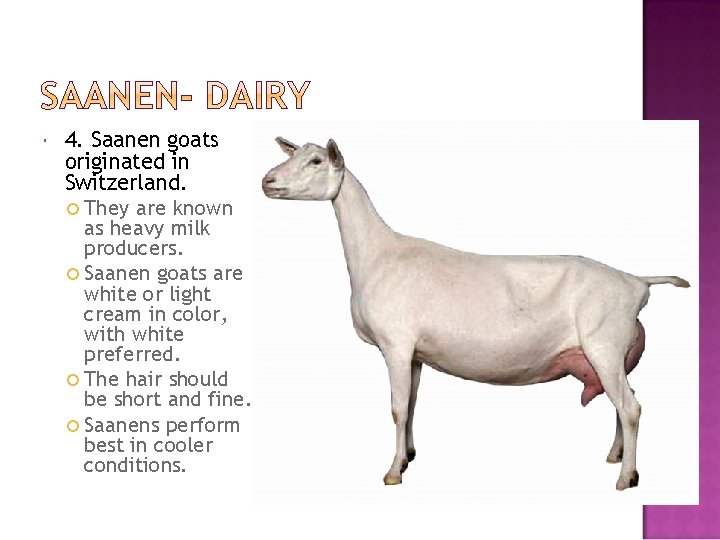
4. Saanen goats originated in Switzerland. They are known as heavy milk producers. Saanen goats are white or light cream in color, with white preferred. The hair should be short and fine. Saanens perform best in cooler conditions.
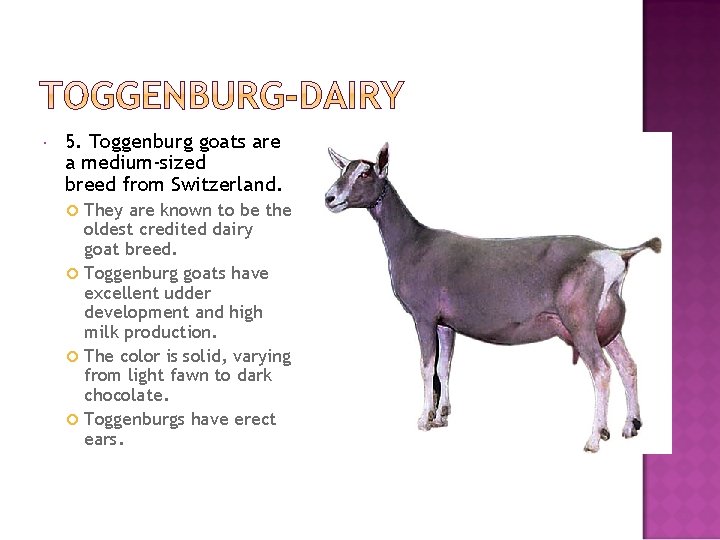
5. Toggenburg goats are a medium-sized breed from Switzerland. They are known to be the oldest credited dairy goat breed. Toggenburg goats have excellent udder development and high milk production. The color is solid, varying from light fawn to dark chocolate. Toggenburgs have erect ears.
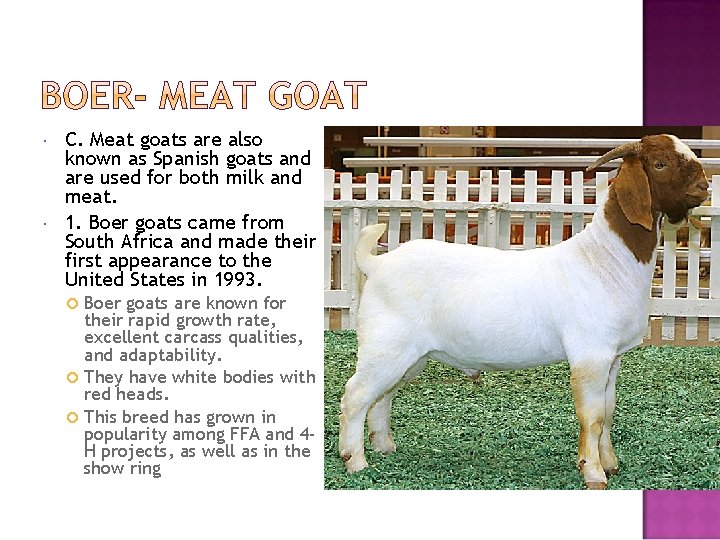
C. Meat goats are also known as Spanish goats and are used for both milk and meat. 1. Boer goats came from South Africa and made their first appearance to the United States in 1993. Boer goats are known for their rapid growth rate, excellent carcass qualities, and adaptability. They have white bodies with red heads. This breed has grown in popularity among FFA and 4 H projects, as well as in the show ring
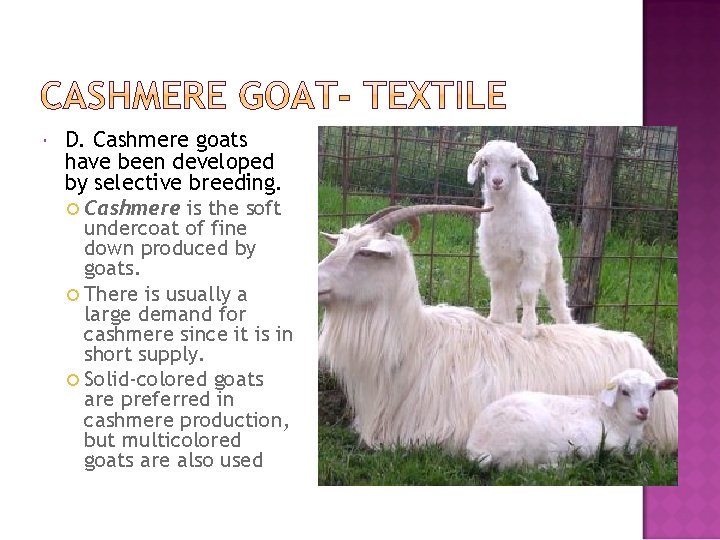
D. Cashmere goats have been developed by selective breeding. Cashmere is the soft undercoat of fine down produced by goats. There is usually a large demand for cashmere since it is in short supply. Solid-colored goats are preferred in cashmere production, but multicolored goats are also used
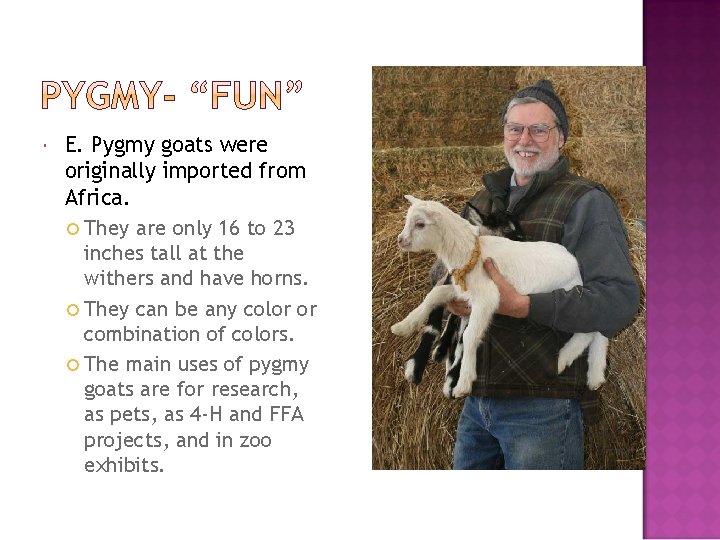
E. Pygmy goats were originally imported from Africa. They are only 16 to 23 inches tall at the withers and have horns. They can be any color or combination of colors. The main uses of pygmy goats are for research, as pets, as 4 -H and FFA projects, and in zoo exhibits.
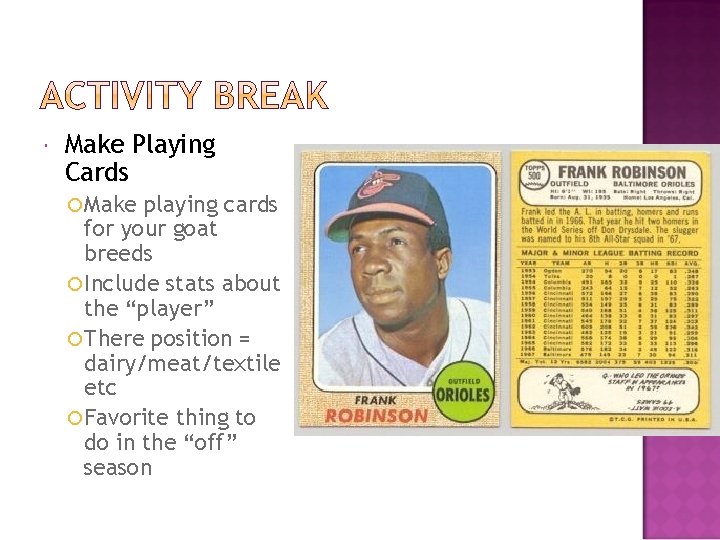
Make Playing Cards Make playing cards for your goat breeds Include stats about the “player” There position = dairy/meat/textile etc Favorite thing to do in the “off” season