
ANIMAL SCIENCE 1 Companion Animal Unit What is

- Slides: 56
ANIMAL SCIENCE 1 Companion Animal Unit What is a companion animal?
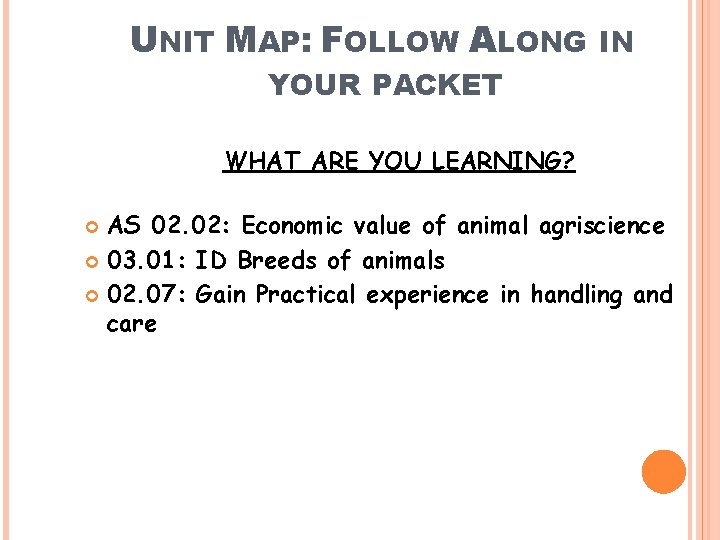
UNIT MAP: FOLLOW ALONG IN YOUR PACKET WHAT ARE YOU LEARNING? AS 02. 02: Economic value of animal agriscience 03. 01: ID Breeds of animals 02. 07: Gain Practical experience in handling and care
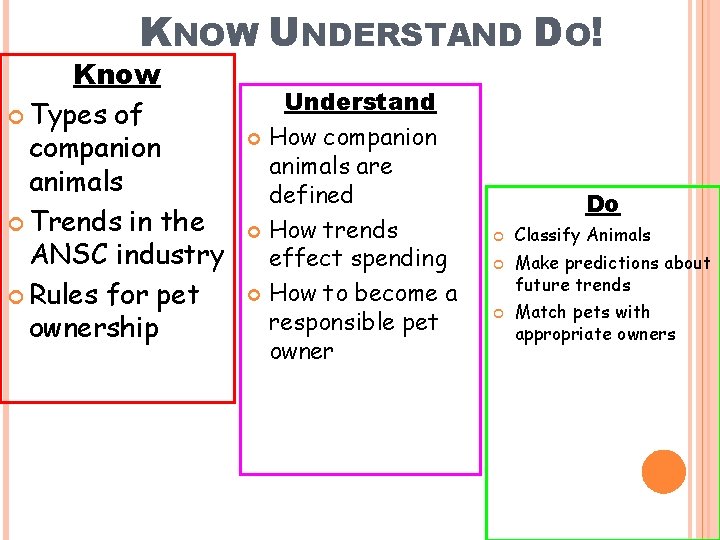
KNOW UNDERSTAND DO! Know Types of companion animals Trends in the ANSC industry Rules for pet ownership Understand How companion animals are defined How trends effect spending How to become a responsible pet owner Do Classify Animals Make predictions about future trends Match pets with appropriate owners
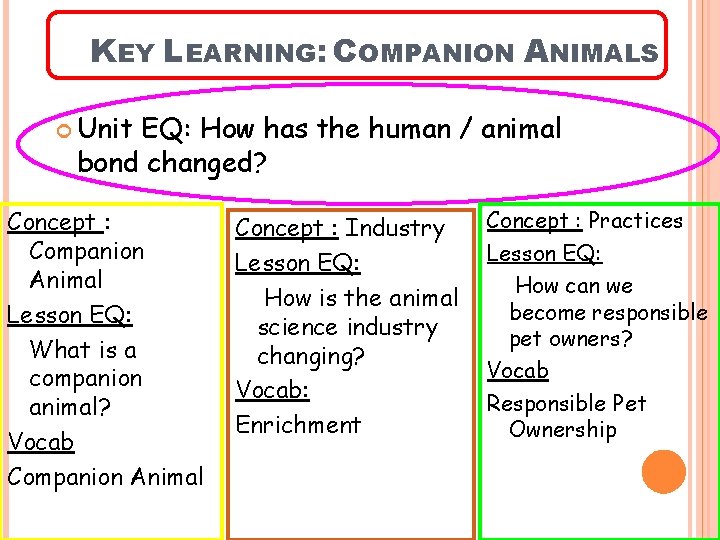
KEY LEARNING: COMPANION ANIMALS Unit EQ: How has the human / animal bond changed? Concept : Companion Animal Lesson EQ: What is a companion animal? Vocab Companion Animal Concept : Industry Lesson EQ: How is the animal science industry changing? Vocab: Enrichment Concept : Practices Lesson EQ: How can we become responsible pet owners? Vocab Responsible Pet Ownership
UNIT MAP SET UP (WARM UP) Unit Name: Companion Animals Unit Essential Question: What trends are happening in the companion animal industry today? Concepts: (Fill in after we take our test) Daily Essential Questions: (Fill in as we go through the unit) Vocabulary: (Fill in before we take our test
ESSENTIAL QUESTION 1 What is a companion animal?
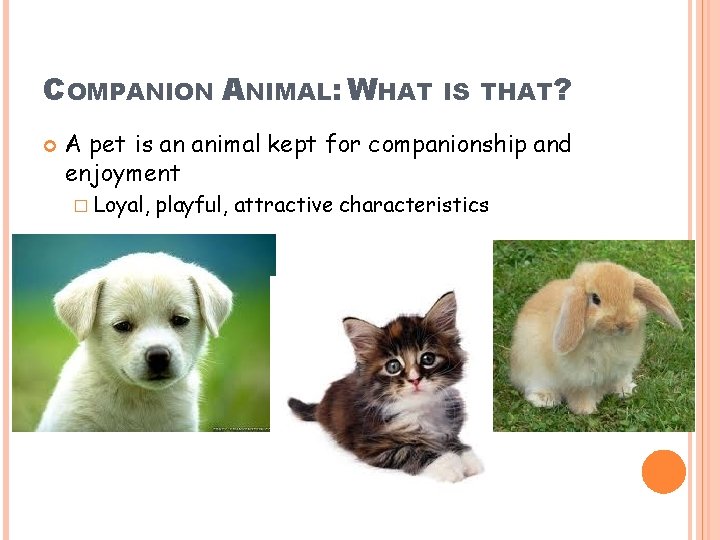
COMPANION ANIMAL: WHAT IS THAT? A pet is an animal kept for companionship and enjoyment � Loyal, playful, attractive characteristics
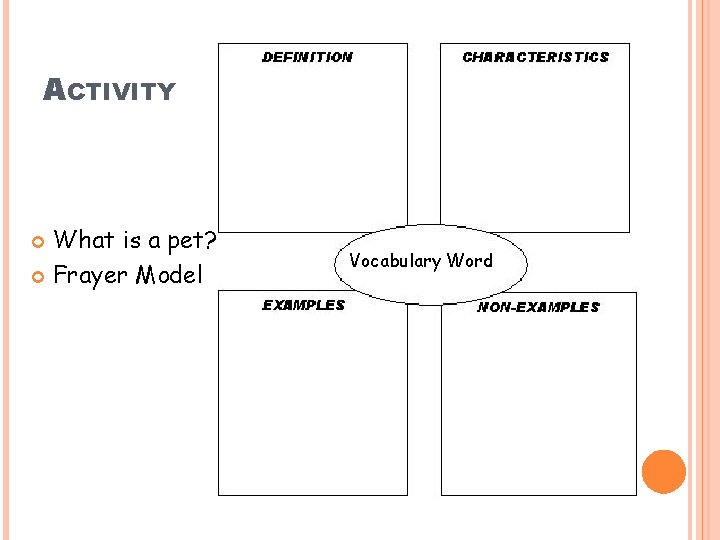
ACTIVITY What is a pet? Frayer Model Vocabulary Word
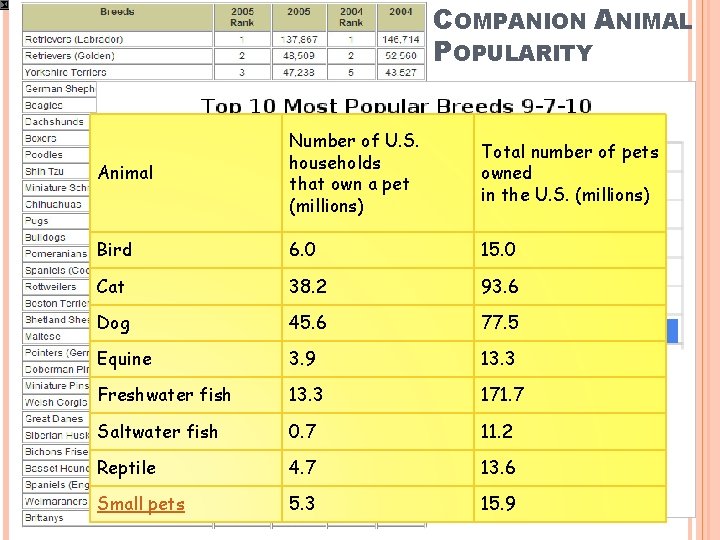
COMPANION ANIMAL POPULARITY Animal Number of U. S. households that own a pet (millions) Total number of pets owned in the U. S. (millions) Bird 6. 0 15. 0 Cat 38. 2 93. 6 Dog 45. 6 77. 5 Equine 3. 9 13. 3 Freshwater fish 13. 3 171. 7 Saltwater fish 0. 7 11. 2 Reptile 4. 7 13. 6 Small pets 5. 3 15. 9
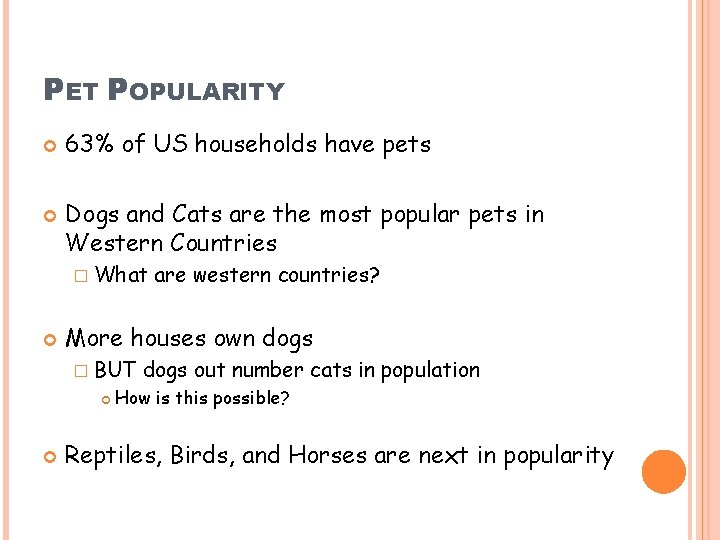
PET POPULARITY 63% of US households have pets Dogs and Cats are the most popular pets in Western Countries � What More houses own dogs � BUT are western countries? dogs out number cats in population How is this possible? Reptiles, Birds, and Horses are next in popularity
INTERESTING FACTS (JUST LISTEN) Restrictions � Many cities limit the # of pets a person can own � Certain breeds or types can be restricted Berkeley, CA and Boulder, CO � Have a law stating people do not “own” their pets. They are the pet’s “Guardian: Class Discussion: Why do think some one would institute (start) this wording for people and their pets relationship?
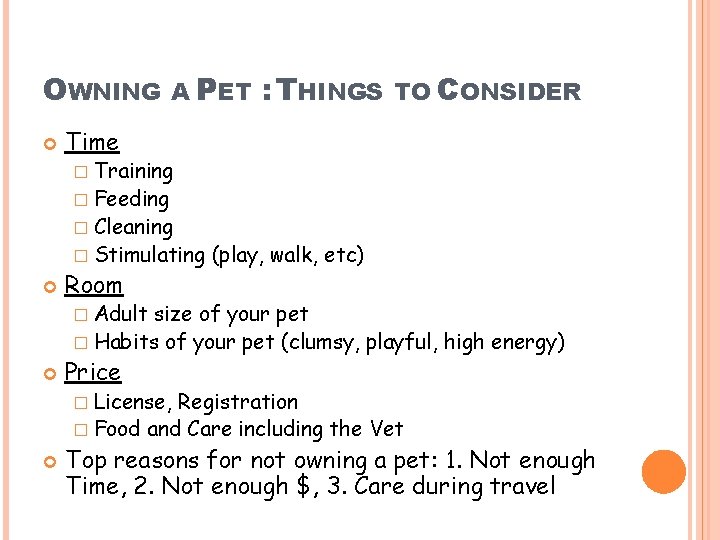
OWNING A PET : THINGS TO CONSIDER Time � Training � Feeding � Cleaning � Stimulating Room (play, walk, etc) � Adult size of your pet � Habits of your pet (clumsy, playful, high energy) Price � License, Registration � Food and Care including the Vet Top reasons for not owning a pet: 1. Not enough Time, 2. Not enough $, 3. Care during travel
CLASS ACTIVITIES What is a Pet ? Make a pet ! Survey your Classroom Please complete these activities and put them in your bin when completed! Don’t forget to answer your essential daily question in your notes
ANIMAL SCIENCE 1 Companion Animal Unit History of companion animals
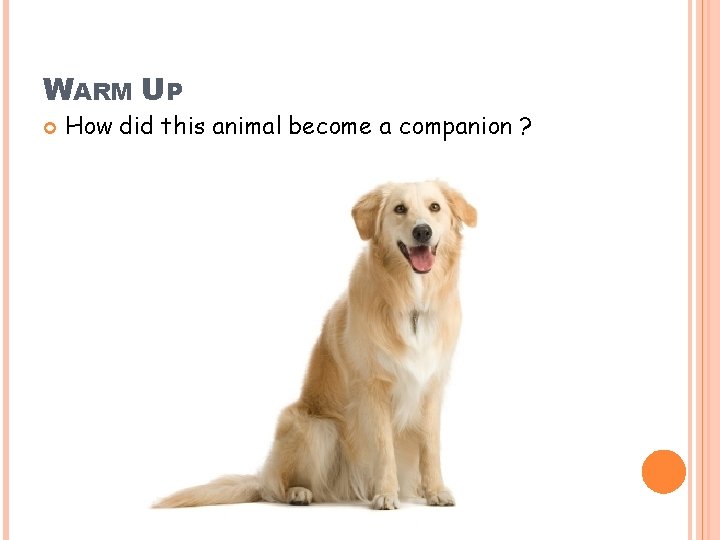
WARM UP How did this animal become a companion ?
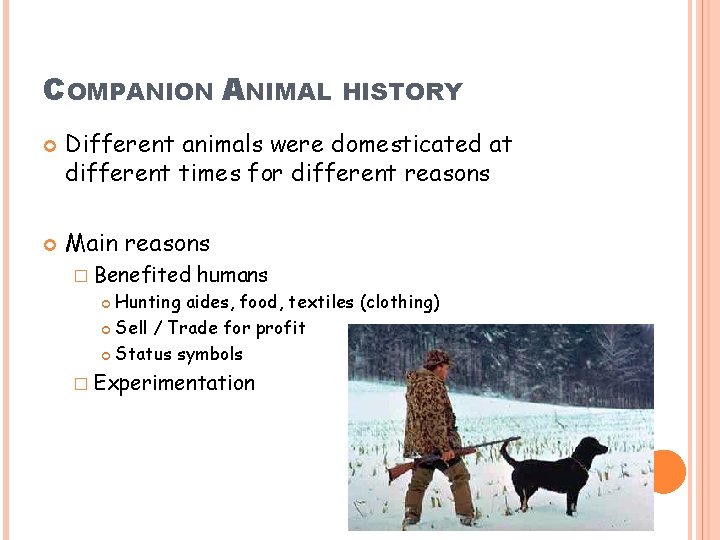
COMPANION ANIMAL HISTORY Different animals were domesticated at different times for different reasons Main reasons � Benefited humans Hunting aides, food, textiles (clothing) Sell / Trade for profit Status symbols � Experimentation
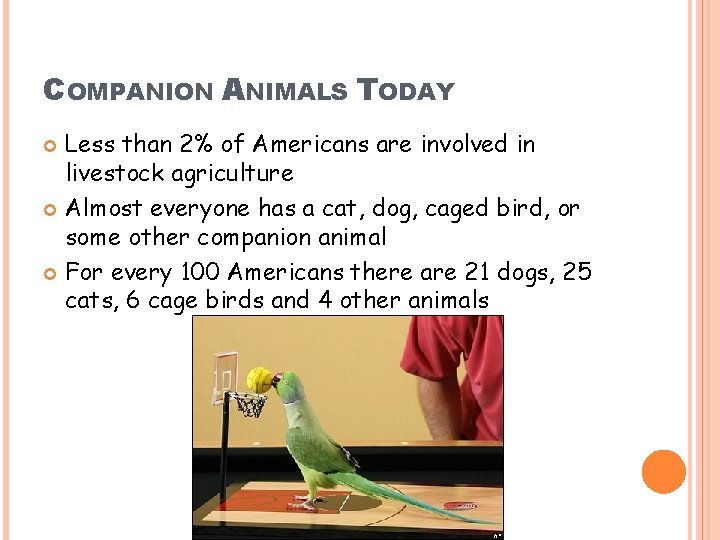
COMPANION ANIMALS TODAY Less than 2% of Americans are involved in livestock agriculture Almost everyone has a cat, dog, caged bird, or some other companion animal For every 100 Americans there are 21 dogs, 25 cats, 6 cage birds and 4 other animals
COMPANION ANIMAL TYPES Ornamental � For looking, not touching example: Fish Status � Standing in society is shown by what animal you own � Interest outside main occupation (job) Playthings Hobbies Companions Helpers These can over lap How the animal is “used” is the key!
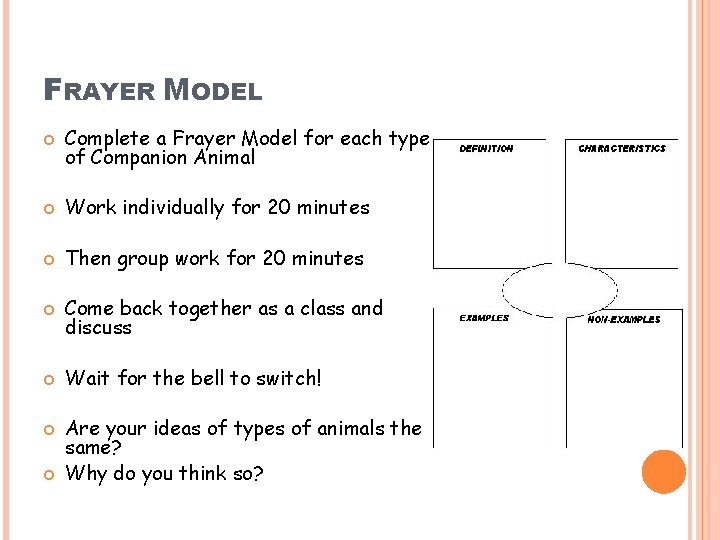
FRAYER MODEL Complete a Frayer Model for each type of Companion Animal Work individually for 20 minutes Then group work for 20 minutes Come back together as a class and discuss Wait for the bell to switch! Are your ideas of types of animals the same? Why do you think so?
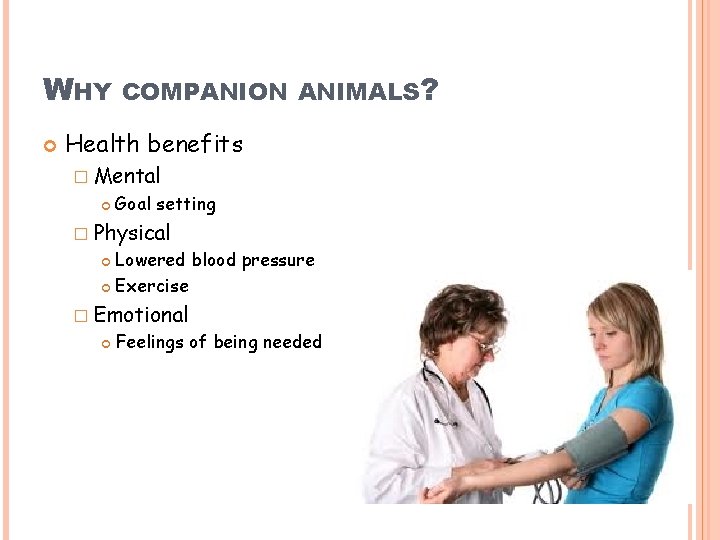
WHY COMPANION ANIMALS? Health benefits � Mental Goal setting � Physical Lowered blood pressure Exercise � Emotional Feelings of being needed
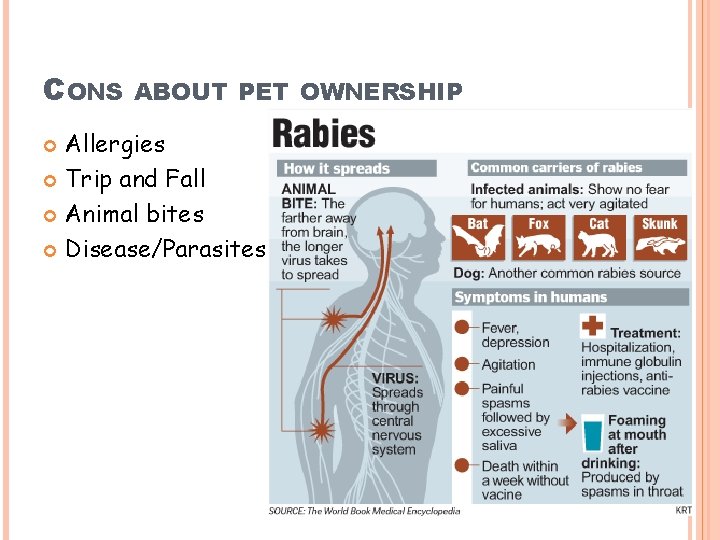
CONS ABOUT PET OWNERSHIP Allergies Trip and Fall Animal bites Disease/Parasites
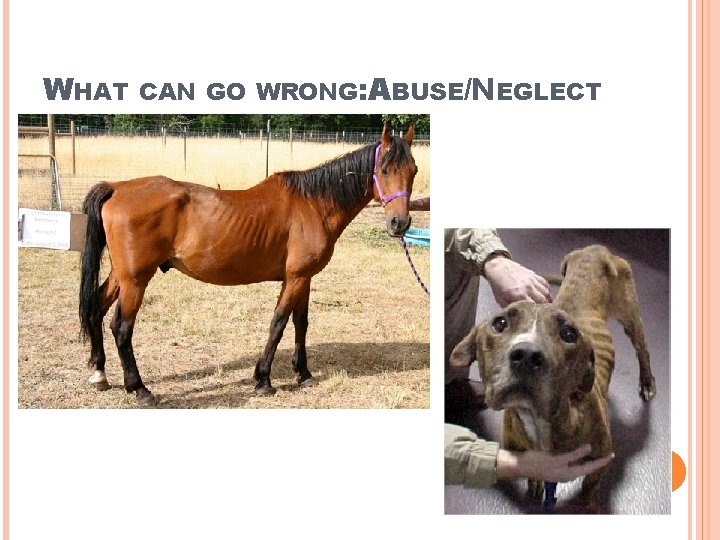
PROBLEMS FOR PETS CAUSED BY HUMANS Care problems: abandonment, abuse and neglect � Overindulge: problems Mis-use � Example: Overfeeding-> Obesity-> Health Bunnies for Easter, Puppies for Christmas What is the problem? Over breeding for desired traits � Results in poor health
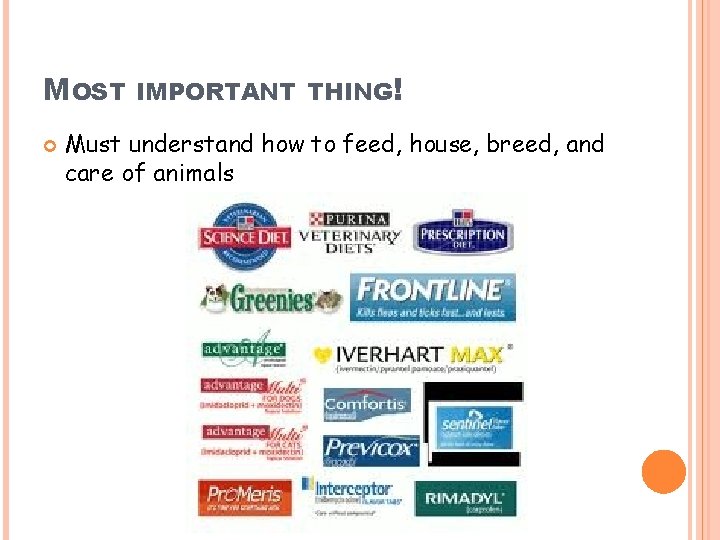
MOST IMPORTANT THING! Must understand how to feed, house, breed, and care of animals
BASIC RULES Space � Enough room to move naturally Enrichment � Activities to keep animals “entertained” Food � Proper FOR PET CARE amount and type Water � Always available!
ACTIVITY Lab cage inspection � Worksheet Improving environments � Worksheet Turn your worksheets into your bin when complete!
WARM UP PLEASE TURN IN YORU FRAYER MODELS FROM YESTERDAY INTO YOUR CLASS BIN (3 rd drawer) Get out your notes and write 1 thought for your warm up. Be ready to share after attendance WARM UP: What keeps people safe in society?
ANIMAL SCIENCE 1 Companion Animal Unit Rules and Regulations
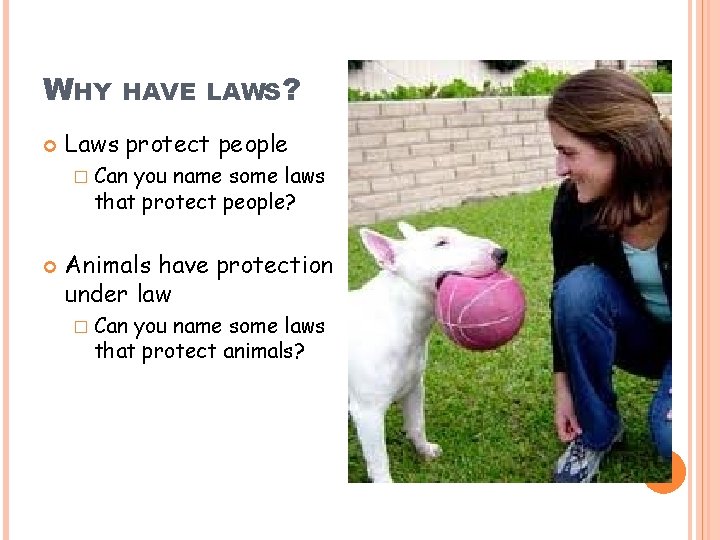
WHY HAVE LAWS? Laws protect people � Can you name some laws that protect people? Animals have protection under law � Can you name some laws that protect animals?
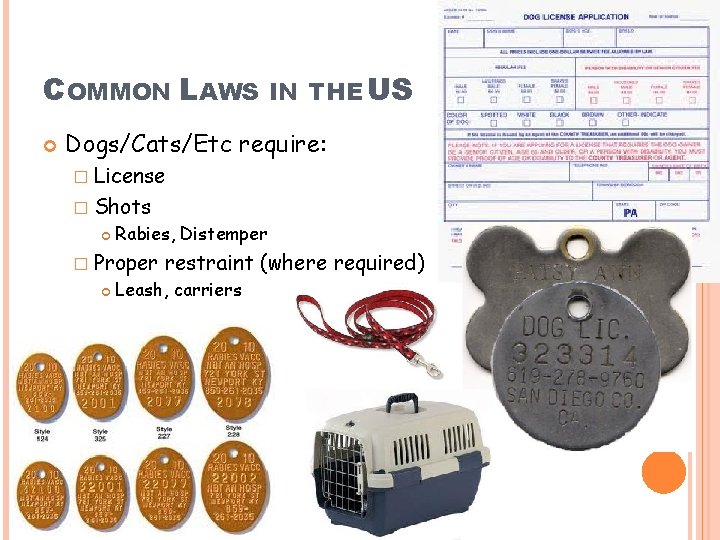
COMMON LAWS IN THE US Dogs/Cats/Etc require: � License � Shots Rabies, Distemper � Proper restraint (where required) Leash, carriers
LAWS FOR DELAWARE Group Activity � Learn your Laws!!!
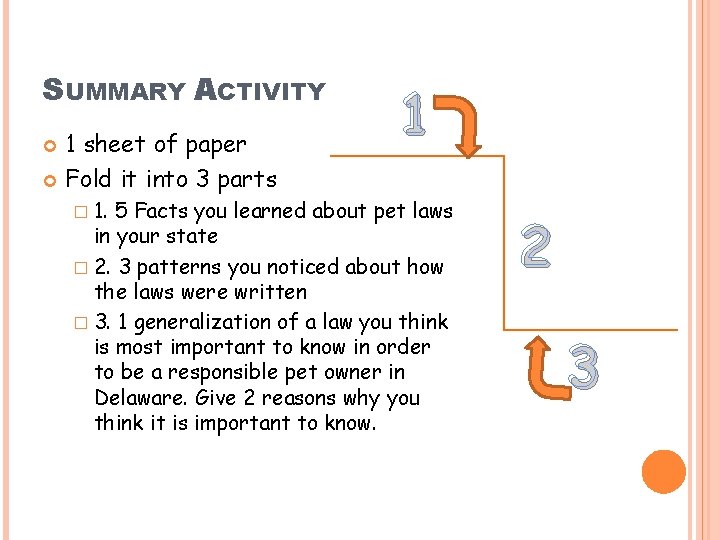
SUMMARY ACTIVITY 1 sheet of paper Fold it into 3 parts � 1. 1 5 Facts you learned about pet laws in your state � 2. 3 patterns you noticed about how the laws were written � 3. 1 generalization of a law you think is most important to know in order to be a responsible pet owner in Delaware. Give 2 reasons why you think it is important to know. 2 3
ANIMAL SCIENCE 1 Companion Animal Unit Pet Trade and Economy
WARM UP How much money does it cost to own a dog over its life time?
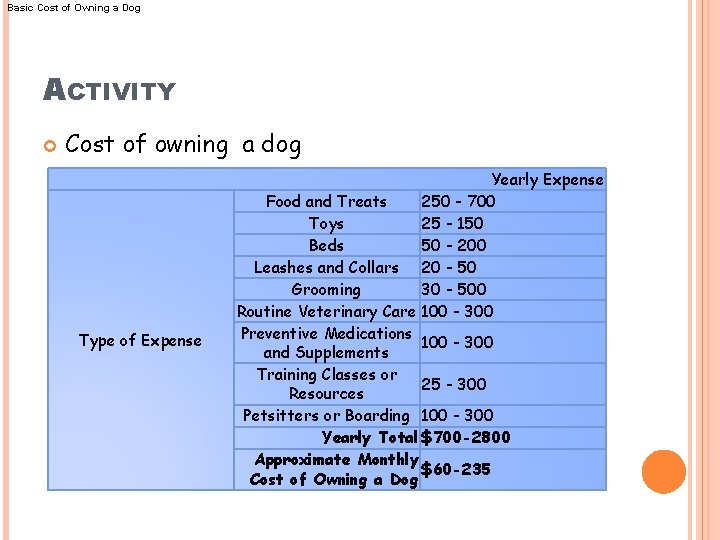
Basic Cost of Owning a Dog ACTIVITY Cost of owning a dog Type of Expense Yearly Expense Food and Treats 250 - 700 Toys 25 - 150 Beds 50 - 200 Leashes and Collars 20 - 50 Grooming 30 - 500 Routine Veterinary Care 100 - 300 Preventive Medications 100 - 300 and Supplements Training Classes or 25 - 300 Resources Petsitters or Boarding 100 - 300 Yearly Total $700 -2800 Approximate Monthly $60 -235 Cost of Owning a Dog
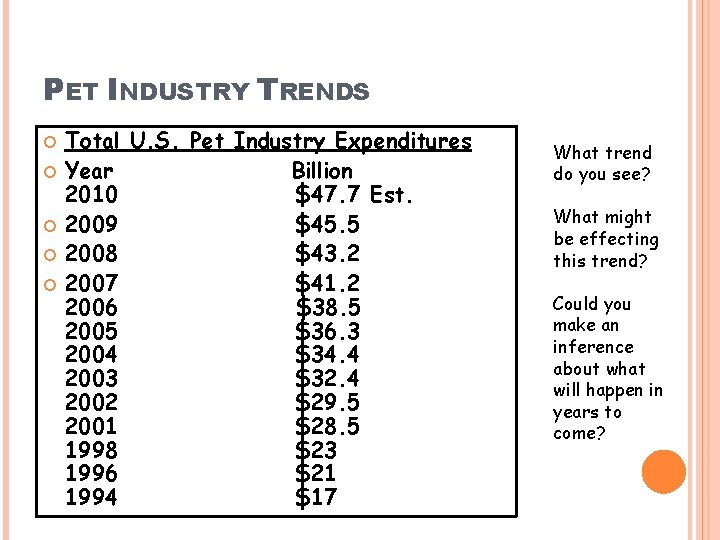
PET INDUSTRY TRENDS Total U. S. Pet Industry Expenditures Year Billion 2010 $47. 7 Est. 2009 $45. 5 2008 $43. 2 2007 $41. 2 2006 $38. 5 2005 $36. 3 2004 $34. 4 2003 $32. 4 2002 $29. 5 2001 $28. 5 1998 $23 1996 $21 1994 $17 What trend do you see? What might be effecting this trend? Could you make an inference about what will happen in years to come?
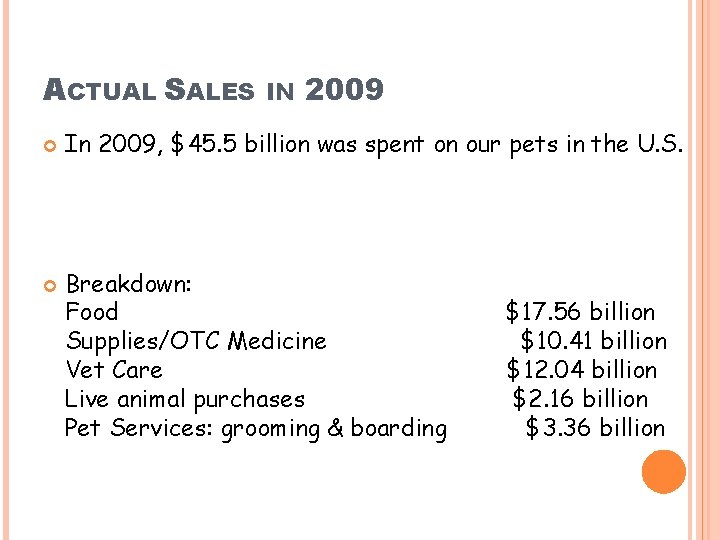
ACTUAL SALES IN 2009 In 2009, $45. 5 billion was spent on our pets in the U. S. Breakdown: Food $17. 56 billion Supplies/OTC Medicine $10. 41 billion Vet Care $12. 04 billion Live animal purchases $2. 16 billion Pet Services: grooming & boarding $3. 36 billion
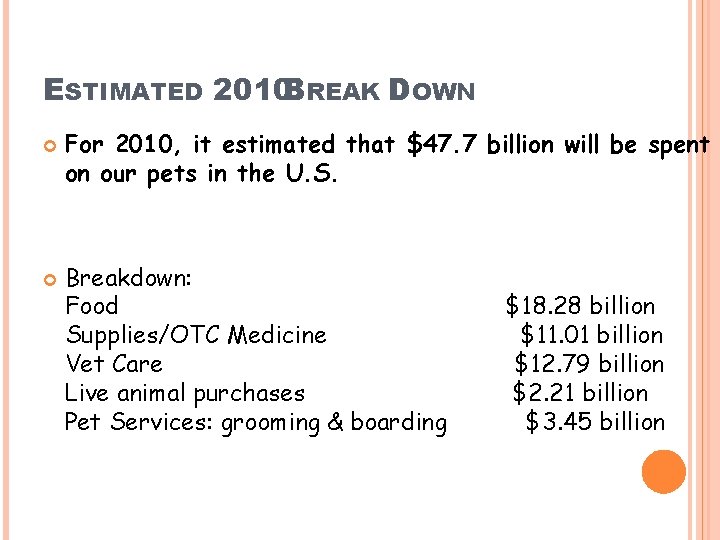
ESTIMATED 2010 BREAK DOWN For 2010, it estimated that $47. 7 billion will be spent on our pets in the U. S. Breakdown: Food $18. 28 billion Supplies/OTC Medicine $11. 01 billion Vet Care $12. 79 billion Live animal purchases $2. 21 billion Pet Services: grooming & boarding $3. 45 billion
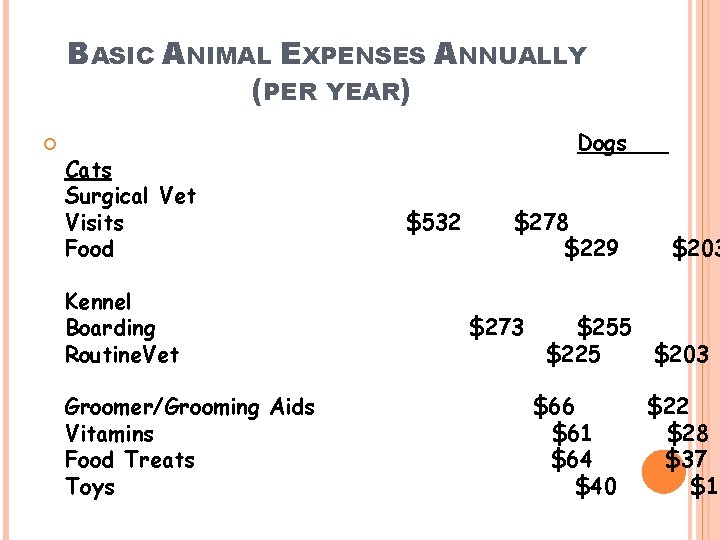
BASIC ANIMAL EXPENSES ANNUALLY (PER YEAR) Dogs Cats Surgical Vet Visits $532 $278 Food $229 $203 Kennel Boarding $273 $255 Routine. Vet $225 $203 Groomer/Grooming Aids $66 $22 Vitamins $61 $28 Food Treats $64 $37 Toys $40 $19
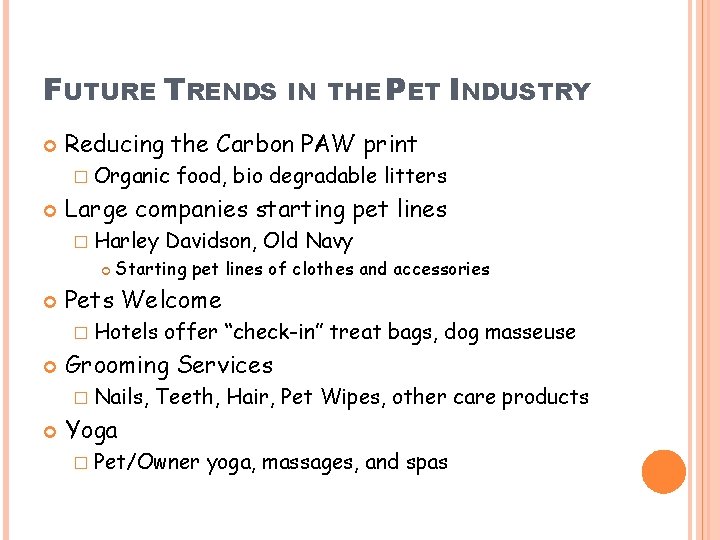
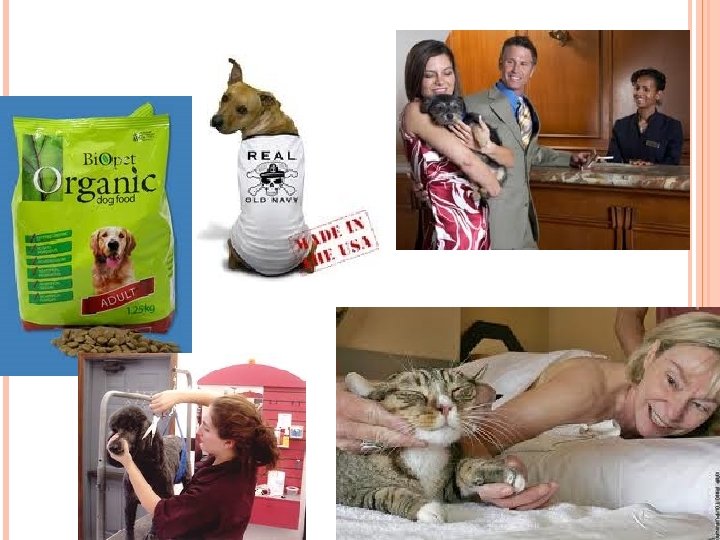
FUTURE TRENDS Reducing the Carbon PAW print � Organic Pets Welcome offer “check-in” treat bags, dog masseuse Grooming Services � Nails, Davidson, Old Navy Starting pet lines of clothes and accessories � Hotels food, bio degradable litters Large companies starting pet lines � Harley IN THE PET INDUSTRY Teeth, Hair, Pet Wipes, other care products Yoga � Pet/Owner yoga, massages, and spas
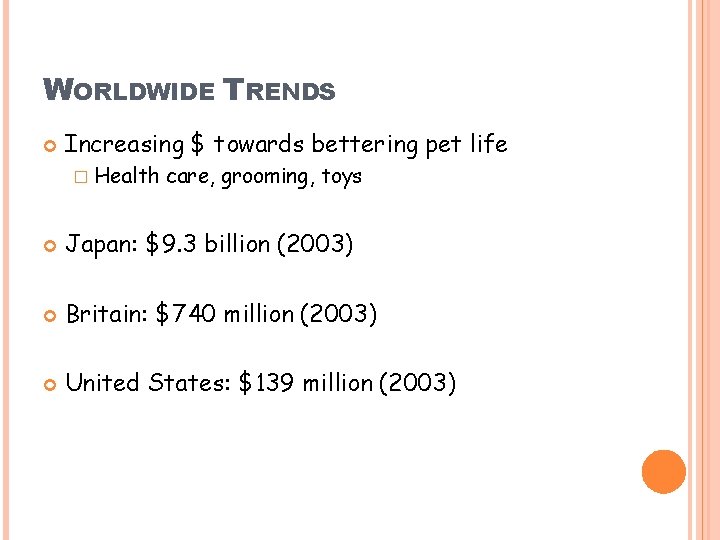
WORLDWIDE TRENDS Increasing $ towards bettering pet life � Health care, grooming, toys Japan: $9. 3 billion (2003) Britain: $740 million (2003) United States: $139 million (2003)
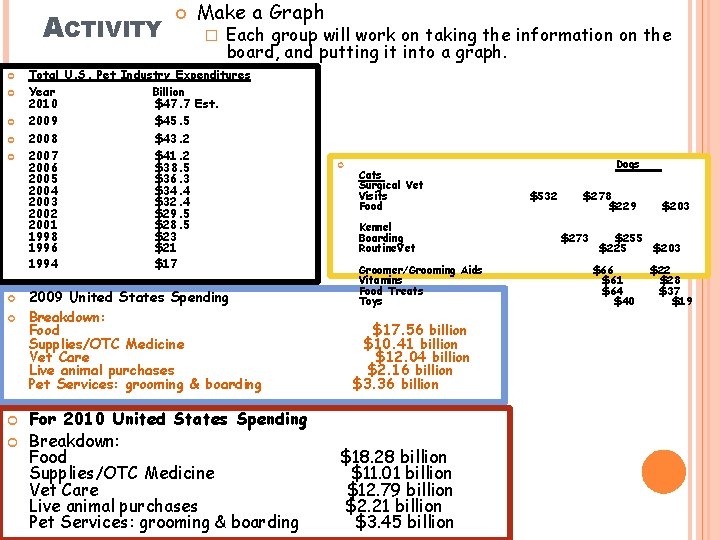
ACTIVITY Make a Graph � Each group will work on taking the information on the board, and putting it into a graph. Total U. S. Pet Industry Expenditures Year Billion 2010 $47. 7 Est. 2009 $45. 5 2008 $43. 2 2007 $41. 2 2006 $38. 5 2005 $36. 3 2004 $34. 4 2003 $32. 4 2002 $29. 5 2001 $28. 5 1998 $23 1996 $21 1994 $17 Dogs Cats Surgical Vet Visits $532 $278 Food $229 $203 Kennel Boarding $273 $255 Routine. Vet $225 $203 Groomer/Grooming Aids $66 $22 Vitamins $61 $28 Food Treats $64 $37 Toys $40 $19 2009 United States Spending Breakdown: Food $17. 56 billion Supplies/OTC Medicine $10. 41 billion Vet Care $12. 04 billion Live animal purchases $2. 16 billion Pet Services: grooming & boarding $3. 36 billion For 2010 United States Spending Breakdown: Food $18. 28 billion Supplies/OTC Medicine $11. 01 billion Vet Care $12. 79 billion Live animal purchases $2. 21 billion Pet Services: grooming & boarding $3. 45 billion
ANIMAL SCIENCE 1 Companion Animal Unit Being a Responsible Pet Owner in Today’s Society
WARM UP Define “Responsibility” in your OWN words. What does it mean to you, to BE responsible? Think on how this would apply to pet ownership and care
DEFINE Responsible: a form of trustworthiness; the trait of being answerable to someone for something or being responsible for one's conduct Pet: a domesticated animal kept for companionship or amusement Ownership: to have or hold as one's own: possess
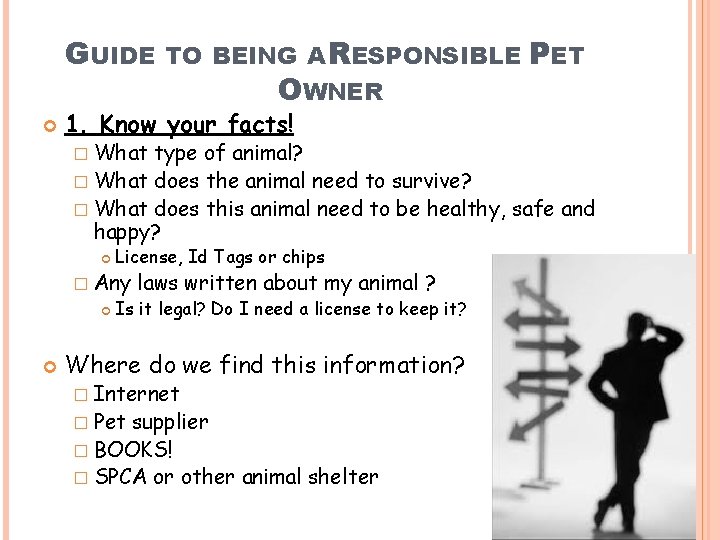
GUIDE TO BEING A RESPONSIBLE OWNER 1. Know your facts! � What PET type of animal? � What does the animal need to survive? � What does this animal need to be healthy, safe and happy? License, Id Tags or chips � Any laws written about my animal ? Is it legal? Do I need a license to keep it? Where do we find this information? � Internet � Pet supplier � BOOKS! � SPCA or other animal shelter
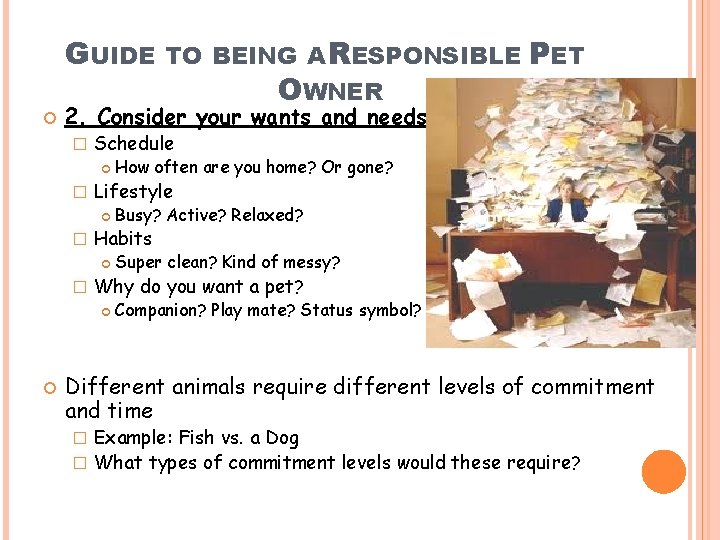
GUIDE OWNER PET 2. Consider your wants and needs � Schedule � � Busy? Active? Relaxed? Habits � How often are you home? Or gone? Lifestyle Super clean? Kind of messy? Why do you want a pet? TO BEING A RESPONSIBLE Companion? Play mate? Status symbol? Different animals require different levels of commitment and time Example: Fish vs. a Dog � What types of commitment levels would these require? �
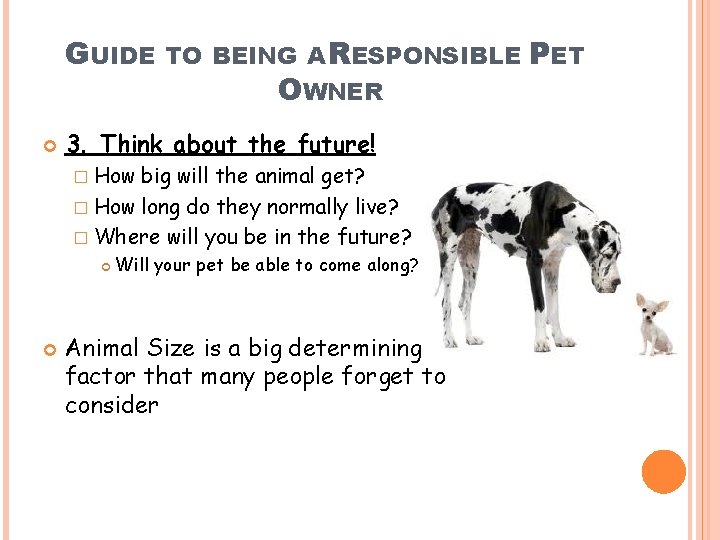
GUIDE TO BEING A RESPONSIBLE OWNER 3. Think about the future! � How big will the animal get? � How long do they normally live? � Where will you be in the future? Will your pet be able to come along? Animal Size is a big determining factor that many people forget to consider PET
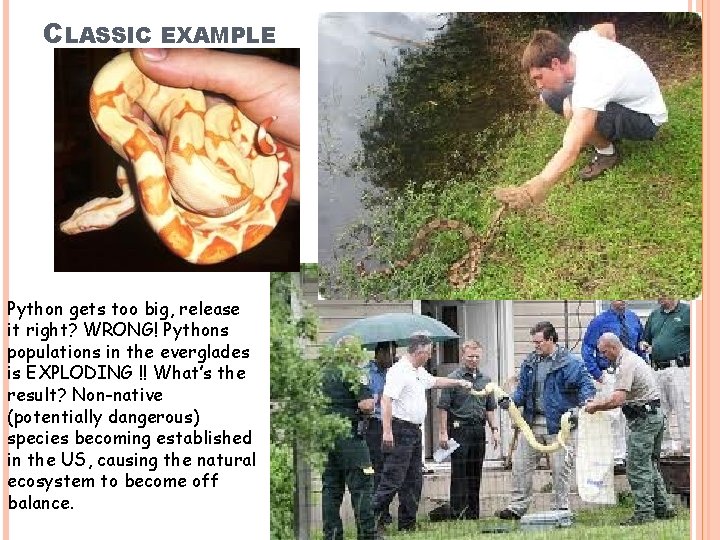
CLASSIC EXAMPLE Python gets too big, release it right? WRONG! Pythons populations in the everglades is EXPLODING !! What’s the result? Non-native (potentially dangerous) species becoming established in the US, causing the natural ecosystem to become off balance.
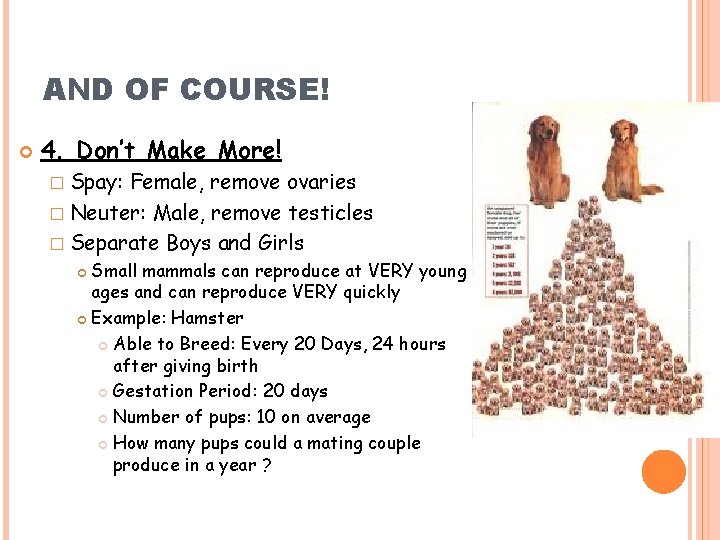
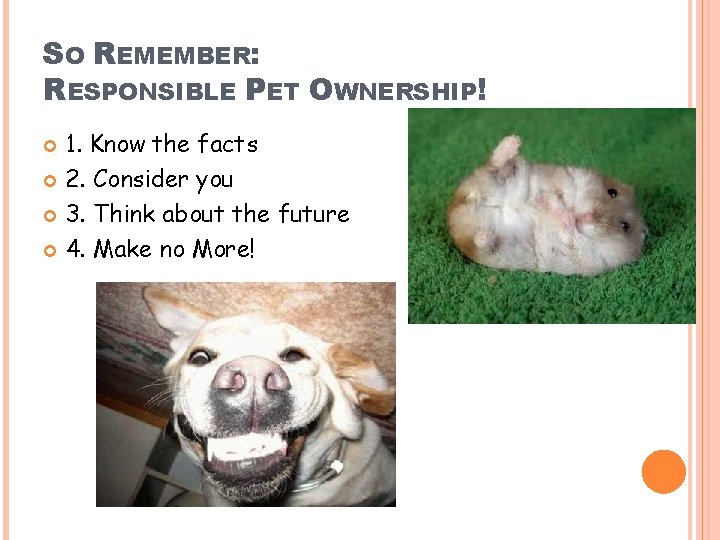
AND OF COURSE! 4. Don’t Make More! � Spay: Female, remove ovaries � Neuter: Male, remove testicles � Separate Boys and Girls Small mammals can reproduce at VERY young ages and can reproduce VERY quickly Example: Hamster Able to Breed: Every 20 Days, 24 hours after giving birth Gestation Period: 20 days Number of pups: 10 on average How many pups could a mating couple produce in a year ?
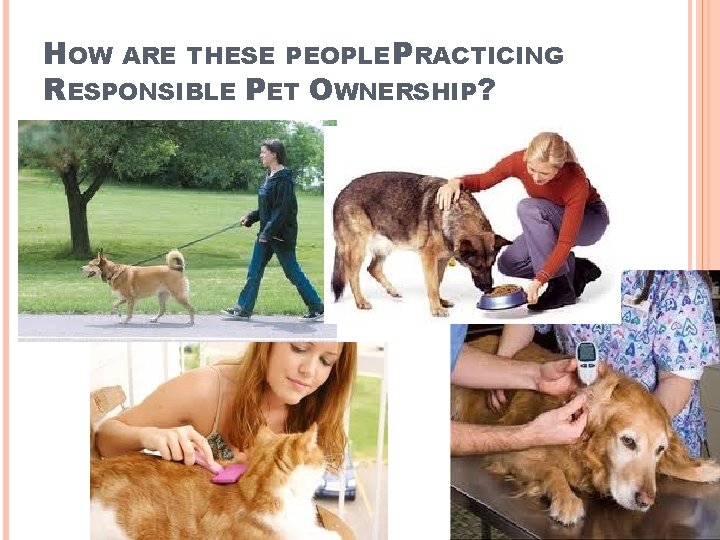
HOW ARE THESE PEOPLE PRACTICING RESPONSIBLE PET OWNERSHIP?
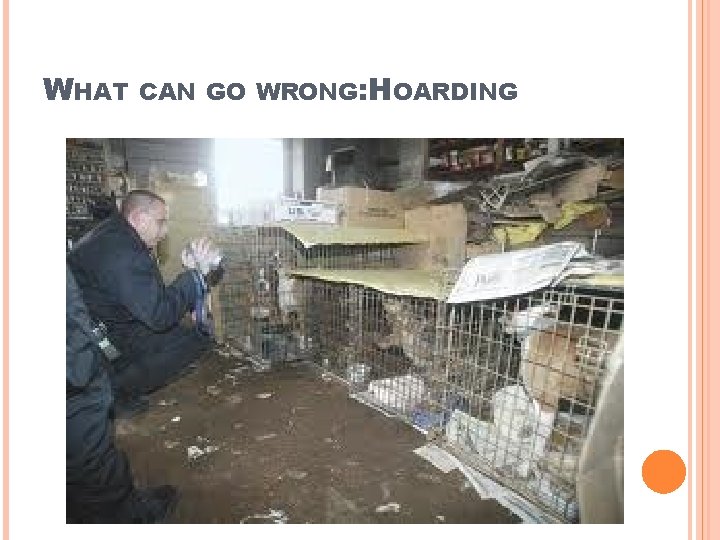
WHAT CAN GO WRONG: HOARDING
WHAT CAN GO WRONG: ABUSE/NEGLECT
SO REMEMBER: RESPONSIBLE PET OWNERSHIP! 1. Know the facts 2. Consider you 3. Think about the future 4. Make no More!
ACTIVITY Match that Pet!!!
TEST REVIEW Complete the test review. Use this to Study. You cannot use your notes or study guide for the test. Define: Companion Animal, Responsible Pet Ownership, Enrichment 1. What are items to consider when owning/looking for a pet? (hint there are 3) list examples 2. What is the current trend in the animal science industry? (know examples) 3. What does it mean to be a responsible pet owner? What are the “rules” to follow? 4. Why were animals domesticated? 5. What are the (4) main rules of pet care? 6. List the Pros and Cons of pet ownership.