
Animal Origins Bringing it all together History of
Animal Origins • Bringing it all together –History of Life –Basic Animal Body Plan –Animal Groups: Understanding evolutionary relationships among phyla of animals • The Cambrian Explosion • Other body plan features –Symmetry –Segmentation –Tissue Types
Bringing it all together • Evolutionary History of Life • Basic Animal Body Plan—germ layers and gastrulation • Animal Groups: Taxonomy and Systematics
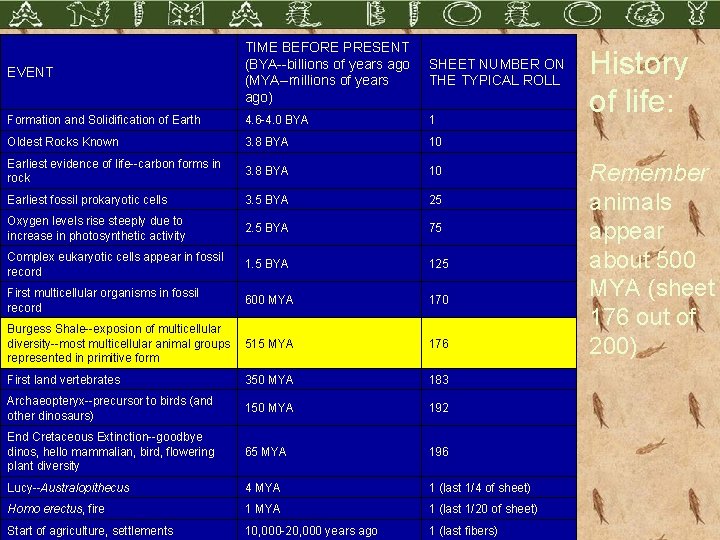
EVENT TIME BEFORE PRESENT (BYA--billions of years ago (MYA--millions of years ago) SHEET NUMBER ON THE TYPICAL ROLL Formation and Solidification of Earth 4. 6 -4. 0 BYA 1 • Animals show up about Oldest Rocks Known 3. 8 BYA 10 Earliest evidence of life--carbon forms in rock 3. 8 BYA 10 Earliest fossil prokaryotic cells 3. 5 BYA 25 Oxygen levels rise steeply due to increase in photosynthetic activity 2. 5 BYA 75 Complex eukaryotic cells appear in fossil record 1. 5 BYA 125 First multicellular organisms in fossil record 600 MYA 170 Burgess Shale--exposion of multicellular diversity--most multicellular animal groups represented in primitive form 515 MYA 176 First land vertebrates 350 MYA 183 Archaeopteryx--precursor to birds (and other dinosaurs) 150 MYA 192 End Cretaceous Extinction--goodbye dinos, hello mammalian, bird, flowering plant diversity 65 MYA 196 Lucy--Australopithecus 4 MYA 1 (last 1/4 of sheet) Homo erectus, fire 1 MYA 1 (last 1/20 of sheet) Start of agriculture, settlements 10, 000 -20, 000 years ago 1 (last fibers) History of life: Remember animals appear about 500 MYA (sheet 176 out of 200)
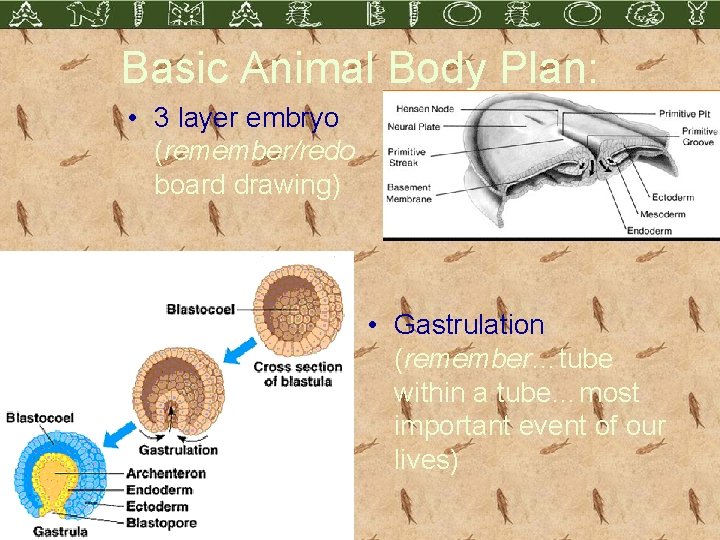
Basic Animal Body Plan: • 3 layer embryo (remember/redo board drawing) • Gastrulation (remember…tube within a tube…most important event of our lives)
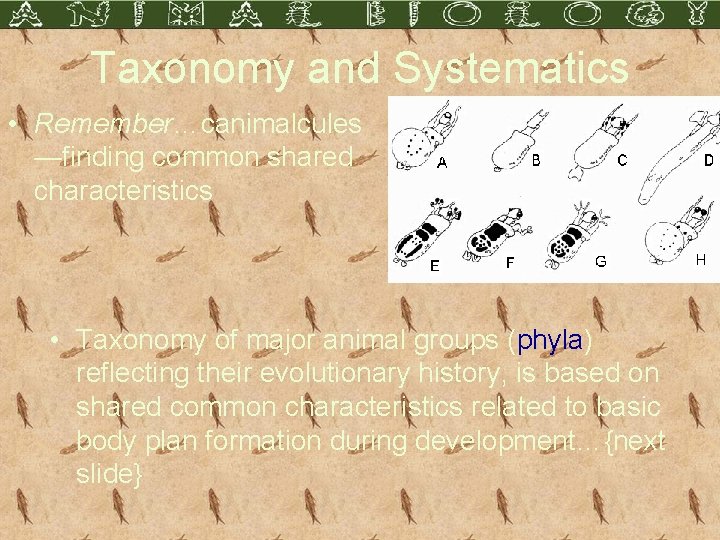
Taxonomy and Systematics • Remember…canimalcules —finding common shared characteristics • Taxonomy of major animal groups (phyla) reflecting their evolutionary history, is based on shared common characteristics related to basic body plan formation during development…{next slide}
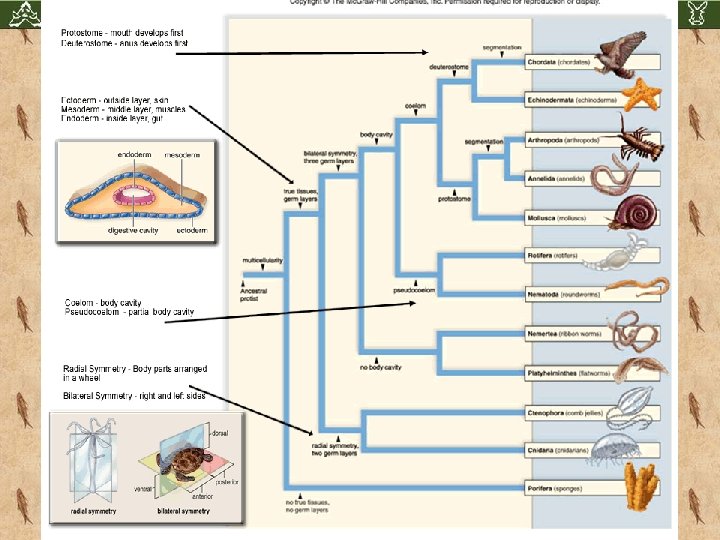
Understanding evolutionary relationships among animal phyla • Goal is to see which major groups are closely related • Adults are so different that it is difficult to find shared common characteristics • Embryos do share many characteristics and can be easily compared
Animals with no mesoderm • • • Least complex groups Embryo has only ectoderm and endoderm Called “diploblastic” Usually have radial symmetry Include Cnidaria (corals, sea anemones, jellyfish) and Ctenophora
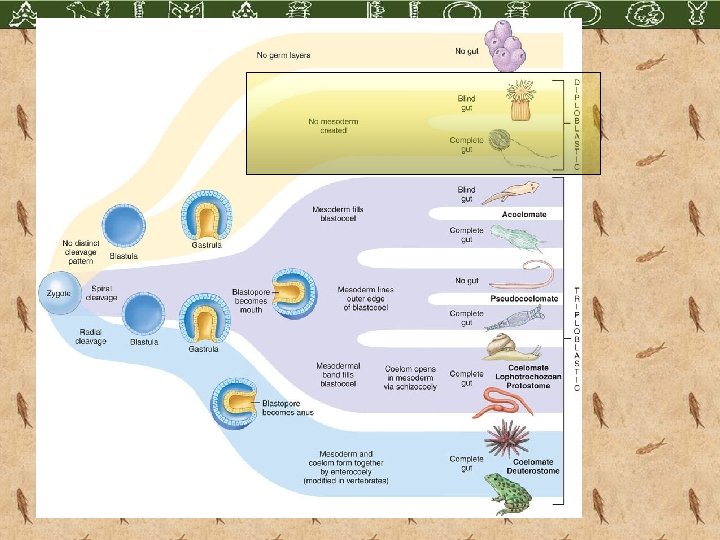
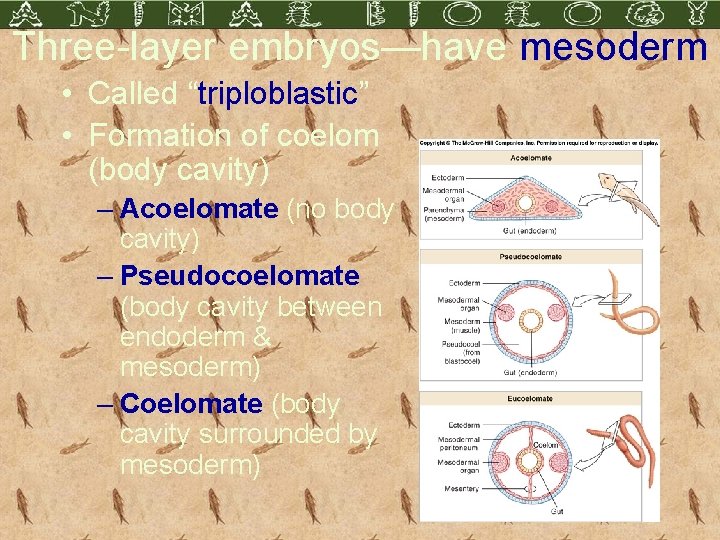
Three-layer embryos—have mesoderm • Called “triploblastic” • Formation of coelom (body cavity) – Acoelomate (no body cavity) – Pseudocoelomate (body cavity between endoderm & mesoderm) – Coelomate (body cavity surrounded by mesoderm)
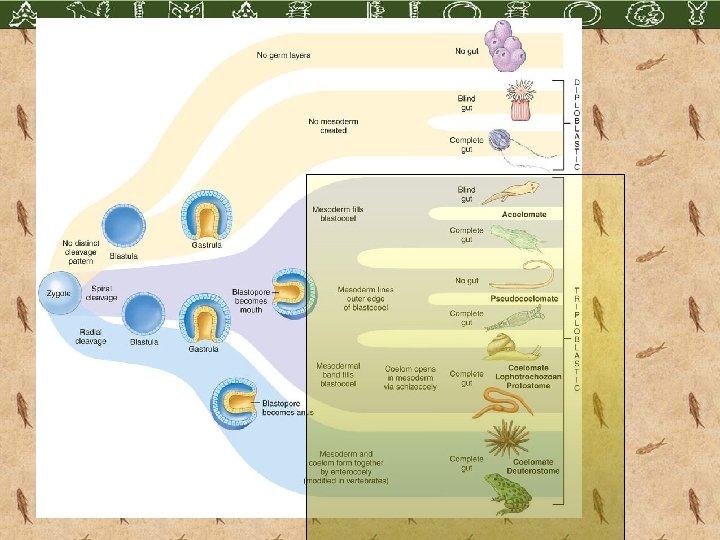
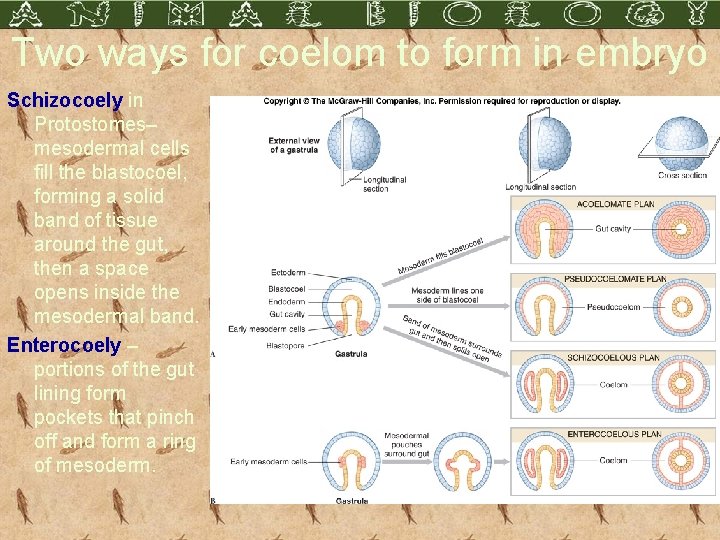
Two ways for coelom to form in embryo Schizocoely in Protostomes– mesodermal cells fill the blastocoel, forming a solid band of tissue around the gut, then a space opens inside the mesodermal band. Enterocoely – portions of the gut lining form pockets that pinch off and form a ring of mesoderm.
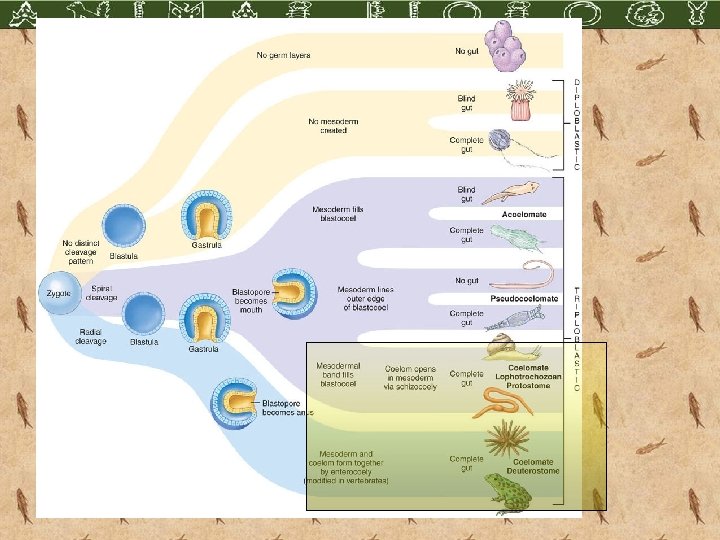

Protostomes (mouth first) versus Deuterostomes (anus first)

What’s in the fossil record? The Cambrian Explosion http: //palaeo. gly. bris. ac. uk/Palaeofiles/Cambrian/Index. html
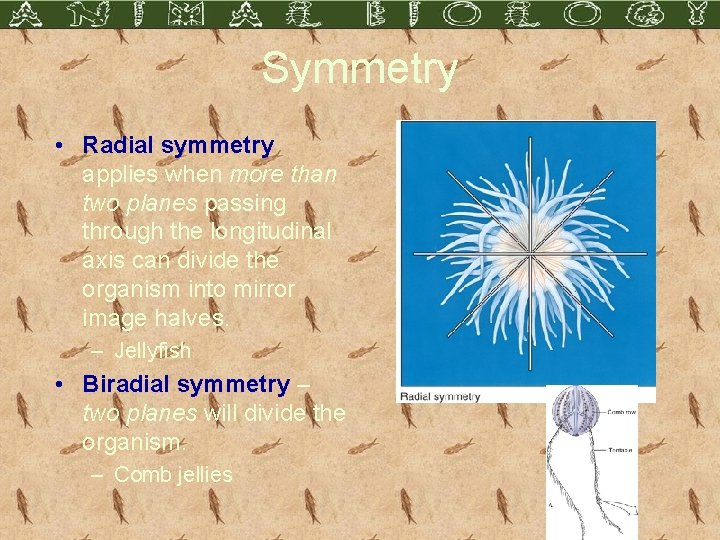
Symmetry • Radial symmetry applies when more than two planes passing through the longitudinal axis can divide the organism into mirror image halves. – Jellyfish • Biradial symmetry – two planes will divide the organism. – Comb jellies

Radiata • The Cnidarians (jellyfish, corals & sea anemones) and Ctenophores (comb jellies), the radial or biradial animals, comprise the Radiata. – No front/back – Weak swimmers – Can interact with environment in all directions.
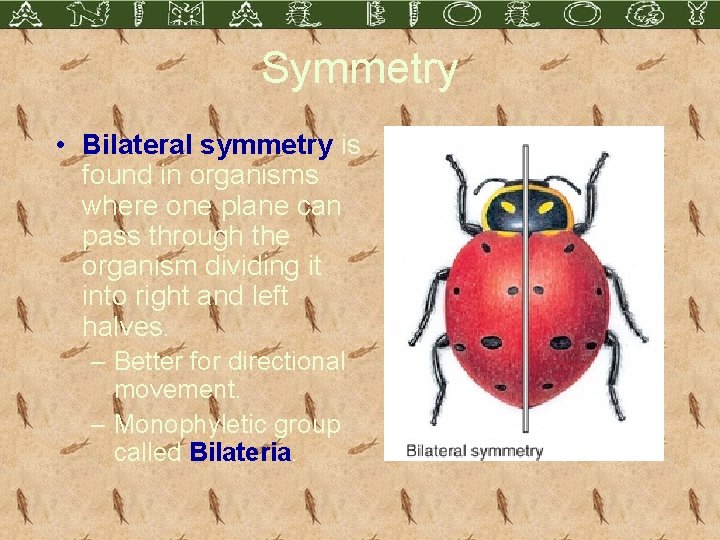
Symmetry • Bilateral symmetry is found in organisms where one plane can pass through the organism dividing it into right and left halves. – Better for directional movement. – Monophyletic group called Bilateria.
Cephalization • Bilateral symmetry is associated with cephalization, differentiation of a head. – Nervous tissue, sense organs, and often the mouth are located in the head. – Advantages for organisms moving head first – directional movement. – Elongation along anteroposterior axis.
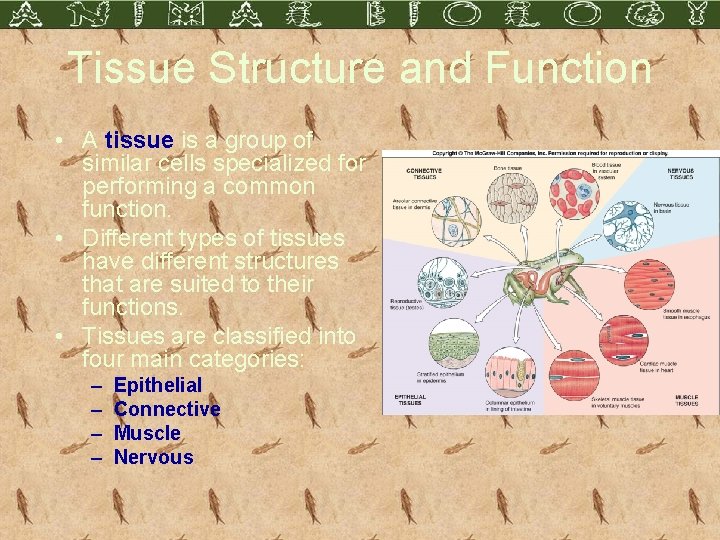
Tissue Structure and Function • A tissue is a group of similar cells specialized for performing a common function. • Different types of tissues have different structures that are suited to their functions. • Tissues are classified into four main categories: – – Epithelial Connective Muscle Nervous
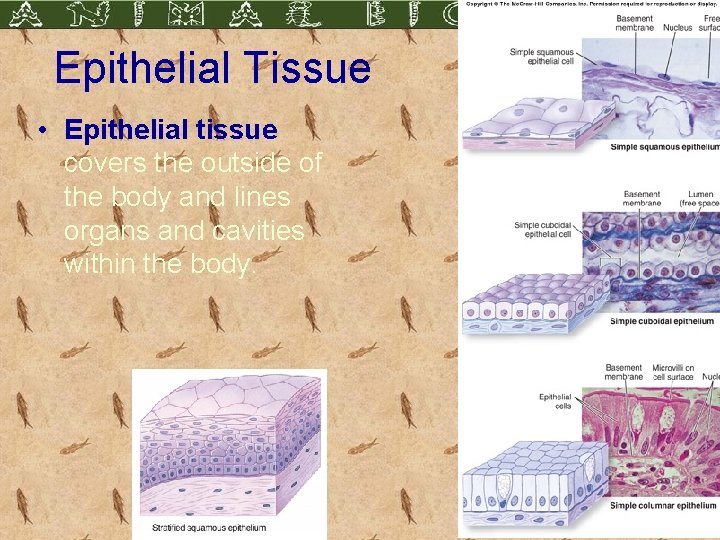
Epithelial Tissue • Epithelial tissue covers the outside of the body and lines organs and cavities within the body.
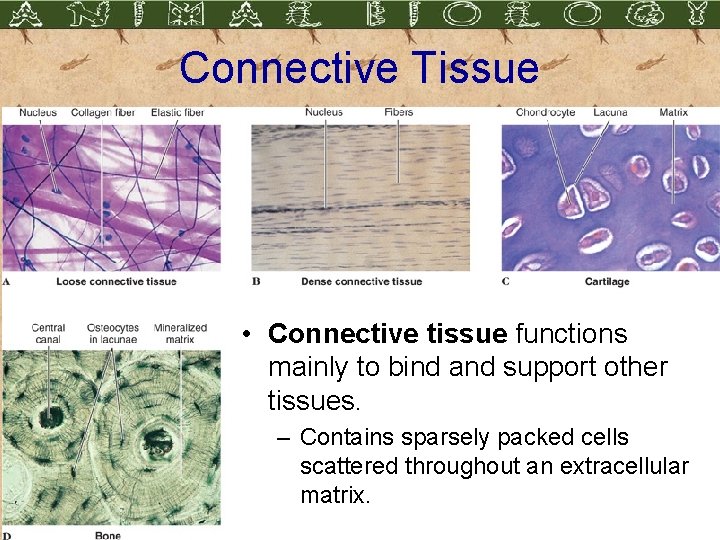
Connective Tissue • Connective tissue functions mainly to bind and support other tissues. – Contains sparsely packed cells scattered throughout an extracellular matrix.
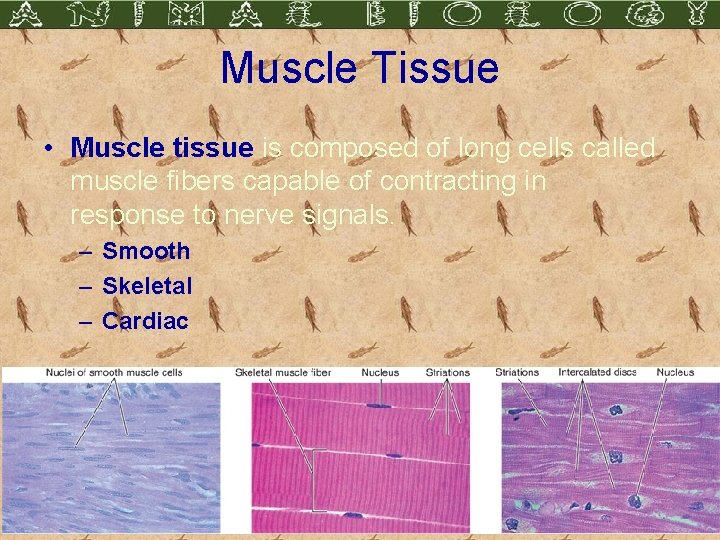
Muscle Tissue • Muscle tissue is composed of long cells called muscle fibers capable of contracting in response to nerve signals. – Smooth – Skeletal – Cardiac
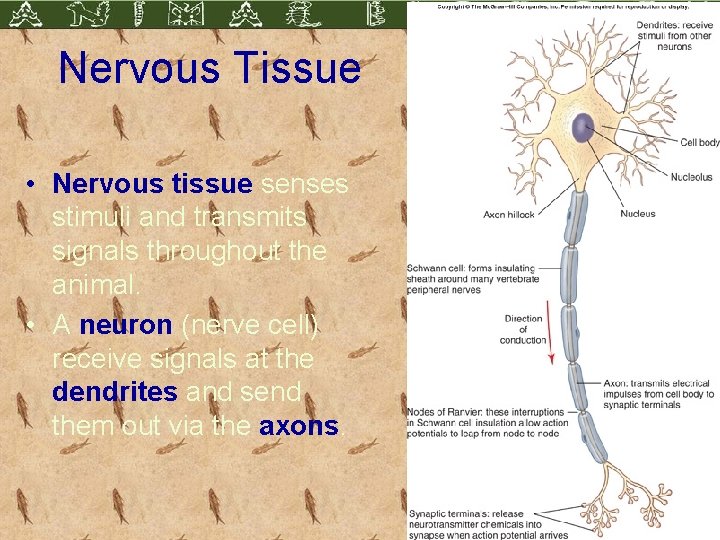
Nervous Tissue • Nervous tissue senses stimuli and transmits signals throughout the animal. • A neuron (nerve cell) receive signals at the dendrites and send them out via the axons.
- Slides: 24