
Animal Nutrition Human Digestion AP Biology 2006 2007
Animal Nutrition Human Digestion AP Biology 2006 -2007
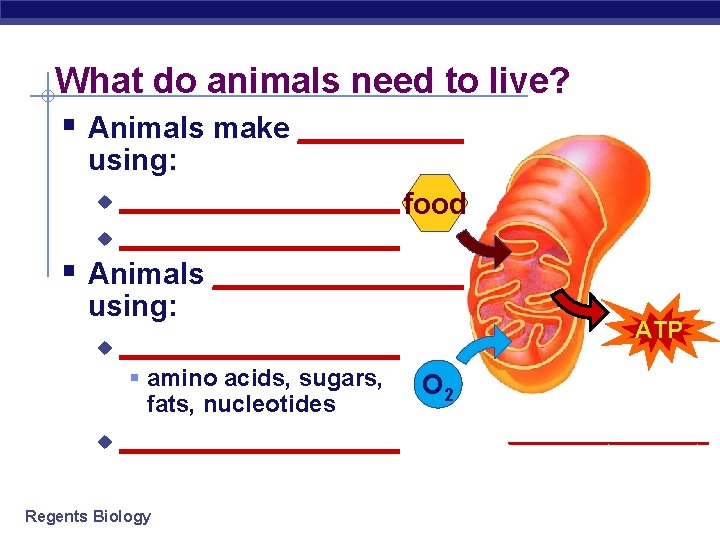
What do animals need to live? § Animals make _____ using: _________ food u _________ u § Animals ________ using: u _________ § amino acids, sugars, fats, nucleotides u ATP _________ Regents Biology O 2 _________

Different diets; different lives § All animals eat other organisms u _______ § eat mainly _____ w gorillas, cows, rabbits, snails u _______ § eat other _____ w sharks, hawks, spiders, snakes u _______ § eat __________ w cockroaches, bears, raccoons, humans w humans evolved as hunters, scavengers & gatherers Regents Biology

Getting & Using Food § ________ u taking in food § ________ u _____________ § breaking up food into smaller pieces u _____________ § breaking down food into molecules small enough to be absorbed into cells § enzymes intracellular digestion § ________ u absorb across cell membrane § ___________________ § ________ u undigested material passes out of body Regents Biology extracellular digestion
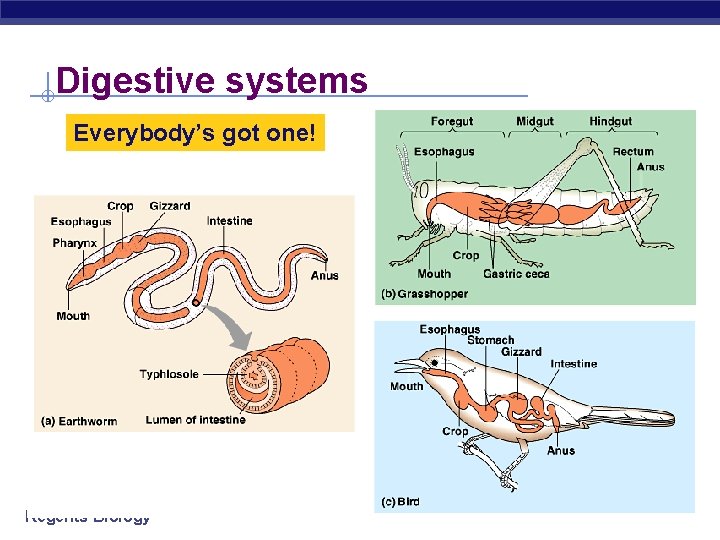
Digestive systems Everybody’s got one! Regents Biology
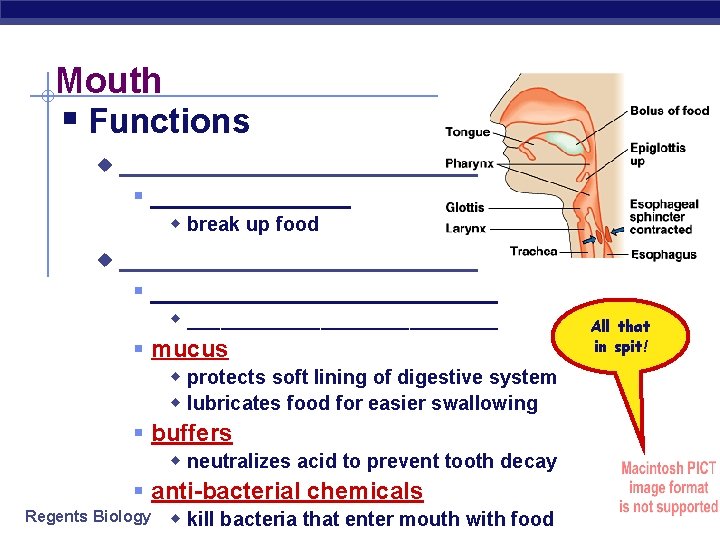
Mouth § Functions u ____________ § ________ w break up food u ____________ § _____________ w ______________ § mucus w protects soft lining of digestive system w lubricates food for easier swallowing § buffers w neutralizes acid to prevent tooth decay § anti-bacterial chemicals Regents Biology w kill bacteria that enter mouth with food All that in spit!

Swallowing (& not choking) § ____________ flap of cartilage u closes _____ (windpipe) when swallowing u food travels down ________ u § ____________ u involuntary muscle contractions to move food along Regents Biology
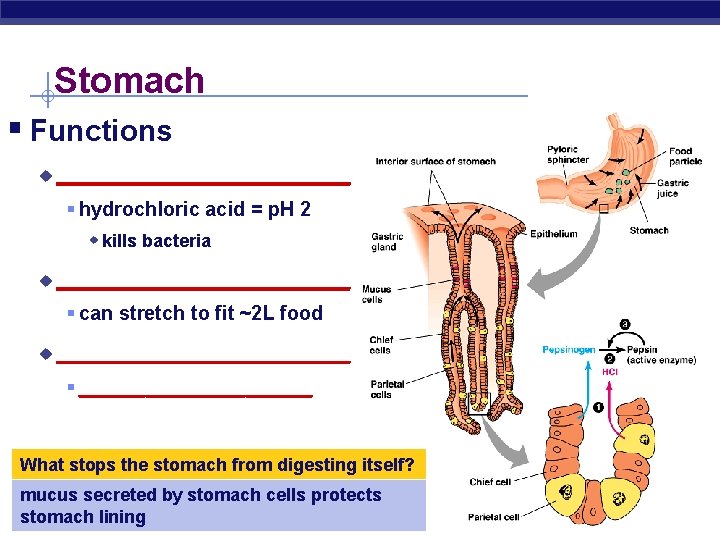
Stomach § Functions u ___________ § hydrochloric acid = p. H 2 w kills bacteria u ___________ § can stretch to fit ~2 L food u ___________ § ___________ What stops the stomach from digesting itself? mucus secreted by stomach cells protects Regents Biology stomach lining
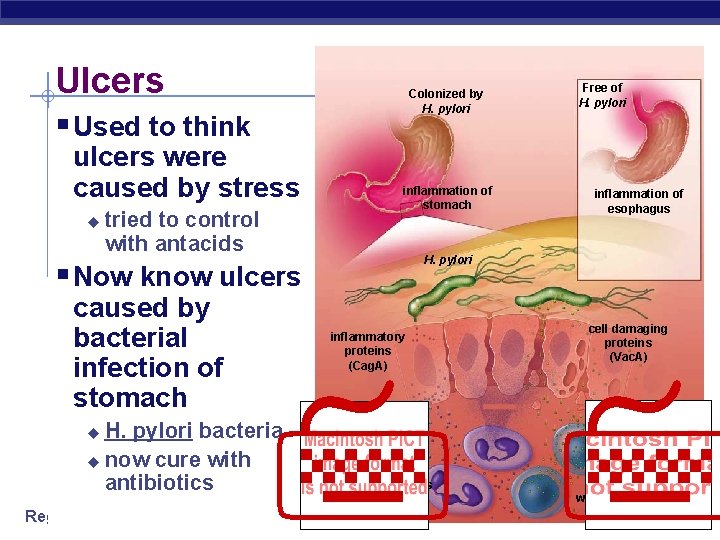
Ulcers Colonized by H. pylori § Used to think ulcers were caused by stress u tried to control with antacids inflammation of stomach Regents Biology inflammatory proteins (Cag. A) cell damaging proteins (Vac. A) H. pylori bacteria u now cure with antibiotics u inflammation of esophagus H. pylori § Now know ulcers caused by bacterial infection of stomach Free of H. pylori cytokines helper T cells neutrophil cells white blood cells
Small intestine § Functions u ___________ § ____________ w amylase from pancreas § ____________ w trypsin & chymotrypsin from pancreas § ____________ w bile from liver & lipase from pancreas u ___________ § nutrients move into body cells by: w diffusion w active transport Regents Biology This is where all the work is done!
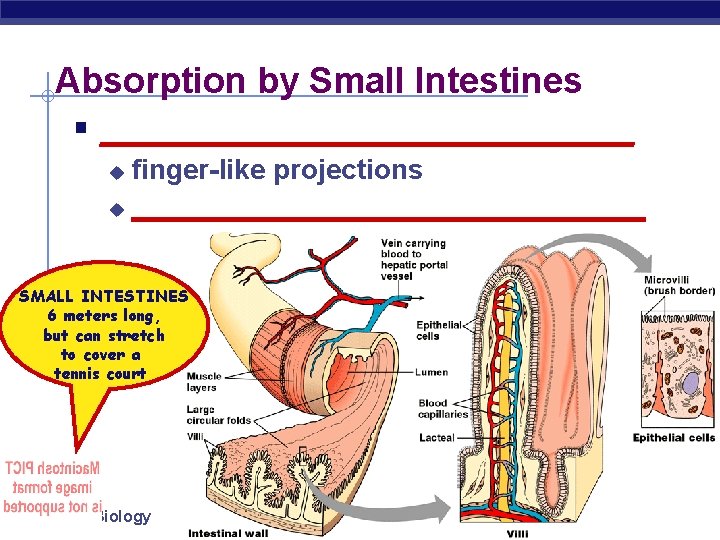
Absorption by Small Intestines § ________________ finger-like projections u _________________ u SMALL INTESTINES 6 meters long, but can stretch to cover a tennis court Regents Biology
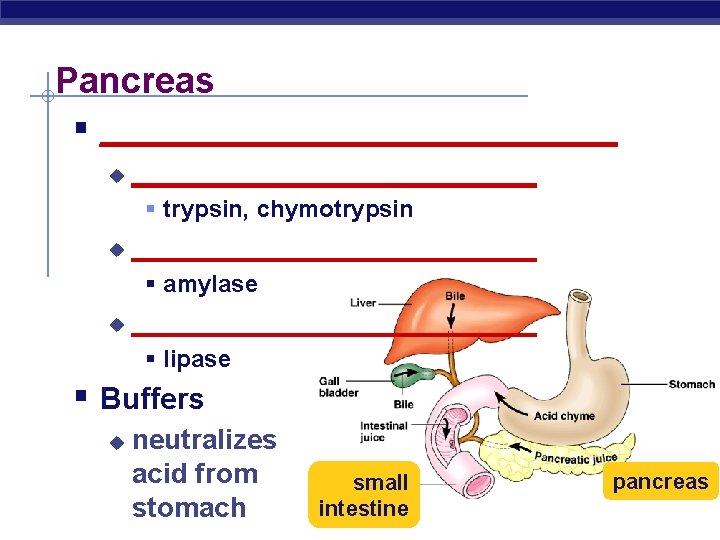
Pancreas § ________________ u _____________ § trypsin, chymotrypsin u _____________ § amylase u _____________ § lipase § Buffers neutralizes acid from stomach Regents Biology u small intestine pancreas
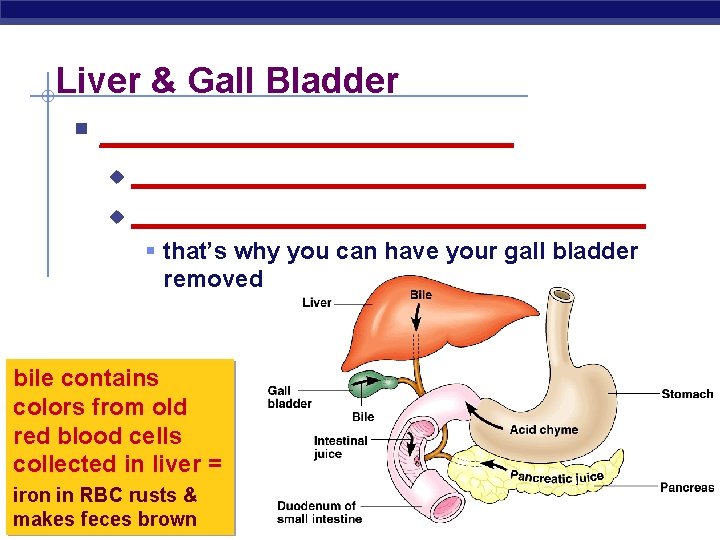
Liver & Gall Bladder § _____________________________ u § that’s why you can have your gall bladder removed bile contains colors from old red blood cells collected in liver = iron in RBC rusts & Regentsfeces Biology makes brown
Large intestines (colon) § Function u __________________ § use ~9 liters of water every day in digestive juices w if don’t reabsorb water, would die of dehydration § > 90% of water re-absorbed w not enough water re-absorbed n __________ can be fatal! w too much water re-absorbed n __________ n Regents § Biology reabsorb by diffusion
You’ve got company! § Living in the large intestine is a community of helpful bacteria u PEE-YOO! Escherichia coli: ______ § ______________ w digests fruits & vegetables § ______________ w vitamin K & B vitamins § ______________ w by-product of bacterial metabolism w methane, hydrogen sulfide w STINKY! Regents Biology
Rectum § Last section of large intestines eliminate feces u what’s left over? u § ______________ w mainly cellulose from plants w called ______________ w keeps everything moving & cleans out intestines § masses of bacteria Regents Biology So don’t forget to wash your hands!
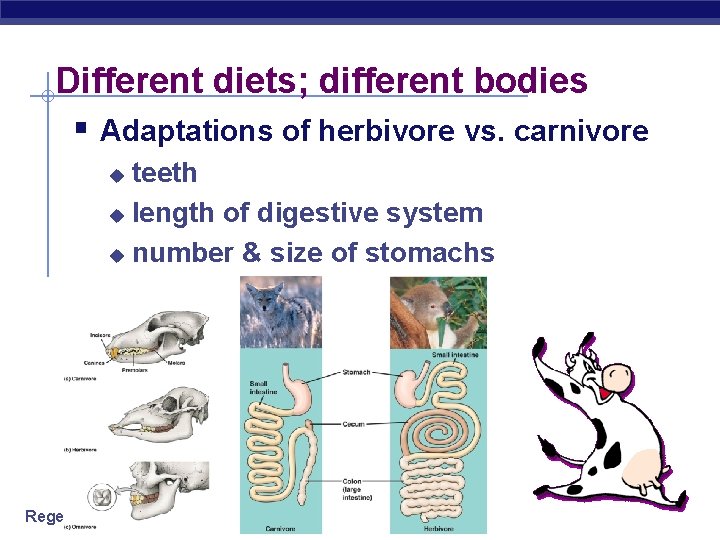
Different diets; different bodies § Adaptations of herbivore vs. carnivore teeth u length of digestive system u number & size of stomachs u Regents Biology
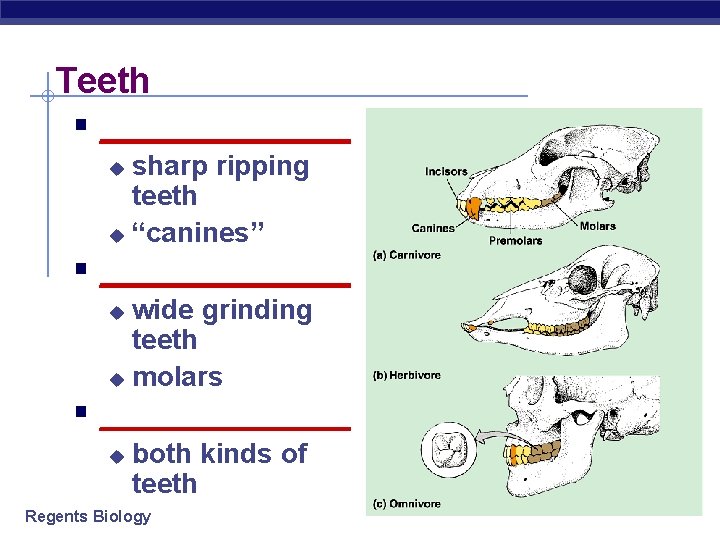
Teeth § ________ sharp ripping teeth u “canines” u § ________ wide grinding teeth u molars u § ________ u both kinds of teeth Regents Biology
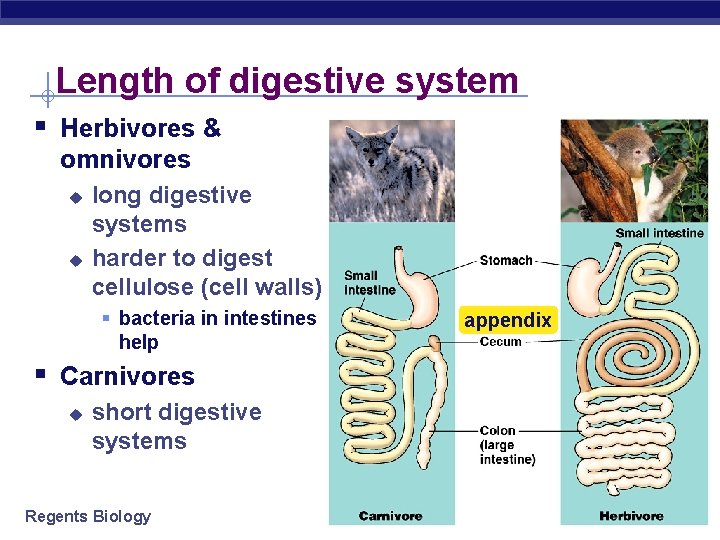
Length of digestive system § Herbivores & omnivores u u long digestive systems harder to digest cellulose (cell walls) § bacteria in intestines help § Carnivores u short digestive systems Regents Biology appendix
Eating a balanced diet § What happens if an animal’s diet is missing an essential nutrient? u deficiency diseases § § § Regents Biology scurvy — vitamin C (collagen production) rickets — vitamin D (calcium absorption) blindness — vitamin A (retinol production) anemia — vitamin B 12 (coenzyme function) kwashiorkor — protein
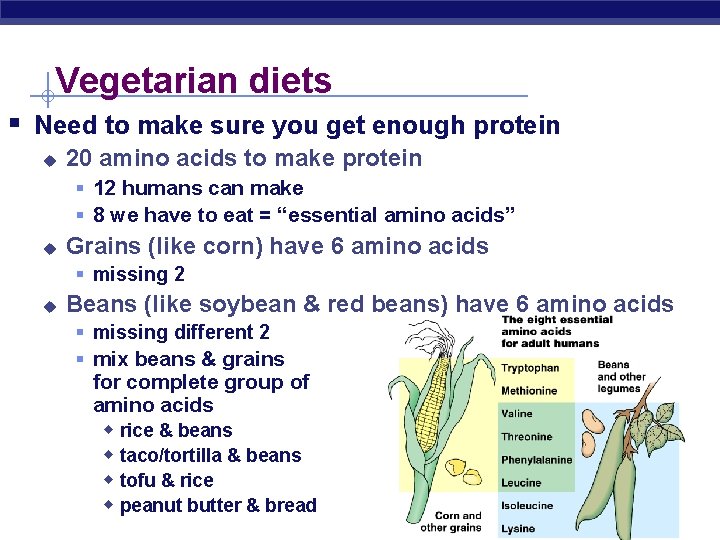
Vegetarian diets § Need to make sure you get enough protein u 20 amino acids to make protein § 12 humans can make § 8 we have to eat = “essential amino acids” u Grains (like corn) have 6 amino acids § missing 2 u Beans (like soybean & red beans) have 6 amino acids § missing different 2 § mix beans & grains for complete group of amino acids w rice & beans w taco/tortilla & beans w tofu & rice w peanut butter & bread Regents Biology
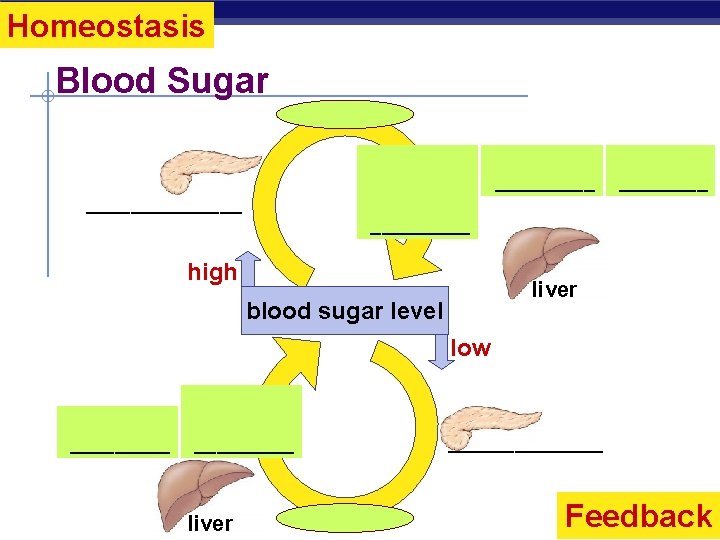
Homeostasis Blood Sugar insulin liver stores body _____ cells take up sugar ______________ high reduces ____ liver blood sugar level low triggers _____ Regents Biology liver releases _____ liver _______ ucagon Feedback
- Slides: 22