
ANIMAL HEALTH Bellwork Identify two reasons why learning
ANIMAL HEALTH Bellwork: Identify two reasons why learning about animal health is important.
Why is it important to be able to learn about animal health? Healthy animals grow faster, produce more, and thus generate more profit for the farmer. Protect our animals Prevention of death Keen sense of observation is important. Ability to know when something is not right with an animal is important.
Why is it important to learn about animal health? n Keen sense of observation is important n Ability to learn when something is not right with an animal is important

SIGNS OF GOOD HEALTH Best sign is simply a contented animal Alertness and chewing of cud in ruminant animals Shiny hair coat, bright eyes and pink membranes Normal body discharges of urine & feces Normal body temperature, pulse rate, and respiration or breathing rate

NORMAL BODY TEMPERATURES FOR ANIMALS
SIGNS OF POOR HEALTH Rough hair coat and dull, glassy eyes Animal stays alone with its head down Walks slowly when forced to walk Abnormal feces, either too hard or too soft, as well as discolored urine Lowered production High temperatures, labored breathing, and rapid pulse rates

Sick Vs. Not Sick?

Sick Vs. Not Sick?

Sick Vs. Not Sick?

Sick Vs. Not Sick?

Sick Vs. Not Sick?
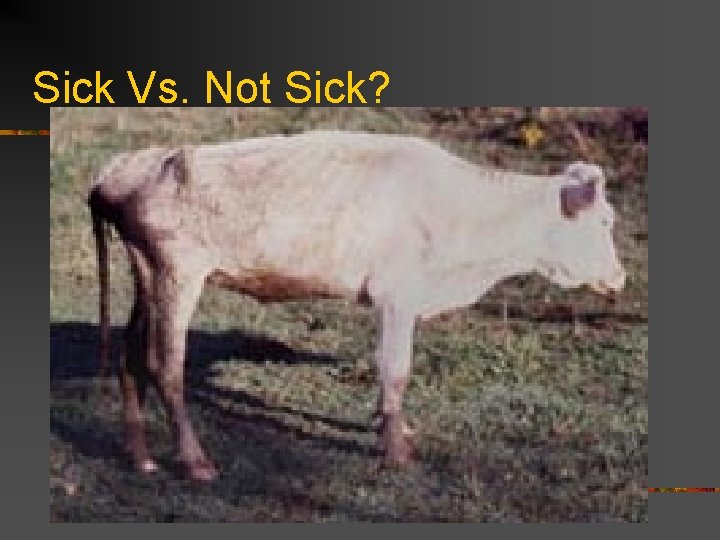
Sick Vs. Not Sick?

How do we keep our animals healthy? The first step to good animal health is maintaining a healthy environment. Often much less expensive to maintain a healthy environment for animals than to treat unhealthy animals due to a poor living environment.
SANITATION Important to good health Factors related to good sanitation include keeping facilities for animals clean Requires use of clean equipment Includes feed containers, milking equipment, artificial-breeding equipment, needles and syringes, and surgical equipment
SANITATION Syringe — an instrument used to give injections of medicine or to draw body fluids from animals. Use of disinfectants in working with animals is very important Disinfectant — material that destroys infective agents such as bacteria and viruses.
HOUSING Should be clean and free from cold drafts Good air circulation to help decrease high temperatures in the summer and reduce humidity in the winter Extremely dry and dusty conditions should be avoided whenever possible Proper maintenance of housing is also important (loose boards, roofing materials, nails, other junk)
HANDLING MANURE Piles of manure, dirty pens and dirty feedlots are sources of serious health problems. Harbor diseases and parasites, attract flies which may also spread diseases Manure should not be allowed to accumulate. Continually soiled pens and cages can lower the quality of air breathed by animals. Wet, poorly drained, manure-soiled feedlots reduce the rate of gain in beef cattle and swine. Feedlots — areas in which large numbers of animals are grown for food.
CONTROLLING PESTS Regular use of disinfectants helps control lice and flies. Close observation of animals is important in determining and controlling outbreaks. A good prevention program is a wise decision. Control of other pests such as birds and wild animals is also important. Many birds carry parasites on their bodies and in their droppings Wild animals can chase animals and cause injuries, bites may cause infections or other health problems

ISOLATION Animals may have diseases or parasites that are not readily apparent. Wise to keep them isolated from other animals for a period of time, usually a minimum of 30 days. Gives time to observe the animal for health problems. Isolation of diseased animals is also important. Animals with contagious diseases can spread the disease by contact with healthy animals. Difficult to treat animals when they are living with large groups of animals. Healthy animals tend to pick on unhealthy ones, making it difficult for sick animals to regain health.

PASTURE ROTATION A consideration in maintaining a healthy environment for animals. Many disease organisms are harbored in the soil and are killed only by not being able to come in contact with host animals for extended periods of time. Host animal — a species of animal in or on which diseases or parasites can live. Helps break the life cycle of most parasites.

DISEASES Two major classes of diseases Contagious — diseases that can be spread by contact. Mostly caused by bacteria and viruses Spread by direct contact with infected animals Non-contagious — diseases that cannot be spread to other animals. Caused by nutrient deficiencies or nutrient excess, poisonous plants and animals, injection of foreign material, open wounds
DISEASES Symptoms of diseases Poor growth and/or reduced production; reduced feed intake; rough, dry hair coat; discharge from eyes or nose; coughing or gasping for air; trembling, shaking, shivering; unusual discharges; open sores or wounds; unusual swelling of the body; abortion. Abortion — loss of a fetus before it is viable.
PARASITES Two general categories of parasites Internal – living inside the animal External – living outside the animal Internal parasites Roundworms — slender worms that are tapered on both ends. Flukes — very small flat worms that are parasites. Protozoa — microscopic one-celled animals that are parasites. of animals Secondary host — a plant or animal that carries a disease or parasite during part of the life cycle.

LIFE CYCLES OF COMMON INTERNAL PARASITES

PARASITES External parasites Flies Ticks Mites Fleas Symptoms of Infestation Poor growth, weight loss, constant coughing and gagging, anemia, lowered production and reproduction, diarrhea or bloody feces, worms in feces, swelling under neck, poor stamina, loss of hair
PREVENTING & TREATING ANIMAL HEALTH PROBLEMS Number of activities and procedures to prevent and treat health problems Administering drugs Dipping Restraining animals Dipping — the process of treating animals for external parasites by walking or swimming them through a medicated bath. Vaccination — the injection of an agent into an animal to prevent disease.

How can health problems be prevented? Vaccination Proper feeding Checking animals on a regular basis Worming Good husbandry practices

What are other ways to prevent health problems? Take the animal’s temperature in the rectum. Determine pulse rate by placing your ear against the animal’s chest and listening to the heartbeat. Check the respiration rate by watching the animal’s ribcage for one minute and counting the number of breaths. Restrain animals to administer health care, treat injuries, or observe them. Maintain a proper vaccination program. Use feed additives. Employ veterinary services.
Six Ways to Administer Drugs & Use for Each Method 1. Pills 2. Powders 3. Paste 4. Liquids in mouth, stomach, or by injection into the body 5. Infusion 6. Dipping
ADMINISTERING DRUGS Factors to be considered before administering drugs to an animal Amount to be administered Type of drug to use Purpose of the drug Site of administration of drug Type of animal to be treated Amount of time drug remains in the animal Most of this information can be found on the drug container
ADMINISTERING DRUGS Drugs are manufactured and sold as pills, powder, paste or liquid Pills Balling gun — a device used to place a pill in an animal’s throat. Powders Normally mixed in feed or water Paste Normally used for treating horses and worms Liquids Drenching — a process of administering drugs orally to animals.
ADMINISTERING DRUGS Liquids Injection — the process of administering drugs by needle and syringe. Intravenous — in a vein. Intramuscular — in a muscle. Subcutaneous — under the skin. Intradermal — between layers of skin. Intraruminal — in the rumen. Intraperitoneal — in the abdominal cavity.
ADMINISTERING DRUGS Infusion — the process for treating udder problems through the teat canal. Udder — the milk secreting glands of the animal. Teats — the appendages of an udder. Cannula — blunt needle. Dipping – process for treating animals, mostly cattle, sheep and dogs for external parasites. Fill a vat with medicated water and force animal to go through Popular when animals must be completely covered with medication
TAKING TEMPERATURES Animal temperatures are usually taken in the rectum Animal thermometers are normally longer and heavier than those used for human medicine Have an eye at one end with a string attached to it to prevent loss in the body cavity

DETERMINING PULSE & RESPIRATION RATES Pulse Rate Hold ear against the animal’s chest and listen to heartbeat Number of beats per minute is the pulse rate Respiration Rate Watch the animal’s rib cage Number of breaths per minute is the respiration rate

RESTRAINING ANIMALS Head gates – trap heads of large animals Squeeze chutes – hold large animals Halters – tied to a post to hold an animal Twitches – hold the lip of a horse Nose leads – holds cattle by the nose Casting harnesses – cause animal to fall down with a gentle tug of a rope
VACCINATION Prevention of disease is always less expensive than treating animals once they have the disease Vaccination – injection of an agent such as a modified disease organism into an animal to prevent a specific disease. Immune – an animal that is not affected by the disease organism. Veterinarian – animal doctor.
MEDICATION WITHDRAWAL Drugs used to medicate food animals such as dairy cows, poultry, hogs, beef, and sheep must be withdrawn before products can be used for human consumption. Requires several days for drugs to leave the animal’s system
VETERINARY SERVICES Essential part of a good health program Important to know when to call the veterinarian for help or deal with the problem yourself Consult veterinarian when planning and executing disease-prevention programs Any time animal has reproductive problems, suddenly dies, or is in contact with animals with contagious diseases, a veterinarian should be contacted
- Slides: 39