
ANIMAL GENETICS BREEDING UNIT I Biostatistics Computer Application
ANIMAL GENETICS & BREEDING UNIT – I Biostatistics & Computer Application Lecture – 12 Measures of Dispersion Variance and Standard Deviation Dr K G Mandal Department of Animal Genetics & Breeding Bihar Veterinary College, Patna Bihar Animal Sciences University, Patna

Measures of Dispersion • Variation or scatter of observation in a set of data around a central value is known as Measures of Dispersion. Sl. No. 1. 2. 3. 4. 5. Total Mean(x) Set – 1 01 02 03 04 90 100 20 Set – 2 20 18 22 23 17 100 20 Set - 3 20 20 20 100 20
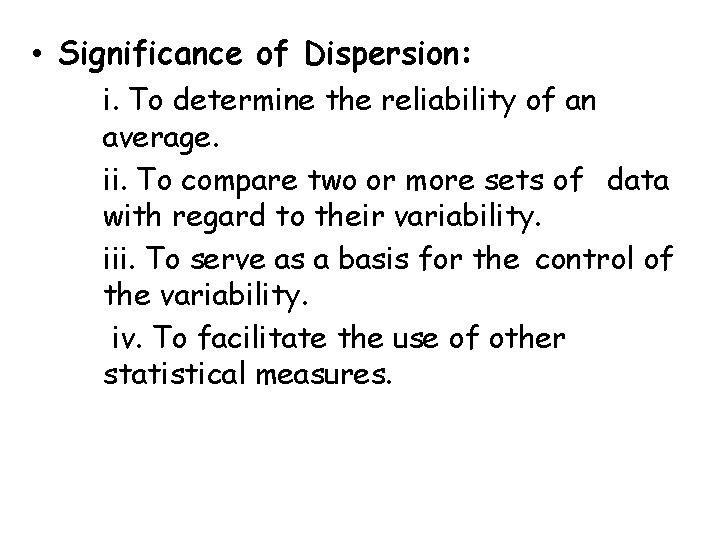
• Significance of Dispersion: i. To determine the reliability of an average. ii. To compare two or more sets of data with regard to their variability. iii. To serve as a basis for the control of the variability. iv. To facilitate the use of other statistical measures.
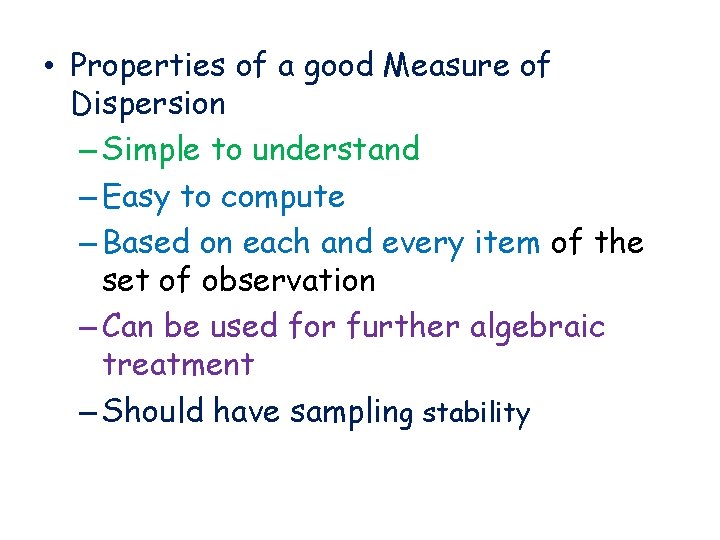
• Properties of a good Measure of Dispersion – Simple to understand – Easy to compute – Based on each and every item of the set of observation – Can be used for further algebraic treatment – Should have sampling stability
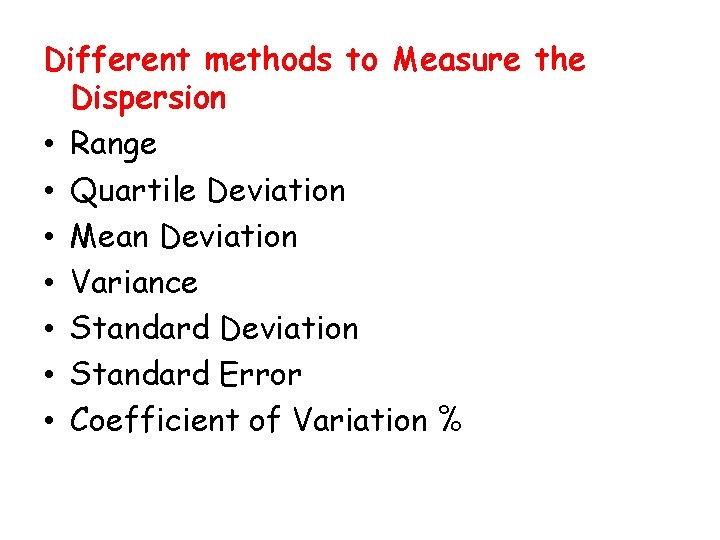
Different methods to Measure the Dispersion • Range • Quartile Deviation • Mean Deviation • Variance • Standard Deviation • Standard Error • Coefficient of Variation %
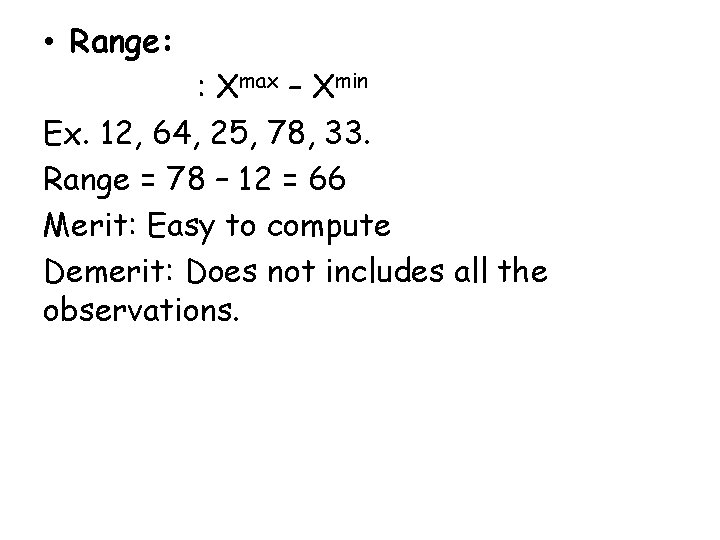
• Range: : Xmax – Xmin Ex. 12, 64, 25, 78, 33. Range = 78 – 12 = 66 Merit: Easy to compute Demerit: Does not includes all the observations.
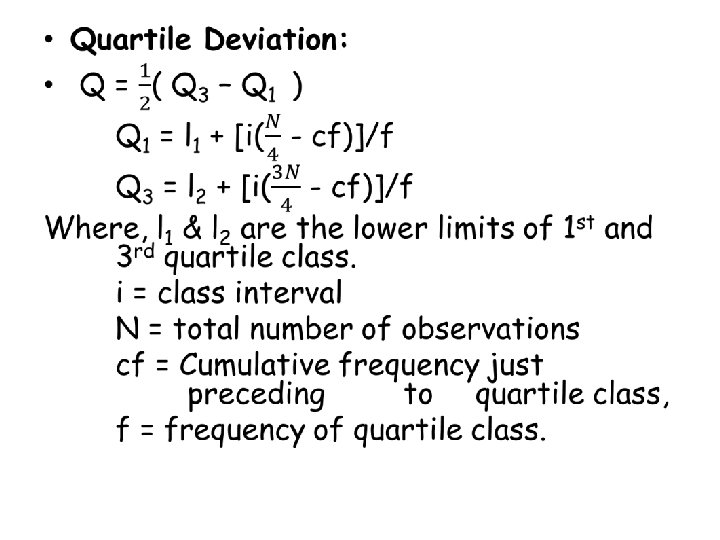
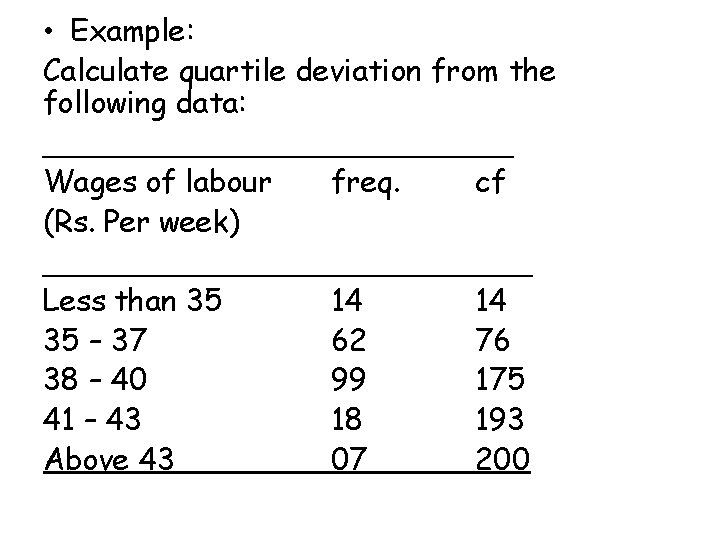
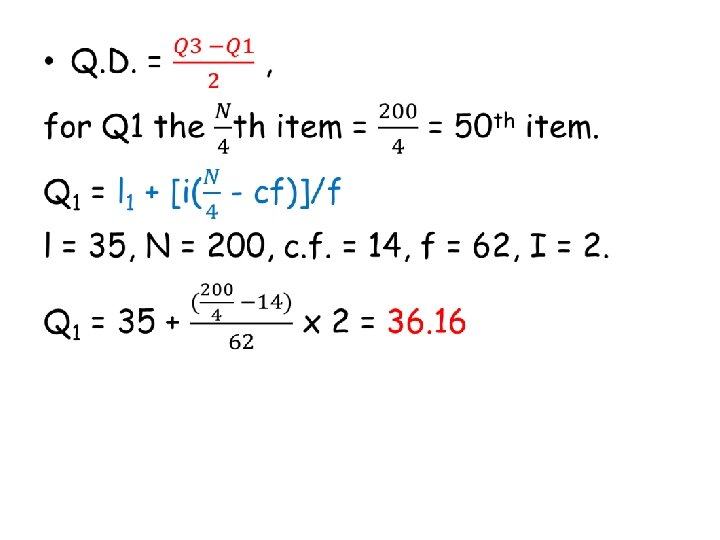
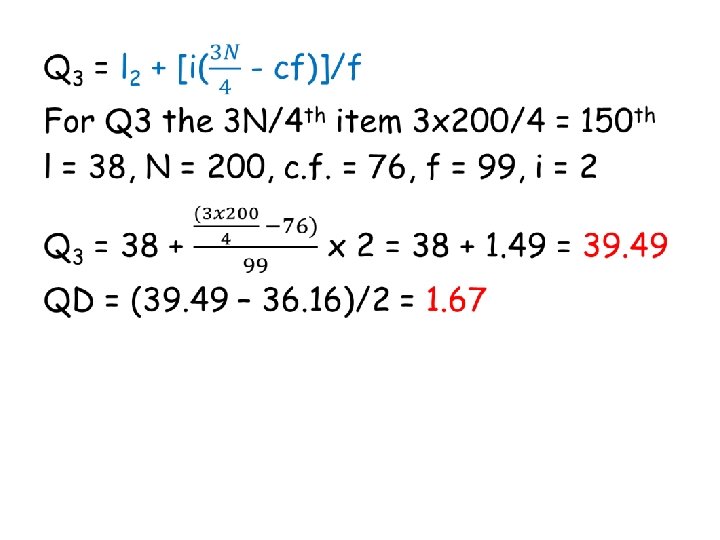
• Example: Calculate quartile deviation from the following data: _____________ Wages of labour freq. cf (Rs. Per week) _____________ Less than 35 14 14 35 – 37 62 76 38 – 40 99 175 41 – 43 18 193 Above 43 07 200
![• Mean Deviation : 1/N [ ∑ (Xi – X)] Sl. No. 1.](http://slidetodoc.com/presentation_image_h2/c9f7cb0c58b1349337db41e662d3f43c/image-11.jpg "• Mean Deviation : 1/N [ ∑ (Xi – X)] Sl. No. 1.")
• Mean Deviation : 1/N [ ∑ (Xi – X)] Sl. No. 1. 2. 3. Xi 2 3 4 (Xi – X) 2 – 4 3 – 4 4 – 4 (Xi – X) -2 -1 0 4. 5. Total Mean (X) 5 6 20 4 5 – 4 6 - 4 1 2 0
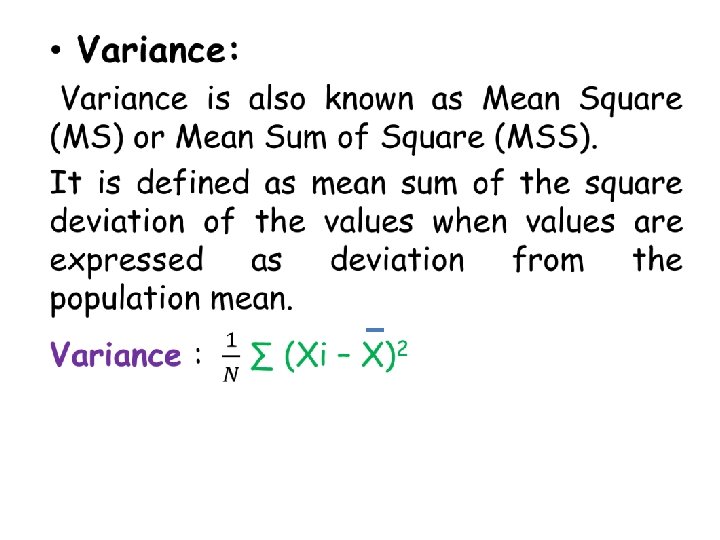
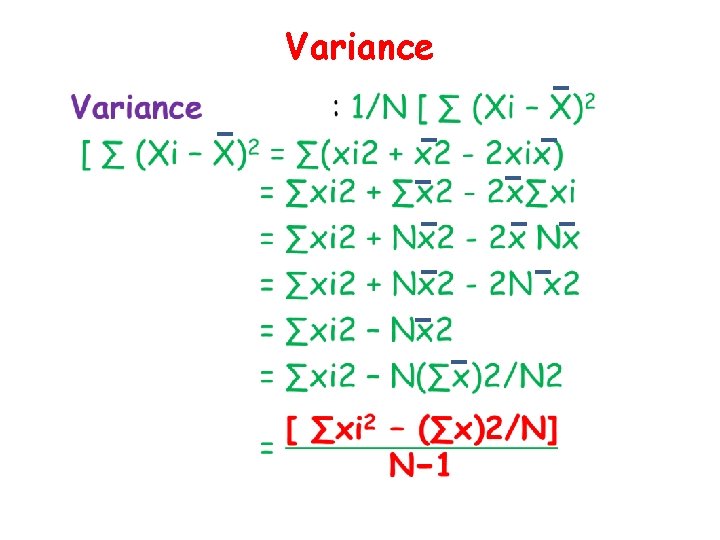
• Importance of Variance: 1. One of the most important measures of dispersion: i) Additivity or addition ii) Subdivisibility or partitioning 2. Based on all the observations of a set of data. 3. Easy to understand & easy to compute.
Variance •
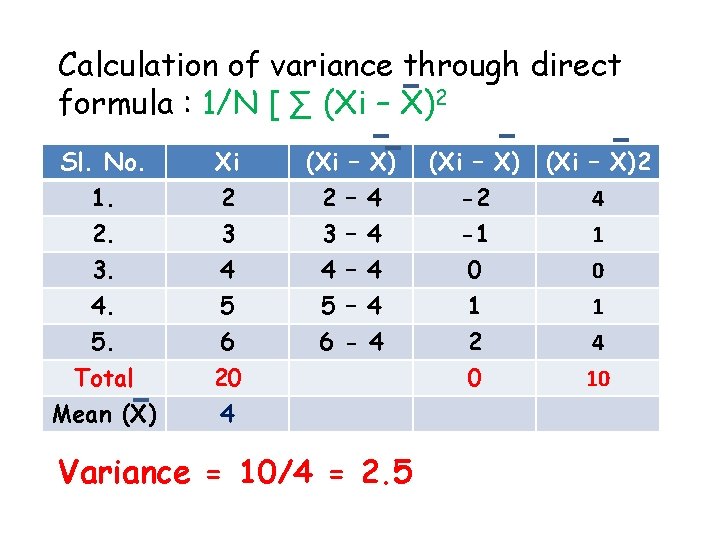
Calculation of variance through direct formula : 1/N [ ∑ (Xi – X)2 Sl. No. 1. 2. 3. Xi 2 3 4 (Xi – X) 2 – 4 3 – 4 4 – 4 (Xi – X) -2 -1 0 (Xi – X)2 4 1 0 4. 5. Total Mean (X) 5 6 20 4 5 – 4 6 - 4 1 2 0 1 4 10 Variance = 10/4 = 2. 5
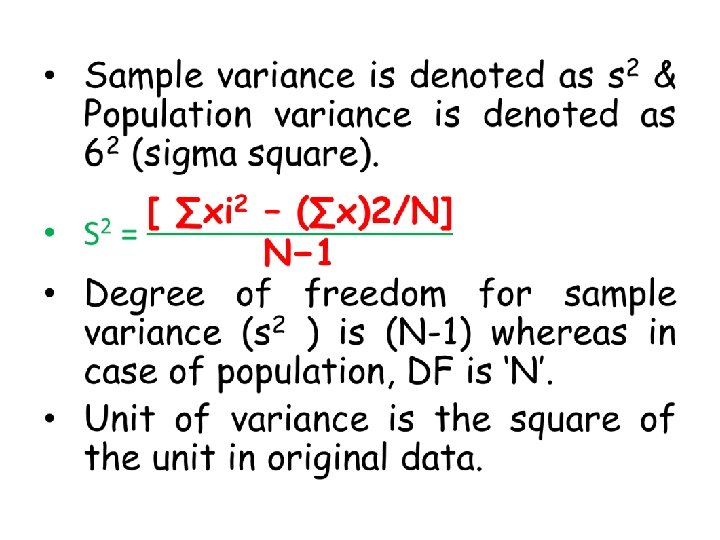
![Calculation of variance through computational formula Variance =[ ∑x 2 – (∑x)2/N] / (N-1).](http://slidetodoc.com/presentation_image_h2/c9f7cb0c58b1349337db41e662d3f43c/image-17.jpg "Calculation of variance through computational formula Variance =[ ∑x 2 – (∑x)2/N] / (N-1).")
Calculation of variance through computational formula Variance =[ ∑x 2 – (∑x)2/N] / (N-1). Sl. No. 1. 2. 3. Xi 2 3 4 Xi 2 4 9 16 4. 5 5. Total Mean (X) 6 20 4 25 36 90 Variance =[ 90 - 202 /5 ] /4 = [90– 400/5]/4 = (90 – 80)/4 = 10/4 = 2. 5
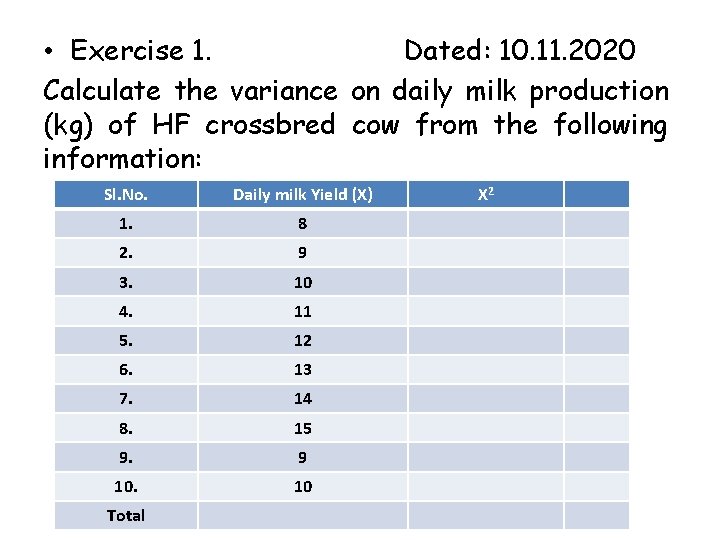
• Exercise 1. Dated: 10. 11. 2020 Calculate the variance on daily milk production (kg) of HF crossbred cow from the following information: Sl. No. Daily milk Yield (X) 1. 8 2. 9 3. 10 4. 11 5. 12 6. 13 7. 14 8. 15 9. 9 10. 10 Total X 2
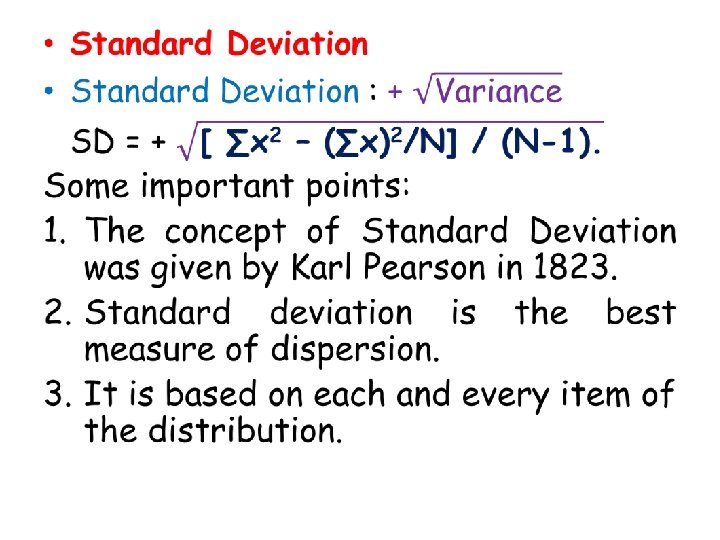
1. It can undergo further algebraic treatment. 2. It is less affected by fluctuation of sampling. 3. It is possible to calculate the combined standard deviation of two or more groups. 4. It takes the original unit of the data. 5. S. D. is the most powerful measure of dispersion because it satisfies almost all the properties for an ideal measure of dispersion.
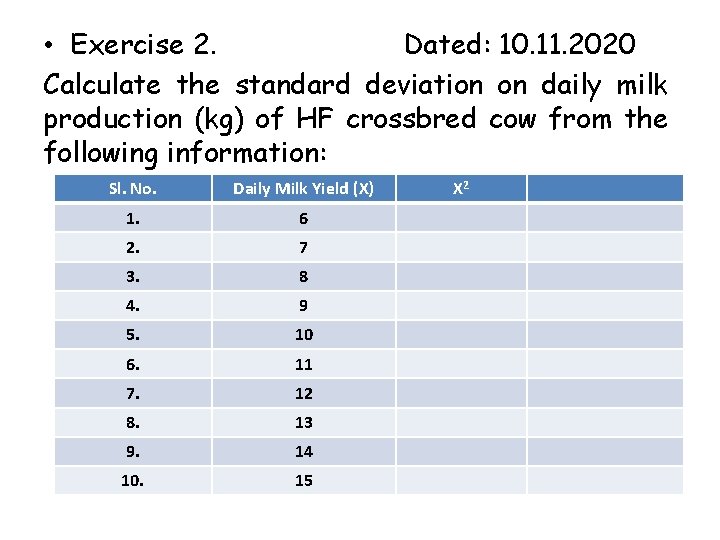
• Exercise 2. Dated: 10. 11. 2020 Calculate the standard deviation on daily milk production (kg) of HF crossbred cow from the following information: Sl. No. Daily Milk Yield (X) 1. 6 2. 7 3. 8 4. 9 5. 10 6. 11 7. 12 8. 13 9. 14 10. 15 X 2

THANK YOU
- Slides: 22