
Animal Farm By George Orwell Background Many of
Animal Farm By George Orwell
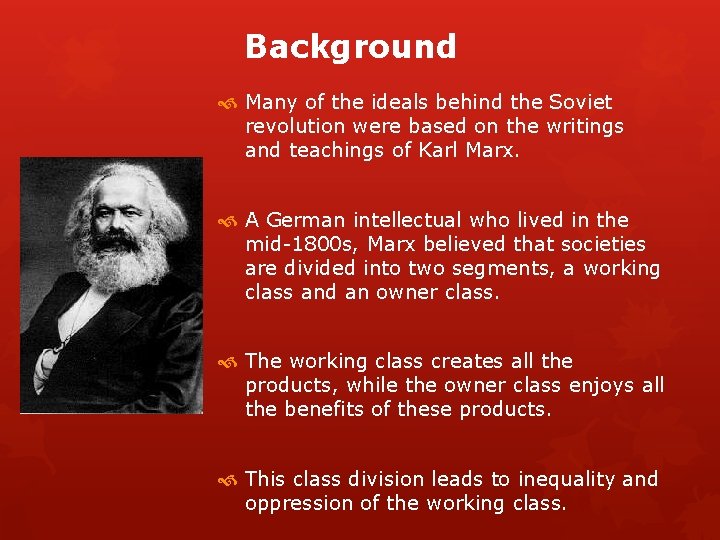
Background Many of the ideals behind the Soviet revolution were based on the writings and teachings of Karl Marx. A German intellectual who lived in the mid-1800 s, Marx believed that societies are divided into two segments, a working class and an owner class. The working class creates all the products, while the owner class enjoys all the benefits of these products. This class division leads to inequality and oppression of the working class.
Background Marx’s objective was to create a classless society in which the work is shared by all for the benefit of all, and he believed revolution was the way to achieve this goal. This was called ‘Communism’. The character of Old Major in Animal Farm is sometimes interpreted as a representation of Karl Marx. Major’s speech in the novel’s opening chapter reflects many Marxist ideas, from the opening “Comrades, ” a typical form of address in the former Soviet Union, to the revolutionary song he teaches the other animals.
Animal Farm We will now read Chapter 1. Consider your discussion on revolutions and Marx’s idea for a classless society as we read.
Focus Activity Why do you think revolutions occur? What circumstances would lead people to overthrow the daily political and economical structure of their lives? Look at this example, considering the questions above. http: //www. youtube. com/watch? v=ln. PR 90 d. J 3 Gk (How Face. Book Changed The World The Arab Spring [1/4])
Chapter 1 Discuss these questions in your groups 1. What are your first impressions of all the animals? 2. What do you make of Major's speech? How effective and convincing is it? 3. Bearing in mind that Animal Farm is an allegory of the failure of Soviet Russia, who do you think 'Major' represents? 4. Does Major have the animals' best interests at heart? 5. Who or what do the rats represent? 6. What do you think of Major's ideology? Does it sound good in theory? How do you think it will work in practice? 7. Why do you think the song is so effective in generating enthusiasm? EXTENSION: Find examples of effective persuasive techniques used by Old Major. Explain their effect.
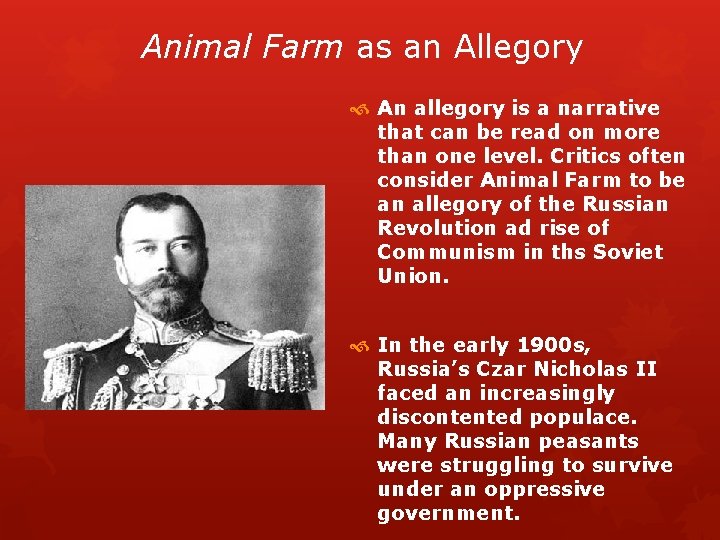
Animal Farm as an Allegory An allegory is a narrative that can be read on more than one level. Critics often consider Animal Farm to be an allegory of the Russian Revolution ad rise of Communism in ths Soviet Union. In the early 1900 s, Russia’s Czar Nicholas II faced an increasingly discontented populace. Many Russian peasants were struggling to survive under an oppressive government.
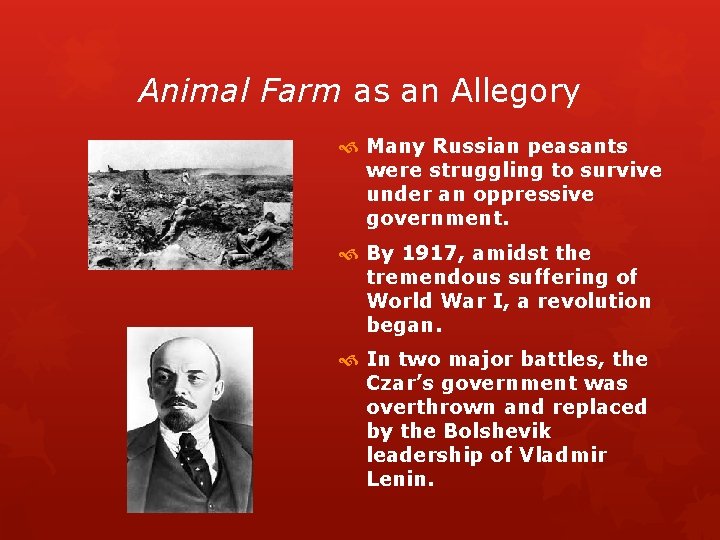
Animal Farm as an Allegory Many Russian peasants were struggling to survive under an oppressive government. By 1917, amidst the tremendous suffering of World War I, a revolution began. In two major battles, the Czar’s government was overthrown and replaced by the Bolshevik leadership of Vladmir Lenin.
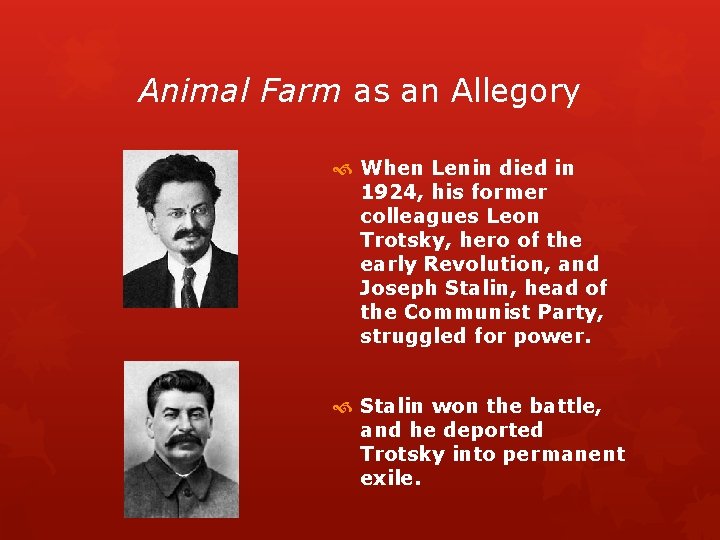
Animal Farm as an Allegory When Lenin died in 1924, his former colleagues Leon Trotsky, hero of the early Revolution, and Joseph Stalin, head of the Communist Party, struggled for power. Stalin won the battle, and he deported Trotsky into permanent exile.
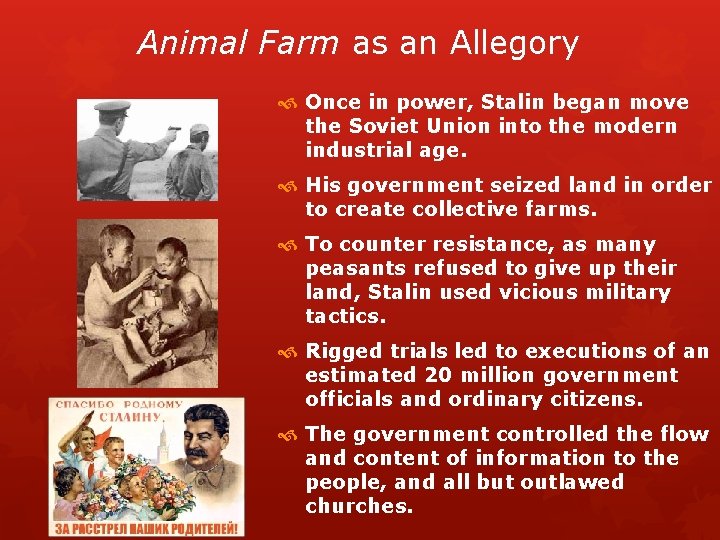
Animal Farm as an Allegory Once in power, Stalin began move the Soviet Union into the modern industrial age. His government seized land in order to create collective farms. To counter resistance, as many peasants refused to give up their land, Stalin used vicious military tactics. Rigged trials led to executions of an estimated 20 million government officials and ordinary citizens. The government controlled the flow and content of information to the people, and all but outlawed churches.
Animal Farm We are now going to read Chapters 2 and 3. Consider what you know about Trotsky and Stalin as we read.
Chapter 2 Discuss these questions in your groups: 1. How have the pigs ‘elaborated Old Major’s teachings into a complete system of thought’? What differences are there between the Seven Commandments and what Major tells the animals not to do? 2. Do you think the questions asked by the animals in the education classes are ‘foolish’? 3. Why do you think Orwell chooses to call Boxer and Clover the pigs’ ‘most faithful disciples’? 4. Why does the Rebellion happen? Does this tell us anything about the influence of Animalism on the animals? 5. Why do you think Orwell has Snowball make mistakes in his writing? YOU HAVE FIVE MINUTES
Chapter 3 Discuss these questions in your groups: 1. What difficulties did the animals have in gathering in the harvest and how did they overcome these difficulties? Is all going well? 2. What does the behaviour of Mollie, the cat and Benjamin tell us about their attitudes to the rebellion? 3. Why do you think Snowball’s various projects, except reading and writing classes, were ‘failures’? 4. What degrees of success do the different animals have in learning to read and write? What does this tell us about their characters? 5. What kind of people do you think the sheep represent? YOU HAVE FIVE MINUTES
Active Reading The major characters in Animal Farm are introduced in the first four chapters. As you read, think about the purpose of each of Orwell’s characters.
Animal Farm as a Fable A fable is a narration intended to enforce a useful truth. Fables have two important characteristics. First, they teach a moral or lesson. In Animal Farm, the moral involves Orwell’s views about Soviet politics. Second, the characters are most frequently animals. These animal characters often function as a satiric device to point out the follies of humankind.
Fables – The Tortoise and the Hare http: //www. youtube. com/watch? v=pjok. VI 0 LJzw (The Hare And The Tortoise - Aesop's fables)
Animal Farm as a Fable Though Old Major, Snowball, and Napoleon may represent Karl Marx, Leon Trotsky, and Joseph Stalin, many of the story characters are much more general. Some animals are grouped together as a single character—“the sheep, ” “the hens, ” and “the dogs. ” Orwell also capitalizes on the traits generally associated with particular animals, such as sheep as followers and dogs as loyal.
Animal Farm We are now going to read Chapter 4. Consider the characters of Napoleon and Snowball as we read, and how their relationship develops. Also consider the main characters and their characteristics as we read – what role have they played in the novel so far?
Chapter 4 Answer these questions in your jotters: 1. What are the differences between the characters of Frederick and Pilkington and between the farms they run? 2. How does Orwell indicate that Frederick and Pilkington are ‘thoroughly frightened’ by the events on Animal Farm? 3. What was Napoleon doing during the Battle of the Cowshed? 4. What do you think Orwell was satirising (making fun of) when he described how the animals celebrated their victory? YOU HAVE TEN MINUTES
Chapters 1 -4 Make a chart in your jotter, noting details that describe each character or by listing key actions. E. g. Characteristics / Actions / Purpose Old Major Gets the revolution started; inspires hope for a real change. YOU HAVE TEN MINUTES
Chapters 1 -4 Analysing Literature Using evidence from the novel, answer these questions in detail. 1. Describe how the Rebellion takes place. How does the animals’ behaviour during the Rebellion suggest both human and animal characteristics? 2. How do the pigs gain the rights to the cow’s milk? Why do the other animals allow this to occur? What does this event suggest about the power hierarchy on the farm? 3. How does the original vision of Animalism become the slogan “Four legs good, two legs bad”? In your opinion, do the animals want rules with simple language? What kind of language do the pigs use? 4. What technique does Orwell use to cast doubt on the likelihood of a successful revolution? 5. Characterize Snowball as a leader. Do you think his reaction to the stable-boy’s death is the appropriate reaction to have during a revolution?
Starter How would you feel if the rules for correct behaviour kept changing? In your groups, discuss some methods people have for persuading others to follow particular rules of behaviour. Consider ways in which this persuasion relies on bias and manipulation of information.
Animal Farm by George Orwell Learning Intentions: Explore theme of Propaganda and Communication Study the character of Squealer and his role
Propaganda and Communication What is PROPAGANDA? Information, ideas, or rumours deliberately spread widely to help or harm a person, group, movement, institution, nation, etc.
Propaganda and Communication/ Appearance vs. Reality As we read consider the following questions: What do you think of Squealer? What does his name suggest? Why is his propaganda so powerful?
Propaganda and Communication/ Appearance vs. Reality
Propaganda and Communication/ Appearance vs. Reality
Propaganda and Communication/ Appearance vs. Reality

Propaganda and Communication/ Appearance vs. Reality
Propaganda and Communication/ Appearance vs. Reality http: //www. youtube. com/watch? v=TJUkf. Ex. Xqp. U (North Korea propaganda) Propaganda still exists today, despite the public being more informed than ever.
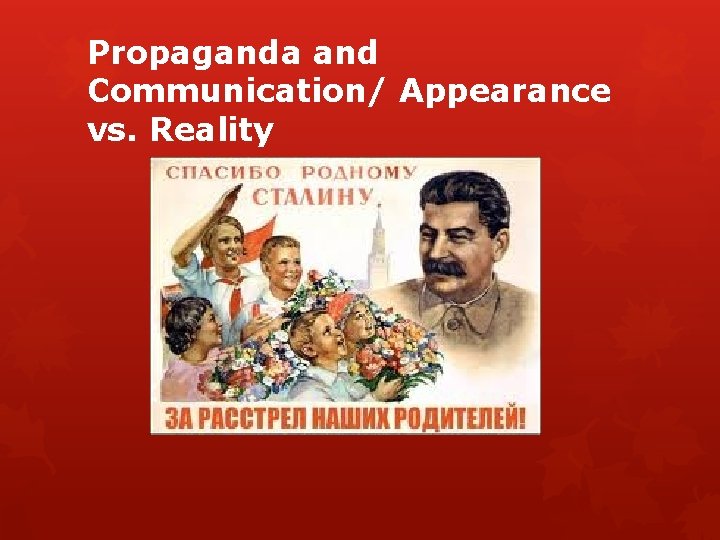
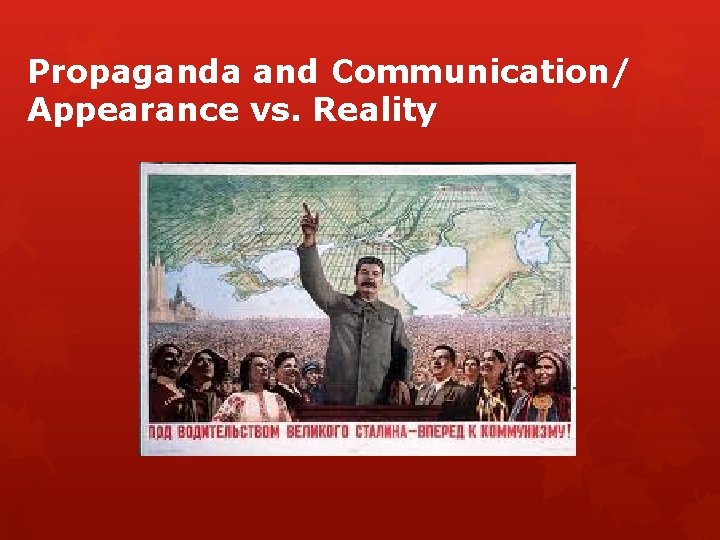
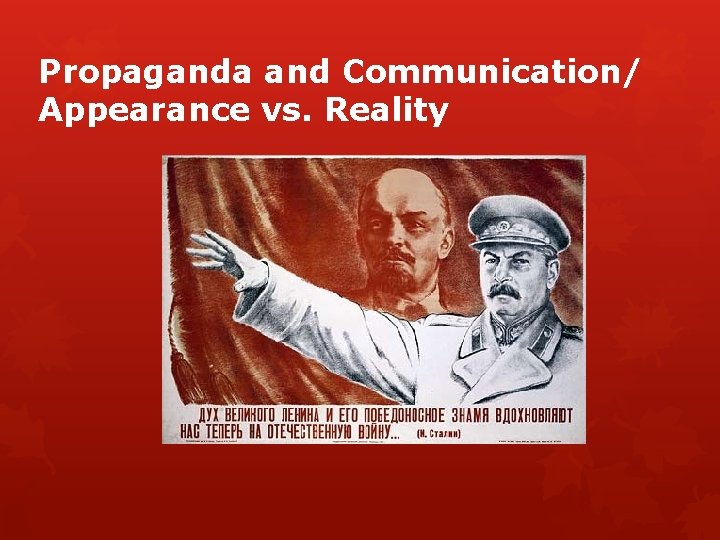
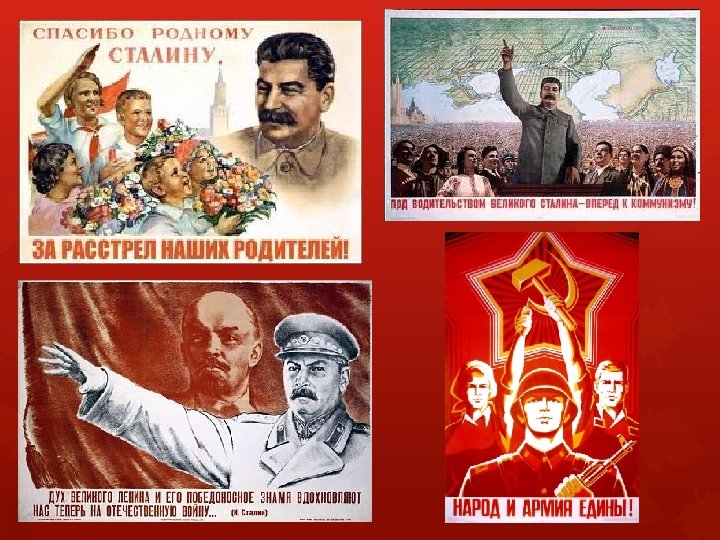
Key Techniques Used in Propaganda Bandwagon – implying that by not acting in the desired way, you will be different from everyone else. Stereotyping and Name-Calling – making general statements about enemies, undermining them. Assertation – statements presented as fact (think about Napoleon’s smearing of Snowball). Emotive Language – often plays on ideas of bravery, duty, pride, etc. Powerful imagery – idealised images, designed to attract and persuade people of a certain campaign or way of thinking (e. g. Stalin’s presentation of Russia as vast, powerful and full of happy people; himself as the ‘father’ of the country).
Chapter 5 We will now read Chapter 5. Consider the role of the pigs and their position in the farm as we read.
Chapter 5 Answer these questions in your jotter: 1. Why does Mollie leave? How does Orwell prepared us for this development? You need to remind yourself of what she does in earlier chapters. 2. Orwell says ‘It had come to be accepted that the pigs…should decide all questions. ’ How does this happen? 3. How does Orwell make us aware of the importance of the sheep’s ‘Four legs good, two legs bad’ slogan? 4. Orwell says that Squealer’s argument was ‘unanswerable. ’ Do you think it was? YOU HAVE TEN MINUTES
Chapter 6 - Irony What is ‘irony’? Ironic statements are statements that imply a meaning in opposition to their literal meaning. As we read Chapters 6 and 7, consider what language may be used ironically. Also, think about the methods Squealer uses to confuse the animals, and if governments today give people the truth about what is happening.
Chapter 6 - Irony http: //www. youtube. com/watch? v=FYq 2 d 7 i. KKhk (Irony – What. You. Ought. To. Know)
Chapters 6 and 1. What word, in the second paragraph, is used 7 by Orwell in a heavily ironic way, to show that Napoleon is becoming more dictatorial? 2. What advantages are there for the animals running their own farm? 3. In what way is Snowball so useful to Napoleon, even though he has been expelled from the farm? 4. How does Orwell show that to be literate is not enough, if you cannot understand the significance of what you have read? 5. Why do you think that Benjamin refuses to ‘grow enthusiastic’ about the windmill? 6. Who does Orwell suggets is responsible for spreading the idea that Snowball visits the farm at night? 7. What makes some of the animals confess to ‘crimes’ when they know they will be executed? Why does Napoleon want them to confess? 8. Re-read the paragraph beginning “The animals huddled about Clover. ” Why do you think Orwell chooses to include it and place it in this particular position in the chapter? 9. Why do the words of the new anthem “not come up to ‘Beasts of
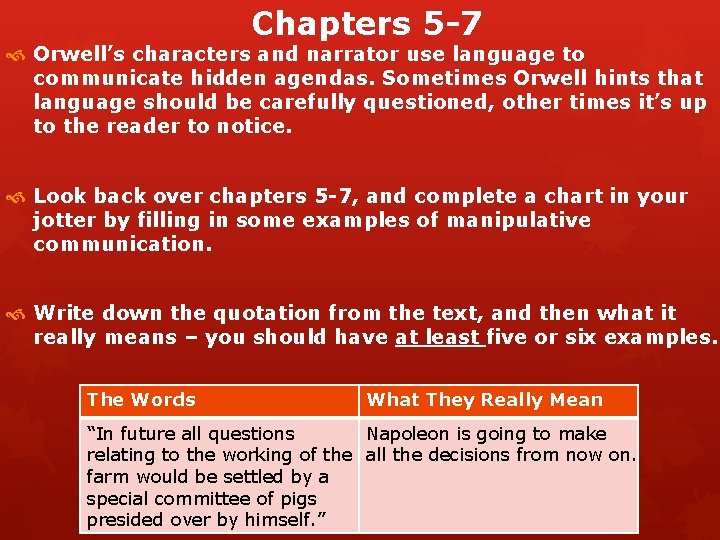
Chapters 5 -7 Orwell’s characters and narrator use language to communicate hidden agendas. Sometimes Orwell hints that language should be carefully questioned, other times it’s up to the reader to notice. Look back over chapters 5 -7, and complete a chart in your jotter by filling in some examples of manipulative communication. Write down the quotation from the text, and then what it really means – you should have at least five or six examples. The Words What They Really Mean “In future all questions Napoleon is going to make relating to the working of the all the decisions from now on. farm would be settled by a special committee of pigs presided over by himself. ”
Chapter 8 We will now read Chapter 8. As we read, think about the incidents which indicate Naopleon’s increasing dominance – does Orwell want us to sympathise with him?
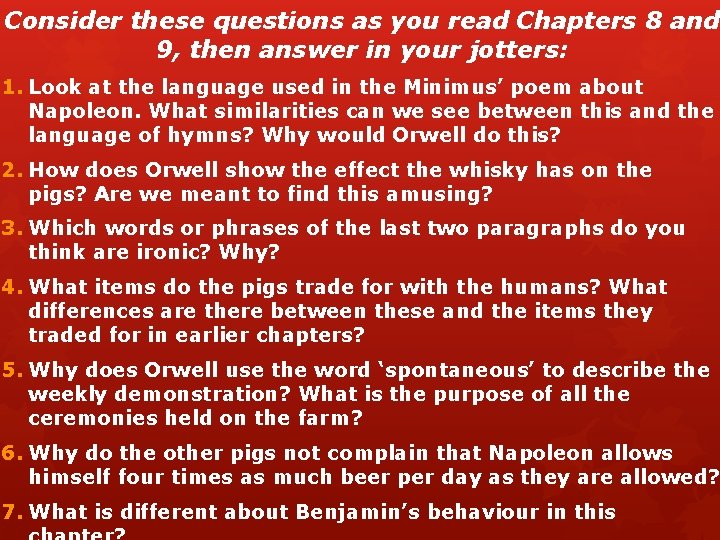
Consider these questions as you read Chapters 8 and 9, then answer in your jotters: 1. Look at the language used in the Minimus’ poem about Napoleon. What similarities can we see between this and the language of hymns? Why would Orwell do this? 2. How does Orwell show the effect the whisky has on the pigs? Are we meant to find this amusing? 3. Which words or phrases of the last two paragraphs do you think are ironic? Why? 4. What items do the pigs trade for with the humans? What differences are there between these and the items they traded for in earlier chapters? 5. Why does Orwell use the word ‘spontaneous’ to describe the weekly demonstration? What is the purpose of all the ceremonies held on the farm? 6. Why do the other pigs not complain that Napoleon allows himself four times as much beer per day as they are allowed? 7. What is different about Benjamin’s behaviour in this
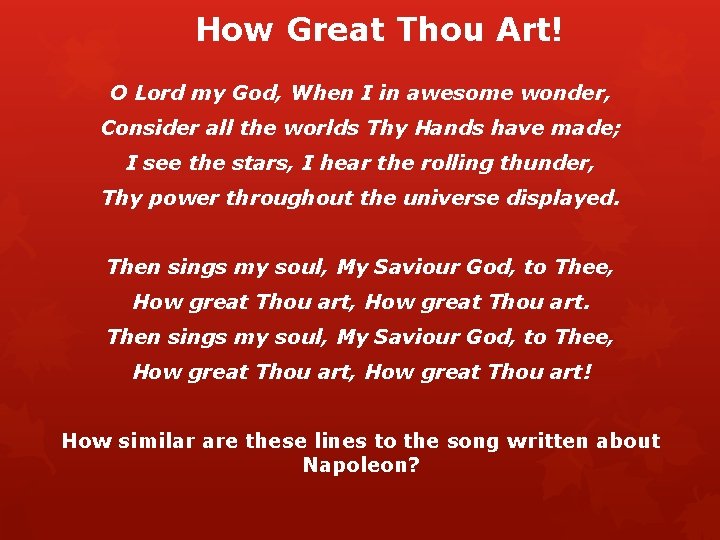
How Great Thou Art! O Lord my God, When I in awesome wonder, Consider all the worlds Thy Hands have made; I see the stars, I hear the rolling thunder, Thy power throughout the universe displayed. Then sings my soul, My Saviour God, to Thee, How great Thou art, How great Thou art! How similar are these lines to the song written about Napoleon?
Chapter 10 We will now read Chapter 10. We see the animals compare the pigs and the men. Think about whether they understand the significance of what they have seen.
Chapter 10 1. What do you think those animals who dimly remember the rebellion would pass on to the younger animals about it? 2. Orwell uses the phrase “unalterable way of life” to express Benjamin’s ideas. What does Benjamin (and Orwell) mean? Why do you think Orwell chooses the word “unalterable”? 3. Re-read the paragraph beginning “And yet the animals never gave up hope. ” What does it tell us of the animals’ feelings? In what way is the ending ironic? 4. What point is Orwell making when he has Pilkington compare “your lower animals” with “our lower classes”?
Chapters 8 -10 As Napoleon takes over leadership of the farm, a new social and political structure emerges. This restructuring leads to many changes in power and privilege among the animals. Compare the living conditions of the pigs with the living conditions of the other animals. Under Napoleon’s Leadership Life for the Pigs Life for Other Animals pigs live in farmhouse Work longer hours Napoleon is waited on Receive less food
Chapters 8 -10 Personal Response In your groups discuss the following: What is your reaction to the novel’s ending? For example, do you find it uplifting, depressing, cynical? Explain.
Analysing Literature Using evidence from the novel, answer these questions in detail. 1. Describe how the Rebellion takes place. How does the animals’ behaviour during the Rebellion suggest both human and animal characteristics? 2. How do the pigs gain the rights to the cow’s milk? Why do the other animals allow this to occur? What does this event suggest about the power hierarchy on the farm? 3. How does the original vision of Animalism become the slogan “Four legs good, two legs bad”? In your opinion, do the animals want rules with simple language? What kind of language do the pigs use? 4. What technique does Orwell use to cast doubt on the likelihood of a successful revolution? 5. Characterize Snowball as a leader. Do you think his reaction to the stable-boy’s death is the appropriate reaction to have during a revolution?
Analysing Literature 1. What dealings does Napoleon have with Frederick and Pilkington? How does the battle over the windmill affect the animals? What events from Soviet history is Orwell highlighting? 2. What happens to Boxer and how do the other animals learn of his fate? How do they come to a final conclusion about these events? 3. What changes are made to the Fifth and Sixth Commandments? How is the entire list of Commandments ultimately refashioned? What point is Orwell making about the role of communication in Soviet society? 4. In Chapter 10 the pigs begin to walk on two legs. In your opinion is this evolution a sign of progress? Explain. 5. Some critics believe that, at the end of the book, Orwell suggests that the pigs and human political leaders are interchangeable. Do you think most government rulers are interchangeable? How might power change those who have it? Explain.
Animal Farm Personal Response Animal Farm contains many extremely effective scenes. Some are humorous or witty, others are bitterly ironic or pessimistic. Which scene did you find most memorable and effective? Why?
Animal Farm by George Orwell Lesson Objectives: Beginning to look at the main themes of the novel Analysing the text for examples of themes Recap the historical context
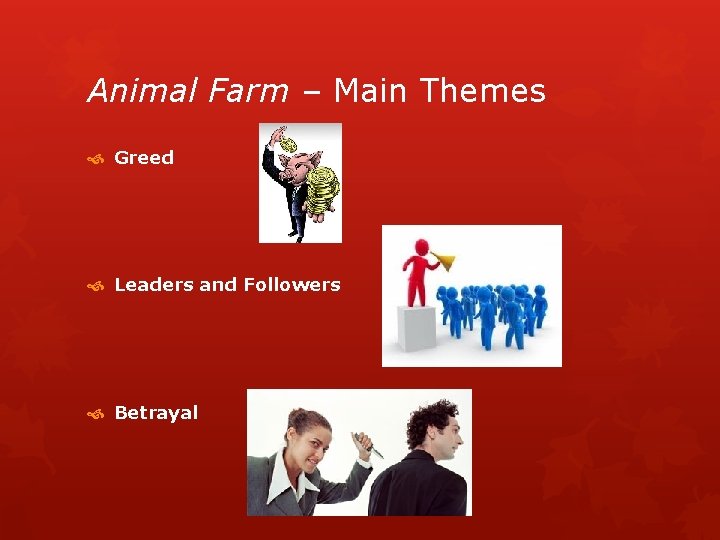
Animal Farm – Main Themes Greed Leaders and Followers Betrayal
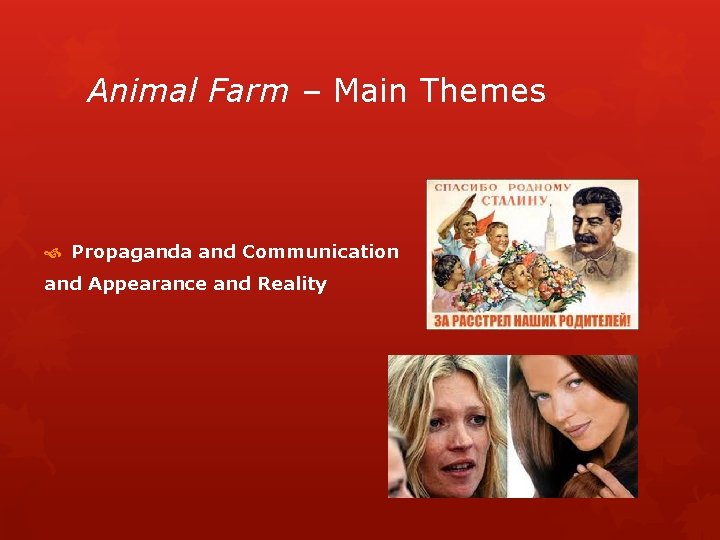
Animal Farm – Main Themes Propaganda and Communication and Appearance and Reality
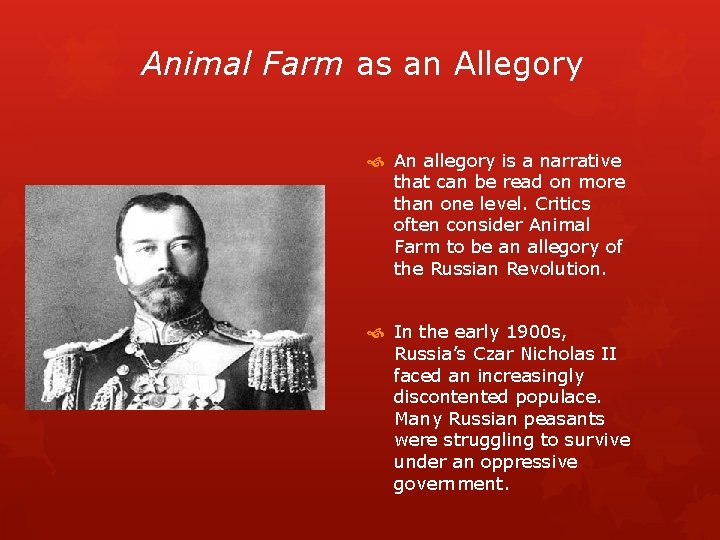
Animal Farm as an Allegory An allegory is a narrative that can be read on more than one level. Critics often consider Animal Farm to be an allegory of the Russian Revolution. In the early 1900 s, Russia’s Czar Nicholas II faced an increasingly discontented populace. Many Russian peasants were struggling to survive under an oppressive government.
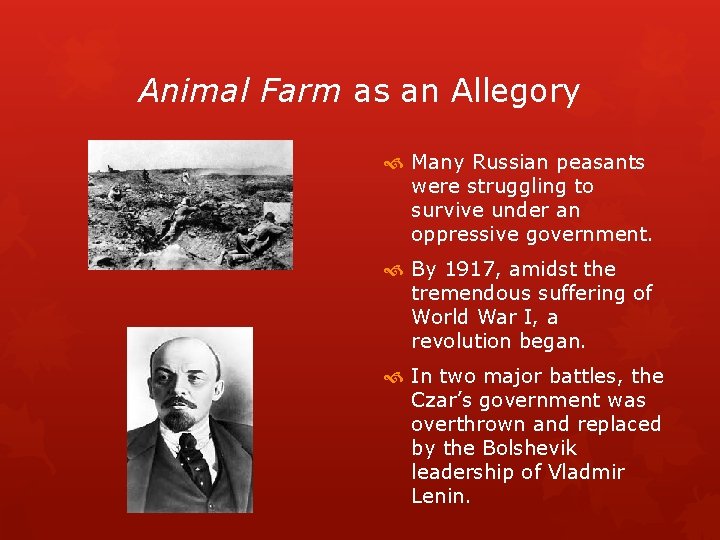
Animal Farm as an Allegory Many Russian peasants were struggling to survive under an oppressive government. By 1917, amidst the tremendous suffering of World War I, a revolution began. In two major battles, the Czar’s government was overthrown and replaced by the Bolshevik leadership of Vladmir Lenin.
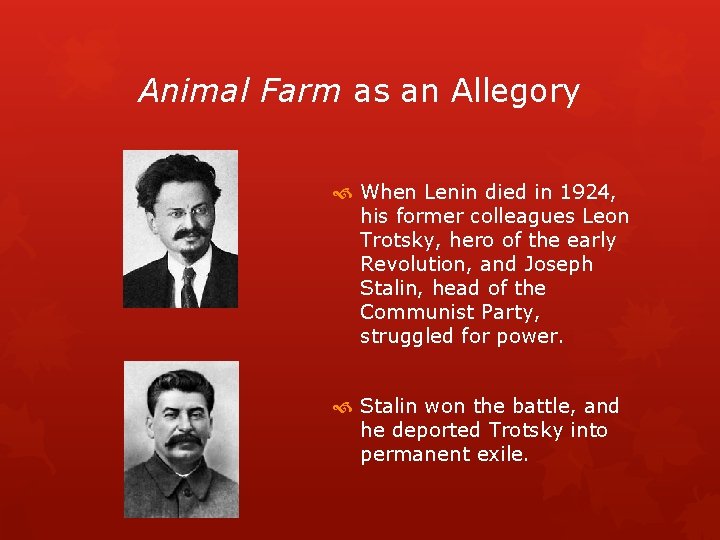
Animal Farm as an Allegory When Lenin died in 1924, his former colleagues Leon Trotsky, hero of the early Revolution, and Joseph Stalin, head of the Communist Party, struggled for power. Stalin won the battle, and he deported Trotsky into permanent exile.
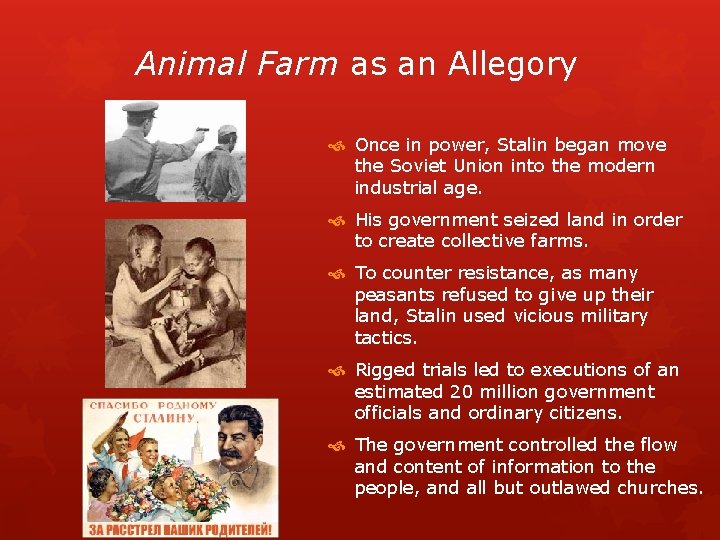
Animal Farm as an Allegory Once in power, Stalin began move the Soviet Union into the modern industrial age. His government seized land in order to create collective farms. To counter resistance, as many peasants refused to give up their land, Stalin used vicious military tactics. Rigged trials led to executions of an estimated 20 million government officials and ordinary citizens. The government controlled the flow and content of information to the people, and all but outlawed churches.
Starter Animal Farm – Main Themes What examples from the text can you think of for each of the main themes? Discuss in your groups and note down in your jotters/notebooks. Greed Leaders and Followers Betrayal Propaganda and Communication Appearance and Reality
Learning Intentions We will: Explore how an effective critical essay is constructed. Analyse the different themes in ‘Animal Farm’ and examples of these throughout the novel. Why? Critical thinking and writing are essential skills – in school, you will be writing essays in many subjects and getting a grip on this NOW will make your life so much easier. It is also essential in a working environment to be able to think critically, i. e. break something down to better understand the whole – employers look for it, and it’s a necessity in university.
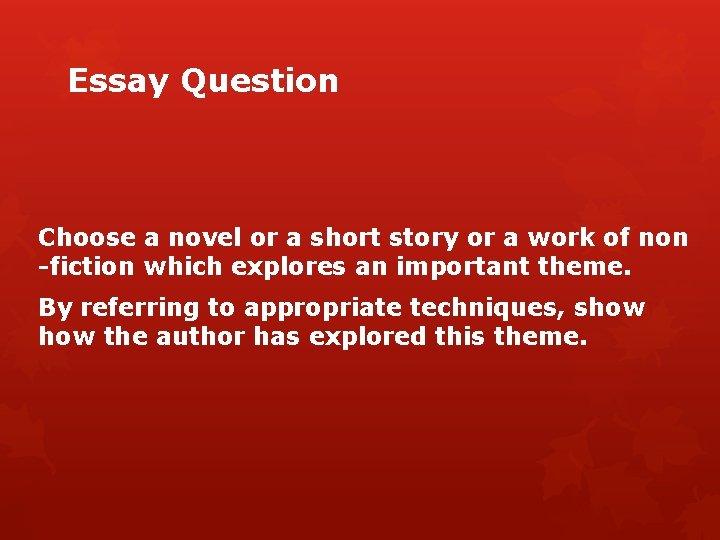
Essay Question Choose a novel or a short story or a work of non -fiction which explores an important theme. By referring to appropriate techniques, show the author has explored this theme.
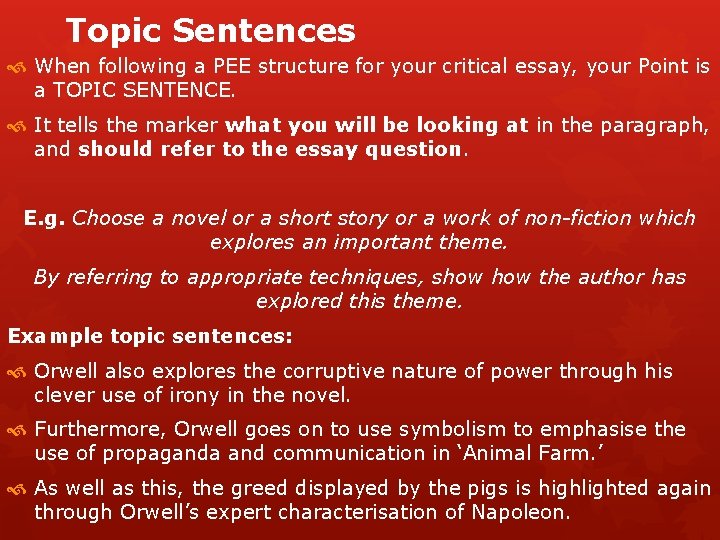
Topic Sentences When following a PEE structure for your critical essay, your Point is a TOPIC SENTENCE. It tells the marker what you will be looking at in the paragraph, and should refer to the essay question. E. g. Choose a novel or a short story or a work of non-fiction which explores an important theme. By referring to appropriate techniques, show the author has explored this theme. Example topic sentences: Orwell also explores the corruptive nature of power through his clever use of irony in the novel. Furthermore, Orwell goes on to use symbolism to emphasise the use of propaganda and communication in ‘Animal Farm. ’ As well as this, the greed displayed by the pigs is highlighted again through Orwell’s expert characterisation of Napoleon.
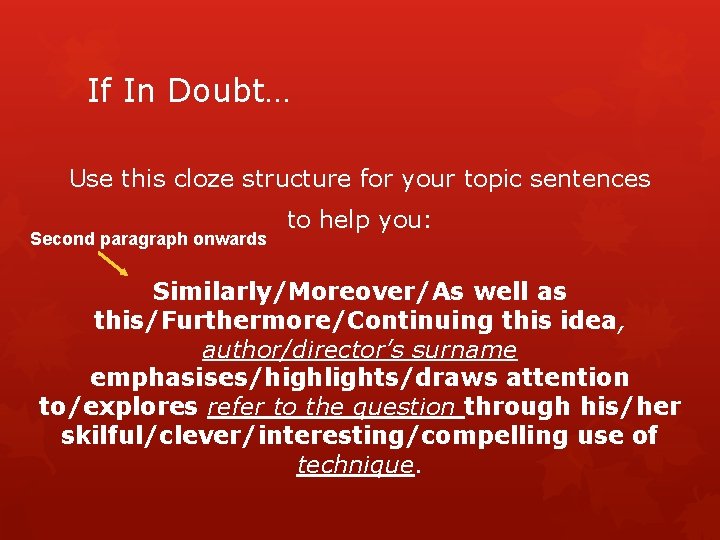
If In Doubt… Use this cloze structure for your topic sentences Second paragraph onwards to help you: Similarly/Moreover/As well as this/Furthermore/Continuing this idea, author/director’s surname emphasises/highlights/draws attention to/explores refer to the question through his/her skilful/clever/interesting/compelling use of technique.
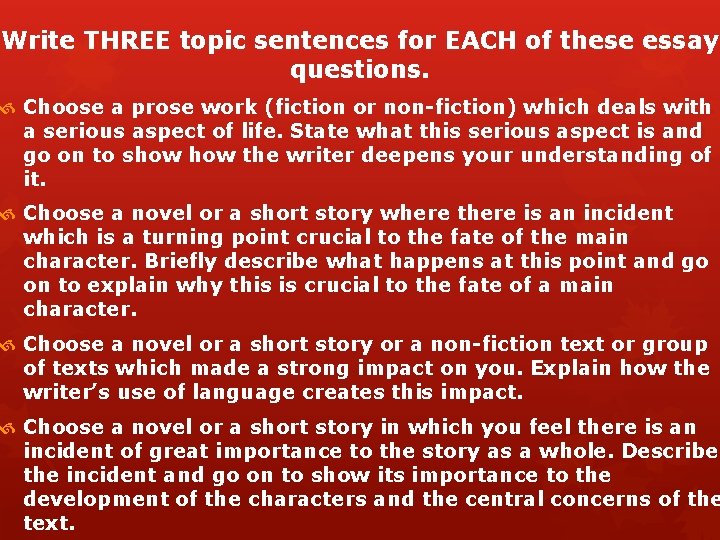
Write THREE topic sentences for EACH of these essay questions. Choose a prose work (fiction or non-fiction) which deals with a serious aspect of life. State what this serious aspect is and go on to show the writer deepens your understanding of it. Choose a novel or a short story where there is an incident which is a turning point crucial to the fate of the main character. Briefly describe what happens at this point and go on to explain why this is crucial to the fate of a main character. Choose a novel or a short story or a non-fiction text or group of texts which made a strong impact on you. Explain how the writer’s use of language creates this impact. Choose a novel or a short story in which you feel there is an incident of great importance to the story as a whole. Describe the incident and go on to show its importance to the development of the characters and the central concerns of the text.
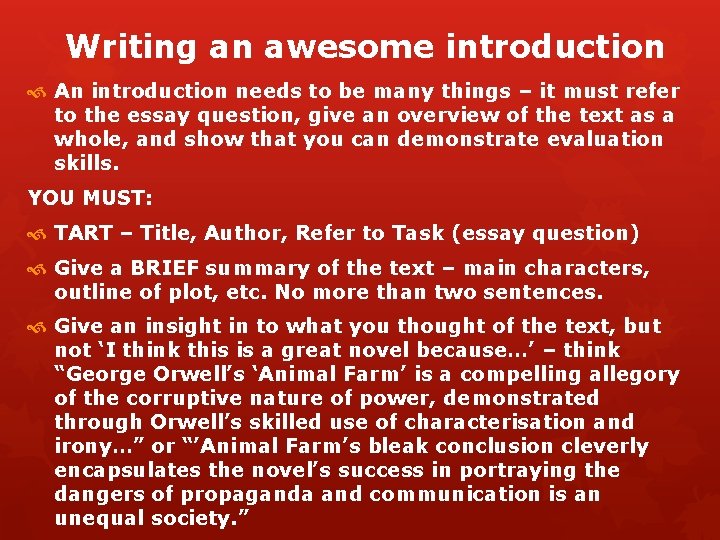
Writing an awesome introduction An introduction needs to be many things – it must refer to the essay question, give an overview of the text as a whole, and show that you can demonstrate evaluation skills. YOU MUST: TART – Title, Author, Refer to Task (essay question) Give a BRIEF summary of the text – main characters, outline of plot, etc. No more than two sentences. Give an insight in to what you thought of the text, but not ‘I think this is a great novel because…’ – think “George Orwell’s ‘Animal Farm’ is a compelling allegory of the corruptive nature of power, demonstrated through Orwell’s skilled use of characterisation and irony…” or “’Animal Farm’s bleak conclusion cleverly encapsulates the novel’s success in portraying the dangers of propaganda and communication is an unequal society. ”
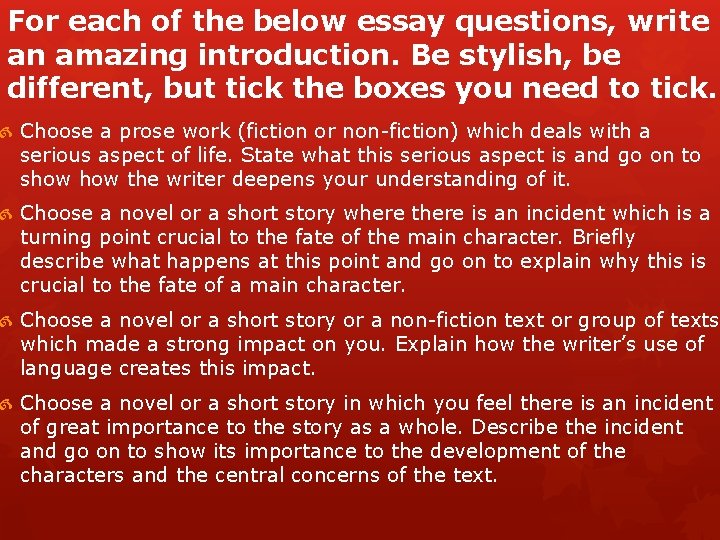
For each of the below essay questions, write an amazing introduction. Be stylish, be different, but tick the boxes you need to tick. Choose a prose work (fiction or non-fiction) which deals with a serious aspect of life. State what this serious aspect is and go on to show the writer deepens your understanding of it. Choose a novel or a short story where there is an incident which is a turning point crucial to the fate of the main character. Briefly describe what happens at this point and go on to explain why this is crucial to the fate of a main character. Choose a novel or a short story or a non-fiction text or group of texts which made a strong impact on you. Explain how the writer’s use of language creates this impact. Choose a novel or a short story in which you feel there is an incident of great importance to the story as a whole. Describe the incident and go on to show its importance to the development of the characters and the central concerns of the text.
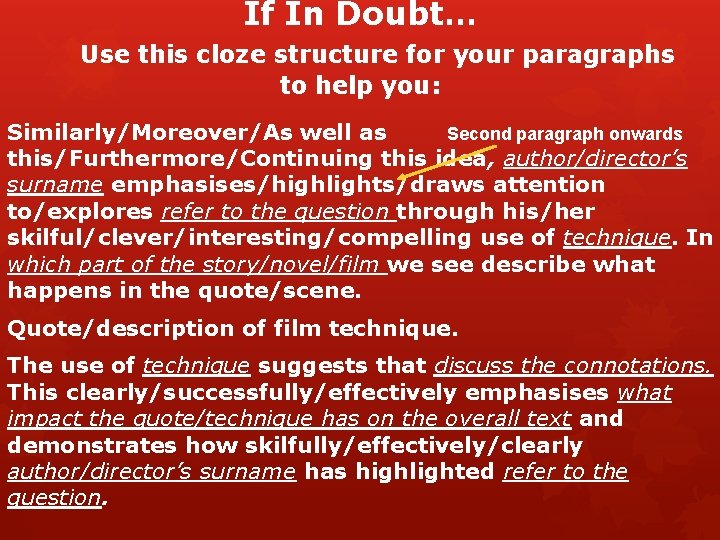
If In Doubt… Use this cloze structure for your paragraphs to help you: Similarly/Moreover/As well as Second paragraph onwards this/Furthermore/Continuing this idea, author/director’s surname emphasises/highlights/draws attention to/explores refer to the question through his/her skilful/clever/interesting/compelling use of technique. In which part of the story/novel/film we see describe what happens in the quote/scene. Quote/description of film technique. The use of technique suggests that discuss the connotations. This clearly/successfully/effectively emphasises what impact the quote/technique has on the overall text and demonstrates how skilfully/effectively/clearly author/director’s surname has highlighted refer to the question.
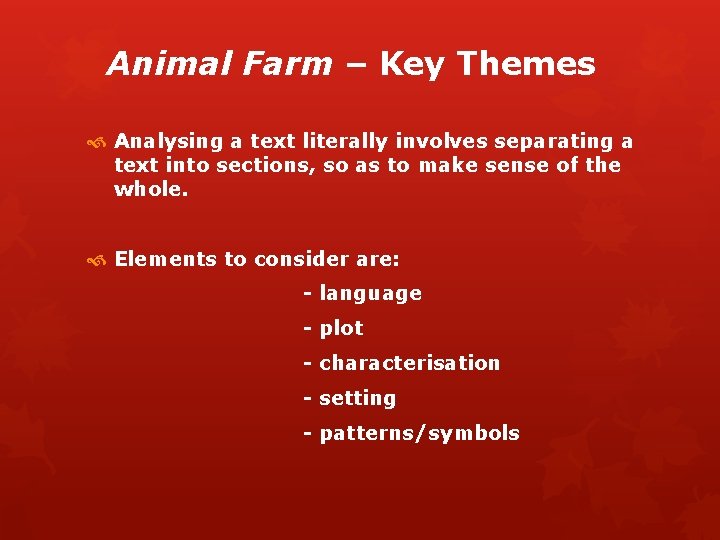
Animal Farm – Key Themes Analysing a text literally involves separating a text into sections, so as to make sense of the whole. Elements to consider are: - language - plot - characterisation - setting - patterns/symbols
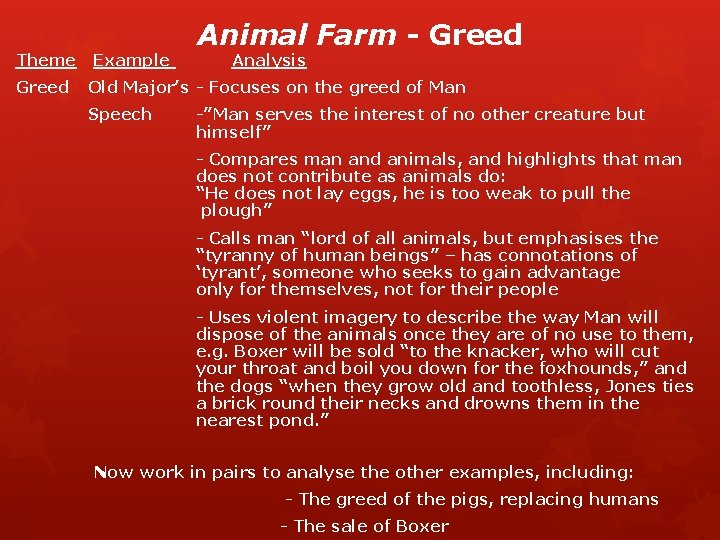
Theme Greed Example Animal Farm - Greed Analysis Old Major’s - Focuses on the greed of Man Speech -”Man serves the interest of no other creature but himself” - Compares man and animals, and highlights that man does not contribute as animals do: “He does not lay eggs, he is too weak to pull the plough” - Calls man “lord of all animals, but emphasises the “tyranny of human beings” – has connotations of ‘tyrant’, someone who seeks to gain advantage only for themselves, not for their people - Uses violent imagery to describe the way Man will dispose of the animals once they are of no use to them, e. g. Boxer will be sold “to the knacker, who will cut your throat and boil you down for the foxhounds, ” and the dogs “when they grow old and toothless, Jones ties a brick round their necks and drowns them in the nearest pond. ” Now work in pairs to analyse the other examples, including: - The greed of the pigs, replacing humans - The sale of Boxer
Animal Farm by George Orwell Lesson Objectives: Review responses for the analysis of GREED Look at theme of LEADERS AND FOLLOWERS Analysing examples and characters from the text
Animal Farm – Leaders and Followers Take an Examples worksheet We will analyse the first together – Snowball vs. Napoleon
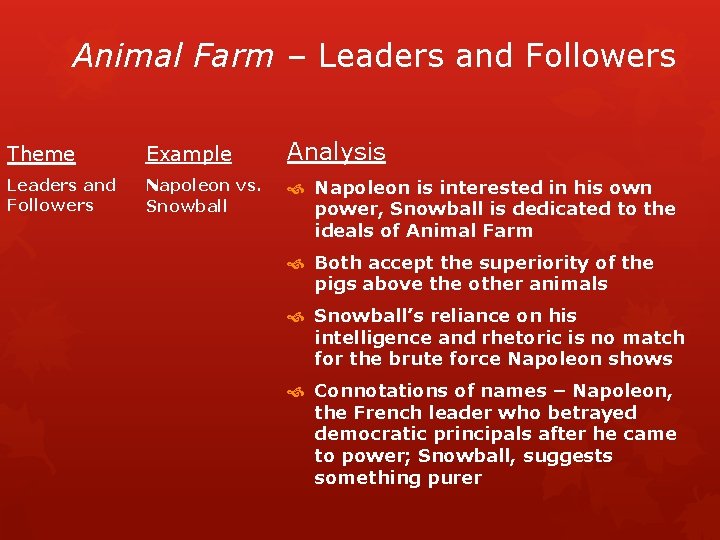
Animal Farm – Leaders and Followers Theme Example Analysis Leaders and Followers Napoleon vs. Snowball Napoleon is interested in his own power, Snowball is dedicated to the ideals of Animal Farm Both accept the superiority of the pigs above the other animals Snowball’s reliance on his intelligence and rhetoric is no match for the brute force Napoleon shows Connotations of names – Napoleon, the French leader who betrayed democratic principals after he came to power; Snowball, suggests something purer
Animal Farm – Leaders and Followers Now work in pairs to analyse the other examples, including: - Napoleon and his rule over the other animals TIP (think about his dogs; how often he appears; the way he uses propaganda, the effect these create) - The followers – Boxer, the sheep, etc. TIP (think about Boxer’s mantra, the sheep’s chorus, the faith the animals show in Napoleon, the effect these create)
Animal Farm – Propaganda and Communication/ Appearance vs. Reality Now work in pairs to analyse - Squealer’s propaganda TIP (what effect does his propaganda have? What techniques does he use, e. g. opinion as fact? ) - ‘Snowball’s’ sabotage of the farm TIP (why does Napoleon tell the animals this? How does it make him more powerful? )
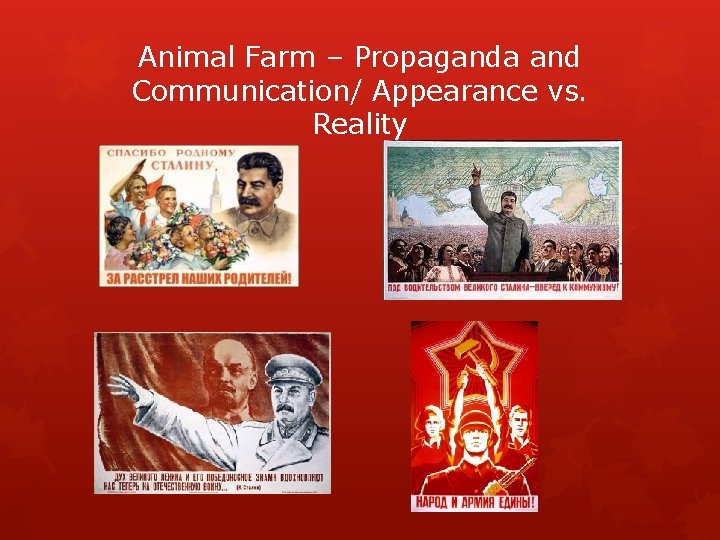
Animal Farm – Propaganda and Communication Work in pairs to design a PROPAGANDA leaflet for the pigs of Animal Farm Remember to use similar language and persuasive propaganda techniques, as used by Squealer in the novel Take note of the IMAGERY used in Stalinist propaganda posters for inspiration The leaflet should have ONE main image, and TWO paragraphs
Animal Farm – Propaganda and Communication/ Appearance vs. Reality
Animal Farm by George Orwell Lesson Objectives: Complete our propaganda leaflets Look at theme of BETRAYAL in the novel and analyse examples of this
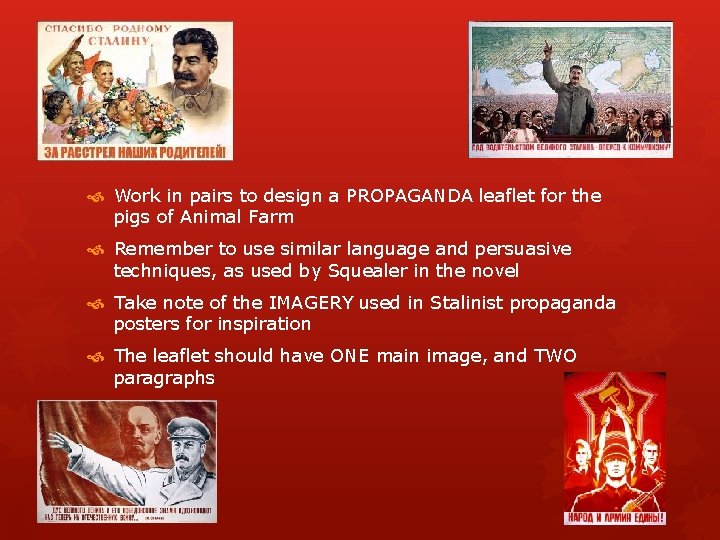
Work in pairs to design a PROPAGANDA leaflet for the pigs of Animal Farm Remember to use similar language and persuasive techniques, as used by Squealer in the novel Take note of the IMAGERY used in Stalinist propaganda posters for inspiration The leaflet should have ONE main image, and TWO paragraphs
Animal Farm - Betrayal Which characters are betrayed in the novel? In what ways do they set themselves up to be betrayed? What effect do these betrayals have? How do we feel about those who betray them?
Animal Farm - Betrayal Take an Examples worksheet Now work in pairs to analyse - Old Major’s Speech (TIP: Think about what Old Major intended for the farm, and what happened instead; the 7 commandments, how they change) - Boxer (TIP: Think about how Boxer contributes to the farm; his wishes for retirement; what he is sold for)
Animal Farm by George Orwell Lesson Objectives Looking at key quotations from the novel Analysing these quotations with reference to their context and meaning
Animal Farm - Quotations Look back at the very first Examples worksheet we completed What quotations from the novel do you remember? Why do you think these quotations are important?
Example The descriptions of the slaughters “Immediately the dogs bounded forward, seized four of the pigs by the ear and dragged them, squealing with pain and terror, to Napoleon’s feet. ” “When they had finished their confessions the dogs promptly tore their throats out, and in a terrible voice Napoleon demanded whether any other animal had anything to confess. ” “And so the tale of executions went on, until there was a pile of corpses lying before Napoleon’s feet and the air was heavy with the smell of blood, which had been unknown there since the expulsion of Jones. ”
Animal Farm - Quotations Take a Quotations worksheet Work in pairs to analyse quotations from the following: - Old Major’s speech (TIP: Look at how he describes the humans; the warnings he gives to the other animals) - Squealer’s propaganda (TIP: Look at the way he changes Napoleon’s stance on the windmill; the rewriting of Snowball’s role on the farm) - The 7 Commandments (TIP: Look at how they alter throughout the novel to reflect the pigs taking over the Manor house; the final change to one commandment) - Boxer and the sheep’s mantras (TIP: Think about the repetition and the effect it has; what it tells us about their characters)
Animal Farm by George Orwell Lesson Objectives Continue analysing quotations from the novel, with reference to their context and meaning Review our responses as a class
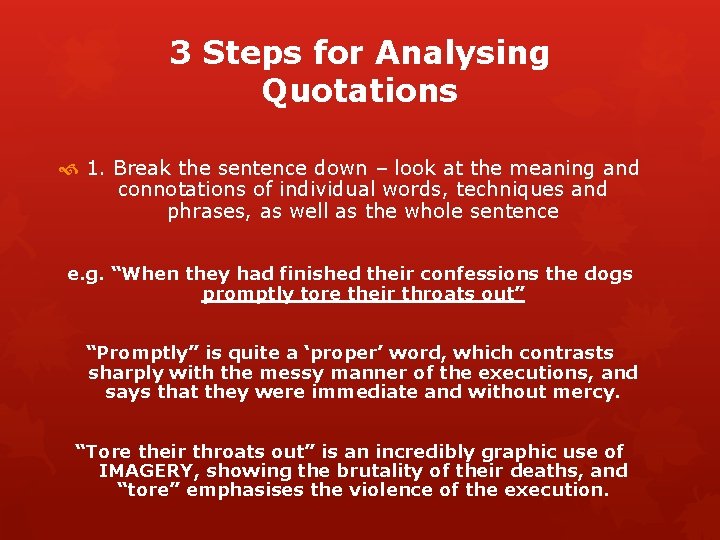
3 Steps for Analysing Quotations 1. Break the sentence down – look at the meaning and connotations of individual words, techniques and phrases, as well as the whole sentence e. g. “When they had finished their confessions the dogs promptly tore their throats out” “Promptly” is quite a ‘proper’ word, which contrasts sharply with the messy manner of the executions, and says that they were immediate and without mercy. “Tore their throats out” is an incredibly graphic use of IMAGERY, showing the brutality of their deaths, and “tore” emphasises the violence of the execution.
3 Steps for Analysing Quotations 2. Think about what the whole sentence suggests e. g. “When they had finished their confessions the dogs promptly tore their throats out” The sentence shows that there is no delay in doling out ‘justice’ to the pigs, and gives a sense of a lack of justice in their fates.
3 Steps for Analysing Quotations 3. Comment on the context of the quotation e. g. “When they had finished their confessions the dogs promptly tore their throats out” The violence and swiftness of the executions highlights the extent that Napoleon is willing to go to to maintain power – he has turned on his own kind, and is now using fear and violence as a means of controlling the animals.
1. Break the sentence down – look at the meaning and connotations of individual words, techniques and phrases, as well as the whole sentence e. g. “When they had finished their confessions the dogs promptly tore their throats out” “Promptly” is quite a ‘proper’ word, which contrasts sharply with the messy manner of the executions, and says that they were immediate and without mercy. “Tore their throats out” is an incredibly graphic use of IMAGERY, showing the brutality of their deaths, and “tore” emphasises the violence of the execution. 2. Think about what the whole sentence suggests The sentence shows that there is no delay in doling out ‘justice’ to the pigs, and gives a sense of a lack of justice in their fates. 3. Comment on the context of the quotation The violence and swiftness of the executions highlights the extent that Napoleon is willing to go to to maintain power – he has turned on his own kind, and is now using fear and violence as a means of controlling the animals.
Animal Farm - Quotations Take a Quotations worksheet Work in pairs to analyse quotations from the following: - Old Major’s speech (TIP: Look at how he describes the humans; the warnings he gives to the other animals) - The 7 Commandments (TIP: Look at how they alter throughout the novel to reflect the pigs taking over the Manor house; the final change to one commandment) - Squealer’s propaganda (TIP: Look at the way he changes Napoleon’s stance on the windmill; the rewriting of Snowball’s role on the farm) - Boxer and the sheep’s mantras (TIP: Think about the repetition and the effect it has; what it tells us about their characters)
Animal Farm by George Orwell Lesson Objectives: Finish analysing quotations from the novel, with reference to their context and meaning Work in groups to share and discuss your analysis
3 Steps for Analysing Quotations 1. Break the sentence down – look at the meaning and connotations of individual words, techniques and phrases, as well as the whole sentence 2. Think about what the whole sentence suggests 3. Comment on the context of the quotation
Animal Farm - Quotations Take a Quotations worksheet Work in pairs to analyse quotations from the following: - Old Major’s speech (TIP: Look at how he describes the humans; the warnings he gives to the other animals) - The 7 Commandments (TIP: Look at how they alter throughout the novel to reflect the pigs taking over the Manor house; the final change to one commandment) - Squealer’s propaganda (TIP: Look at the way he changes Napoleon’s stance on the windmill; the rewriting of Snowball’s role on the farm) - Boxer and the sheep’s mantras (TIP: Think about the repetition and the effect it has; what it tells us about their characters)
Animal Farm - Quotations Work in groups to discuss your analysis You have TWO MINUTES to discuss each quotation REMEMBER TO DISCUSS THE CONNOTATION OF INDIVIDUAL WORDS AND PHRASES, AS WELL AS CONTEXT
Animal Farm by George Orwell Lesson Objectives: Introduction to our critical essays Revise PEE essay structure Look at the critical essay question
Critical Writing Skills P E E

Why bother? We need to follow a structure to write essays We are going to use the PEE structure as a guide This will help with any critical writing throughout the school
Introduction Start with TART (Title, Author, Refer to Task) E. g. Animal Farm by George Orwell is an allegory based on the distortion of Communist ideals in Stalinist Russia. Orwell uses characterisation, imagery and themes of greed and betrayal to depict the breakdown of a society.
What do they mean? P - Point E - Evidence E - Explain/ evaluate (analysis)
Point The Point is simply what each paragraph is aboutyou make a main point in every paragraph you write. This is usually the topic sentence you use. Do not signpost your paragraph e. g. do not say “I am going to talk about”
Evidence A quotation is the evidence that you have to back up your point It is important that you pick a quotation that you can explain and evaluate Make sure there is enough information in each quotation that you pick. You also need to introduce the quotation into the text It allows you to explain the background information of where the quotation comes from – what part of the novel, what is happening around that time
Explain/ Evaluate This is the chance for you to explain how the quotation backs up the point you are making You need to make sure that you fully explain the quotation You then need to evaluate the quotation- give your opinion on how successful it is Your opinion should be implicit - do not write “I think”
Remember: This is basic critical essay formula It can be developed and become more sophisticated as you progress If you follow this, you are choosing the right path, and are more likely to succeed
Animal Farm – Critical Essay Question Choose a novel which deals with the effects of a breakdown in society Show any of this negative pressure affects the characters in the novel and go on to show whether or not they tackle it successfully - What examples in the text highlight the breakdown of a society? - How are the characters affected? - What themes are connected with this idea? - What techniques does Orwell use to depict this?
Animal Farm – Critical Essay Choose a novel which deals with the effects of a breakdown in society. Show any of this negative pressure affects the characters in the novel and go on to show whether or not they tackle it successfully Work in groups to discuss FIVE EXAMPLES FROM THE TEXT you might write about in this essay You should make reference to quotations for EACH POINT Use your Examples from the Text worksheets and Quotations Analysis worksheets as a guide YOU HAVE TEN MINUTES
Choose a novel or short story in which the writer creates a realistic or convincing character. By referring to appropriate techniques, show the writer creates this character, and say why you find him or her to be realistic or convincing. Choose a novel or a short story which has a character who provokes a strong reaction in you. Describe how you feel about this character and show the writer leads you to feel so strongly about the character. Choose a novel or a short story which has a character who affects you emotionally. Describe how you feel about the character, and show the writer leads you to feel this way. Choose a novel or a short story which gives you an insight into an aspect of human nature or behaviour. State what the aspect is, and show the characters’ actions and relationships lead you to a deeper understanding of human nature or behaviour.
Homework Plan this critical essay over the holidays. When you come back you will write this UNDER TIMED CONDITIONS, with only your plan in front of you. Choose a novel or a short story which has a character who provokes a strong reaction in you. Describe how you feel about this character and show the writer leads you to feel so strongly about the character.
DISCLAIMER: I have totally lost my voice so will be banging things on a desk to get your attention. DO NOT IRRITATE ME. Timed Essay Choose a novel or a short story which has a character who provokes a strong reaction in you. Describe how you feel about this character and show the writer leads you to feel so strongly about the character. Remember, you should only have your PLAN in front of you. (If you weren’t here on the last day, use this period to PLAN your essay)
Today You have FIFTEEN MINUTES to complete your essays from Monday, then bring to me. You will then read the exemplar ‘Animal Farm’ essay and discuss it in your pairs. What was effective? How can you use this to help your own critical writing? You have ten minutes. You will complete the task on creating a ‘What makes a good critical essay? ’ display in your groups. This will be completed today and tomorrow and should be a USEFUL, WELL-DESIGNED and DETAILED DISPLAY, used to help you with your essay writing. DISCLAIMER: I still have no voice so will be banging things on a desk to get your attention. DO NOT IRRITATE ME.
Today You will complete the task on creating a ‘What makes a good critical essay? ’ display in your groups. This will be completed today and tomorrow and should be a USEFUL, WELLDESIGNED and DETAILED DISPLAY, used to help you with your essay writing. DISCLAIMER: I still have no voice so will be banging things on a desk to get your attention. DO NOT IRRITATE ME.
Homework DUE MONDAY 2 ND NOVEMBER Write an INTRODUCTION for each of these essay questions. Use the exemplar essay as a guide, as well as the work you have completed in your groups. Remember, it should refer to the question, give an outline of the novel, have a varied vocabulary, and be intelligent and articulate. 1. Choose a novel or a short story which gives you an insight into an aspect of human nature or behaviour. State what the aspect is, and show the characters’ actions and relationships lead you to a deeper understanding of human nature or behaviour. 2. Choose a novel which deals with the effects of a breakdown in society. Show any of this negative pressure affects the characters in the novel and go on to show whether or not they tackle it successfully. 3. Choose a novel or a short story in which you feel there is an incident of great importance to the story as a whole. Describe the incident and go on to show its importance to the development of the characters and the central concerns of the text.
Homework Due Wednesday 4 th November You will complete a critical essay under FULL EXAM CONDITIONS. For homework, plan and revise notes and quotes for this essay question: Choose a novel which deals with the effects of a breakdown in society. Show any of this negative pressure affects the characters in the novel and go on to show whether or not they tackle it successfully.
Animal Farm – Critical Essay Choose a novel which deals with the effects of a breakdown in society. Show any of this negative pressure affects the characters in the novel and go on to show whether or not they tackle it successfully. Work in pairs to discuss FIVE EXAMPLES FROM THE TEXT you might write about in this essay Use your Examples from the Text, Quotations Analysis and Essay Preparation worksheets as a guide YOU HAVE FIFTEEN MINUTES
Today Record the feedback from your critical essay on your Feedback Profile and your large PDP sheet. Using this feedback and the marking scheme peer assess your partner’s unmarked essay. Give them notes on what they did well, as well as what they need to improve upon. BE SPECIFIC What mark would you give their essay? Remember, you are not doing them any favours by being overlygenerous. YOU HAVE FIFTEEN MINUTES
Choose a novel which deals with the effects of a breakdown in society. Show any of this negative pressure affects the characters in the novel and go on to show whether or not they tackle it successfully.
Animal Farm by George Orwell Learning Intentions: Develop our understanding of the novel’s CONTEXT. Analyse examples of the main themes/characterisation/structure, etc. of the novel.
Animal Farm as an Allegory COPY THIS DOWN An allegory is a narrative that can be read in more than one way Animal Farm is an allegory On first impressions, it appears to be a simple tale about a group of animals trying to run a farm by themselves However, it actually represents Stalinist Russia, and his manipulation of Communist ideals
Animal Farm - Context COPY THIS DOWN It is a SATIRE of Soviet Socialism – where the ideologies of Communism were taken and distorted to benefit the leaders, i. e. Stalin Communism was written about by Karl Marx – he wanted a classless society where everyone was equal, and all work was shared Napoleon represents Joseph Stalin, who turns Animal Farm into a dictatorship, as Stalin did in Russia Snowball represents Leon Trotsky, a rival of Stalin who was later assassinated on his orders Old Major is often thought to represent Karl Marx, whose
Revision Task On each piece of paper is an aspect of ‘Animal Farm’ that you write about in your exam. For each one, come up with as many ideas, quotes, points of analysis, etc. that you can think of, writing them down on the sheet. Try to add to what others have written – develop their ideas/analysis, come up with other quotes, etc. ALL the notes will be shared on the blog to help with your prelim revision, so be as detailed as you can. You will have TWO MINUTES on each station.
Revision Task – RUAE and ‘Animal Farm’ WORK IN PAIRS On the large piece of paper, write PROPAGANDA/MANIPULATION OF LANGUAGE across the top as a header. In pairs, find TEN QUOTATIONS in ‘Animal Farm’ that come under this heading – think about how Napoleon is described by the other pigs, the slandering of Snowball, the changing of the commandments and the excuses for that, Boxer’s fate and the subsequent ‘explanation’, etc. Now, using the FORMULAE we have practiced for close reading, ANALYSE these quotes showing: - the connotations of the language, structure, etc. - what Orwell is using that to tell us. - How that contributes to the novel overall.
Quotation Flashcards Write down the quote on one side of the card. On the other, write bullet points of analysis, keeping in mind: - what the quote suggests - what the writer is trying to say - how this relates to overall themes/issues explored in the novel
Animal Farm – Critical Essay Success Criteria INTRODUCTION: Get straight to the point! Indicate the ideas you will write about Identify the techniques you will write about Make clear your point of view
Animal Farm – Critical Essay Success Criteria PARAGRAPHS: Get straight to the point in your Topic Sentence! E. g. George Orwell shows the breakdown of a society through his exploration of theme of betrayal. Show your knowledge of the text Identify the techniques you will write about Introduce and analyse your quotation well Make clear your point of view Keep the question in mind – refer back to the task
INTRODUCTION: Use TART as a base • • Get straight to the point! Indicate the ideas you will write about Identify the techniques Make clear your point of view PARAGRAPHS: Get straight to the point in your Topic Sentence! E. g. Orwell explores the corruptive nature of power most strikingly through his portrayal of Napoleon, a brutish pig who goes on to become leader of the farm. • Show your knowledge of the text and identify techniques • Analyse your quotation well • Make clear your point of view • Keep the question in mind – refer back to the task CONCLUSION: Use TART as a base • Come back to the essay question • Summarise your main points • Use EVALUATIVE language – successfully, effectively, interesting, compelling, etc.
Animal Farm – Success Criteria What other things make a good essay? Think about language, structure, references to the text…
Animal Farm – Success Criteria What else makes a good essay? Language Structure Reference to text
Animal Farm – Critical Essay • Having someone else look at our work can often help it to become better • They can see strengths or mistakes that we sometimes cannot see ourselves
Animal Farm – Critical Essay We are now going to complete some PEER EVALUATION Read over your partner’s essay Using the success criteria we have discussed as a guide, note TWO STRENGTHS and TWO TARGETS for your partner’s work YOU HAVE TEN MINUTES
Animal Farm – Critical Essay Now, having completed PEER EVALUATION of another essay, and having looked at success criteria and exemplar essays, think about YOUR OWN WORK. On a Post-It, write TWO STRENGTHS and TWO TARGETS for your own essay – these should be different from the feedback your partner has given. Attach the Post-It to your essay, and pass to the front of your row YOU HAVE TWO MINUTES
On the whiteboard, plan an essay for each of the questions below. Consider which quotes are relevant, as well as points of analysis you should include. You have FIVE MINUTES on each one. Choose a novel or short story which has an incident or moment of great tension. Describe briefly what happens at this point in the story and go on to show it is important to the outcome of the story as a whole. Choose a prose text (fiction or non-fiction) in which a society or a person or a culture or a setting is effectively portrayed. Show the writer’s presentation of the subject makes an impact on you, and helps you to understand the subject in greater depth. Choose a novel or short story in which you feel sympathy with one of the main characters because of the difficulties or injustice or hardships she or he has to face. Describe the problems the character faces and show by what means your are made to feel sympathy for her or him. Choose a text or group of texts which uses setting, or humour, or description to make clear to you an interesting aspect of society. Show the use of any of these techniques helped you to understand the writer’s point of view on the interesting aspect of this society.
Learning Intentions • Develop and consolidate our knowledge and understanding of the novel • Improve our analysing skills Task Using the ‘Animal Farm’ – Key Quotations sheet, the Analysis Questions sheet and your knowledge of and notes on the novel, you will work in your groups to create a REVISION GUIDE for the novel. It should have: § Plot Outline § Important characters list § Key quotations and analysis § Discussion Questions § Exploration of main themes § Any other sections you feel are important. Each person should take responsibility for at least ONE section. This will be shared on the class blog and will be used for your revision so make it good!
Learning Intentions: Develop our understanding of the novel Improve our reading for understanding, analysis and evaluation skills Using your close reading formulae, answer the following questions on ‘Animal Farm’: 1. In the opening paragraph, comment on the writer’s use of word choice to describe how Mr Jones moves. 2 marks 2. “The others said of Squealer that he could turn black into white. ” What does the writer’s use of language here tell us about Squealer? 2 marks 3. “The animals were not certain… they accepted his explanation without further questions. ” How effective is this sentence as a conclusion to Chapter 5? 4 marks 4. Comment on the writer’s use of imagery in the opening sentence of Chapter 6. 2 marks 5. Which phrase is used ironically at the beginning of chapter 6 and why? 2 marks 6. “Napoleon decreed that there should be a full investigation into Snowball’s activities. ” On page 49, how does this sentence act as a LINK in the chapter? 2 marks 7. How effective are the closing lines of the novel as a conclusion to the text as a whole? 2 marks
- Slides: 129