
Animal Decontamination Chemical Events and Natural Disasters Risks

- Slides: 24
Animal Decontamination Chemical Events and Natural Disasters
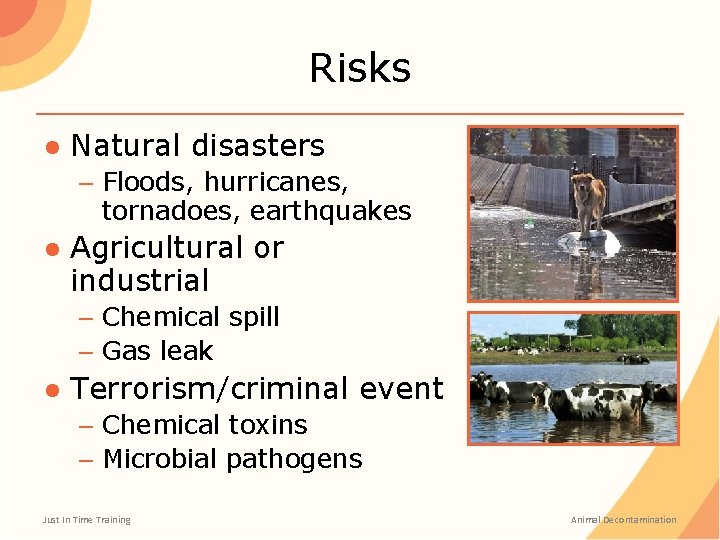
Risks ● Natural disasters – Floods, hurricanes, tornadoes, earthquakes ● Agricultural or industrial – Chemical spill – Gas leak ● Terrorism/criminal event – Chemical toxins – Microbial pathogens Just In Time Training Animal Decontamination
Goals of Decontamination ● Neutralize/remove harmful materials ● Confine to specified area ● Limit exposure time – Limit tissue damage and absorption – Prevent systemic poisoning ● Prevent secondary contamination to responders and other animals Just In Time Training Animal Decontamination
Contaminants of Concern ● Solids – Fecal materials from manure pits or septic tanks containing pathogenic microorganisms – Mold spores ● Liquids – Gasoline, diesel fuel, motor oil, solvents, kerosene, propane – Insecticides, herbicides, fungicides, rodenticides – Soaps, detergents, disinfectants, household cleaners – Heavy metals: Arsenic, lead – Antifreeze Just In Time Training ● Particulates – Dust, smoke, debris in air – Fiberglass and asbestos fibers ● Toxic gases – Confined manure pits or tanks § Methane, hydrogen sulfide, carbon dioxide, ammonia – Anhydrous ammonia, chlorine – Toxic fumes from burning products – Chemical reactions § Ammonia + hypochlorite (bleach) = chlorine gas – Pipeline breakage – Gasoline/diesel exhaust – Welding/cutting torch fumes Animal Decontamination
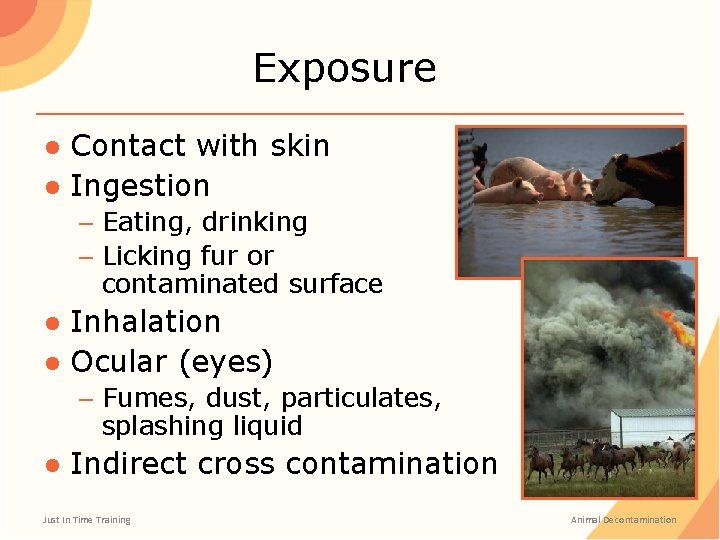
Exposure ● Contact with skin ● Ingestion – Eating, drinking – Licking fur or contaminated surface ● Inhalation ● Ocular (eyes) – Fumes, dust, particulates, splashing liquid ● Indirect cross contamination Just In Time Training Animal Decontamination
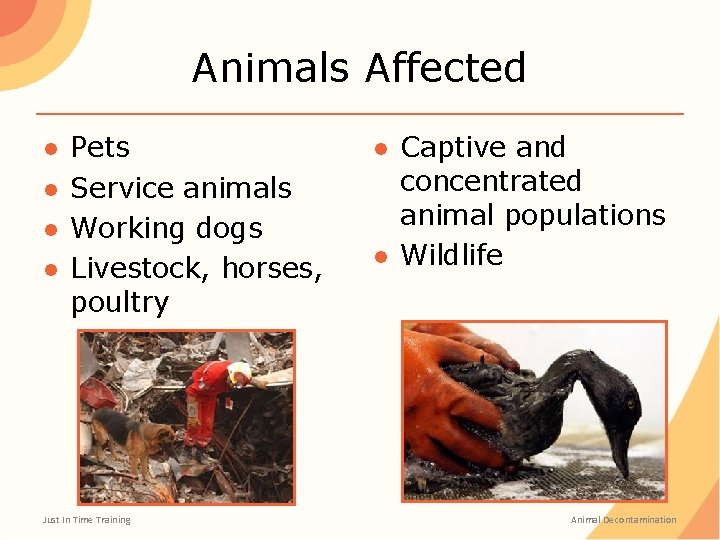
Animals Affected ● ● Pets Service animals Working dogs Livestock, horses, poultry Just In Time Training ● Captive and concentrated animal populations ● Wildlife Animal Decontamination
Affects To Animals ● Similar to humans ● Immediate (acute) damage – Skin irritation, redness – Chemical burns, hair loss – Respiratory distress – Systemic shock, death ● Chronic injury – Respiratory damage, scarring ● Carcinogenesis Just In Time Training Animal Decontamination
Considerations ● Human safety – Animal welfare and health ● Response needs – Personnel and resources required – Personnel safety ● Specific toxic substance ● Number and variety of species – Time constraints Just In Time Training Animal Decontamination
Environmental Issues ● Large volumes of wastewater ● Contaminated objects – Leashes, collars, halters, hair ● Legal or jurisdictional issues/regulations – Consult with officials before and after regarding appropriate disposal measures ● Weather conditions – Fans, shade, shelter to avoid overheating – Dryer, heater, shelter to avoid hypothermia Just In Time Training Animal Decontamination
DECONTAMINATION SETUP Just In Time Training Animal Decontamination
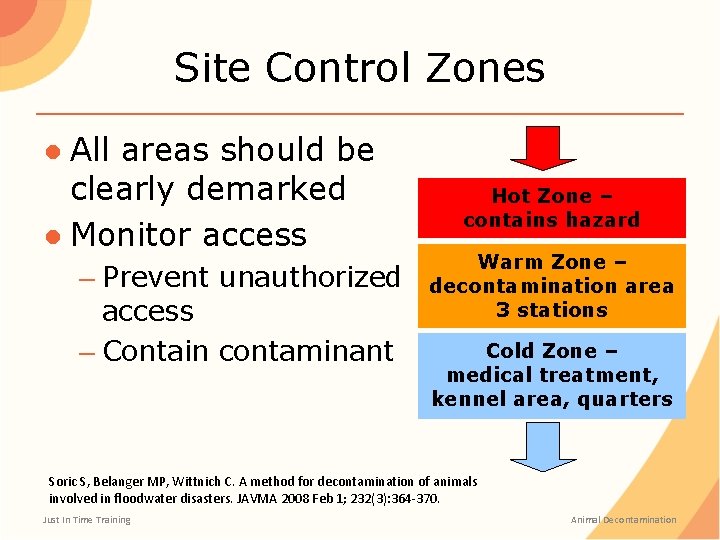
Site Control Zones ● All areas should be clearly demarked ● Monitor access – Prevent unauthorized access – Contain contaminant Hot Zone – contains hazard Warm Zone – decontamination area 3 stations Cold Zone – medical treatment, kennel area, quarters Soric S, Belanger MP, Wittnich C. A method for decontamination of animals involved in floodwater disasters. JAVMA 2008 Feb 1; 232(3): 364 -370. Just In Time Training Animal Decontamination
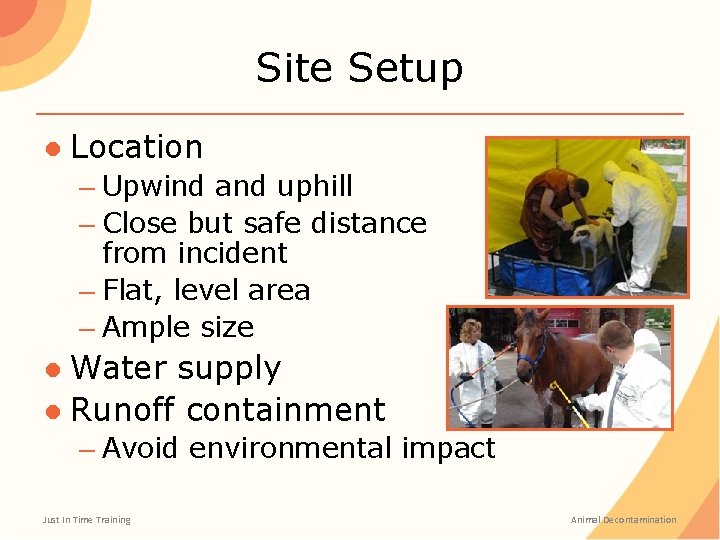
Site Setup ● Location – Upwind and uphill – Close but safe distance from incident – Flat, level area – Ample size ● Water supply ● Runoff containment – Avoid environmental impact Just In Time Training Animal Decontamination
DECONTAMINATION PROCEDURE Just In Time Training Animal Decontamination
Warm Zone: Station 1 ● Medical assessment – Emergency decontamination ● Photograph and record information – Owner, if available – Location found ● Remove and discard contaminated items (e. g. , collars, halters) ● Place clean restraining device Just In Time Training Animal Decontamination
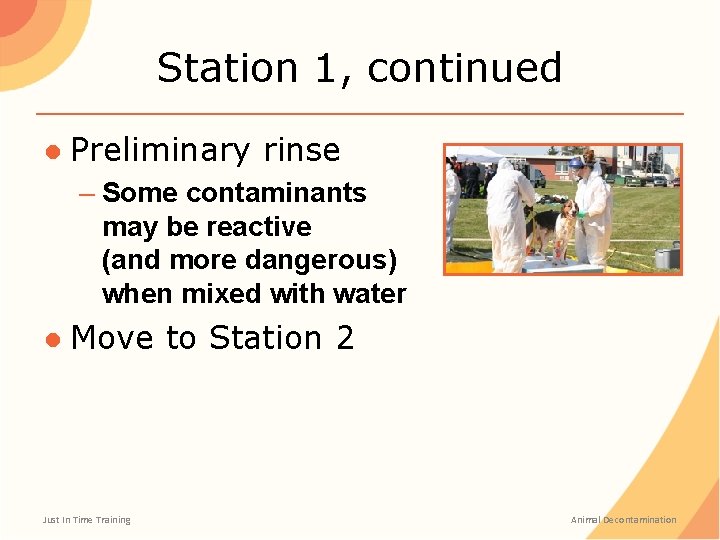
Station 1, continued ● Preliminary rinse – Some contaminants may be reactive (and more dangerous) when mixed with water ● Move to Station 2 Just In Time Training Animal Decontamination
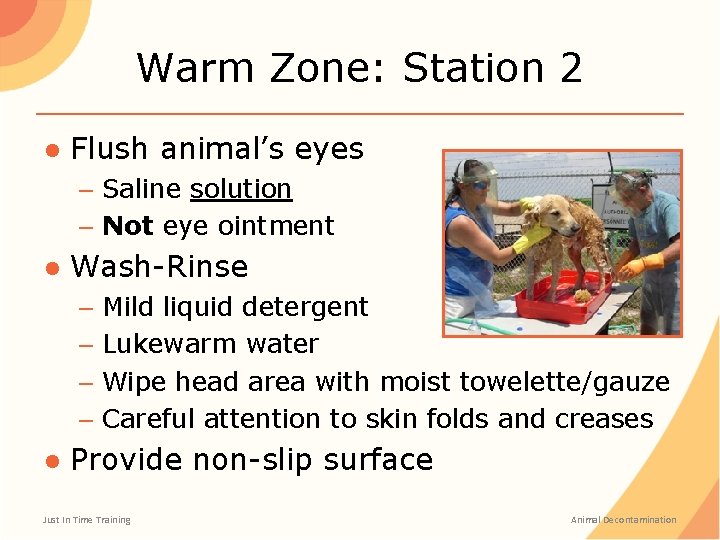
Warm Zone: Station 2 ● Flush animal’s eyes – Saline solution – Not eye ointment ● Wash-Rinse – Mild liquid detergent – Lukewarm water – Wipe head area with moist towelette/gauze – Careful attention to skin folds and creases ● Provide non-slip surface Just In Time Training Animal Decontamination
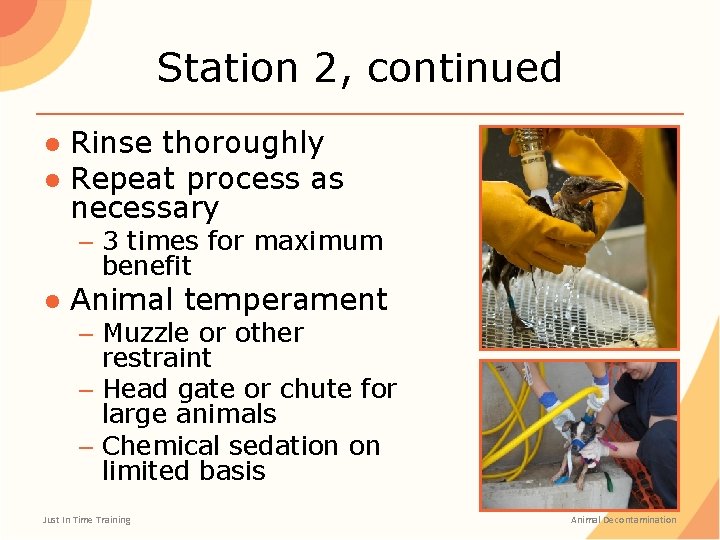
Station 2, continued ● Rinse thoroughly ● Repeat process as necessary – 3 times for maximum benefit ● Animal temperament – Muzzle or other restraint – Head gate or chute for large animals – Chemical sedation on limited basis Just In Time Training Animal Decontamination
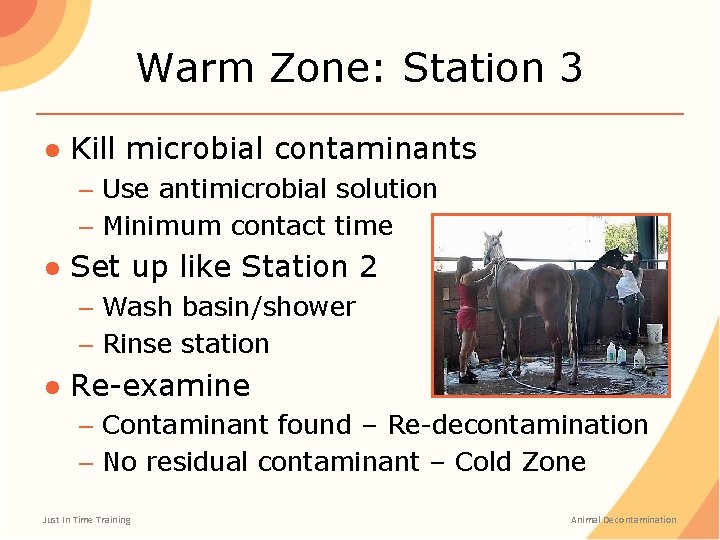
Warm Zone: Station 3 ● Kill microbial contaminants – Use antimicrobial solution – Minimum contact time ● Set up like Station 2 – Wash basin/shower – Rinse station ● Re-examine – Contaminant found – Re-decontamination – No residual contaminant – Cold Zone Just In Time Training Animal Decontamination
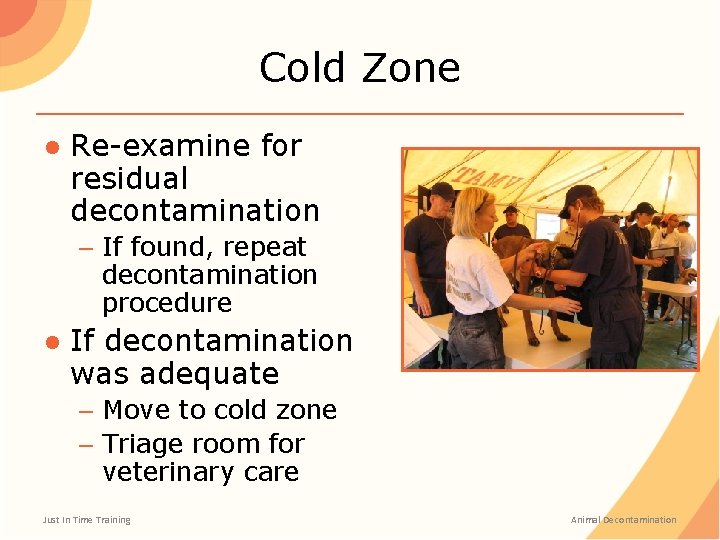
Cold Zone ● Re-examine for residual decontamination – If found, repeat decontamination procedure ● If decontamination was adequate – Move to cold zone – Triage room for veterinary care Just In Time Training Animal Decontamination
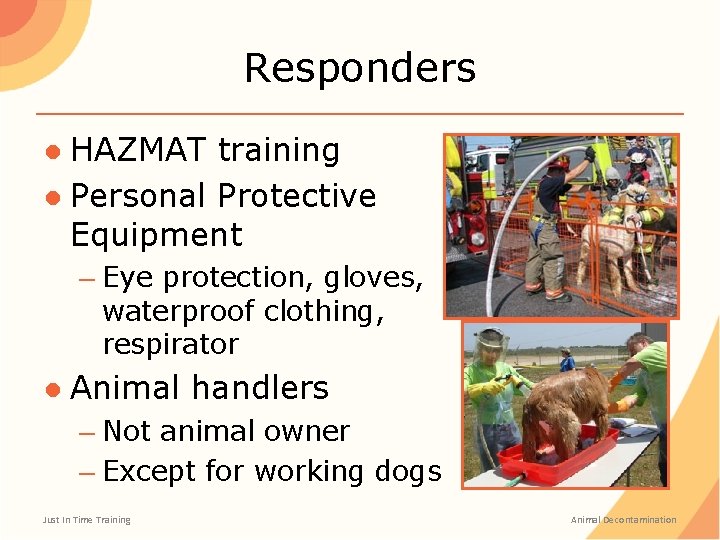
Responders ● HAZMAT training ● Personal Protective Equipment – Eye protection, gloves, waterproof clothing, respirator ● Animal handlers – Not animal owner – Except for working dogs Just In Time Training Animal Decontamination
Responder Safety ● Injury from animals – Bites, scratches, crushing, kicks – Contaminant exposure ● Heavy lifting – Back injuries, muscle strain ● Biological hazards – Zoonoses ● PPE safety issues – Slip, trips and falls Just In Time Training Animal Decontamination
Resources ● National Alliance of State Animal and Agricultural Emergency Programs (NASAAEP). Animal Decontamination Best Practices. 2012. http: //www. learn. cfsph. iastate. edu/dr/node/157. ● Soric S, Belanger MP, Wittnich C. A method for decontamination of animals involved in floodwater disasters. J Am Vet Med Assoc. 2008 Feb 1; 232(3): 364 -70. ● VMAT Decontamination Standard Operating Procedure. http: //pennvetwdc. org/wp-content/uploads/2012/02/ VMAT_DECON_SOP_APRIL 2004. pdf ● FEMA Animals In Disasters – Technological Hazards at http: //www. training. fema. gov/emiweb/downloads/is 10_a 6. pdf ● FEMA Canine Decontamination http: //www. k 9 team. org/files/articles/Canine%20 Decontamin ation%20 Guide. pdf Just In Time Training Animal Decontamination
Resources ● Murphy L, Slessman D, Mauck B. Decontamination of Large Animals. In Technical Large Animal Emergency Rescue, Gimenez R, Gimenez T, May KA, editors. 2008. Wiley. Blackwell, Ames. ISBN#978 -0 -813801998 -3. ● Murphy L. Basic Veterinary Decontamination. In: Veterinary Disaster Response. Wingfield WE, Palmer SB, editors. 2009. Wiley-Blackwell: Ames. ISBN#978 -0 -81381014 -0. ● Murphy L. Responding to Mass Exposures. In Small Animal Toxicology, 3 rd edition. Peterson ME, Talcott PA, editors. 2013. Elsevier Saunders: St Louis. ISBN#978 -1 -4557 -0717 -1. ● Soric S, Belanger MP, Wittnich C. A method for decontamination of animals involved in floodwater disasters. J Am Vet Med Assoc. 2008 Feb 1; 232(3): 364 -70. Just In Time Training Animal Decontamination
Acknowledgments Development of this presentation was by the Center for Food Security and Public Health at Iowa State University through funding from the Multi-State Partnership for Security in Agriculture Authors: Melissa Lang, BS; Glenda Dvorak, DVM, MPH, DACVPM