
Animal Assisted Interventions Dr Deborah Hutchins CTRS FDRT
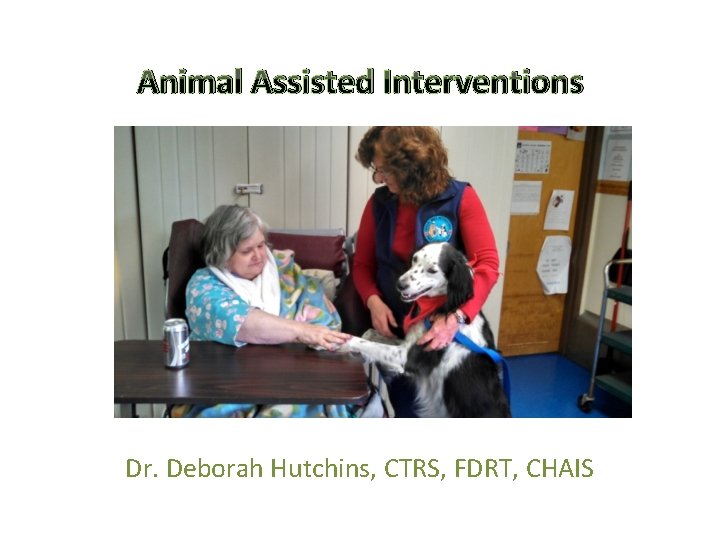
Animal Assisted Interventions Dr. Deborah Hutchins, CTRS, FDRT, CHAIS
Learning Outcomes: • Provide an overview of current AAI terminology • Identify various types of AAI and the established benefits. • Identify organizations and resources to support the provision of AAI in a healthcare setting. • Review studies that support potential outcomes and interventions for various populations and settings. • Explain the considerations of implementing an AAI program with various populations and service settings.
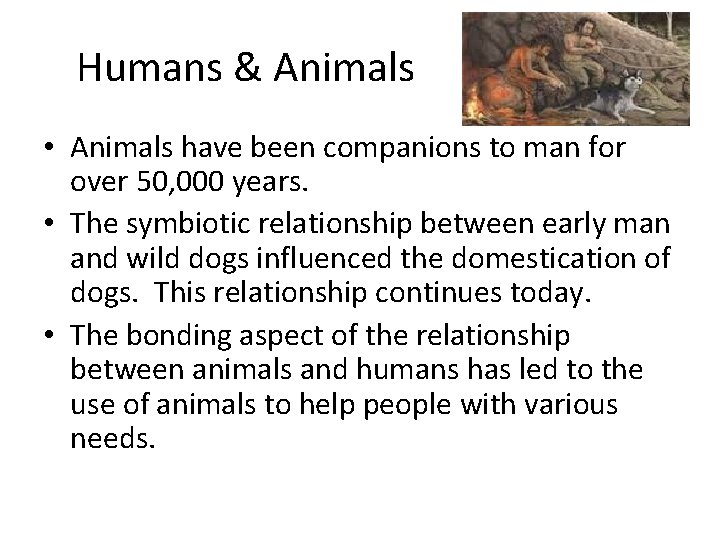
Humans & Animals • Animals have been companions to man for over 50, 000 years. • The symbiotic relationship between early man and wild dogs influenced the domestication of dogs. This relationship continues today. • The bonding aspect of the relationship between animals and humans has led to the use of animals to help people with various needs.
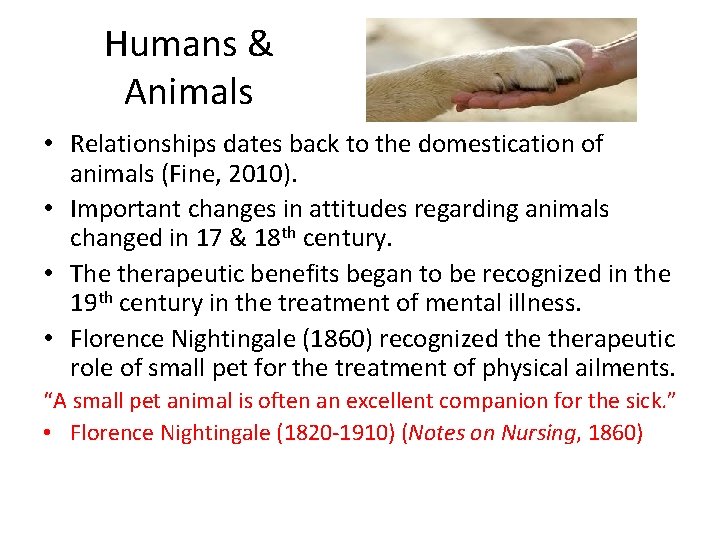
Humans & Animals • Relationships dates back to the domestication of animals (Fine, 2010). • Important changes in attitudes regarding animals changed in 17 & 18 th century. • The therapeutic benefits began to be recognized in the 19 th century in the treatment of mental illness. • Florence Nightingale (1860) recognized therapeutic role of small pet for the treatment of physical ailments. “A small pet animal is often an excellent companion for the sick. ” • Florence Nightingale (1820 -1910) (Notes on Nursing, 1860)
Human-Animal Bond • “ a mutually beneficial and dynamic relationship between people and other animals that is influenced by behaviors that are essential to the health and well-being of both. This includes, but is not limited to, emotional, psychological, and physical interactions of people, other animals, and the environment” (JAVA, 1998)
Benefits of Companion Animals • Impact on several neurotransmitters – Increased oxytocin, decrease in cortisol – Increase in beta endorphins & dopamine • Decreased anxiety & stress; Improved mood • Decreased loneliness & “Social lubricant” • Improved fitness by providing a stimulus for exercise • Children who are pet owners have increased self-esteem; builds focus & perseverance. (Fine, 2010; Heimlich, 2001; Mills, 2016; Van Houtee, 1995)
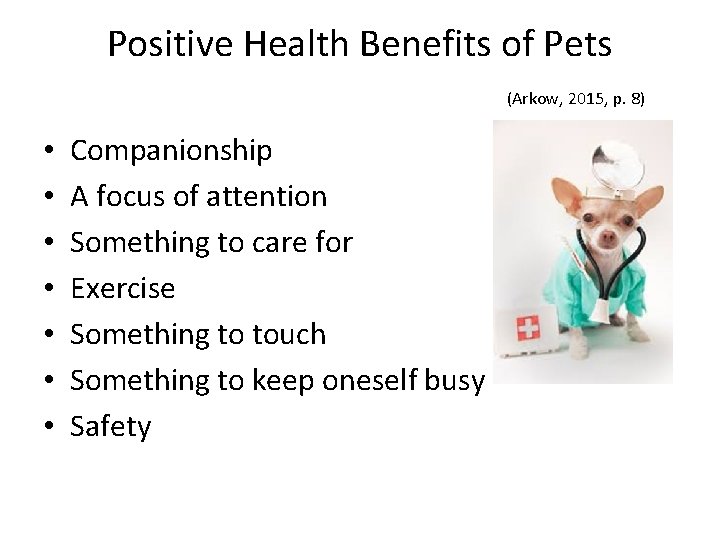
Positive Health Benefits of Pets (Arkow, 2015, p. 8) • • Companionship A focus of attention Something to care for Exercise Something to touch Something to keep oneself busy Safety
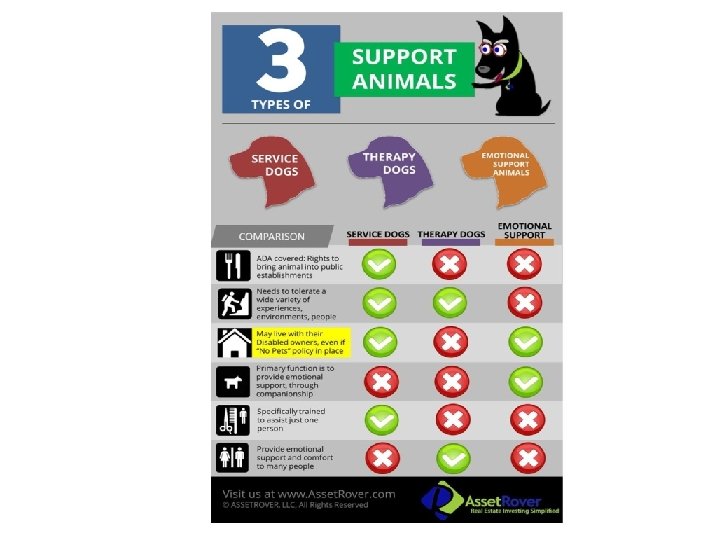
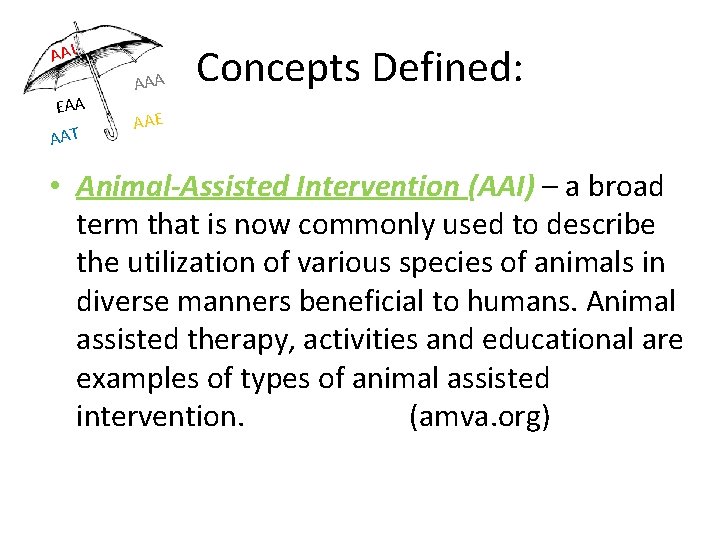
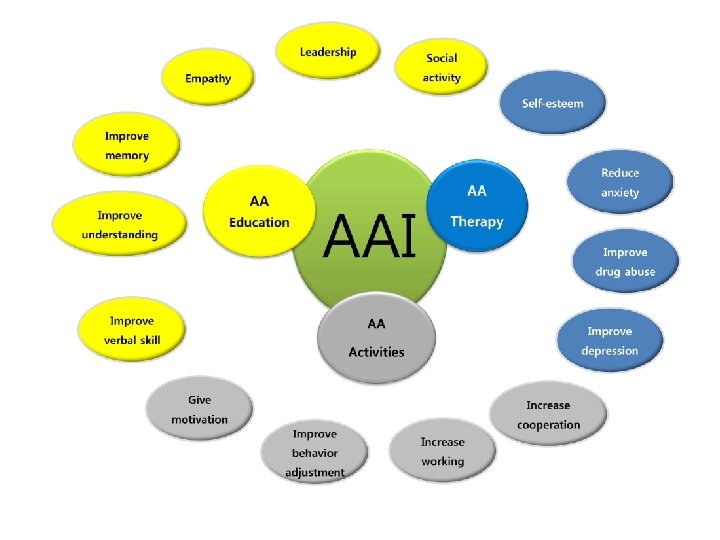
AAI EAA AAT AAA Concepts Defined: AAE • Animal-Assisted Intervention (AAI) – a broad term that is now commonly used to describe the utilization of various species of animals in diverse manners beneficial to humans. Animal assisted therapy, activities and educational are examples of types of animal assisted intervention. (amva. org)
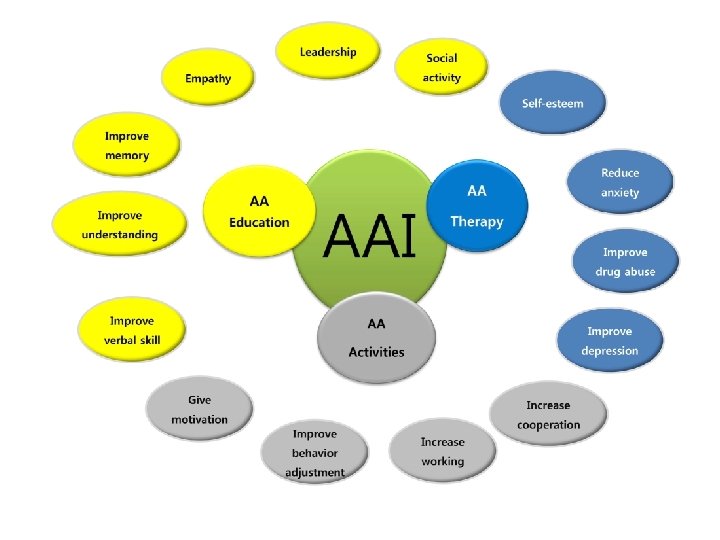
Concepts Defined: • Animal-assisted activities (AAA) provide opportunities for motivation, education, or recreation to enhance quality of life. Animal assisted activities are delivered in a variety of environments by specially trained professionals, paraprofessionals, or volunteers in association with animals that meet specific criteria. (amva. org)
Concepts Defined: • Animal-assisted therapy (AAT) is a goal directed intervention in which an animal meeting specific criteria is an integral part of the treatment process. Animal-assisted therapy is delivered and/or directed by health or human service providers working within the scope of their profession. Animal-assisted therapy is designed to promote improvement in human physical, social, emotional, or cognitive function. Animalassisted therapy is provided in a variety of settings, and may be group or individual in nature. The process is documented and evaluated. (amva. org)
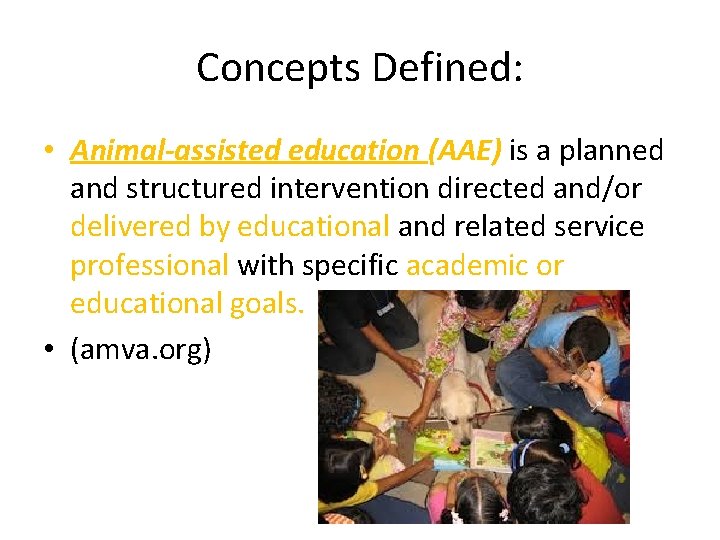
Concepts Defined: • Animal-assisted education (AAE) is a planned and structured intervention directed and/or delivered by educational and related service professional with specific academic or educational goals. • (amva. org)
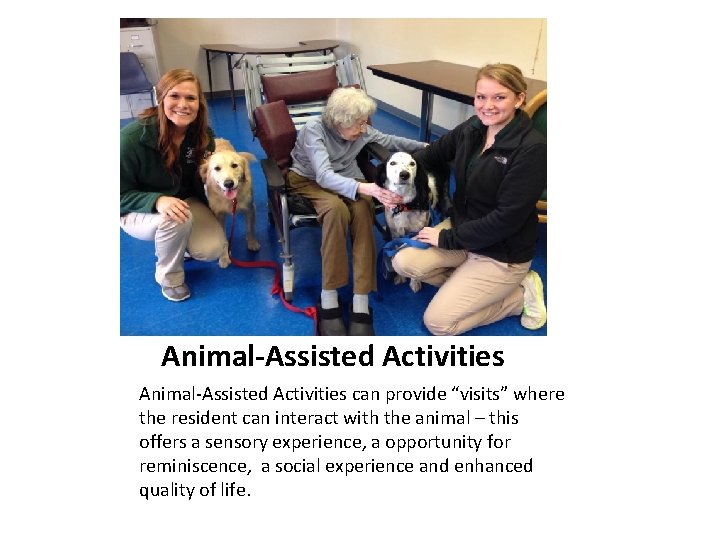
Animal-Assisted Activities can provide “visits” where the resident can interact with the animal – this offers a sensory experience, a opportunity for reminiscence, a social experience and enhanced quality of life.
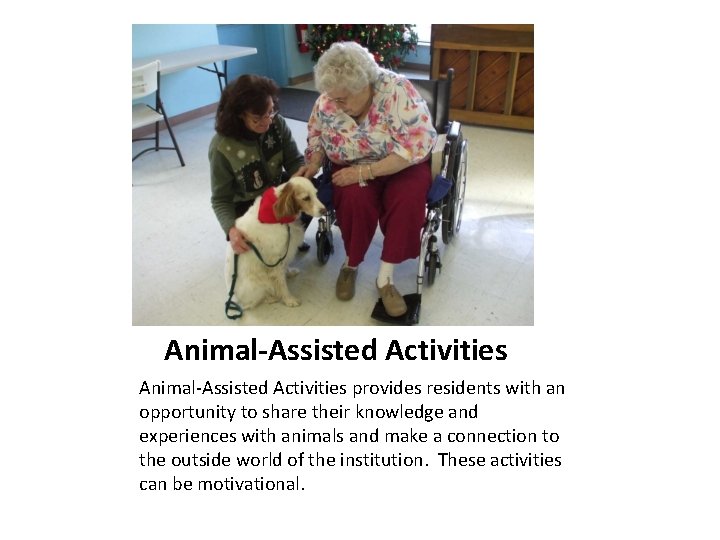
Animal-Assisted Activities provides residents with an opportunity to share their knowledge and experiences with animals and make a connection to the outside world of the institution. These activities can be motivational.
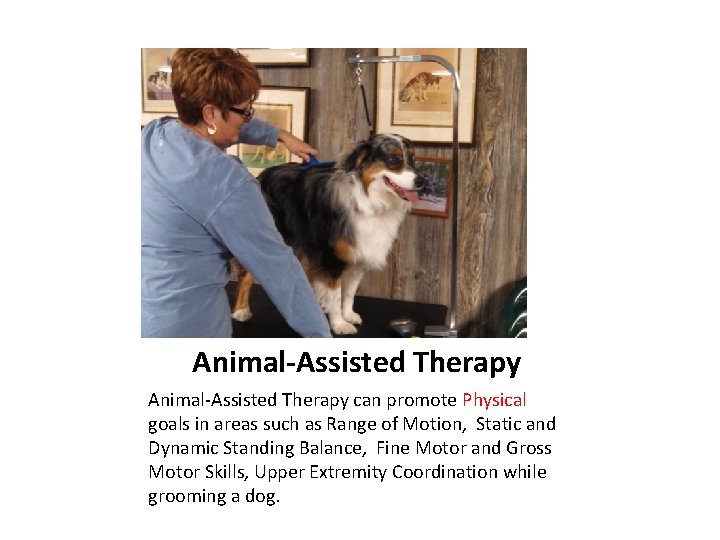
Animal-Assisted Therapy can promote Physical goals in areas such as Range of Motion, Static and Dynamic Standing Balance, Fine Motor and Gross Motor Skills, Upper Extremity Coordination while grooming a dog.
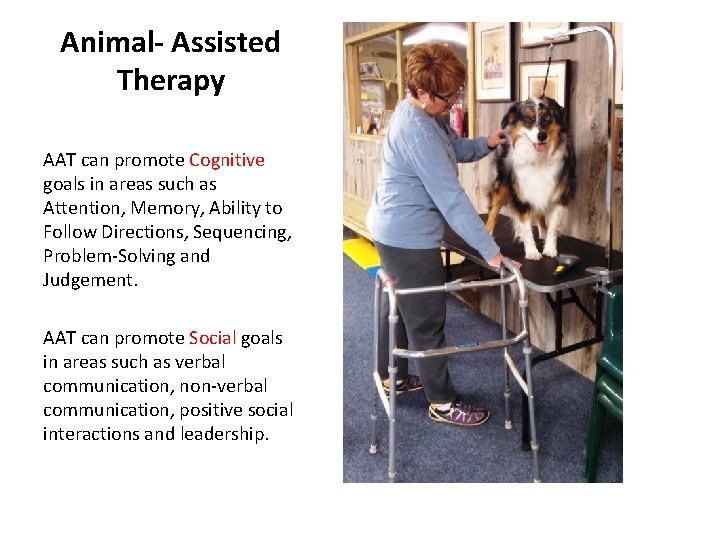
Animal- Assisted Therapy AAT can promote Cognitive goals in areas such as Attention, Memory, Ability to Follow Directions, Sequencing, Problem-Solving and Judgement. AAT can promote Social goals in areas such as verbal communication, non-verbal communication, positive social interactions and leadership.
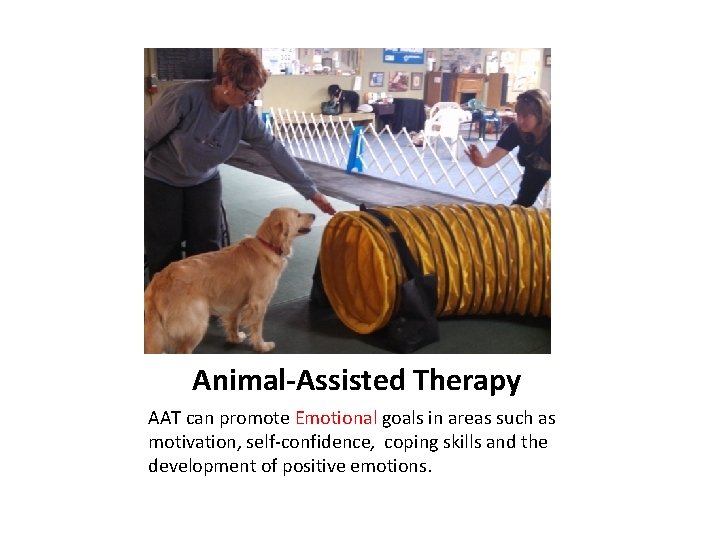
Animal-Assisted Therapy AAT can promote Emotional goals in areas such as motivation, self-confidence, coping skills and the development of positive emotions.
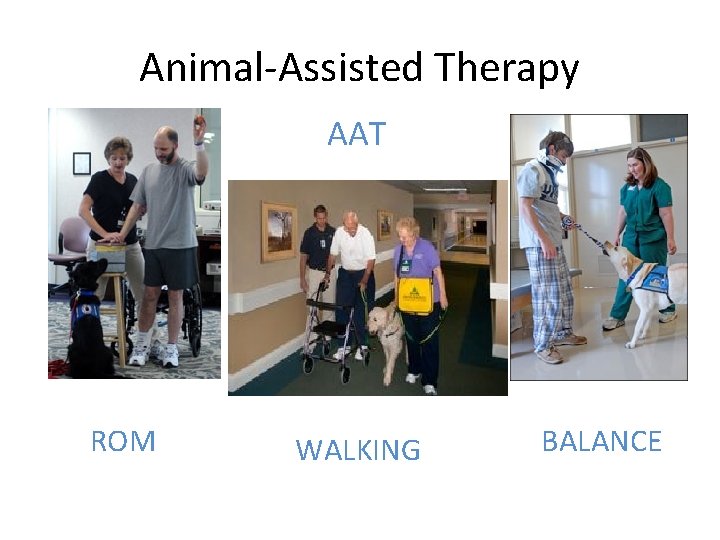
Animal-Assisted Therapy AAT ROM WALKING BALANCE
Animal-Assisted Therapy • Therapist’s working with their own dog/animal. (Logistics) • Therapist working with a volunteer animalhandler team. (Volunteer training) • Therapist working with a resident animalhandler. (Resident dog considerations) • Documentation & Evaluation. • Animal skills related to therapy goals.
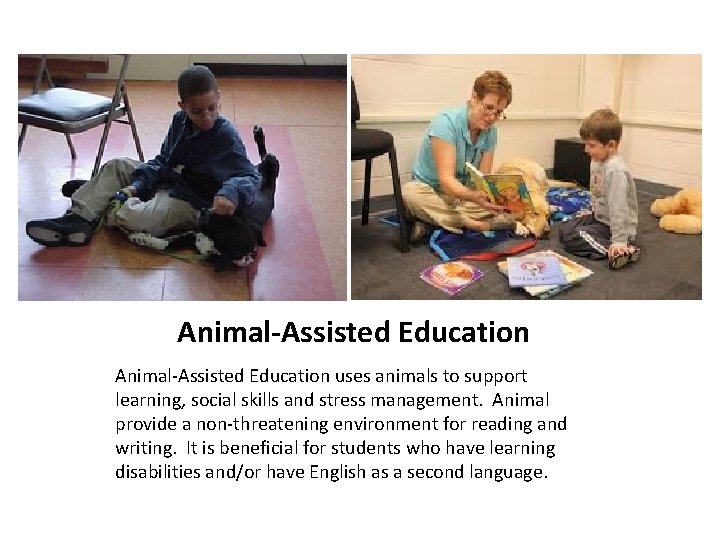
Animal-Assisted Education uses animals to support learning, social skills and stress management. Animal provide a non-threatening environment for reading and writing. It is beneficial for students who have learning disabilities and/or have English as a second language.
• Founded in 1977, a leader in promoting human-animal therapy, activities & education. • Highest industry standards, risk management, continuing education, registration process. • Species include dogs, cats, horses, birds, rabbits, miniature pigs, llamas/alpacas, guinea pigs and domesticated rats. • 14, 000 Pet Partners therapy teams in 48 states. https: //petpartners. org/
Therapy Dogs International • Established in 1976 as a volunteer organization dedicated to regulating, testing and registration of therapy dogs & handlers. • Dogs and handlers in all 50 states – over 24, 750 registered TDI dogs/handlers. • Therapy dog activities for Hospitals, nursing homes, hospice, home visits • Tail Waggin’ Tutors • Disaster Stress Relief Dogs
Alliance of Therapy Dogs • National Therapy Dog Registry • Founded in 1990 as Therapy Dogs Incorporated WY. • 14, 000 members in Us, Canada, Puerto Rico • Provides registration, support and insurance • Evaluation and Observation • No dietary restrictions (e. g. raw food diets)
Animal-Assisted Crisis Response • Specially trained teams geared to respond to intense emotional and environmental situations • Continuing education requirements • Work with other organizations to meet needs of survivors, responders and others affected by crises or disasters www. hopeaacr. org
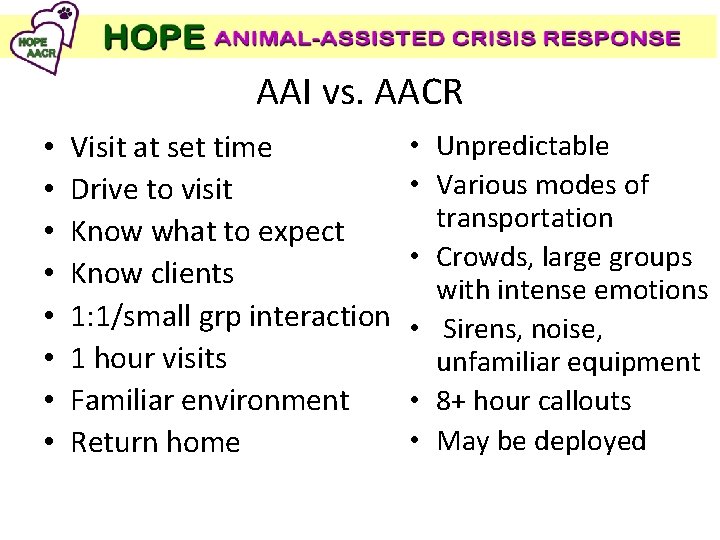
AAI vs. AACR • • Visit at set time Drive to visit Know what to expect Know clients 1: 1/small grp interaction 1 hour visits Familiar environment Return home • Unpredictable • Various modes of transportation • Crowds, large groups with intense emotions • Sirens, noise, unfamiliar equipment • 8+ hour callouts • May be deployed
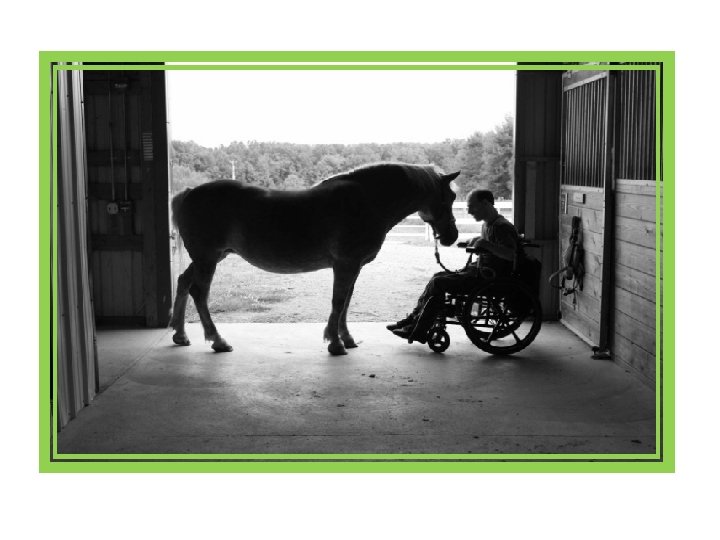
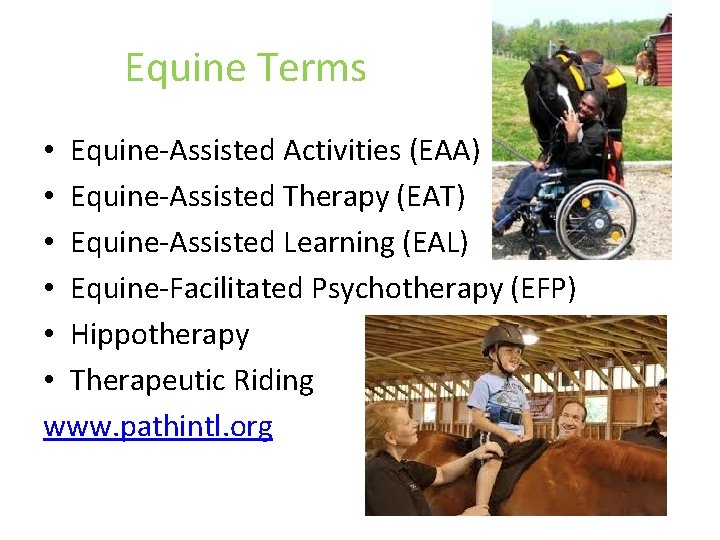
Equine Terms • Equine-Assisted Activities (EAA) • Equine-Assisted Therapy (EAT) • Equine-Assisted Learning (EAL) • Equine-Facilitated Psychotherapy (EFP) • Hippotherapy • Therapeutic Riding www. pathintl. org
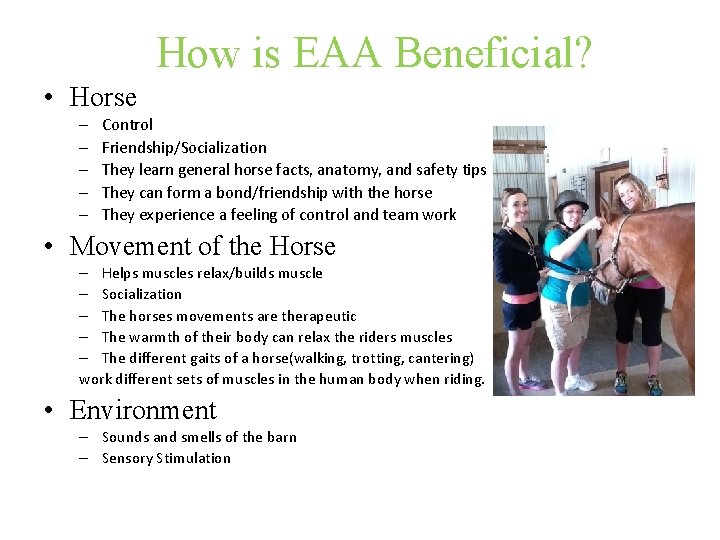
How is EAA Beneficial? • Horse – – – Control Friendship/Socialization They learn general horse facts, anatomy, and safety tips They can form a bond/friendship with the horse They experience a feeling of control and team work • Movement of the Horse – Helps muscles relax/builds muscle – Socialization – The horses movements are therapeutic – The warmth of their body can relax the riders muscles – The different gaits of a horse(walking, trotting, cantering) work different sets of muscles in the human body when riding. • Environment – Sounds and smells of the barn – Sensory Stimulation
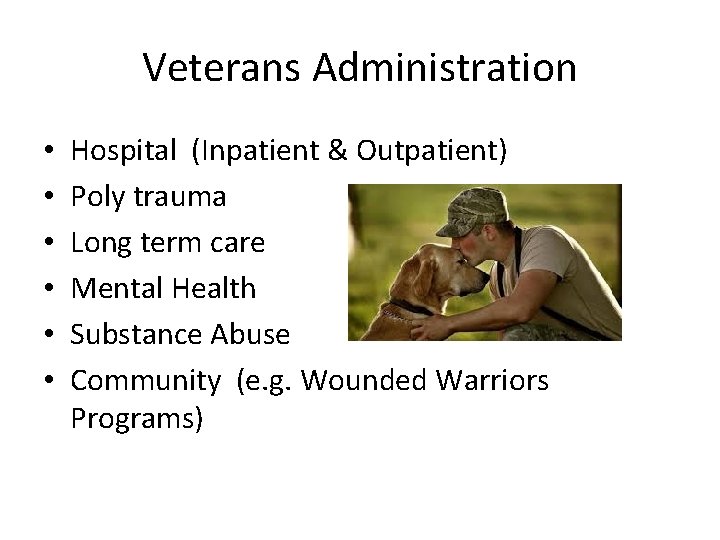
Veterans Administration • • • Hospital (Inpatient & Outpatient) Poly trauma Long term care Mental Health Substance Abuse Community (e. g. Wounded Warriors Programs)
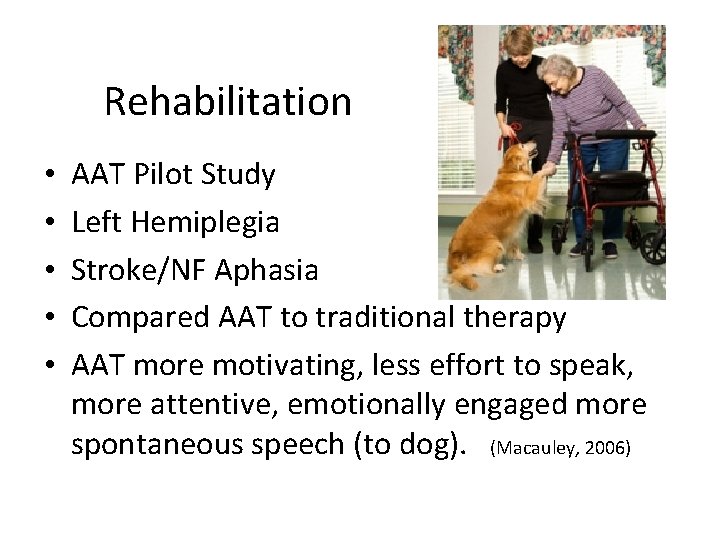
Rehabilitation • • • AAT Pilot Study Left Hemiplegia Stroke/NF Aphasia Compared AAT to traditional therapy AAT more motivating, less effort to speak, more attentive, emotionally engaged more spontaneous speech (to dog). (Macauley, 2006)
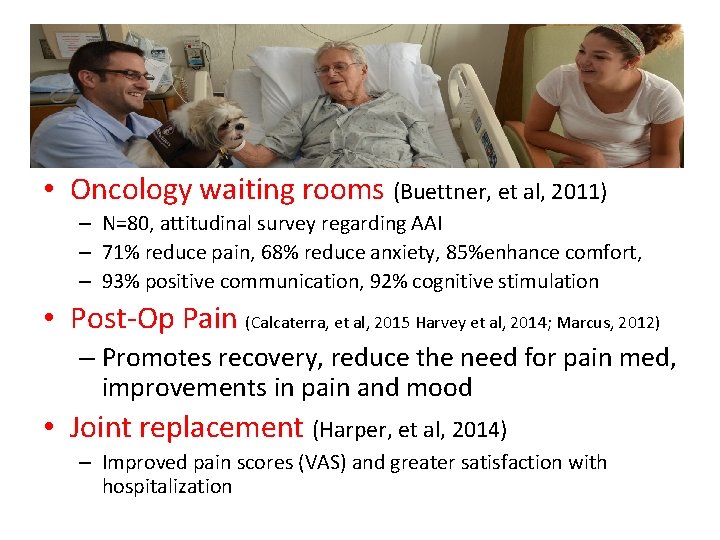
• Oncology waiting rooms (Buettner, et al, 2011) – N=80, attitudinal survey regarding AAI – 71% reduce pain, 68% reduce anxiety, 85%enhance comfort, – 93% positive communication, 92% cognitive stimulation • Post-Op Pain (Calcaterra, et al, 2015 Harvey et al, 2014; Marcus, 2012) – Promotes recovery, reduce the need for pain med, improvements in pain and mood • Joint replacement (Harper, et al, 2014) – Improved pain scores (VAS) and greater satisfaction with hospitalization
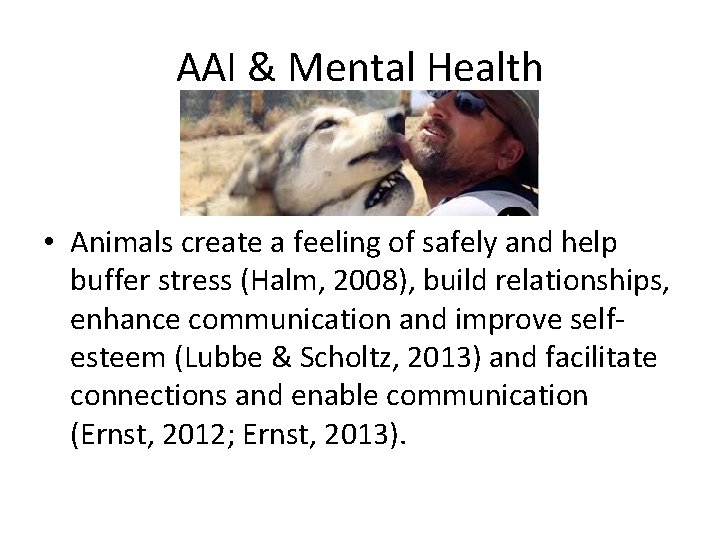
AAI & Mental Health • Animals create a feeling of safely and help buffer stress (Halm, 2008), build relationships, enhance communication and improve selfesteem (Lubbe & Scholtz, 2013) and facilitate connections and enable communication (Ernst, 2012; Ernst, 2013).
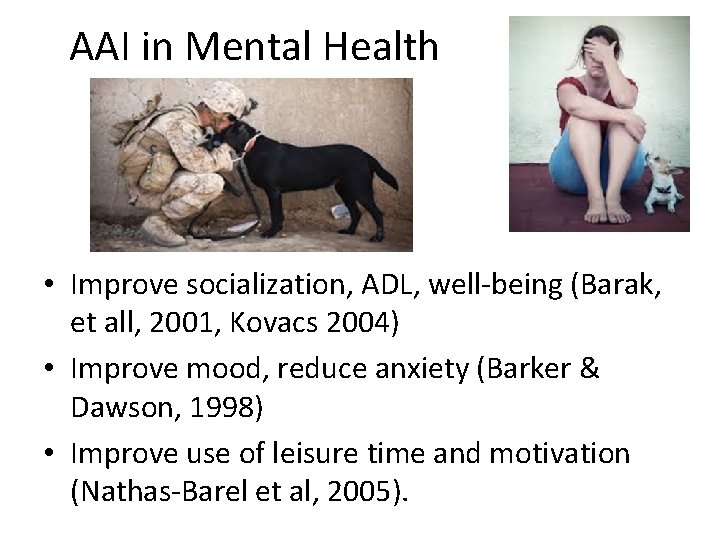
AAI in Mental Health • Improve socialization, ADL, well-being (Barak, et all, 2001, Kovacs 2004) • Improve mood, reduce anxiety (Barker & Dawson, 1998) • Improve use of leisure time and motivation (Nathas-Barel et al, 2005).
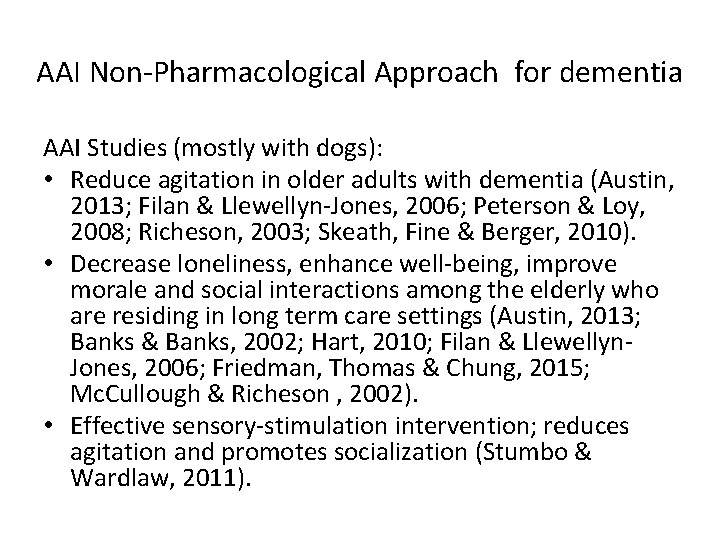
AAI Non-Pharmacological Approach for dementia AAI Studies (mostly with dogs): • Reduce agitation in older adults with dementia (Austin, 2013; Filan & Llewellyn-Jones, 2006; Peterson & Loy, 2008; Richeson, 2003; Skeath, Fine & Berger, 2010). • Decrease loneliness, enhance well-being, improve morale and social interactions among the elderly who are residing in long term care settings (Austin, 2013; Banks & Banks, 2002; Hart, 2010; Filan & Llewellyn. Jones, 2006; Friedman, Thomas & Chung, 2015; Mc. Cullough & Richeson , 2002). • Effective sensory-stimulation intervention; reduces agitation and promotes socialization (Stumbo & Wardlaw, 2011).
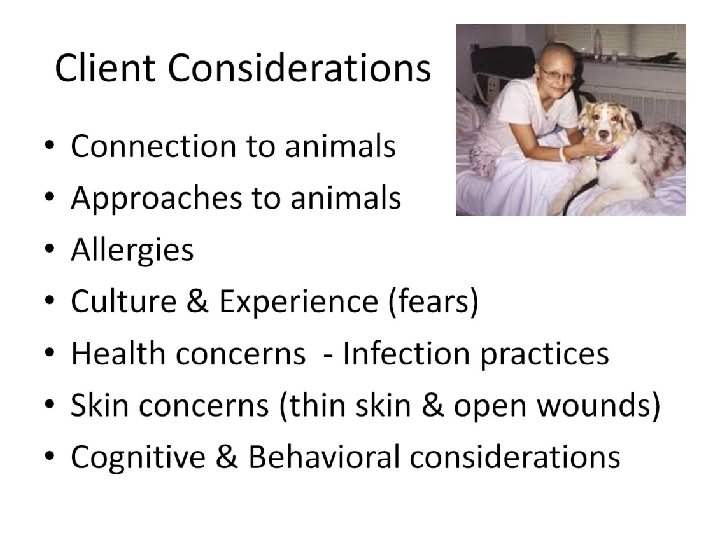
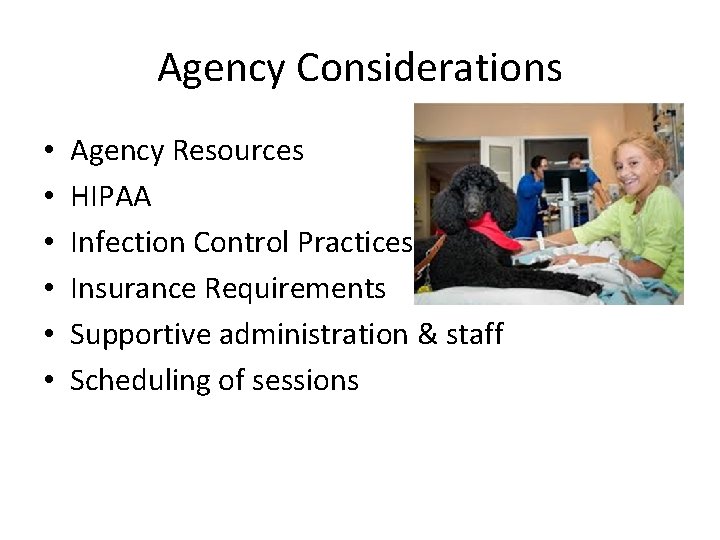
Agency Considerations • • • Agency Resources HIPAA Infection Control Practices Insurance Requirements Supportive administration & staff Scheduling of sessions
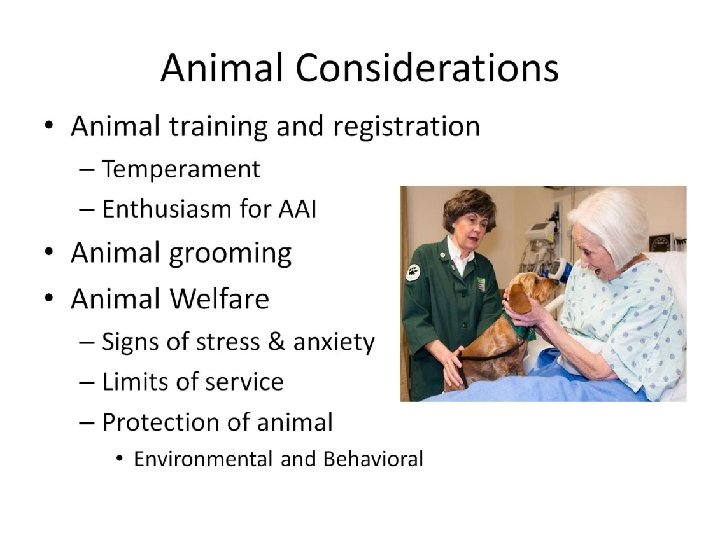
Managing Risk • • Develop a written policy Identify a AAI liaison Require formal training and registration Animals and handlers should be screened Infection control should guide locations for AAI Staff & Volunteer education/training Observe standard health practices Revaluation and immunization check (SHEA, 2015)
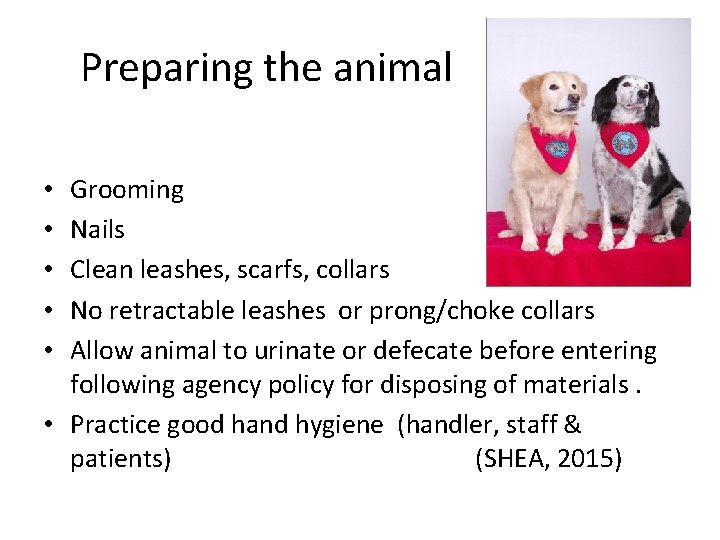
Preparing the animal Grooming Nails Clean leashes, scarfs, collars No retractable leashes or prong/choke collars Allow animal to urinate or defecate before entering following agency policy for disposing of materials. • Practice good hand hygiene (handler, staff & patients) (SHEA, 2015) • • •
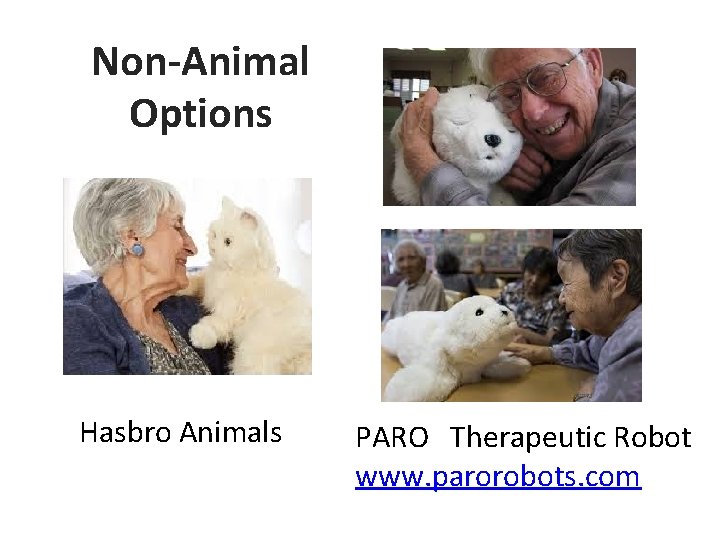
Non-Animal Options Hasbro Animals PARO Therapeutic Robot www. parorobots. com
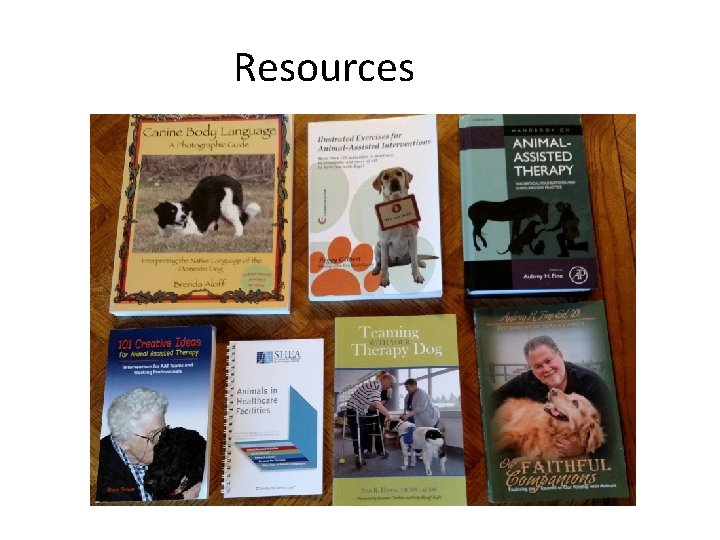
Resources
Resources • See References Handout • HABI Newsletter lmelfi@habri. org • Pet Partners - http: //www. petpartners. org • Therapy Dogs International - http: //www. tdi-dog. org • Alliance of Therapy Dogs https: //www. therapydogs. com • Temple Owls https: //sites. temple. edu/rtwiseowls/category/anim al-assisted-therapy/
- Slides: 47