
Animal adaptation First animalKoala Structural adaptation ClawsThe koala
- Slides: 5
Animal adaptation
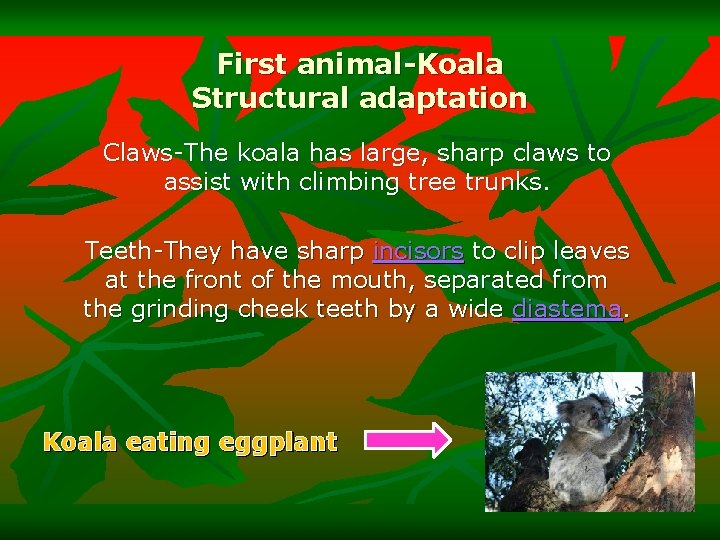
First animal-Koala Structural adaptation Claws-The koala has large, sharp claws to assist with climbing tree trunks. Teeth-They have sharp incisors to clip leaves at the front of the mouth, separated from the grinding cheek teeth by a wide diastema. Koala eating eggplant
First animal-Koala Behavioural adaptation Social behaviour-Koalas are essentially solitary animals, but they live in communities where the social structure is quite complex. Koalas are territorial, but each koala within the social group has its own specific range for feeding, which may or may not overlap the range of its neighbour. There is always one dominant male in each social group, but he is by no means the only male.
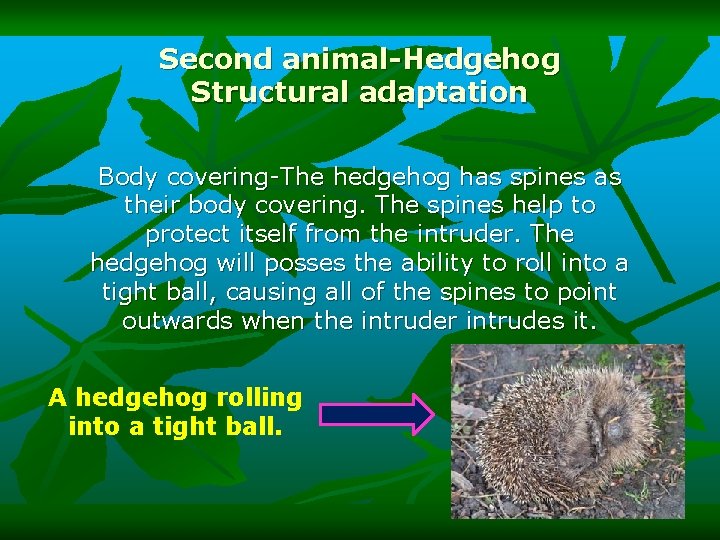
Second animal-Hedgehog Structural adaptation Body covering-The hedgehog has spines as their body covering. The spines help to protect itself from the intruder. The hedgehog will posses the ability to roll into a tight ball, causing all of the spines to point outwards when the intruder intrudes it. A hedgehog rolling into a tight ball.
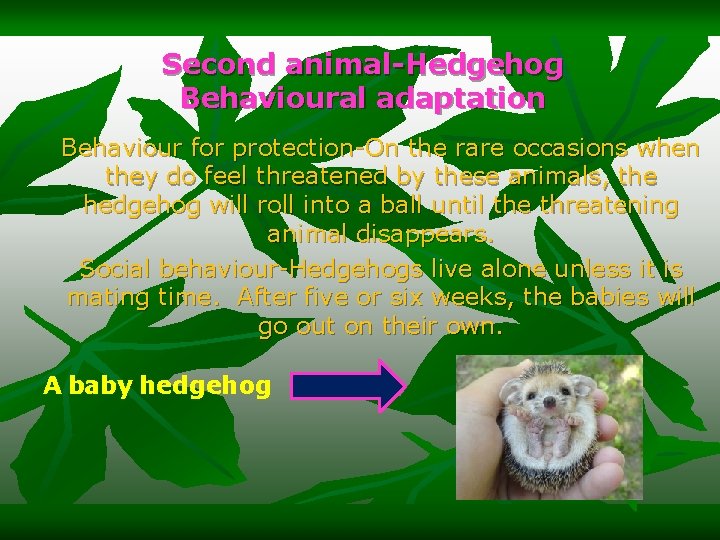
Second animal-Hedgehog Behavioural adaptation Behaviour for protection-On the rare occasions when they do feel threatened by these animals, the hedgehog will roll into a ball until the threatening animal disappears. Social behaviour-Hedgehogs live alone unless it is mating time. After five or six weeks, the babies will go out on their own. A baby hedgehog