
Angular resolution study of isolated gamma with GLD

![Position Resolution of Cluster (cell : 1 cm) barrel endcap σ [mrad] 1 Ge.](https://slidetodoc.com/presentation_image_h2/022ddbf0bd58f6a7fc86b1a2b5ca5562/image-9.jpg "Position Resolution of Cluster (cell : 1 cm) barrel endcap σ [mrad] 1 Ge.")
![Energy Dependent Result of position resolution σ [mrad] 1 Ge. V 2 Ge. V](https://slidetodoc.com/presentation_image_h2/022ddbf0bd58f6a7fc86b1a2b5ca5562/image-10.jpg "Energy Dependent Result of position resolution σ [mrad] 1 Ge. V 2 Ge. V")

![σ [mrad] Energy Dependence (1, 2, 5, 10, 50 Ge. V) 2 Ge. V](https://slidetodoc.com/presentation_image_h2/022ddbf0bd58f6a7fc86b1a2b5ca5562/image-14.jpg "σ [mrad] Energy Dependence (1, 2, 5, 10, 50 Ge. V) 2 Ge. V")
![Cell size dependence gamma @10 Ge. V 1 [cm] : 48. 3 ± 0.](https://slidetodoc.com/presentation_image_h2/022ddbf0bd58f6a7fc86b1a2b5ca5562/image-18.jpg "Cell size dependence gamma @10 Ge. V 1 [cm] : 48. 3 ± 0.")
![Absorber Dependence (Tungsten, Lead) Tungsten[3 mm] Lead[4. 8 mm] Same total radiation length Lead[3](https://slidetodoc.com/presentation_image_h2/022ddbf0bd58f6a7fc86b1a2b5ca5562/image-22.jpg "Absorber Dependence (Tungsten, Lead) Tungsten[3 mm] Lead[4. 8 mm] Same total radiation length Lead[3")
- Slides: 30
Angular resolution study of isolated gamma with GLD detector simulation 2007/Feb/5 ACFA ILC Workshop M 1 ICEPP, Tokyo Hitoshi HANO On behalf of the Acfa-Sim-J Group 1
Contents n Introduction n Angular Resolution Study Position Resolution of ECAL cluster ¨ Direction of Reconstructed gamma ¨ n Calorimeter Component Dependence ¨Cell size Dependence ¨Material Dependence n Summary 2
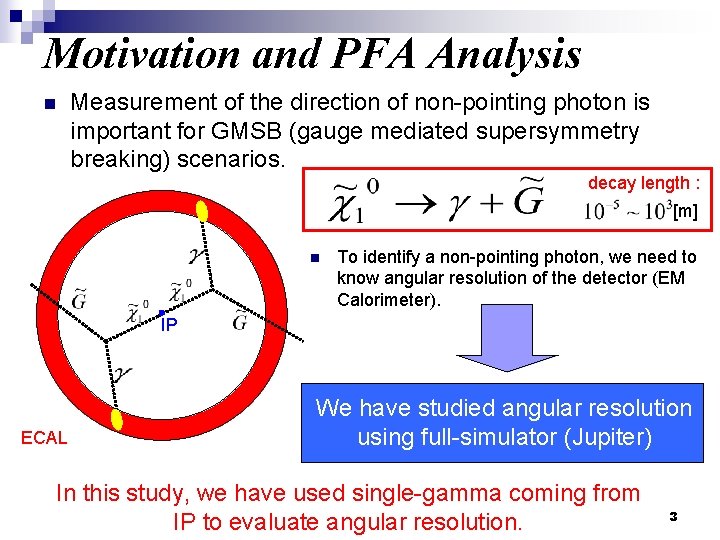
Motivation and PFA Analysis n Measurement of the direction of non-pointing photon is important for GMSB (gauge mediated supersymmetry breaking) scenarios. decay length : [m] n To identify a non-pointing photon, we need to know angular resolution of the detector (EM Calorimeter). IP ECAL We have studied angular resolution using full-simulator (Jupiter) In this study, we have used single-gamma coming from IP to evaluate angular resolution. 3
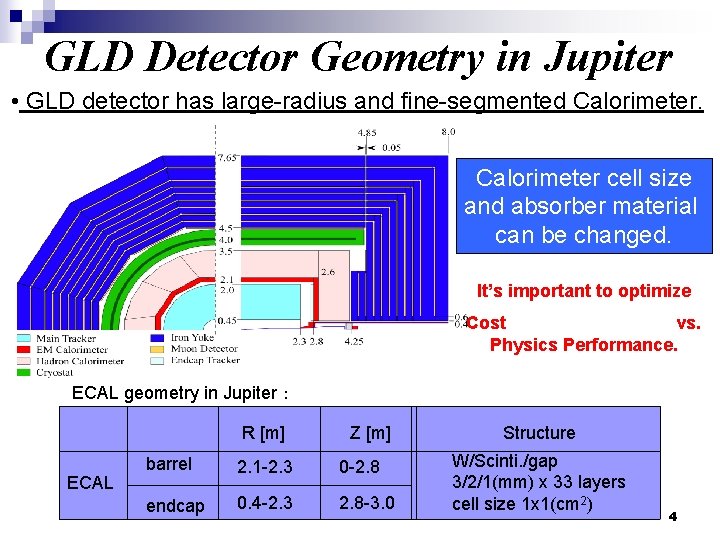
GLD Detector Geometry in Jupiter • GLD detector has large-radius and fine-segmented Calorimeter cell size and absorber material can be changed. It’s important to optimize Cost vs. Physics Performance. ECAL geometry in Jupiter : R [m] ECAL Z [m] barrel 2. 1 -2. 3 0 -2. 8 endcap 0. 4 -2. 3 2. 8 -3. 0 Structure W/Scinti. /gap 3/2/1(mm) x 33 layers cell size 1 x 1(cm 2) 4
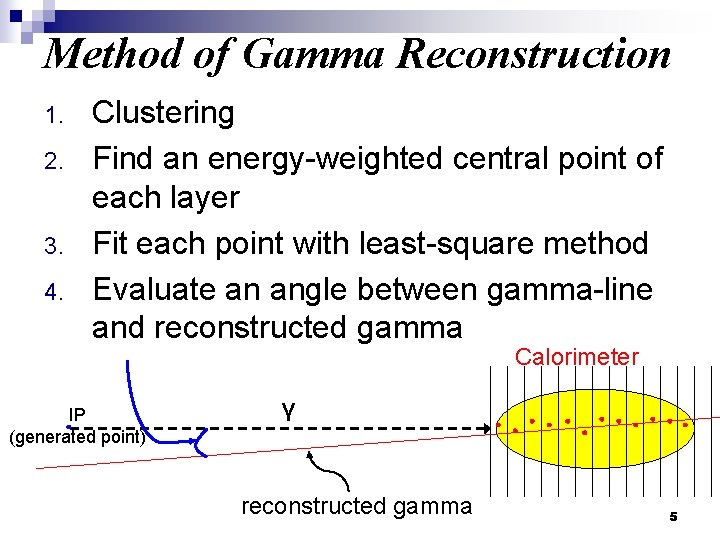
Method of Gamma Reconstruction 1. 2. 3. 4. Clustering Find an energy-weighted central point of each layer Fit each point with least-square method Evaluate an angle between gamma-line and reconstructed gamma Calorimeter IP (generated point) γ reconstructed gamma 5
Angular Resolution Study ~ Position Resolution of Cluster ~ 6
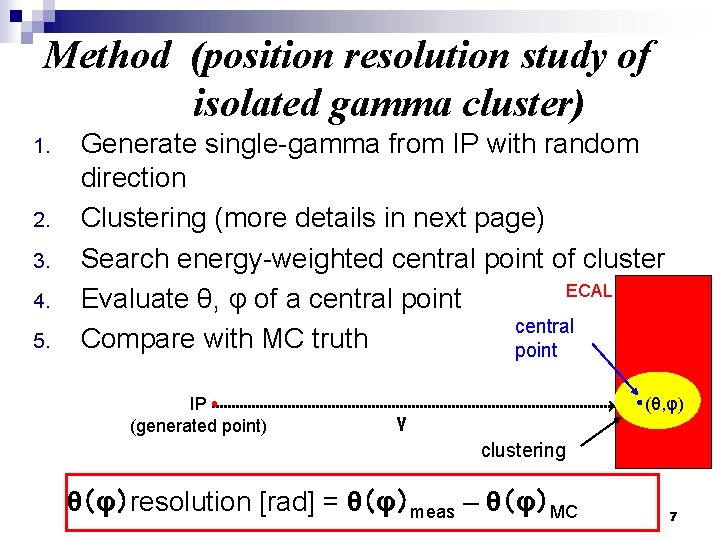
Method (position resolution study of aaaaaaa isolated gamma cluster) 1. 2. 3. 4. 5. Generate single-gamma from IP with random direction Clustering (more details in next page) Search energy-weighted central point of cluster ECAL Evaluate θ, φ of a central point central Compare with MC truth point IP (generated point) (θ, φ) γ clustering θ(φ)resolution [rad] = θ(φ)meas – θ(φ)MC 7
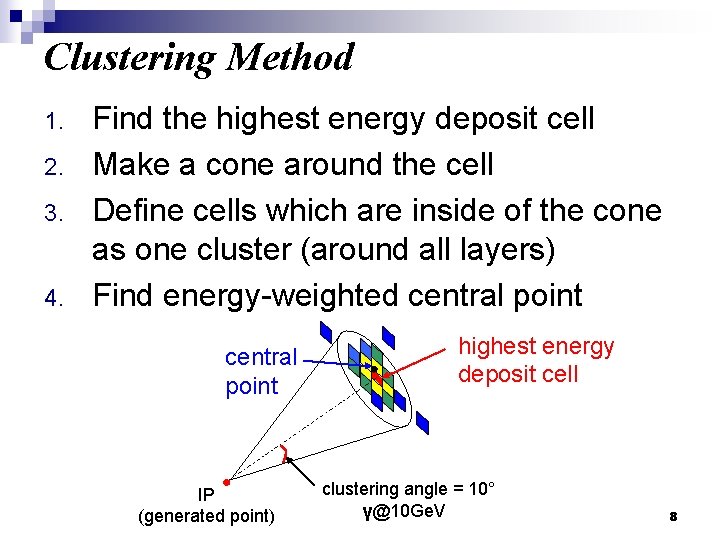
Clustering Method 1. 2. 3. 4. Find the highest energy deposit cell Make a cone around the cell Define cells which are inside of the cone as one cluster (around all layers) Find energy-weighted central point IP (generated point) highest energy deposit cell clustering angle = 10° γ@10 Ge. V 8
Position Resolution of Cluster (cell : 1 cm) barrel endcap σ [mrad] 1 Ge. V 2 Ge. V 5 Ge. V 10 Ge. V |cos(θ)| θ resolution is better for larger cos(θ) ECAL IP (generated point) |cos(θ)| φ resolution is worse for larger cos(θ) geometrical effect Position resolution : ~0. 1 [cm] gamma@10 Ge. V 9
Energy Dependent Result of position resolution σ [mrad] 1 Ge. V 2 Ge. V 5 Ge. V 10 Ge. V 1/√E θ barrel : [mrad] φ barrel : [mrad] θ endcap : [mrad] φ endcap : [mrad] 10
Angular Resolution Study ~ Direction of Reconstructed gamma ~ 11
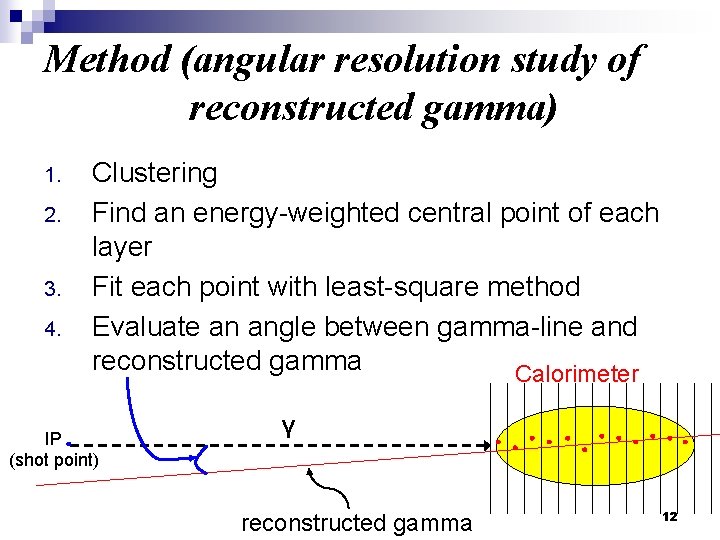
Method (angular resolution study of reconstructed gamma) 1. 2. 3. 4. Clustering Find an energy-weighted central point of each layer Fit each point with least-square method Evaluate an angle between gamma-line and reconstructed gamma Calorimeter IP (shot point) γ reconstructed gamma 12
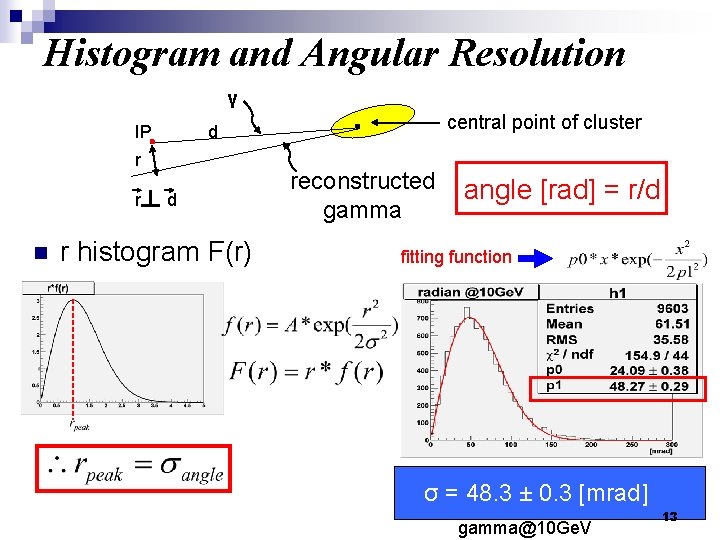
Histogram and Angular Resolution γ IP r r n central point of cluster d d r histogram F(r) reconstructed gamma angle [rad] = r/d fitting function σ = 48. 3 ± 0. 3 [mrad] gamma@10 Ge. V 13
σ [mrad] Energy Dependence (1, 2, 5, 10, 50 Ge. V) 2 Ge. V 10 Ge. V 1 Ge. V Average over full acceptance 5 Ge. V 50 Ge. V 1/√E [mrad] 14
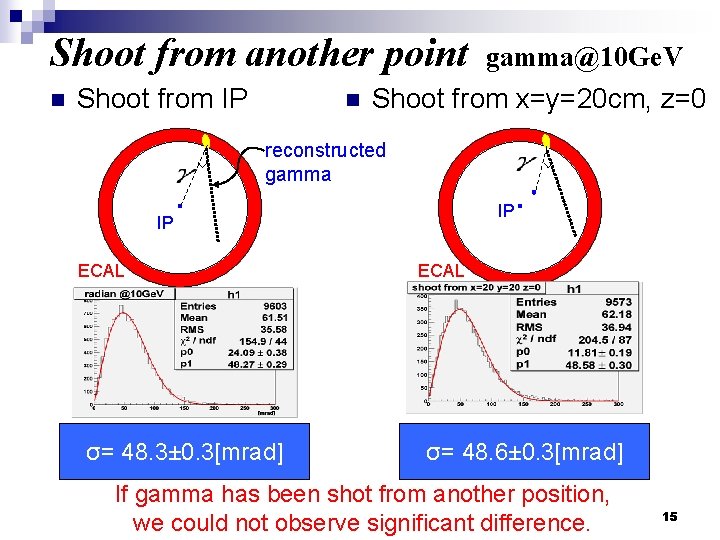
Shoot from another point n Shoot from IP n gamma@10 Ge. V Shoot from x=y=20 cm, z=0 reconstructed gamma IP IP ECAL σ= 48. 3± 0. 3[mrad] ECAL σ= 48. 6± 0. 3[mrad] If gamma has been shot from another position, we could not observe significant difference. 15
Calorimeter Component Dependence 16
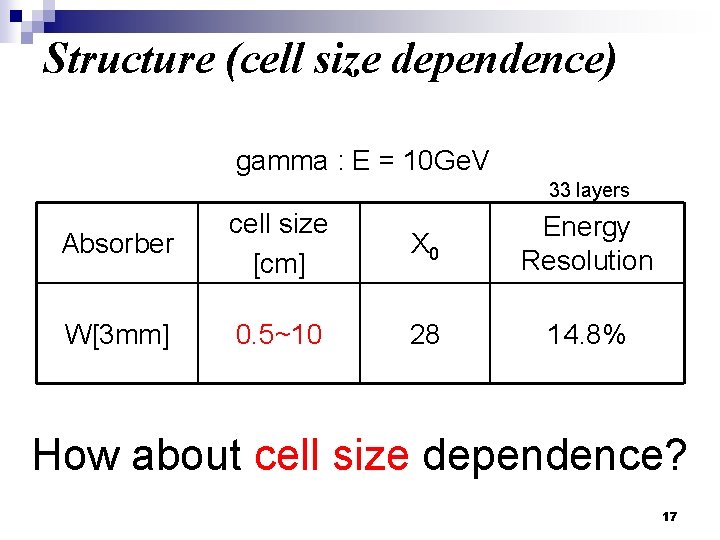
Structure (cell size dependence) gamma : E = 10 Ge. V 33 layers Absorber cell size [cm] X 0 Energy Resolution W[3 mm] 0. 5~10 28 14. 8% How about cell size dependence? 17
Cell size dependence gamma @10 Ge. V 1 [cm] : 48. 3 ± 0. 3 [mrad] 0. 5 [cm] : 46. 4 ± 0. 3 [mrad] <5% We could not observe significant improvement from 1 cm to 0. 5 cm
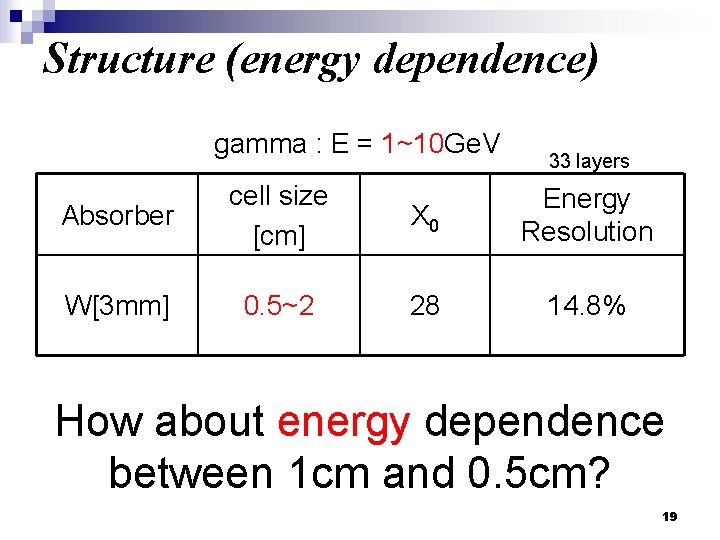
Structure (energy dependence) gamma : E = 1~10 Ge. V 33 layers Absorber cell size [cm] X 0 Energy Resolution W[3 mm] 0. 5~2 28 14. 8% How about energy dependence between 1 cm and 0. 5 cm? 19
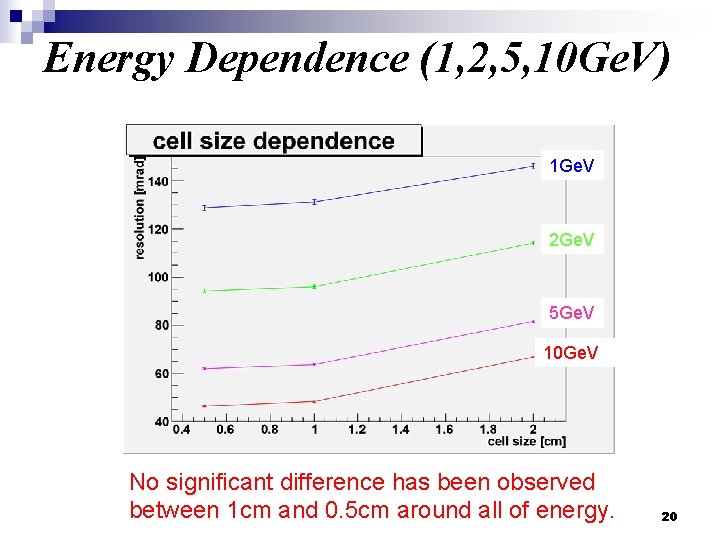
Energy Dependence (1, 2, 5, 10 Ge. V) 1 Ge. V 2 Ge. V 5 Ge. V 10 Ge. V No significant difference has been observed between 1 cm and 0. 5 cm around all of energy. 20
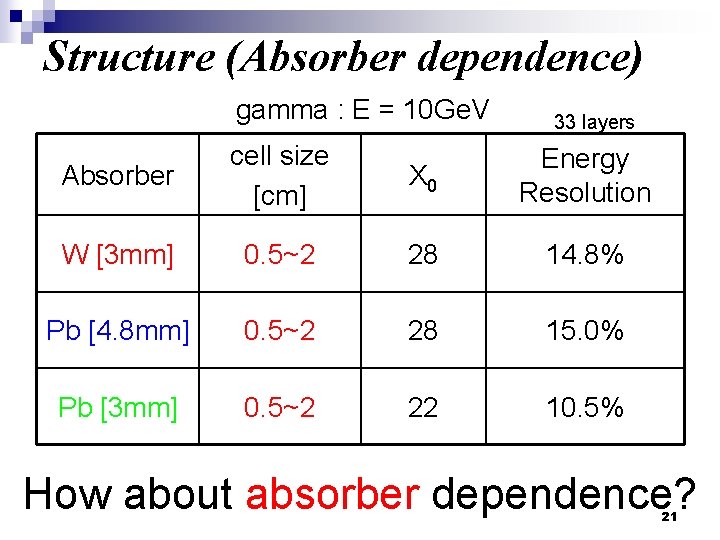
Structure (Absorber dependence) gamma : E = 10 Ge. V 33 layers Absorber cell size [cm] X 0 Energy Resolution W [3 mm] 0. 5~2 28 14. 8% Pb [4. 8 mm] 0. 5~2 28 15. 0% Pb [3 mm] 0. 5~2 22 10. 5% How about absorber dependence? 21
Absorber Dependence (Tungsten, Lead) Tungsten[3 mm] Lead[4. 8 mm] Same total radiation length Lead[3 mm] Tungsten [3 mm] : 48. 3 ± 0. 3 [mrad] Lead @1 x 1 [cm] [4. 8 mm] : 45. 5 ± 0. 3 [mrad] Angular resolution with Lead is better than Tungsten 22
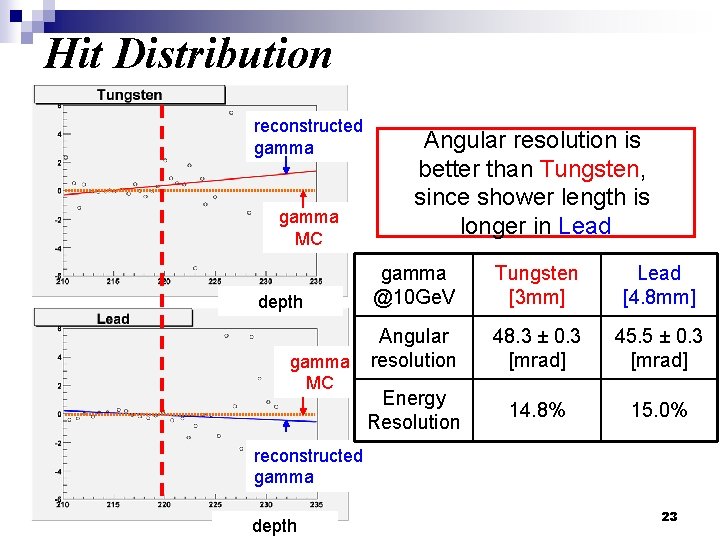
Hit Distribution reconstructed gamma MC depth gamma MC Angular resolution is better than Tungsten, since shower length is longer in Lead gamma @10 Ge. V Tungsten [3 mm] Lead [4. 8 mm] Angular resolution 48. 3 ± 0. 3 [mrad] 45. 5 ± 0. 3 [mrad] Energy Resolution 14. 8% 15. 0% reconstructed gamma depth 23
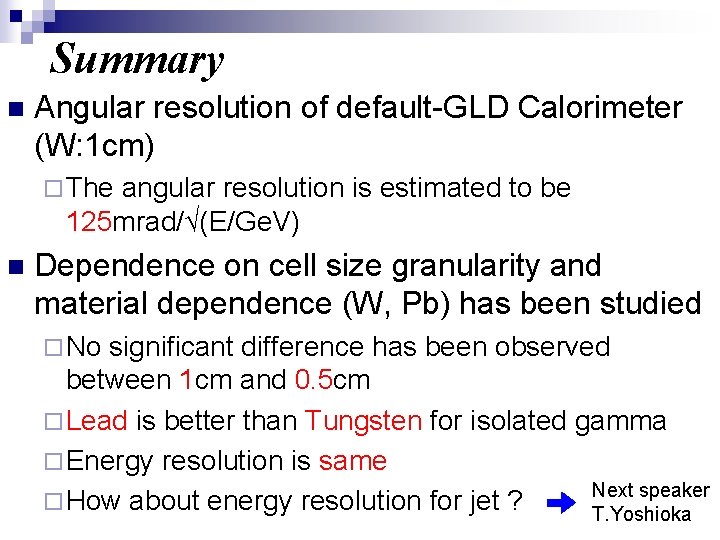
Summary n Angular resolution of default-GLD Calorimeter (W: 1 cm) ¨ The angular resolution is estimated to be 125 mrad/√(E/Ge. V) n Dependence on cell size granularity and material dependence (W, Pb) has been studied ¨ No significant difference has been observed between 1 cm and 0. 5 cm ¨ Lead is better than Tungsten for isolated gamma ¨ Energy resolution is same Next speaker ¨ How about energy resolution for jet ? T. Yoshioka
Backup 25
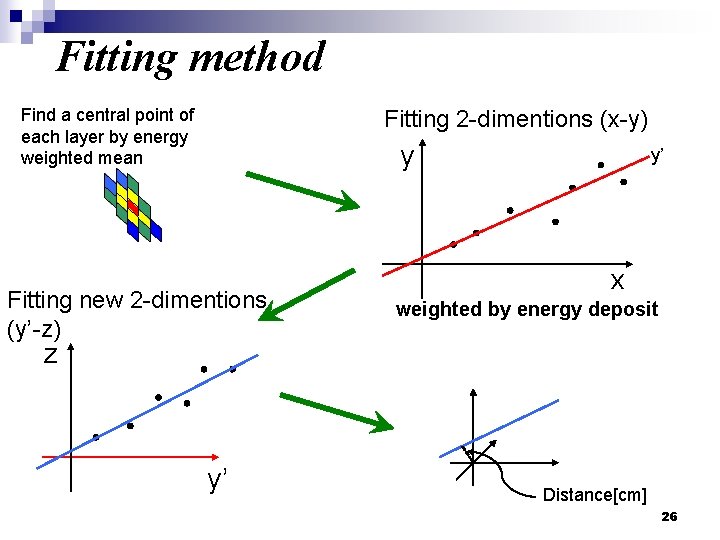
Fitting method Find a central point of each layer by energy weighted mean Fitting 2 -dimentions (x-y) y Fitting new 2 -dimentions (y’-z) y’ x weighted by energy deposit z y’ Distance[cm] 26
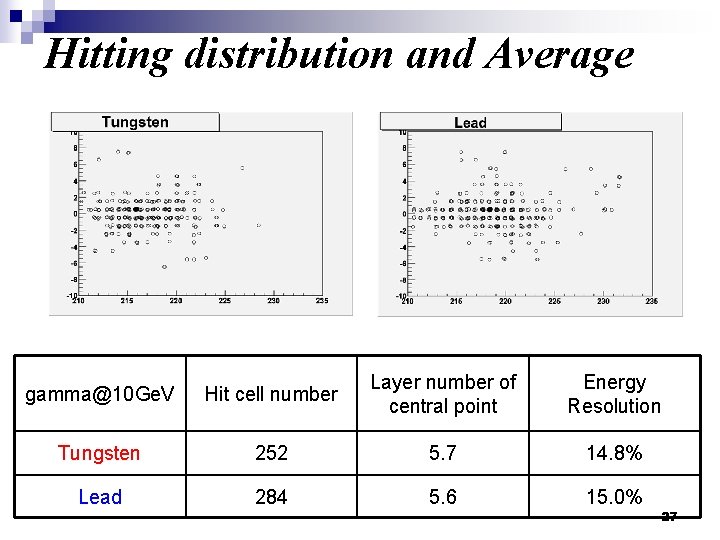
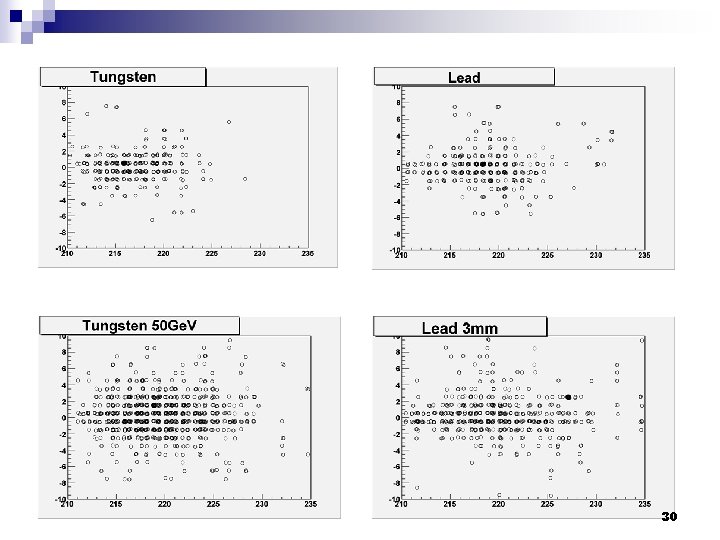
Hitting distribution and Average gamma@10 Ge. V Hit cell number Layer number of central point Energy Resolution Tungsten 252 5. 7 14. 8% Lead 284 5. 6 15. 0% 27
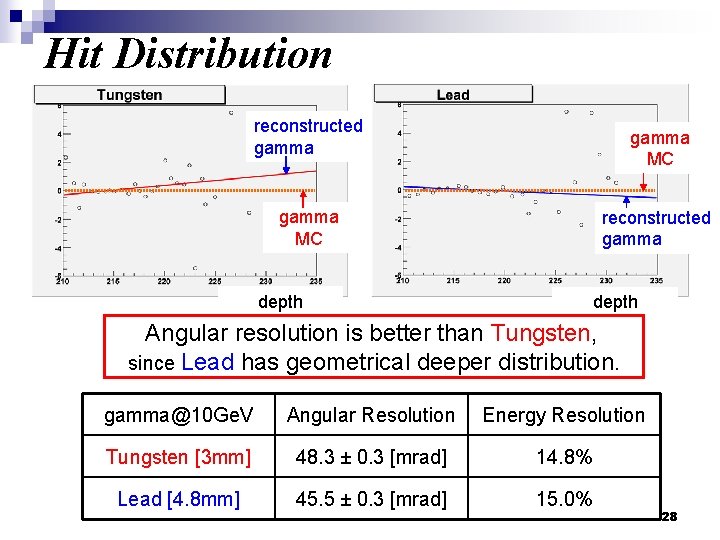
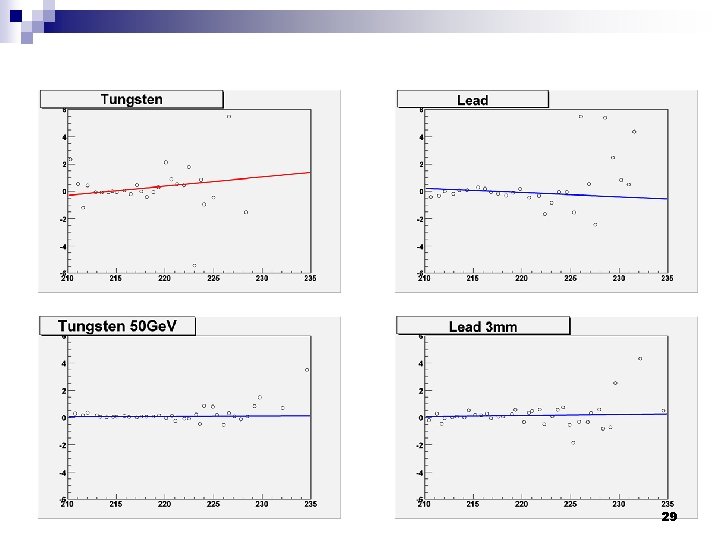
Hit Distribution reconstructed gamma MC reconstructed gamma depth Angular resolution is better than Tungsten, since Lead has geometrical deeper distribution. gamma@10 Ge. V Angular Resolution Energy Resolution Tungsten [3 mm] 48. 3 ± 0. 3 [mrad] 14. 8% Lead [4. 8 mm] 45. 5 ± 0. 3 [mrad] 15. 0% 28
29
30