
ANGLOSAXON HISTORY INVADERS Iberians Iberian Peninsula between Portugal
ANGLOSAXON HISTORY
INVADERS Iberians (Iberian Peninsula between Portugal and Spain – said to be from Spain) Romans (Italy, all over Roman empire) Jutes (Jutland, Denmark) Angles and Saxons (Germany) Vikings (Danes, Norsemen, all over Scandinavia Normans (Normandy, France)
ENGLAND’S HISTORY First known EXPLORERS were from Spain and were called the Iberians. The earliest known INHABITANTS were the Celts or Britons. In 43 AD (1 st Century) the Emperor Claudius CONQUERED Britain and began a 400 -year rule for the Romans during which time they built roads and forts and kept out ALL OTHER INVADERS.
END OF ROMAN RULE In 410 AD, the Romans withdrew to protect their capitol, which was under attack by barbarians. When the Romans left, they left no organized central government. There were only clans (family, clan, tribe, kingdom). Everyone and no one was in charge!
THE INVASIONS BEGIN In 449 with Britain unprotected the invasions began. A group of non-Christian looters came across the North German Plain and the North Sea from Jutland,
THE INVASIONS BEGIN Soon thereafter, the Angles and Saxons crossed the Baltic shores of Germany and guaranteed the slaughter of every woman and child if the Britons did not cooperate.
NEW GOVERNMENT In 793 the Vikings attempted to defeat the Angles and Saxons but were unsuccessful. The Vikings were defeated by Alfred the Great, who unified the country and created the HEPTARCHY.
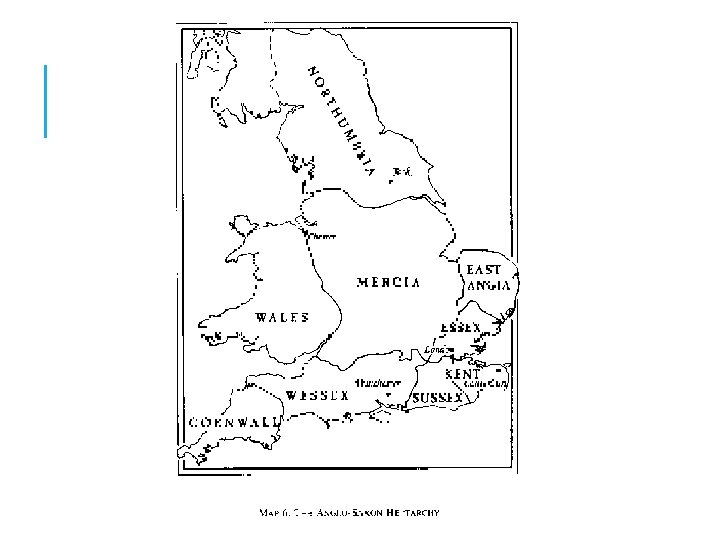
HEPTARCHY Angles and Saxons divided the country into seven kingdoms called the HEPTARCHY.
HEPTARCHY The Anglo-Saxon language is what we refer to now as Old English. Together, the Angles and the Saxons created Angleland, whose name slowly changed to Engla Land, then, of course, England.
HEPTARCHY While each of the different kingdoms had its own king, one king always stood out as being stronger than the others and was “in charge” Egbert of Wessex was the last king to control the heptarchy, and often considered to be the first king of England.
EPIC It is a long narrative poem on a serious subject, told in a formal and elevated style, and centered on a heroic or quasi-divine figure on whose actions depend the fate of a tribe, a nation, or the human race
TRADITIONAL EPIC Traditional epic – written versions of what had originally been oral poems about a tribal or national hero during a warlike age. Examples: Iliad, Odyssey, Beowulf
LITERARY EPIC Literary epic – a narrative poem composed by poets in imitation of the traditional epic form Examples: Aeneid, Paradise Lost, Hyperion
EPIC TRAITS 1. The hero is a figure of great national or even cosmic importance 2. The setting of the poem is ample in scale, and may be worldwide, or even larger 3. The action involves superhuman deeds in battle or a long journey in the face of opposition by some “godlike” character 4. Supernatural beings (or gods) take an active part in the action. 5. An epic poem is a ceremonial performance, and is narrated in a formal style that is deliberately distanced from ordinary speech.
ALFRED THE GREAT Unified the country (Heptarchy) Set up the first public schools Established the Anglo-Saxon Chronicle (the first historical document written in English, which replaced Latin, the language of the church and educated folks.
MY KINGDOM FOR A COUNTRY… HEPTARCHY North Umbria Mercia East Anglia Essex Wessex Sussex Kent
WHAT DO WE HAVE IN COMMON? Common language Heroic ideal and traditional set of heroes Admiration for people of courage Loyalty to leader by showing personal valor Respect for persons of authority Rulers were generous to their followers Awareness that life is short Acceptance of whatever wyrd (fate) had in store
ANGLO SAXON CULTURE
RELIGION Before the Romans, the Celtic religion was Animism, which also means spirit. Much like Native Americans, Celts saw spirits in all things…rivers, trees, fire… Many believed the spirits would not be satisfied without human sacrifice. Druids were Celtic priests believed to have worshipped at Stonehenge.
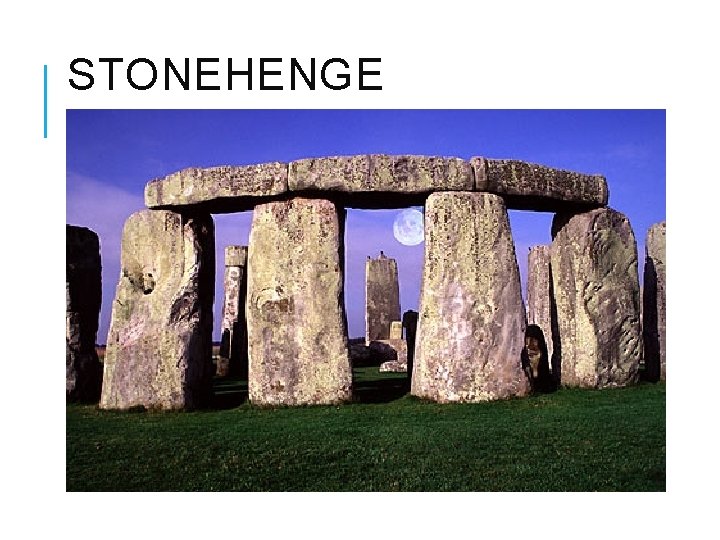
STONEHENGE
STONEHENGE Considered one of the great wonders of the world and located in England. Stone used to build could only be found 300 miles away in Western Wales. Each stone weighed up to 80 tons, so it is a mystery how it was transported and arranged.
CATHOLICISM When the Romans arrived, they brought with them Christianity: specifically, Catholicism. Once “barbarians” invaded and conquered, Christianity slowly died out. Missionaries led by St. Augustine from France (the Continent) came and converted King Ethelbert of Kent. He created the first monastery and named St. Augustine the first Archbishop of Canterbury, the most powerful religious position in England.
MONASTERIES Monasteries were converted to centers of learning. Monks were given the task of translating Latin documents into English so the common people could read their own histories and religious documents.
ORSE MYTHOLOGY Briefly…
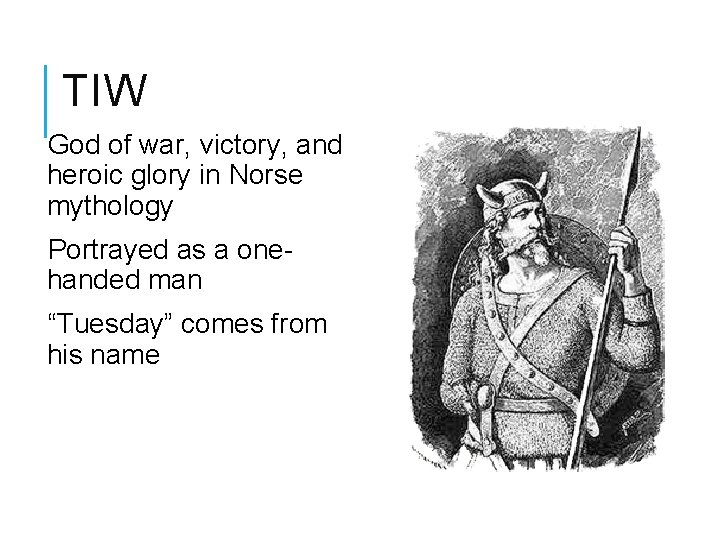
TIW God of war, victory, and heroic glory in Norse mythology Portrayed as a onehanded man “Tuesday” comes from his name
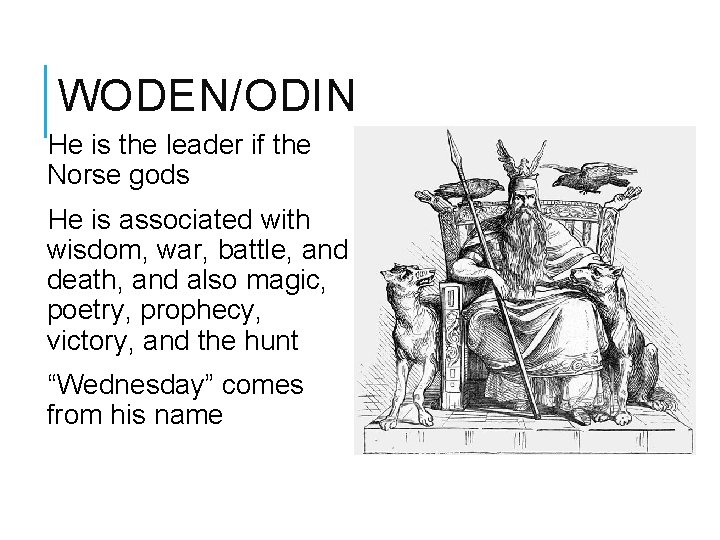
WODEN/ODIN He is the leader if the Norse gods He is associated with wisdom, war, battle, and death, and also magic, poetry, prophecy, victory, and the hunt “Wednesday” comes from his name
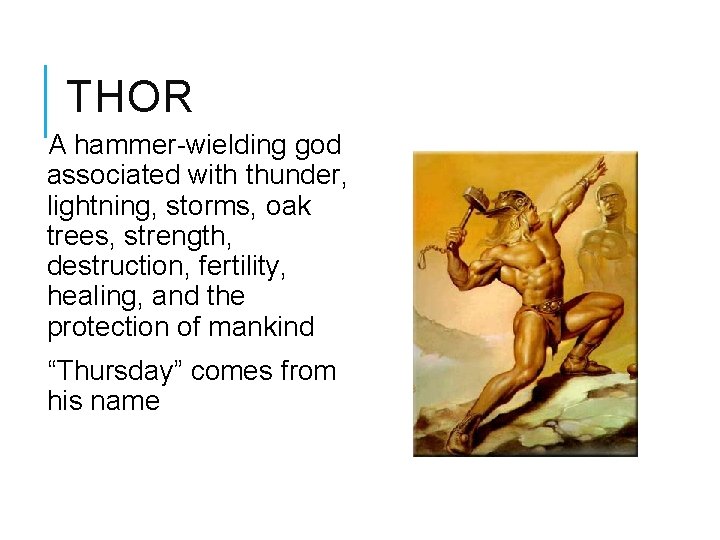
THOR A hammer-wielding god associated with thunder, lightning, storms, oak trees, strength, destruction, fertility, healing, and the protection of mankind “Thursday” comes from his name
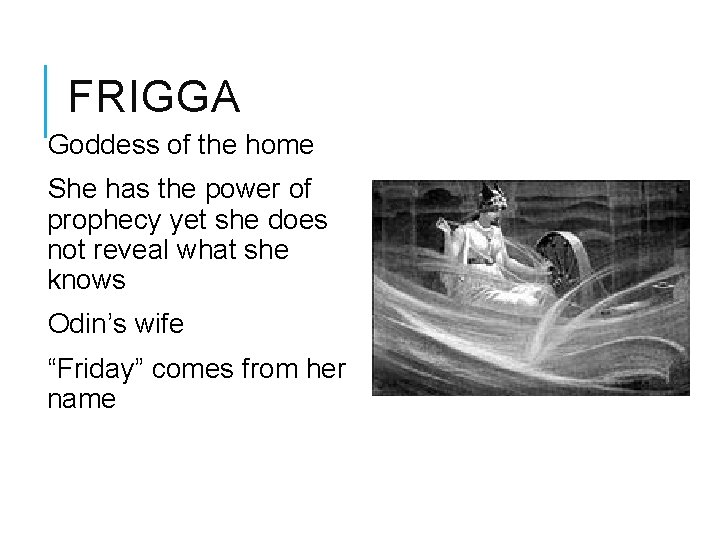
FRIGGA Goddess of the home She has the power of prophecy yet she does not reveal what she knows Odin’s wife “Friday” comes from her name
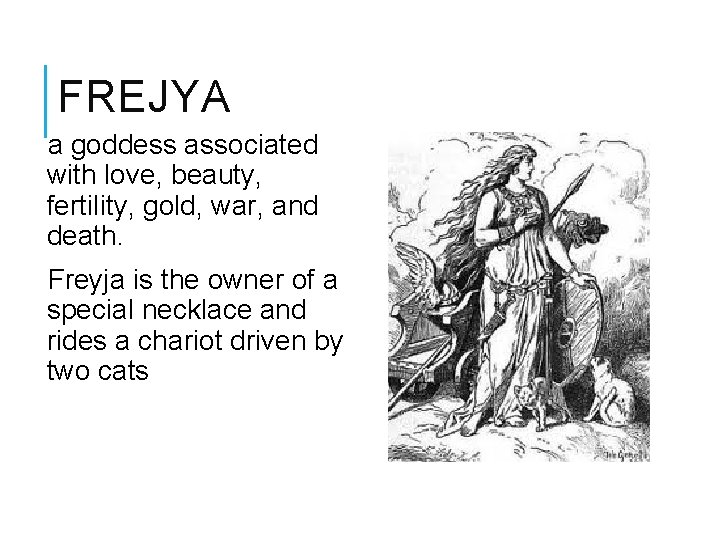
FREJYA a goddess associated with love, beauty, fertility, gold, war, and death. Freyja is the owner of a special necklace and rides a chariot driven by two cats
THE END COMETH… Edward the Confessor, the last great Saxon king, fell ill and allegedly promised the throne to his cousin in Normandy, France.
SUCCESSION William, Duke of Normandy, was this cousin, who unfortunately was illegitimate and unable to receive the honor as the English blood line must be “pure”. For this reason, he was also known as “William the Bastard”
NORMAN INVASION When Edward died, the nobles refused William and named Harold as king. William refused to take “no” for an answer. He brought his tough Norman army and launched the Norman Invasion in 1066, defeating Harold in the Battle of Hastings. On Christmas Day, 1066, William the Conqueror was crowned king of England.
ANGLO-SAXON CONTRIBUTIONS Literature Common laws Language Government
LITERATURE Beowulf was the first recorded piece of British literature. Literature was an “oral tradition” passed by word of mouth by professional poets called scops (pronounced shopes), who sang the songs. Songs usually delivered around campfires in a mead or communal hall as warriors consumed “mead”, a honey-based beer.
POETRY Most popular genre of literature was poetry. Heroic poetry recounts the deeds of a hero. Epic poetry is categorized here: a long, narrative poem, which recounts the deeds of a hero and reflects the values of the day Elegaic poetry mourns the passing of
TRACING OUR LANGUAGE/ALPHABET 1. Hebrew 2. Greek 3. Latin 4. Old English 5. Middle English 6. Modern English
INDO-EUROPEAN (MOTHER LANGUAGE OF ALL LANGUAGE SEVEN MAJOR BRANCHES) Germanic Balto-Slavic Celtic Albanian Italic Indo-Iranian Armenian
GERMANIC Branch from which English is derived. English very closely resembles German and Dutch and is affectionately referred to as Old English.
ITALIC This is the Romance language branch: Spanish, French, Portuguese, Italian
LITERARY TERMS Kenning – This term denotes the recurrent use in the Anglo-Saxon Beowulf and poems written in other Old Germanic languages, of a descriptive phrase in place of the ordinary name for something.
KENNINGS Some kennings are instances of: Metonymy: one thing is applied to another with which it has become closely associated because of a recurrent relationship. Examples: “The whale road” = the sea “The ring-giver” = the king
KENNINGS Some kennings are instances of: Synecdoche: a part of something is used to signify the whole, or – more rarely – the whole is used to signify the part. Examples: “the ringed prow” – a ship “ten hands” – ten workers “a hundred sails” – a hundred ships “wheels” - car
KENNINGS Some kennings are instances of: Picturesque features of the object Examples: “foamy-necked floater” – a ship under sail “storm of swords” – a battle
EPITHET An epithet is a phrase or word that describes a person without using his/her name. “Higlac’s Follower, ” “shepherd of evil, ” etc.
KING ARTHUR Stories of the legendary or mythical King Arthur and the Knights of the Round Table are fictional. Historically, however, one leader of the Celts, a man on whom the legend is based, led the Celts in a fierce battle before being driven into the mountains of Wales. It was his valor that launched the English ideal of what an English hero should be.
- Slides: 47