
Anglicanism 101 What it means to be AnglicanEpiscopalian
Anglicanism 101 What it means to be Anglican/Episcopalian St. John in the Wilderness Episcopal Church Fall, 2007 1
Anglicanism 101 o o o Identity Authority English Reformation Book of Common Prayer A New American Church Emphases: n n n Community Pastoral/Spiritual Care Mission/Work of the Church 2
Week 2 Authority in the Anglican Communion 3
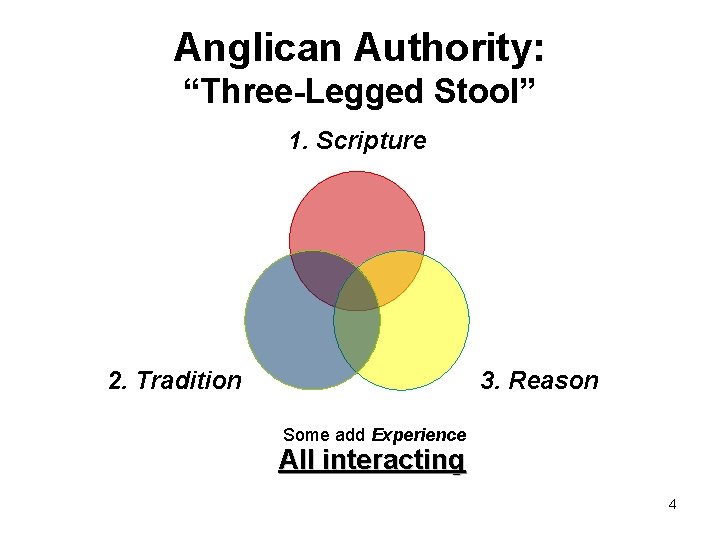
Anglican Authority: “Three-Legged Stool” 1. Scripture 2. Tradition 3. Reason Some add Experience All interacting 4
Scripture o o o Record of God’s revelation to humanity Measure of all else: source, norm Nothing taught contrary to Scripture n n o Anglican: tempered by reason Differs from biblical fundamentalism o Belief that Bible’s words are exact, written by God Anglican position: n n Formal : Scripture one source among several o Guide to life, not lawbook In practice: more weight given to Scripture 5
Scriptural Focus o o o Outlined in the BCP Scripture designed to be read as a whole – no “pick and choose” Sunday Lectionary n Three year cycle – all Gospels o o Many additional OT and NT readings Daily Office Lectionary n Two-year cycle – all readings 6
Scriptural Interpretation: Options 1. 2. 3. Needs no interpretation – speaks for itself Needs interpretation – 1 person or group can do it for all others Should be interpreted widely in context of community Anglican position – middle way n n n Many voices Many experiences Many paths to God 7
Tradition o o o o Collective experience, not necessarily individual Additions to Scripture Judeo-Christian roots Universal: catholic (small “c”) Early church traditions recovered Pastoral/relational emphasis Belief that Spirit is active in full church councils Tension between freedom and tyranny n Often described as vagueness, ambiguity 8
Incarnation o o o God among us, transforming ourselves and the world Sacraments, liturgy follow from Incarnation Sacraments are central to Christian life n Make present the passion of Christ o Baptism: “buried with Christ in his death” n Full initiation into community of Christ § o All are ministers, not just the ordained Eucharist: makes present the sacrifice of Christ on behalf of all people n Participants share in effect of Christ’s sacrifice 9
Liturgy o The way we celebrate the sacraments n o o Greek: “work of the people” Weekly remembrance of Christ’s sacrifice Has “power to bring us…to where we can hear God at the depth of our being” (Holmes) Anglican emphases: n n n Ritual Symbolism Beauty Dignity Participation of the people 10
Reason “Not simply human but reflecting the mind of God” – Urban Holmes o Natural theology – learning about God through observation of the natural world o God still present and active in Creation o We collaborate with God and each other to further Creation 11
Sources o o o Edwards, David. What Anglicans Believe. Cincinnati: Forward Movement, 1996. Holmes, Urban T. III. What Is Anglicanism? Harrisburg, PA: Morehouse, 1982. Howe, Bp. John. Our Anglican Heritage. Elgin, IL: Cook, 1977. Hein, David, and Shattuck, Gardiner H. Jr. The Episcopalians. Westport, CT: Praeger, 2004. Episcopal Diocese of Southern Ohio, available at http: //www. episcopal-dso. org/ 12
- Slides: 12