
Angles Objective Learn to name and measure angles
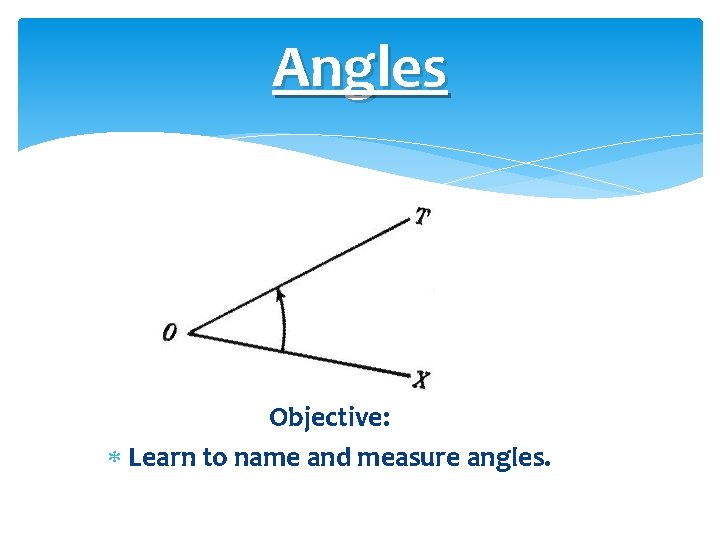
Angles Objective: Learn to name and measure angles.
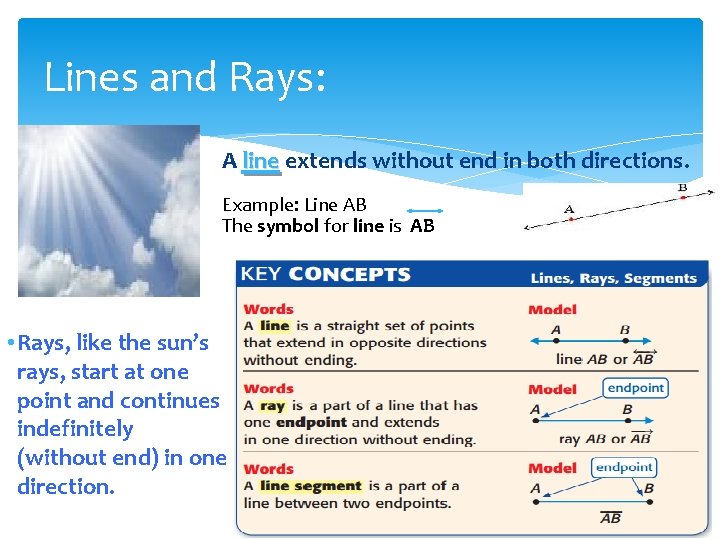
Lines and Rays: A line extends without end in both directions. Example: Line AB The symbol for line is AB • Rays, like the sun’s rays, start at one point and continues indefinitely (without end) in one direction.

Angles: When 2 rays have the same endpoint they form an angle. The 2 rays are the sides of the angle and the common endpoint is the vertex. You can use the angle symbol ( < ), the vertex, and a point on each side to name the angle. You can use the vertex alone, or a number to name the angle. For example: <ABC < CBA <B
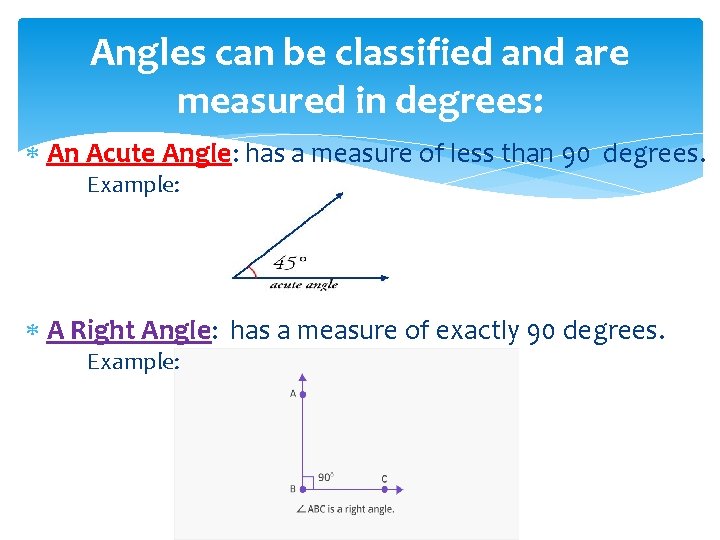
Angles can be classified and are measured in degrees: An Acute Angle: has a measure of less than 90 degrees. Example: A Right Angle: has a measure of exactly 90 degrees. Example:
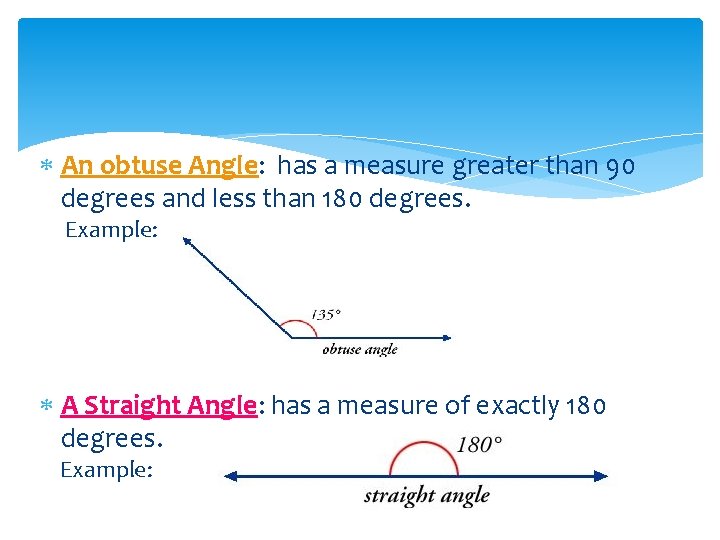
An obtuse Angle: has a measure greater than 90 degrees and less than 180 degrees. Example: A Straight Angle: has a measure of exactly 180 degrees. Example:
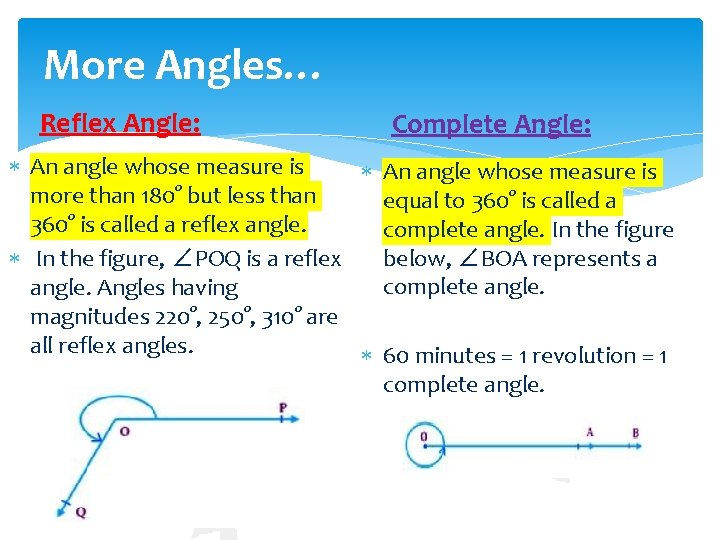
More Angles… Reflex Angle: Complete Angle: An angle whose measure is more than 180° but less than equal to 360° is called a reflex angle. complete angle. In the figure below, ∠BOA represents a In the figure, ∠POQ is a reflex complete angle. Angles having magnitudes 220°, 250°, 310° are all reflex angles. 60 minutes = 1 revolution = 1 complete angle.

- Slides: 7