
Angles Mixed Without Circle Theorems Foundation GCSE Questions


- Slides: 23
Angles – Mixed – Without Circle Theorems – Foundation – GCSE Questions These questions are the same format as previous GCSE exams. COPY means they use the exact same numbers as the original GCSE question. Otherwise, they are clone questions using different numbers. The worksheets are provided in a variety of sizes.
Printing To print handouts from slides Select the slide from the left. Then click: File > Print > ‘Print Current Slide’ To print multiple slides Click on a section title to highlight all those slides, or press ‘Ctrl’ at the same time as selecting slides to highlight more than one. Then click: File > Print > ‘Print Selection’ To print double-sided handouts Highlight both slides before using ‘Print Selection’. Choose ‘Print on Both Sides’ and ‘Flip on Short Edge’.
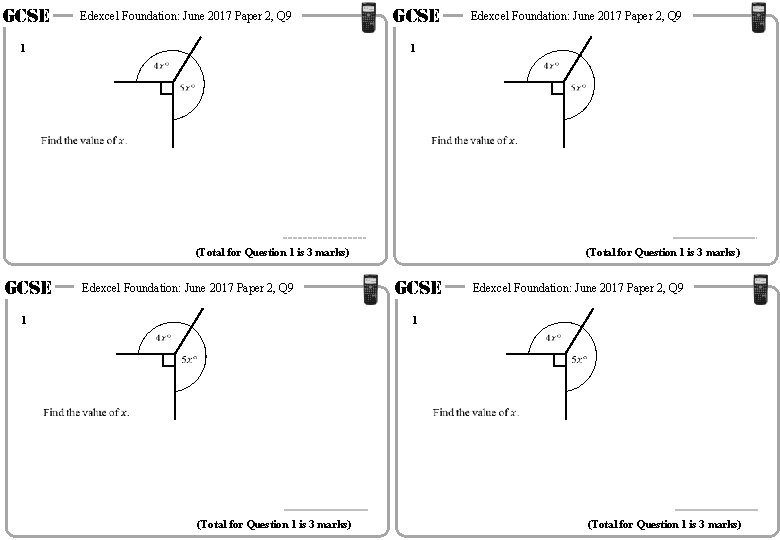
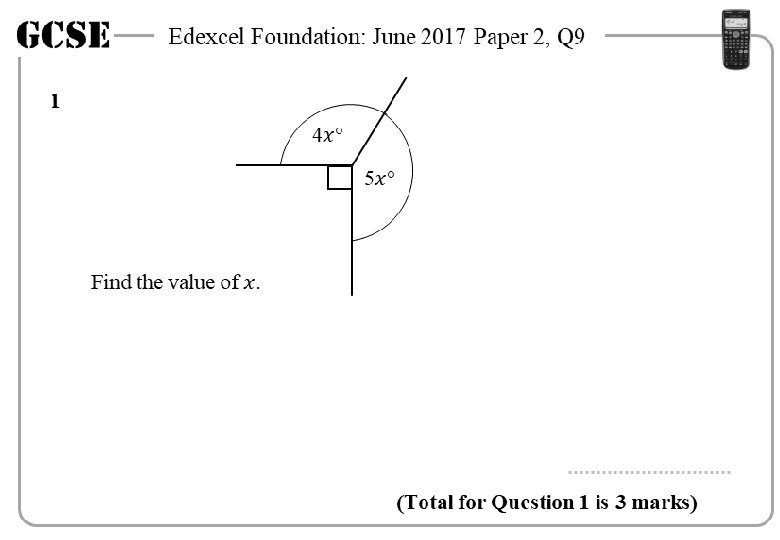
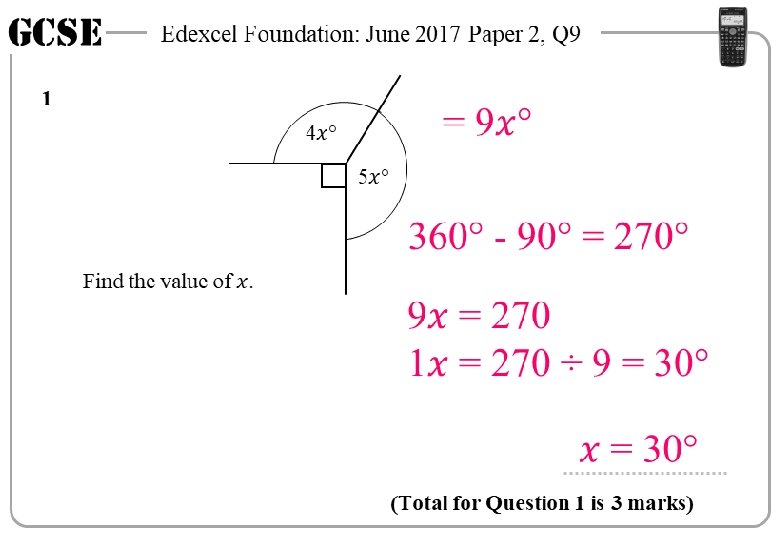
GCSE Edexcel Foundation: June 2017 Paper 2, Q 9 1 (Total for Question 1 is 3 marks)
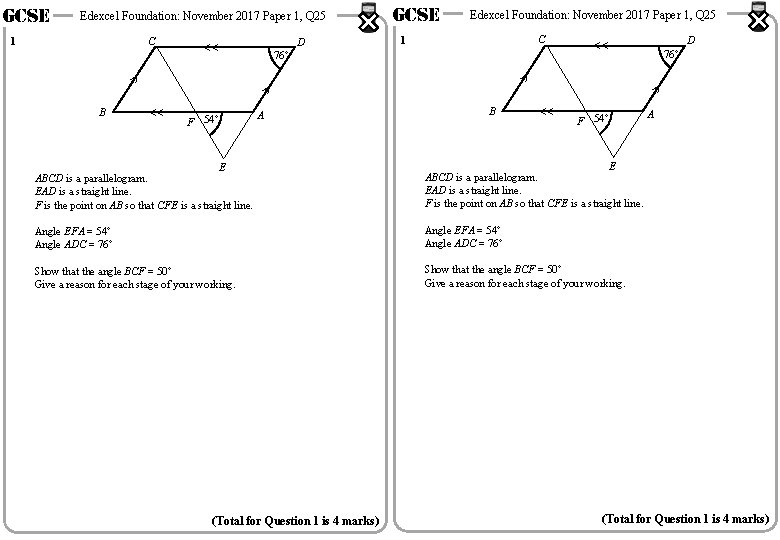
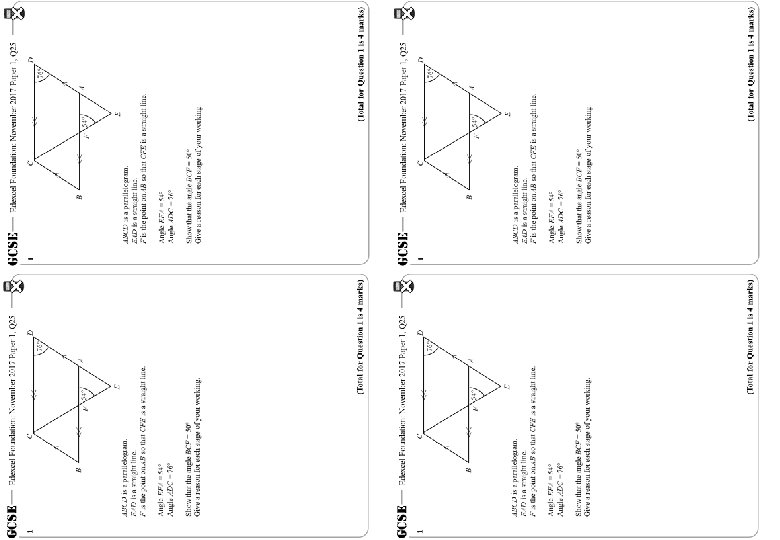
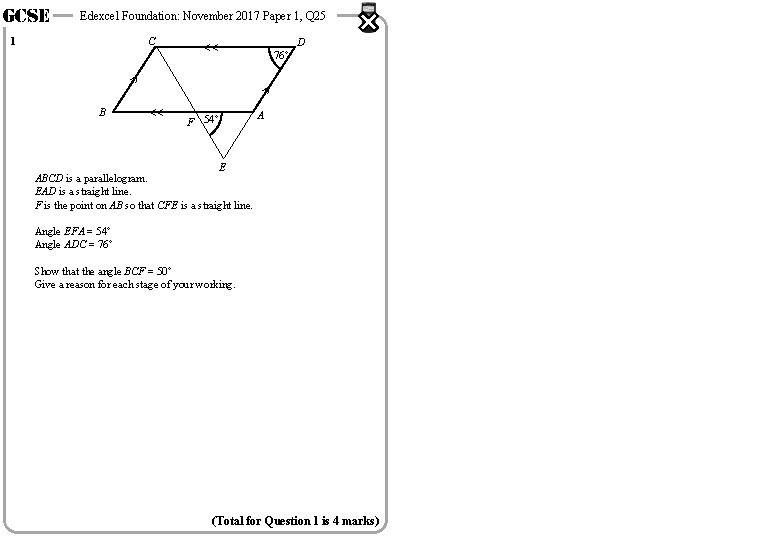
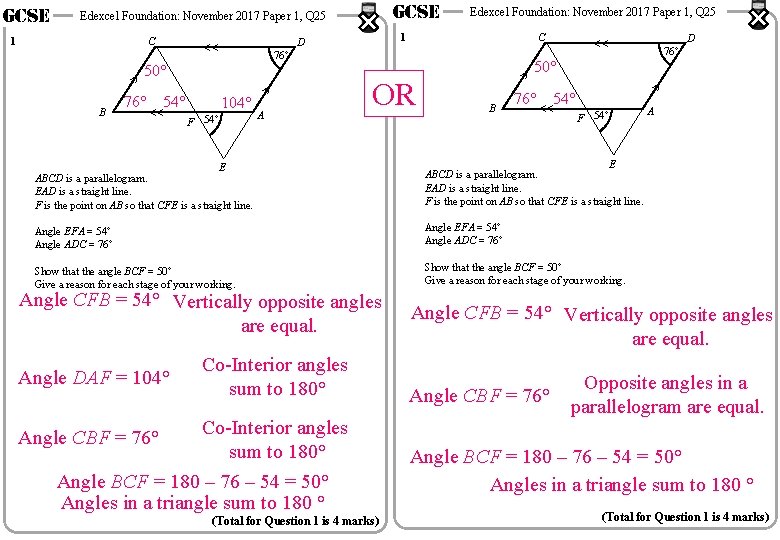
GCSE Edexcel Foundation: November 2017 Paper 1, Q 25 C 1 D << GCSE Edexcel Foundation: November 2017 Paper 1, Q 25 C 1 76° < < B D << << F 54° A B << F 54° E ABCD is a parallelogram. EAD is a straight line. F is the point on AB so that CFE is a straight line. Angle EFA = 54° Angle ADC = 76° Show that the angle BCF = 50° Give a reason for each stage of your working. (Total for Question 1 is 4 marks) A (Total for Question 1 is 4 marks)
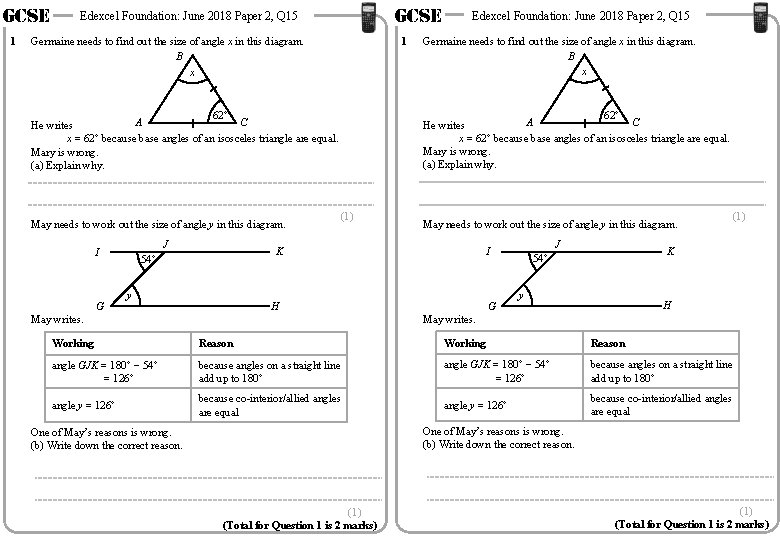
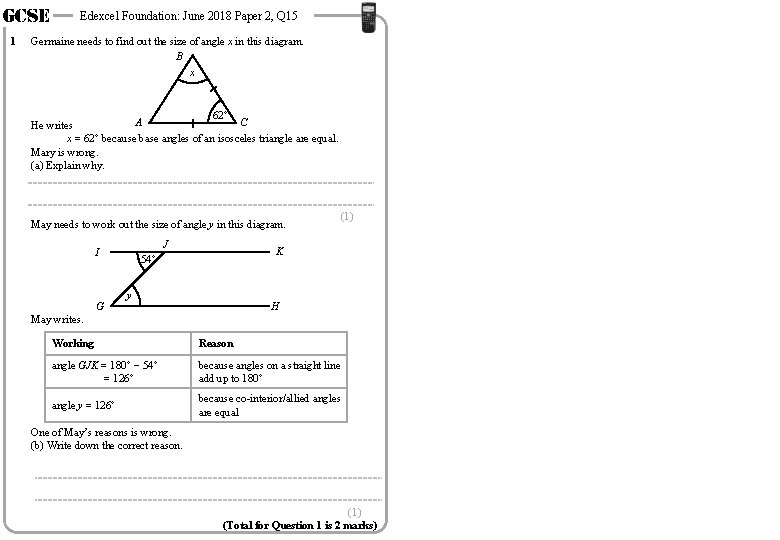
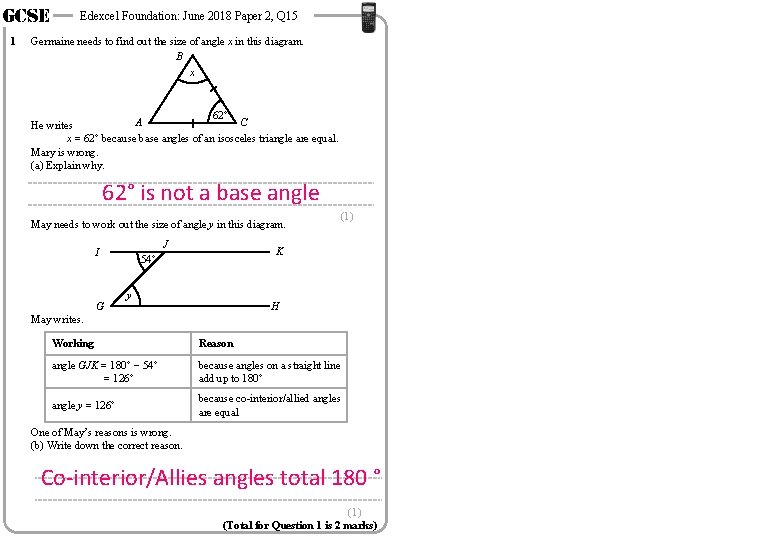
GCSE 1 GCSE Edexcel Foundation: June 2018 Paper 2, Q 15 1 Germaine needs to find out the size of angle x in this diagram. B x J I G Germaine needs to find out the size of angle x in this diagram. B x 62° A C He writes x = 62° because base angles of an isosceles triangle are equal. Mary is wrong. (a) Explain why. May needs to work out the size of angle y in this diagram. Edexcel Foundation: June 2018 Paper 2, Q 15 (1) May needs to work out the size of angle y in this diagram. K 54° y J I H G (1) K 54° y H May writes. Working Reason angle GJK = 180° − 54° = 126° because angles on a straight line add up to 180° angle y = 126° because co-interior/allied angles are equal One of May’s reasons is wrong. (b) Write down the correct reason. (1) (Total for Question 1 is 2 marks)
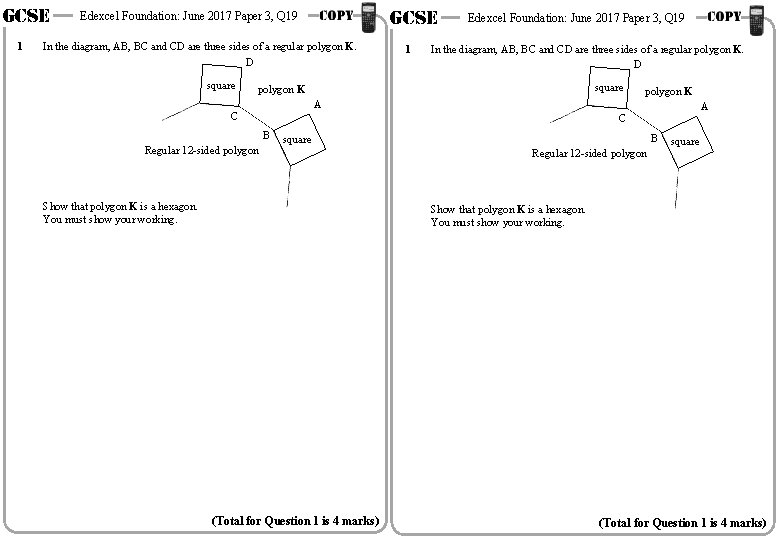
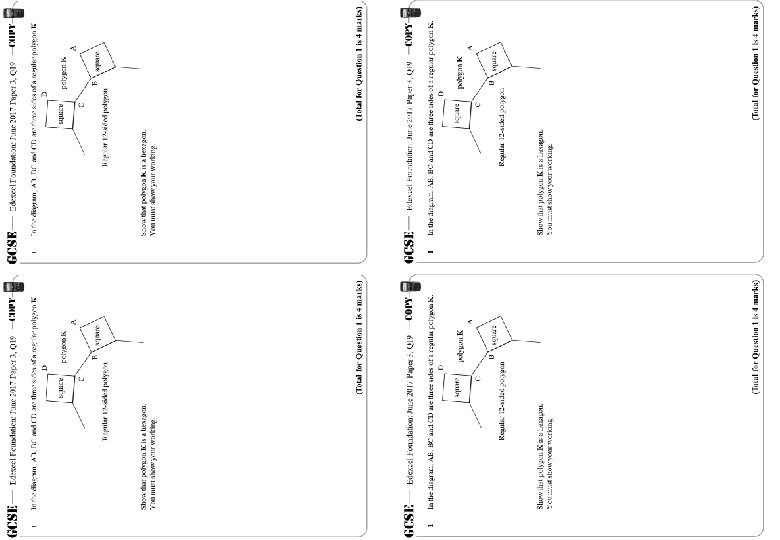
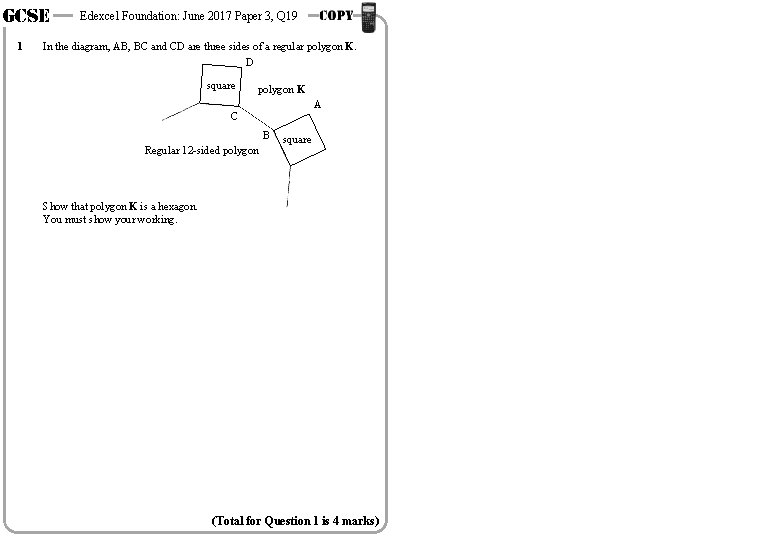
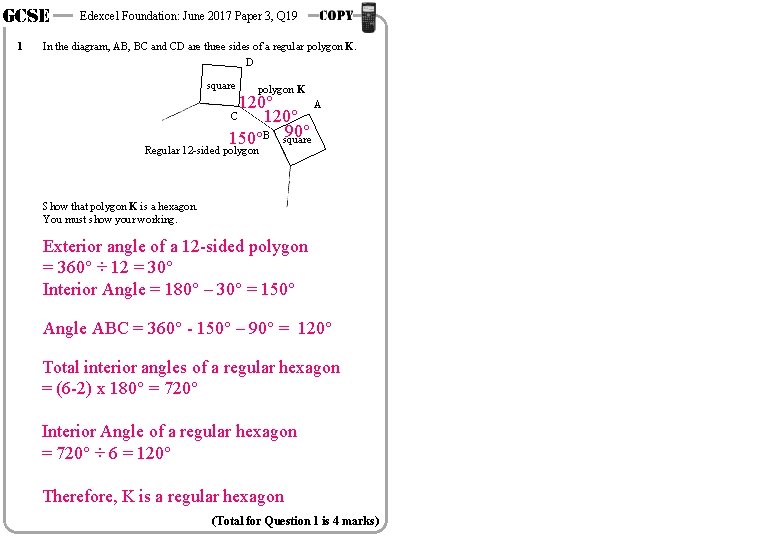
GCSE 1 GCSE Edexcel Foundation: June 2017 Paper 3, Q 19 In the diagram, AB, BC and CD are three sides of a regular polygon K. D square 1 Edexcel Foundation: June 2017 Paper 3, Q 19 In the diagram, AB, BC and CD are three sides of a regular polygon K. D square polygon K A C B Regular 12 -sided polygon K B square Show that polygon K is a hexagon. You must show your working. Regular 12 -sided polygon square Show that polygon K is a hexagon. You must show your working. (Total for Question 1 is 4 marks)
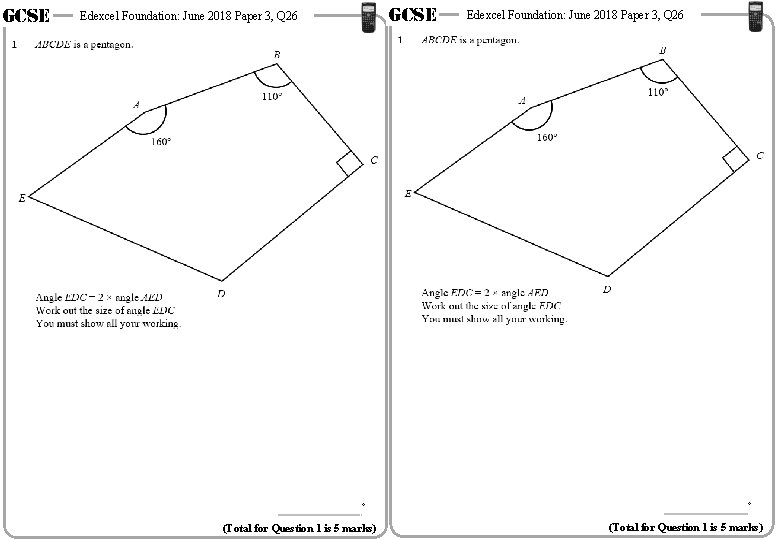
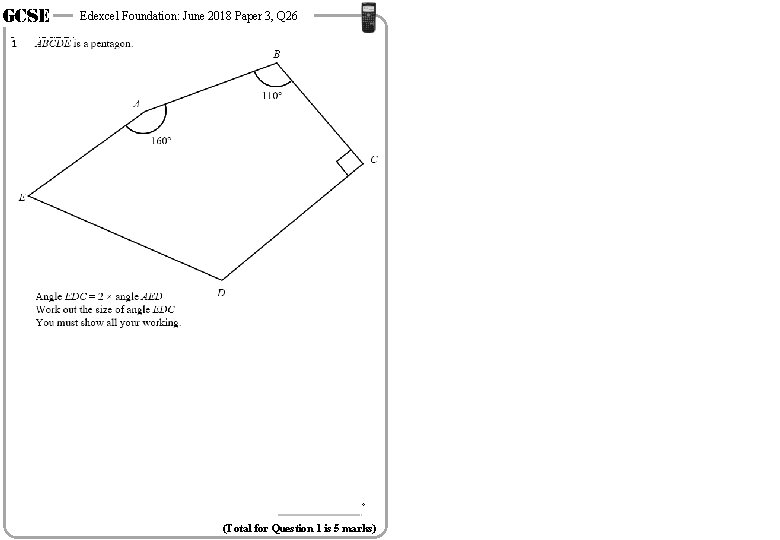
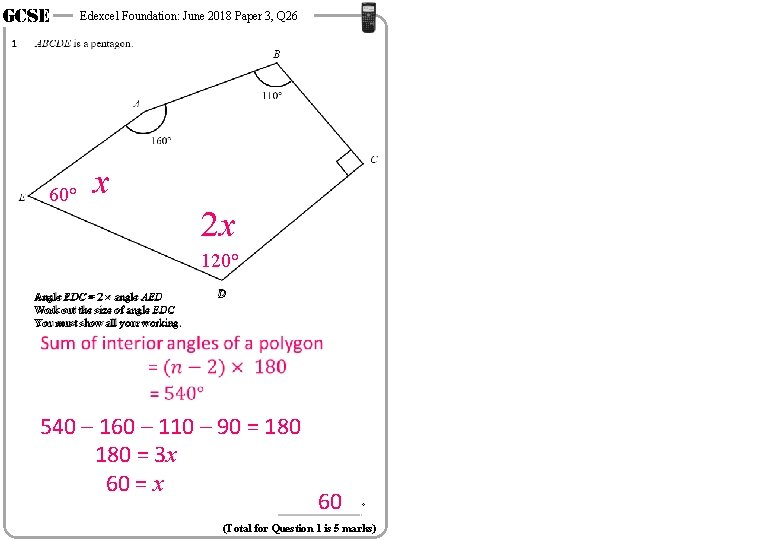
GCSE 1 GCSE Edexcel Foundation: June 2018 Paper 3, Q 26 ABCDE is a pentagon. 1 B ABCDE is a pentagon. 110° A Edexcel Foundation: June 2018 Paper 3, Q 26 B 110° A 160° C C E E Angle EDC = 2 × angle AED Work out the size of angle EDC You must show all your working. D Angle EDC = 2 × angle AED Work out the size of angle EDC You must show all your working. ° (Total for Question 1 is 5 marks) D ° (Total for Question 1 is 5 marks)
GCSE Edexcel Foundation: November 2017 Paper 1, Q 25 C 1 D << 76° < < B << F 54° A E ABCD is a parallelogram. EAD is a straight line. F is the point on AB so that CFE is a straight line. Angle EFA = 54° Angle ADC = 76° Show that the angle BCF = 50° Give a reason for each stage of your working. (Total for Question 1 is 4 marks)
GCSE 1 Edexcel Foundation: June 2018 Paper 2, Q 15 Germaine needs to find out the size of angle x in this diagram. B x 62° A C He writes x = 62° because base angles of an isosceles triangle are equal. Mary is wrong. (a) Explain why. May needs to work out the size of angle y in this diagram. J I G (1) K 54° y H May writes. Working Reason angle GJK = 180° − 54° = 126° because angles on a straight line add up to 180° angle y = 126° because co-interior/allied angles are equal One of May’s reasons is wrong. (b) Write down the correct reason. (1) (Total for Question 1 is 2 marks)
GCSE 1 Edexcel Foundation: June 2017 Paper 3, Q 19 In the diagram, AB, BC and CD are three sides of a regular polygon K. D square polygon K A C B Regular 12 -sided polygon square Show that polygon K is a hexagon. You must show your working. (Total for Question 1 is 4 marks)
GCSE 1 Edexcel Foundation: June 2018 Paper 3, Q 26 ABCDE is a pentagon. B 110° A 160° C E Angle EDC = 2 × angle AED Work out the size of angle EDC You must show all your working. D ° (Total for Question 1 is 5 marks)
GCSE Edexcel Foundation: June 2017 Paper 2, Q 9 1 360° - 90° = 270° (Total for Question 1 is 3 marks)
GCSE Edexcel Foundation: November 2017 Paper 1, Q 25 C 1 76° < 54° << 50° 104° F 54° A OR B 76° 54° << F 54° ABCD is a parallelogram. EAD is a straight line. F is the point on AB so that CFE is a straight line. E ABCD is a parallelogram. EAD is a straight line. F is the point on AB so that CFE is a straight line. Angle EFA = 54° Angle ADC = 76° Show that the angle BCF = 50° Give a reason for each stage of your working. E Angle CFB = 54° Vertically opposite angles are equal. Angle DAF = 104° 76° < < 76° D << < 50° B C 1 D << Edexcel Foundation: November 2017 Paper 1, Q 25 Co-Interior angles sum to 180° Angle BCF = 180 – 76 – 54 = 50° Angles in a triangle sum to 180 ° Angle CBF = 76° (Total for Question 1 is 4 marks) A Angle CFB = 54° Vertically opposite angles are equal. Angle CBF = 76° Opposite angles in a parallelogram are equal. Angle BCF = 180 – 76 – 54 = 50° Angles in a triangle sum to 180 ° (Total for Question 1 is 4 marks)
GCSE 1 Edexcel Foundation: June 2018 Paper 2, Q 15 Germaine needs to find out the size of angle x in this diagram. B x 62° A C He writes x = 62° because base angles of an isosceles triangle are equal. Mary is wrong. (a) Explain why. 62° is not a base angle May needs to work out the size of angle y in this diagram. J I G (1) K 54° y H May writes. Working Reason angle GJK = 180° − 54° = 126° because angles on a straight line add up to 180° angle y = 126° because co-interior/allied angles are equal One of May’s reasons is wrong. (b) Write down the correct reason. Co-interior/Allies angles total 180 ° (1) (Total for Question 1 is 2 marks)
GCSE 1 Edexcel Foundation: June 2017 Paper 3, Q 19 In the diagram, AB, BC and CD are three sides of a regular polygon K. D square polygon K A 120° 90° 150°B square C Regular 12 -sided polygon Show that polygon K is a hexagon. You must show your working. Exterior angle of a 12 -sided polygon = 360° ÷ 12 = 30° Interior Angle = 180° – 30° = 150° Angle ABC = 360° - 150° – 90° = 120° Total interior angles of a regular hexagon = (6 -2) x 180° = 720° Interior Angle of a regular hexagon = 720° ÷ 6 = 120° Therefore, K is a regular hexagon (Total for Question 1 is 4 marks)
GCSE 60° Edexcel Foundation: June 2018 Paper 3, Q 26 x 2 x 120° Angle EDC = 2 × angle AED Work out the size of angle EDC You must show all your working. D 540 – 160 – 110 – 90 = 180 = 3 x 60 = x 60 ° (Total for Question 1 is 5 marks)
Questions? Comments? Suggestions? …or have you found a mistake!? Any feedback would be appreciated . Please feel free to email: tom@goteachmaths. co. uk