
Angles L 1 Functional Maths Angles October 2019
Angles L 1 Functional Maths – Angles October 2019. Kindly contributed by Andrew Butler, Newcastle. Search for Andrew on www. skillsworkshop. org Please refer to the download page for this resource on skillsworkshop for detailed curriculum links and related resources (including the related PDF worksheets). This PPT includes animations and should be run full screen. For further guidance, teachers should also refer to the notes area under some of the slides. Reformed Functional Maths curriculum links include E 3. 20 Use appropriate positional vocabulary to describe position and direction including eight compass points and including full/half/quarter turns L 1. 24 Draw 2 -D shapes and demonstrate an understanding of line symmetry & knowledge of the relative size of angles L 1. 26 Use angles when describing position and direction, and measure angles in degrees L 2. 22 Calculate values of angles and/or coordinates with 2 -D and 3 -D shapes
Angles Session Aims • To investigate angles and their uses • To accurately measure different classifications of angles Learning Outcomes By the end of this session you should be able to: • Accurately measure 2 types of angles • Name the different classifications of angles • Give at least one example for using angles • EXTENSION ACTIVITY – Estimate angles within 360º
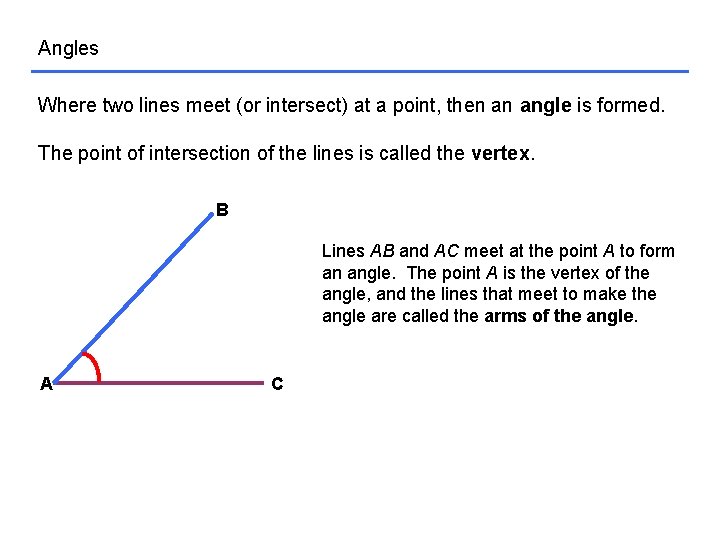
Angles Where two lines meet (or intersect) at a point, then an angle is formed. The point of intersection of the lines is called the vertex. B Lines AB and AC meet at the point A to form an angle. The point A is the vertex of the angle, and the lines that meet to make the angle are called the arms of the angle. A C
Angles are used in daily life. • Engineers and architects use angles for designs, roads, buildings and sporting facilities. • Gardeners use angles to create pathways, flowerbeds and lawns • Joiners use angles to make chairs, tables and doorframes. • Artists use their knowledge of angles to sketch portraits and paintings. • Hairdressers use angles to cut hair
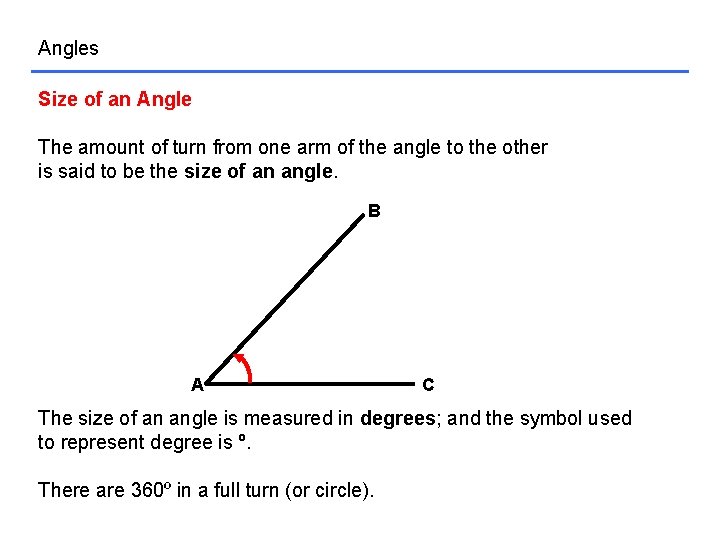
Angles Size of an Angle The amount of turn from one arm of the angle to the other is said to be the size of an angle. B A C The size of an angle is measured in degrees; and the symbol used to represent degree is º. There are 360º in a full turn (or circle).
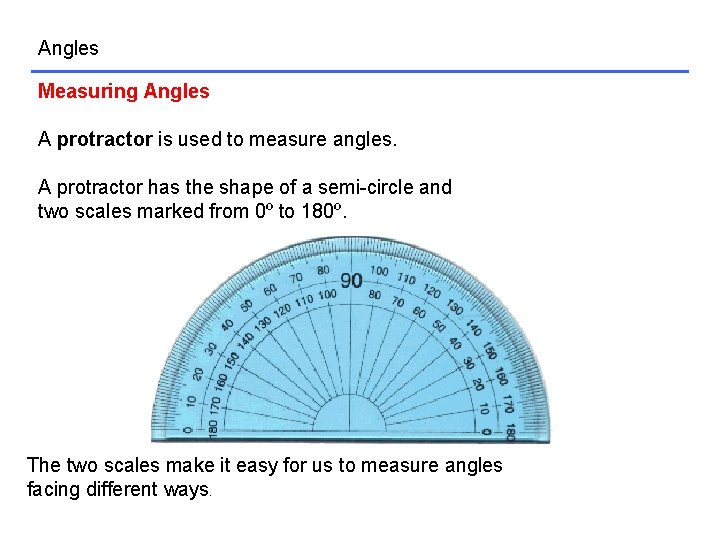
Angles Measuring Angles A protractor is used to measure angles. A protractor has the shape of a semi-circle and two scales marked from 0º to 180º. The two scales make it easy for us to measure angles facing different ways.
Angles Purposely left blank – see slide notes
Angles Purposely left blank – see slide notes
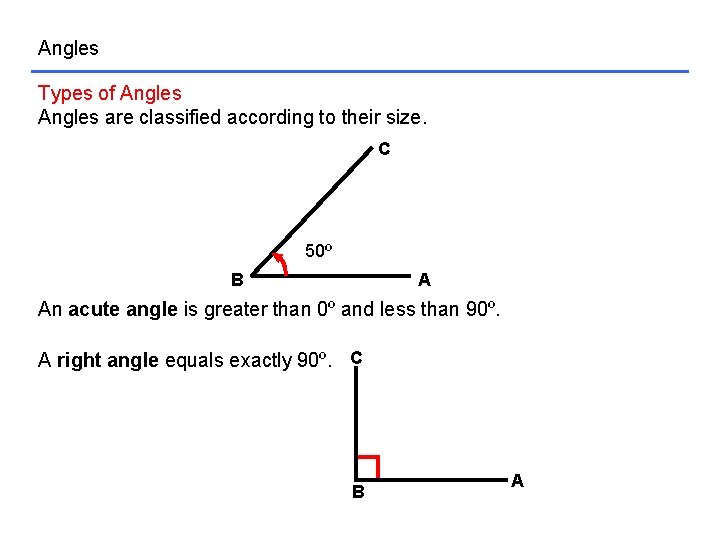
Angles Types of Angles are classified according to their size. C 50º B A An acute angle is greater than 0º and less than 90º. A right angle equals exactly 90º. C B A
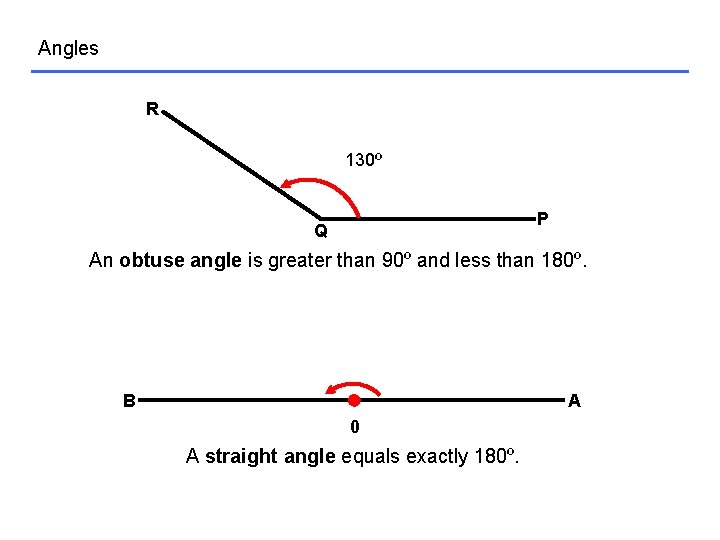
Angles R 130º P Q An obtuse angle is greater than 90º and less than 180º. B A 0 A straight angle equals exactly 180º.
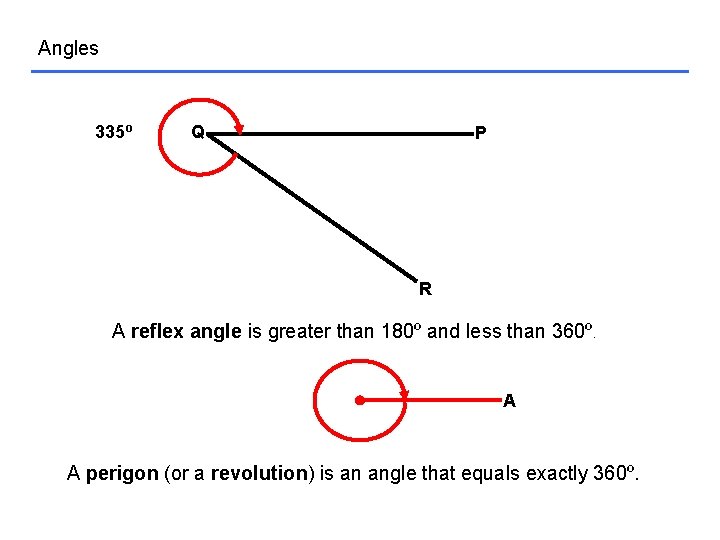
Angles 335º Q P R A reflex angle is greater than 180º and less than 360º. A A perigon (or a revolution) is an angle that equals exactly 360º.
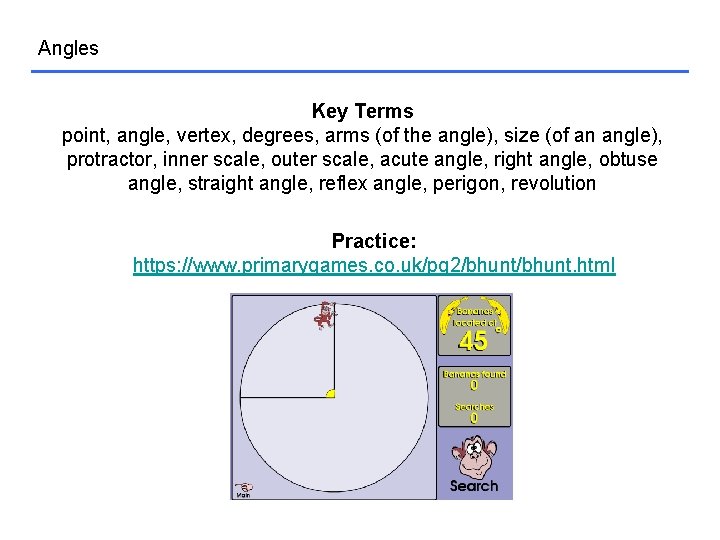
Angles Key Terms point, angle, vertex, degrees, arms (of the angle), size (of an angle), protractor, inner scale, outer scale, acute angle, right angle, obtuse angle, straight angle, reflex angle, perigon, revolution Practice: https: //www. primarygames. co. uk/pg 2/bhunt. html
- Slides: 12