
ANGLERFISH Gabriel Mourra Brandon Negron Janpaul Paredero What
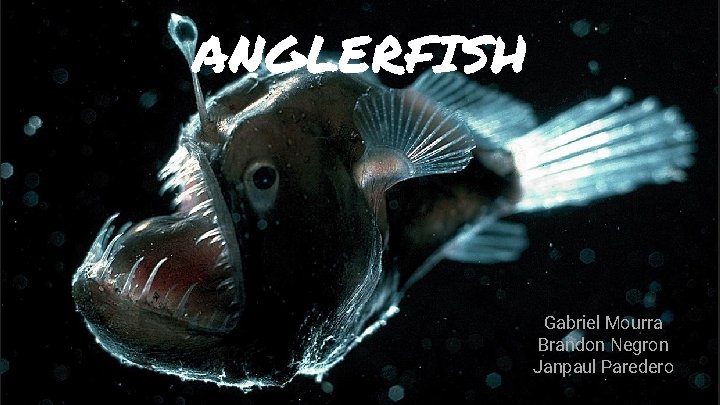
ANGLERFISH Gabriel Mourra Brandon Negron Janpaul Paredero
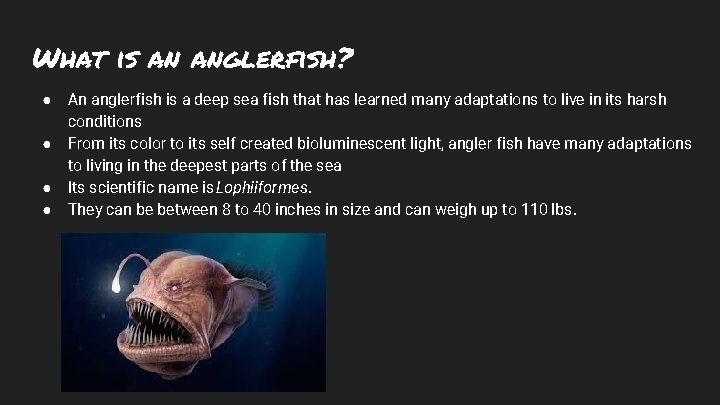
What is an anglerfish? ● ● An anglerfish is a deep sea fish that has learned many adaptations to live in its harsh conditions From its color to its self created bioluminescent light, angler fish have many adaptations to living in the deepest parts of the sea Its scientific name is Lophiiformes. They can be between 8 to 40 inches in size and can weigh up to 110 lbs.
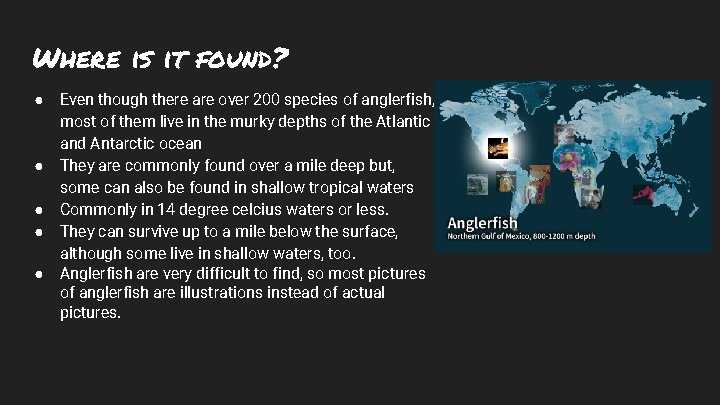
Where is it found? ● ● ● Even though there are over 200 species of anglerfish, most of them live in the murky depths of the Atlantic and Antarctic ocean They are commonly found over a mile deep but, some can also be found in shallow tropical waters Commonly in 14 degree celcius waters or less. They can survive up to a mile below the surface, although some live in shallow waters, too. Anglerfish are very difficult to find, so most pictures of anglerfish are illustrations instead of actual pictures.
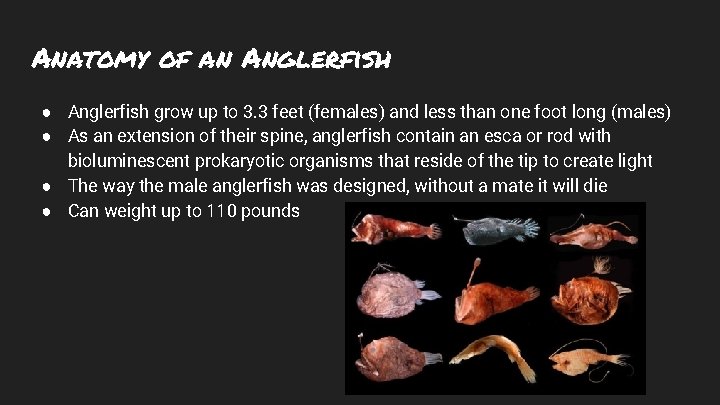
Anatomy of an Anglerfish ● Anglerfish grow up to 3. 3 feet (females) and less than one foot long (males) ● As an extension of their spine, anglerfish contain an esca or rod with bioluminescent prokaryotic organisms that reside of the tip to create light ● The way the male anglerfish was designed, without a mate it will die ● Can weight up to 110 pounds
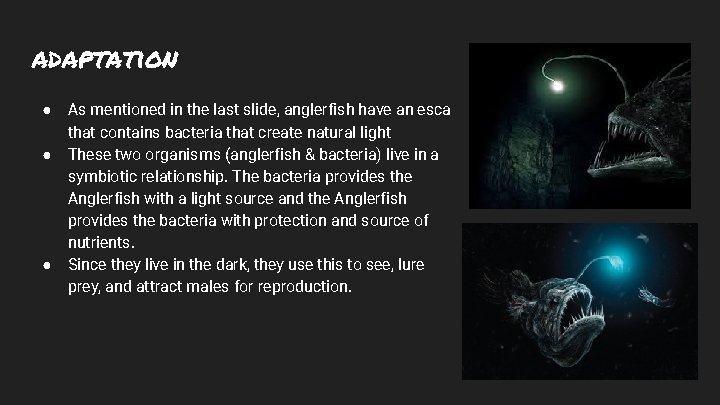
adaptation ● ● ● As mentioned in the last slide, anglerfish have an esca that contains bacteria that create natural light These two organisms (anglerfish & bacteria) live in a symbiotic relationship. The bacteria provides the Anglerfish with a light source and the Anglerfish provides the bacteria with protection and source of nutrients. Since they live in the dark, they use this to see, lure prey, and attract males for reproduction.

Why is this adaptation important? ● This adaptation allows the anglerfish to find food in the dark waters where no light reaches ● It not only helps them see but lures other organisms at the same time ● Since they have large mouths, it allows the lured prey to be consumed easily by the anglerfish
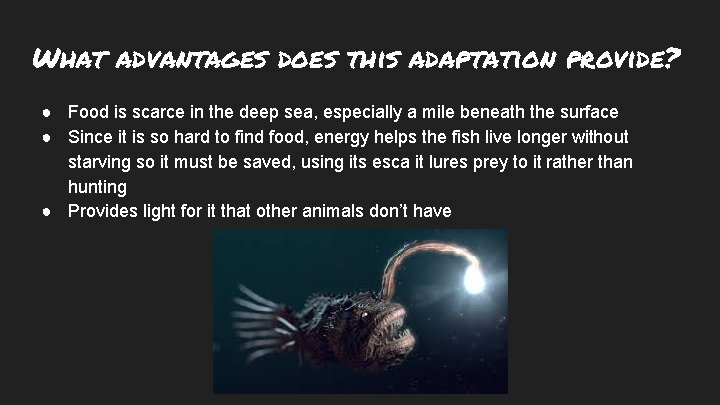
What advantages does this adaptation provide? ● Food is scarce in the deep sea, especially a mile beneath the surface ● Since it is so hard to find food, energy helps the fish live longer without starving so it must be saved, using its esca it lures prey to it rather than hunting ● Provides light for it that other animals don’t have
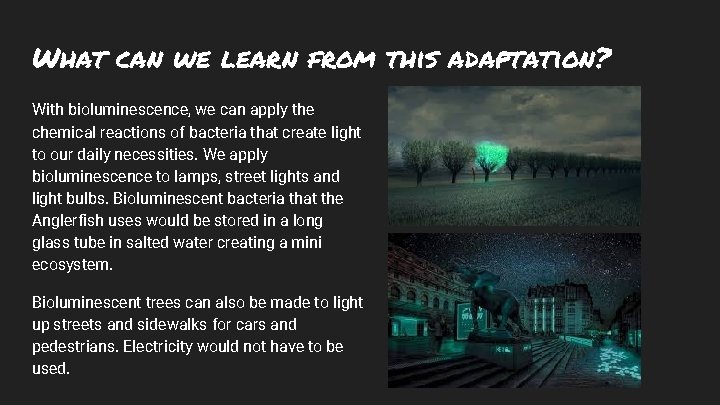
What can we learn from this adaptation? With bioluminescence, we can apply the chemical reactions of bacteria that create light to our daily necessities. We apply bioluminescence to lamps, street lights and light bulbs. Bioluminescent bacteria that the Anglerfish uses would be stored in a long glass tube in salted water creating a mini ecosystem. Bioluminescent trees can also be made to light up streets and sidewalks for cars and pedestrians. Electricity would not have to be used.

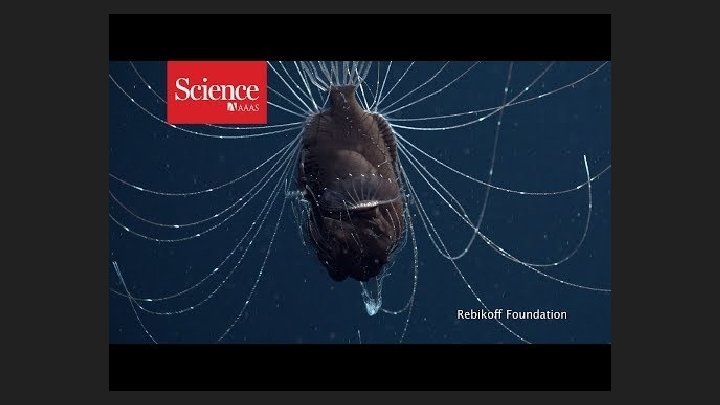
How does the anglerfish reproduce? ● The Anglerfish engages in parasitic mating. ● ● The male attaches to the female by biting her , and then fuses himself onto the flesh of the much larger female anglerfish. As the male continues living with the female, she absorbs his nutrients and the male slowly withers away while attached to his mate They are oviparous, they lay eggs

Works Cited ● https: //curiosity. com/topics/the-male-anglerfish-fuses-to-flesh-during-matingcuriosity/ ● https: //www. futurity. org/anglerfish-bacteria-symbiosis-1816222/ ● https: //www. britannica. com/animal/paracanthopterygian ● https: //www. nationalgeographic. com/animals/fish/group/anglerfish/ ● https: //cosmosmagazine. com/biology/first-ever-footage-of-mating-deep-seaanglerfish
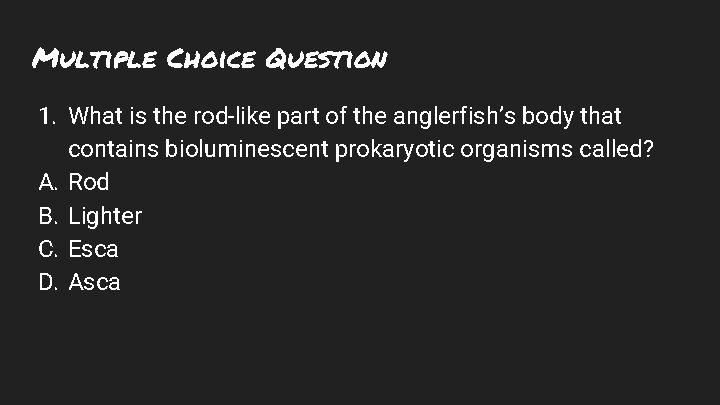
Multiple Choice Question 1. What is the rod-like part of the anglerfish’s body that contains bioluminescent prokaryotic organisms called? A. Rod B. Lighter C. Esca D. Asca

Short Answer Question 2. How does the anglerfish use its esca to help its everyday life in the dark sea?
- Slides: 13