
Angleresolved photoemission spectroscopy ARPES Overview Outline Review momentum
- Slides: 36
Angle-resolved photoemission spectroscopy (ARPES) Overview
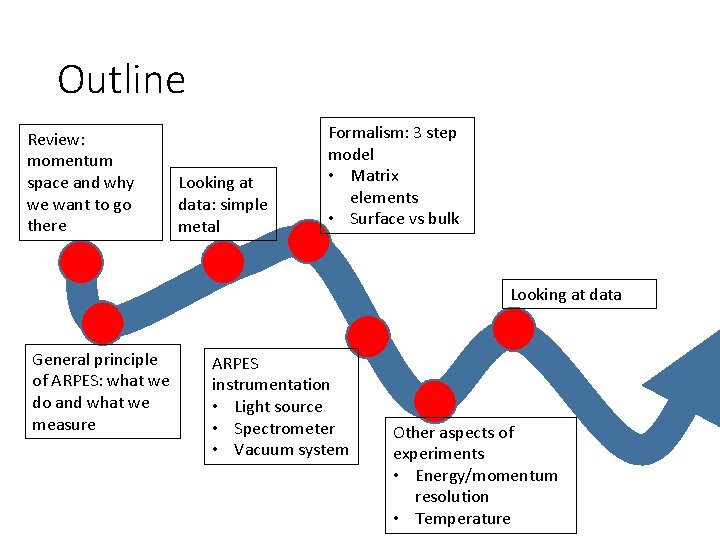
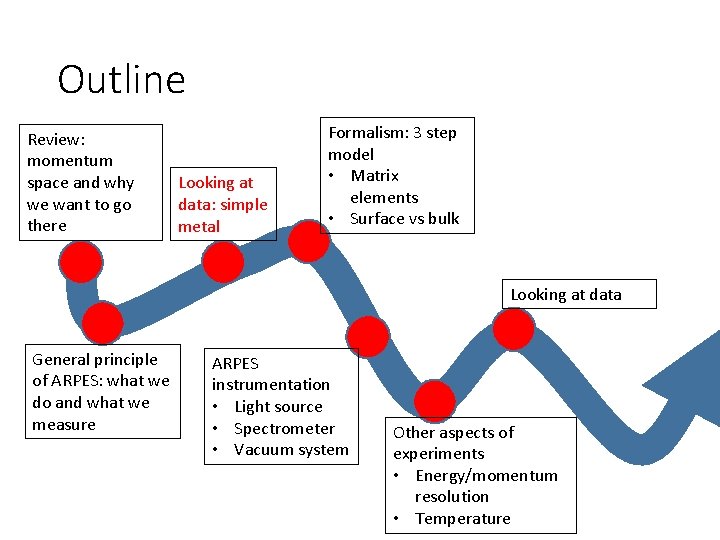
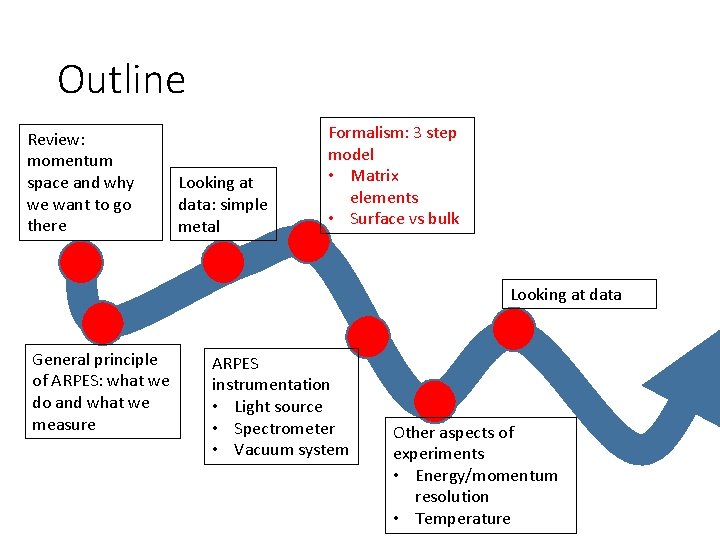
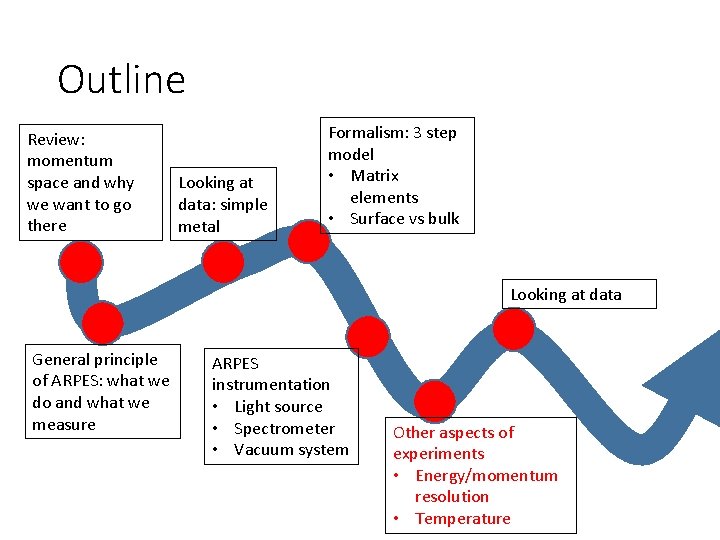
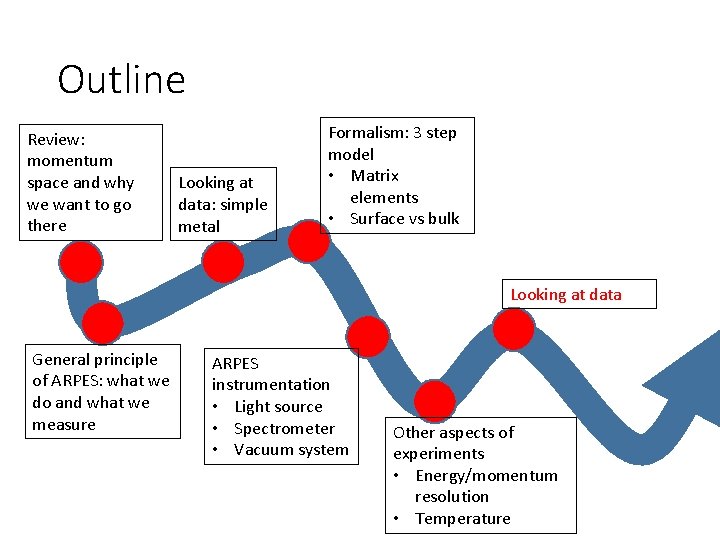
Outline Review: momentum space and why we want to go there Looking at data: simple metal Formalism: 3 step model • Matrix elements • Surface vs bulk Looking at data General principle of ARPES: what we do and what we measure ARPES instrumentation • Light source • Spectrometer • Vacuum system Other aspects of experiments • Energy/momentum resolution • Temperature
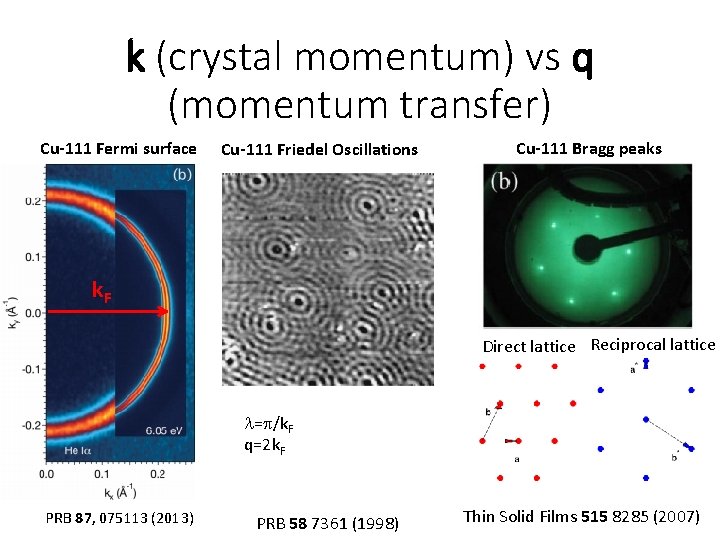
k (crystal momentum) vs q (momentum transfer) Cu-111 Fermi surface Cu-111 Friedel Oscillations Cu-111 Bragg peaks k. F Direct lattice Reciprocal lattice l=p/k. F q=2 k. F PRB 87, 075113 (2013) PRB 58 7361 (1998) Thin Solid Films 515 8285 (2007)
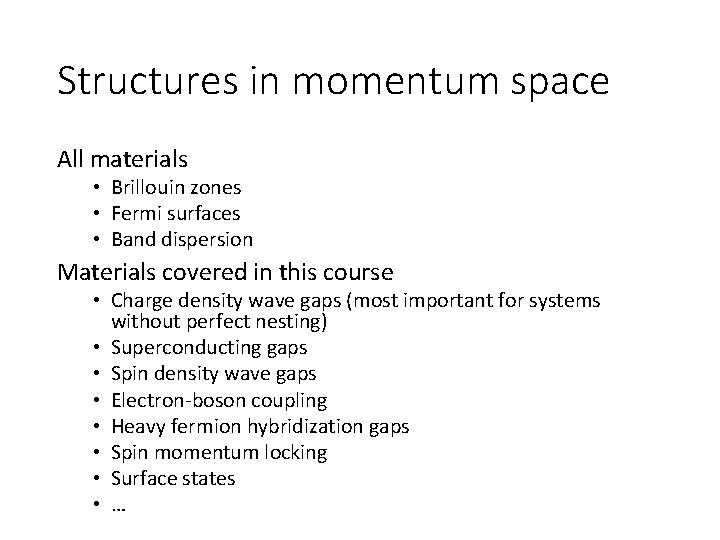
Structures in momentum space All materials • Brillouin zones • Fermi surfaces • Band dispersion Materials covered in this course • Charge density wave gaps (most important for systems without perfect nesting) • Superconducting gaps • Spin density wave gaps • Electron-boson coupling • Heavy fermion hybridization gaps • Spin momentum locking • Surface states • …
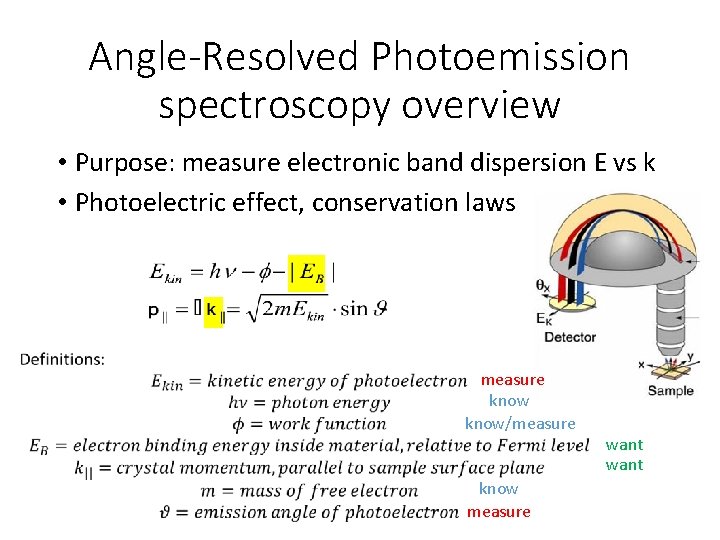
Angle-Resolved Photoemission spectroscopy overview • Purpose: measure electronic band dispersion E vs k • Photoelectric effect, conservation laws measure know/measure know measure want
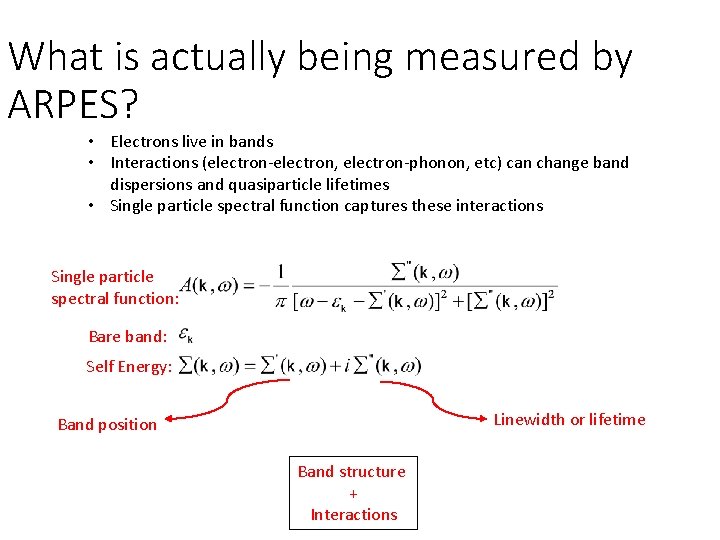
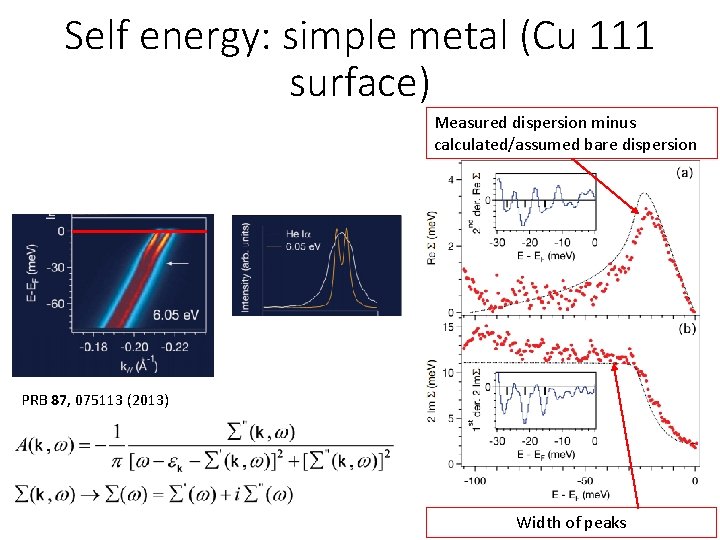
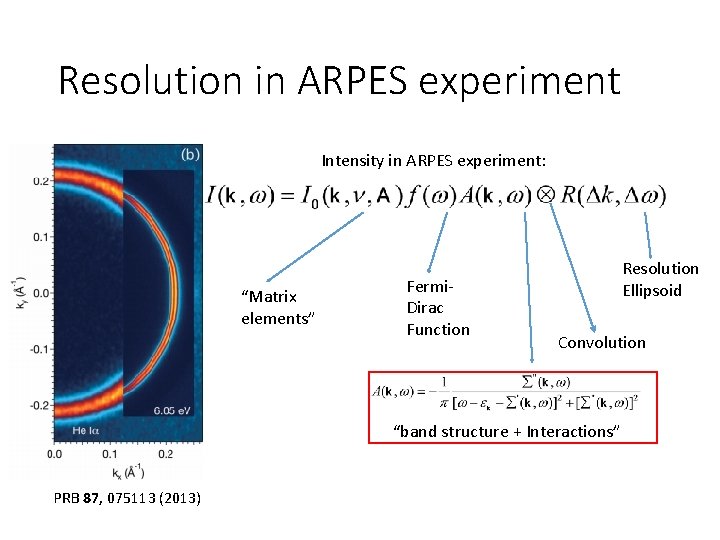
What is actually being measured by ARPES? • Electrons live in bands • Interactions (electron-electron, electron-phonon, etc) can change band dispersions and quasiparticle lifetimes • Single particle spectral function captures these interactions Single particle spectral function: Bare band: Self Energy: Linewidth or lifetime Band position Band structure + Interactions
Outline Review: momentum space and why we want to go there Looking at data: simple metal Formalism: 3 step model • Matrix elements • Surface vs bulk Looking at data General principle of ARPES: what we do and what we measure ARPES instrumentation • Light source • Spectrometer • Vacuum system Other aspects of experiments • Energy/momentum resolution • Temperature
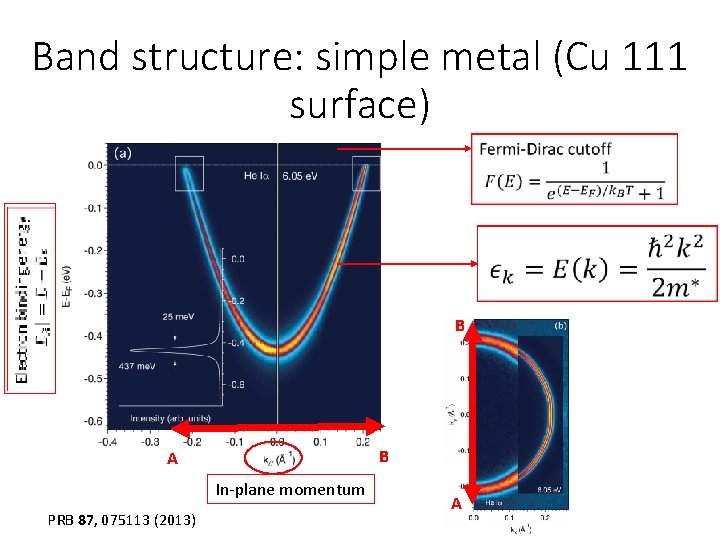
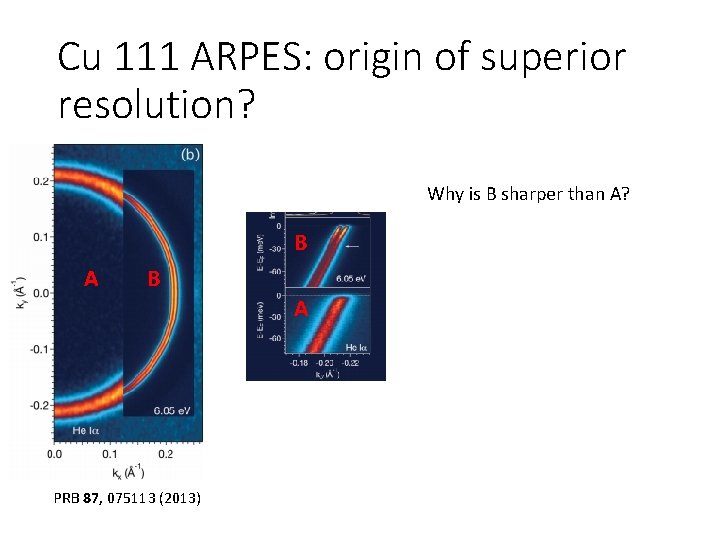
Band structure: simple metal (Cu 111 surface) B B A In-plane momentum PRB 87, 075113 (2013) A
Self energy: simple metal (Cu 111 surface) Measured dispersion minus calculated/assumed bare dispersion PRB 87, 075113 (2013) Width of peaks
Outline Review: momentum space and why we want to go there Looking at data: simple metal Formalism: 3 step model • Matrix elements • Surface vs bulk Looking at data General principle of ARPES: what we do and what we measure ARPES instrumentation • Light source • Spectrometer • Vacuum system Other aspects of experiments • Energy/momentum resolution • Temperature
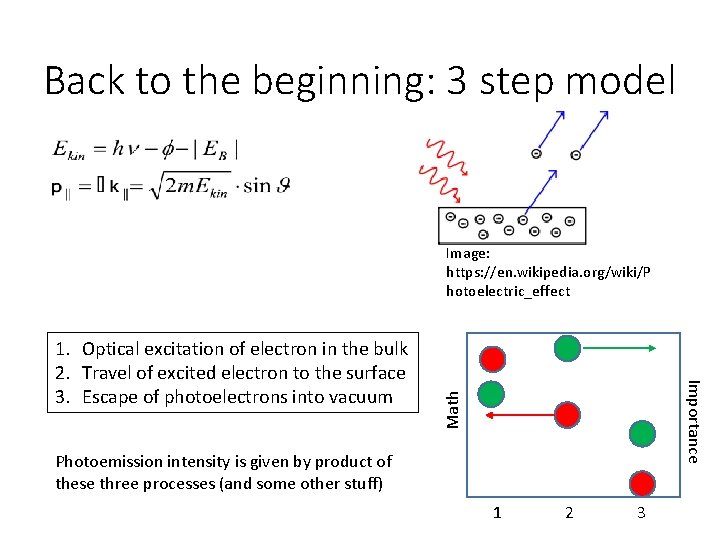
Back to the beginning: 3 step model Image: https: //en. wikipedia. org/wiki/P hotoelectric_effect Math Importance 1. Optical excitation of electron in the bulk 2. Travel of excited electron to the surface 3. Escape of photoelectrons into vacuum Photoemission intensity is given by product of these three processes (and some other stuff) 1 2 3
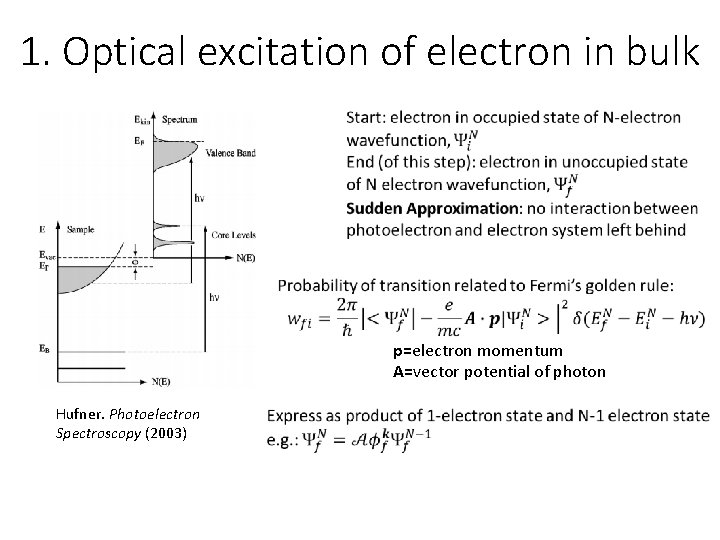
1. Optical excitation of electron in bulk p=electron momentum A=vector potential of photon Hufner. Photoelectron Spectroscopy (2003)
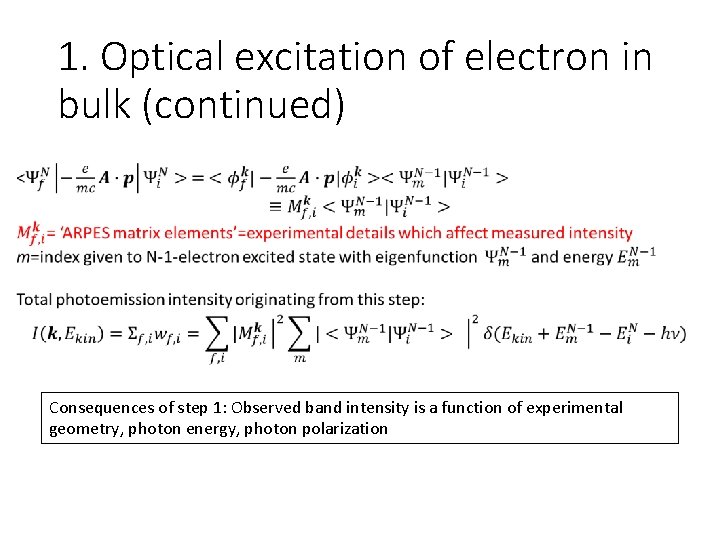
1. Optical excitation of electron in bulk (continued) Consequences of step 1: Observed band intensity is a function of experimental geometry, photon energy, photon polarization
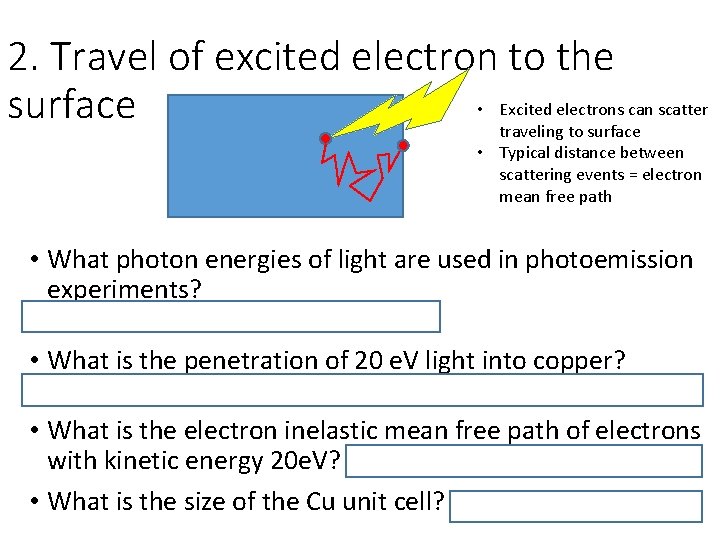
2. Travel of excited electron to the • Excited electrons can scatter surface traveling to surface • Typical distance between scattering events = electron mean free path • What photon energies of light are used in photoemission experiments? 6 -6000 e. V (this course: 6 -150 e. V) • What is the penetration of 20 e. V light into copper? ~11 nm (source: http: //xdb. lbl. gov/Section 1/Sec_1 -6. pdf) • What is the electron inelastic mean free path of electrons with kinetic energy 20 e. V? ~0. 6 nm (Seah and Dench) • What is the size of the Cu unit cell? 0. 36 nm
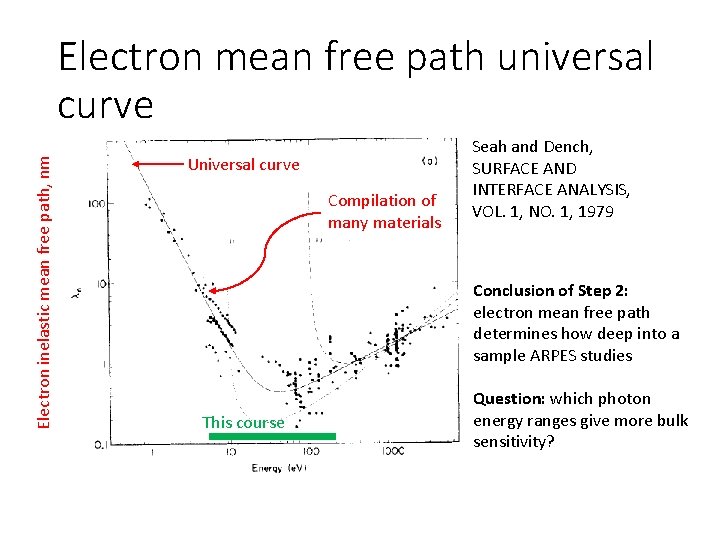
Electron inelastic mean free path, nm Electron mean free path universal curve Universal curve Compilation of many materials Seah and Dench, SURFACE AND INTERFACE ANALYSIS, VOL. 1, NO. 1, 1979 Conclusion of Step 2: electron mean free path determines how deep into a sample ARPES studies This course Question: which photon energy ranges give more bulk sensitivity?
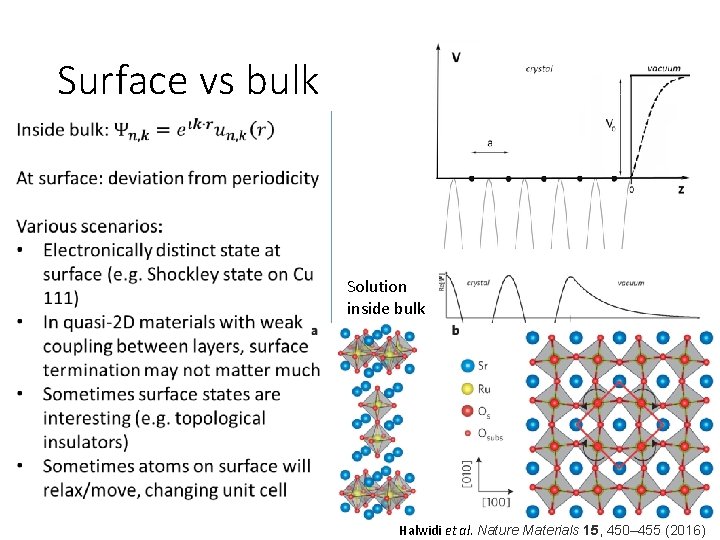
Surface vs bulk Solution inside bulk Solution localized at surface (Shockley states) Images from: https: //en. wikipedia. org/wiki/Surface_states Halwidi et al. Nature Materials 15, 450– 455 (2016)
3. Escape of photoelectrons into vacuum •
Outline Review: momentum space and why we want to go there Looking at data: simple metal Formalism: 3 step model • Matrix elements • Surface vs bulk Looking at data General principle of ARPES: what we do and what we measure ARPES instrumentation • Light source • Spectrometer • Vacuum system Other aspects of experiments • Energy/momentum resolution • Temperature
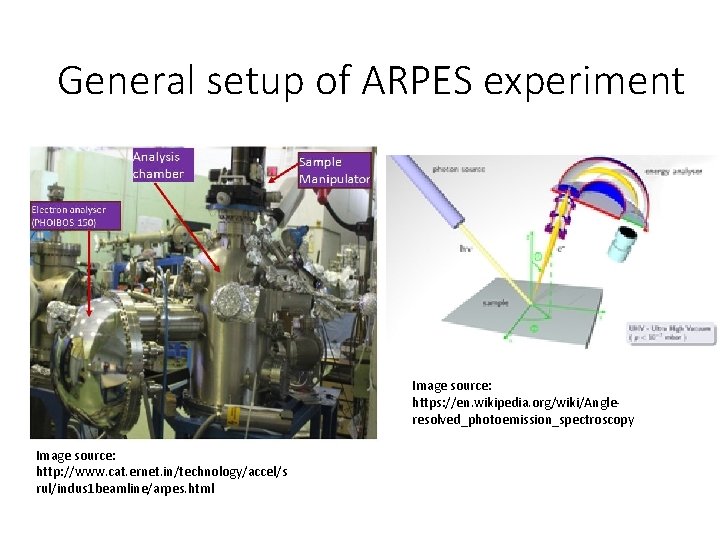
General setup of ARPES experiment Image source: https: //en. wikipedia. org/wiki/Angleresolved_photoemission_spectroscopy Image source: http: //www. cat. ernet. in/technology/accel/s rul/indus 1 beamline/arpes. html
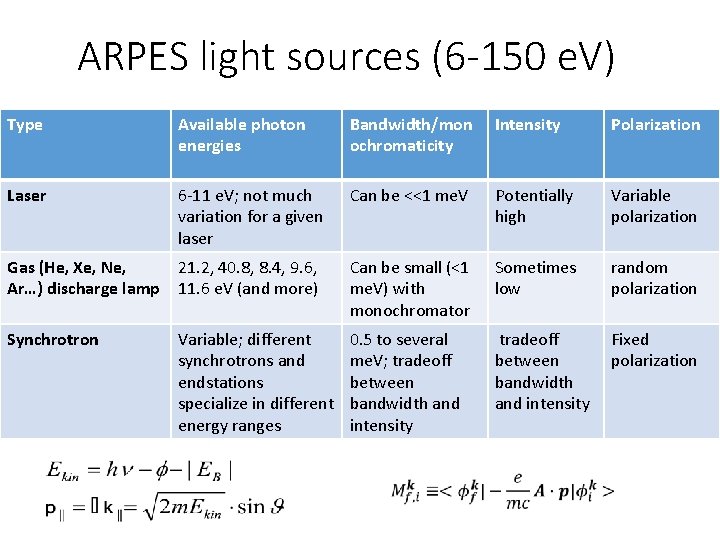
ARPES light sources (6 -150 e. V) Type Available photon energies Bandwidth/mon ochromaticity Intensity Polarization Laser 6 -11 e. V; not much variation for a given laser Can be <<1 me. V Potentially high Variable polarization Gas (He, Xe, Ne, 21. 2, 40. 8, 8. 4, 9. 6, Ar…) discharge lamp 11. 6 e. V (and more) Can be small (<1 me. V) with monochromator Sometimes low random polarization Synchrotron 0. 5 to several me. V; tradeoff between bandwidth and intensity Fixed polarization Variable; different synchrotrons and endstations specialize in different energy ranges
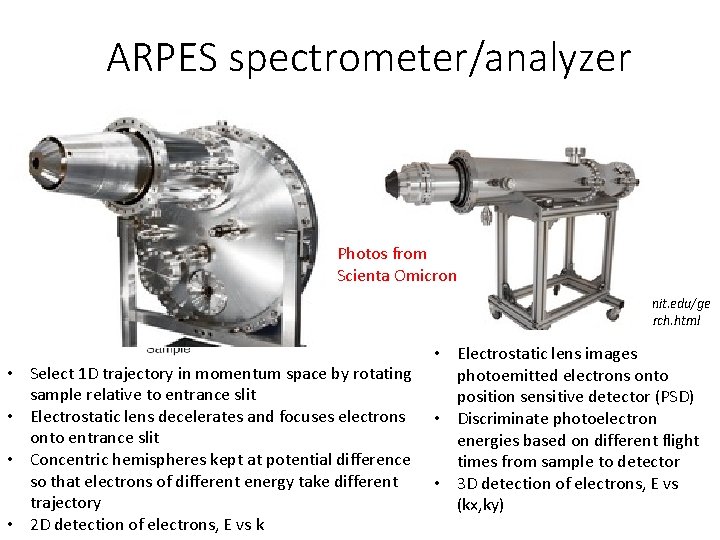
ARPES spectrometer/analyzer Hemispherical analyzer Time-of-flight analyzer sample Photos from Scienta Omicron Image: RMP 75 473 (2003) • Select 1 D trajectory in momentum space by rotating sample relative to entrance slit • Electrostatic lens decelerates and focuses electrons onto entrance slit • Concentric hemispheres kept at potential difference so that electrons of different energy take different trajectory • 2 D detection of electrons, E vs k Image: http: //web. mit. edu/ge diklab/research. html • Electrostatic lens images photoemitted electrons onto position sensitive detector (PSD) • Discriminate photoelectron energies based on different flight times from sample to detector • 3 D detection of electrons, E vs (kx, ky)
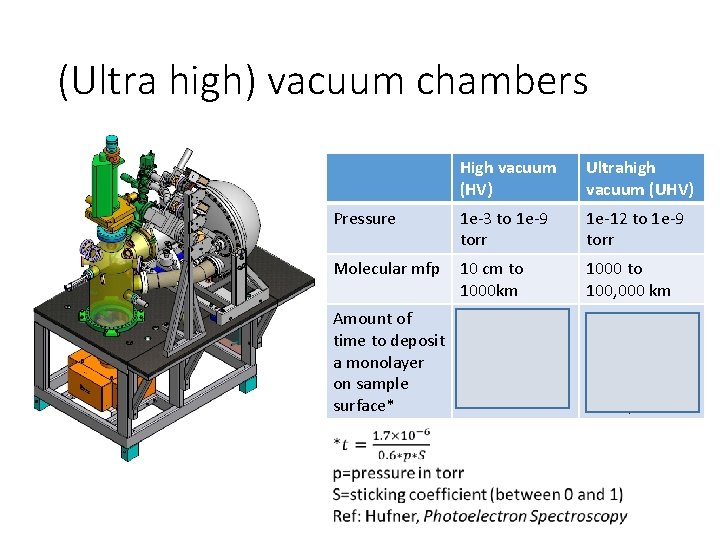
(Ultra high) vacuum chambers High vacuum (HV) Ultrahigh vacuum (UHV) Pressure 1 e-3 to 1 e-9 torr 1 e-12 to 1 e-9 torr Molecular mfp 10 cm to 1000 km 1000 to 100, 000 km Amount of time to deposit a monolayer on sample surface* . 006 s to 95 minutes (typical estimate: 6 s) 95 minutes to 65 days (typical estimate: 20 hours)
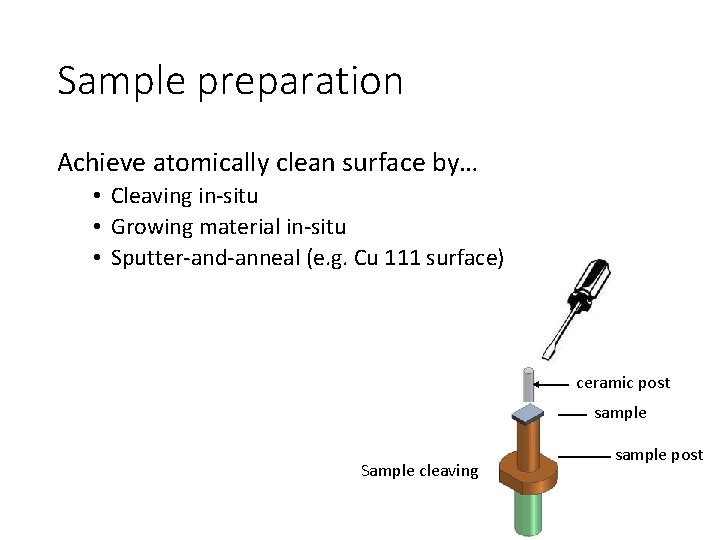
Sample preparation Achieve atomically clean surface by… • Cleaving in-situ • Growing material in-situ • Sputter-and-anneal (e. g. Cu 111 surface) ceramic post sample Sample cleaving sample post
Outline Review: momentum space and why we want to go there Looking at data: simple metal Formalism: 3 step model • Matrix elements • Surface vs bulk Looking at data General principle of ARPES: what we do and what we measure ARPES instrumentation • Light source • Spectrometer • Vacuum system Other aspects of experiments • Energy/momentum resolution • Temperature
Resolution in ARPES experiment Intensity in ARPES experiment: “Matrix elements” Fermi. Dirac Function Resolution Ellipsoid Convolution “band structure + Interactions” PRB 87, 075113 (2013)
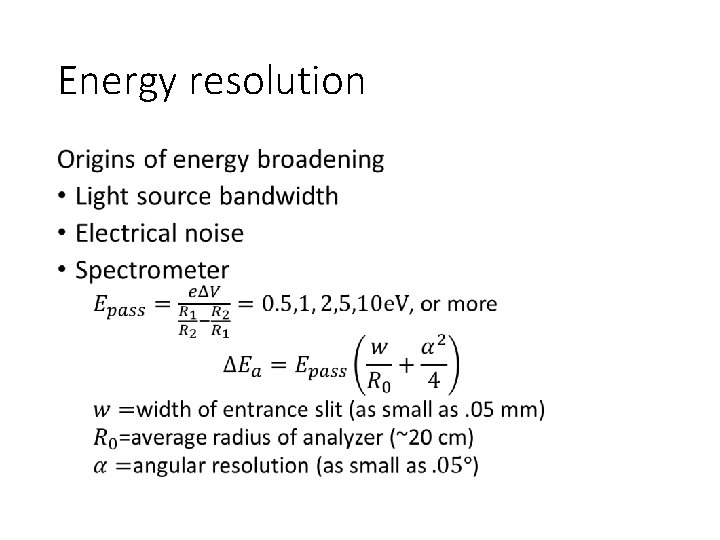
Energy resolution •
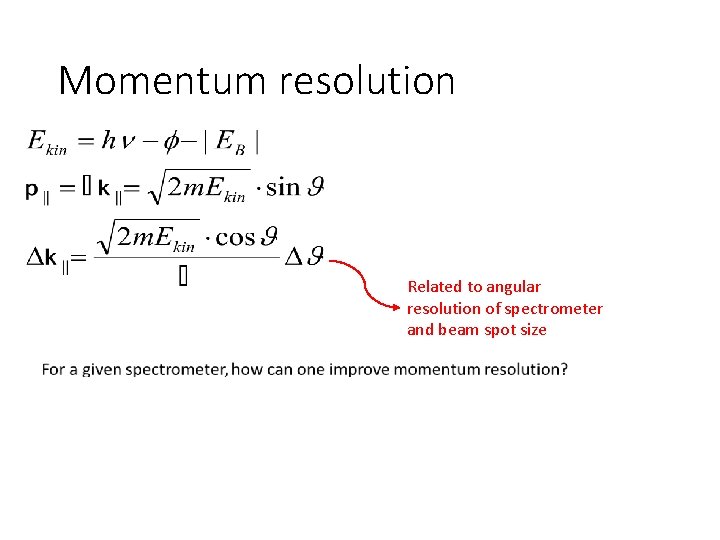
Momentum resolution Related to angular resolution of spectrometer and beam spot size
Cu 111 ARPES: origin of superior resolution? B A PRB 87, 075113 (2013) Why is B sharper than A? • Energy resolution approximately the same • 6. 05 e. V has superior momentum resolution • 6. 05 e. V has tiny spot size to avoid averaging over sample inhomogeneities
Some notes on resolution… • Instrument resolution represents a convolution of original spectrum with 2 D resolution ellipsoid. It does not represent the smallest energy or momentum scale which can be resolved • Resolution can move spectral features around a bit • There are sometimes tradeoffs to achieving better resolution (e. g. sacrificing photon intensity or ability to access all of momentum space) which may be unacceptable for some experiments • Resolution has improved a lot in the last 30 years
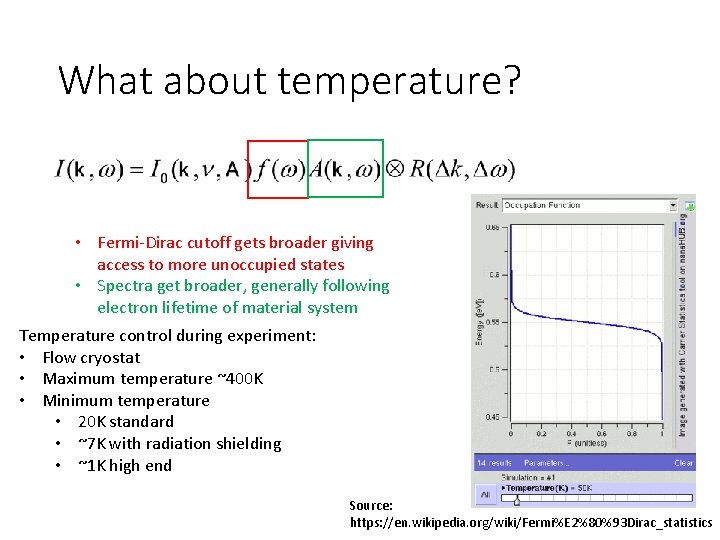
What about temperature? • Fermi-Dirac cutoff gets broader giving access to more unoccupied states • Spectra get broader, generally following electron lifetime of material system Temperature control during experiment: • Flow cryostat • Maximum temperature ~400 K • Minimum temperature • 20 K standard • ~7 K with radiation shielding • ~1 K high end Source: https: //en. wikipedia. org/wiki/Fermi%E 2%80%93 Dirac_statistics
Outline Review: momentum space and why we want to go there Looking at data: simple metal Formalism: 3 step model • Matrix elements • Surface vs bulk Looking at data General principle of ARPES: what we do and what we measure ARPES instrumentation • Light source • Spectrometer • Vacuum system Other aspects of experiments • Energy/momentum resolution • Temperature
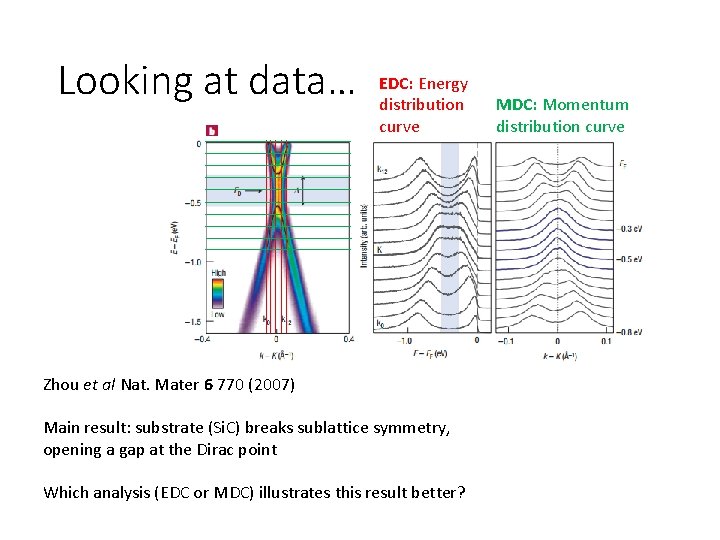
Looking at data… EDC: Energy distribution curve Zhou et al Nat. Mater 6 770 (2007) Main result: substrate (Si. C) breaks sublattice symmetry, opening a gap at the Dirac point Which analysis (EDC or MDC) illustrates this result better? MDC: Momentum distribution curve
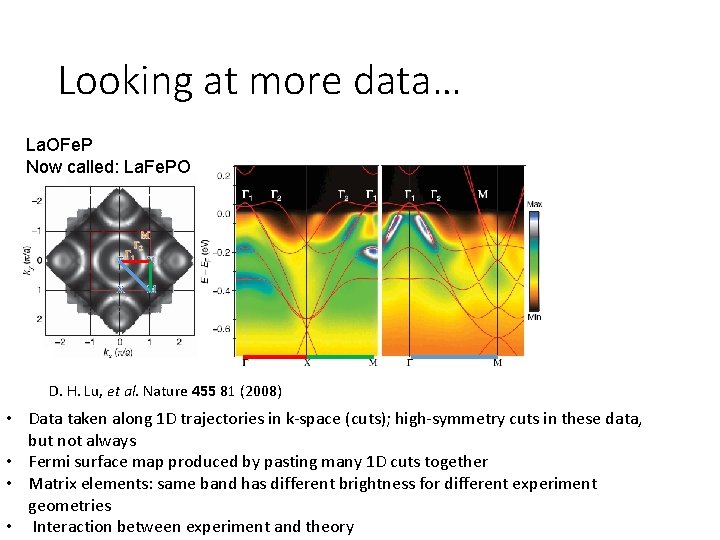
Looking at more data… La. OFe. P Now called: La. Fe. PO D. H. Lu, et al. Nature 455 81 (2008) • Data taken along 1 D trajectories in k-space (cuts); high-symmetry cuts in these data, but not always • Fermi surface map produced by pasting many 1 D cuts together • Matrix elements: same band has different brightness for different experiment geometries • Interaction between experiment and theory
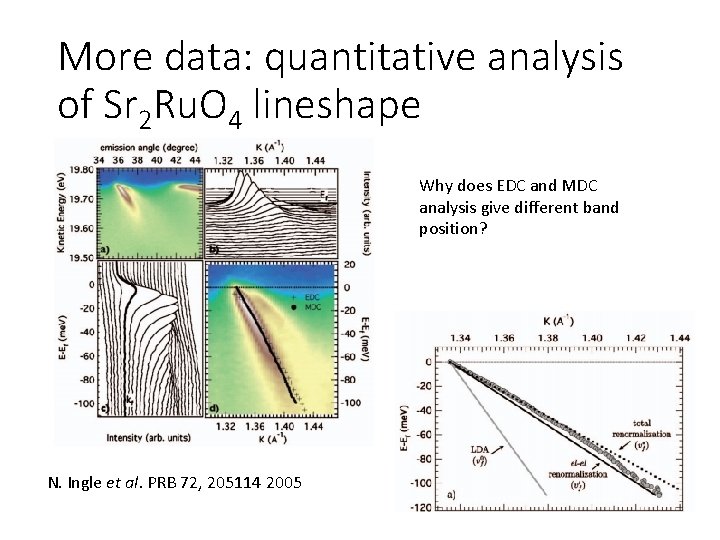
More data: quantitative analysis of Sr 2 Ru. O 4 lineshape Why does EDC and MDC analysis give different band position? N. Ingle et al. PRB 72, 205114 2005
Resources • Campuzano, Norman, Randeria. Photoemission in the high-Tc superconductors. https: //arxiv. org/pdf/condmat/0209476. pdf • Damascelli, Hussain, Shen. Angle-resolved photoemission studies of the cuprate superconductors. Rev. Mod. Phys. 75 473 (2003) • Damascelli. Probing the Electronic Structure of Complex Systems by ARPES. Physica Scripta. Vol. T 109, 61– 74, 2004 (https: //www. cuso. ch/fileadmin/physique/document/ Damascelli_ARPES_CUSO_2011_Lecture_Notes. pdf) • Hufner, Photoelectron Spectroscopy, Springer (2003)
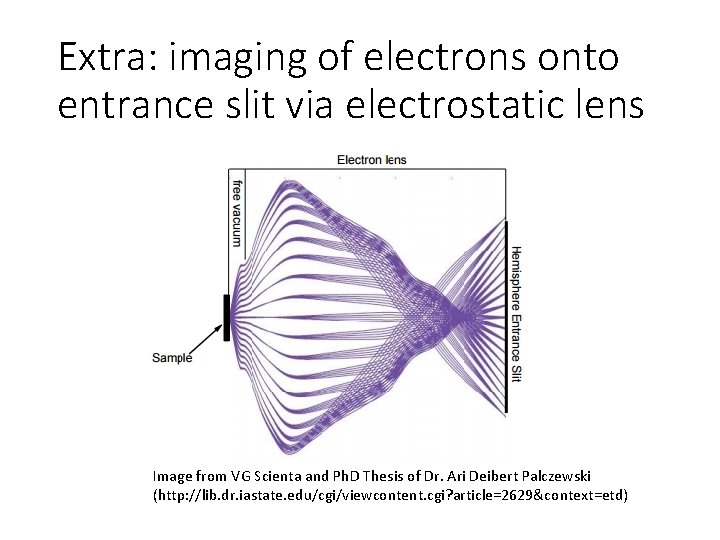
Extra: imaging of electrons onto entrance slit via electrostatic lens Image from VG Scienta and Ph. D Thesis of Dr. Ari Deibert Palczewski (http: //lib. dr. iastate. edu/cgi/viewcontent. cgi? article=2629&context=etd)