
Angle Theorems for Triangles Essential Question What can




- Slides: 17
Angle Theorems for Triangles Essential Question? What can you conclude about the measures of the angles of a triangle? 8. G. 5
Common Core Standard: 8. G ─Understand congruence and similarity using physical models, transparencies, or geometry software. 5. Use informal arguments to establish facts about the angle sum and exterior angle of triangles, about the angles created when parallel lines are cut by a transversal, and the angle-angle criterion for similarity of triangles. For example, arrange three copies of the same triangle so that the sum of the three angles appears to form a line, and give an argument in terms of transversals why this is so.
Objectives: • To learn the basic angle theorems for triangles and use them to solve problems.
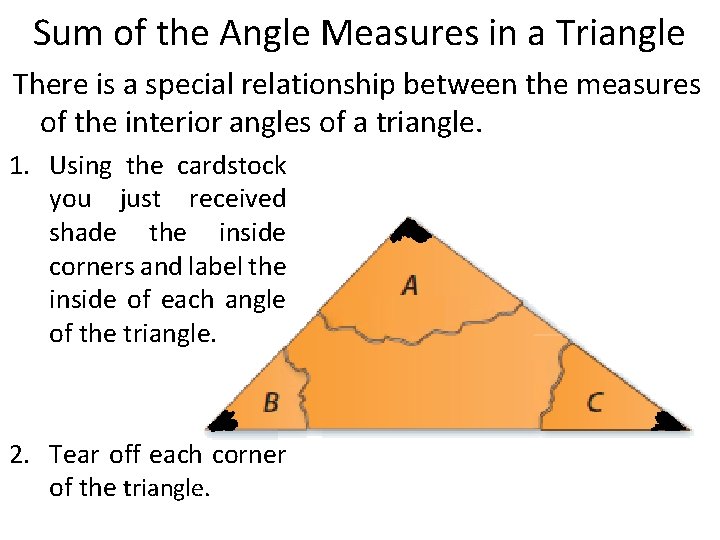
Sum of the Angle Measures in a Triangle There is a special relationship between the measures of the interior angles of a triangle. 1. Using the cardstock you just received shade the inside corners and label the inside of each angle of the triangle. 2. Tear off each corner of the triangle.
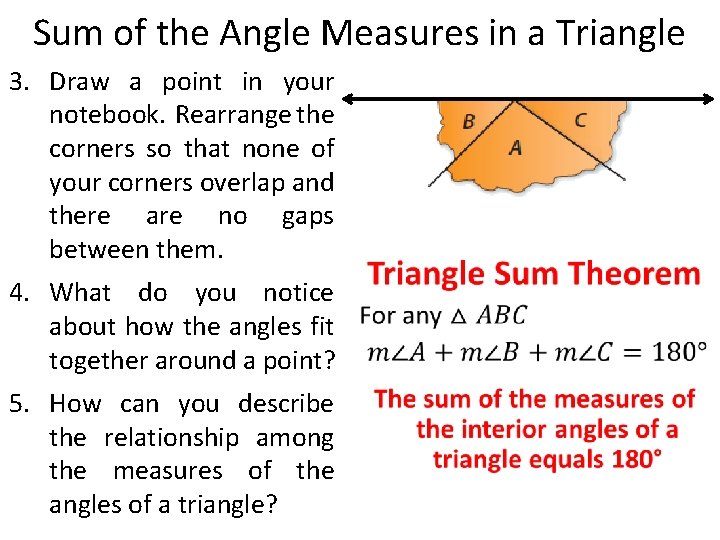
Sum of the Angle Measures in a Triangle 3. Draw a point in your notebook. Rearrange the corners so that none of your corners overlap and there are no gaps between them. 4. What do you notice about how the angles fit together around a point? 5. How can you describe the relationship among the measures of the angles of a triangle?
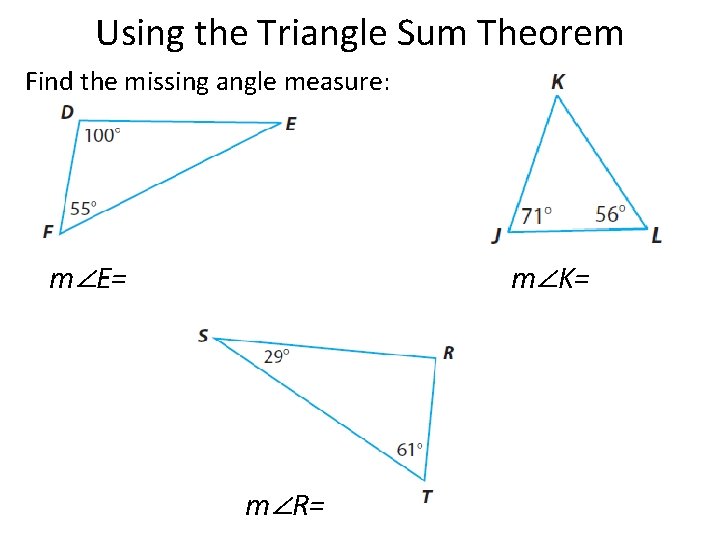
Using the Triangle Sum Theorem Find the missing angle measure: m∠E= m∠K= m∠R=
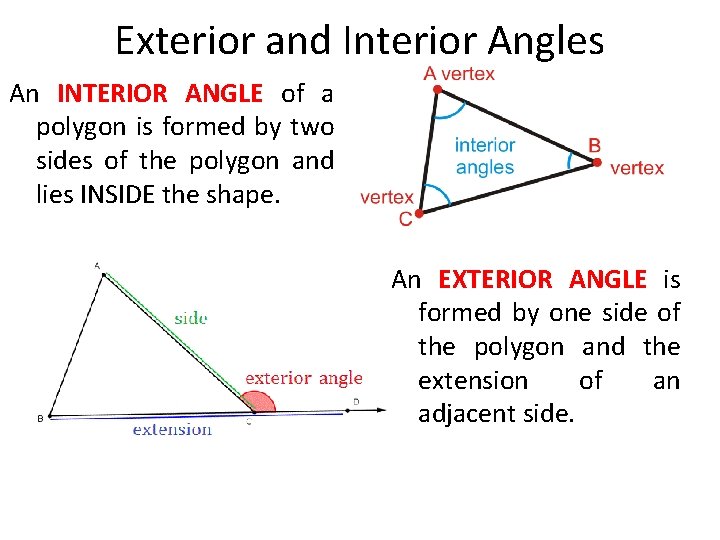
Exterior and Interior Angles An INTERIOR ANGLE of a polygon is formed by two sides of the polygon and lies INSIDE the shape. An EXTERIOR ANGLE is formed by one side of the polygon and the extension of an adjacent side.
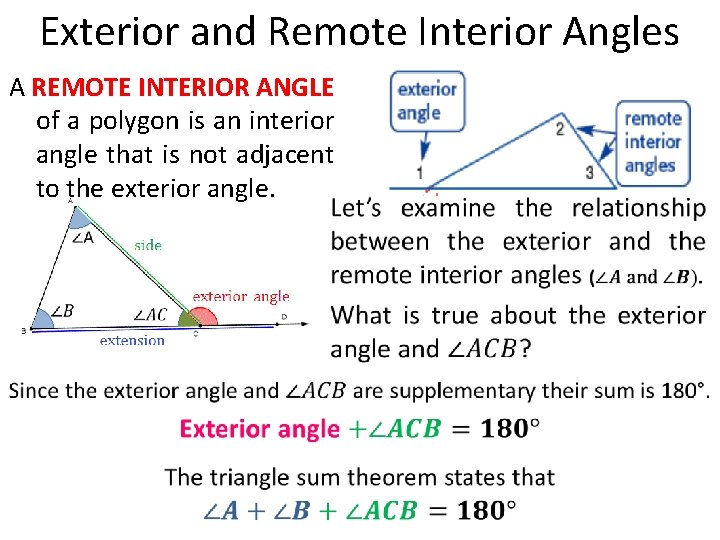
Exterior and Remote Interior Angles A REMOTE INTERIOR ANGLE of a polygon is an interior angle that is not adjacent to the exterior angle.
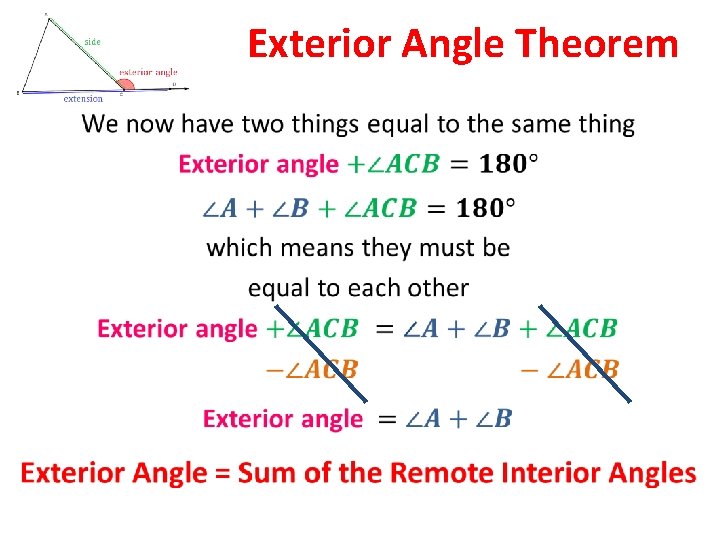
Exterior Angle Theorem
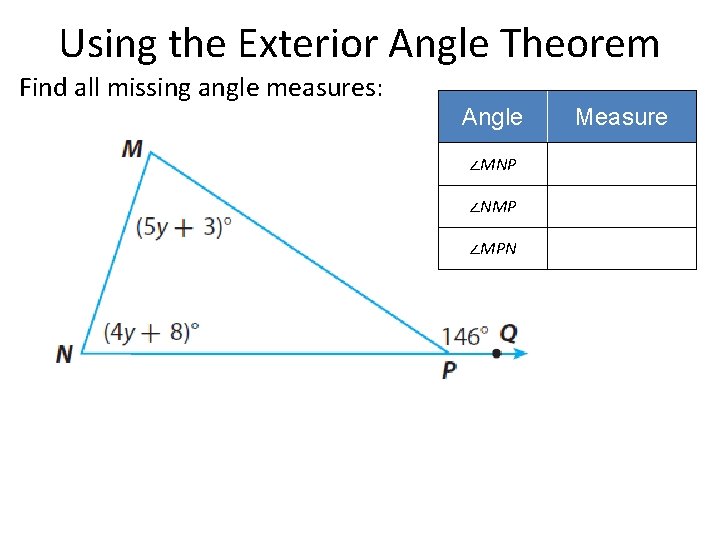
Using the Exterior Angle Theorem Find all missing angle measures: Angle ∠MNP ∠NMP ∠MPN Measure
Using the Exterior Angle Theorem Find all missing angle measures: Angle ∠CAB ∠ABC ∠ACB Measure
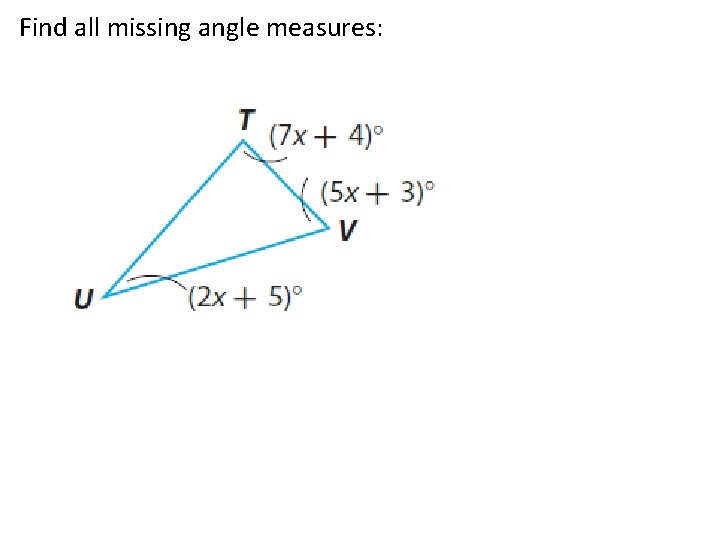
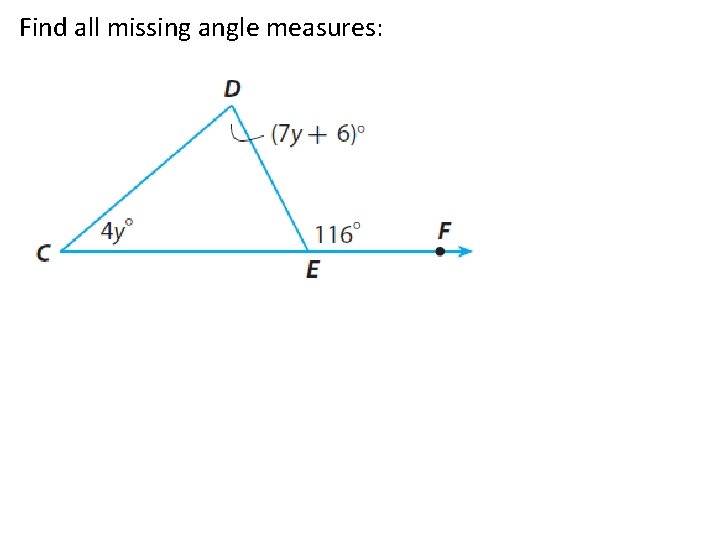
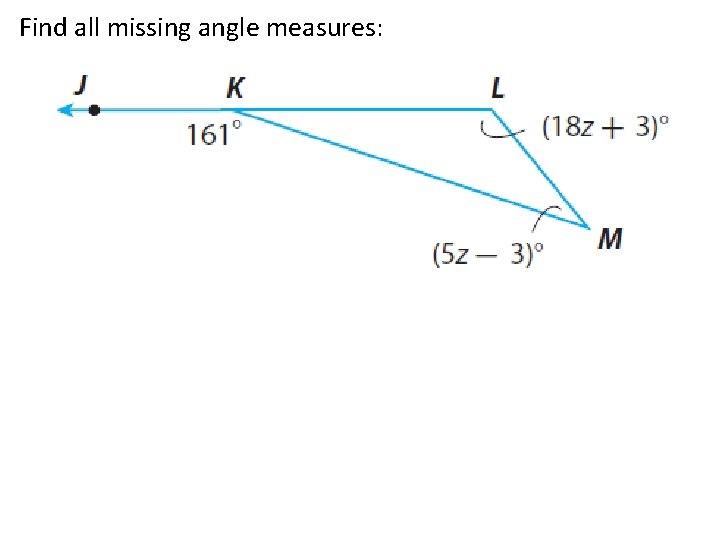
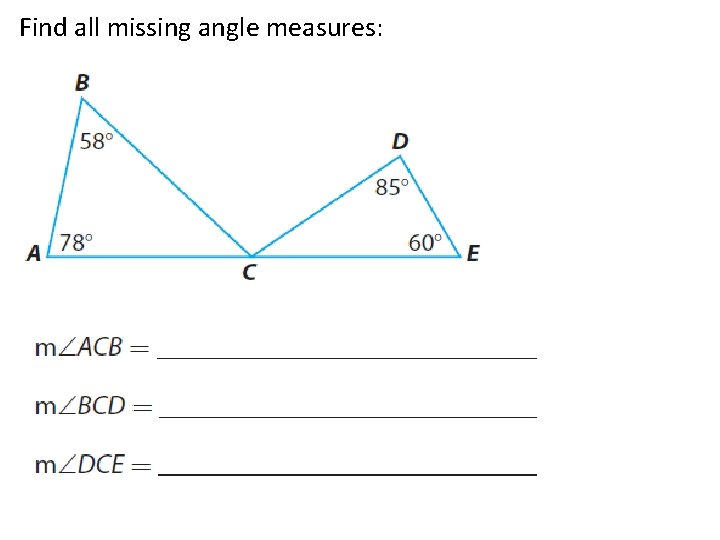
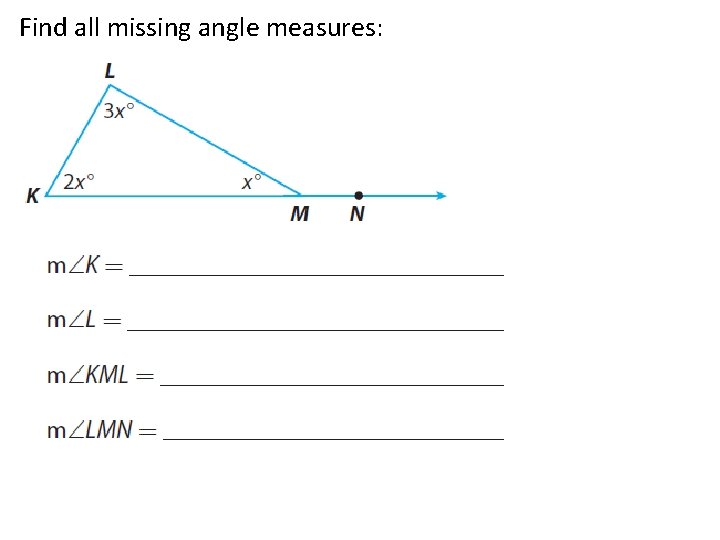
Find all missing angle measures:
Find all missing angle measures:
Find all missing angle measures:
Find all missing angle measures:
Find all missing angle measures:
Find all missing angle measures: