
Anger Management Counseling Psychological Services University of Cincinnati

- Slides: 44
Anger Management Counseling & Psychological Services University of Cincinnati
I feel… Furious Spiteful Grouchy Frustrated Enraged Annoyed Irritated Mad Irate ANGRY
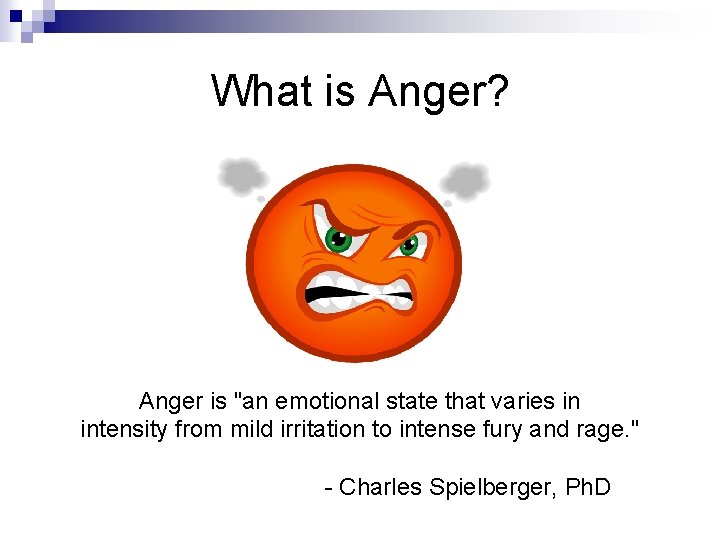
What is Anger? Anger is "an emotional state that varies in intensity from mild irritation to intense fury and rage. " - Charles Spielberger, Ph. D
How do you experience anger?
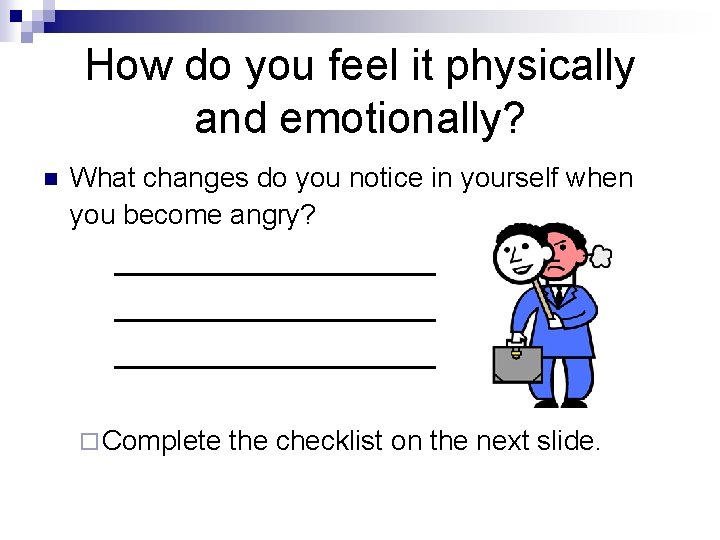
How do you feel it physically and emotionally? n What changes do you notice in yourself when you become angry? __________________ ¨ Complete the checklist on the next slide.
n Are there other ways you experience anger internally? __________________________
n Think about these reactions. n Are they good for you—your health? your relationships? Your success at school and in life?
Why do we get angry? n “We are predisposed to become angry when we appraise an event or a person as a threat to one of our basic needs such as food or shelter, or more mature needs such as identity, recognition, achievement, and social affiliation. ” – Dr. Weisinger’s Anger Work-out Book, p. 31
Appraisal n Part of what makes us angry is how we appraise or interpret situations. n Sometimes we misinterpret situations as threatening when in actuality they are not.
When do you get angry?
n When was the last time you were angry? Day/week: ___________ Time: _____________ Place: _____________
n What was happening in the hours before you became angry? ______________________ ______________________
n What was your mood before you became angry? ____________________________________
n What occurred right before you became angry? _________________________
n Psychologists often call that “right before” event a “trigger. ” n The scene has been set by previous events and your mood, and then something triggers your response of anger.
n For example, maybe you have had a bad morning…got up late and felt groggy, spilled coffee and had to change your shirt, tired from the day before, a little worried about a paper you need to write…and then, the trigger: someone cuts you off in traffic.
Understanding Triggers n Recognizing there has been a series of precursors to the anger can reduce the impact of the trigger. n And, knowing your specific triggers can help you respond differently when they occur the next time.
Thoughts Matter n Triggers are accompanied by thoughts, including thoughts that you have so quickly that they are almost automatic and you may not even notice them.
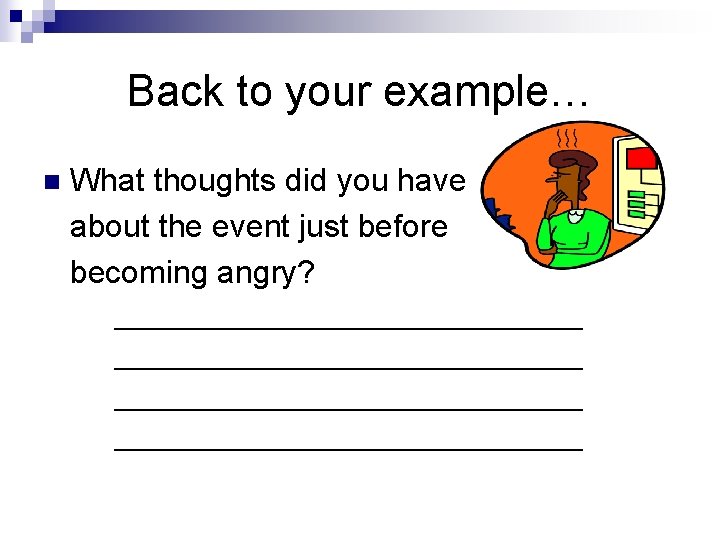
Back to your example… n What thoughts did you have about the event just before becoming angry? ______________________________
Brainstorming n The thoughts that lead to anger often involve feeling treated unfairly. n While calm, brainstorm other ways to think about the situation to help prepare yourself for the next time it occurs
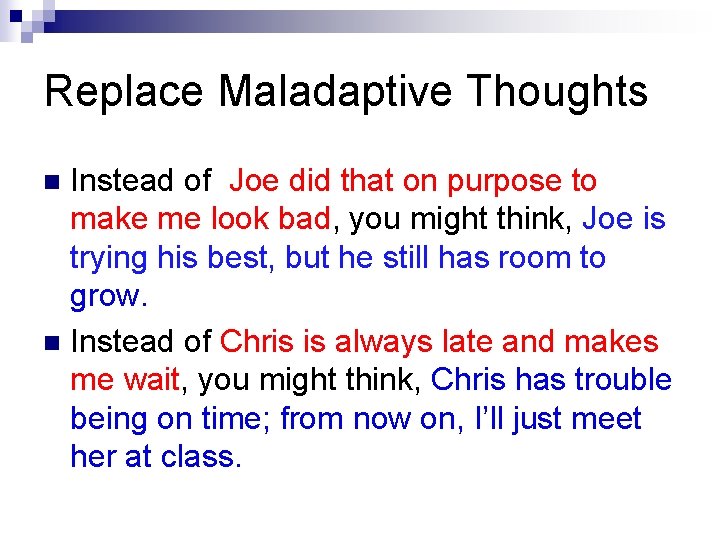
Replace Maladaptive Thoughts Instead of Joe did that on purpose to make me look bad, you might think, Joe is trying his best, but he still has room to grow. n Instead of Chris is always late and makes me wait, you might think, Chris has trouble being on time; from now on, I’ll just meet her at class. n
Now You Try n Usual thought that leads to anger ________________ n New way of thinking about it _______________________________
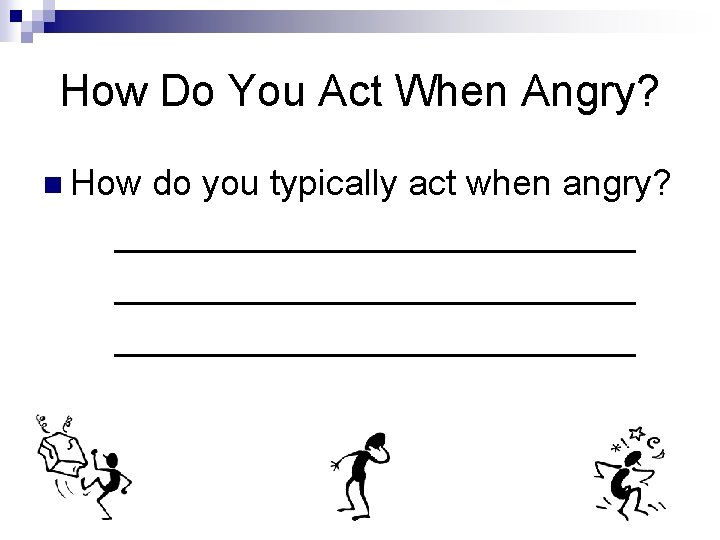
How Do You Act When Angry? n How do you typically act when angry? __________________________
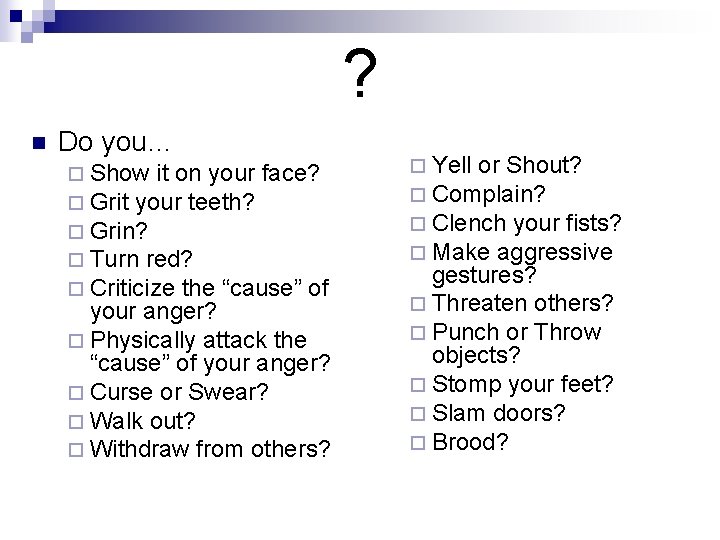
? n Do you… ¨ Show it on your face? ¨ Grit your teeth? ¨ Grin? ¨ Turn red? ¨ Criticize the “cause” of your anger? ¨ Physically attack the “cause” of your anger? ¨ Curse or Swear? ¨ Walk out? ¨ Withdraw from others? ¨ Yell or Shout? ¨ Complain? ¨ Clench your fists? ¨ Make aggressive gestures? ¨ Threaten others? ¨ Punch or Throw objects? ¨ Stomp your feet? ¨ Slam doors? ¨ Brood?
Aggression n These are aggressive behaviors. Aggression and anger are not the same thing. People act aggressively for a purpose, such as showing others their anger, intimidating others, getting a feeling of relief….
Avoiding n Sometimes people avoid others when they are angry so they won’t show the anger or take it out on others. This can be helpful at times, but it can also lead to isolation and passivity--not dealing with problems, so never solving them.
What are the Effects of Your Actions? n What usually occurs after you react to your own anger? ___________________________
n What are the short term effects? ___________________________ n For example: ¨ Do you experience relief? ¨ Do you become angrier? Depressed? ¨ Does your anger influence other situations you encounter or your interactions with others?
? n What are the long term effects? n For example: ¨ Do you become angry again in a similar situation? ¨ Do you continue to experience the same problem as before? ¨ Are there significant long term effects, such as lost friendships or jobs, a drinking problem, or a court appearance?
Negative Aspects of Anger may lead to muddled thinking or impulsive action n Anger can cause confusion as to where the true problem lies n Anger can lead to aggression or avoidance n ** Based on: The Society for Safe and Caring Schools and Communities 2 Secondary Assembly Script 7, Topic 4 A, Managing Anger
Can Anger be a Positive? n Although anger is often viewed as a negative feeling, it can be used in a positive way… ¨ Anger provides cues that there is a problem ¨ Anger provides energy and can help motivate action ¨ Anger encourages the expression of feelings ** Based on - The Society for Safe and Caring Schools and Communities 2 Secondary Assembly Script 7, Topic 4 A, Managing Anger
Positive Relief n Anger feels uncomfortable. There are ways to relieve it that are not destructive. Taking some time before reacting can be constructive—not aggression, not avoidance, just a break before deciding how to handle things that have led to the anger.
Time Out n Ways to ease feelings of anger ¨ Take a walk or engage in some other physical activity ¨ Perform a relaxation exercise (e. g. meditation, progressive relaxation, etc. ) ¨ Read a book ¨ Listen to music ¨ Watch television ¨ Talk to or call a friend ¨ Write in your journal ¨ Complete chores n What ideas do you have?
Practicing Relaxation n Progressive relaxation ** Adapted from: The Anxiety and Phobia Workbook by Edmond J. Bourne, Ph. D ¨ Take 3 deep abdominal breaths and imagine the tension leaving your body as you exhale ¨ Clench your fists and hold for up to 10 seconds (use this amount of time for each muscle group). Release. ¨ Tighten your biceps. Release. ¨ Tighten your triceps. Release. n Continue to follow the directions above for each muscle group making sure you include muscles in your face, shoulders, and core, and continue to breathe deeply.
Practicing Relaxation n You can also envision yourself in a setting you find peaceful ¨ Make sure you envision the scene in great detail ¨ You do not have to limit yourself to reality ** Adapted from: The Anxiety and Phobia Workbook by Edmond J. Bourne, Ph. D
Use the Anger n Let anger be your friend. Listen to it. What is the problem you are encountering? Is it related to the preceding situations or moods? Why is the trigger powerful over you? n What steps can you take to figure out the problem?
Addressing the Problem n Once you have figured out the problem, you can figure out how to address it. Do you need to rearrange your schedule? Learn time management skills? Talk with someone about your interactions? End a bad relationship? Find a major you like better?
You’re Not Alone n Sometimes things are easy to figure out and change. Many time, though, it’s hard. n Consider using CAPS to help you learn to understand better what your anger is telling you, and how to make good changes in your life.
Questions? n If you have any questions you can contact CAPS ¨ Phone: 556 -0648 ¨ Location: 225 Calhoun St Suite 200 ¨ Hours: Monday thru Friday 8 AM – 5 PM ¨ Website: http: //www. uc. edu/counseling. html
CAPS n We offer… ¨ Confidential individual and group counseling to UC students ¨ Urgent Care walk-in services during business hours ¨ Consultation to faculty, staff, family, and friends concerned about a student ¨ Workshops and presentations on stress management, communication, relationships, balancing demands, and a variety of other topics ¨ Assistance using community resources
References n American Psychological Association: Psychology Topics www. apa. org/topics/controlanger. html n Dr. Weisinger’s Anger Workout Book: Step -by-Step Methods for Greater Productivity, Better Relationships, and Healthier Life -By Hendrie Weisinger, Ph. D
References n Lifewatch Employee Assistance Program www. lifewatch-eap. com n The Society for Safe & Caring Schools & Communities www. sacsc. ca n The Anxiety & Phobia Workbook -By Edmund J. Bourne, Ph. D