
Anger Management Conflict Resolution Aims of this session
- Slides: 14
Anger Management & Conflict Resolution
Aims of this session: A brief look at: • Causes of anger and confrontation • Anger / conflict escalation • When & how we should intervene to deescalate • Strategies for both pupils & staff
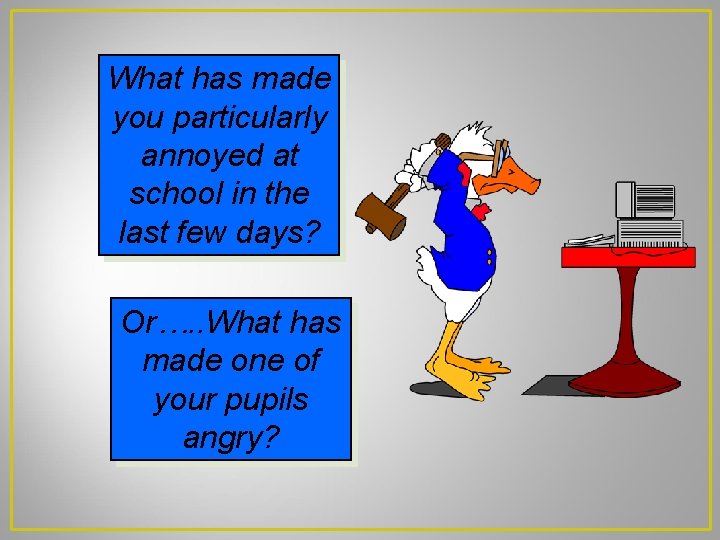
What has made you particularly annoyed at school in the last few days? Or…. . What has made one of your pupils angry?
Why do we get angry? Most people get angry if they are ignored, are insulted, or abused. Fear can also be a major factor. It is a natural reaction to situations in which we feel threatened. . . Helps the fight, flight or flock reflex.
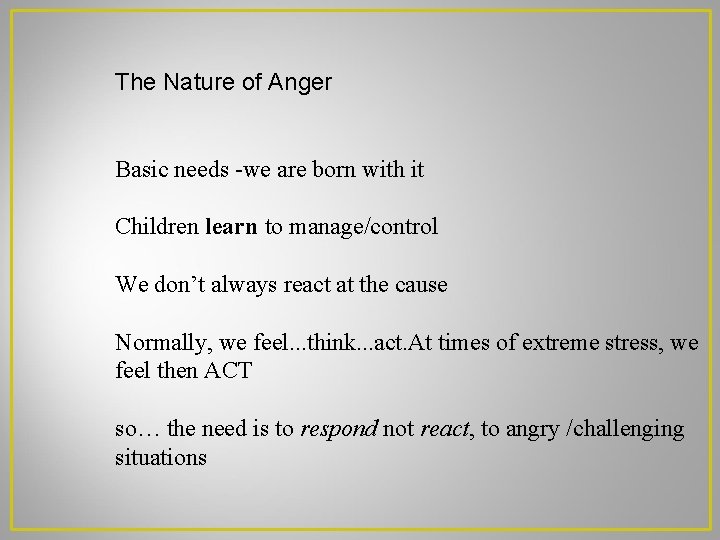
The Nature of Anger Basic needs -we are born with it Children learn to manage/control We don’t always react at the cause Normally, we feel. . . think. . . act. At times of extreme stress, we feel then ACT so… the need is to respond not react, to angry /challenging situations
Anyone can become angry - that is easy. But to become angry with the right person to the right degree, at the right time, for the right purpose, and in the right way - this is not easy. (Aristotle)
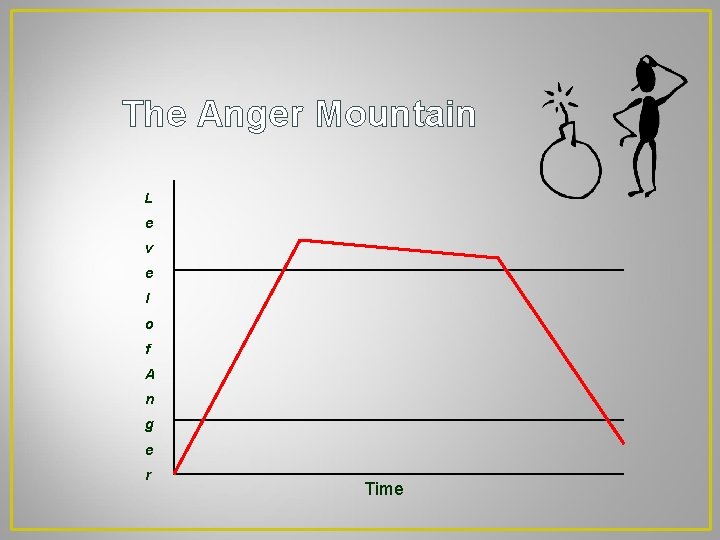
The Anger Mountain L e v e l o f A n g e r Time
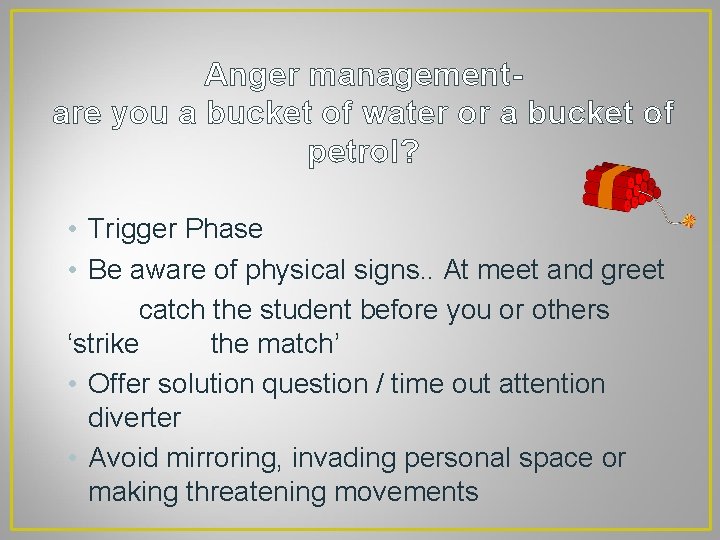
Anger managementare you a bucket of water or a bucket of petrol? • Trigger Phase • Be aware of physical signs. . At meet and greet catch the student before you or others ‘strike the match’ • Offer solution question / time out attention diverter • Avoid mirroring, invading personal space or making threatening movements
Escalation - remain calm • Actively listen, show concern • Be solution focused “I can see you are upset, and am really concerned about how this is affecting your behaviour in my lesson. Let’s spend some time sorting this out”. (use upset, not angry) • Listen. . reframe “I’m not sure I understand-tell me more. Let me see if I understand. . you are upset because. . . If you were me how would you sort this out? ”
Crisis Phase • • Don’t be drawn into the confrontational spiral Be aware of proximity / eye contact / posture keep voice calm Acknowledge feelings. ’. I see you are unhappy, I can see your point’ • If violent and out of control, move the class out
De-escalation - after the conflict/anger • ABC • How to address the issue with the student • How did we react during the situation?
Planning for Anger in the Classroom • Remember that behaviour that challenges is directed AT teachers and rarely caused by them. Separate the behaviour from the child. • Take SEN into account. • Record the incidents- day and time • Plan for follow-up to assist consistency • Appreciate we all get angry at times and there are ways of controlling it.
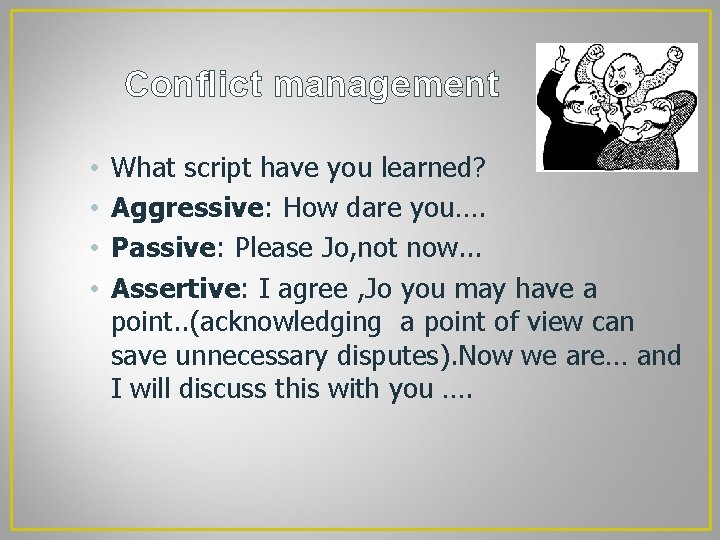
Conflict management • • What script have you learned? Aggressive: How dare you…. Passive: Please Jo, not now. . . Assertive: I agree , Jo you may have a point. . (acknowledging a point of view can save unnecessary disputes). Now we are… and I will discuss this with you ….
Resolution for confrontations are successful if… • A co-operative relationship already exists • They are not carried out publicly • Respect is shown to the student • The student’s feelings are acknowledged • A compromise can sometimes be offered • A calm atmosphere can be maintained • A teacher does not use dominant, threatening behaviour