
Aneuploidy and Syndromes Perresha Crawford Karyotype Number and
Aneuploidy and Syndromes Perresha Crawford
Karyotype Number and visual appearance of the chromosomes in the cell nuclei of an organism or species • Normal karyotype 22 pairs of autosomes 1 pair of sex chromosomes • Aneuploidy Abnormality of the number of chromosomes • Trisomy 21 (Down’s syndrome) • Trisomy 18 (Edward’s syndrome) • Trisomy 13 (Patau syndrome) • Triploidy • Turner’s syndrome • Potter’s syndrome • Prune Belly syndrome • Pentology of Cantrell
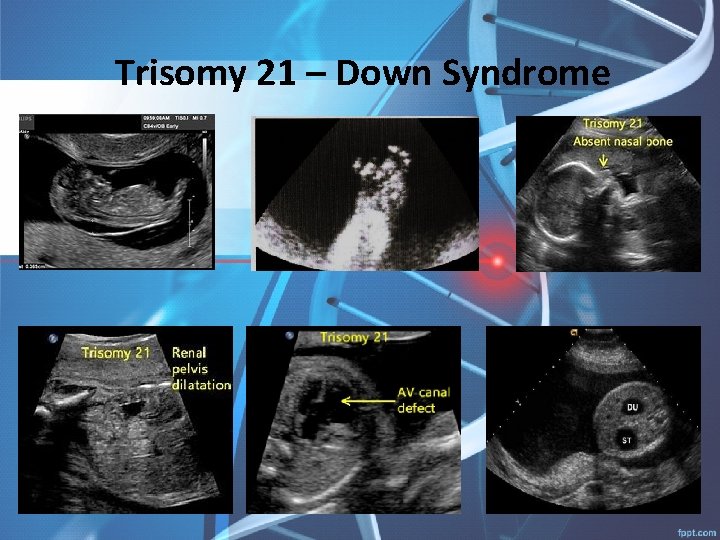
Trisomy 21 – Down Syndrome • • • Heart defects – pulmonary stenosis – pulmonary hypoplasia – mild ventriculomegaly – septal defects – endocardial cushion defect – tetralogy of Fallot Cystic hygroma Hydrops Pyelectasis Echogenic bowel Protuberant tongue Low-set ears Short nose Intrauterine growth restriction Brachycephaly • • • Atresia – duodenal – esophageal – Anorectal Extremity anomalies – shortened femur/ humerus – clinodactyly – hypoplasia of middle phalanx – Space between 1 st/2 nd toes Absence of the nasal bone Thickened nuchal fold Calcification of the chordae tendinea Imperforate anus Polyhydramnios Choroid plexus cysts Hydrothorax
Trisomy 21 – Down Syndrome
Trisomy 18 – Edward’s Syndrome • Heart defects • Cranial anomalies – dolichocephaly – microcephaly – hydrocephalus – agenesis of the corpus callosum – cerebellar hypoplasia – encephalocele – strawberry shaped head – choroid plexus cysts • Renal anomalies • Omphalocele • Congenital diaphragmatic hernia • IUGR • Extremity anomalies – persistently clenched fists – overlapping digits – talipes – rocker-bottom feet – radial aphasia • Facial abnormalities – low set ears – micrognathia – cleft lip and palate • Neural tube defects • Cystic hygroma • Non immune hydrops • Single umbilical artery • Polyhydramnios
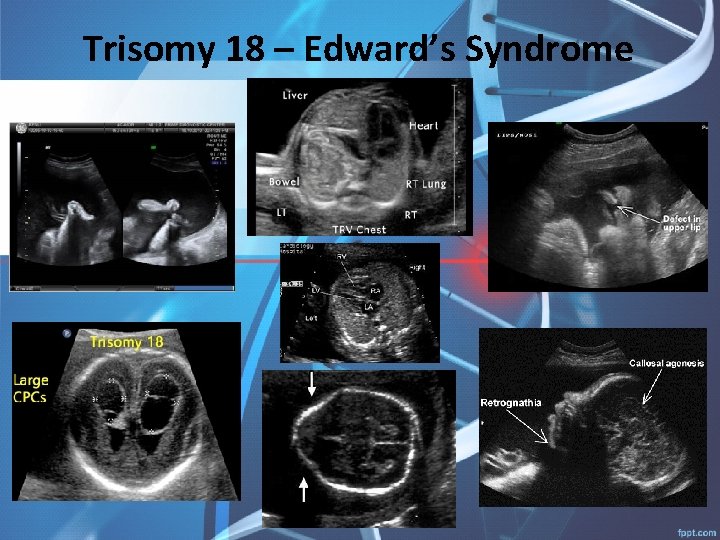
Trisomy 18 – Edward’s Syndrome
Trisomy 13 – Patau’s Syndrome • Facial anomalies – hypotelorism – proboscis – cyclopia – single nostril – cleft lip/ palate – microphthalmia – micrognathia • Cranial anomalies – holoprosencephaly – corpus callosum agenesis – microcephaly • Meningomyelocele Cystic hygroma Omphalocele Renal anomalies Extremity anomalies – polydactyly – talipes – rocker bottom feet – overlapping fingers • Heart defects – septal defects – hypoplastic left heart – echogenic cordae tendineae • •
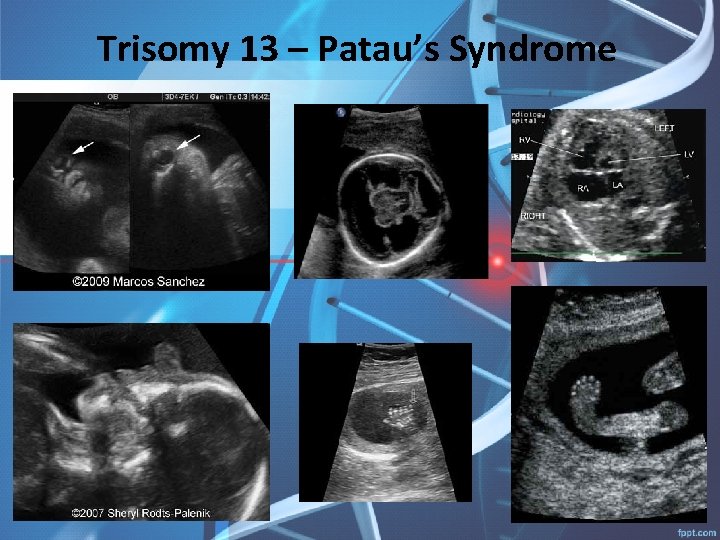
Trisomy 13 – Patau’s Syndrome
Triploidy • Heart defects – septal defects – truncus arteriosus – pulmonary atresia • Cranial anomalies – holoprosencephaly – corpus callosum agenesis – hydrocephalus – Dandy Walker malformation • Facial anomalies – low set ears – hypertelorism – cleft lip/ palate – micrognathia • • Oligohydramnios Genitourinary – renal agenesis – renal hypoplasia – renal cystic dysplasia – ambiguous genitalia – cryptochidism Extremity anomalies – talipes – syndactyly Severe IUGR Placental changes Omphalocele Meningomyelocele Neural tube defects

Triploidy
Turner’s Syndrome – 45 X • Cardiac anomalies – Aortic coarctation – Ventricular septal defects – Tetralogy – Bicuspid aortic valve • Oligohydramnios • IUGR • Renal anomalies – – Horseshoe kidney Renal agenesis Hydronephrosis Hypoplastic kidney • Cystic hygroma • Hydrops
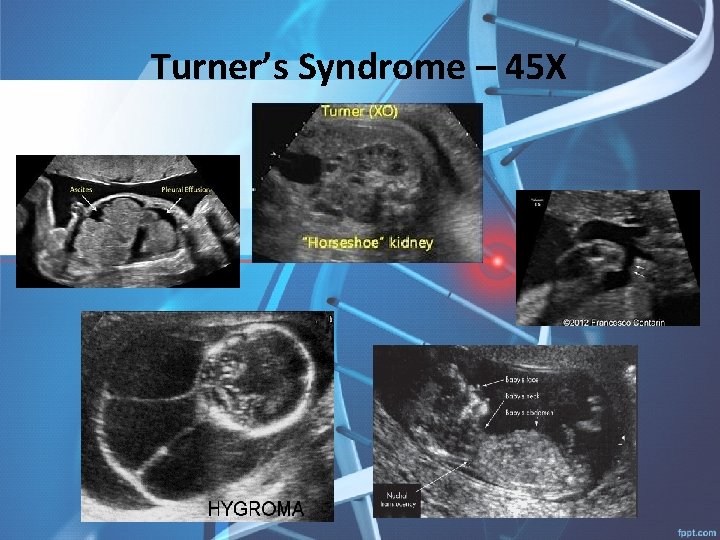
Turner’s Syndrome – 45 X
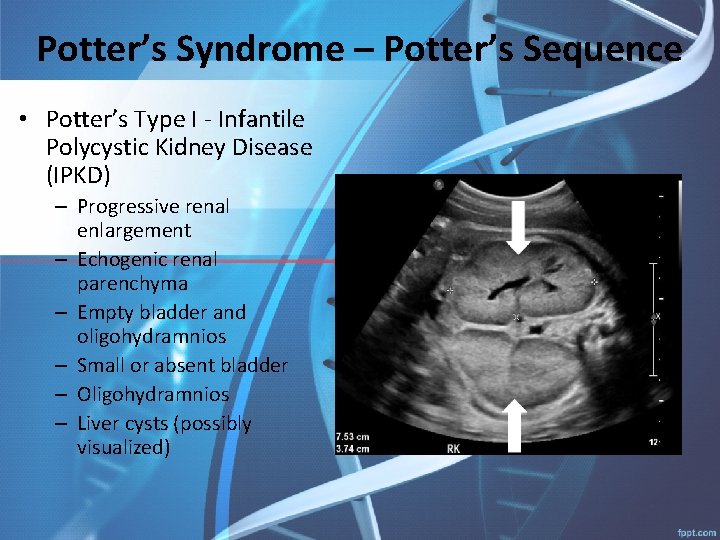
Potter’s Syndrome – Potter’s Sequence • Potter’s Type I - Infantile Polycystic Kidney Disease (IPKD) – Progressive renal enlargement – Echogenic renal parenchyma – Empty bladder and oligohydramnios – Small or absent bladder – Oligohydramnios – Liver cysts (possibly visualized)
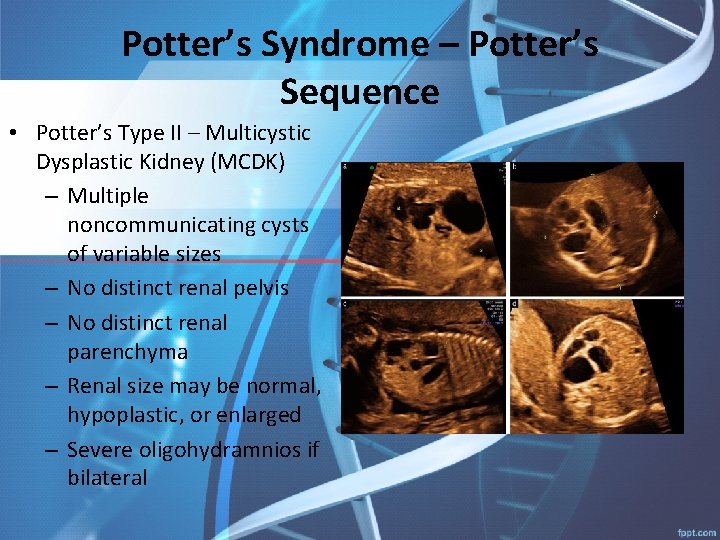
Potter’s Syndrome – Potter’s Sequence • Potter’s Type II – Multicystic Dysplastic Kidney (MCDK) – Multiple noncommunicating cysts of variable sizes – No distinct renal pelvis – No distinct renal parenchyma – Renal size may be normal, hypoplastic, or enlarged – Severe oligohydramnios if bilateral
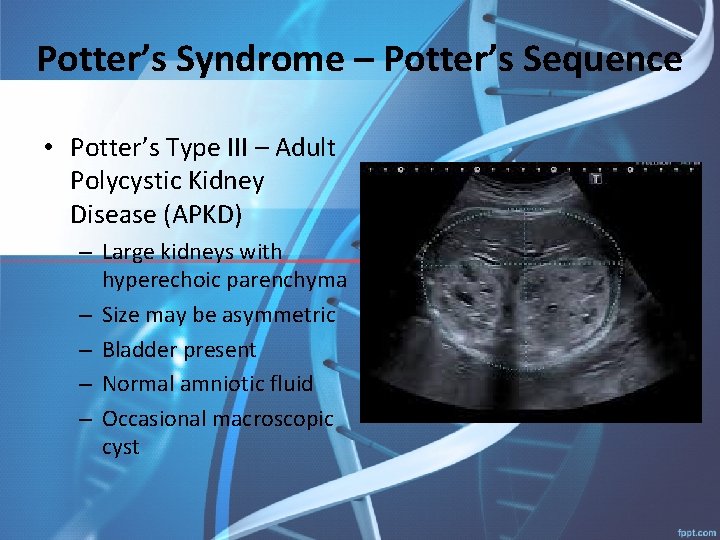
Potter’s Syndrome – Potter’s Sequence • Potter’s Type III – Adult Polycystic Kidney Disease (APKD) – Large kidneys with hyperechoic parenchyma – Size may be asymmetric – Bladder present – Normal amniotic fluid – Occasional macroscopic cyst
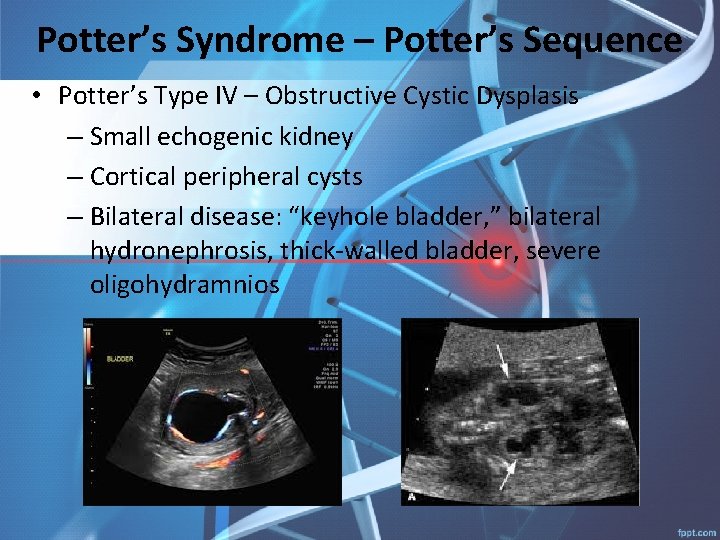
Potter’s Syndrome – Potter’s Sequence • Potter’s Type IV – Obstructive Cystic Dysplasis – Small echogenic kidney – Cortical peripheral cysts – Bilateral disease: “keyhole bladder, ” bilateral hydronephrosis, thick-walled bladder, severe oligohydramnios
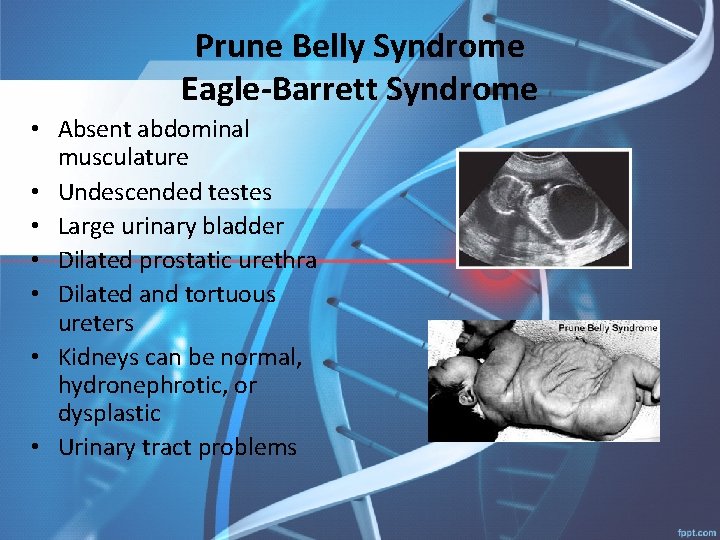
Prune Belly Syndrome Eagle-Barrett Syndrome • Absent abdominal musculature • Undescended testes • Large urinary bladder • Dilated prostatic urethra • Dilated and tortuous ureters • Kidneys can be normal, hydronephrotic, or dysplastic • Urinary tract problems
Pentalogy of Cantrell Rare anomaly with 5 associated defects: • • • Omphalocele Ectopia cordis Distal sternum cleft Intracardiac defects Diaphragmatic hernia
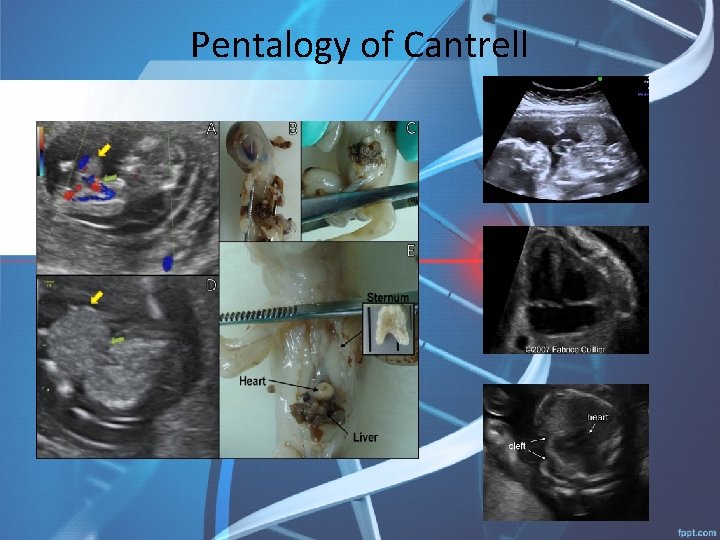
Pentalogy of Cantrell
“The benefits of the examination are greatest when the sonographer is adept at detecting congenital anomalies and understands the cause, progression, and prognosis of the common congenital anomalies including chromosomal anomalies”
Works Cited Cereda, A. , & Carey, J. C. (2012, October 23). The trisomy 18 syndrome. Retrieved February 20, 2020, from https: //www. ncbi. nlm. nih. gov/pmc/articles/PMC 3520824/ Frías, J. L. , & Davenport, M. L. (2003, March 1). Health Supervision for Children With Turner Syndrome. Retrieved February 21, 2020, from https: //pediatrics. aappublications. org/content/111/3/692. full Gimpel, MD, C. , Avni, MD, E. F. , Breysem, MD, L. , & Et. al. (2019, March). Imaging of Kidney Cysts and Cystic Kidney Diseases in Children: An International Working Group Consensus Statement. Retrieved February 21, 2020, from https: //pubs. rsna. org/doi/pdf/10. 1148/radiol. 2018181243 Hagen-Ansert, S. L. (2018). Textbook of diagnostic sonography (Vol. 2). St. Louis, MO: Elsevier. Hassan Toufaily, M. (2016). Triploidy. Retrieved February 19, 2020, from https: //rarediseases. org/rare-diseases/triploidy/ Hill, L. M. (2011, June 1). Triploidy. Retrieved February 20, 2020, from https: //iame. com/online/triploidy/content. php Nogueira, M. , Real, D. V. , Nogueira, R. , & et. al. (2015, March 3). Prenatal Anterior Abdominal Wall Defects – A Radiologic-Pathologic Correlation. Retrieved February 21, 2020, from https: //posterng. netkey. at/esr/viewing/index. php? module=viewing_poster&task=viewsection&pi=126606&ti=422858&si=1482&searchkey= Schreuder, F. K. , & Schreuder, M. F. (2019). Potter Syndrome. Retrieved February 21, 2020, from https: //rarediseases. org/rare-diseases/potter-syndrome/ Trisomy 13 - Genetics Home Reference - NIH. (2020, February 11). Retrieved February 20, 2020, from https: //ghr. nlm. nih. gov/condition/trisomy-13#resources Trisomy 13 and Trisomy 18 in Children. (2020). Retrieved February 18, 2020, from https: //www. stanfordchildrens. org/en/topic/default? id=trisomy-18 -and-13 -90 P 02419 Turner syndrome. (n. d. ). Retrieved February 21, 2020, from https: //rarediseases. info. nih. gov/diseases/7831/turner-syndrome Turner syndrome. (2016, January 11). Retrieved February 21, 2020, from https: //rarediseases. info. nih. gov/diseases/7831/turner-syndrome Werner, MD, H. Trisomy 21. (2006, August 30). Retrieved February 20, 2020, from https: //sonoworld. com/The. Fetus/page. aspx? id=1894
- Slides: 21