
ANESTHETIC MANAGEMENT IN SMALL ANIMALS BY dr hassan

ANESTHETIC MANAGEMENT IN SMALL ANIMALS BY : dr. hassan bakr Sponsored by : orange vet. Center – vetbook Date : 14 -3 -2016
General anesthetic considerations 1 -breed 2 -general animal behavior. 3 -general health and physical status. 4 -purpose of anesthesia. 5 -familarity with the drugs. 6 -current medications.
Consider safety during anesthesia 1 -avilability of reversible agents. � 2 -assurance of a clear air way ( tracheal � tube ) 3 -carfule monitoring of anesthetized patient. 4 -preanesthetic fasting ( except in small and weak animals. � �
Anesthesia stages. 1 - preanesthetic stage. 2 - induction. � 3 -maintainance. 4 -recovery. � � �
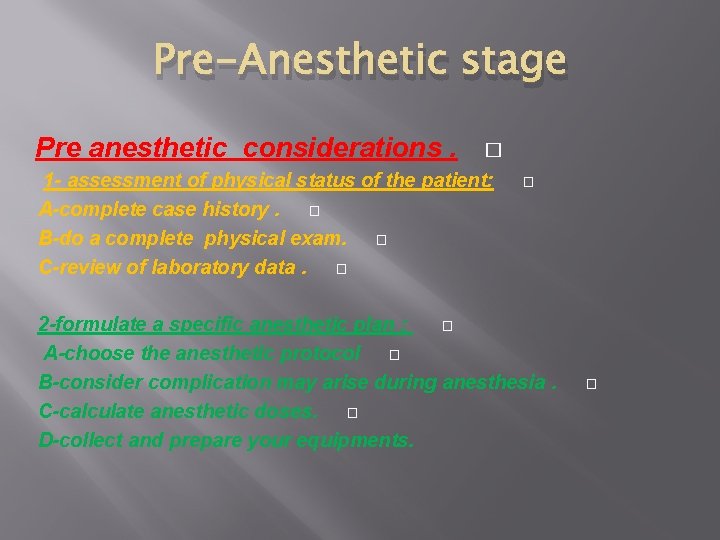
Pre-Anesthetic stage Pre anesthetic considerations. � 1 - assessment of physical status of the patient: A-complete case history. � B-do a complete physical exam. � C-review of laboratory data. � � 2 -formulate a specific anesthetic plan : � A-choose the anesthetic protocol � B-consider complication may arise during anesthesia. C-calculate anesthetic doses. � D-collect and prepare your equipments. �
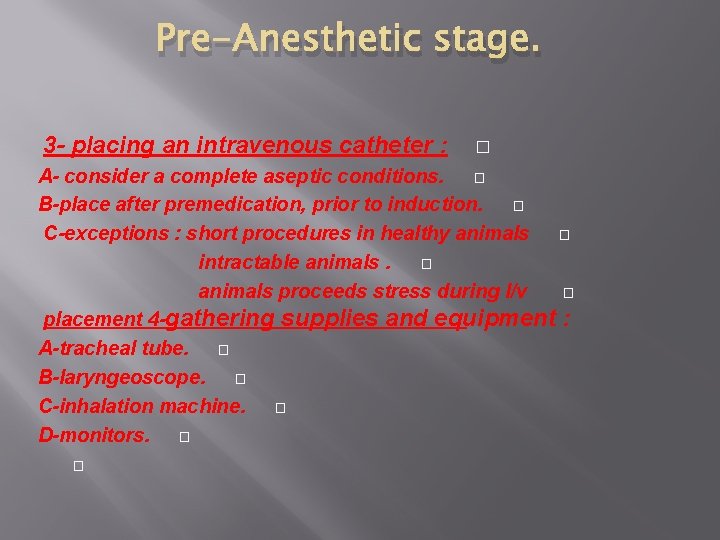
Pre-Anesthetic stage. 3 - placing an intravenous catheter : � A- consider a complete aseptic conditions. � B-place after premedication, prior to induction. � C-exceptions : short procedures in healthy animals � intractable animals. � animals proceeds stress during I/v � placement 4 -gathering supplies and equipment : A-tracheal tube. � B-laryngeoscope. � C-inhalation machine. � D-monitors. � �
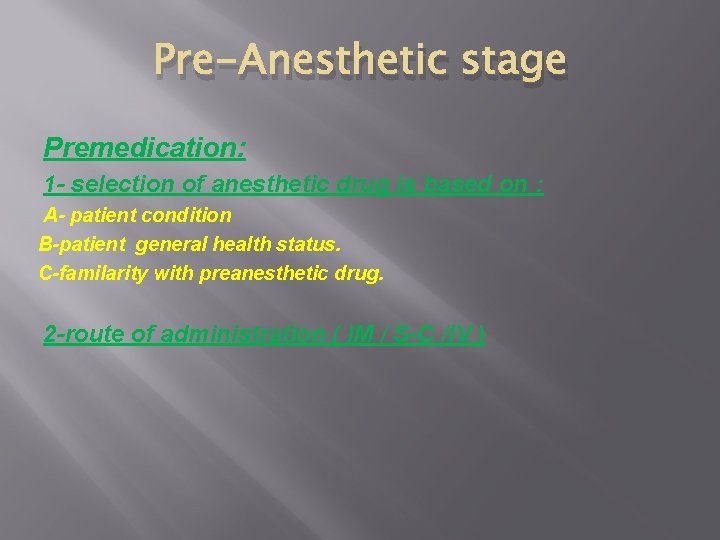
Pre-Anesthetic stage Premedication: 1 - selection of anesthetic drug is based on : A- patient condition B-patient general health status. C-familarity with preanesthetic drug. 2 -route of administration ( IM / S-C /IV )
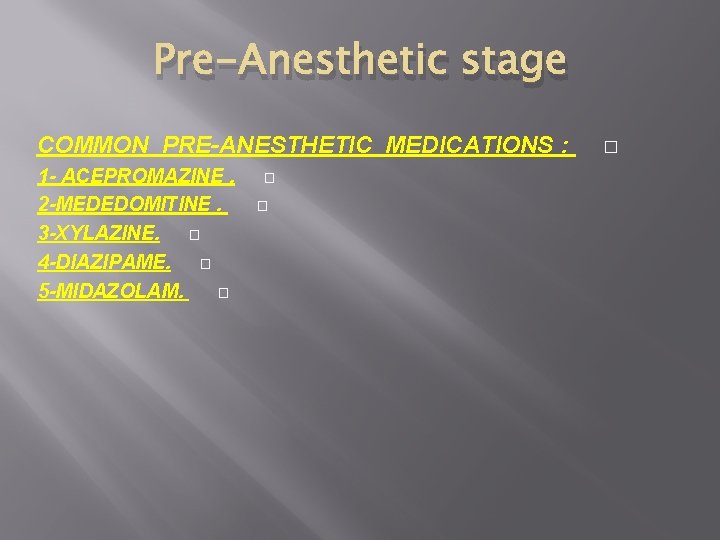
Pre-Anesthetic stage COMMON PRE-ANESTHETIC MEDICATIONS : 1 - ACEPROMAZINE. 2 -MEDEDOMITINE. 3 -XYLAZINE. � 4 -DIAZIPAME. � 5 -MIDAZOLAM. � �
ACEPROMAZINE ACTIONS : � 1 -CAUSE SEDATION. � 2 - NO ANALGESIA. � 3 - ANTI-EMITIC. � 4 - LOW SIZURES THRESHLOD � 5 - CAUSE HYPOTENTION IN HIGH DOSES. � 6 - ASSOCIATED WITH LOWER MORTALITY IN EQUINE ANESTHESIA. CONTRAINDICATED IN : kidney and liver insufficiency , toxemia , hypovolemia and shock. � � �
MEDEDOMITINE ALPHA 2 AGONIST. � CAUSE SEDATION , ANALGESIA , MUSCLE RELAXATION. SIDE EFFECTS : � CAUSE S. A BLOCK , SINUS BRADYCARDIA HYPERTENSION THEN HYPOTENSION. � RECDUCE CARDIAC OUTPUT. � VOMITIMG IN CATS AND DOGS. � � REVERSAL AGENT : ATIPAMIZOL. � �
XYLAZINE ALPHA 2 AGONIST. � CAUSE SEDATION , ANALGESIA , MUSCLE RELAXATION. SIDE EFFECTS : � CAUSE S. A BLOCK , SINUS � BRADYCARDIA HYPERTENSION THEN HYPOTENSION. � RECDUCE CARDIAC OUTPUT. � VOMITIMG IN CATS AND DOGS. � REVERSAL AGENT : YHOMBINE � �
DIAZEPAM - MIDAZOLAM Decrease the dosage of I/V anesthesia. � Anticonvulsant. � Produce muscle relaxation. � May cause excitation in healthy dogs and cats if given alone. In horses cause pronounced muscle relaxation � with mild sedation. � Reversal agent: flumazenil �
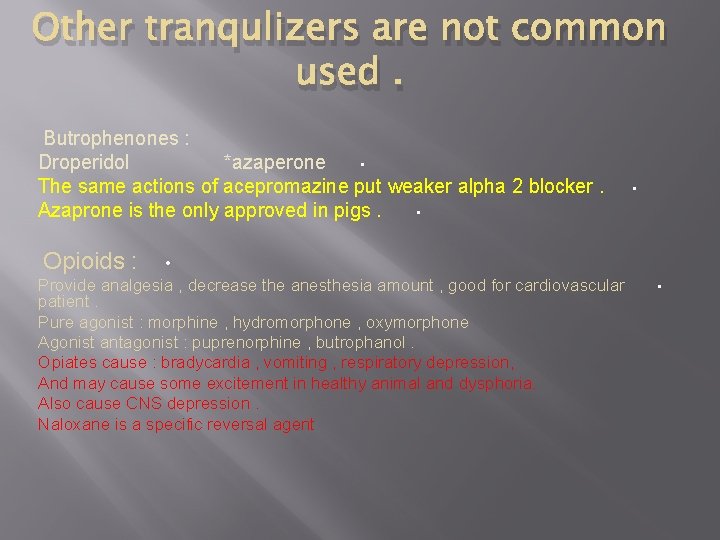
Other tranqulizers are not common used. Butrophenones : Droperidol *azaperone • The same actions of acepromazine put weaker alpha 2 blocker. Azaprone is the only approved in pigs. • Opioids : • • Provide analgesia , decrease the anesthesia amount , good for cardiovascular patient. Pure agonist : morphine , hydromorphone , oxymorphone Agonist antagonist : puprenorphine , butrophanol. Opiates cause : bradycardia , vomiting , respiratory depression, And may cause some excitement in healthy animal and dysphoria. Also cause CNS depression. Naloxane is a specific reversal agent •
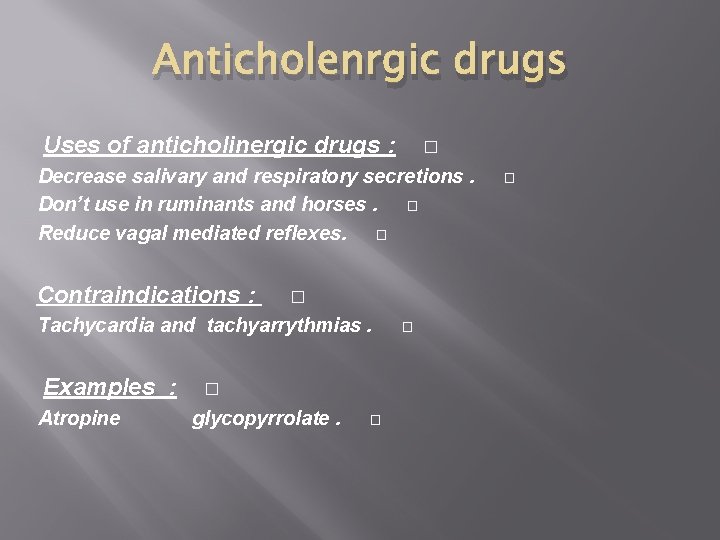
Anticholenrgic drugs Uses of anticholinergic drugs : � Decrease salivary and respiratory secretions. Don’t use in ruminants and horses. � Reduce vagal mediated reflexes. � Contraindications : � Tachycardia and tachyarrythmias. Examples : Atropine � glycopyrrolate. � � �
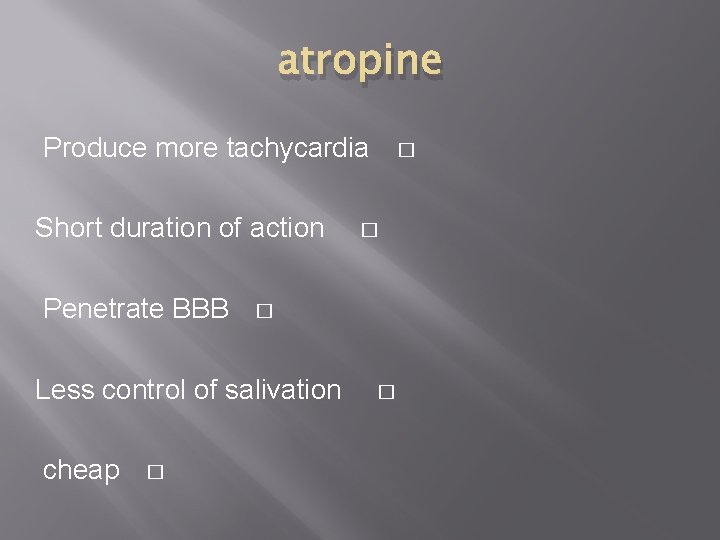
atropine Produce more tachycardia Short duration of action Penetrate BBB � � � Less control of salivation cheap � �
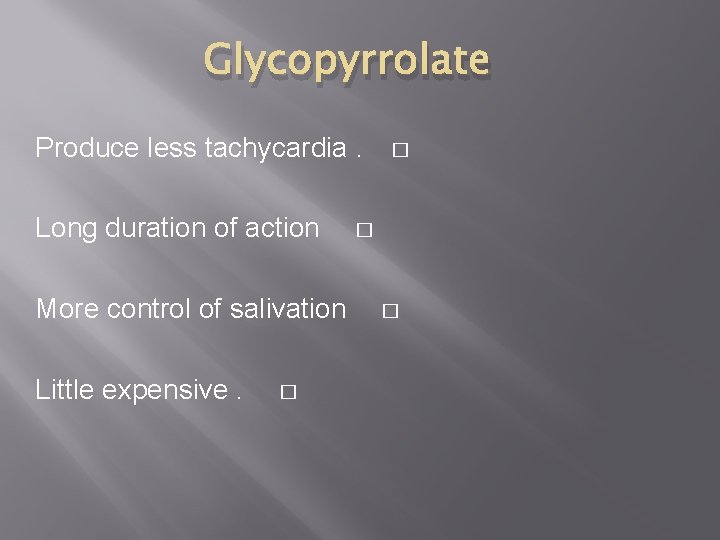
Glycopyrrolate Produce less tachycardia. Long duration of action More control of salivation Little expensive. � �
Stage II : induction. Considrations during induction : � intravenous induction : � Never inject to rapid � Inject able induction affect the dose of inhalant anesthesia. Most drugs are titrated dose to effect. � Adjustment of induction dose are determined according to the effect of pre medications. � Induction drugs � Ketamin combinations , thiopental , and propofol � �
Ketamin Actions : � Sedation � Analgesia � Reduce nerve sensations Side effects � � Increase salivary and respiratory secreations. Produce muscle rigidity. � Can produce sizures alone or in high doses. � �
Thiopental Thiobarbiturates group � Given slowly to produce anesthesia , dose to effect. Has apneutic effect. � Depress myocardial contractility. � Prolonged recovery in grayhounds. � � �
Propofol it is not a barbiturate � Rapid action � Rapid recovery � Hypnotic effect � Produce no analgesia � Cause apnea � Cause hypotension � can be used in maintaince to control a repid action and rapid recovery. �
3 - maintenance. We can maintain anesthesia either by injectable drugs or inhalant drugs. Inject able maintenance : � � used for short duration procedures or when inhalant � anesthesia is unavailable or contraindicated achieved by a single dose for short procedures or small intermittent boluses doses of a drug or a constant rate infusion in longer duration procedures �
Inhalation maintenance Endotracheal intubation � Using inhalation anesthesia machine. Monitoring for respiration , pulse and temperature, . � � �
Stage 4 : recovery Post-anesthetic monitoring should continue until � the animal can maintain sternal recumbency or lift its head and until vital signs are stable External heat source should be applied to raise � body temperature to within 1 or 2 degrees of normal body temperature Stimulating the animal will speed recovery but keep � in mind that once the stimulation is stopped that the animal will likely go back to sleep Post-operative analgesics should be administered � as required.
Stage 4 : recovery Sedation may be required for the animal that is experiencing a rough recovery a. acepromazine � b. medetomidine � Fluid therapy should be continued in the � recovery period until the animal is completely recovered from anesthesia. Some disease states will require continued fluid administration. �
Common anesthetic problems Bradycardia � Tachycardia � Hypotension � Hypertension � Blood loss � Apnea � Tachypnea � Too Light � Too Deep �
Bradycardia Remember that a heart rate defined as bradycardic is specific to a particular � animal/breed. Smaller breeds are much less tolerant of lower heart rates while larger breeds don’t have a problem with a heart rate of 60. The target heart rate for an animal should be its pre-anesthetic heart rate, keeping in mind that the pre-anesthetic rate will often be elevated because of stress/anxiety. Possible causes. � opioid administration � traction on viscera � alpha 2 agonist administration hypothermia � dopamine administration � hypertension � hypoxemia � � �
Bradycardia Treatments: � remove cause (if possible – as in hypothermia) � anticholinergic � glycopyrolate 0. 005 – 0. 02 mg/kg IV atropine 0. 01 – 0. 02 mg/kg IV if administering dopamine – discontinue and wait approximately 5 minutes before administering anticholinergic � bradycardia induced by alpha 2 agonists such as Domitor can be approached this way: if the heart rate is just low, blood pressure is fine and there are no � arrhythmias, then you don’t really need to treat. if arrhythmias do start to appear (second degree AV block, escape � complexes) then it may be best to administer a small amount of the reversal (atipamezole) to bring the heart rate up rather than giving an anticholinergi. �
tachycardia anticholinergic administration hypovolemia � too light/pain during surgery too much dobutamine/dopamine hyperthermia � high ETCO 2 � � Treatment: � remove cause � in animals with high heart rates and normal blood pressures that are at an appropriate depth of anesthesia, it is often the case that they have lower than normal circulating volume so that the heart has to work harder/faster to maintain good cardiac output and blood pressure. Often, the first response to tachycardia in an animal that is assessed to be appropriately managed in terms of its pain, is to administer a fluid bolus (10 ml/kg crystalloids over 15 min) to see if an increase in volume will bring the heart rate down. �
tachycardia high ETCO 2 will produce sympathetic stimulation that can cause an increase in heart rate. Solution: ventilate when an animal is responding to surgical � stimulation, then you should reevaluate your approach to pain management in this animal. Often, a supplemental dose of an opioid (hydromorphone, fentanyl) will provide you with the additional analgesia that is required. �
hypotention Possible Causes: � hypovolemia/blood loss � excessive anesthetic dose (usually inhalant but can � occur with injectables such as propofol) poor myocardial contractility � bradycardia. �
Hypotention Treatments: � generally, the first approach to dealing with hypotension in an animal � under anesthesia is to a) reduce the dose of inhalant anesthesia and b) administer a bolus of either crystalloids (10 ml/kg over 15 min) or dextrans (5 ml/kg initially – can go up to 20 ml/kg in more emergent cases) (if nonresponsive to a bolus of crystalloids or you don’t want to give any more crystalloids. in cases where the inhalant concentration cannot be lowered but you REALLY need to reduce it because of cardiovascular depression, you can consider giving a supplemental dose of narcotic (say hydromorphone = 0. 05 – 0. 1 mg/kg IV). This will allow you to reduce the dose of inhalant required for anesthesia. �
Hypertention Possible Causes: � too light/inadequate anesthesia � excessive dobutamine or dopamine administration � alpha 2 agonist administration � excessive fluid administration � elevated ETCO 2 � Treatments: � increase depth of anesthesia (either by increasing inhalant � concentration or administering an additional dose of narcotic) reduce dobutamine or dopamine administration � ventilate if ETCO 2 is elevated � diuresis if volume overload �
Blood loss Most blood loss during anesthesia occurs because of a surgical or medical procedure. Acute blood loss can lead to hypovolemia, hypotension and reduced oxygen delivery. Anesthetized animals have greater difficulty compensating for blood loss than do conscious animals. Ongoing efforts to quantify blood loss must be made so that adequate volume replacement can be made. When quantifying blood loss, keep in mind that for every 1 ml of blood lost, you need to give 3 ml of crystalloids back to restore the volume. This should be provided in addition to the calculated maintenance solutions. Animals that lose 20% of their blood volume should have that volume replaced with whole blood rather than crystalloids. �
Apnea Mostly occur after induction by injectable drugs. � occurs frequently and will generally resolve on its own � In animals where you are particularly concerned about induction � apnea (i. e. animals that already have some respiratory embarrassment), preoxygenating prior to the induction of anesthesia will help to reduce the impact of induction apnea on oxygen levels. May also occur because of being either too deep under anesthesia (or too light) � �
Tachypenia Possible causes: � too light for the procedure � excessive ETCO 2 � hyperthermia � hypoxemia � The most common cause of tachypnea during � anesthesia is an inadequate depth of anesthesia – too light (see below). Treatments: � correct the cause �
Too light Possible causes: � mismatch between the depth of anesthesia (inadequate) and the � level of surgical stimulation (excessive). Usually occurs at the beginning of surgery. � during the transfer of an animal to inhalant anesthesia following � induction with propofol. Treatments: � if the animal is moving, then you need to increase the depth of anesthesia - giving a supplemental dose of the induction drug is indicated. if you just need to increase the depth slowly because you � have noticed that the animal is responding a little to surgical stimulation (i. e. mild increase in blood pressure, heart rate or respiratory rate), then you can produce an increase in depth of anesthesia by a) turning up the vaporizer and b) increasing the fresh gas flow rate. �
Too deep Possible Causes: � mismatch between the depth of anesthesia (excessive) and the � level of surgical stimulation (inadequate. ) too much induction drug � vaporizer set too high. � Preventing an animal from becoming too deep under anesthesia requires close attention to the anesthetic needs of the animal. Before administering an injectable induction drug, carefully � evaluate how sedate the animal is following the premedication. If it is very sedate, then you will not have to give much induction drug. In the same vein, if an animal is very deep after you induce � anesthesia, then you will not have to give much inhalant initially. �
Too deep Treatment: � if the depth of anesthesia is too deep because of injectable drugs you can either a) reverse part or all of any reversible drugs b) support the animal as it metabolizes any non-reversible drugs. inhaled anesthesia: � decreasing the vaporizer setting � increasing the fresh gas flow (this increases the rate at which the gas containing the reduced concentration replaces the gas with the “old”, higher concentration of anesthetic. � �

Thank you �
- Slides: 40