
Anemia Lab MHD I November 3 2014 Case
Anemia Lab MHD I November 3, 2014
Case 1 A CBC is ordered on a 32 -year old healthy man as part of a life-insurance policy evaluation.

Case 1 What type of “test tube” is used to submit a blood sample for CBC analysis?
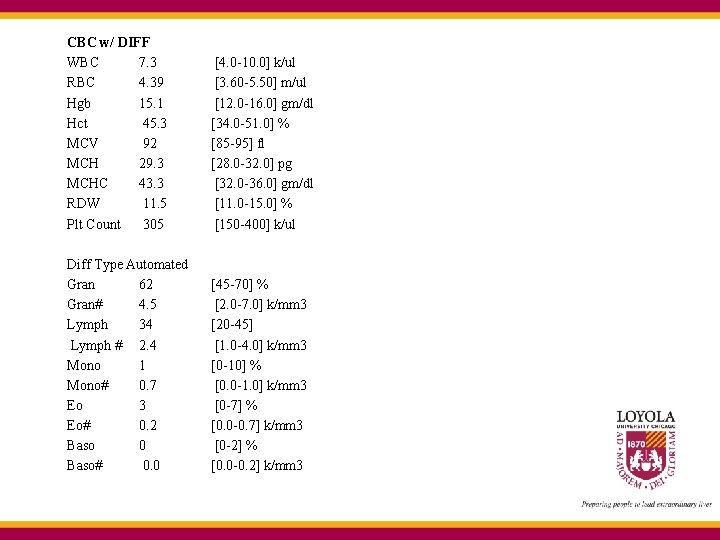
CBC w/ DIFF WBC 7. 3 RBC 4. 39 Hgb 15. 1 Hct 45. 3 MCV 92 MCH 29. 3 MCHC 43. 3 RDW 11. 5 Plt Count 305 [4. 0 -10. 0] k/ul [3. 60 -5. 50] m/ul [12. 0 -16. 0] gm/dl [34. 0 -51. 0] % [85 -95] fl [28. 0 -32. 0] pg [32. 0 -36. 0] gm/dl [11. 0 -15. 0] % [150 -400] k/ul Diff Type Automated Gran 62 Gran# 4. 5 Lymph 34 Lymph # 2. 4 Mono 1 Mono# 0. 7 Eo 3 Eo# 0. 2 Baso 0 Baso# 0. 0 [45 -70] % [2. 0 -7. 0] k/mm 3 [20 -45] [1. 0 -4. 0] k/mm 3 [0 -10] % [0. 0 -1. 0] k/mm 3 [0 -7] % [0. 0 -0. 7] k/mm 3 [0 -2] % [0. 0 -0. 2] k/mm 3
Case 1 Define “automated differential” and summarize how it is performed. Define “manual differential” and summarize how it is performed.
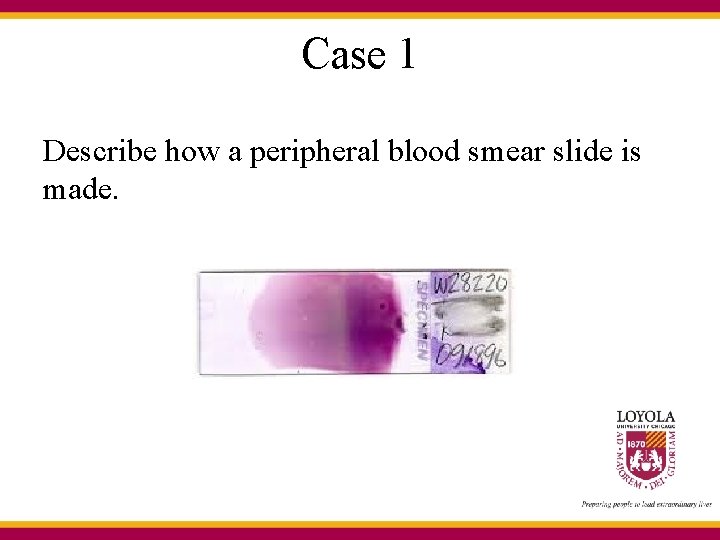
Case 1 Describe how a peripheral blood smear slide is made.
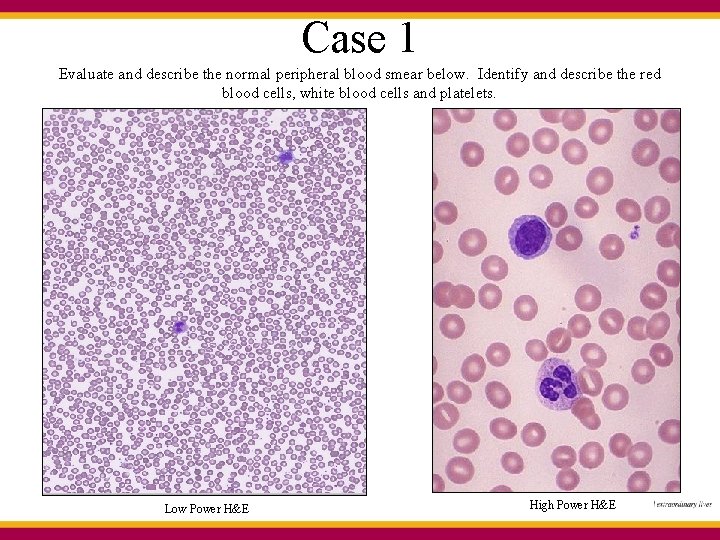
Case 1 Evaluate and describe the normal peripheral blood smear below. Identify and describe the red blood cells, white blood cells and platelets. Low Power H&E High Power H&E
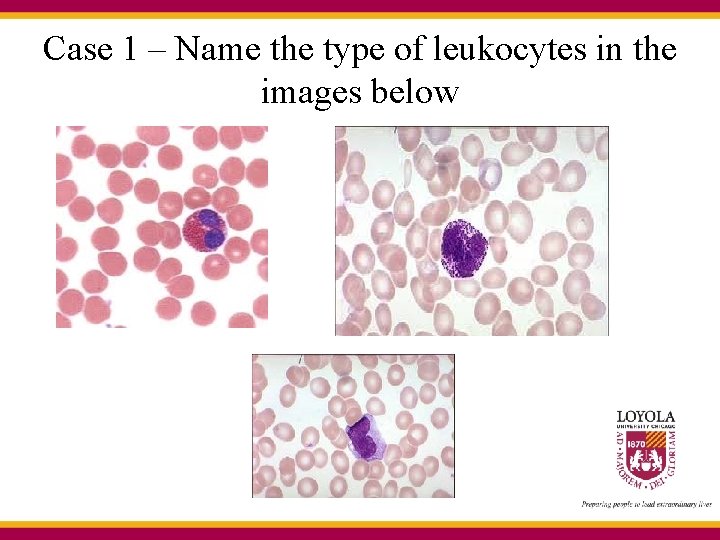
Case 1 – Name the type of leukocytes in the images below
Case 2 A 45 -year old woman from Washington presents to a physician because she is feeling “off” and very tired. On review of systems she reports having an unintentional 10# weight loss over the last several months and looser stools. She has been a sushi enthusiast for years. Vitals: T 97. 6 F, Pulse 90, RR 16 , BP 130/80 Physical exam reveals a thin woman. HEENT - pale conjunctiva. She has mild diffuse tenderness to palpation of the abdomen without masses or organomegaly. There is mild decreased vibration sense of the feet bilaterally. CBC RBC 3. 1 m/ul Hemoglobin 9. 1 g/dl Hematocrit 27. 3% MCV 110 fl Platelet 130 k/ul Reticulocyte index 1. 2%
Case 2 Interpret the CBC. What is the differential diagnosis for these findings?
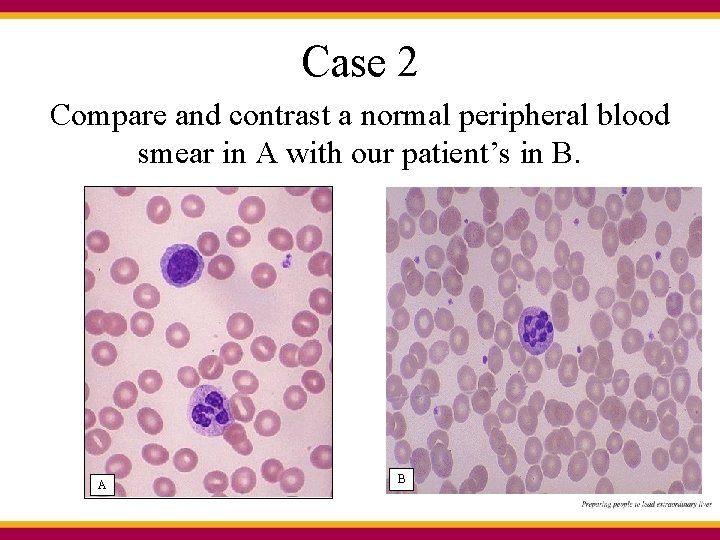
Case 2 Compare and contrast a normal peripheral blood smear in A with our patient’s in B. B A B
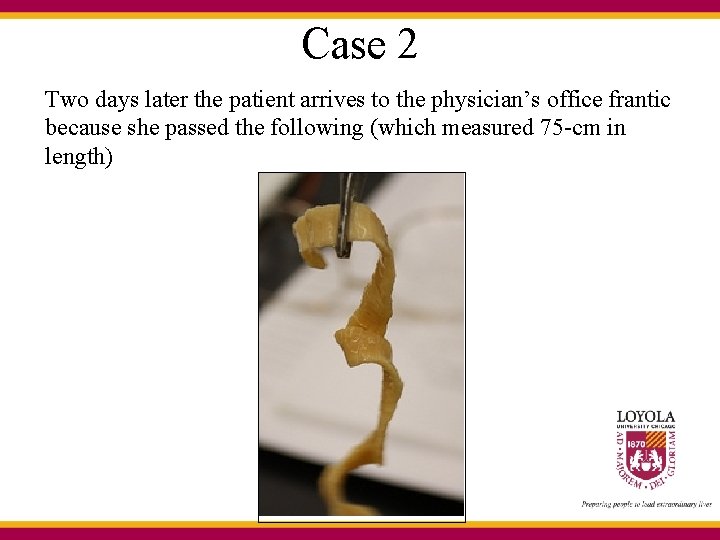
Case 2 Two days later the patient arrives to the physician’s office frantic because she passed the following (which measured 75 -cm in length)
Case 2 What is your diagnosis? Correlate the clinical with the pathologic findings.
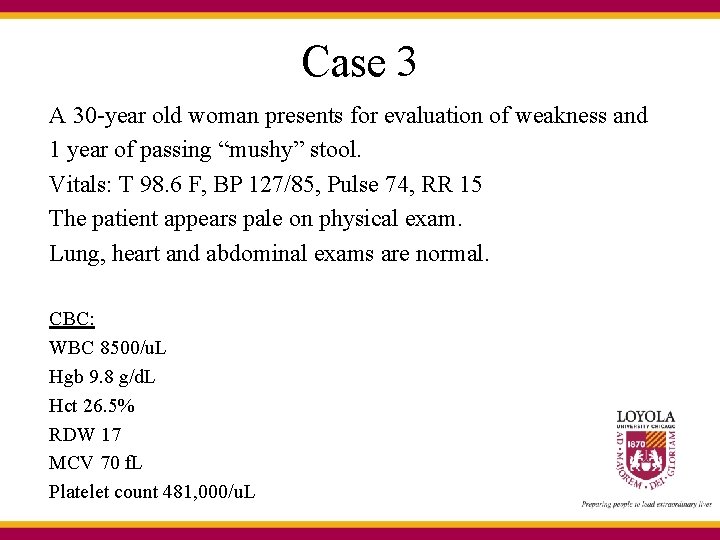
Case 3 A 30 -year old woman presents for evaluation of weakness and 1 year of passing “mushy” stool. Vitals: T 98. 6 F, BP 127/85, Pulse 74, RR 15 The patient appears pale on physical exam. Lung, heart and abdominal exams are normal. CBC: WBC 8500/u. L Hgb 9. 8 g/d. L Hct 26. 5% RDW 17 MCV 70 f. L Platelet count 481, 000/u. L
Case 3 Interpret the CBC Develop a differential diagnosis for the findings.
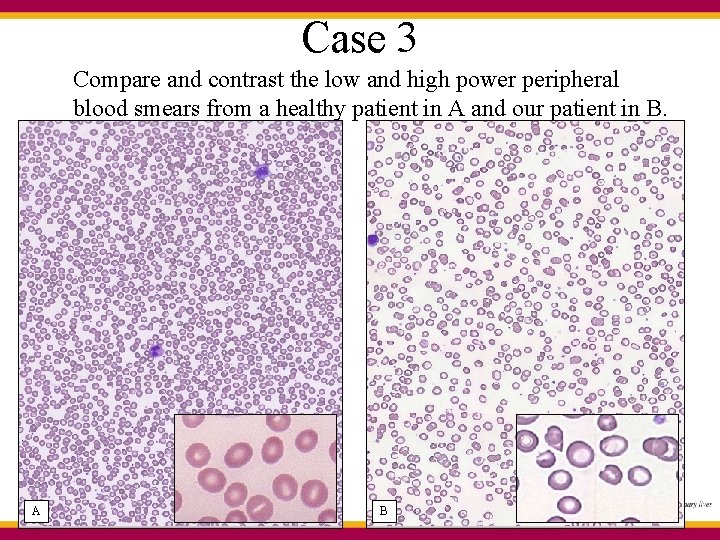
Case 3 Compare and contrast the low and high power peripheral blood smears from a healthy patient in A and our patient in B. A B
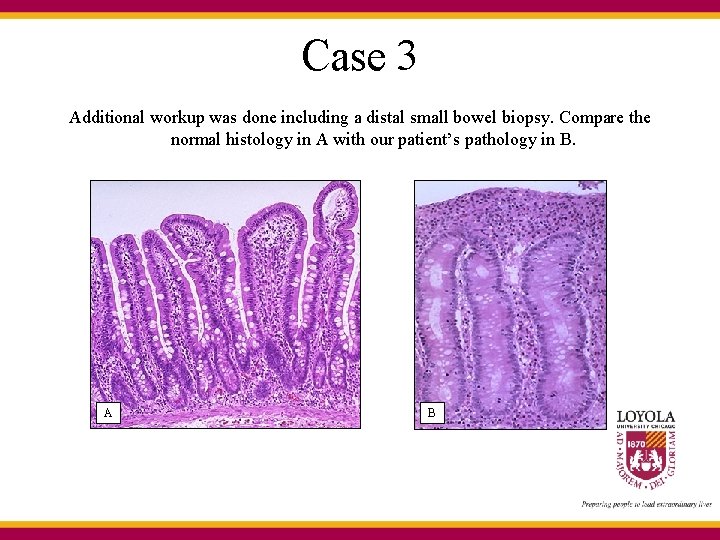
Case 3 Additional workup was done including a distal small bowel biopsy. Compare the normal histology in A with our patient’s pathology in B. A B
Case 3 Briefly summarize the disease process depicted in the small bowel biopsy (you will formally learn about it during the MHD GI block) Correlate the clinical with the pathologic findings.
Case 4 A 22 -year-old African-American man presents with severe pain in several joints and diffuse abdominal pain. He states he is active physically and participates in different sports several times a week. He has had no fevers or chills. Review of systems is negative for any symptoms of infection. CBC: WBC 13. 2 x 10³/u. L, Hemoglobin 7. 9 g/d. L, Hematocrit 22. 8%, MCV 91. 4 femtoliters (f. L), RDW 24. 1, Platelets 481, 000/u. L.
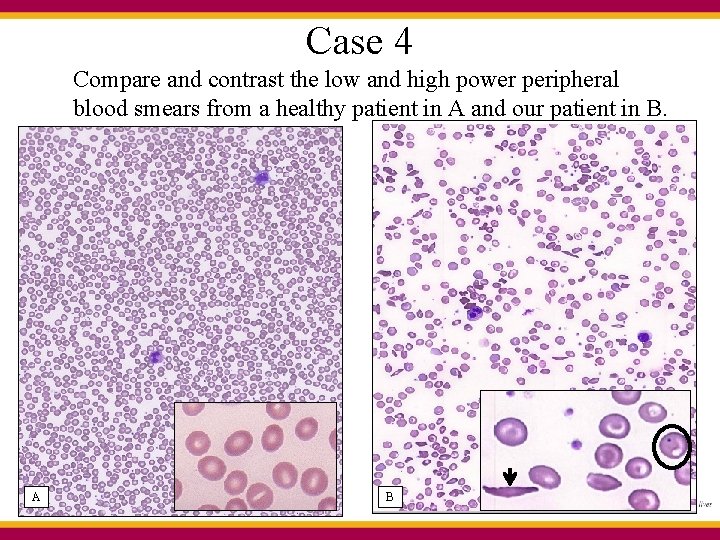
Case 4 Compare and contrast the low and high power peripheral blood smears from a healthy patient in A and our patient in B. A B
Case 4 Describe and explain the morphology of the RBCs (arrow and circle). What is your diagnosis? Define “poikilocytosis” and how it is demonstrated on the smear.
Case 4 Correlate the clinical findings with the disease process.
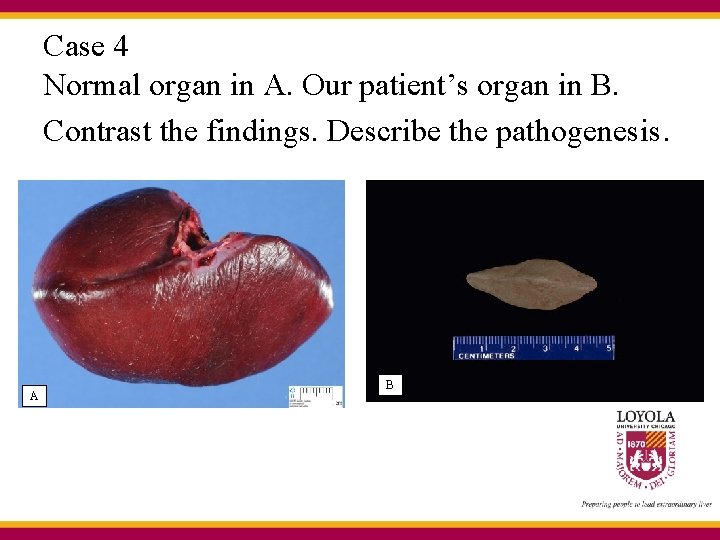
Case 4 Normal organ in A. Our patient’s organ in B. Contrast the findings. Describe the pathogenesis. A B
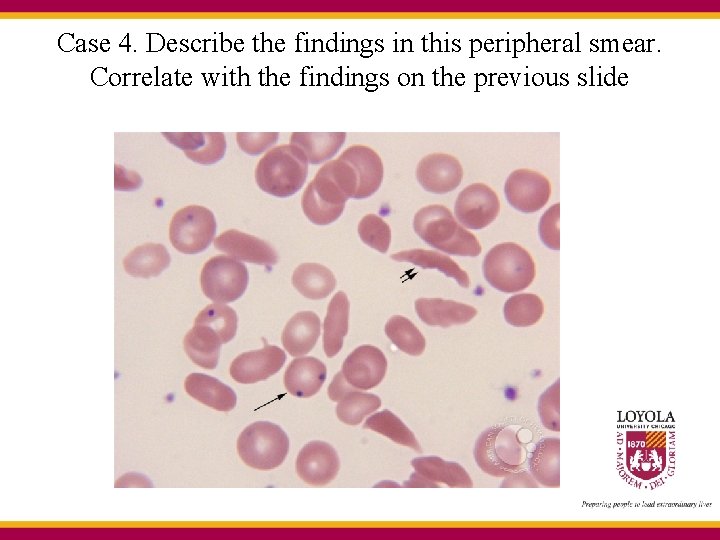
Case 4. Describe the findings in this peripheral smear. Correlate with the findings on the previous slide
Case 4 Patients with this disease process are at risk for infections with what types of micro-organisms?
Case 5 A 5 -year old presents to the ED with fever and bloody diarrhea. He has recently been at a picnic, where they served rare hamburgers. Vitals: T 102. 1 F, pulse 150, BP 90/42, RR 40 Physical exam reveals a fatigued child with pallor, abdominal tenderness, and petechiae. The CBC demonstrates RBC, hemoglobin and hematocrit <5 th percentile for age, platelets 50, 000. He is in renal failure.
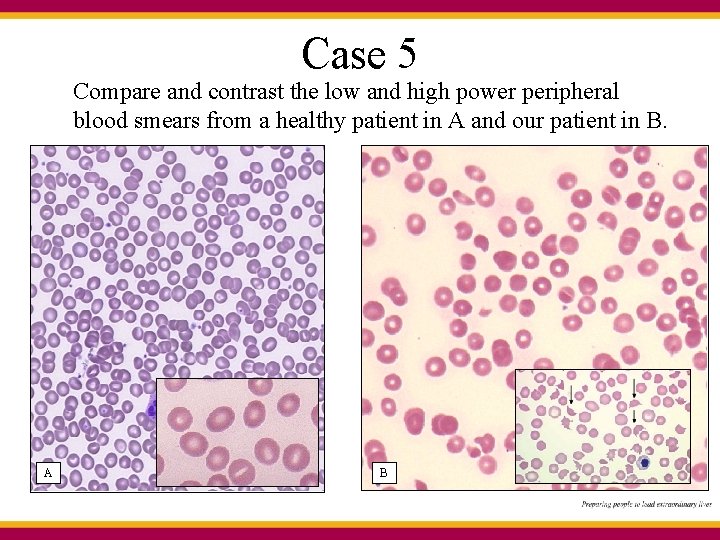
Case 5 Compare and contrast the low and high power peripheral blood smears from a healthy patient in A and our patient in B. A B
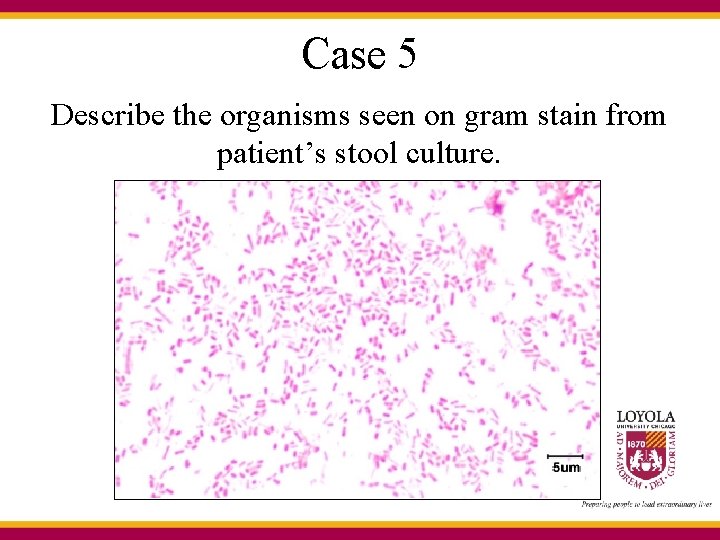
Case 5 Describe the organisms seen on gram stain from patient’s stool culture.
Case 5 What is your diagnosis? Correlate the clinical and histologic findings.
Case 6 A 5 -year old child, currently residing in inner city Chicago, presents to an urgent care clinic with irritability, poor appetite, weight loss, abdominal pain and reduced attention span. Vital signs: T 98. 6 F, BP 110/79, RR 50, Pulse 150. Physical exam demonstrates an irritable, thin child with abdominal tenderness.
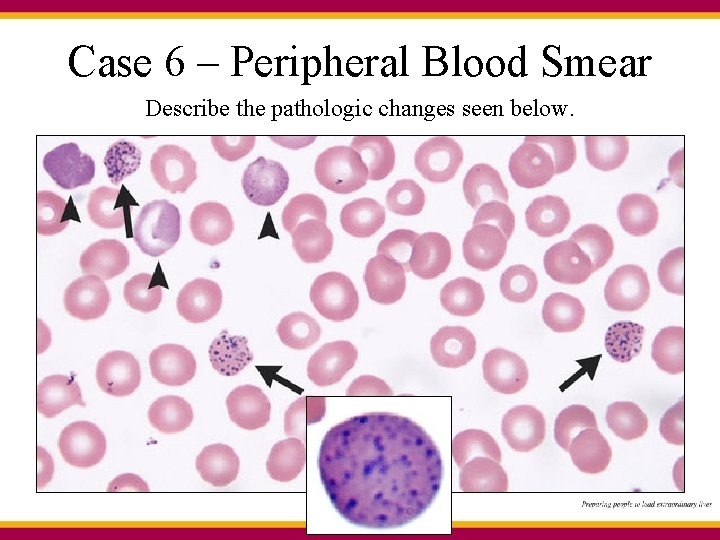
Case 6 – Peripheral Blood Smear Describe the pathologic changes seen below.
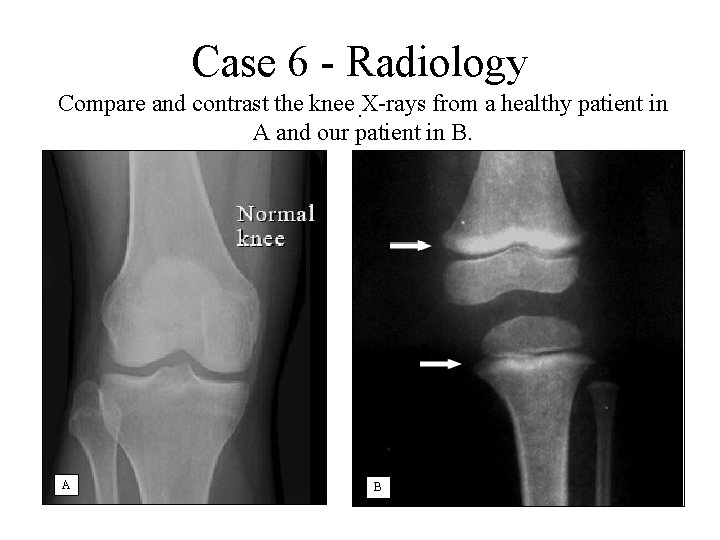
Case 6 - Radiology Compare and contrast the knee. X-rays from a healthy patient in A and our patient in B. A B
Case 6 What is your diagnosis? What findings would you expect to see on the patient’s CBC? Correlate the clinical with the pathologic findings.
- Slides: 33