
ANDROID OS Open Software Platform for Mobile Devices
ANDROID OS Open Software Platform for Mobile Devices David Angulo Rubio
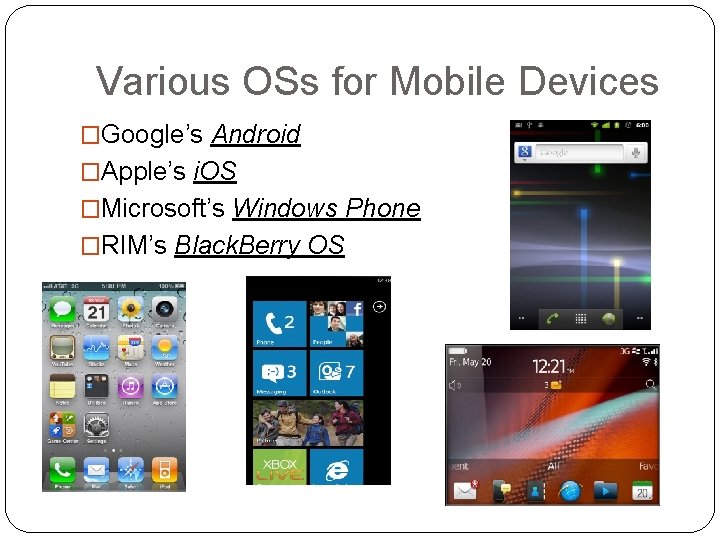
Various OSs for Mobile Devices �Google’s Android �Apple’s i. OS �Microsoft’s Windows Phone �RIM’s Black. Berry OS
ANDROID �Open software platform for mobile development �A complete stack – OS, Middleware, Applications �An Open Handset Alliance (OHA) project �Powered by Linux operating system �Fast application development in Java �Open source under the Apache 2

BACKGROUND �Software platform from Google and the Open Handset Alliance �July 2005, Google acquired Android, Inc. �November 2007, Open Handset Alliance formed to develop open standards for mobile devices Ø Google, Intel, Motorola, Nvidia, Samsung, TI, … �October 2008, Android available as open source �December 2008, 14 new members joined Android project � 1. 0 : Oct. 2008 � 2. 3 Gingerbread: Dec. 2010 � 3. 0 Honeycomb: Feb. 2011 �A tablet-oriented release � 3. 2 Honeycomb: July 2011 �Ice Cream Sandwich : Nov 2011
AGENDA �Mobile Application Development (MAD) �Intro to Android platform �Platform architecture �Application building blocks �Development tools �Hello Android
Reasons to go MAD �SMART PHONES �INTERNET ACCESS ANYWHERE �SOCIAL NETWORKING �MILLIONS OF MOBILE USERS �OPEN STANDARS
Development Tools � Eclipse, Intelli. J, Net. Beans �Level of support for every IDE varies � Android SDK` 3. 2 developer. android. com
Integrate the Standalone tools into Eclipse �AVD and SDK Manager �DDMS �Traceview �Hierarchy. Viewer �Draw 9 Patch
Supported Operating Systems �Linux (tested on Linux Ubuntu Dapper Drake) �Windows XP (32 -bit) or Vista (32 - or 64 -bit) �Mac OS X 10. 4. 8 or later (x 86 only)
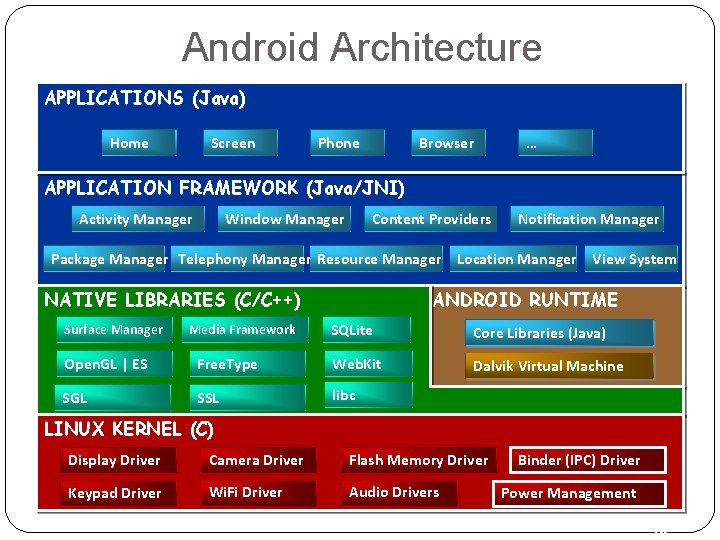
Android Architecture APPLICATIONS (Java) Home Screen Phone Browser … APPLICATION FRAMEWORK (Java/JNI) Activity Manager Window Manager Content Providers Notification Manager Package Manager Telephony Manager Resource Manager Location Manager View System ANDROID RUNTIME NATIVE LIBRARIES (C/C++) Surface Manager Media Framework SQLite Core Libraries (Java) Dalvik Virtual Machine Open. GL | ES Free. Type Web. Kit SGL SSL libc LINUX KERNEL (C) Display Driver Camera Driver Flash Memory Driver Keypad Driver Wi. Fi Driver Audio Drivers Binder (IPC) Driver Power Management 10
Android Project Fields � First, the src folder contains your Java source files. The Hello. Android. java file is the source file for the Hello. Android activity you specified when you created the project earlier. � The R. java file is a special file generated by the ADT to keep track of all the names of views, constants, etc, used in your Android project. You should not modify the content of this file as its content is generated automatically by the ADT. � The Android Library contains a file named android. jar. This file contains all the classes that you would use to program an Android application. � The res folder contains all the resources used by your Android application. For example, the drawable folder contains a png image file that is used as the icon for your application. The layout folder contains an XML file used to represent the user interface of your Android application. The values folder contains an XML file used to store a list of string constants. � The Android. Manifest. xml file is an application configuration file that contains detailed information about your application, such as the number of activities you have in your application, the types of permissions your application needs, the version information of your application, and so on.
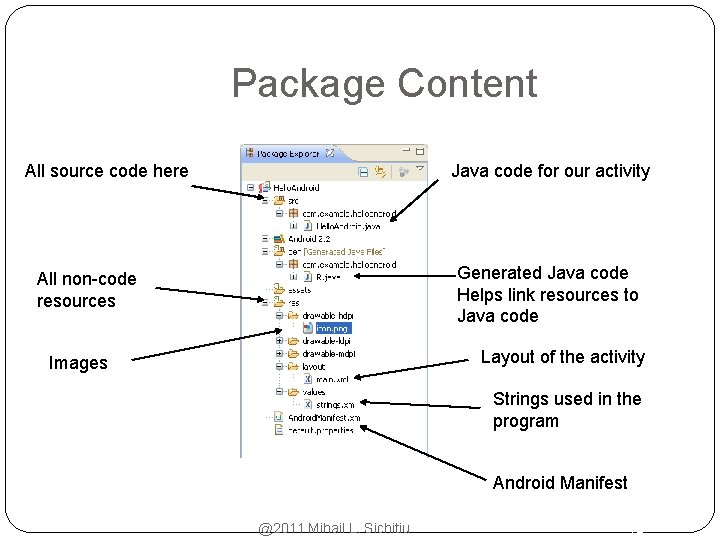
Package Content All source code here Java code for our activity Generated Java code Helps link resources to Java code All non-code resources Layout of the activity Images Strings used in the program Android Manifest @2011 Mihail L. Sichitiu 12
Advantages � There a lot of advantages that Google’s Android will derive from being an open source software. Some include: �The ability for anyone to customize the Google Android platform will open the applications playing small field to small and new players who lack the financial muscle to negotiate wireless carriers like AT&T and Orange �The consumer will benefit from having a wide range of mobile applications to choose from since the monopoly will be broken by Google android. �Although this will depend on the carrier, one will be able to customize a mobile phone using Google Android platform like never before, right down to the screen. �Every feature on the screen can be customized Conclusion �We can only hope that the new versions from Android have overcom actual limitations and that the future possibilities became a reality
- Slides: 13