
Androgen Receptor Binding Assay Update Vickie S Wilson
Androgen Receptor Binding Assay Update Vickie S. Wilson EDVMS Meeting December 10 -12 -2003
Overview • General introduction to binding assays • NICEATM/ICCVAM and Expert Panel • Summary of work completed § Training and Protocol Refinement § Comparison of RPC and PV § Scatchard analyses § R 1881 comparison § 16 chemicals • Future Direction
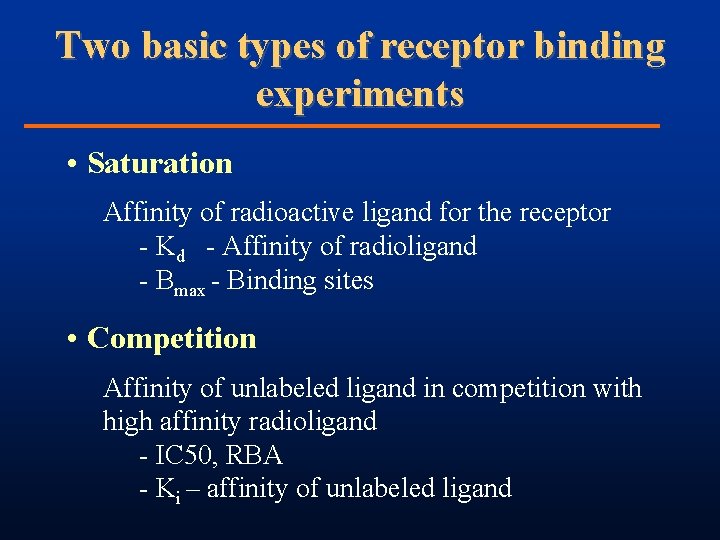
Two basic types of receptor binding experiments • Saturation Affinity of radioactive ligand for the receptor - Kd - Affinity of radioligand - Bmax - Binding sites • Competition Affinity of unlabeled ligand in competition with high affinity radioligand - IC 50, RBA - Ki – affinity of unlabeled ligand
![Basic Steps in Receptor Binding Assays k 1 Receptor (R) + [3 H]Ligand (Free)](http://slidetodoc.com/presentation_image_h2/55ae442a3a64f54cd816e07bfd0c170e/image-5.jpg "Basic Steps in Receptor Binding Assays k 1 Receptor (R) + [3 H]Ligand (Free)")
Basic Steps in Receptor Binding Assays k 1 Receptor (R) + [3 H]Ligand (Free) Receptor: Ligand Complex (Bound) k 2 3 H R R Receptor 3 H R Incubate R Radiolabeled ligand Test chemical 3 H 3 H 3 H [T] [T] 1 2 … 7 Measure Radioactivity Bound Analyze Results 3 H 3 H R R R 3 H Separate Bound from Free 3 H
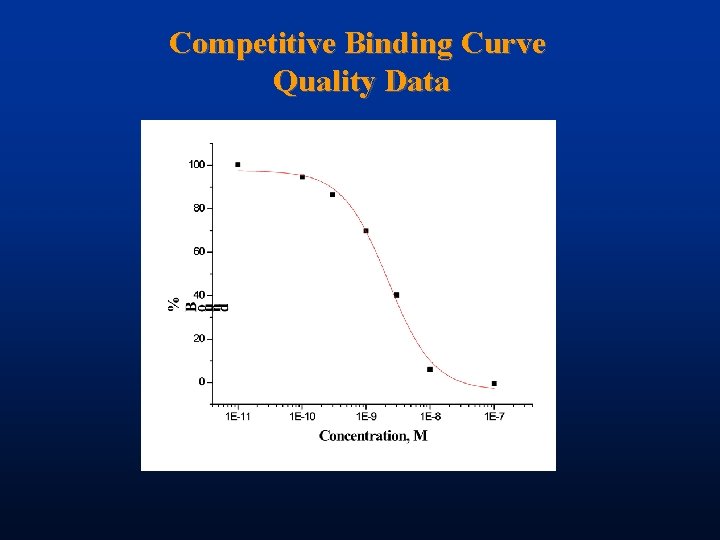
Competitive Binding Curve Quality Data
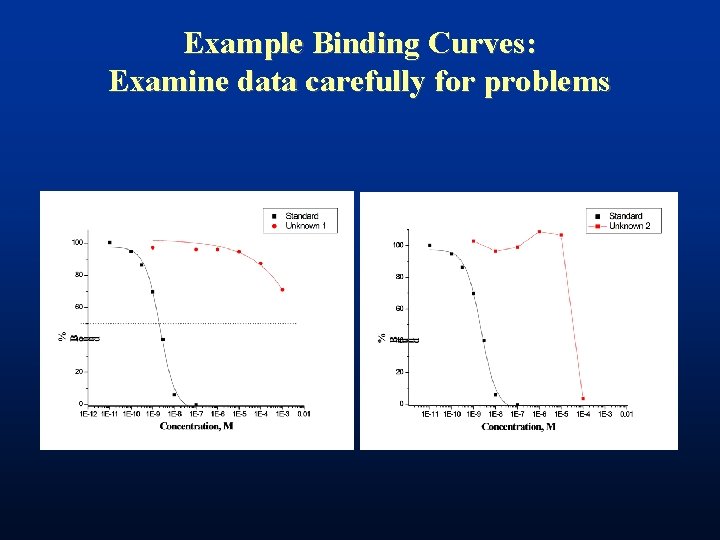
Example Binding Curves: Examine data carefully for problems
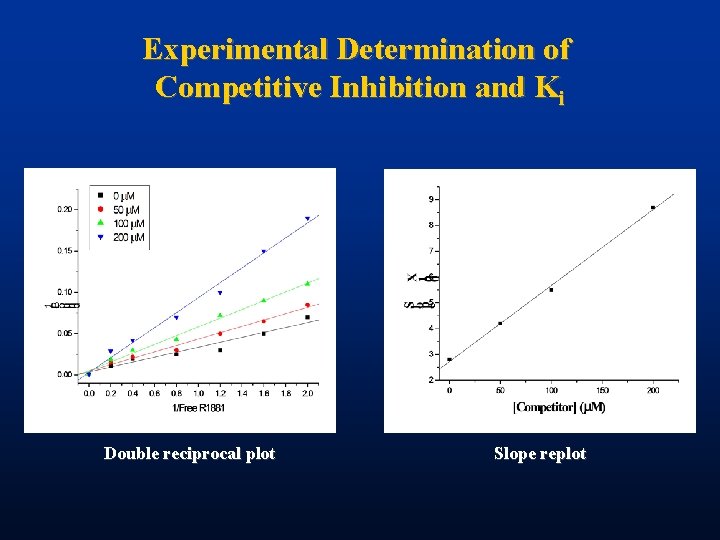
Experimental Determination of Competitive Inhibition and Ki Double reciprocal plot Slope replot
EDC Expert Panel Report • Acknowledged the lack of a standardized in vitro AR binding assay protocol • Identified need for establishing comparative performance criteria • Agreed on minimum procedural standards • Acknowledged that RPC is “Gold Standard” for comparison purposes § Most frequently used - Particularly useful as a reference § Has several disadvantages • Recommended as high priority the development of an assay using purified, recombinant full-length AR • Patent issues with h. AR so an assay using an AR sequence from a species closely related to human may be necessary
Overview • General introduction to binding assays • NICEATM/ICCVAM and Expert Panel • Summary of work completed § Training and Protocol Refinement § Comparison of RPC and PV § Scatchard analyses § R 1881 comparison § 16 chemicals • Future Direction
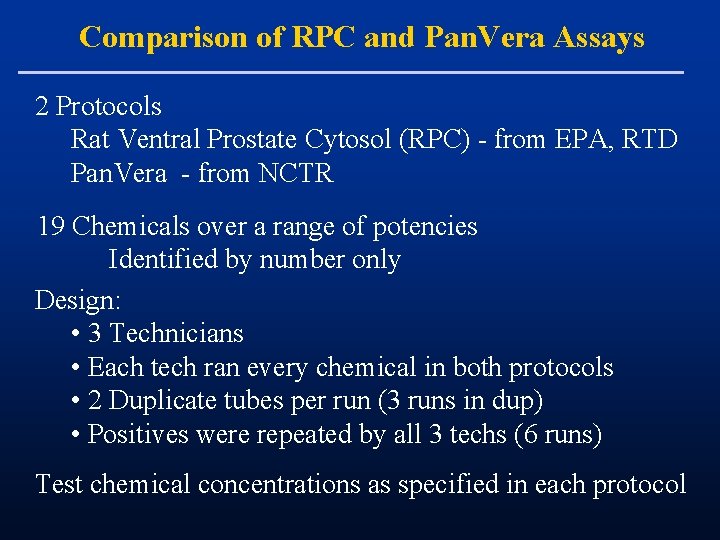
Comparison of RPC and Pan. Vera Assays 2 Protocols Rat Ventral Prostate Cytosol (RPC) - from EPA, RTD Pan. Vera - from NCTR 19 Chemicals over a range of potencies Identified by number only Design: • 3 Technicians • Each tech ran every chemical in both protocols • 2 Duplicate tubes per run (3 runs in dup) • Positives were repeated by all 3 techs (6 runs) Test chemical concentrations as specified in each protocol
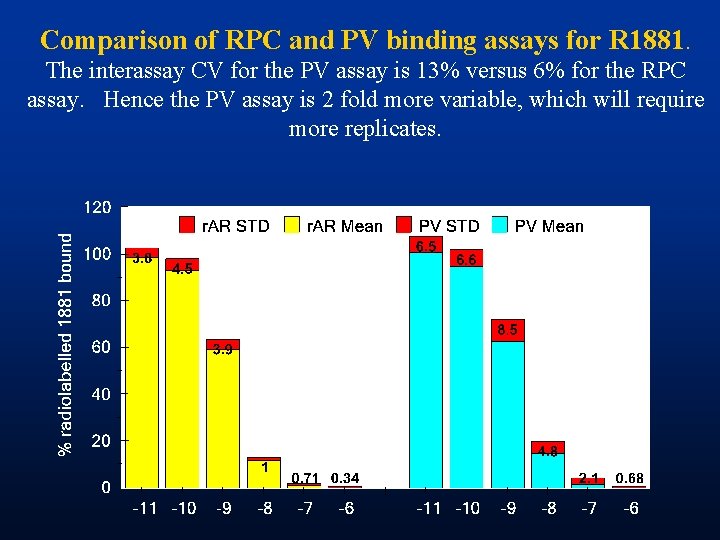
Comparison of RPC and PV binding assays for R 1881. The interassay CV for the PV assay is 13% versus 6% for the RPC assay. Hence the PV assay is 2 fold more variable, which will require more replicates.

Binding Curves Example of Variability between runs 6 runs of same chemical in both protocols RPC PV
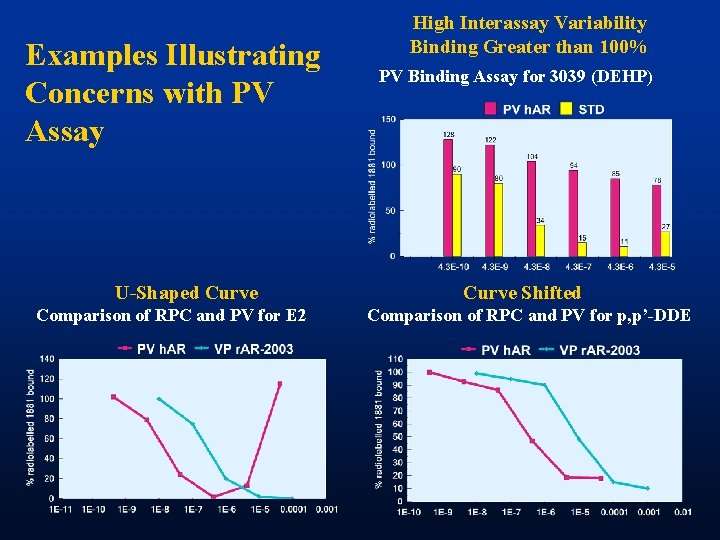
Examples Illustrating Concerns with PV Assay U-Shaped Curve Comparison of RPC and PV for E 2 High Interassay Variability Binding Greater than 100% PV Binding Assay for 3039 (DEHP) Curve Shifted Comparison of RPC and PV for p, p’-DDE
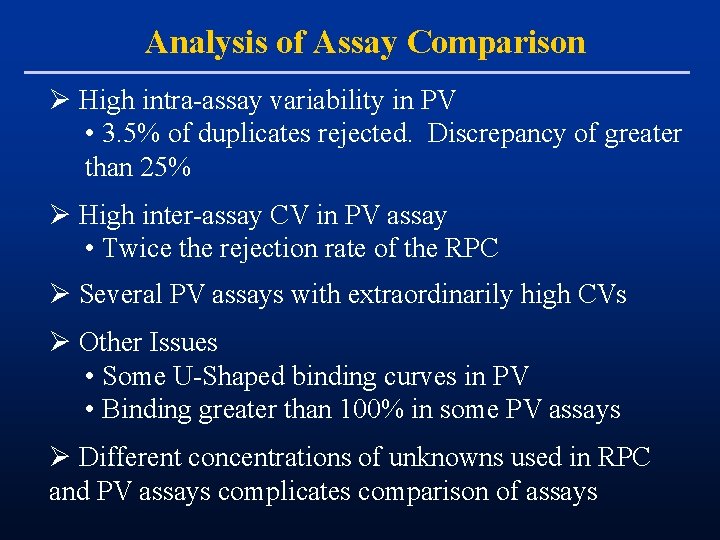
Analysis of Assay Comparison Ø High intra-assay variability in PV • 3. 5% of duplicates rejected. Discrepancy of greater than 25% Ø High inter-assay CV in PV assay • Twice the rejection rate of the RPC Ø Several PV assays with extraordinarily high CVs Ø Other Issues • Some U-Shaped binding curves in PV • Binding greater than 100% in some PV assays Ø Different concentrations of unknowns used in RPC and PV assays complicates comparison of assays
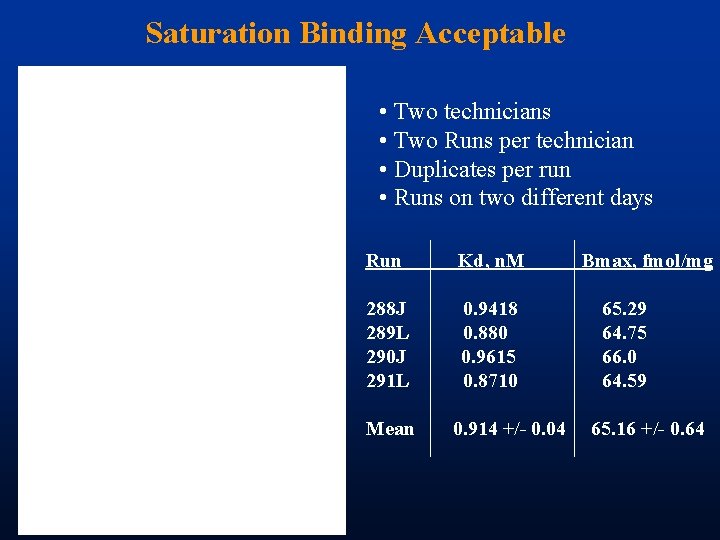
Saturation Binding Acceptable • Two technicians • Two Runs per technician • Duplicates per run • Runs on two different days Run Kd, n. M 288 J 289 L 290 J 291 L 0. 9418 0. 880 0. 9615 0. 8710 Mean 0. 914 +/- 0. 04 Bmax, fmol/mg 65. 29 64. 75 66. 0 64. 59 65. 16 +/- 0. 64
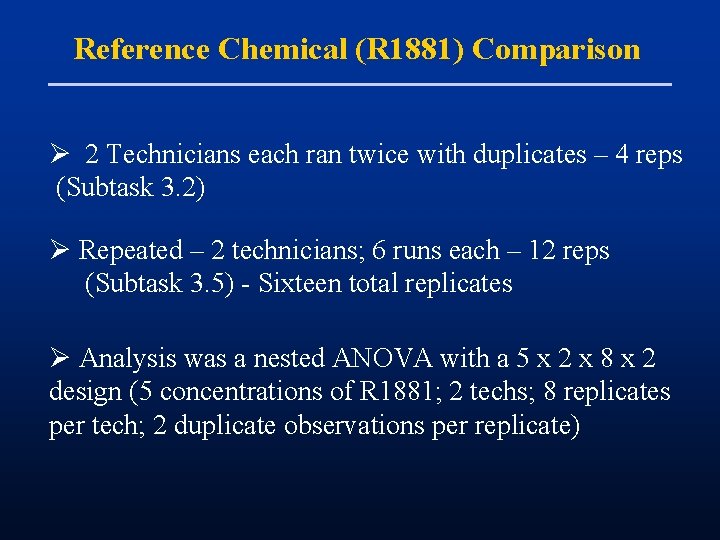
Reference Chemical (R 1881) Comparison Ø 2 Technicians each ran twice with duplicates – 4 reps (Subtask 3. 2) Ø Repeated – 2 technicians; 6 runs each – 12 reps (Subtask 3. 5) - Sixteen total replicates Ø Analysis was a nested ANOVA with a 5 x 2 x 8 x 2 design (5 concentrations of R 1881; 2 techs; 8 replicates per tech; 2 duplicate observations per replicate)
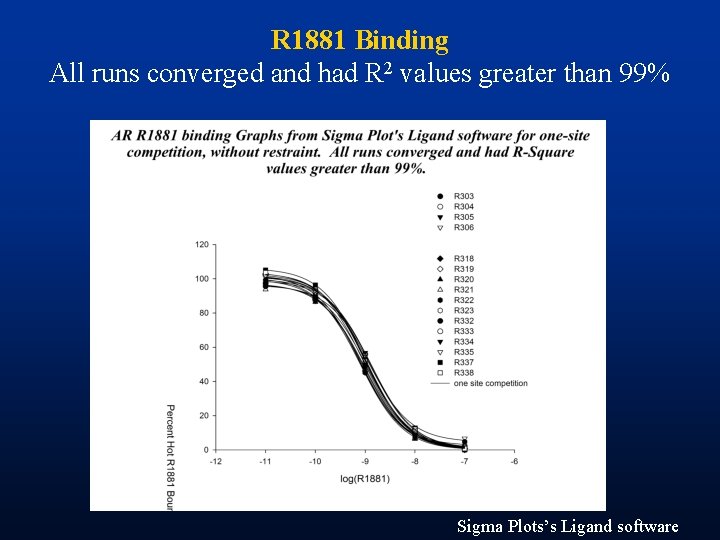
R 1881 Binding All runs converged and had R 2 values greater than 99% Sigma Plots’s Ligand software
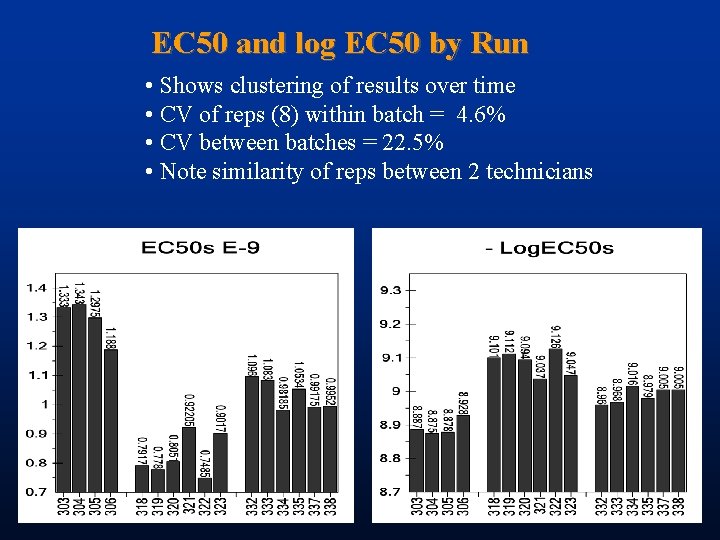
EC 50 and log EC 50 by Run • Shows clustering of results over time • CV of reps (8) within batch = 4. 6% • CV between batches = 22. 5% • Note similarity of reps between 2 technicians
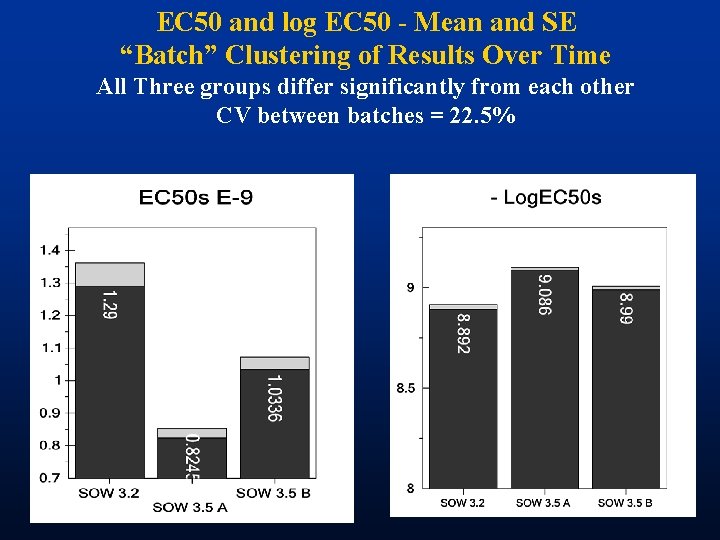
EC 50 and log EC 50 - Mean and SE “Batch” Clustering of Results Over Time All Three groups differ significantly from each other CV between batches = 22. 5%
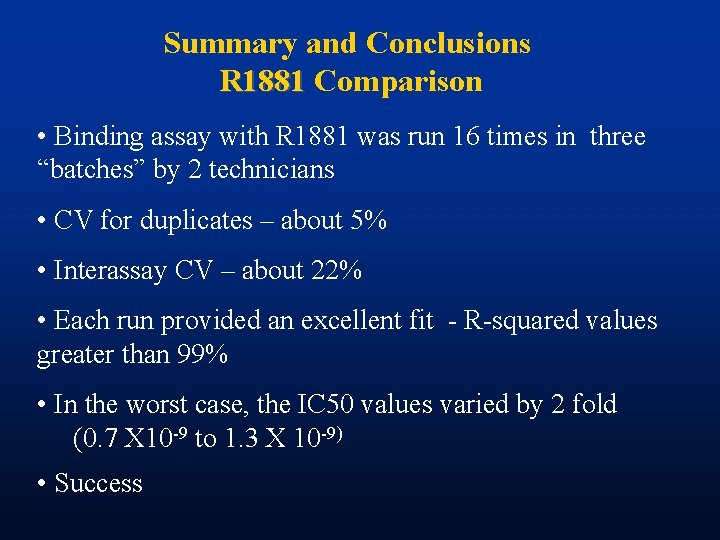
Summary and Conclusions R 1881 Comparison • Binding assay with R 1881 was run 16 times in three “batches” by 2 technicians • CV for duplicates – about 5% • Interassay CV – about 22% • Each run provided an excellent fit - R-squared values greater than 99% • In the worst case, the IC 50 values varied by 2 fold (0. 7 X 10 -9 to 1. 3 X 10 -9) • Success
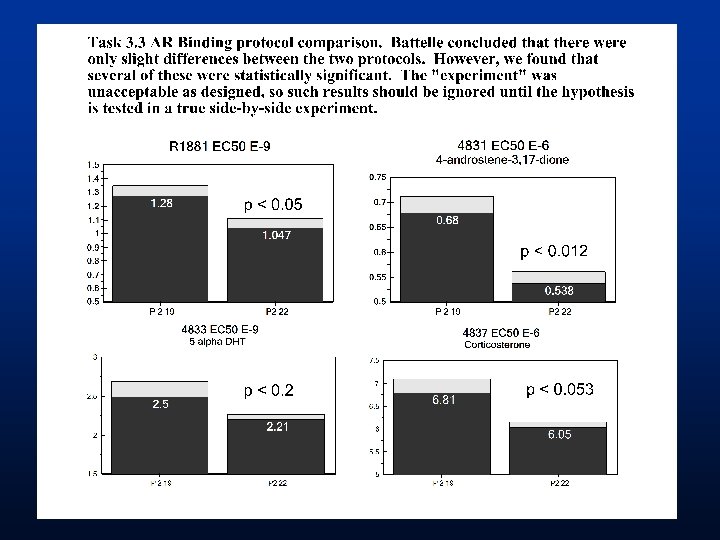
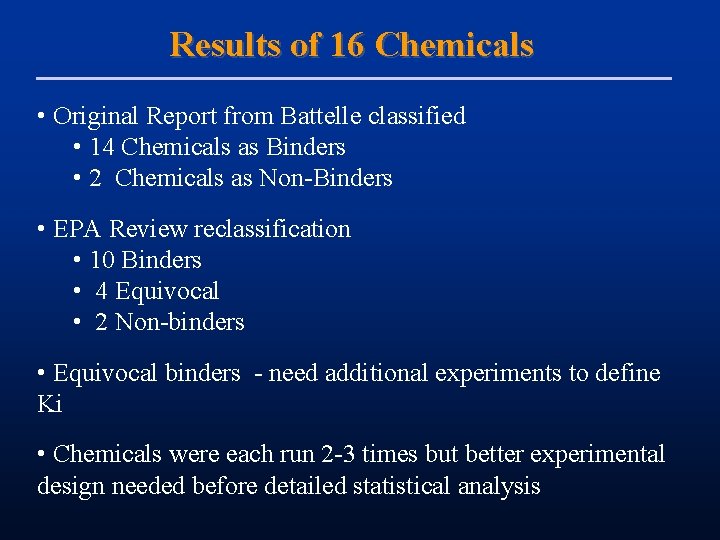
Results of 16 Chemicals • Original Report from Battelle classified • 14 Chemicals as Binders • 2 Chemicals as Non-Binders • EPA Review reclassification • 10 Binders • 4 Equivocal • 2 Non-binders • Equivocal binders - need additional experiments to define Ki • Chemicals were each run 2 -3 times but better experimental design needed before detailed statistical analysis
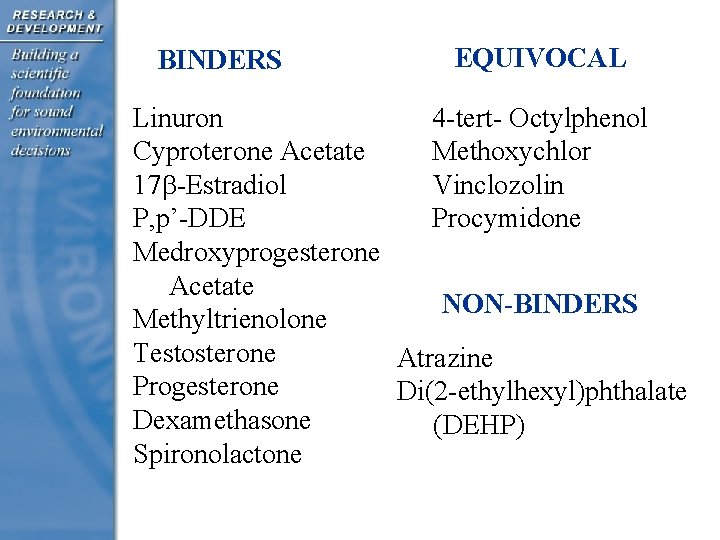
BINDERS EQUIVOCAL 4 -tert- Octylphenol Linuron Methoxychlor Cyproterone Acetate Vinclozolin 17 b-Estradiol Procymidone P, p’-DDE Medroxyprogesterone Acetate NON-BINDERS Methyltrienolone Testosterone Atrazine Progesterone Di(2 -ethylhexyl)phthalate Dexamethasone (DEHP) Spironolactone
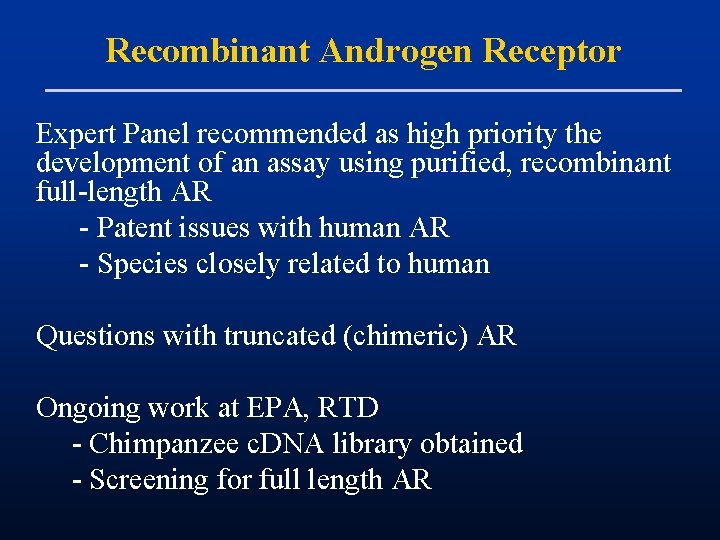
Recombinant Androgen Receptor Expert Panel recommended as high priority the development of an assay using purified, recombinant full-length AR - Patent issues with human AR - Species closely related to human Questions with truncated (chimeric) AR Ongoing work at EPA, RTD - Chimpanzee c. DNA library obtained - Screening for full length AR
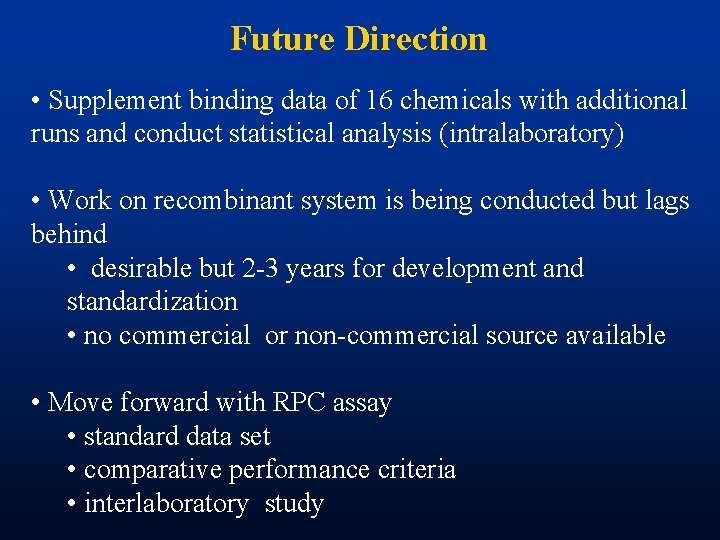
Future Direction • Supplement binding data of 16 chemicals with additional runs and conduct statistical analysis (intralaboratory) • Work on recombinant system is being conducted but lags behind • desirable but 2 -3 years for development and standardization • no commercial or non-commercial source available • Move forward with RPC assay • standard data set • comparative performance criteria • interlaboratory study
- Slides: 26