
Andrea 1 Public Habitat associations of the Culex
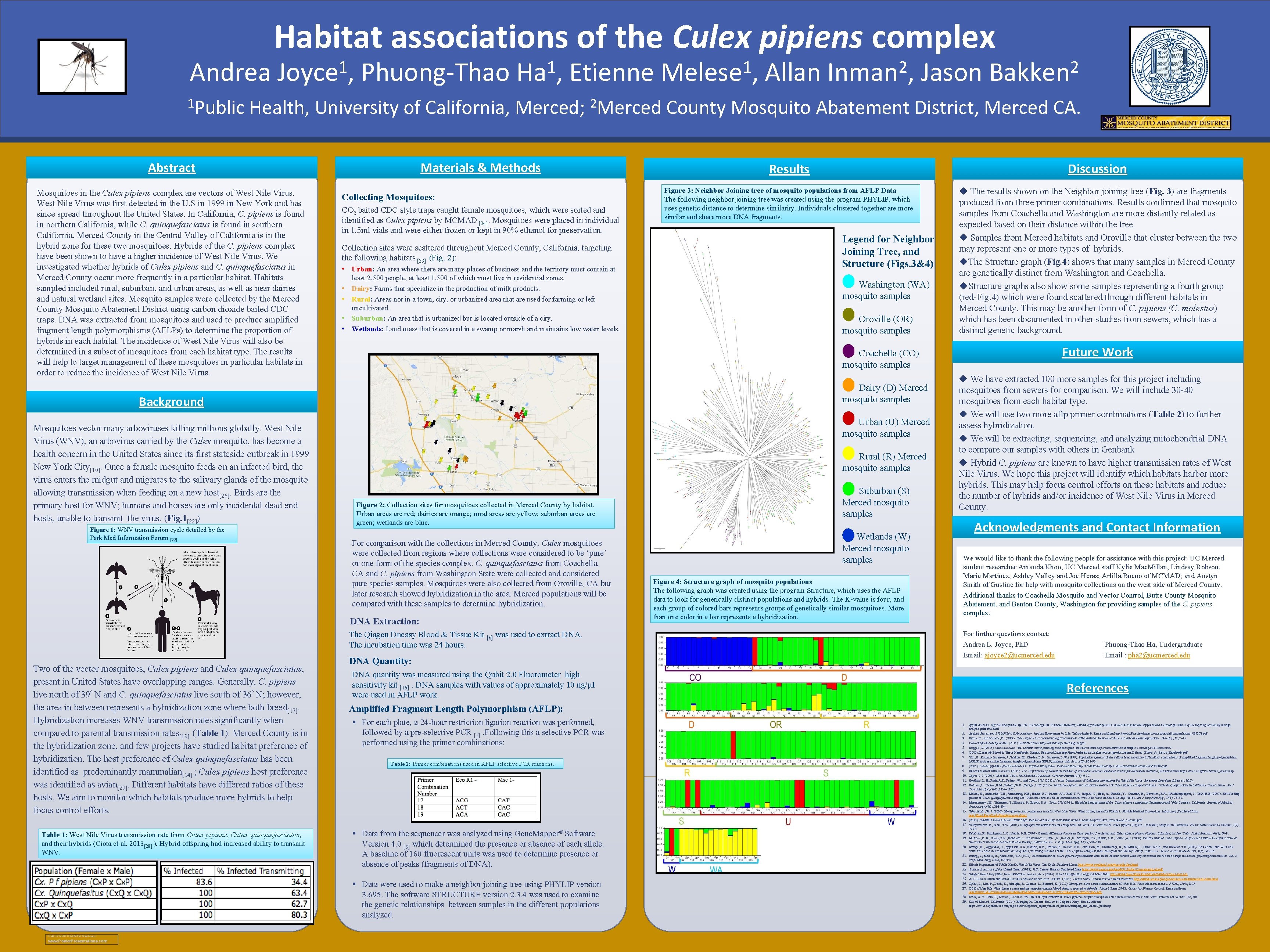
Andrea 1 Public Habitat associations of the Culex pipiens complex 1 Joyce , Phuong-Thao 1 Ha , Etienne Health, University of California, Merced; Abstract Mosquitoes in the Culex pipiens complex are vectors of West Nile Virus was first detected in the U. S in 1999 in New York and has since spread throughout the United States. In California, C. pipiens is found in northern California, while C. quinquefasciatus is found in southern California. Merced County in the Central Valley of California is in the hybrid zone for these two mosquitoes. Hybrids of the C. pipiens complex have been shown to have a higher incidence of West Nile Virus. We investigated whether hybrids of Culex pipiens and C. quinquefasciatus in Merced County occur more frequently in a particular habitat. Habitats sampled included rural, suburban, and urban areas, as well as near dairies and natural wetland sites. Mosquito samples were collected by the Merced County Mosquito Abatement District using carbon dioxide baited CDC traps. DNA was extracted from mosquitoes and used to produce amplified fragment length polymorphisms (AFLPs) to determine the proportion of hybrids in each habitat. The incidence of West Nile Virus will also be determined in a subset of mosquitoes from each habitat type. The results will help to target management of these mosquitoes in particular habitats in order to reduce the incidence of West Nile Virus. 2 Merced Materials & Methods Collecting Mosquitoes: CO 2 baited CDC style traps caught female mosquitoes, which were sorted and identified as Culex pipiens by MCMAD [24]. Mosquitoes were placed in individual in 1. 5 ml vials and were either frozen or kept in 90% ethanol for preservation. Collection sites were scattered throughout Merced County, California, targeting the following habitats [23] (Fig. 2): • Urban: An area where there are many places of business and the territory must contain at least 2, 500 people, at least 1, 500 of which must live in residential zones. • Dairy: Farms that specialize in the production of milk products. • Rural: Areas not in a town, city, or urbanized area that are used for farming or left uncultivated. • Suburban: An area that is urbanized but is located outside of a city. • Wetlands: Land mass that is covered in a swamp or marsh and maintains low water levels. Figure 1: WNV transmission cycle detailed by the Park Med Information Forum [22] Jason Results Discussion Figure 3: Neighbor Joining tree of mosquito populations from AFLP Data The following neighbor joining tree was created using the program PHYLIP, which uses genetic distance to determine similarity. Individuals clustered together are more similar and share more DNA fragments. u The results shown on the Neighbor joining tree (Fig. 3) are fragments produced from three primer combinations. Results confirmed that mosquito samples from Coachella and Washington are more distantly related as expected based on their distance within the tree. u Samples from Merced habitats and Oroville that cluster between the two may represent one or more types of hybrids. u. The Structure graph (Fig. 4) shows that many samples in Merced County are genetically distinct from Washington and Coachella. u. Structure graphs also show some samples representing a fourth group (red-Fig. 4) which were found scattered through different habitats in Merced County. This may be another form of C. pipiens (C. molestus) which has been documented in other studies from sewers, which has a distinct genetic background. Legend for Neighbor Joining Tree, and Structure (Figs. 3&4) Washington (WA) mosquito samples Oroville (OR) mosquito samples Rural (R) Merced mosquito samples Figure 2: . Collection sites for mosquitoes collected in Merced County by habitat. Urban areas are red; dairies are orange; rural areas are yellow; suburban areas are green; wetlands are blue. For comparison with the collections in Merced County, Culex mosquitoes were collected from regions where collections were considered to be ‘pure’ or one form of the species complex. C. quinquefasciatus from Coachella, CA and C. pipiens from Washington State were collected and considered pure species samples. Mosquitoes were also collected from Oroville, CA but later research showed hybridization in the area. Merced populations will be compared with these samples to determine hybridization. The Qiagen Dneasy Blood & Tissue Kit [6] was used to extract DNA. The incubation time was 24 hours. DNA Quantity: Future Work Suburban (S) Merced mosquito samples Wetlands (W) Merced mosquito samples Figure 4: Structure graph of mosquito populations The following graph was created using the program Structure, which uses the AFLP data to look for genetically distinct populations and hybrids. The K-value is four, and each group of colored bars represents groups of genetically similar mosquitoes. More than one color in a bar represents a hybridization. u We have extracted 100 more samples for this project including mosquitoes from sewers for comparison. We will include 30 -40 mosquitoes from each habitat type. u We will use two more aflp primer combinations (Table 2) to further assess hybridization. u We will be extracting, sequencing, and analyzing mitochondrial DNA to compare our samples with others in Genbank u Hybrid C. pipiens are known to have higher transmission rates of West Nile Virus. We hope this project will identify which habitats harbor more hybrids. This may help focus control efforts on those habitats and reduce the number of hybrids and/or incidence of West Nile Virus in Merced County. Acknowledgments and Contact Information We would like to thank the following people for assistance with this project: UC Merced student researcher Amanda Khoo, UC Merced staff Kylie Mac. Millan, Lindsay Robson, Maria Martinez, Ashley Valley and Joe Heras; Arlilla Bueno of MCMAD; and Austyn Smith of Gustine for help with mosquito collections on the west side of Merced County. Additional thanks to Coachella Mosquito and Vector Control, Butte County Mosquito Abatement, and Benton County, Washington for providing samples of the C. pipiens complex. For further questions contact: Andrea L. Joyce, Ph. D Phuong-Thao Ha, Undergraduate Email: ajoyce 2@ucmerced. edu Email : pha 2@ucmerced. edu DNA quantity was measured using the Qubit 2. 0 Fluorometer high sensitivity kit [16]. DNA samples with values of approximately 10 ng/µl were used in AFLP work. References Amplified Fragment Length Polymorphism (AFLP): For each plate, a 24 -hour restriction ligation reaction was performed, followed by a pre-selective PCR [1]. Following this a selective PCR was performed using the primer combinations: Table 2: Primer combinations used in AFLP selective PCR reactions. 1. 2. 3. 4. 5. 6. 7. 8. 9. 10. 11. 12. 13. 14. 15. 16. 17. Table 1: West Nile Virus transmission rate from Culex pipiens, Culex quinquefasciatus, and their hybrids (Ciota et al. 2013[28] ). Hybrid offspring had increased ability to transmit WNV. Data from the sequencer was analyzed using Gene. Mapper® Software Version 4. 0 [8] which determined the presence or absence of each allele. A baseline of 160 fluorescent units was used to determine presence or absence of peaks (fragments of DNA). Data were used to make a neighbor joining tree using PHYLIP version 3. 695. The software STRUCTURE version 2. 3. 4 was used to examine the genetic relationships between samples in the different populations analyzed. RESEARCH POSTER PRESENTATION DESIGN © 2012 www. Poster. Presentations. com 2 Bakken County Mosquito Abatement District, Merced CA. Dairy (D) Merced mosquito samples Urban (U) Merced mosquito samples DNA Extraction: Two of the vector mosquitoes, Culex pipiens and Culex quinquefasciatus, present in United States have overlapping ranges. Generally, C. pipiens live north of 39º N and C. quinquefasciatus live south of 36º N; however, the area in between represents a hybridization zone where both breed[17]. Hybridization increases WNV transmission rates significantly when compared to parental transmission rates[19] (Table 1). Merced County is in the hybridization zone, and few projects have studied habitat preference of hybridization. The host preference of Culex quinquefasciatus has been identified as predominantly mammalian[14] ; Culex pipiens host preference was identified as avian[20]. Different habitats have different ratios of these hosts. We aim to monitor which habitats produce more hybrids to help focus control efforts. Allan 2 Inman , Coachella (CO) mosquito samples Background Mosquitoes vector many arboviruses killing millions globally. West Nile Virus (WNV), an arbovirus carried by the Culex mosquito, has become a health concern in the United States since its first stateside outbreak in 1999 New York City[10]. Once a female mosquito feeds on an infected bird, the virus enters the midgut and migrates to the salivary glands of the mosquito allowing transmission when feeding on a new host[26]. Birds are the primary host for WNV; humans and horses are only incidental dead end hosts, unable to transmit the virus. (Fig. 1[22]) 1 Melese , 18. 19. 20. 21. 22. 23. 24. 25. 26. 27. 28. 29. Aflp® Analysis. Applied Biosystems by Life Technologies®. Retrieved from http: //www. appliedbiosystems. com/absite/us/en/home/applications-technologies/dna-sequencing-fragment-analysis/aflpanalysis. printable. html Applied Biosystems 3730/3730 xl DNA Analyzer. Applied Biosystems by Life Technologies®. Retrieved from http: //tools. lifetechnologies. com/content/sfs/manuals/cms_039278. pdf Byrne, K. , and Nichols, R. . (1999). Culex pipiens in London underground tunnels: differentiation between surface and subterranean populations. Heredity, 82, 7– 15. Cambridge dictionary online. (2014). Retrieved from http: //dictionary. cambridge. org/us Doggett, S. (2013). Culex molestus. The London (down) underground mosquito, Retrieved from http: //cameronwebb. wordpress. com/tag/culex-molestus/ (2006). Dneasy® Blood & Tissue Handbook. Qiagen. Retrieved from http: //mvz. berkeley. edu/egl/resources/productinserts/DNeasy_Blood_&_Tissue_Handbook. pdf Yan, G. , Romero-Severson, J. , Walton, M. , Chadee, D. D. , Severson, D. W. (1999). Population genetics of the yellow fever mosquito in Trinidad: comparisons of amplified fragment length polymorphism (AFLP) and restriction fragment length polymorphism (RFLP) markers. Mol Ecol, 8(6), 951 -63. (2005). Genemapper® software version 4. 0. Applied Biosystems. Retrieved from http: //tools. lifetechnologies. com/content/sfs/manuals/4363080 b. pdf Identification of Rural Locales. (2014). U. S. Department of Education Institute of Education Sciences National Center for Education Statistics, Retrieved from https: //nces. ed. gov/ccd/rural_locales. asp Sejvar, J. J. (2003). West Nile Virus: An Historical Overview. Ochsner Journal, 5(3), 6 -10. Goddard, L. B. , Roth, A. E. , Reisen, W. , and Scott, T. W. (2012). Vector Competence of California mosquitoes for West Nile Virus. Emerging Infectious Diseases, 8(12). Kothera, L. , Nelms, B. M. , Reisen, W. K. , Savage, H. M. (2013). Population genetic and admixture analyses of Culex pipiens complex (Diptera: Culicidae) populations in California, United States. Am J Trop Med Hyg, 89(6), 1154– 1167. Molaei, G. , Andreadis, T. G. , Armstrong, P. M. , Bueno, R. J. , Dennet J. A. , Real, S. V. , Sargent, C. , Bala, A. , Randle, Y. , Guzman, H. , Travassos, R. A. , Wuithiranyagool, T. , Tesh, R. B. (2007). Host feeding pattern of Culex quinquefasciatus (diptera: Culicidae) and its role in transmission of West Nile Virus in Harris County, Texas. Am J Trop Med Hyg, 77(1), 73 -81. Montgomery , M. , Thiemann, T. , Macedo, P. , Brown, D. A. , Scott, T. W. (2011). Blood-feeding patterns of the Culex pipiens complex in Sacramento and Yolo Counties, California. Journal of Medical Entomology, 48(2), 398 -404. Tabachnick, W. J. (2008). Mosquito vector competence tests for West Nile Virus: What do they mean for Florida? . Florida Medical Entomology Laboratory, Retrieved from http: //fmel. ifas. ufl. edu/buzz/wtvector. shtml (2010). Qubit® 2. 0 Fluorometer. Invitrogen. Retrieved from http: //evolution. unibas. ch/walser/pdf/Qubit_Fluorometer_manual. pdf Vaidyanathan, R. , Scott, T. W. (2007). Geographic variation in vector competence for West Nile virus in the Culex pipiens (Diptera: Culicidae) complex in California. Vector Borne Zoonotic Disease, 7(2), 193 -8. Rebekah, K. , Harrington, L. C. , Norris, D. E. (2007). Genetic differences between Culex pipiens f. molestus and Culex pipiens (diptera: Culicidae) in New York. J Med Entomol. , 44(1), 50 -9. Mc. Abee, R. D. , Green, E. N. , Holeman, J. , Christiansen, J. , Frye , N. , Dealey, K. , Mulligan, F. S. , Brault, A. C. , Cornel, A. J. (2008). Identification of Culex pipiens complex mosquitoes in a hybrid zone of West Nile Virus transmission in Fresno County, California. Am. J. Trop. Med. Hyg, 78(2), 303– 310. Savage, H. , , Aggarwal, D. , Apperson, C. S. , Katholi, C. R. , Gordon, E. , Hassan, H. K. , Anderson, M. , Charnetzky, D. , Mc. Millen, L. , Unnasch E. A. , and Unnasch T. R. (2003). Host choice and West Nile Virus infection rates in blood-fed mosquitoes, including members of the Culex pipiens complex, from Memphis and Shelby County, Tennessee. Vector Borne Zoonotic Dis, 7(3), 365 -86. Huang, S. , Molaei, G. , Andreadis, T. G. (2011). Reexamination of Culex pipiens hybridization zone in the Eastern United States by ribosomal DNA-based single nucleotide polymorphism markers. Am. J. Trop. Med. Hyg, 85(3), 434 -441. Illinois Department of Public Health. West Nile Virus, The Cycle. Retrieved from http: //www. southern 7. org/west-nile-faq. html Statistical abstract of the United States: (2012). U. S. Census Bureau. Retrieved from https: //www. census. gov/prod/2011 pubs/12 statab/agricult. pdf Winged Insect Key (Flies, bees, butterflies, beetles, etc. ). (2014). Insect Identification. org, Retrieved from http: //www. insectidentification. org/winged-insect-key. asp 2010 Census Urban and Rural Classification and Urban Area Criteria. (2014). United States Census Bureau, Retrieved from http: //www. census. gov/geo/reference/ua/urban-rural-2010. html Styler, L. , Lim, P. , Louie, K. , Albright, R. , Dramer, L. , Bernard, K. (2011). Mosquito saliva causes enhancement of West Nile Virus infection in mice. J Virol, 85(4), 1517 (2012). West Nile Virus disease cases and presumptive viremic blood donors reported to Arbo. Net, United States, 2012. Center for Disease Control, Retrieved from http: //www. cdc. gov/westnile/stats. Maps/final. Maps. Data/data/2012 WNVHuman. Infectionsby. State. pdf Ciota, A. T. , Chin, P. , Kramer, L. (2013). The effect of hybridization of Culex pipiens complex mosquitoes on transmission of West Nile Virus. Parasites & Vectors, (6), 305 City of Merced, California. (2014). Bringing the Theatre Back to its Original Glory. Retrieved from https: //www. cityofmerced. org/depts/redevelopment_agency/merced_theatre/bringing_theatre_back. asp
- Slides: 1