
Andexanet Alfa a Universal Antidote for Reversal of
- Slides: 1
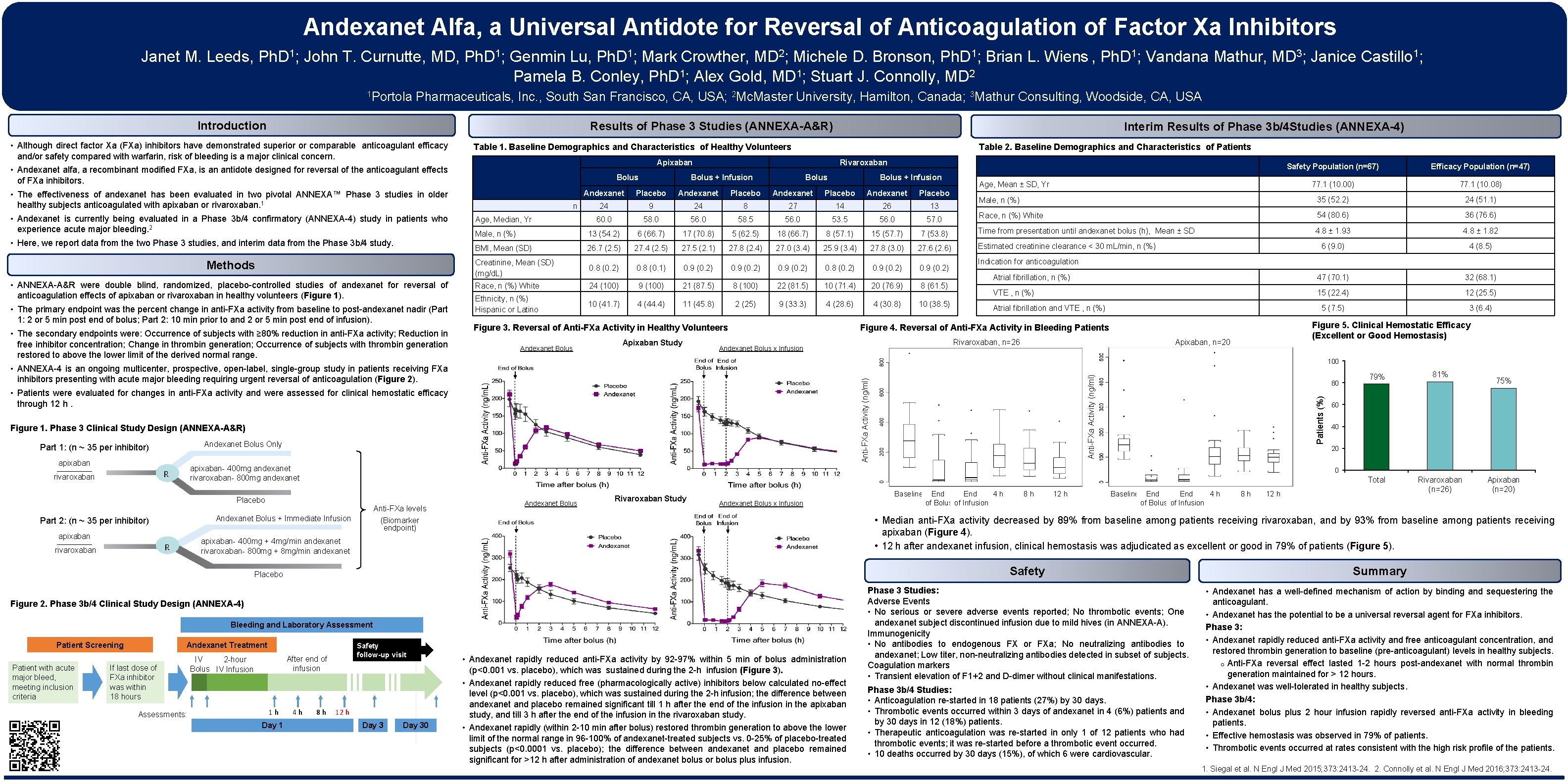
Andexanet Alfa, a Universal Antidote for Reversal of Anticoagulation of Factor Xa Inhibitors Janet M. Leeds, Ph. D 1; John T. Curnutte, MD, Ph. D 1; Genmin Lu, Ph. D 1; Mark Crowther, MD 2; Michele D. Bronson, Ph. D 1; Brian L. Wiens , Ph. D 1; Vandana Mathur, MD 3; Janice Castillo 1; Pamela B. Conley, Ph. D 1; Alex Gold, MD 1; Stuart J. Connolly, MD 2 1 Portola Pharmaceuticals, Inc. , South San Francisco, CA, USA; 2 Mc. Master University, Hamilton, Canada; 3 Mathur Consulting, Woodside, CA, USA Introduction Results of Phase 3 Studies (ANNEXA-A&R) Apixaban Bolus Rivaroxaban Bolus + Infusion Andexanet Placebo 24 9 24 8 27 14 26 13 60. 0 58. 0 56. 0 58. 5 56. 0 53. 5 56. 0 57. 0 Male, n (%) 13 (54. 2) 6 (66. 7) 17 (70. 8) 5 (62. 5) 18 (66. 7) 8 (57. 1) 15 (57. 7) 7 (53. 8) BMI, Mean (SD) 26. 7 (2. 5) 27. 4 (2. 5) 27. 5 (2. 1) 27. 8 (2. 4) 27. 0 (3. 4) 25. 9 (3. 4) 27. 8 (3. 0) 27. 6 (2. 6) Creatinine, Mean (SD) (mg/d. L) 0. 8 (0. 2) 0. 8 (0. 1) 0. 9 (0. 2) 0. 8 (0. 2) 0. 9 (0. 2) Race, n (%) White 24 (100) 9 (100) 21 (87. 5) 8 (100) 22 (81. 5) 10 (71. 4) 20 (76. 9) 8 (61. 5) Ethnicity, n (%) Hispanic or Latino 10 (41. 7) 4 (44. 4) 11 (45. 8) 2 (25) 9 (33. 3) 4 (28. 6) 4 (30. 8) 10 (38. 5) n Age, Median, Yr Figure 3. Reversal of Anti-FXa Activity in Healthy Volunteers Andexanet Bolus Apixaban Study apixaban ____ rivaroxaban Male, n (%) 35 (52. 2) 24 (51. 1) Race, n (%) White 54 (80. 6) 36 (76. 6) Time from presentation until andexanet bolus (h), Mean ± SD 4. 8 ± 1. 93 4. 8 ± 1. 82 6 (9. 0) 4 (8. 5) Atrial fibrillation, n (%) 47 (70. 1) 32 (68. 1) VTE , n (%) 15 (22. 4) 12 (25. 5) 5 (7. 5) 3 (6. 4) Estimated creatinine clearance < 30 m. L/min, n (%) Indication for anticoagulation Atrial fibrillation and VTE , n (%) Figure 5. Clinical Hemostatic Efficacy (Excellent or Good Hemostasis) Rivaroxaban, n=26 Apixaban, n=20 80 Anti-FXa levels Andexanet Bolus Rivaroxaban Study Baseline Andexanet Bolus x Infusion Placebo Figure 2. Phase 3 b/4 Clinical Study Design (ANNEXA-4) Bleeding and Laboratory Assessment Andexanet Treatment If last dose of FXa inhibitor was within 18 hours Assessments: Safety follow-up visit After end of infusion IV 2 -hour Bolus IV Infusion 1 h Day 1 4 h 81% Total Rivaroxaban (n=26) 75% 60 40 20 8 h 12 h Day 30 End 4 h of Bolus of Infusion 8 h 12 h Baseline End 4 h of Bolus of Infusion 8 h 12 h Apixaban (n=20) • Median anti-FXa activity decreased by 89% from baseline among patients receiving rivaroxaban, and by 93% from baseline among patients receiving apixaban (Figure 4). • 12 h after andexanet infusion, clinical hemostasis was adjudicated as excellent or good in 79% of patients (Figure 5). (Biomarker endpoint) apixaban- 400 mg + 4 mg/min andexanet rivaroxaban- 800 mg + 8 mg/min andexanet R 79% 0 Andexanet Bolus + Immediate Infusion Part 2: (n ~ 35 per inhibitor) Patient with acute major bleed, meeting inclusion criteria 77. 1 (10. 08) apixaban- 400 mg andexanet rivaroxaban- 800 mg andexanet Placebo Patient Screening 77. 1 (10. 00) Age, Mean ± SD, Yr 100 Andexanet Bolus Only R apixaban ____ rivaroxaban Efficacy Population (n=47) Figure 4. Reversal of Anti-FXa Activity in Bleeding Patients Andexanet Bolus x Infusion Figure 1. Phase 3 Clinical Study Design (ANNEXA-A&R) Part 1: (n ~ 35 per inhibitor) Safety Population (n=67) Patients (%) • ANNEXA-A&R were double blind, randomized, placebo-controlled studies of andexanet for reversal of anticoagulation effects of apixaban or rivaroxaban in healthy volunteers (Figure 1). • The primary endpoint was the percent change in anti-FXa activity from baseline to post-andexanet nadir (Part 1: 2 or 5 min post end of bolus; Part 2: 10 min prior to and 2 or 5 min post end of infusion). • The secondary endpoints were: Occurrence of subjects with ≥ 80% reduction in anti-FXa activity; Reduction in free inhibitor concentration; Change in thrombin generation; Occurrence of subjects with thrombin generation restored to above the lower limit of the derived normal range. • ANNEXA-4 is an ongoing multicenter, prospective, open-label, single-group study in patients receiving FXa inhibitors presenting with acute major bleeding requiring urgent reversal of anticoagulation (Figure 2). • Patients were evaluated for changes in anti-FXa activity and were assessed for clinical hemostatic efficacy through 12 h. Table 2. Baseline Demographics and Characteristics of Patients Anti-FXa Activity (ng/ml) Methods Table 1. Baseline Demographics and Characteristics of Healthy Volunteers Anti-FXa Activity (ng/ml) • Although direct factor Xa (FXa) inhibitors have demonstrated superior or comparable anticoagulant efficacy and/or safety compared with warfarin, risk of bleeding is a major clinical concern. • Andexanet alfa, a recombinant modified FXa, is an antidote designed for reversal of the anticoagulant effects of FXa inhibitors. • The effectiveness of andexanet has been evaluated in two pivotal ANNEXA™ Phase 3 studies in older healthy subjects anticoagulated with apixaban or rivaroxaban. 1 • Andexanet is currently being evaluated in a Phase 3 b/4 confirmatory (ANNEXA-4) study in patients who experience acute major bleeding. 2 • Here, we report data from the two Phase 3 studies, and interim data from the Phase 3 b/4 study. Interim Results of Phase 3 b/4 Studies (ANNEXA-4) • Andexanet rapidly reduced anti-FXa activity by 92 -97% within 5 min of bolus administration (p<0. 001 vs. placebo), which was sustained during the 2 -h infusion (Figure 3). • Andexanet rapidly reduced free (pharmacologically active) inhibitors below calculated no-effect level (p<0. 001 vs. placebo), which was sustained during the 2 -h infusion; the difference between andexanet and placebo remained significant till 1 h after the end of the infusion in the apixaban study, and till 3 h after the end of the infusion in the rivaroxaban study. • Andexanet rapidly (within 2 -10 min after bolus) restored thrombin generation to above the lower limit of the normal range in 96 -100% of andexanet-treated subjects vs. 0 -25% of placebo-treated subjects (p<0. 0001 vs. placebo); the difference between andexanet and placebo remained significant for >12 h after administration of andexanet bolus or bolus plus infusion. Safety Summary Phase 3 Studies: Adverse Events • No serious or severe adverse events reported; No thrombotic events; One andexanet subject discontinued infusion due to mild hives (in ANNEXA-A). Immunogenicity • No antibodies to endogenous FX or FXa; No neutralizing antibodies to andexanet; Low titer, non-neutralizing antibodies detected in subset of subjects. Coagulation markers • Transient elevation of F 1+2 and D-dimer without clinical manifestations. • Andexanet has a well-defined mechanism of action by binding and sequestering the anticoagulant. • Andexanet has the potential to be a universal reversal agent for FXa inhibitors. Phase 3: • Andexanet rapidly reduced anti-FXa activity and free anticoagulant concentration, and restored thrombin generation to baseline (pre-anticoagulant) levels in healthy subjects. o Anti-FXa reversal effect lasted 1 -2 hours post-andexanet with normal thrombin generation maintained for > 12 hours. • Andexanet was well-tolerated in healthy subjects. Phase 3 b/4: • Andexanet bolus plus 2 hour infusion rapidly reversed anti-FXa activity in bleeding patients. • Effective hemostasis was observed in 79% of patients. • Thrombotic events occurred at rates consistent with the high risk profile of the patients. Phase 3 b/4 Studies: • Anticoagulation re-started in 18 patients (27%) by 30 days. • Thrombotic events occurred within 3 days of andexanet in 4 (6%) patients and by 30 days in 12 (18%) patients. • Therapeutic anticoagulation was re-started in only 1 of 12 patients who had thrombotic events; it was re-started before a thrombotic event occurred. • 10 deaths occurred by 30 days (15%), of which 6 were cardiovascular. 1. Siegal et al. N Engl J Med 2015; 373: 2413 -24. 2. Connolly et al. N Engl J Med 2016; 373: 2413 -24.