
AND THRESHOLDS PERFORMANCE MANAGEMENT REFERENCE CARD EVM system
- Slides: 2
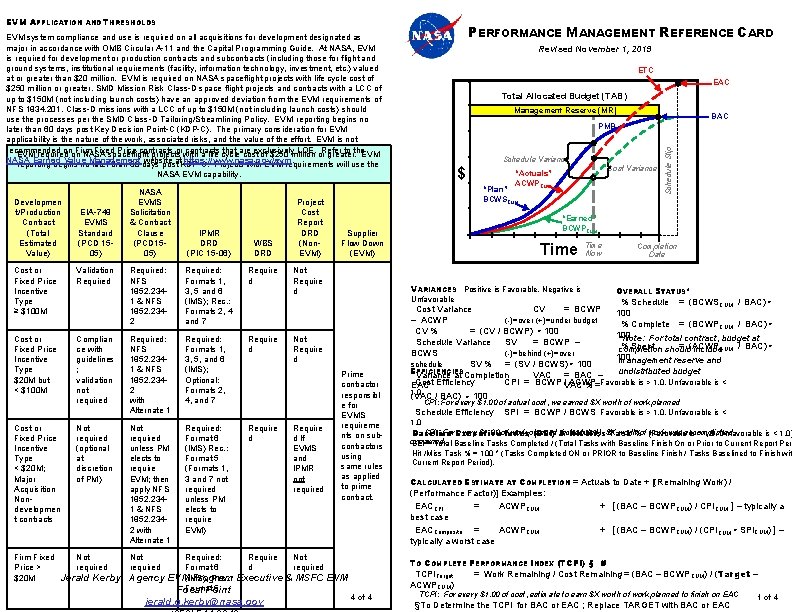
AND THRESHOLDS PERFORMANCE MANAGEMENT REFERENCE CARD EVM system compliance and use is required on all acquisitions for development designated as major in accordance with OMB Circular A-11 and the Capital Programming Guide. At NASA, EVM is required for development or production contracts and subcontracts (including those for flight and ground systems, institutional requirements (facility, information technology, investment, etc. ) valued at or greater than $20 million. EVM is required on NASA spaceflight projects with life cycle cost of $250 million or greater. SMD Mission Risk Class-D space flight projects and contracts with a LCC of up to $150 M (not including launch costs) have an approved deviation from the EVM requirements of NFS 1834. 201. Class-D missions with a LCC of up to $150 M (not including launch costs) should use the processes per the SMD Class-D Tailoring/Streamlining Policy. EVM reporting begins no later than 60 days post Key Decision Point-C (KDP-C). The primary consideration for EVM applicability is the nature of the work, associated risks, and the value of the effort. EVM is not recommended on Firm Fixed Price contracts or contracts that are exclusively LOE. Refer to the EVM required on NASA spaceflight projects with a life cycle cost of $250 million or greater. EVM NASA Earned Value Management website at https: //www. nasa. gov/evm. reporting begins no later than 60 days post KDP-C. Projects with EVM requirements will use the NASA EVM capability. Developmen t/Production Contract (Total Estimated Value) EIA-748 EVMS Standard (PCD 1505) Cost or Fixed Price Incentive Type ≥ $100 M Validation Required Cost or Fixed Price Incentive Type $20 M but < $100 M Complian ce with guidelines ; validation not required Cost or Fixed Price Incentive Type < $20 M; Major Acquisition Nondevelopmen t contracts Not required (optional at discretion of PM) NASA EVMS Solicitation & Contract Clause (PCD 1505) IPMR DRD (PIC 15 -06) Required: NFS 1852. 2341 & NFS 1852. 2342 Required: Formats 1, 3, 5 and 6 (IMS); Rec. : Formats 2, 4 and 7 Require d Required: NFS 1852. 2341 & NFS 1852. 2342 with Alternate 1 Required: Formats 1, 3, 5, and 6 (IMS); Optional: Formats 2, 4, and 7 Require d Not required unless PM elects to require EVM; then apply NFS 1852. 2341 & NFS 1852. 2342 with Alternate 1 Required: Format 6 (IMS) Rec. : Format 5 (Formats 1, 3 and 7 not required unless PM elects to require EVM) WBS DRD Require d Project Cost Report DRD (Non. EVM) EAC Total Allocated Budget (TAB) Management Reserve (MR) Schedule Variance $ Cost Variance “Actuals” ACWPCum “Earned” BCWPCum Time Now VARIANCES Positive is Favorable, Negative is Prime contractor responsibl e for EVMS requireme nts on subcontractors using same rules as applied to prime contract. Completion Date OVERALL STATUS* Unfavorable Not Require d BAC PMB Supplier Flow Down (EVM) Firm Fixed Not Required: Require Not Price > required Format 6 d required $20 M (IMS); Rec. : Executive & MSFC EVM Jerald Kerby, Agency EVM Program Format 5 Focal Point jerald. g. kerby@nasa. gov ETC “Plan” BCWSCum Not Require d If EVMS and IPMR not required Revised November 1, 2019 Schedule Slip EVM APPLICATION % Schedule = (BCWSCUM / BAC) * Cost Variance CV = BCWP 100 – ACWP (-)=over (+)=under budget % Complete = (BCWPCUM / BAC) * CV % = (CV / BCWP) * 100 *Note: For total contract, budget at Schedule Variance SV = BCWP – % Spent should = (ACWP completion include. CUM / BAC) * BCWS (-)=behind (+)=over 100 management reserve and schedule SV % = (SV / BCWS) * 100 undistributed budget EVariance FFICIENCIES at Completion VAC = BAC – Cost Efficiency CPI = BCWP VAC / ACWP EAC % =Favorable is > 1. 0, Unfavorable is < 1. 0 (VAC / BAC) * 100 CPI: For every $1. 00 of actual cost, we earned $X worth of work planned Schedule Efficiency SPI = BCWP / BCWS Favorable is > 1. 0, Unfavorable is < 1. 0 SPI: For. Execution every $1. 00 of. Index work planned (scheduled), worth%of (Favorable work was accomplished Baseline (BEI) & Hit/Miss$X Task is > 1. 0, Unfavorable is < 1. 0) or earned. BEI = Total Baseline Tasks Completed / (Total Tasks with Baseline Finish On or Prior to Current Report Per Hit /Miss Task % = 100 * (Tasks Completed ON or PRIOR to Baseline Finish / Tasks Baselined to Finish wit Current Report Period). CALCULATED ESTIMATE AT COMPLETION (Performance Factor)] Examples: EACCPI = ACWPCUM best case EACComposite = ACWPCUM typically a worst case = Actuals to Date + [(Remaining Work) / + [ (BAC – BCWPCUM) / CPICUM ] – typically a + [ (BAC – BCWPCUM) / (CPICUM * SPICUM) ] – TO COMPLETE PERFORMANCE INDEX (TCPI) § # TCPITarget ACWPCUM) 4 of 4 = Work Remaining / Cost Remaining = (BAC – BCWPCUM) / (Target – TCPI: For every $1. 00 of cost, estimate to earn $X worth of work planned to finish on EAC §To Determine the TCPI for BAC or EAC ; Replace TARGET with BAC or EAC 1 of 4
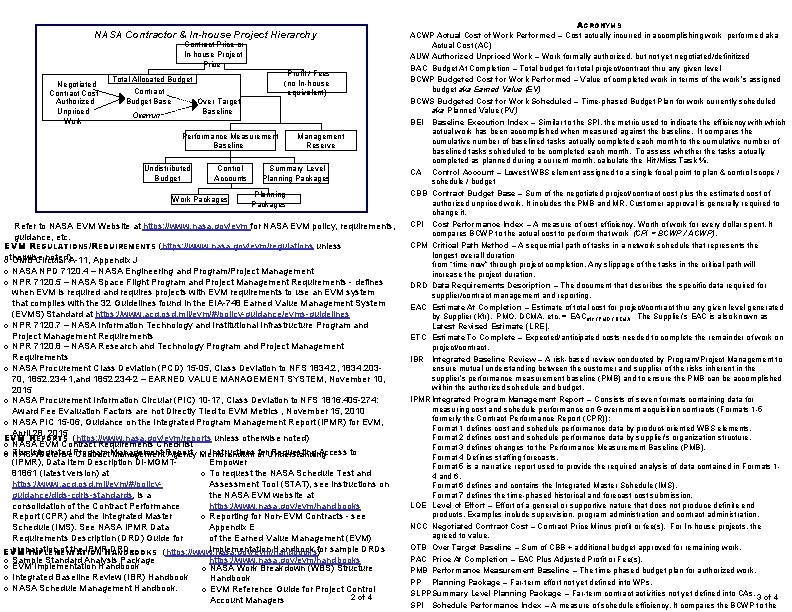
NASA Contractor & In-house Project Hierarchy Contract Price or In-house Project Price Negotiated Contract Cost Authorized Unpriced Work Profit / Fees (no In-house equivalent) Total Allocated Budget Contract Budget Base Over Target Baseline Overrun Performance Measurement Baseline Undistributed Budget Control Accounts Work Packages Management Reserve Summary Level Planning Packages Refer to NASA EVM Website at https: //www. nasa. gov/evm for NASA EVM policy, requirements, guidance, etc. EVM REGULATIONS/REQUIREMENTS (https: //www. nasa. gov/evm/regulations unless noted)A-11, Appendix J ootherwise OMB Circular o NASA NPD 7120. 4 – NASA Engineering and Program/Project Management o NPR 7120. 5 – NASA Space Flight Program and Project Management Requirements - defines when EVM is required and requires projects with EVM requirements to use an EVM system that complies with the 32 Guidelines found in the EIA-748 Earned Value Management System (EVMS) Standard at https: //www. acq. osd. mil/evm/#/policy-guidance/evms-guidelines o NPR 7120. 7 – NASA Information Technology and Institutional Infrastructure Program and Project Management Requirements o NPR 7120. 8 – NASA Research and Technology Program and Project Management Requirements o NASA Procurement Class Deviation (PCD) 15 -05, Class Deviation to NFS 1834. 2, 1834. 20370, 1852. 234 -1, and 1852. 234 -2 – EARNED VALUE MANAGEMENT SYSTEM, November 10, 2015 o NASA Procurement Information Circular (PIC) 10 -17, Class Deviation to NFS 1816. 405 -274: Award Fee Evaluation Factors are not Directly Tied to EVM Metrics , November 15, 2010 o NASA PIC 15 -06, Guidance on the Integrated Program Management Report (IPMR) for EVM, April 28, 2015 EVM REPORTS (https: //www. nasa. gov/evm/reports unless otherwise noted) o NASA EVM Contract Requirements Checklist o Integrated Program o Instructions of for. Understanding Requesting Access to o The NASA/Defense Contract Management Report Agency Memorandum (IPMR), Data Item Description DI-MGMTEmpower 81861 (latest version) at o To request the NASA Schedule Test and https: //www. acq. osd. mil/evm/#/policy. Assessment Tool (STAT), see instructions on guidance/dids-cdrls-standards, is a the NASA EVM website at consolidation of the Contract Performance https: //www. nasa. gov/evm/handbooks Report (CPR) and the Integrated Master o Reporting for Non-EVM Contracts - see Schedule (IMS). See NASA IPMR Data Appendix E Requirements Description (DRD) Guide for of the Earned Value Management (EVM) preparation of the IPMRHDRD. Implementation Handbook for sample DRDs EVM IMPLEMENTATION ANDBOOKS (https: //www. nasa. gov/evm/handbooks) o Sample Standard Analysis Package https: //www. nasa. gov/evm/handbooks o EVM Implementation Handbook o NASA Work Breakdown (WBS) Structure o Integrated Baseline Review (IBR) Handbook o NASA Schedule Management Handbook. o EVM Reference Guide for Project Control 2 of 4 Account Managers ACRONYMS ACWP Actual Cost of Work Performed – Cost actually incurred in accomplishing work performed aka Actual Cost (AC) AUW Authorized Unpriced Work – Work formally authorized, but not yet negotiated/definitized BAC Budget At Completion – Total budget for total project/contract thru any given level BCWP Budgeted Cost for Work Performed – Value of completed work in terms of the work ’s assigned budget aka Earned Value (EV) BCWS Budgeted Cost for Work Scheduled – Time-phased Budget Plan for work currently scheduled aka Planned Value (PV) BEI Baseline Execution Index – Similar to the SPI, the metric used to indicate the efficiency with which actual work has been accomplished when measured against the baseline. It compares the cumulative number of baselined tasks actually completed each month to the cumulative number of baselined tasks scheduled to be completed each month. To assess whether the tasks actually completed as planned during a current month, calculate the Hit/Miss Task %. CA Control Account – Lowest WBS element assigned to a single focal point to plan & control scope / schedule / budget CBB Contract Budget Base – Sum of the negotiated project/contract cost plus the estimated cost of authorized unpriced work. It includes the PMB and MR. Customer approval is generally required to change it. CPI Cost Performance Index – A measure of cost efficiency. Worth of work for every dollar spent. It compares BCWP to the actual cost to perform that work (CPI = BCWP / ACWP). CPM Critical Path Method – A sequential path of tasks in a network schedule that represents the longest overall duration from “time now” through project completion. Any slippage of the tasks in the critical path will increase the project duration. DRD Data Requirements Description – The document that describes the specific data required for supplier/contract management and reporting. EAC Estimate At Completion – Estimate of total cost for project/contract thru any given level generated by Supplier (Ktr), PMO, DCMA, etc. = EACKtr / PMO / DCMA. The Supplier’s EAC is also known as Latest Revised Estimate (LRE). ETC Estimate To Complete – Expected/anticipated costs needed to complete the remainder of work on project/contract. IBR Integrated Baseline Review – A risk-based review conducted by Program/Project Management to ensure mutual understanding between the customer and supplier of the risks inherent in the supplier’s performance measurement baseline (PMB) and to ensure the PMB can be accomplished within the authorized schedule and budget. IPMR Integrated Program Management Report – Consists of seven formats containing data for measuring cost and schedule performance on Government acquisition contracts (Formats 1 -5 formerly the Contract Performance Report (CPR)): Format 1 defines cost and schedule performance data by product-oriented WBS elements. Format 2 defines cost and schedule performance data by supplier's organization structure. Format 3 defines changes to the Performance Measurement Baseline (PMB). Format 4 Defines staffing forecasts. Format 5 is a narrative report used to provide the required analysis of data contained in Formats 14 and 6. Format 6 defines and contains the Integrated Master Schedule (IMS). Format 7 defines the time-phased historical and forecast cost submission. LOE Level of Effort – Effort of a general or supportive nature that does not produce definite end products. Examples include supervision, program administration and contract administration. NCC Negotiated Contract Cost – Contract Price Minus profit or fee(s). For In-house projects, the agreed to value. OTB Over Target Baseline – Sum of CBB + additional budget approved for remaining work. PAC Price At Completion – EAC Plus Adjusted Profit or Fee(s). PMB Performance Measurement Baseline – The time-phased budget plan for authorized work. PP Planning Package – Far-term effort not yet defined into WPs. SLPPSummary Level Planning Package – Far-term contract activities not yet defined into CAs. 3 of 4 SPI Schedule Performance Index – A measure of schedule efficiency. It compares the BCWP to the