
And the role of Innovation And Technical Change
- Slides: 21
And the role of Innovation And Technical Change EEE Spring 2017
� Technology and innovation explains the unexplained part of differences in national economic growth � Long term economic growth is the result of technological change
� Arise from basic differences in historical experience, language and culture � Are reflected in national idiosyncrasies in: �Internal organization of firms �Inter-firm relationships �Role of the public sector �Institutional set-up of the financial sector � R&D intensity and R&D organization �Legal system �Educational system �Infrastructure Development �Culture
§ Ideas-driven growth theory ( Romer) § Porter framework for microenvironment § National innovation systems
� Growth stimulated from within the system (endogenous). � Share of the economy devoted to the ideas sector is a function of the R&D labor market; allocation of resources to the ideas sector depends on R&D productivity and the private economic return to new ideas. � Productivity of new ideas generation is sensitive to the stock of ideas discovered in the past.
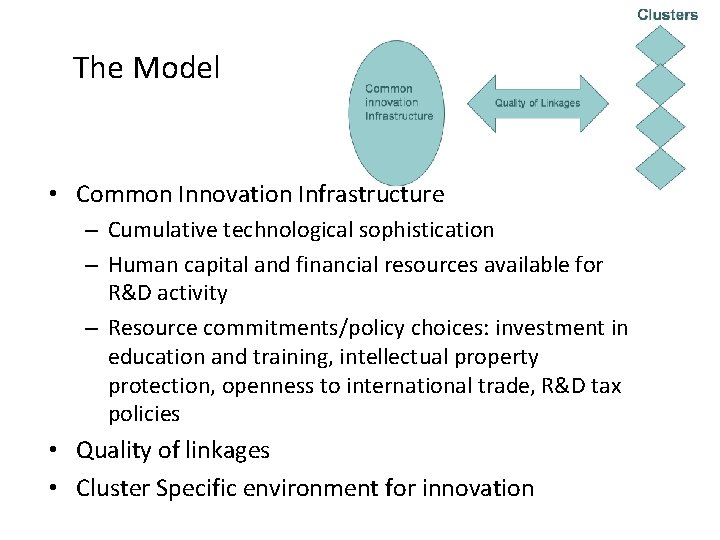
The Model • Common Innovation Infrastructure – Cumulative technological sophistication – Human capital and financial resources available for R&D activity – Resource commitments/policy choices: investment in education and training, intellectual property protection, openness to international trade, R&D tax policies • Quality of linkages • Cluster Specific environment for innovation
� Availability of high-quality, specialized innovation inputs � R&D personnel who are specialized in cluster-related disciplines � Extent to which the local competitive context is both intense and rewards successful innovators � IP protection, regulations, rivalry, openness to int’national competition in the cluster � Nature of domestic demand for cluster products and services � Demanding customers encourage domestic firms to offer best in the world technologies � Availability, density and interconnectedness of vertically and horizontally related industries � Positive externalities from spillovers, transaction efficiencies and cluster-level scale economies
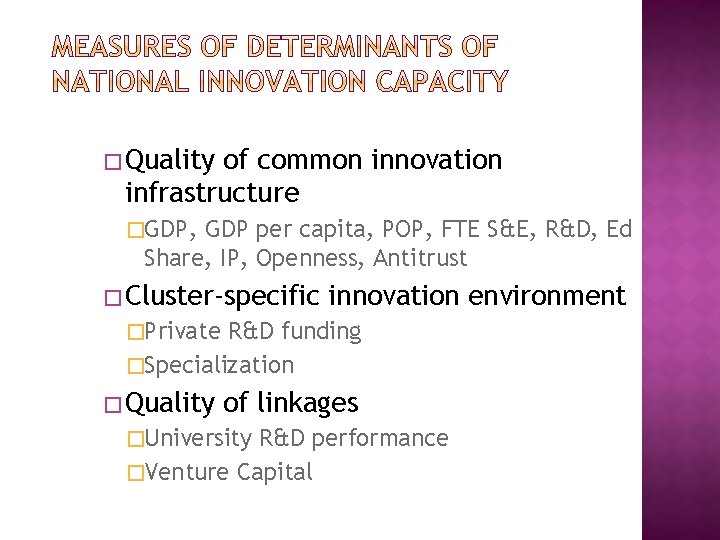
� Quality of common innovation infrastructure �GDP, GDP per capita, POP, FTE S&E, R&D, Ed Share, IP, Openness, Antitrust � Cluster-specific innovation environment �Private R&D funding �Specialization � Quality of linkages �University R&D performance �Venture Capital
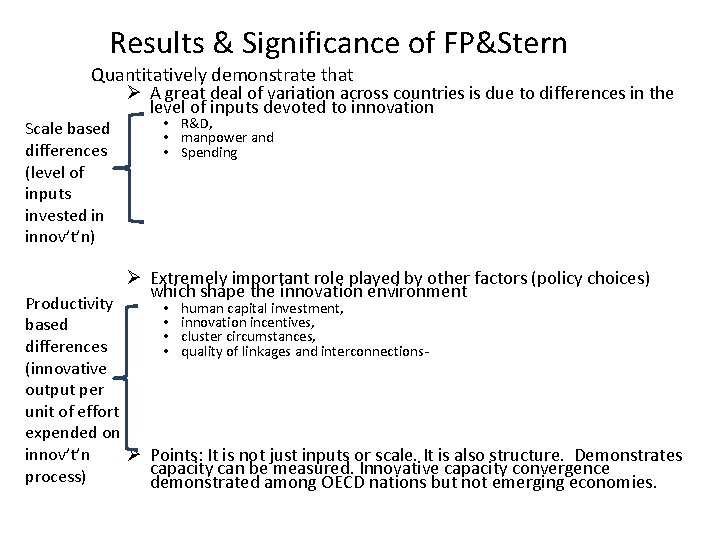
Results & Significance of FP&Stern Quantitatively demonstrate that Ø A great deal of variation across countries is due to differences in the Scale based differences (level of inputs invested in innov’t’n) level of inputs devoted to innovation • R&D, • manpower and • Spending Ø Extremely important role played by other factors (policy choices) which shape the innovation environment Productivity • human capital investment, • innovation incentives, based • cluster circumstances, differences • quality of linkages and interconnections(innovative output per unit of effort expended on innov’t’n Ø Points: It is not just inputs or scale. It is also structure. Demonstrates capacity can be measured. Innovative capacity convergence process) demonstrated among OECD nations but not emerging economies.
� Outcome variable ( dependent variable) as indication of innovative capacity ~ international patents � Benchmarking vs dynamics
� Evolutionary � Policy � The framework: dynamics important and institutional environment development of uniqueness/path dependencies/history matters/how the specialization came about – relational limits
� Sets of habits, routines, rules, norms and laws which regulate the relations between people and shape human interactions � The communication infrastructure, social norms about conflict, consensus and cooperation and the labor market
� What types of institutions matter? � How do they vary?
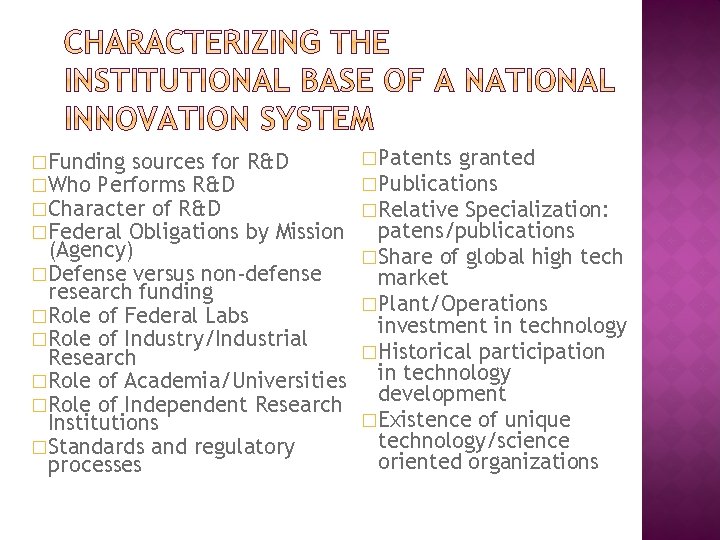
�Funding sources for �Who Performs R&D �Character of R&D �Federal Obligations R&D �Patents granted �Publications �Relative Specialization: patens/publications (Agency) �Share of global high tech �Defense versus non-defense market research funding �Plant/Operations �Role of Federal Labs investment in technology �Role of Industry/Industrial �Historical participation Research in technology �Role of Academia/Universities development �Role of Independent Research �Existence of unique Institutions technology/science �Standards and regulatory oriented organizations processes by Mission
� Size, degree of affluence � Richness of natural resources � Degree to which farming is entrenched � Ratio of large R&D intensive firms to small “high tech” firms � Ownership characteristics of firms (state, foreign, private) � Character of labor pool (level and type of education, work ethic etc. )
� Breadth and character of technology focus �generation �development �technology diffusion �technology transfer �degree of focus on capital intensive innovation/large technologically complex systems � Character of economic focus (domestic, import substitution, export led)
� Sameness and continuity government support for education and basic research � Differences in views about government’s role in innovation � Reflections of conscious decisions in government policies � Degree of relationship between industry and state
� Strong rivals in the domestic environment � Interactive firms � Big linkages with domestic upstream home market demand � Democratic institutions versus government/political continuity?
� Innovation is a multifaceted complex phenomenon that can be shaped by national context � Emerging technologies can play a role in many aspects of innovation, they do not always lead to disruptive innovation � Empirical evidence shows that national context still shapes the character focus of innovation activity. Therefore the particular policy and strategies to take advantage of emerging technologies should vary according to a company’s or subsidiary's national context. � Global integration is a feature of the current economic scene and compels us to reconsider the basis on which national competitive advantage is built and sustained. Thus our focus must be on our capacity to manage the balance of the socio-cultural system as well as the capacity for development of technological advantage. Institutions and historical legacy matters.
� Certain technologies and hence industries exhibit different patterns of development � Likewise different nations with different resources and institutions have different focuses on technologies and hence exhibit differences in patterns of development � Both point have implications for managerial actions and policy development