
And the Goodenough Harris DrawAMan Test By Katelyn
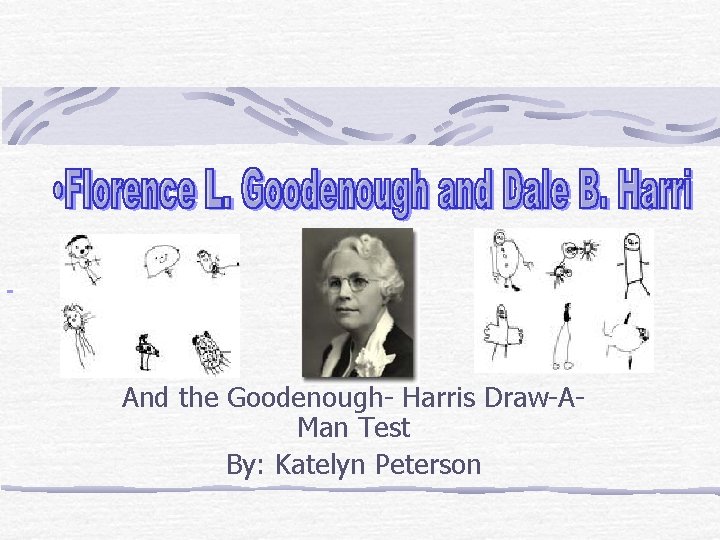
And the Goodenough- Harris Draw-AMan Test By: Katelyn Peterson
A Brief History Born August 6, 1886 in Honesdale, Pennsylvania 1908 graduated from Normal School in Millersville, Pennsylvania degree in Pedagogy 1920 graduated from Columbia University in New York with a B. S. Received her Ph. D from Stanford University in 1924 moved to Minneapolis Minnesota where she was appointed an assistant professor of Child Welfare at the University of Minnesota Died April 4, 1959 in Lakeland, FL while visiting her sister. She died of a stroke
Contributions to Psychology Published nine books and 26 articles (three of the books written while in retirement due to failing eyesight and hearing) Introduced the Minnesota Scale of Paternal Occupations Contributed to the Stanford-Binet I. Q. test in 1921 Listed as a contributor to Lewis Terman’s book Genetic Study of Genius 1925 Served as president of the Society for Research in Child Development from 1946 -1947 Listed in the Watson directory of Outstanding Contributors to Psychology
Draw-A-Man Test Was first introduced in 1926 in Goodenough’s first book Measurement of Intelligence by Drawing Was the first non-verbal standardized test to decipher the cognitive level of young children. Was created to be administer to 4 -10 year olds. Children are given a piece of paper, a pencil and ten minutes to complete the test. A point is given for every characteristic depicted on the man. The original scale was 51 points
Dale B. Harris Previous student of Goodenough Revised the Test in 1963 in his work Children’s Drawings as Measures of Intellectual Maturity Extended the scale to 73 points, wanted to add to the test not change it Added a draw-a-woman and draw yourself section to the test Extended the age range to adolescence

Key Terms Time Sampling: A study of subjects behavior for a certain period of time Event Sampling: observing a certain behavior and counting on how it occurs Intelligence Quotient (IQ): a number arrived at my means of intelligence tests, intended to express the degree of intelligence of an individual in relation to the average for the age-group
Terms Continued… Cognitive Development: the process that includes perception, conceptualizing, knowing, judging, and reasoning Raw Score: the number of points each child receives for their drawing Standard Score: The raw score in relation to the age of the child.
Importance of a Draw Test There is a close relationship between the concept development of drawing and general intelligence Drawing is a primary language to children rather than a means of creating beauty The order of development in drawing is consistent through all different social and economic backgrounds Children draw what they know
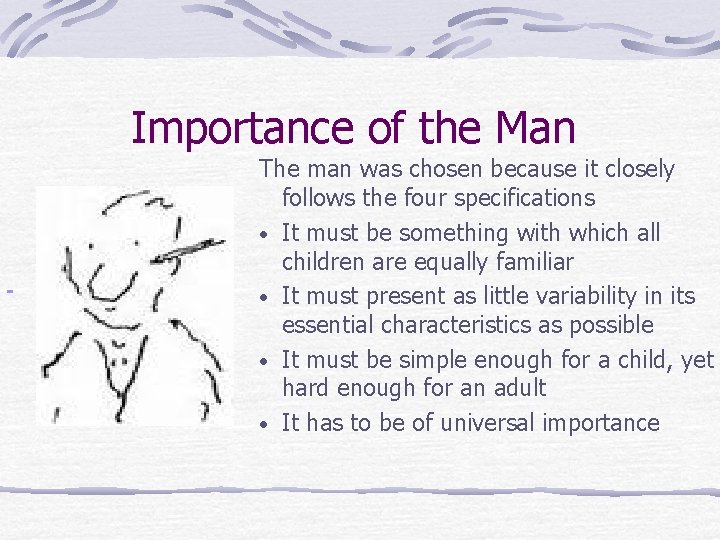
Importance of the Man The man was chosen because it closely follows the four specifications • It must be something with which all children are equally familiar • It must present as little variability in its essential characteristics as possible • It must be simple enough for a child, yet hard enough for an adult • It has to be of universal importance
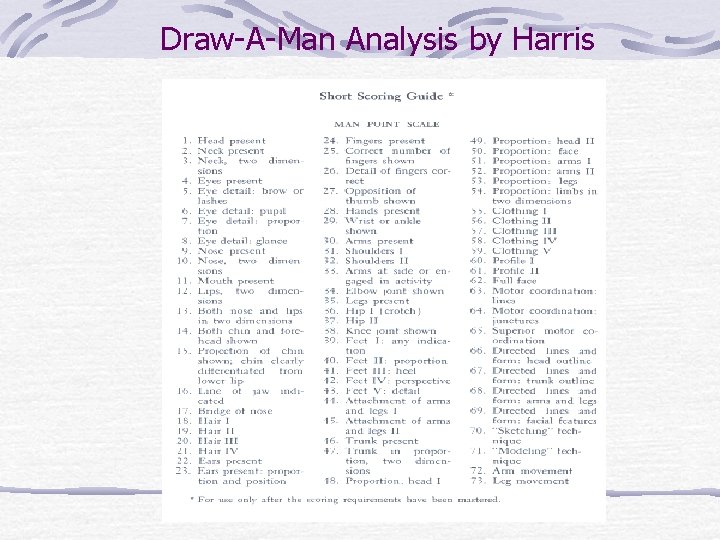
Draw-A-Man Analysis by Harris
Montessori Method Created my Maria Montessori (1870 -1952) Self-directed activity on the part of the child and clinical observation on the part of the teacher Discourages traditional measurement of intelligence (such as grades or tests) Research shows that children that attend Montessori schools score significantly lower on standardized tests
My Hypothesis The Draw-A-Man test is unlike any other standardized test in that it is not based on a question-answer format. I believe that because the Draw-A-Man test is so distinct in this way, that the Montessori children will exhibit the same scores, if not higher than the Traditional school children. I also believe, as correlated to the data found by Goodenough and Harris, that the girls will exceed the boys in their score range. I seek to prove that the Montessori children will show similar if not higher cognitive development as the traditional school children.

The Schools Peak Preparatory Opened in 2004 90% Minority, is a college preparatory school St. Alcuin Montessori School in Dallas TX Founded 1964 and is one of the largest Montessori schools in the United States Begins with a Toddler program and goes to 8 th grade
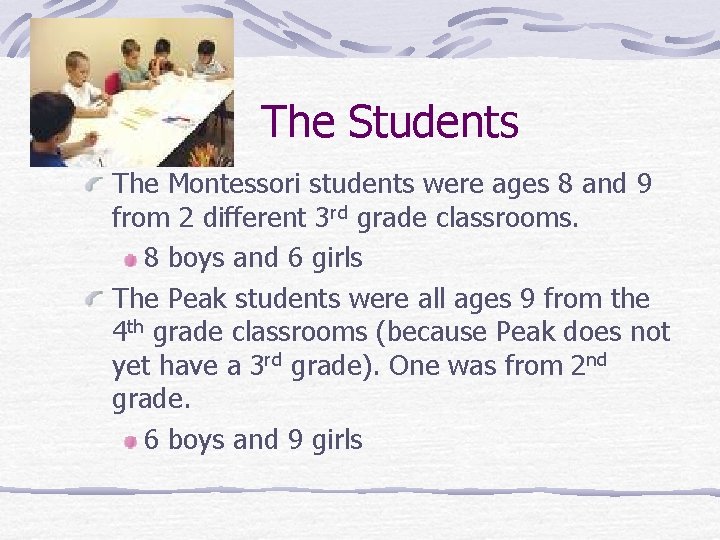
The Students The Montessori students were ages 8 and 9 from 2 different 3 rd grade classrooms. 8 boys and 6 girls The Peak students were all ages 9 from the 4 th grade classrooms (because Peak does not yet have a 3 rd grade). One was from 2 nd grade. 6 boys and 9 girls
The Procedure Every student was given a blank piece of printer paper and a sharpened # 2 pencil. They were all given exactly 10 minutes to complete their drawings. The students were told the same: I’m doing a school project for a psychology class that I am taking. Can you help me? Please listen carefully. On this paper I want you to draw a man. Make the very best man that you can. Take your time and work very carefully. Be sure to make a whole man and not just the head and shoulders. Try not to talk to your neighbor and work by yourself. Try very hard and see what good pictures you can make. After the Test the students were asked to write their name, their birthday and their school on the back of the paper. They were thanked and brought back to their classrooms.
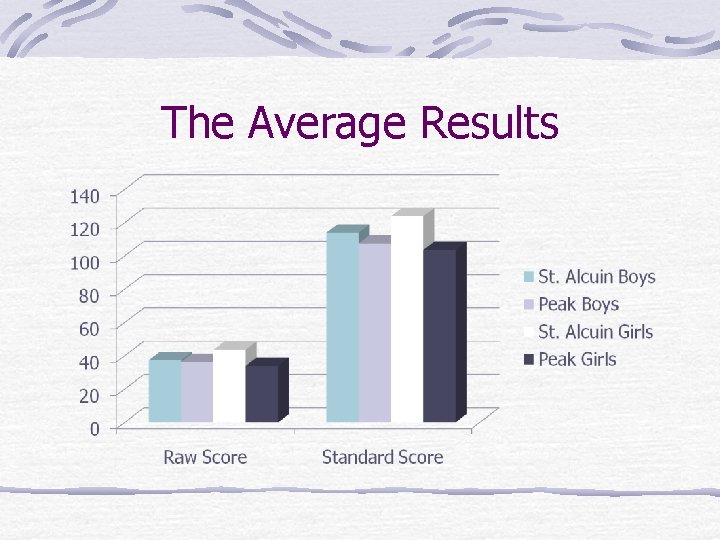
The Students Score Averages Montessori Traditional Boys: 37. 38 Boys: 36. 33 Montessori Girls: 43. 7 Traditional Girls: 34
The Students Standard Score Average Montessori Traditional Boys: 114 Boys: 107. 5 Montessori Girls: 123. 83 Traditional Girls: 103. 6
The Average Results
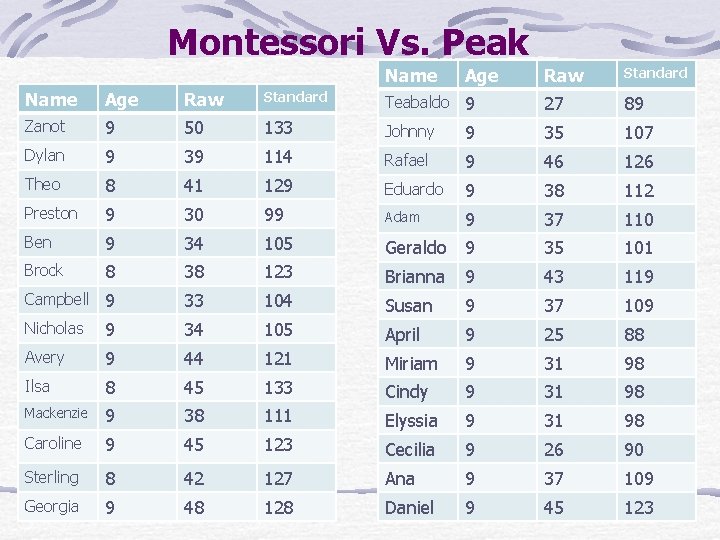
Montessori Vs. Peak Name Age Raw Standard Zanot 9 50 133 Dylan St. Alcuin Montessori 9 39 114 Age Teabaldo 9 Peak Johnny 9 Rafael Raw Standard 27 89 Preparatory 35 107 Traditional 9 46 126 Theo 8 41 129 Eduardo 9 38 112 Preston 9 30 99 Adam 9 37 110 Ben 9 34 105 Geraldo 9 35 101 Brock 8 38 123 Brianna 9 43 119 Campbell 9 33 104 Susan 9 37 109 Nicholas 9 34 105 April 9 25 88 Avery 9 44 121 Miriam 9 31 98 Ilsa 8 45 133 Cindy 9 31 98 Mackenzie 9 38 111 Elyssia 9 31 98 Caroline 9 45 123 Cecilia 9 26 90 Sterling 8 42 127 Ana 9 37 109 Georgia 9 48 128 Daniel 9 45 123
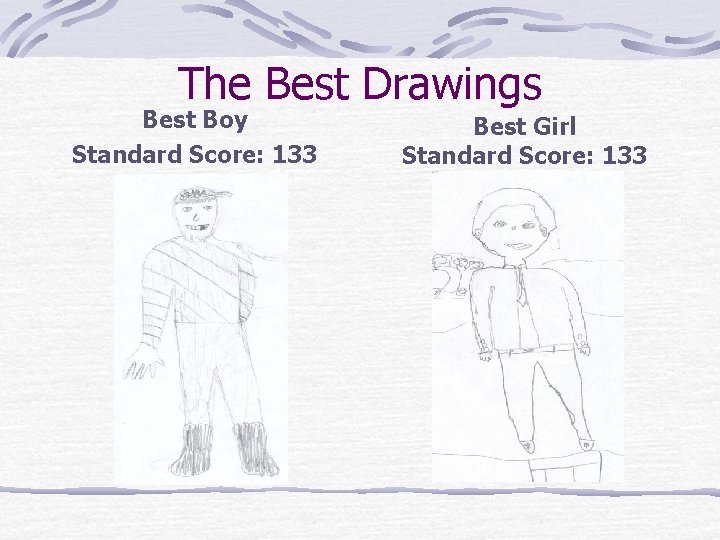
The Best Drawings Best Boy Standard Score: 133 Best Girl Standard Score: 133
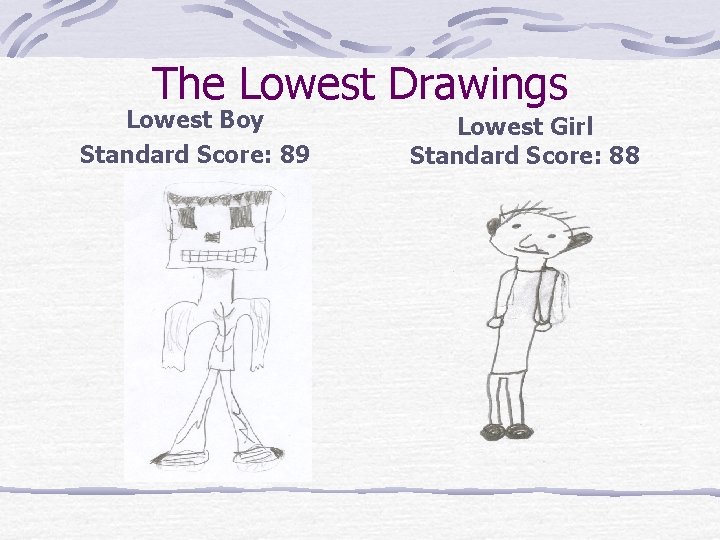
The Lowest Drawings Lowest Boy Standard Score: 89 Lowest Girl Standard Score: 88
Conclusion I was right The Montessori children scored higher overall than the traditional school children did. The girls scored overall higher than the boys (even with an alternated scale. )
Limitations The children were not in the same grade level, even though they were roughly the same age. Distractions to the students They were not in their actual classroom, like Goodenough would have intended Students discussed their drawings Not a true sample size Peak is not exactly the most common of traditional schools I know that 2/7 of the Montessori Children had learning disabilities, but I don’t know about the Traditional children.
Nature V. Nurture • Nature • Goodenough • Harris • Rousseau • Montessori • Nurture • Locke • Goodenough and Harris tested the skills of children based on the principle that they draw what they know. This assumes that children will not be taught past their cognitive stage of development • Montessori believed that children should have self-directed learning with little as little interference as possible. The use of self-correcting tools implies that the children teach themselves as best they can and the teacher is simply an observer in the process.
- Slides: 24