
Ancillary Module SECTION 7 SBMC Fall reduction program
Ancillary Module SECTION 7
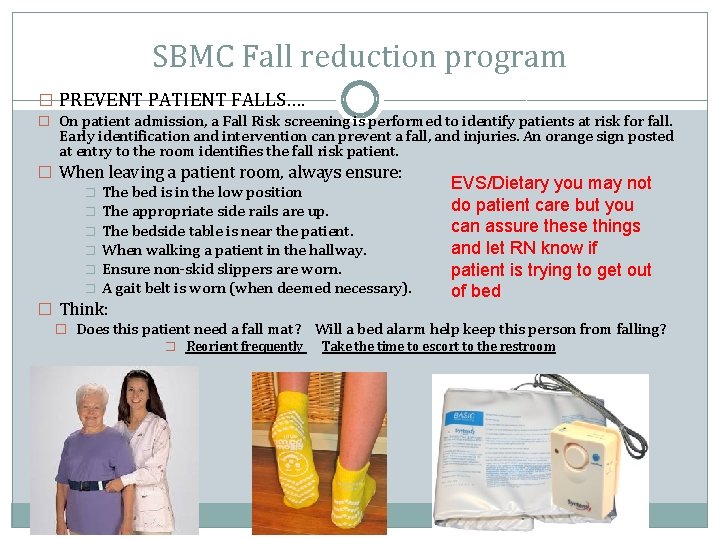
SBMC Fall reduction program � PREVENT PATIENT FALLS…. � On patient admission, a Fall Risk screening is performed to identify patients at risk for fall. Early identification and intervention can prevent a fall, and injuries. An orange sign posted at entry to the room identifies the fall risk patient. � When leaving a patient room, always ensure: EVS/Dietary you may not � The bed is in the low position do patient care but you � The appropriate side rails are up. can assure these things � The bedside table is near the patient. and let RN know if � When walking a patient in the hallway. � Ensure non-skid slippers are worn. patient is trying to get out � A gait belt is worn (when deemed necessary). of bed � Think: � Does this patient need a fall mat? Will a bed alarm help keep this person from falling? � Reorient frequently Take the time to escort to the restroom
Policy & Procedure � Policies can be accessed through the Clinical Tunnel. � 1. � � 6. Go to the Clinical Tunnel 2. Right click mouse on the SBMC Policies and Procedures (this will open to the Table of Contents page) 3. Go to the desired department (i. e. nursing, laboratory, etc) 4. Mouse arrow to the desired policy area to open (blue color and underlined) 5. Depress the "ctrl" key and right mouse button simultaneously while arrow on desired area Policies needed for nursing are most often found in the "Patient Care Services" site or in individual department. 7. If there is a problem with opening a policy on the tunnel leave a message at 2637 to get the hyperlink repaired.
Condition help 2800 � Addresses situations where family members or patient feels their condition is worsening but they are not getting the attention of the healthcare provider and would like someone to come and see the patient. � 1. They feel they are not receiving adequate medical attention. � 2. When they have serious patient care concerns requiring immediate resolution
Abuse � All SBMC employees are mandated abuse reporters � 1. Telephone the appropriate agency CPS, APS, Ombusman � 2. Complete the required forms—found in ED, Nursing service, online in policy � 3. Within the timeframe: a) newborn risk screening or infant/child--36 hours � b) domestic violence or elder--48 hours � 4. Signs/symptoms � a) injury inconsistent with age, suspicious patterns, inconsistent story � b) behavior of patient or caregiver, bruising, belt marks, unusual fractures � c) sexual-inappropriate knowledge, sexually transmitted disease, trauma � d) emotional/neglect-dehydration, malnourishment, not allowed to speak, verbal abuse � e) financial-theft of money from dependent adult, insist on full treatment in terminal pt. � � Refer to Policies PCS 100001, 100002, & 100003 in PCS Manual.

Sadpersons-suicide risk assessment � Risk Factors-depression, mental illness, family hx of suicide, previous attempts, abuse, chronic illness, alcohol & drug abuse q Sex (men receive one point) q Age (one point for people between 19 and 45) q Depression--if the patient says s/he is depressed or appears excessively sad (two points) q Psychiatric care prior to admission (one point) q Excessive drug use (one point) q Rational thinking loss (two points) q Separated or single (one point) q Organized attempt (two points) q No life support—such as friends (one point) q States future attempt (two points) � *Patients who earn more than eight points are, according to this tool, considered high risk. � Don’t leave alone, remove dangerous objects, contact Social Services, MD for psych consult, may need transfer to another facility
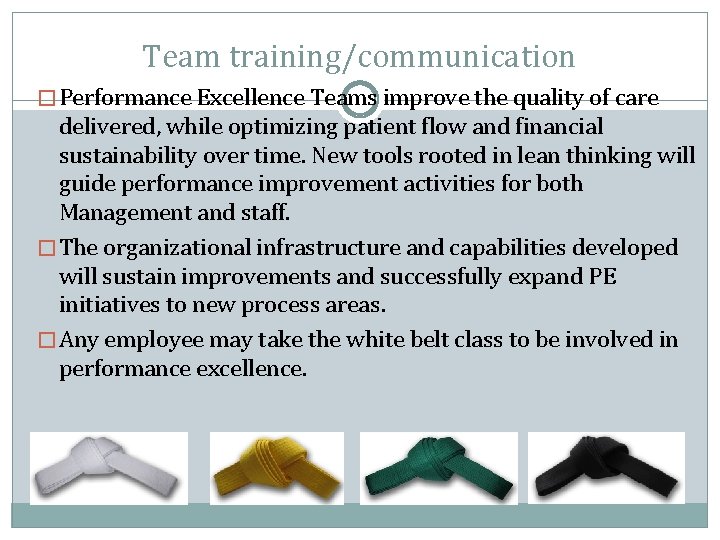
Team training/communication � Performance Excellence Teams improve the quality of care delivered, while optimizing patient flow and financial sustainability over time. New tools rooted in lean thinking will guide performance improvement activities for both Management and staff. � The organizational infrastructure and capabilities developed will sustain improvements and successfully expand PE initiatives to new process areas. � Any employee may take the white belt class to be involved in performance excellence.
PERFORMANCE IMPROVEMENT & CHANGE MANAGEMENT � Performance Improvement is a system design focused on doing the right thing, the right way, the first time, every time. Inappropriate variations are eliminated and continuous improvement is documented. PI improves processes, promotes learning, fosters collaboration and facilitates organizational change. � Since employees closest to the process provide the best ideas for improvement, TEAMWORK is essential to the PI process. Every employee needs to be involved! � PI is EVERYONE’S RESPONSIBILITY AND BUSINESS!
Clinical pain assessment � P-precipitating and palliating factors (what makes it better or worse) � Q-Quality (stabbing, dull, pressure, sharp, aching) � R-region and radiation (where is it, ask to point with 1 finger) � S-severity (use the 0 -10 pain scale) � T-time (how long have you had it, how long does it last) � I am not clinical. What is my role in PATIENT PAIN MANAGEMENT? � Report to the RN immediately if any of the following signs of pain are observed: � Verbal complaint. � Grimacing. � Moaning, crying for help. � Irritability. � Crying or any other signs of pain observed.
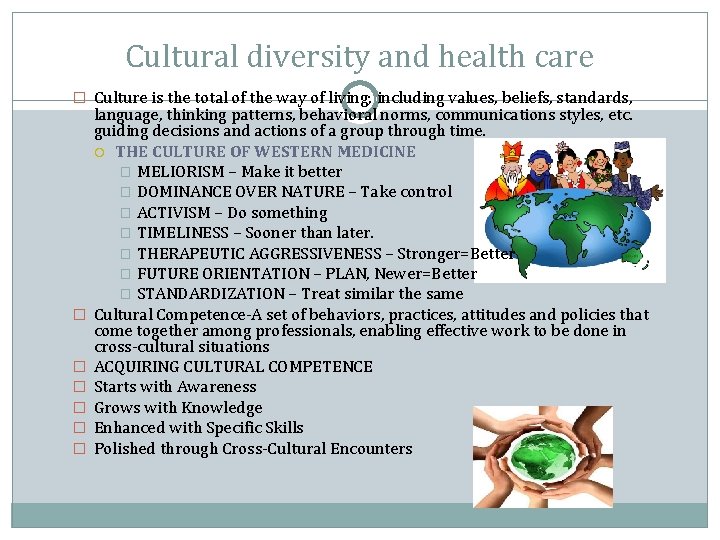
Cultural diversity and health care � Culture is the total of the way of living; including values, beliefs, standards, � � � language, thinking patterns, behavioral norms, communications styles, etc. guiding decisions and actions of a group through time. THE CULTURE OF WESTERN MEDICINE � MELIORISM – Make it better � DOMINANCE OVER NATURE – Take control � ACTIVISM – Do something � TIMELINESS – Sooner than later. � THERAPEUTIC AGGRESSIVENESS – Stronger=Better � FUTURE ORIENTATION – PLAN, Newer=Better � STANDARDIZATION – Treat similar the same Cultural Competence-A set of behaviors, practices, attitudes and policies that come together among professionals, enabling effective work to be done in cross-cultural situations ACQUIRING CULTURAL COMPETENCE Starts with Awareness Grows with Knowledge Enhanced with Specific Skills Polished through Cross-Cultural Encounters
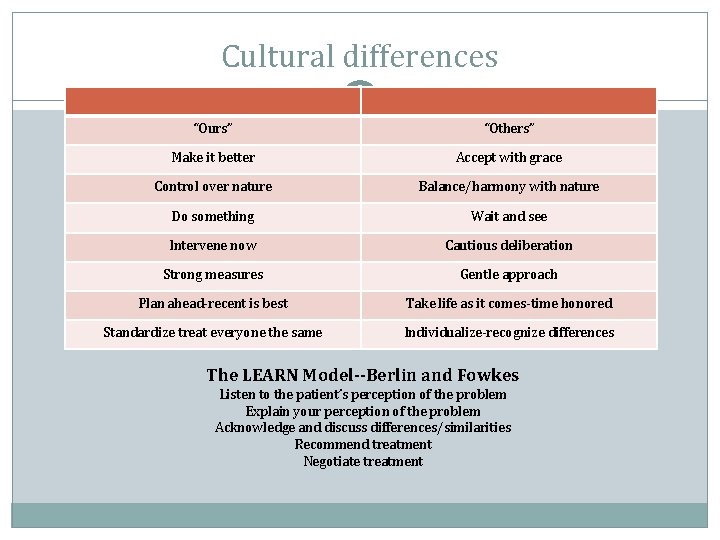
Cultural differences “Ours” “Others” Make it better Accept with grace Control over nature Balance/harmony with nature Do something Wait and see Intervene now Cautious deliberation Strong measures Gentle approach Plan ahead-recent is best Take life as it comes-time honored Standardize treat everyone the same Individualize-recognize differences The LEARN Model--Berlin and Fowkes Listen to the patient’s perception of the problem Explain your perception of the problem Acknowledge and discuss differences/similarities Recommend treatment Negotiate treatment
DIGNITY HEALTH LANGUAGE ACCESS POLICY � It is the policy of Dignity Healthcare that patients or surrogate decision-makers � � � (hereafter patients) who are Limited English Proficient (LEP) and Sensory Impaired shall have services provided to them in their preferred language during the delivery of all significant healthcare services that are effective, understandable, and give respectful care, delivered in a manner compatible with their cultural health beliefs and practices. Goal—Interpreter services shall be available within a reasonable time during all hours of operation at no cost to patients. � PATIENTS REQUIRE COMMUNICATION IN THEIR OWN LANGUAGE Review Policy PCS 900018 – Interpretation Services on line. . DIGNITY HEALTH facilities will provide patients effective, understandable, and respectful care, delivered in a manner compatible with their cultural health beliefs, practices and preferred language. How can we prove Interpreter Services are delivered? Document the provision of interpreter services in the patient medical record. Must include the following: name of requestor; date and time of interpretation; name of SBMC Qualified Medical Interpreter, vendor company name and interpreter name, or Cyra. Com Operator ID number; and a brief description of content interpreted.
Language access cont � SBMC’S LANGUAGE ACCESS PROGRAM � Qualified Medical Interpreter for Spanish. � A Cyracom phone for every in-patient with Medical Interpretation in more than 400 languages. � TTY phones for the hearing impaired. Phones may be obtained from the Nursing. Office or the Education Dept. � VRI (Video Remote Interpreting) equipment -- may be obtained from the Nursing Department � LANGUAGE ACCESS AT SBMC � Signs in several languages are posted at points of entry throughout the facility. � Compliance with the Title VI Civil Rights law of 1964 and numerous CURRENT Federal & State laws governing language access for ALL PATIENTS! � From any telephone at SBMC, dialing 2001 provides language access assistance in numerous languages.
My. Journey �We have a new learning management system called My. Journey. �There are many free courses that can be taken to help improve knowledge of hospital care and environment �All mandatory education will also be required through My. Journey �No one may sign on to My. Journey and complete education under your name except you.
- Slides: 14