
Ancient Rome The Italian Peninsula Narrow bootshaped peninsula
Ancient Rome
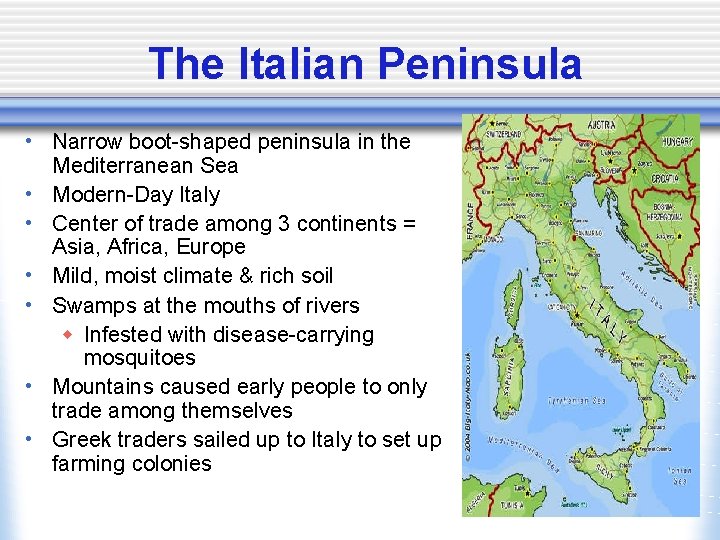
The Italian Peninsula • Narrow boot-shaped peninsula in the Mediterranean Sea • Modern-Day Italy • Center of trade among 3 continents = Asia, Africa, Europe • Mild, moist climate & rich soil • Swamps at the mouths of rivers w Infested with disease-carrying mosquitoes • Mountains caused early people to only trade among themselves • Greek traders sailed up to Italy to set up farming colonies
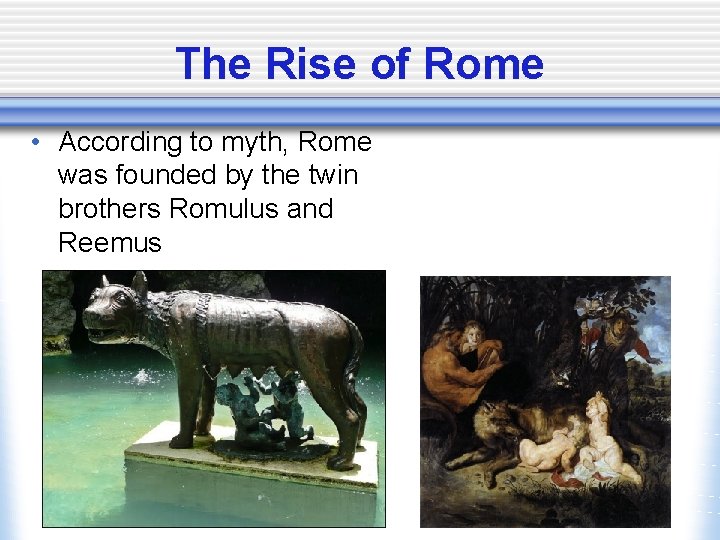
The Rise of Rome • According to myth, Rome was founded by the twin brothers Romulus and Reemus
The Rise of Rome • At first, Rome consisted of 7 villages on 7 hills • In 620 BCE = Roman villages were unified • The Tarquins (wealthy family) were the first kings of united Rome w Taught the people to build houses out of brick & laid out city streets w Created a Forum at the center of the city = became the seat of Roman government w Tarquins were driven out in 509 BCE --> people were upset with Tarquin the Proud’s cruelty and harshness
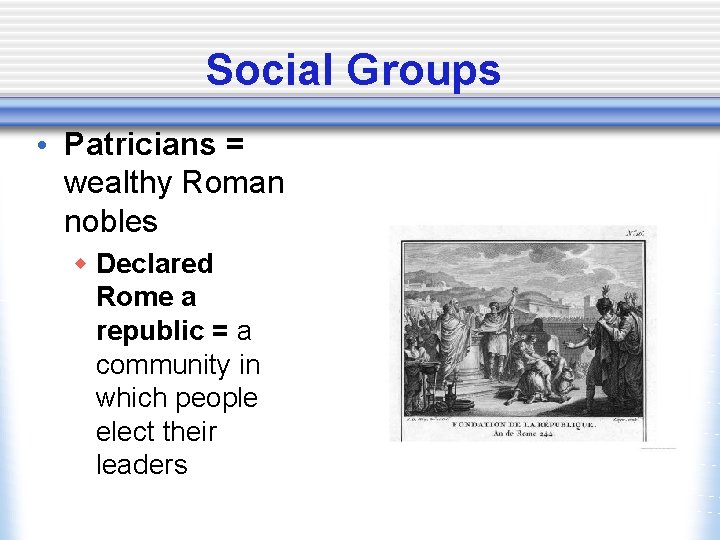
Social Groups • Patricians = wealthy Roman nobles w Declared Rome a republic = a community in which people elect their leaders
Social Groups • Most Romans were plebeians w Landowners, merchants, farmers, etc. w Had some rights, but couldn’t hold public office
Rome’s Government • Rome’s government had 2 branches = legislative & executive • Legislative Branch: w Elected people to the Executive Branch w Senate proposed laws, advised consuls, debated foreign policy & approved building contracts

Rome’s Government • Executive Branch: w Headed by 2 consuls = patrician officials elected to 1 -year terms w Either consul could veto the actions of the other w Occasionally, the Romans appointed a dictator = a leader whose word was law --> only during times of crisis w Dictator could overrule the consuls
Plebeians vs. Patricians • Plebeians resented the fact that they didn’t have any power • Refused to fight in the army unless their demands were met • Plebeians were given representatives in government = called tribunes • Plebeians Assembly of Tribes elected the tribunes • Plebeians improved their social standing w Enslavement for debt ended w Marriage between plebeians & patricians now allowed
Roman Laws • Roman laws were written down on 12 bronze tablets w Called the Twelve Tables & displayed in the Forum
Roman Religion • At first, Romans worshipped nature spirits • Soothsayers = priests who thought they could foretell the future by observing patterns in nature like the flight of birds or the intestines of an animal
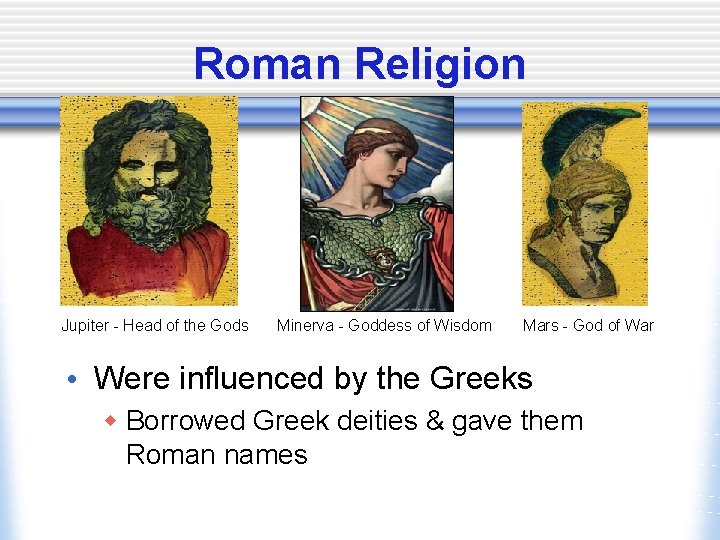
Roman Religion Jupiter - Head of the Gods Minerva - Goddess of Wisdom Mars - God of War • Were influenced by the Greeks w Borrowed Greek deities & gave them Roman names
Roman Families • Roman households were large & close-knit w Included all unmarried children, married sons & their families, dependent relatives & slaves • Father was the absolute head of the household w Controlled property, supervised sons’ education, could even sell family members into slavery • Wives had few legal rights, but had more freedoms than the Greeks w Ran the household w Occasionally got to own property & businesses • Values: thrift, discipline, self-sacrifice, devotion to family & the republic
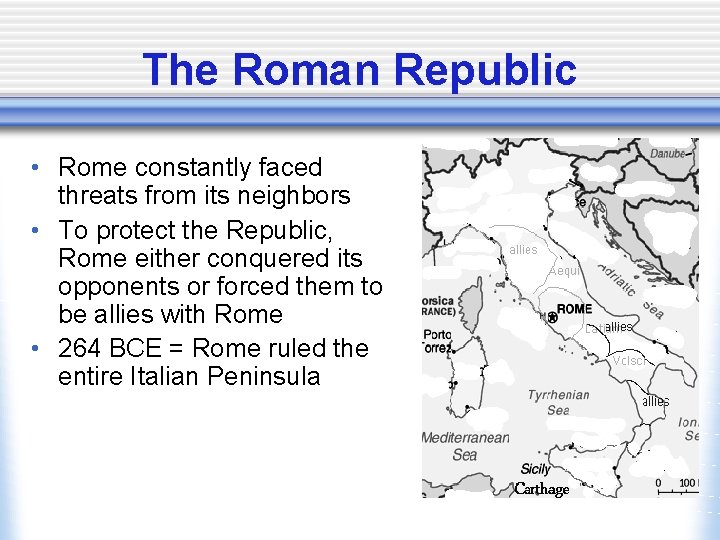
The Roman Republic • Rome constantly faced threats from its neighbors • To protect the Republic, Rome either conquered its opponents or forced them to be allies with Rome • 264 BCE = Rome ruled the entire Italian Peninsula
Roman Legions • Rome had a very strong army • Every male citizen had to serve when needed • Troops were organized into legions of 6, 000 men = smaller, quicker phalanxes
Roman Legions • Soldiers were called legionaries w Well-trained; desertion was punishable by death • Romans treated conquered people well at this time • Rome & its colonies were linked by a series of roads
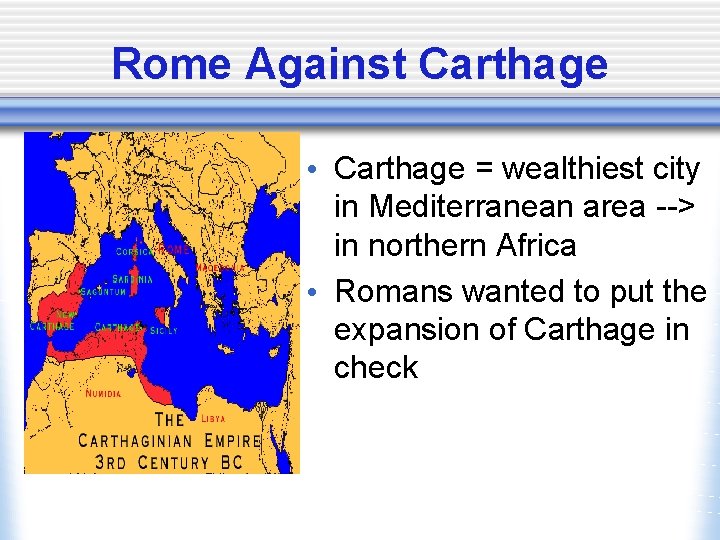
Rome Against Carthage • Carthage = wealthiest city in Mediterranean area --> in northern Africa • Romans wanted to put the expansion of Carthage in check
Rome vs. Carthage 1 st Punic War • Started when Carthage wanted to seize the Strait of Messina & the Romans wanted to stop them • Rome defeated Carthage & took over Sicily • Carthage forced to pay huge indemnity = payment for damages
Rome vs. Carthage 2 nd Punic War • Hannibal = became the general of the Carthaginian army in Spain
Hannibal • Took one of Rome’s allied cities • Invaded Italy with 40, 000 soldiers and 40 elephants • On their way (and in crossing the Alps) --> 1/2 of Hannibal’s army was killed by snow, cold, hunger, sickness, & attacks by mountain people • Despite this, Hannibal’s army was on the verge of destroying the entire Roman army
Scipio • Scipio = Roman general that attacked Carthage forcing Hannibal to retreat back to Africa w He helped the Romans defeat the Carthaginians -> Carthage had to give up their lands in Spain, their warships, & pay an indemnity
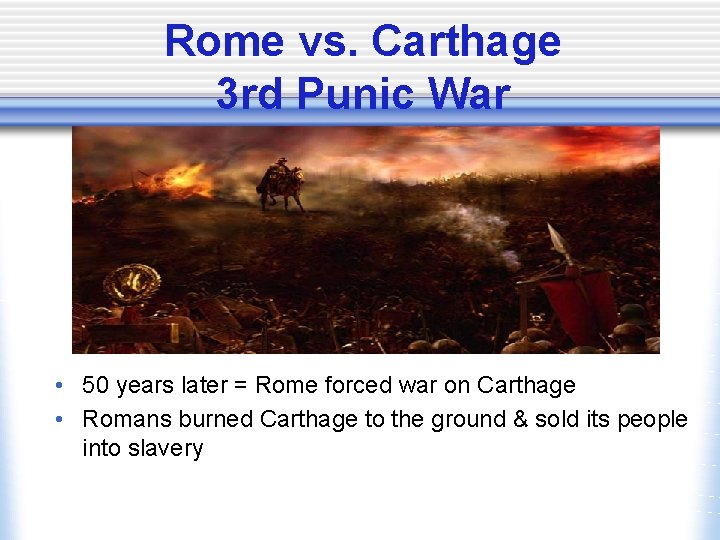
Rome vs. Carthage 3 rd Punic War • 50 years later = Rome forced war on Carthage • Romans burned Carthage to the ground & sold its people into slavery
The Republic in Crisis • Rome controlled all of the Mediterranean • Growing social discontent w Corrupt Roman officials created large estates by stealing land from poor farmers & using a profitable agriculture business to get rich w Roman officials used captives & prisoners of war as slaves on the estates w Conquered people lost their land couldn’t find jobs
The Republic in Crisis: Slave Revolts • One major revolt led by slave named Spartacus --> Romans finally crushed the uprising, killing about 6, 000 revolters
The Republic in Crisis: Possible Solution? • Gracchus Brothers (both consuls) proposed distributing land to the poor -- but they were both murdered
The Republic in Crisis: Solution that Worked • Army leaders came to rule Rome w Formed separate armies that fought each other for power w Julius Caesar used this practice of using the army to get political power
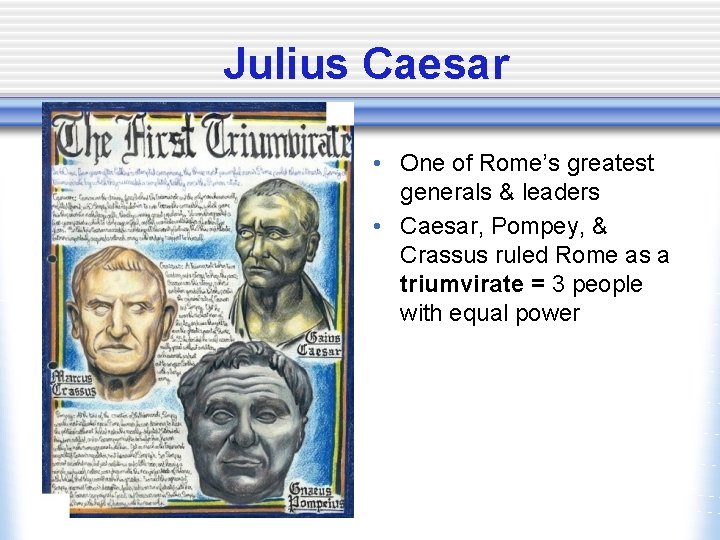
Julius Caesar • One of Rome’s greatest generals & leaders • Caesar, Pompey, & Crassus ruled Rome as a triumvirate = 3 people with equal power
Julius Caesar • Caesar conquered the Celts, fought Germanic tribes & invaded Britain w Seen as a military hero w This helped him advance his political career • Was feared by senators
Julius Caesar • Took over complete control of Rome & became dictator for life w Granted Roman citizenship to people in areas outside of Italy w Provided jobs for the unemployed w Created a new calendar (Julian calendar)
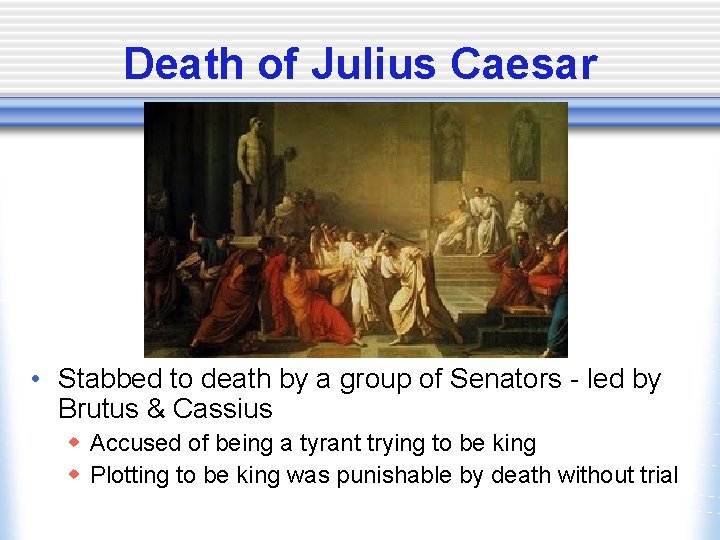
Death of Julius Caesar • Stabbed to death by a group of Senators - led by Brutus & Cassius w Accused of being a tyrant trying to be king w Plotting to be king was punishable by death without trial
End of the Republic • Caesar’s successors (Octavian, Marc Antony, Marcus Lepidus) divided the Roman world among themselves • Octavian forced the other 2 out -- would become the 1 st ruler of the Roman Empire
The First Emperors • Roman Republic = too weak to maintain control • Octavian = believed Rome needed ONE strong ruler
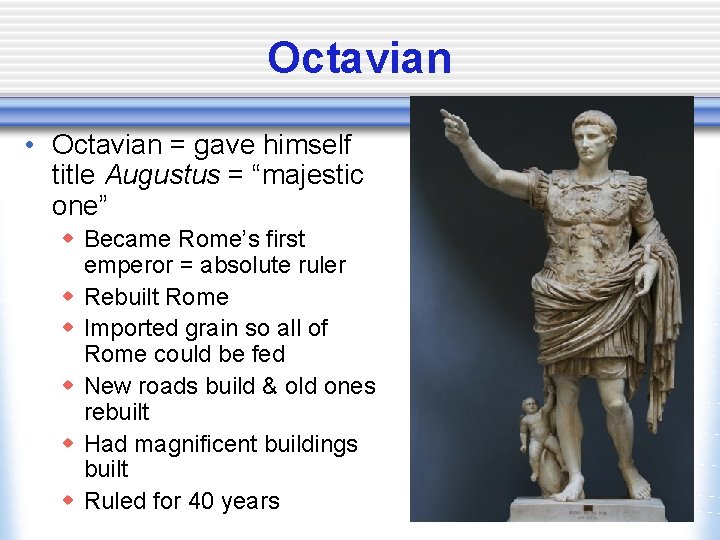
Octavian • Octavian = gave himself title Augustus = “majestic one” w Became Rome’s first emperor = absolute ruler w Rebuilt Rome w Imported grain so all of Rome could be fed w New roads build & old ones rebuilt w Had magnificent buildings built w Ruled for 40 years
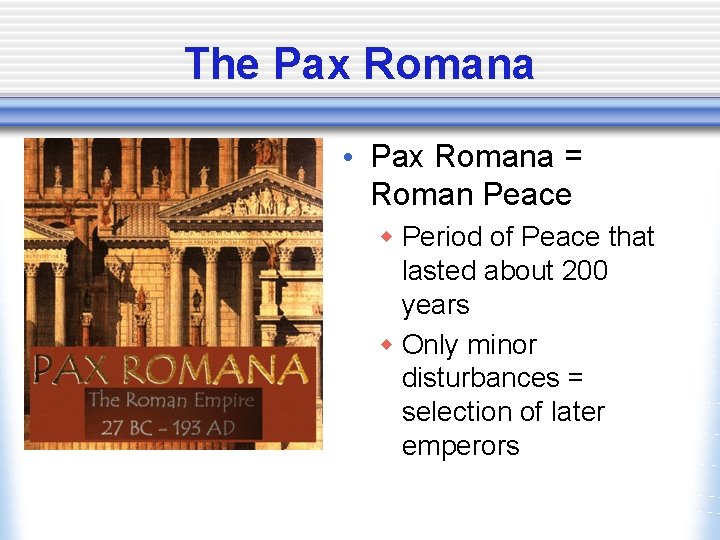
The Pax Romana • Pax Romana = Roman Peace w Period of Peace that lasted about 200 years w Only minor disturbances = selection of later emperors
The First Emperors • Augustus was followed by the Julio. Claudian Emperors (4 of them) w All members of Augustus’s family w Poor leaders
The First Emperors • Tiberius Caesar = accused innocent people of treason
The First Emperors • Caligula Caesar = mentally disturbed & killed by a palace guard
The First Emperors • Claudius Caesar = very smart, but had trouble focusing on affairs of the state
The First Emperors • Nero Caesar = cruel & insane w Willing to bankrupt Rome to pay for his horse racing & music w Paranoid of traitors --> killed own wife, mother, & many senators w Sentenced to death for treason, but killed himself first
Good Emperors • Trajan = increased the empire to its greatest size • Marcus Aurelius = brought the empire to the height of its economic prosperity
Roman Rule • Emperors were also chief priests of the Roman religion • 2 separate sets of laws --> 1 for citizens & 1 for non-citizens w All laws stressed the state over the individual w Gave more legal rights (like you are innocent until proven guilty) • Emperors reduced the size of the army
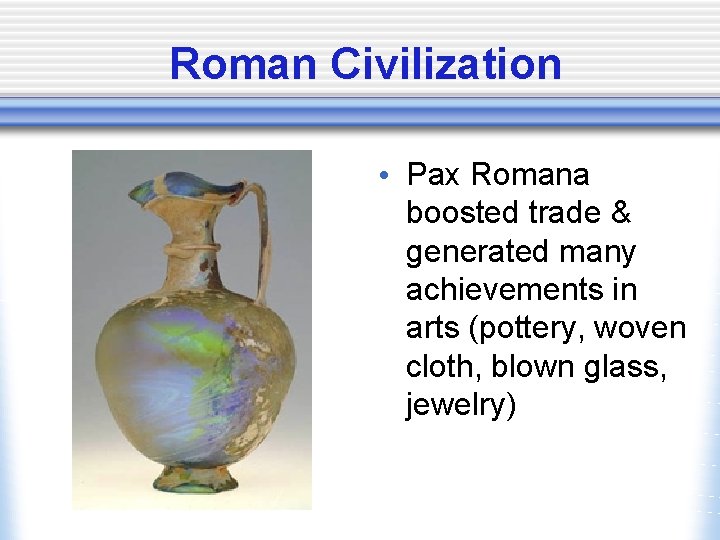
Roman Civilization • Pax Romana boosted trade & generated many achievements in arts (pottery, woven cloth, blown glass, jewelry)
Roman Civilization • Family became less significant w Had fewer children w Likely to divorce & remarry several times w Wives gained some legal rights
Roman Civilization • Wealthy class = owned large farms, ran factories, held public office w Lived in luxurious homes with marble & mosaic floors, running water, and baths
Roman Civilization • Most of Rome was still poor w Bathed in public baths, lived in apartment buildings that could easily collapse or catch fire w Didn’t rebel because they got free food & entertainment --> like chariot races and gladiator fights
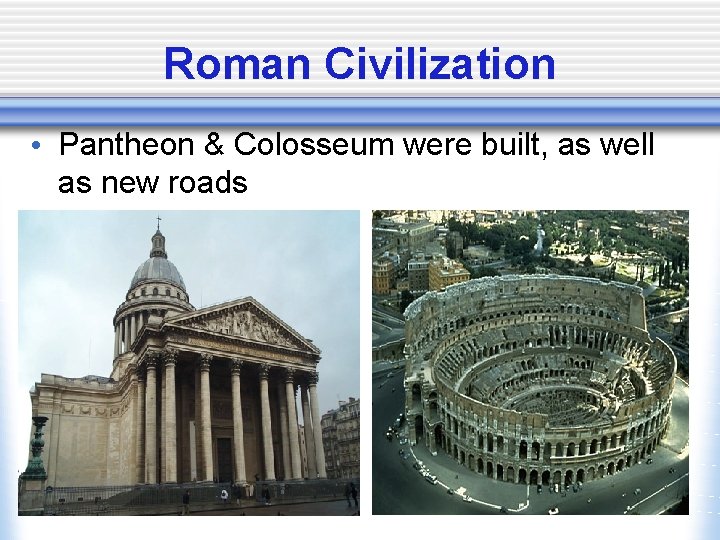
Roman Civilization • Pantheon & Colosseum were built, as well as new roads
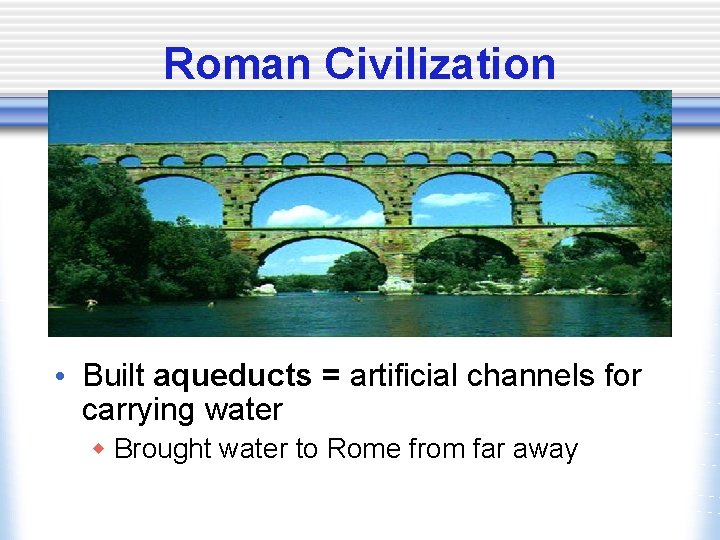
Roman Civilization • Built aqueducts = artificial channels for carrying water w Brought water to Rome from far away
Roman Education • Wealthy boys & girls received tutoring at home • Wealthy boys went on to academies • Wealthy girls continued studying at home & often learned as much as the men • Lower classes usually had at least a knowledge of reading, writing, & arithmetic
Roman Education • Latin = official language of Rome w Basis of Romance languages w Supplies the roots for over half of all English words
Roman Writers • Cicero = wrote beautiful speeches • Livy = historian of Rome • Virgil = wrote epic poems like Homer
The Empire’s Problems • Around 180 AD= Emperor Commodus bankrupted the treasury w Killed by his own troops • The next 28 emperors were installed by the army, only to be killed off
The Empire’s Problems • Armies fighting each other didn’t have time to defend the Empire’s borders against attack • Warfare disrupted production & trade, as well as farmland
The Empire’s Problems • Government minted more coins to cope with economic problems w Caused inflation = a rise in prices & a decrease in the value of money w Higher taxes = only way to pay for soldiers needed in war w Taxing landowners caused them to abandon land --> this meant less crops & food shortage
Unsuccessful Reforms • Diocletian = increased the number of men in the army w Divided the Empire into 2 units § He ruled the east, another ruled the west w His economic reforms failed
Unsuccessful Reforms • Constantine w Tried to stabilize the Empire after civil wars w Made it legal for landowners to chain workers so they didn’t leave w Made most jobs hereditary w Moved the capital in the east & called in Constantinople
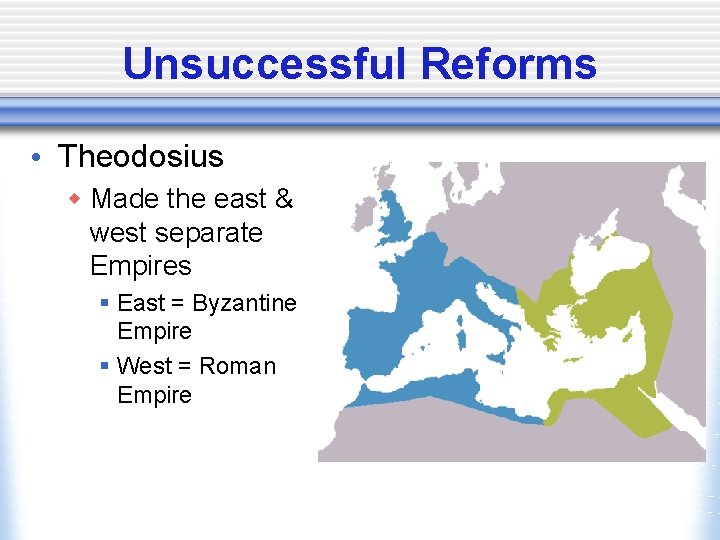
Unsuccessful Reforms • Theodosius w Made the east & west separate Empires § East = Byzantine Empire § West = Roman Empire
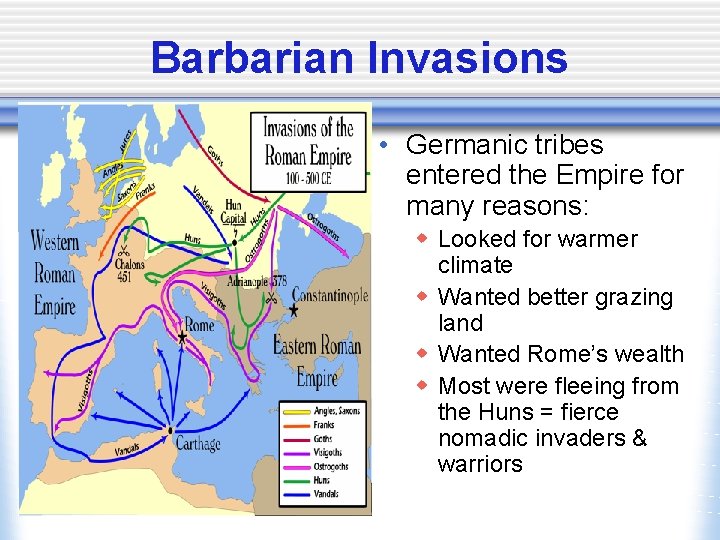
Barbarian Invasions • Germanic tribes entered the Empire for many reasons: w Looked for warmer climate w Wanted better grazing land w Wanted Rome’s wealth w Most were fleeing from the Huns = fierce nomadic invaders & warriors
Warrior Groups • Warrior group = warriors, their families, and a chief • Poor compared to Romans • Many different warrior groups --> only thing they had in common was Germanic language • Romans considered these tribes barbarians & thought of their language as weird babbling & sounds • The Visigoths = captured & sacked Rome • The Huns (led by Attila the Hun) = plundered cities in Italy
End of the Western Empire • Germanic tribes (Vandals, Franks, Goths, etc. ) took over the Empire • Overthrew the emperor • Western Roman Empire ended in the late 400 s w Some Roman culture remained w Germanic rulers accepted: Latin language, Roman laws, and Christian Church
- Slides: 59