
Ancient Rome and the Roman Republic Geography Located
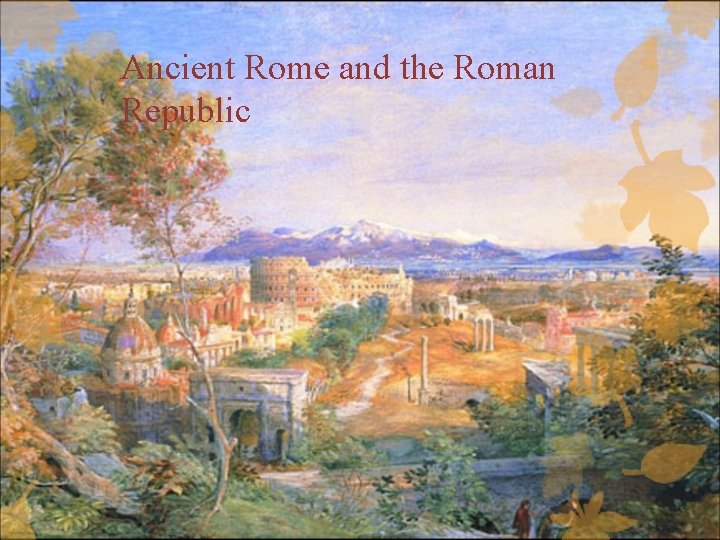
Ancient Rome and the Roman Republic
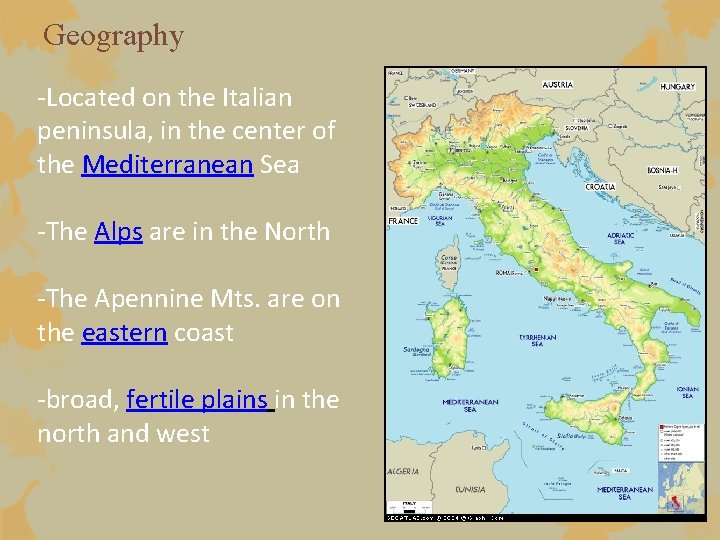
Geography -Located on the Italian peninsula, in the center of the Mediterranean Sea -The Alps are in the North -The Apennine Mts. are on the eastern coast -broad, fertile plains in the north and west
Early Civilization -Italy was originally occupied by many different groups of people -Two main groups were Greek colonists and the Etruscans -The Etruscans ruled much of central Italy and Rome itself -Ancestors of the Romans, the Latins, settled in the area that is now Rome around 800 B. C.
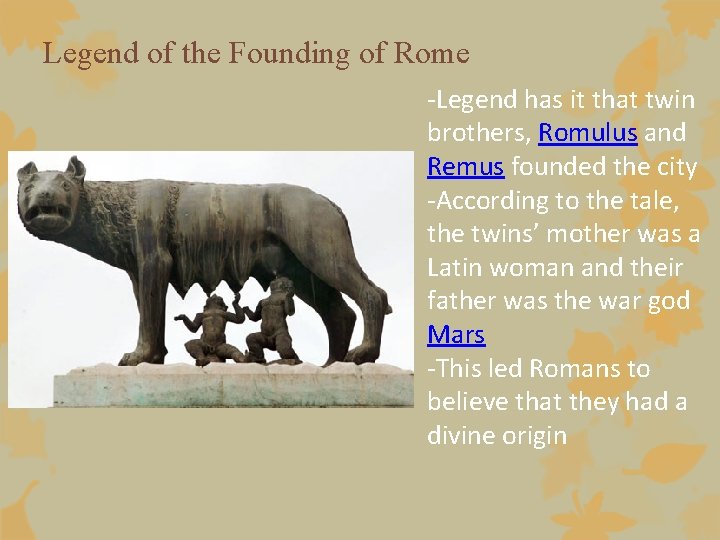
Legend of the Founding of Rome -Legend has it that twin brothers, Romulus and Remus founded the city -According to the tale, the twins’ mother was a Latin woman and their father was the war god Mars -This led Romans to believe that they had a divine origin
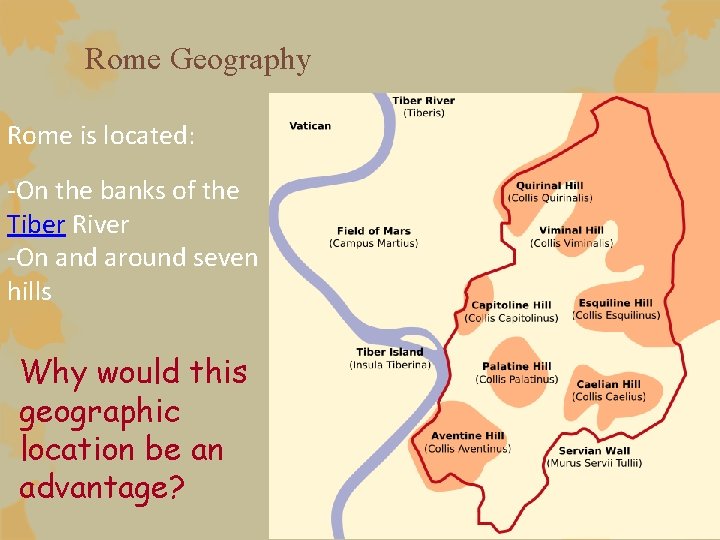
Rome Geography Rome is located: -On the banks of the Tiber River -On and around seven hills Why would this geographic location be an advantage?
Politics - 509 B. C. Rome is Founded -Romans drove out their Etruscan ruler and established a republic - They did not want one person to have all the power
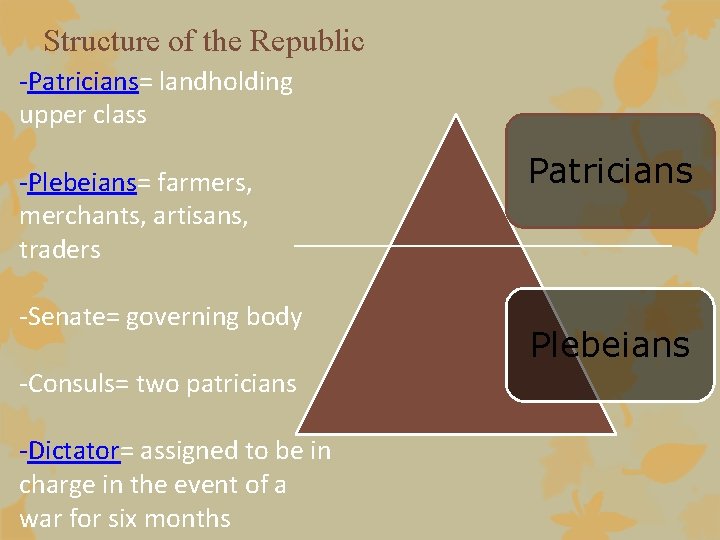
Structure of the Republic -Patricians= landholding upper class -Plebeians= farmers, merchants, artisans, traders -Senate= governing body -Consuls= two patricians -Dictator= assigned to be in charge in the event of a war for six months Patricians Plebeians
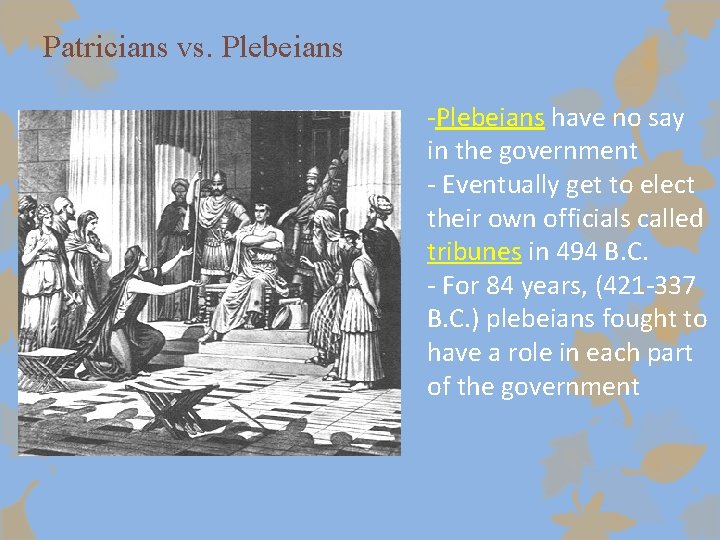
Patricians vs. Plebeians -Plebeians have no say in the government - Eventually get to elect their own officials called tribunes in 494 B. C. - For 84 years, (421 -337 B. C. ) plebeians fought to have a role in each part of the government
Social Structures -A man was the head of the household and his wife and children did not question his authority -Over centuries, women received more rights. These included: -Owning property -Running businesses -All children were taught to learn to read and write -Wealthy had private tutors for their children
Religion -Romans were polytheistic-they believed in many gods and goddesses -Many of the gods were adapted from the Greek gods Greek God Roman God Zeus-ruler of all gods Jupiter-ruler of all gods Hera-wife of Zeus, protected marriage Juno-wife of Jupiter, protected marriage Poseidon-god of the sea Neptune-god of the sea -Roman calendar is full of feasts and celebrations to honor the gods and goddesses -Temples for worship to ask for divine assistance
Politics -Rome grows strong and begins conquering the rest of Italy -By 270 B. C. , Rome controls most of the Italian peninsula -Military is made up of citizens -Rome conquered justly- allowing those conquered to keep their culture, customs, and government- as long as they supplied soldiers, paid taxes, and acknowledge Roman leadership
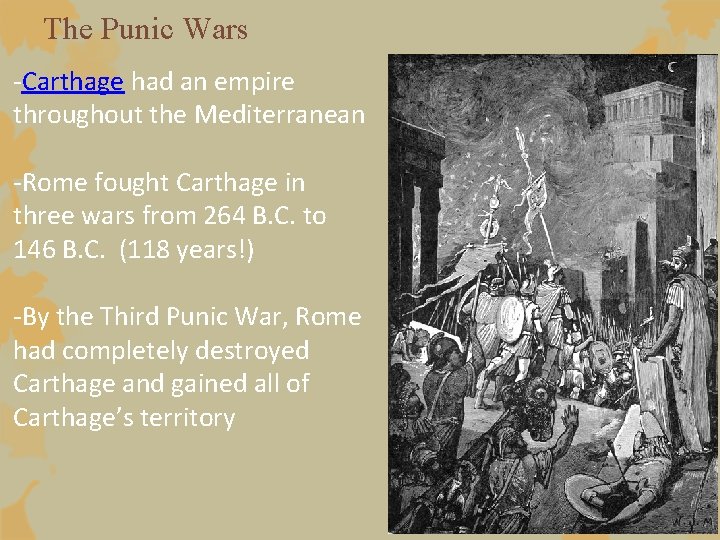
The Punic Wars -Carthage had an empire throughout the Mediterranean -Rome fought Carthage in three wars from 264 B. C. to 146 B. C. (118 years!) -By the Third Punic War, Rome had completely destroyed Carthage and gained all of Carthage’s territory

Economics -Conquests brought much wealth to Rome -Wealthy families bought huge estates called latifundia. -Romans forced the people they conquered to work as slaves on the latifundia -Slave labor hurt the small farmers because it cost them more to produce food, and the price was driven down by the immense quantities coming into Rome -Farmers fell into debt, sold their land, and moved to the city looking for work -gap between rich and poor widens=riots and chaos
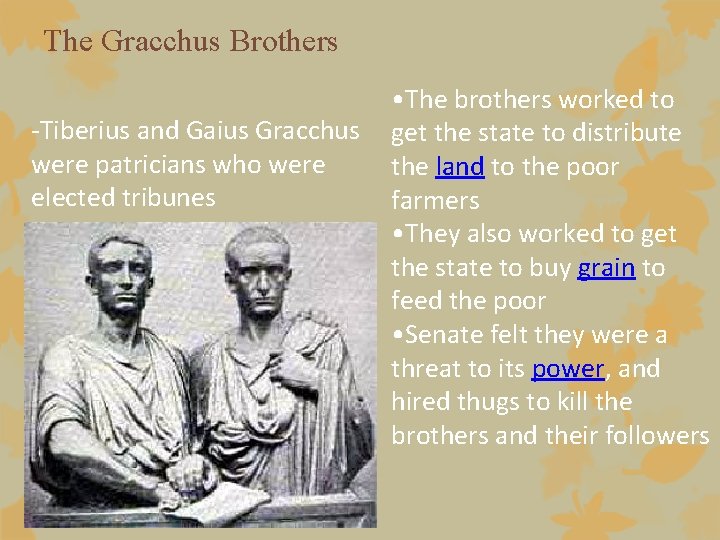
The Gracchus Brothers -Tiberius and Gaius Gracchus were patricians who were elected tribunes • The brothers worked to get the state to distribute the land to the poor farmers • They also worked to get the state to buy grain to feed the poor • Senate felt they were a threat to its power, and hired thugs to kill the brothers and their followers
Republic to Empire -Civil wars break out to decide who should hold power. The senate wanted to keep the status quo; political leaders wanted to weaken the senate and enact reforms -Slave uprisings throughout the republic -Armies became loyal to their commanders because they gave them benefits such as captured land
Rome Vocabulary 1. Alps: Mountain range in northern Italy. 2. Republic: State in which the supreme power rests in the body of citizens entitled to vote and is exercised by representatives chosen directly or indirectly by them. 3. Patricians: A person of noble or high rank. 4. Plebeians: A member of the common people. 5. Tribune: A person who upholds or defends the rights of the people. 6. Polytheistic: Belief in many gods 7. Dictator: An official who had all the powers of a king but could only hold office for 6 months. 8. Etruscans: Ancient people who lived in the area which is now Rome. 9. Epistle: A letter 10. Disciple: A follower of a person or a belief. Vocab work: Choose two vocabulary assignments to do: Sentences, story, crossword, or pictures.
- Slides: 16