
Ancient Rome and the Rise of Christianity Rome
- Slides: 64
Ancient Rome and the Rise of Christianity
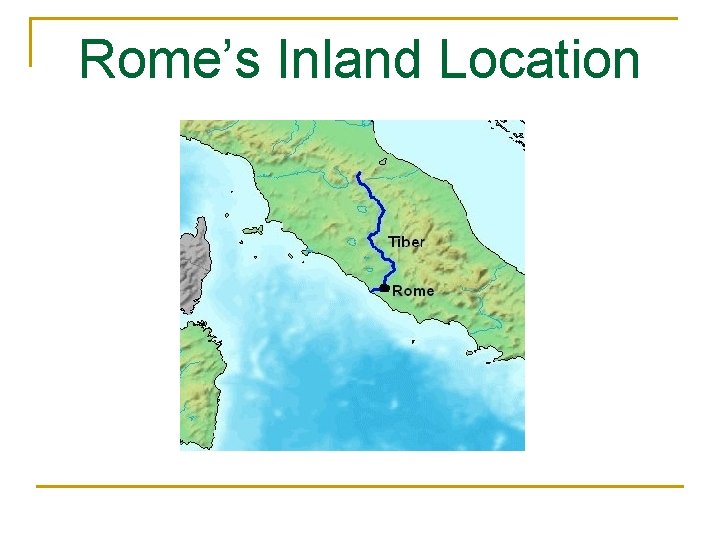
Rome Takes Shape Geographic Advantages of Italy and Rome Peninsula offered water protection on three sides, Alps provided protection to the north. • • Central location in the midst of the Mediterranean • Rome had inland protection but sea access via the Tiber River • Rome was founded on 7 hills connected with bridges which could be raised in times of threat or invasion. • Less rugged mountains and more broad fertile plains than Greece, so – more land upon which to farm
Rome’s Inland Location
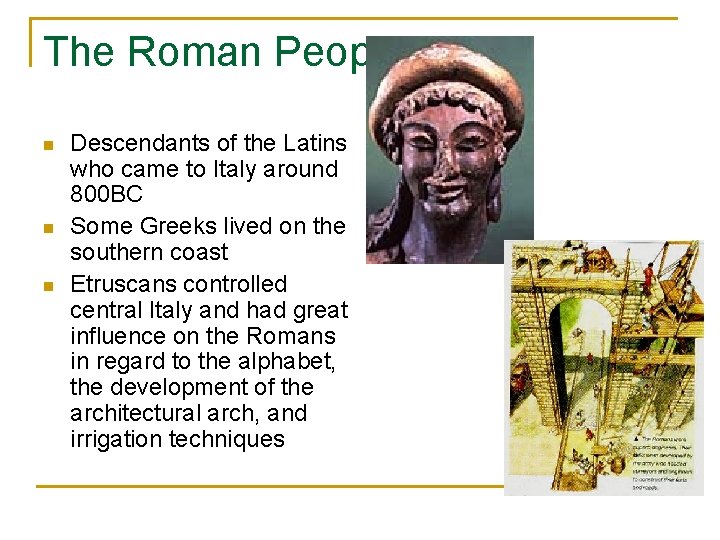
The Roman People n n n Descendants of the Latins who came to Italy around 800 BC Some Greeks lived on the southern coast Etruscans controlled central Italy and had great influence on the Romans in regard to the alphabet, the development of the architectural arch, and irrigation techniques
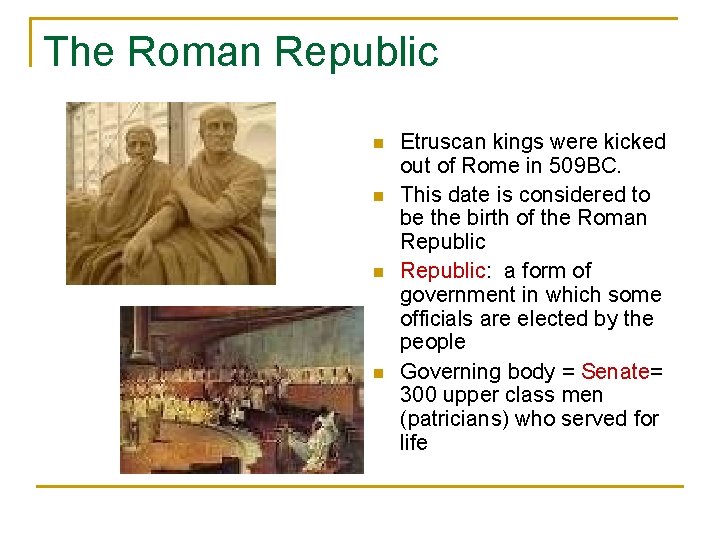
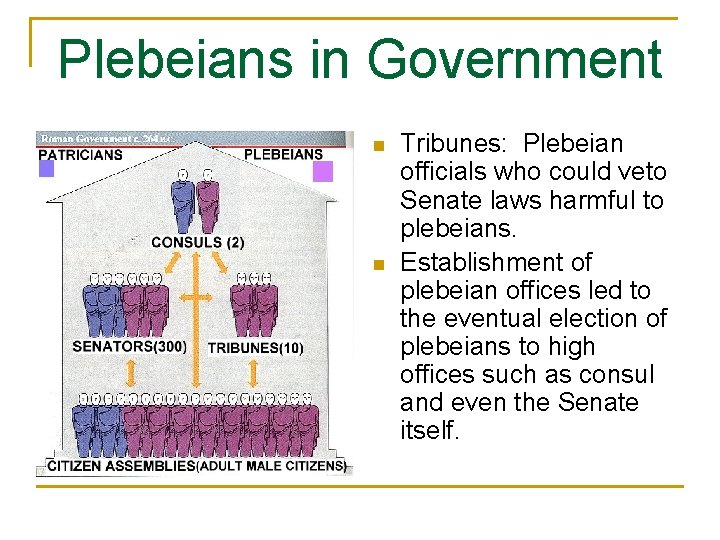
The Roman Republic n n Etruscan kings were kicked out of Rome in 509 BC. This date is considered to be the birth of the Roman Republic: a form of government in which some officials are elected by the people Governing body = Senate= 300 upper class men (patricians) who served for life
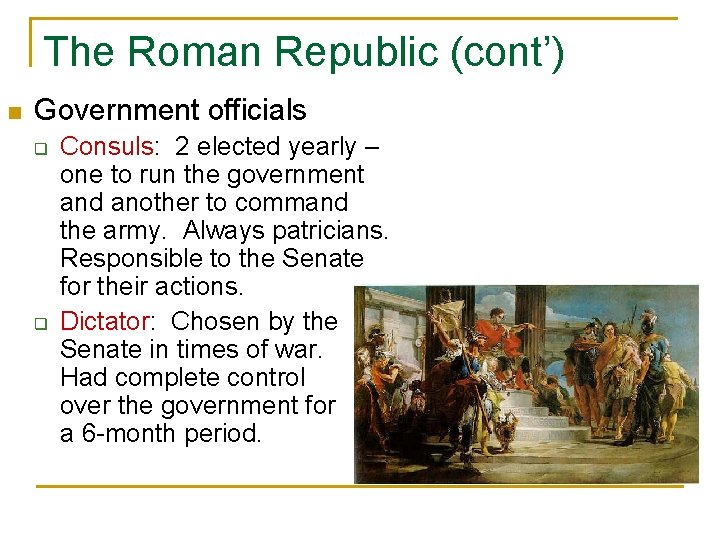
The Roman Republic (cont’) n Government officials q q Consuls: 2 elected yearly – one to run the government and another to command the army. Always patricians. Responsible to the Senate for their actions. Dictator: Chosen by the Senate in times of war. Had complete control over the government for a 6 -month period.
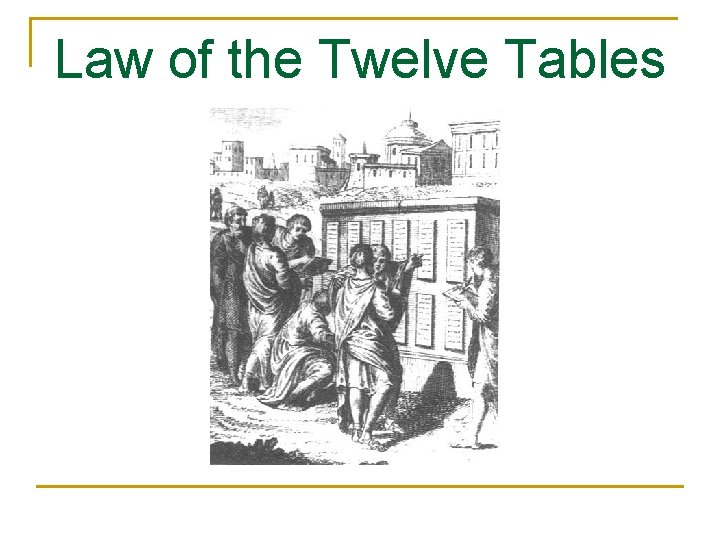
Plebeians Gain Rights n n Plebeians: the vast majority of Roman population - farmers, merchants, artisans, traders. Very little influence in government until 450 BC – Laws of the Twelve Tables – all laws of Rome written on tablets and posted on tables in the Forum. Made it possible for plebeians to know the laws and defend themselves.
Law of the Twelve Tables
Plebeians in Government n n Tribunes: Plebeian officials who could veto Senate laws harmful to plebeians. Establishment of plebeian offices led to the eventual election of plebeians to high offices such as consul and even the Senate itself.
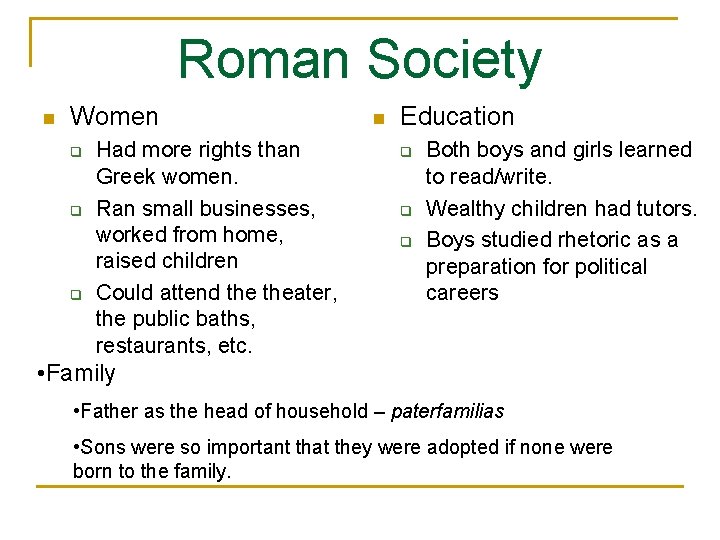
Roman Society n Women q q q Had more rights than Greek women. Ran small businesses, worked from home, raised children Could attend theater, the public baths, restaurants, etc. n Education q q q Both boys and girls learned to read/write. Wealthy children had tutors. Boys studied rhetoric as a preparation for political careers • Family • Father as the head of household – paterfamilias • Sons were so important that they were adopted if none were born to the family.
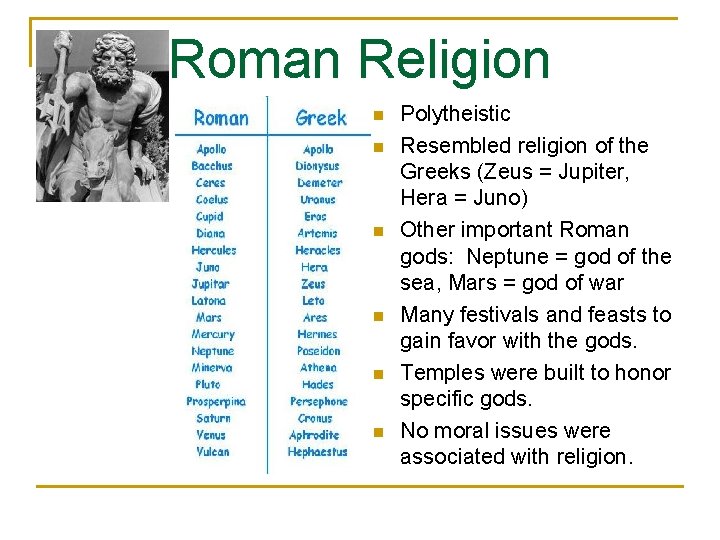
Roman Religion n n n Polytheistic Resembled religion of the Greeks (Zeus = Jupiter, Hera = Juno) Other important Roman gods: Neptune = god of the sea, Mars = god of war Many festivals and feasts to gain favor with the gods. Temples were built to honor specific gods. No moral issues were associated with religion.
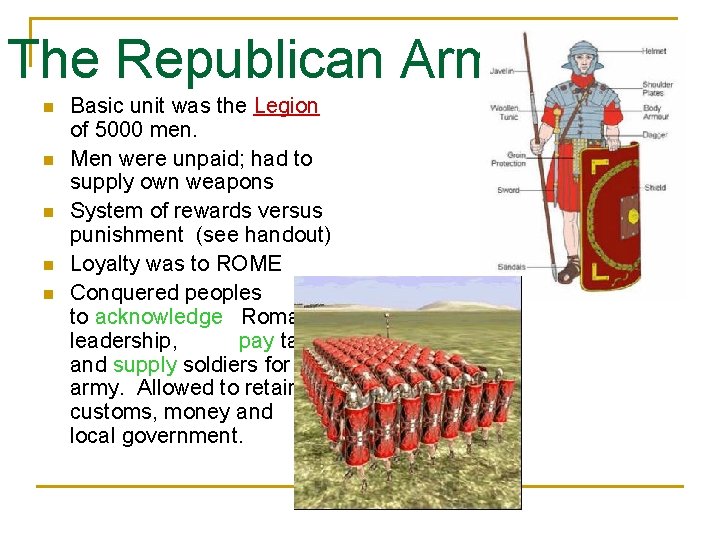
The Republican Army n n n Basic unit was the Legion of 5000 men. Men were unpaid; had to supply own weapons System of rewards versus punishment (see handout) Loyalty was to ROME Conquered peoples had to acknowledge Roman leadership, pay taxes and supply soldiers for the army. Allowed to retain own customs, money and local government.
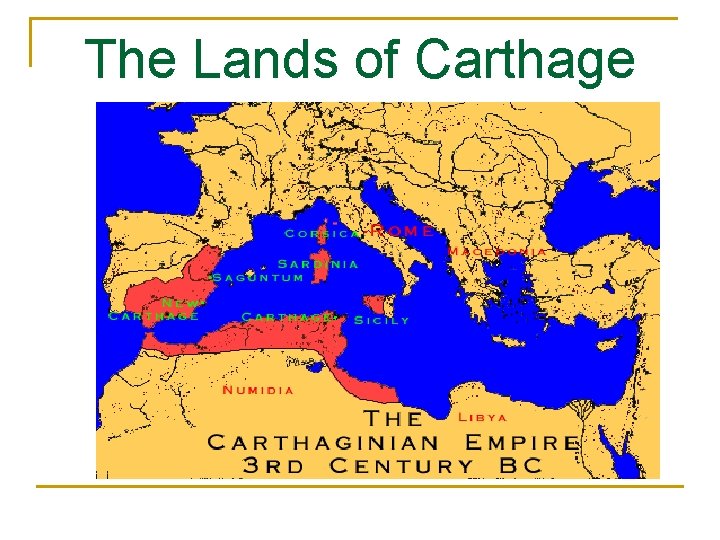
Republic to Empire n The Punic Wars q q As Rome expanded, it came into conflict with other Mediterranean civilizations. Carthage controlled North Africa, Southern Spain, Sardinia, Corsica and part of Sicily. War erupted in 264 BC between Rome and Carthage when Rome began seeking trade routes in Carthage’s portion of Sicily. Rome defeated Carthage in 241 BC and gained control of Sicily, Corsica and Sardinia.
The Lands of Carthage
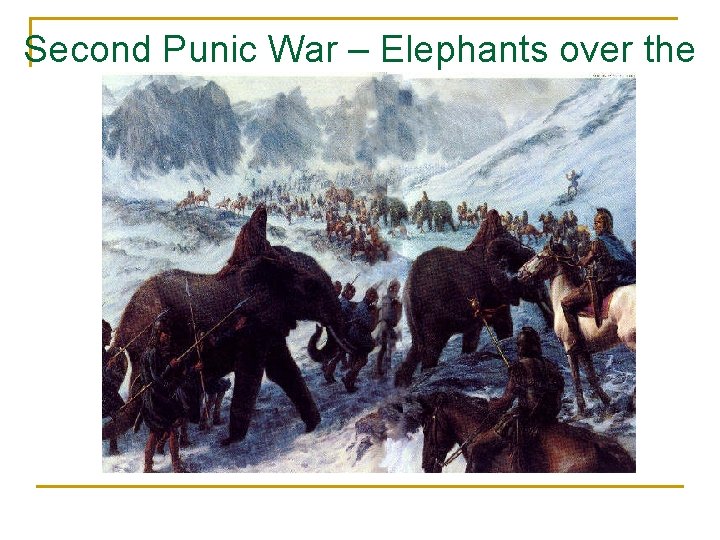
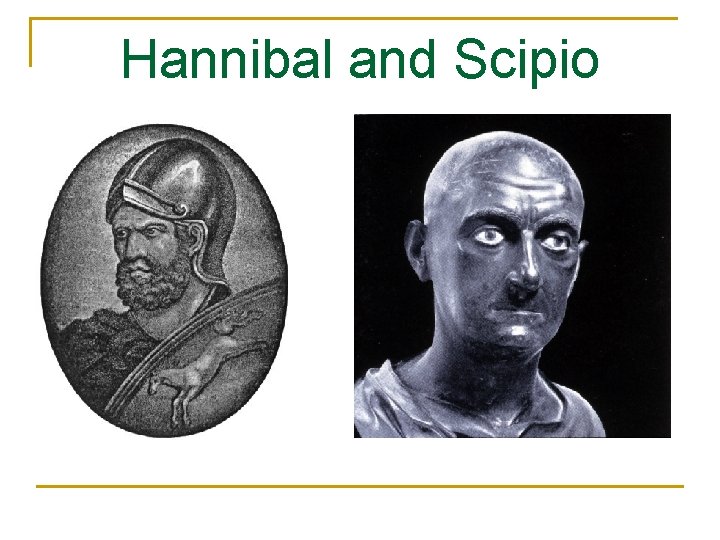
The Punic Wars (cont’) n n n n In 218 BC, Carthage sought revenge against Rome and the Second Punic War began. Carthage was led by the great general Hannibal decided to attack Rome from the north instead of the expected water attack from the south. Hannibal and his army attacked the Romans in northern Italy for 15 years, inflicting heavy losses to the Roman Army ( killed or captured +/- 60, 000 Romans alone at the Battle of Cannae) but never took the city of Rome itself. He was lured back to Carthage when Rome attacked it in 202 BC. The final battle of the Second Punic War was on the Plains of Zama, where Carthage’s losses were as high as 40, 000 men versus only 2500 for Rome. Hannibal fled and later committed suicide. Carthage lost all its lands except those in North Africa.
Second Punic War – Elephants over the Alps
Hannibal and Scipio
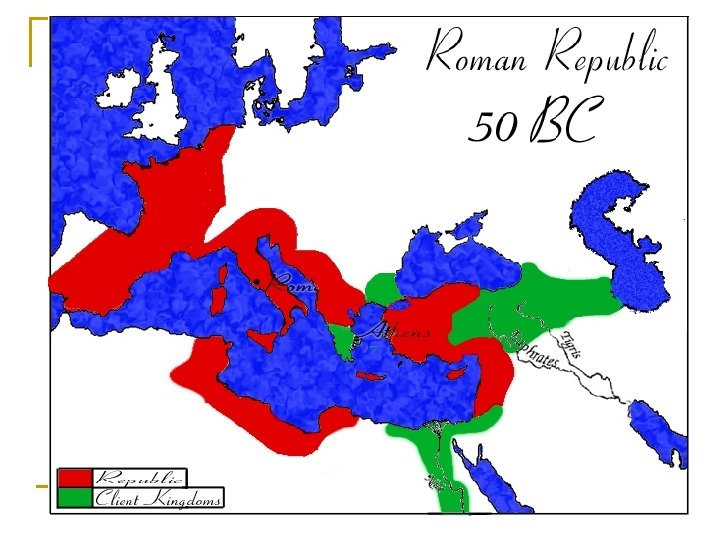
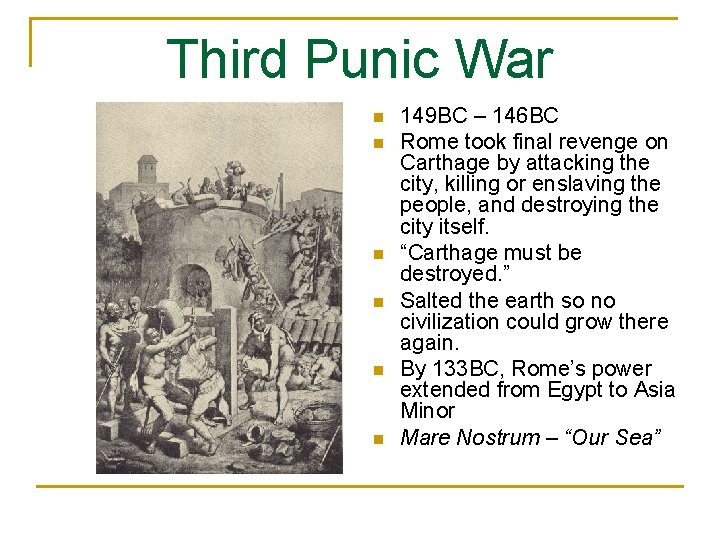
Third Punic War n n n 149 BC – 146 BC Rome took final revenge on Carthage by attacking the city, killing or enslaving the people, and destroying the city itself. “Carthage must be destroyed. ” Salted the earth so no civilization could grow there again. By 133 BC, Rome’s power extended from Egypt to Asia Minor Mare Nostrum – “Our Sea”
Social and Economic Effects of Expansion n n Riches New wealthy class of Romans Latifundia – huge estates purchased by the wealthy Small farmers could not compete with the latifundia and lost their lands n n n Homeless flocked to Rome Huge gap between rich and poor Corruption
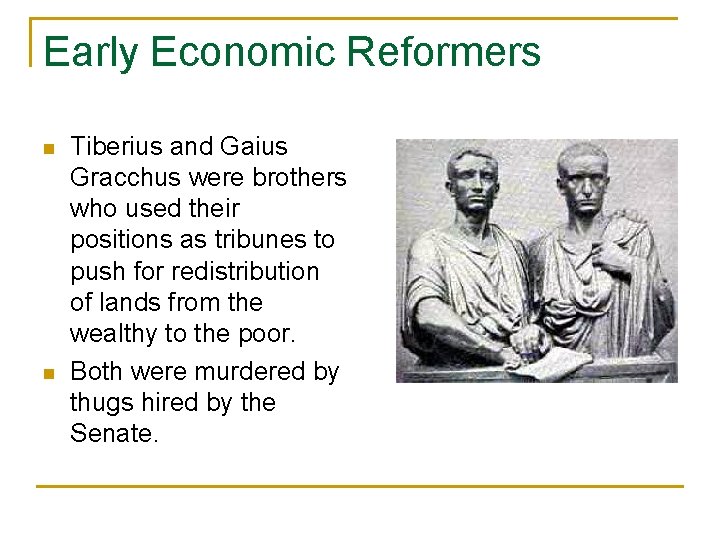
Early Economic Reformers n n Tiberius and Gaius Gracchus were brothers who used their positions as tribunes to push for redistribution of lands from the wealthy to the poor. Both were murdered by thugs hired by the Senate.
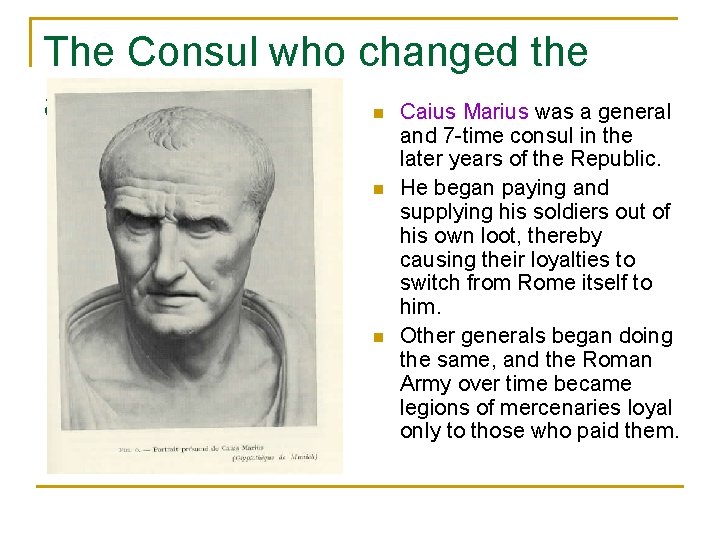
The Consul who changed the army Caius Marius was a general n n n and 7 -time consul in the later years of the Republic. He began paying and supplying his soldiers out of his own loot, thereby causing their loyalties to switch from Rome itself to him. Other generals began doing the same, and the Roman Army over time became legions of mercenaries loyal only to those who paid them.
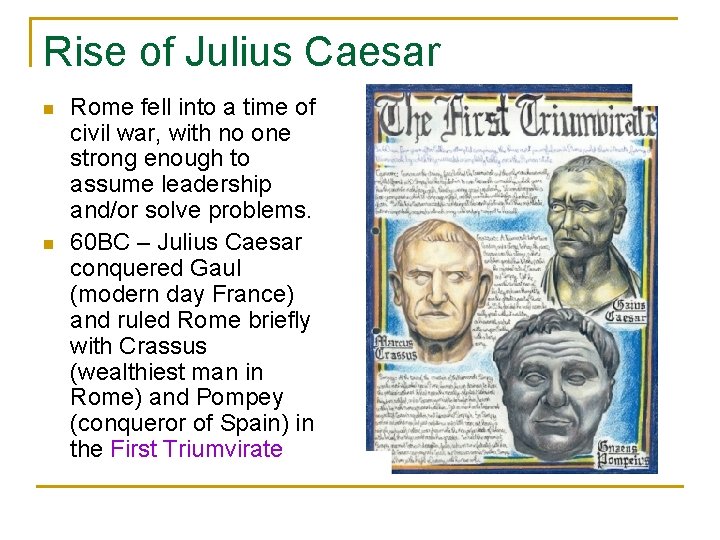
Rise of Julius Caesar n n Rome fell into a time of civil war, with no one strong enough to assume leadership and/or solve problems. 60 BC – Julius Caesar conquered Gaul (modern day France) and ruled Rome briefly with Crassus (wealthiest man in Rome) and Pompey (conqueror of Spain) in the First Triumvirate
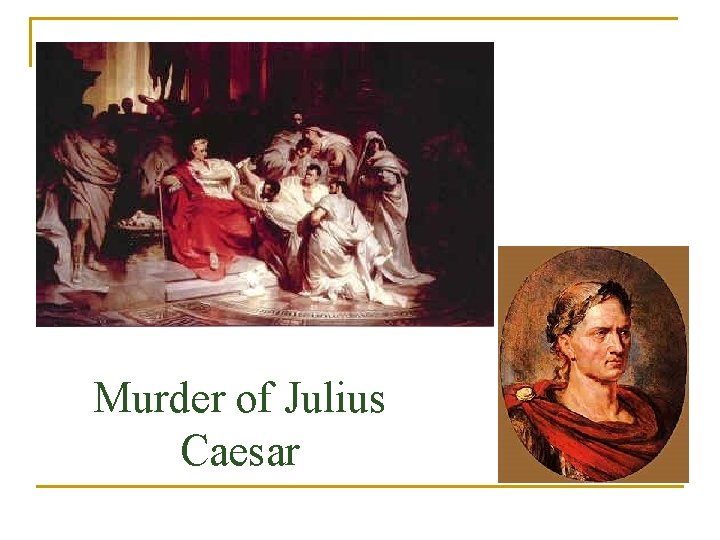
Julius Caesar (cont’) n n The Senate became convinced that Julius Caesar was becoming too powerful and threw support behind Pompey. (Crassus had died in battle in 53 BC. ) Caesar was ordered back to Rome, but with orders to leave his army behind. 49 BC -Caesar returned to Rome WITH his army and thus engaged Pompey in civil war. “Crossing the Rubicon” "alea iacta est - The die is cast" Caesar was victorious and ruled Rome as an absolute ruler until 44 BC when he was murdered by the Senate.
Murder of Julius Caesar
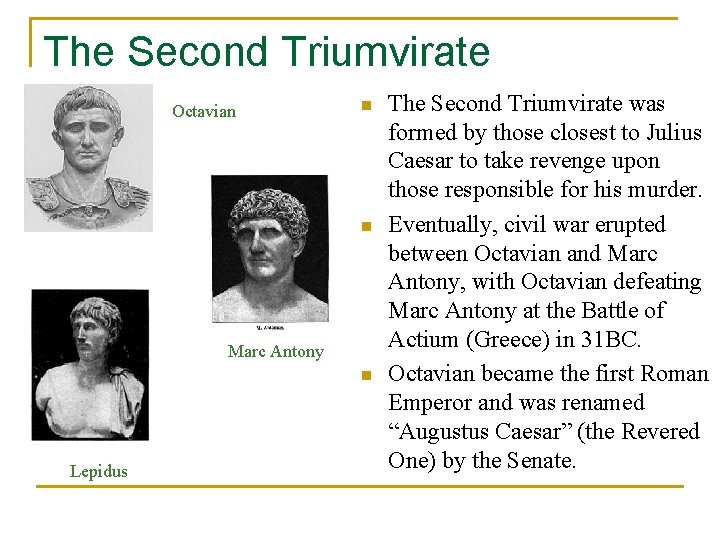
The Second Triumvirate Octavian n n Marc Antony n Lepidus The Second Triumvirate was formed by those closest to Julius Caesar to take revenge upon those responsible for his murder. Eventually, civil war erupted between Octavian and Marc Antony, with Octavian defeating Marc Antony at the Battle of Actium (Greece) in 31 BC. Octavian became the first Roman Emperor and was renamed “Augustus Caesar” (the Revered One) by the Senate.
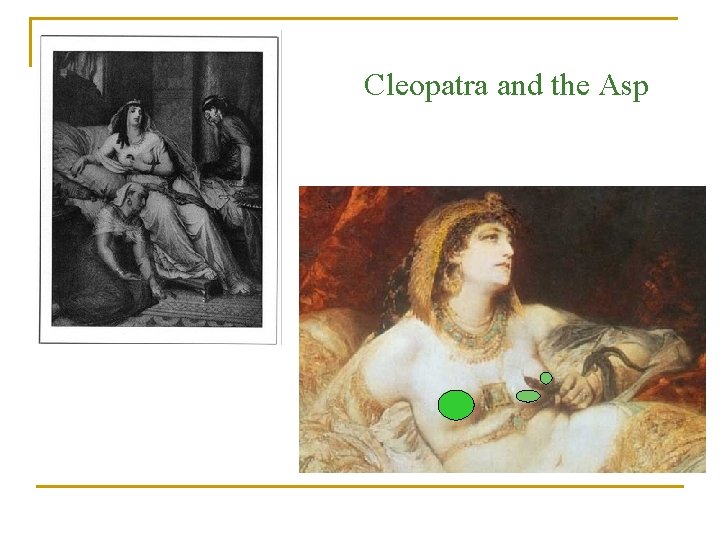
Cleopatra and the Asp
Augustus’ Reign n n n 31 BC-14 AD Created a civil service to enforce laws Opened government jobs to those with ability, not class Allowed self-government to cities and provinces Conducted the first census Created the first postal service Created public works departments such as police, fire brigades, etc.
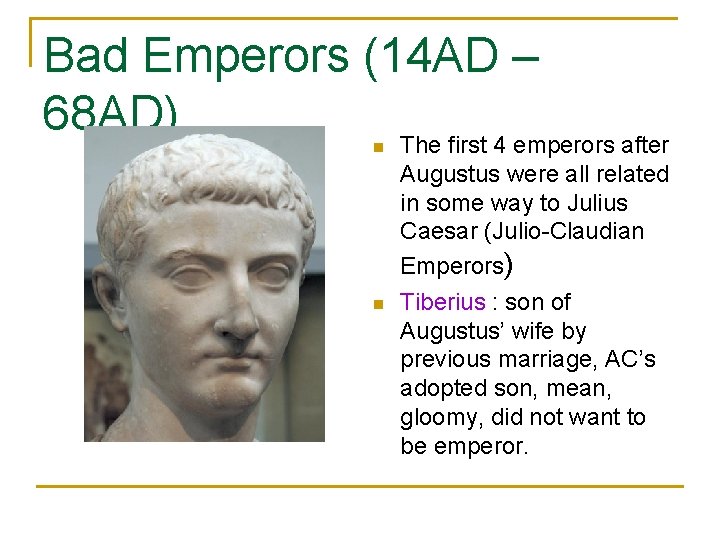
Bad Emperors (14 AD – 68 AD) The first 4 emperors after n n Augustus were all related in some way to Julius Caesar (Julio-Claudian Emperors) Tiberius : son of Augustus’ wife by previous marriage, AC’s adopted son, mean, gloomy, did not want to be emperor.
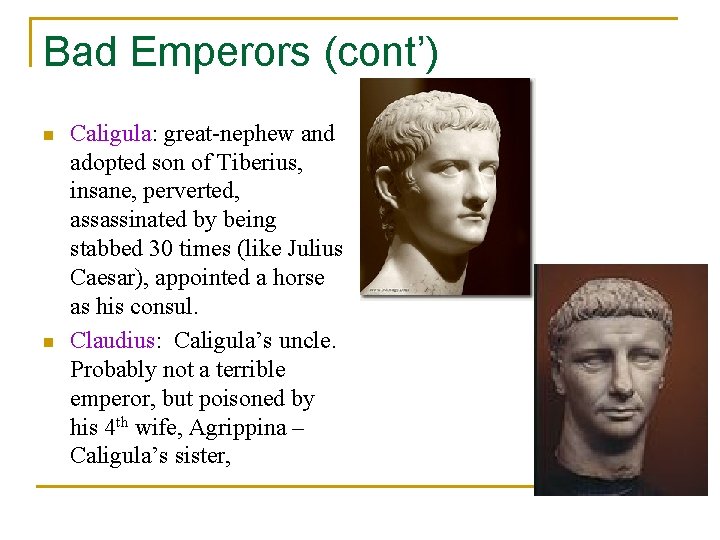
Bad Emperors (cont’) n n Caligula: great-nephew and adopted son of Tiberius, insane, perverted, assassinated by being stabbed 30 times (like Julius Caesar), appointed a horse as his consul. Claudius: Caligula’s uncle. Probably not a terrible emperor, but poisoned by his 4 th wife, Agrippina – Caligula’s sister,
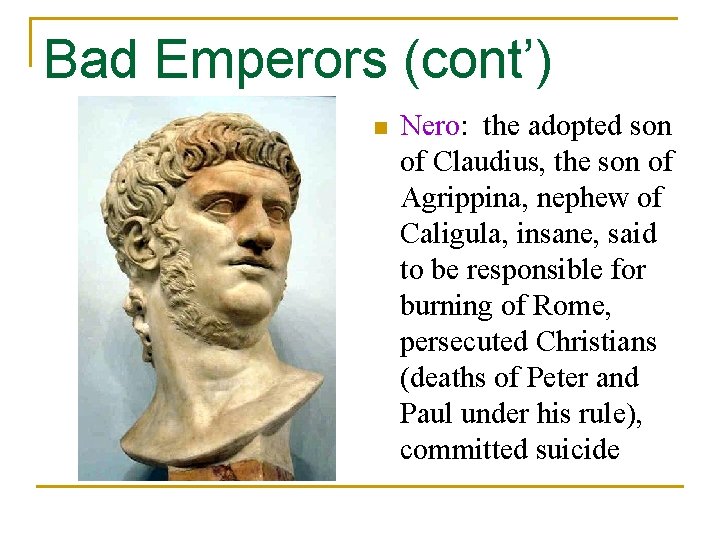
Bad Emperors (cont’) n Nero: the adopted son of Claudius, the son of Agrippina, nephew of Caligula, insane, said to be responsible for burning of Rome, persecuted Christians (deaths of Peter and Paul under his rule), committed suicide
Emperors between Bad and Good 68 AD-96 AD Emps Galba – mean, cruel, had a growth on his left side which he held in with a n n n n woman’s corset, had arthritis, was wealthy, murdered Otho – a friend of Nero until his wife had an affair with Nero, ruled 3 months, committed suicide after losing a battle in Germany Vitellius – was educated but had no military training, was a glutton for food but then was bulemic, was tortured, killed and thrown in a river Vespasian – was bad, but had a mild temper and a sense of justice, died in power Titus – Vespasian’s son, the Coliseum was completed during his reign, was strong, pot-bellied and short, an excellent rider and warrior, Mt. Vesuvius erupted during his reign and tarnished his image as ruler, had a short reign Domitian – Titus’ brother, bad guy, a nasty person, arrogant and cruel, tall with bad eyesight, power-hungry, heavily taxed the Jews, was murdered
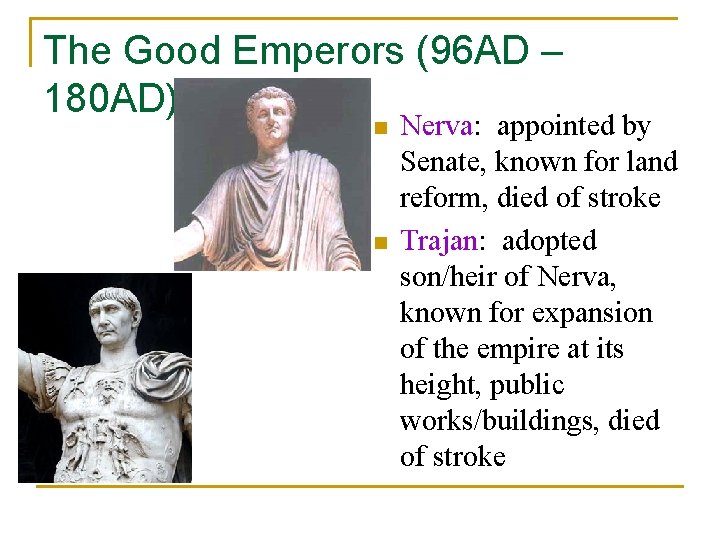
The Good Emperors (96 AD – 180 AD) n n Nerva: appointed by Senate, known for land reform, died of stroke Trajan: adopted son/heir of Nerva, known for expansion of the empire at its height, public works/buildings, died of stroke
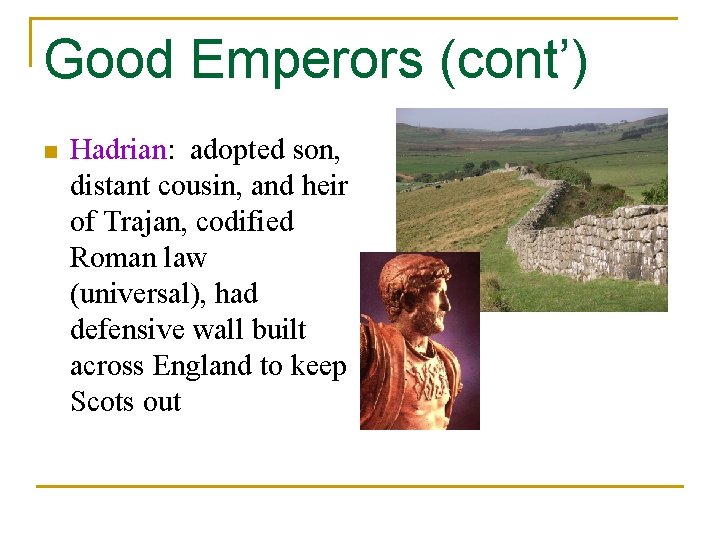
Good Emperors (cont’) n Hadrian: adopted son, distant cousin, and heir of Trajan, codified Roman law (universal), had defensive wall built across England to keep Scots out
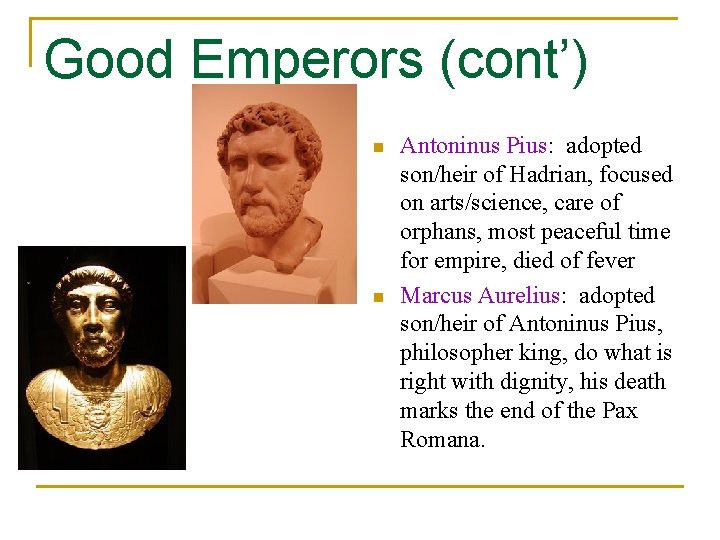
Good Emperors (cont’) n n Antoninus Pius: adopted son/heir of Hadrian, focused on arts/science, care of orphans, most peaceful time for empire, died of fever Marcus Aurelius: adopted son/heir of Antoninus Pius, philosopher king, do what is right with dignity, his death marks the end of the Pax Romana.
Pax Romana – Roman Peace Time period from Augustus Caesar to Marcus n n n Aurelius Time of peace, prosperity, order, security Because of little warfare, armies patrolled roads, protecting citizens and transport of goods from highway robbers Protection of the seas by the Roman navy Easy trade, abundant food supply Spread of cultures and peoples
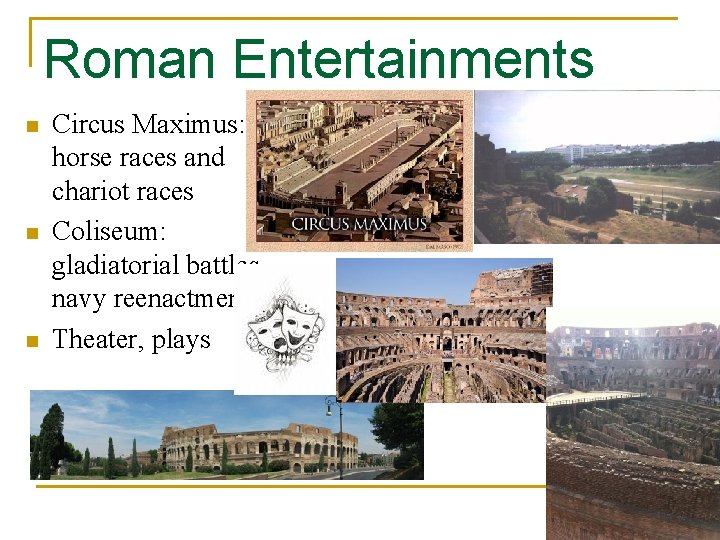
Roman Entertainments n n n Circus Maximus: horse races and chariot races Coliseum: gladiatorial battles, navy reenactments, Theater, plays
Roman Achievement Literary Figures n n Virgil : most distinguished poet of the age, Aeneid: All that a good Roman should be – pious, duty-bound, etc. Horace: Virgil’s friend, wrote The Satires, attacking human weaknesses with his wit. n Livy: most famous prose historian, wanted to restore patriotism and tradition to Rome, so researched and wrote The History of Rome 142 volumes, only 35 survive today, taught history in terms of moral lessons from Rome’s founding to 9 BC.
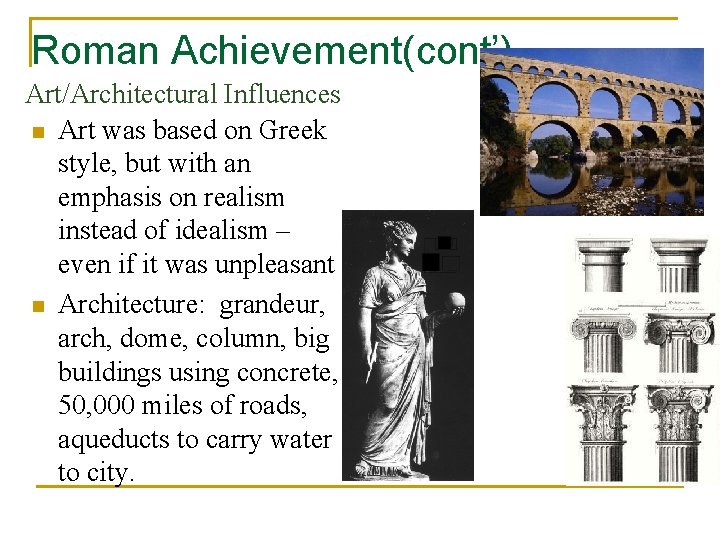
Roman Achievement(cont’) Art/Architectural Influences n Art was based on Greek style, but with an emphasis on realism instead of idealism – even if it was unpleasant n Architecture: grandeur, arch, dome, column, big buildings using concrete, 50, 000 miles of roads, aqueducts to carry water to city.
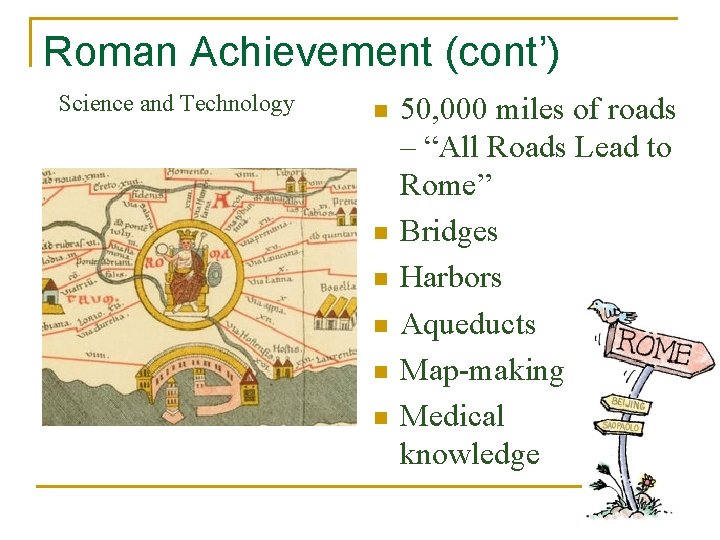
Roman Achievement (cont’) Science and Technology n n n 50, 000 miles of roads – “All Roads Lead to Rome” Bridges Harbors Aqueducts Map-making Medical knowledge
Roman Law – Unifying the Empire n n n Commitment to law and justice Fostering of unity and stability Merging of civil law (citizen law) and law of nations (international law) to create universal law n v v Basic principles of law became common innocent until proven guilty declaration of charges, offering defense fair and impartial judges
Rise of Christianity in the Roman Empire
Changes in Religion n n People wanted more spiritual fulfillment Hellenistic eastern religions flooded the western world Desire for more emotion People turned towards the “Mystery Religions” n Mystery Religions q q q Embraced secret rituals and special rewards Some offered equal status to both women and men Some offered the idea of life after death
Changes to Judaism by Hellenized Jews n Hellenized Jews had absorbed Greek customs and ideas into their form of Judaism n Concerned about weakening or diluting the Jewish religion, some in the Roman Empire began calling for more strict obedience to Jewish laws and traditions.
Jews Antagonize the Romans n Sadducees: priestly class of Jews who were cooperative with Rome. Disappeared after the Temple was destroyed. n Pharisees: academic class of Jews who believed that observing Jewish tradition would protect them from Roman influence. n Zealots: Radical Jews who called for a revolt against Rome and the creation of a new independent state for Jews in Jerusalem. q AD 66 –Zealots rebelled q AD 70 – Romans crushed the rebellion; destroyed Temple, leveled Jerusalem q Many Jews left Judea in fear.
Good News: the Gospels n n n Gospels: the first 4 books of the New Testament (Matthew, Mark, Luke, John) Tell the story of the life of Jesus Written between AD 40 -100
Good News –(cont’) n n The Apostles: 12 close followers of Jesus. Leader of the Apostles was Peter; also the founder of the Christian Church in Rome; the first Pope. n n The message: There is one God in three forms (Father, Son, Holy Spirit). Believe in Him and you shall receive spiritual salvation and eternal life (transformation of the inner person).
The Life of Jesus n n n Born around 4 BC in Bethlehem. A descendant of King David via Mary Grew up in Nazareth, a faithful Jew Worked as a carpenter Began preaching at age 30
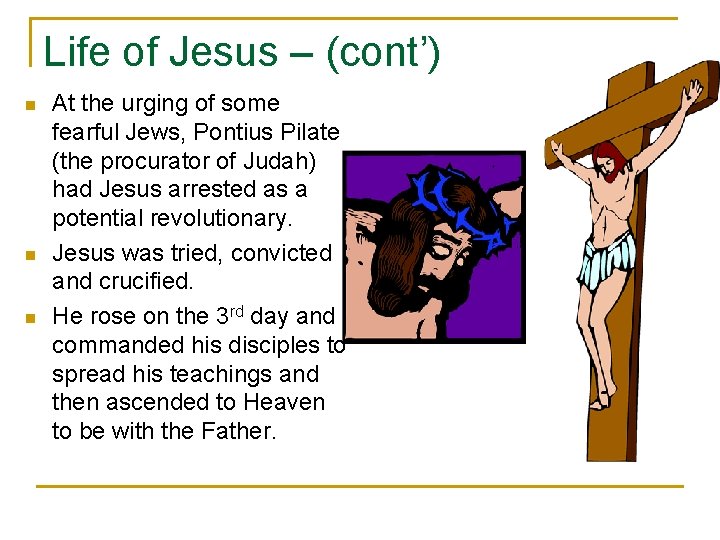
Life of Jesus – (cont’) n n n At the urging of some fearful Jews, Pontius Pilate (the procurator of Judah) had Jesus arrested as a potential revolutionary. Jesus was tried, convicted and crucified. He rose on the 3 rd day and commanded his disciples to spread his teachings and then ascended to Heaven to be with the Father.
Accomplishments of Paul n n Paul persecuted Jesus’ followers until experiencing a conversion Was Saul prior to conversion/ Paul after conversion. Traveled around the eastern Mediterranean setting up churches (Asia Minor/ shores of Aegean) Promoted the idea that Jesus sacrificed himself out of love for humankind and promised that all who believed would achieve eternal life.
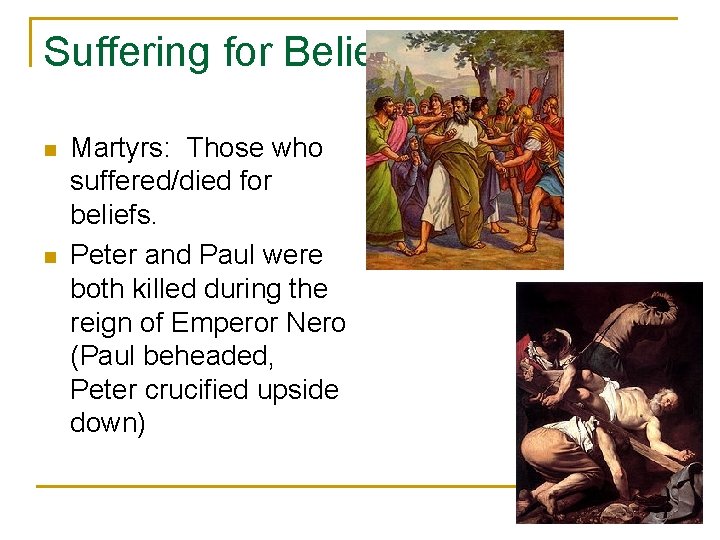
Suffering for Belief n n Martyrs: Those who suffered/died for beliefs. Peter and Paul were both killed during the reign of Emperor Nero (Paul beheaded, Peter crucified upside down)
Spreading the Faith – Why and How? n Why ? q q q The humble, poor and oppressed were welcomed Popular ideas from Plato, the Stoics, and Greeks were represented (discipline and moderation) Documents were written in Greek/Latin that people understood n How? q q Missionaries’ work was easier due to the good roads and safe seas provided by the Roman Empire Persecution by the Romans brought converts who were impressed by the strength of the Christian believers.
Gradual Acceptance of the Faith n Edict of Milan q q v Issued by Emperor Constantine in 313 AD Granted freedom of worship to all citizens of the Roman Empire Emperor Theodosius the Great – 400 AD – proclaimed Christianity as the official religion of the Roman Empire.
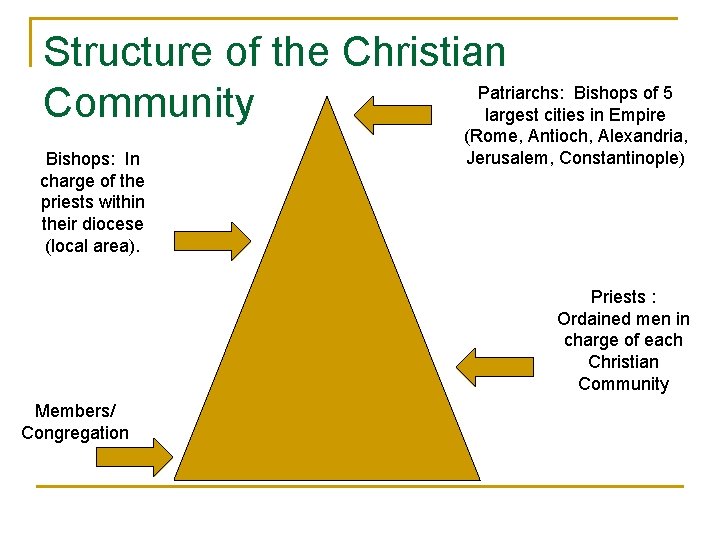
Structure of the Christian Patriarchs: Bishops of 5 Community largest cities in Empire Bishops: In charge of the priests within their diocese (local area). (Rome, Antioch, Alexandria, Jerusalem, Constantinople) Priests : Ordained men in charge of each Christian Community Members/ Congregation
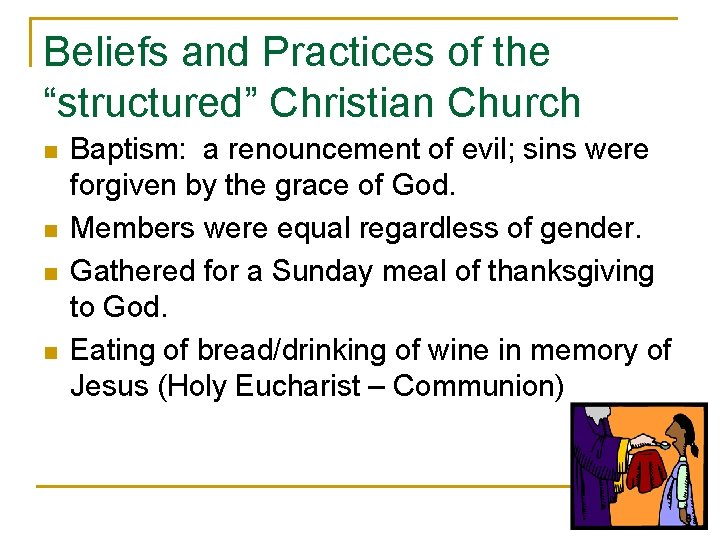
Beliefs and Practices of the “structured” Christian Church n n Baptism: a renouncement of evil; sins were forgiven by the grace of God. Members were equal regardless of gender. Gathered for a Sunday meal of thanksgiving to God. Eating of bread/drinking of wine in memory of Jesus (Holy Eucharist – Communion)
Rivalry between East and West n n Rivalry existed between the patriarchs of the east and the patriarch of the west (Rome) Different ideas = heresy- beliefs contrary to Church teachings n How to deal with it? q Council of Nicaea: a meeting of church leaders to decide just what the official teachings of the Church were going to be
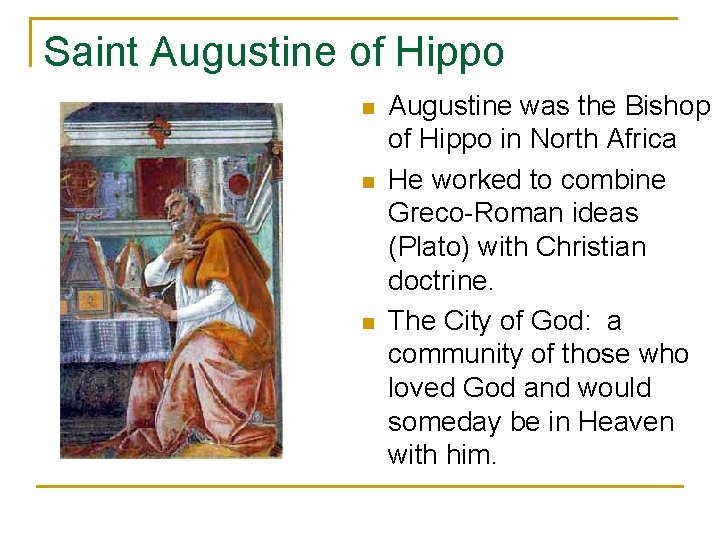
Saint Augustine of Hippo n n n Augustine was the Bishop of Hippo in North Africa He worked to combine Greco-Roman ideas (Plato) with Christian doctrine. The City of God: a community of those who loved God and would someday be in Heaven with him.
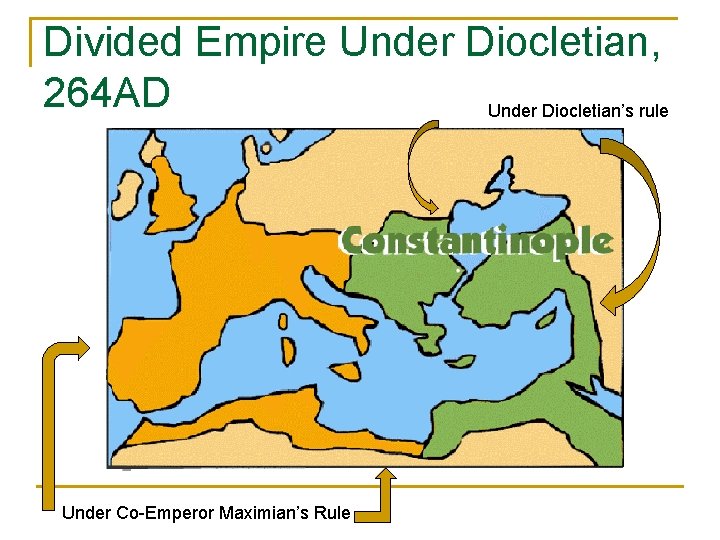
The Long Decline n Actions of Emperor Diocletian q q For easier administration, the empire was divided into two parts: East – ruled by Diocletian, and West – ruled by a Co-emperor To stop rising prices: passed the Edict of Prices which limited or fixed the price of goods Made farmers stay on their lands and continue to farm Sons were required to follow in their father’s footsteps
Divided Empire Under Diocletian, 264 AD Under Diocletian’s rule Under Co-Emperor Maximian’s Rule
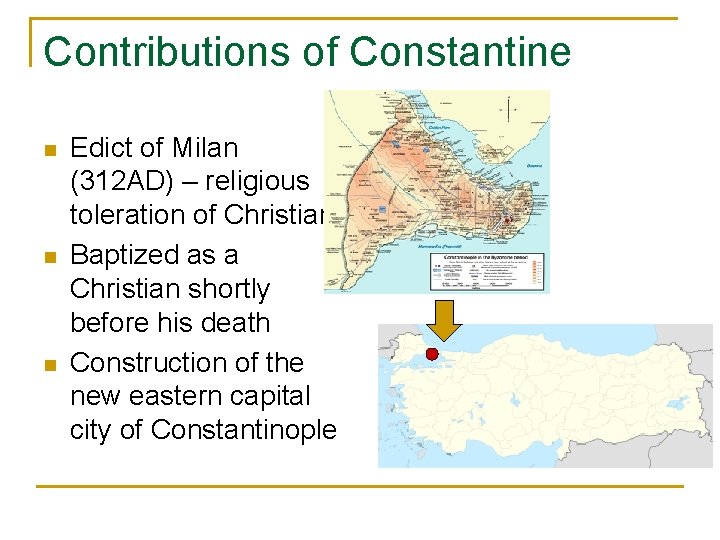
Contributions of Constantine n n n Edict of Milan (312 AD) – religious toleration of Christians Baptized as a Christian shortly before his death Construction of the new eastern capital city of Constantinople
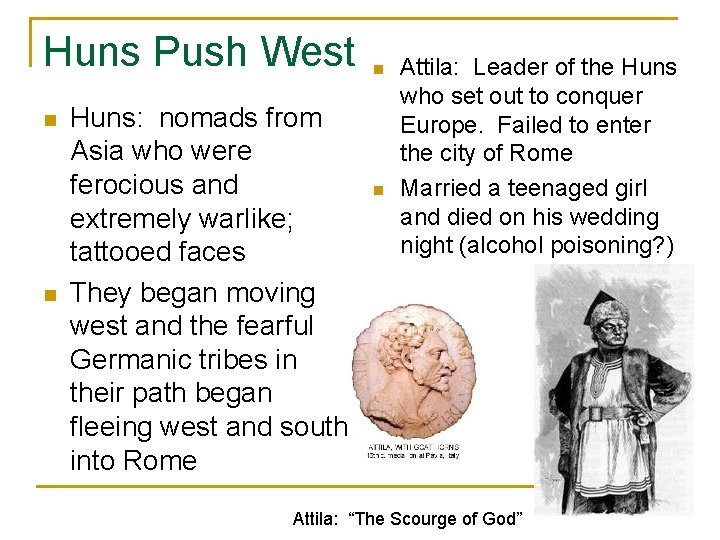
Huns Push West n n Huns: nomads from Asia who were ferocious and extremely warlike; tattooed faces They began moving west and the fearful Germanic tribes in their path began fleeing west and south into Rome n n Attila: Leader of the Huns who set out to conquer Europe. Failed to enter the city of Rome Married a teenaged girl and died on his wedding night (alcohol poisoning? ) Attila: “The Scourge of God”
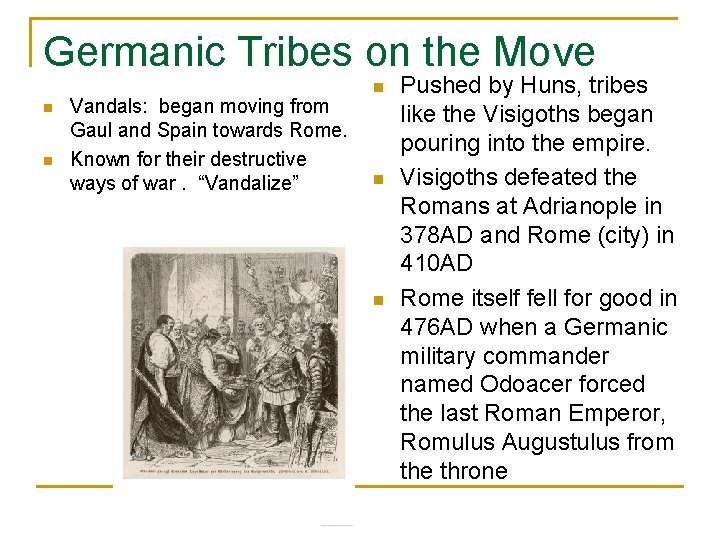
Germanic Tribes on the Move n n Vandals: began moving from Gaul and Spain towards Rome. Known for their destructive ways of war. “Vandalize” n n n Pushed by Huns, tribes like the Visigoths began pouring into the empire. Visigoths defeated the Romans at Adrianople in 378 AD and Rome (city) in 410 AD Rome itself fell for good in 476 AD when a Germanic military commander named Odoacer forced the last Roman Emperor, Romulus Augustulus from the throne
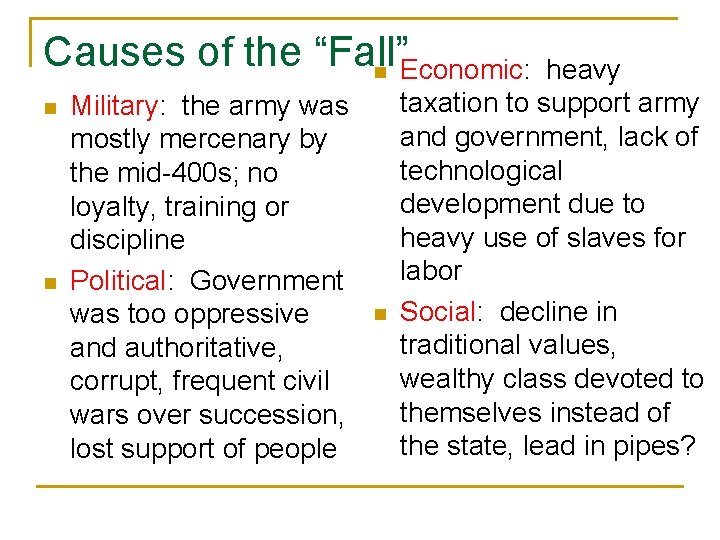
Causes of the “Fall” n Economic: n n Military: the army was mostly mercenary by the mid-400 s; no loyalty, training or discipline Political: Government was too oppressive and authoritative, corrupt, frequent civil wars over succession, lost support of people n heavy taxation to support army and government, lack of technological development due to heavy use of slaves for labor Social: decline in traditional values, wealthy class devoted to themselves instead of the state, lead in pipes?
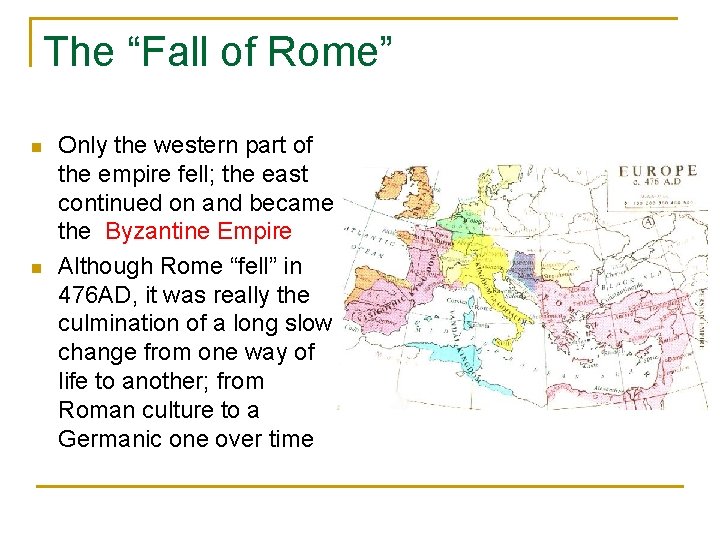
The “Fall of Rome” n n Only the western part of the empire fell; the east continued on and became the Byzantine Empire Although Rome “fell” in 476 AD, it was really the culmination of a long slow change from one way of life to another; from Roman culture to a Germanic one over time