
Ancient Israelites First Israelites Promise Land Early Israelites

- Slides: 27
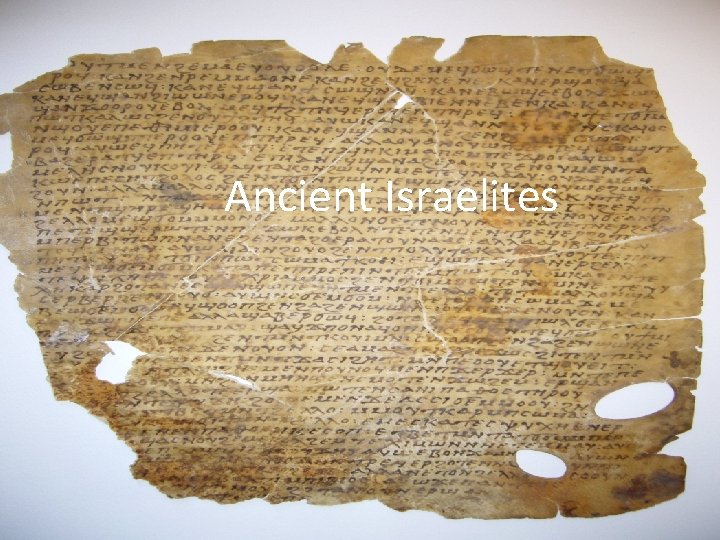
Ancient Israelites
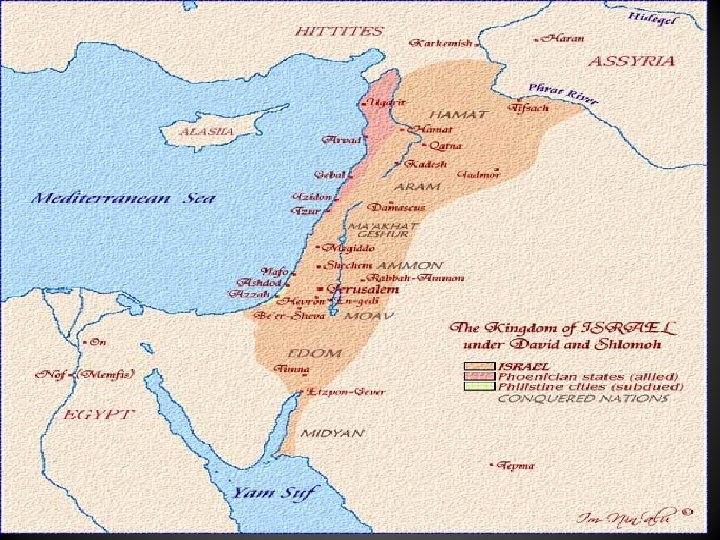
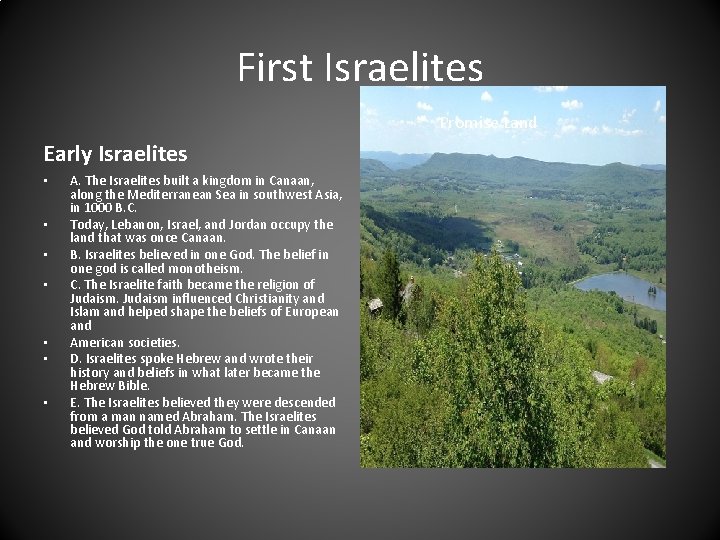
First Israelites Promise Land Early Israelites • • A. The Israelites built a kingdom in Canaan, along the Mediterranean Sea in southwest Asia, in 1000 B. C. Today, Lebanon, Israel, and Jordan occupy the land that was once Canaan. B. Israelites believed in one God. The belief in one god is called monotheism. C. The Israelite faith became the religion of Judaism influenced Christianity and Islam and helped shape the beliefs of European and American societies. D. Israelites spoke Hebrew and wrote their history and beliefs in what later became the Hebrew Bible. E. The Israelites believed they were descended from a man named Abraham. The Israelites believed God told Abraham to settle in Canaan and worship the one true God.
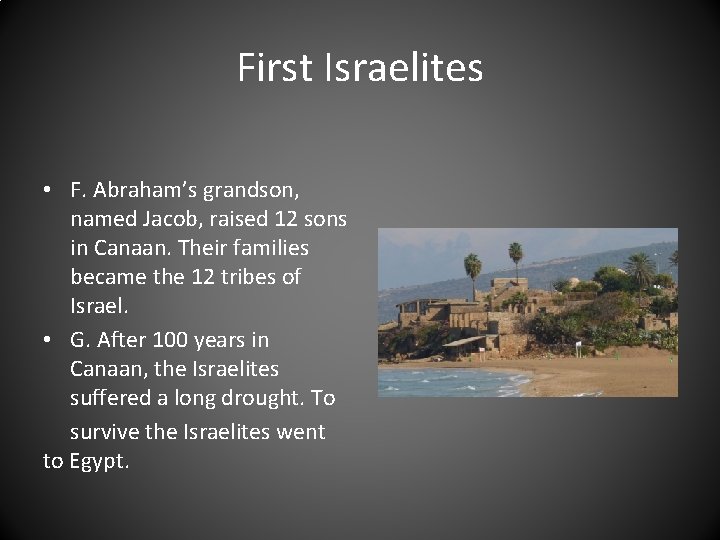
First Israelites • F. Abraham’s grandson, named Jacob, raised 12 sons in Canaan. Their families became the 12 tribes of Israel. • G. After 100 years in Canaan, the Israelites suffered a long drought. To survive the Israelites went to Egypt.
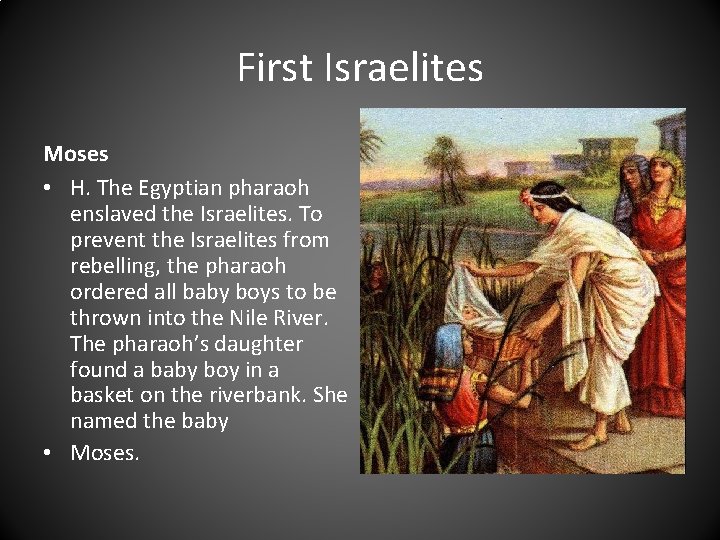
First Israelites Moses • H. The Egyptian pharaoh enslaved the Israelites. To prevent the Israelites from rebelling, the pharaoh ordered all baby boys to be thrown into the Nile River. The pharaoh’s daughter found a baby boy in a basket on the riverbank. She named the baby • Moses.
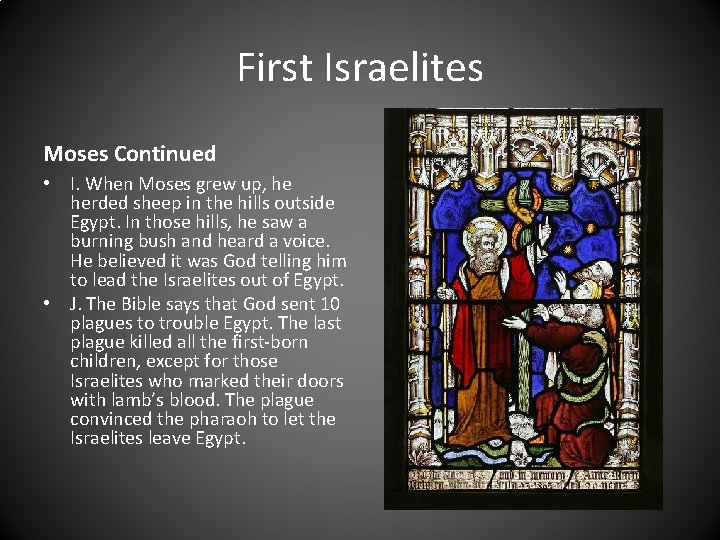
First Israelites Moses Continued • I. When Moses grew up, he herded sheep in the hills outside Egypt. In those hills, he saw a burning bush and heard a voice. He believed it was God telling him to lead the Israelites out of Egypt. • J. The Bible says that God sent 10 plagues to trouble Egypt. The last plague killed all the first-born children, except for those Israelites who marked their doors with lamb’s blood. The plague convinced the pharaoh to let the Israelites leave Egypt.
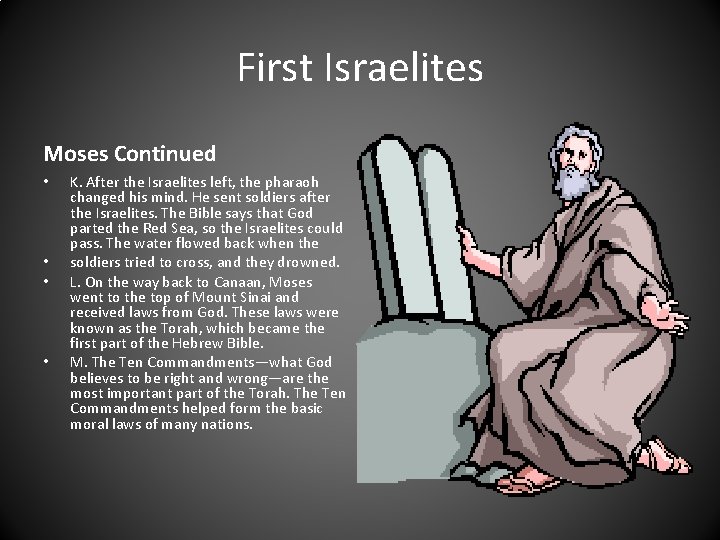
First Israelites Moses Continued • • K. After the Israelites left, the pharaoh changed his mind. He sent soldiers after the Israelites. The Bible says that God parted the Red Sea, so the Israelites could pass. The water flowed back when the soldiers tried to cross, and they drowned. L. On the way back to Canaan, Moses went to the top of Mount Sinai and received laws from God. These laws were known as the Torah, which became the first part of the Hebrew Bible. M. The Ten Commandments—what God believes to be right and wrong—are the most important part of the Torah. The Ten Commandments helped form the basic moral laws of many nations.
The Promise Land
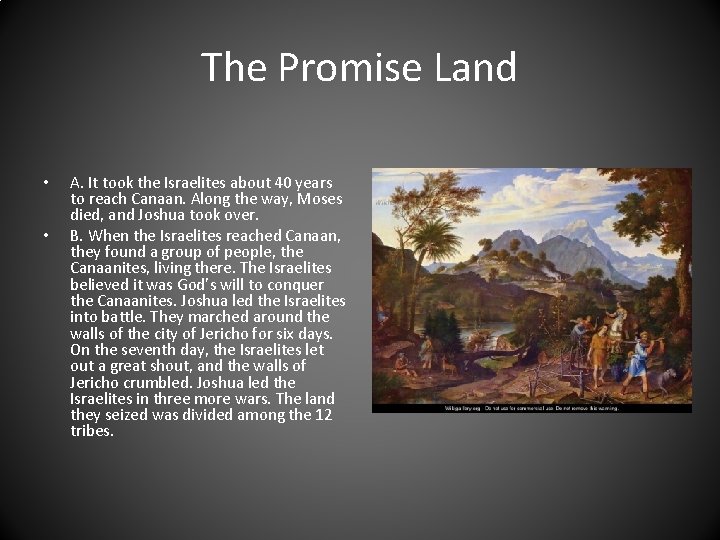
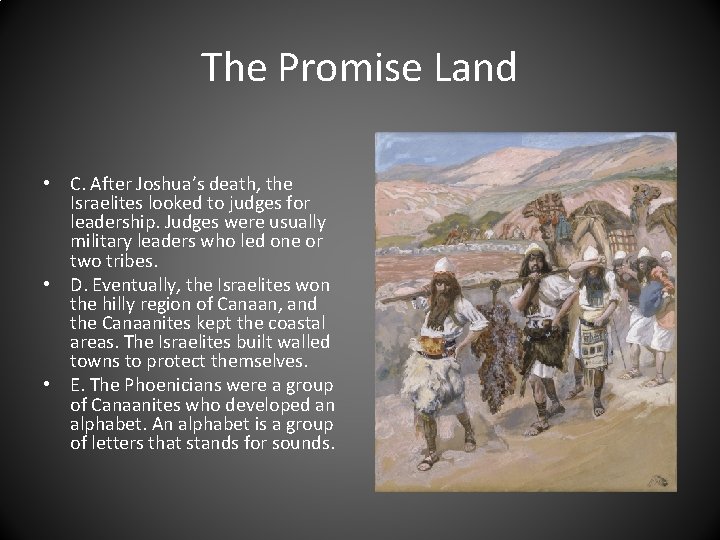
The Promise Land • • A. It took the Israelites about 40 years to reach Canaan. Along the way, Moses died, and Joshua took over. B. When the Israelites reached Canaan, they found a group of people, the Canaanites, living there. The Israelites believed it was God’s will to conquer the Canaanites. Joshua led the Israelites into battle. They marched around the walls of the city of Jericho for six days. On the seventh day, the Israelites let out a great shout, and the walls of Jericho crumbled. Joshua led the Israelites in three more wars. The land they seized was divided among the 12 tribes.
The Promise Land • C. After Joshua’s death, the Israelites looked to judges for leadership. Judges were usually military leaders who led one or two tribes. • D. Eventually, the Israelites won the hilly region of Canaan, and the Canaanites kept the coastal areas. The Israelites built walled towns to protect themselves. • E. The Phoenicians were a group of Canaanites who developed an alphabet. An alphabet is a group of letters that stands for sounds.
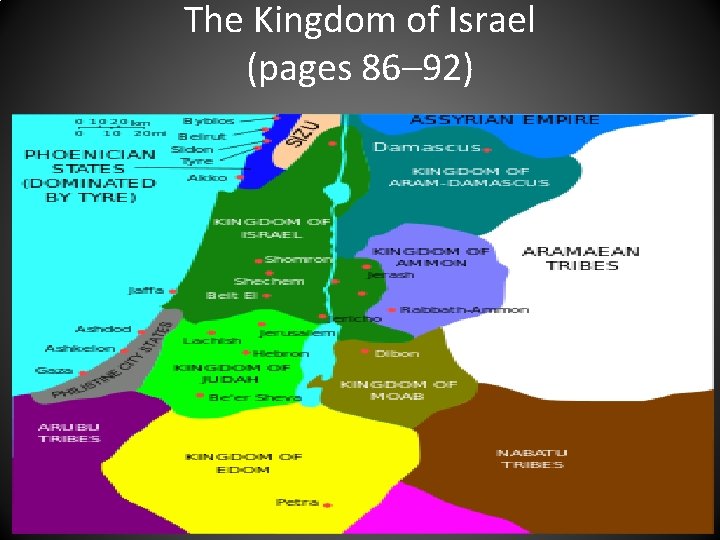
The Kingdom of Israel (pages 86– 92)
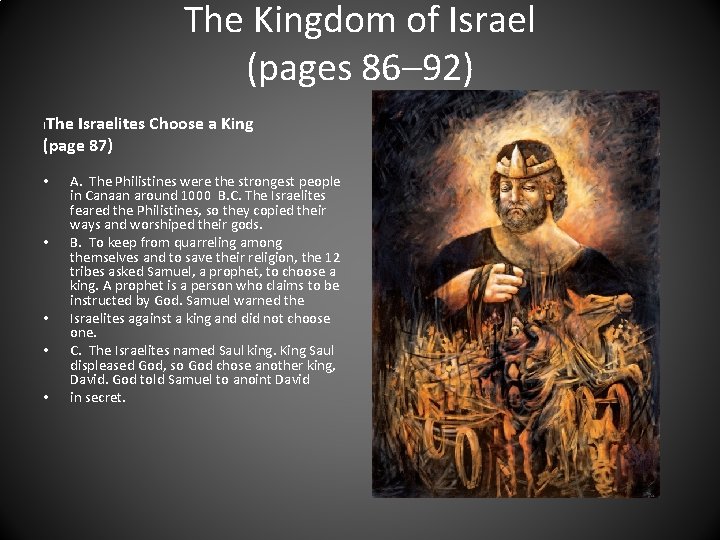
The Kingdom of Israel (pages 86– 92) The Israelites Choose a King (page 87) I • • • A. The Philistines were the strongest people in Canaan around 1000 B. C. The Israelites feared the Philistines, so they copied their ways and worshiped their gods. B. To keep from quarreling among themselves and to save their religion, the 12 tribes asked Samuel, a prophet, to choose a king. A prophet is a person who claims to be instructed by God. Samuel warned the Israelites against a king and did not choose one. C. The Israelites named Saul king. King Saul displeased God, so God chose another king, David. God told Samuel to anoint David in secret.
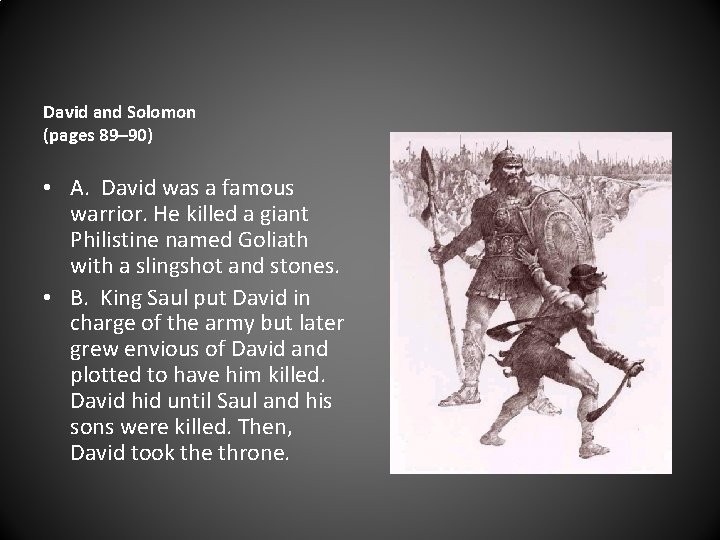
David and Solomon (pages 89– 90) • A. David was a famous warrior. He killed a giant Philistine named Goliath with a slingshot and stones. • B. King Saul put David in charge of the army but later grew envious of David and plotted to have him killed. David hid until Saul and his sons were killed. Then, David took the throne.
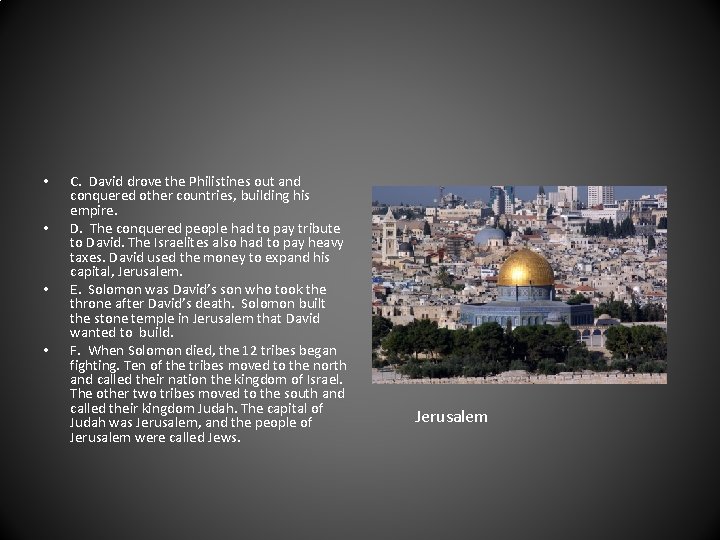
• • C. David drove the Philistines out and conquered other countries, building his empire. D. The conquered people had to pay tribute to David. The Israelites also had to pay heavy taxes. David used the money to expand his capital, Jerusalem. E. Solomon was David’s son who took the throne after David’s death. Solomon built the stone temple in Jerusalem that David wanted to build. F. When Solomon died, the 12 tribes began fighting. Ten of the tribes moved to the north and called their nation the kingdom of Israel. The other two tribes moved to the south and called their kingdom Judah. The capital of Judah was Jerusalem, and the people of Jerusalem were called Jews. Jerusalem
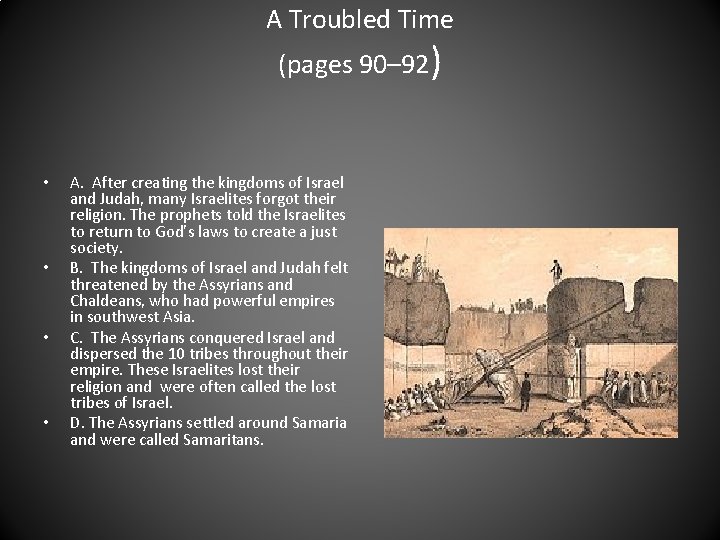
A Troubled Time (pages 90– 92) • • A. After creating the kingdoms of Israel and Judah, many Israelites forgot their religion. The prophets told the Israelites to return to God’s laws to create a just society. B. The kingdoms of Israel and Judah felt threatened by the Assyrians and Chaldeans, who had powerful empires in southwest Asia. C. The Assyrians conquered Israel and dispersed the 10 tribes throughout their empire. These Israelites lost their religion and were often called the lost tribes of Israel. D. The Assyrians settled around Samaria and were called Samaritans.
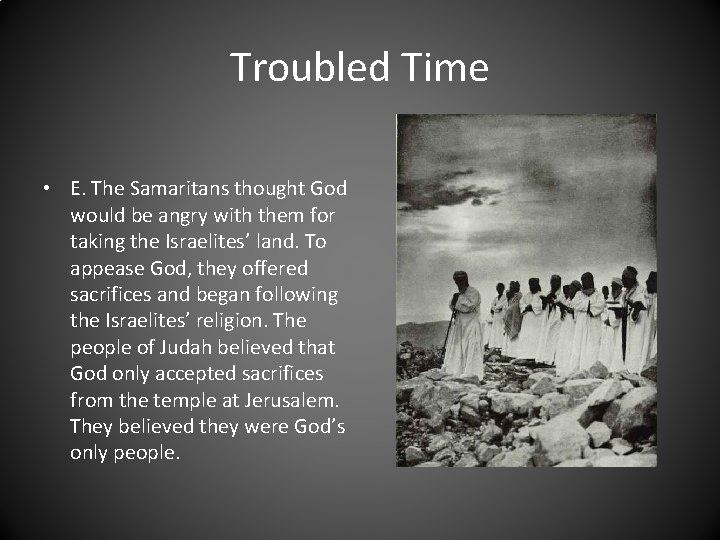
Troubled Time • E. The Samaritans thought God would be angry with them for taking the Israelites’ land. To appease God, they offered sacrifices and began following the Israelites’ religion. The people of Judah believed that God only accepted sacrifices from the temple at Jerusalem. They believed they were God’s only people.
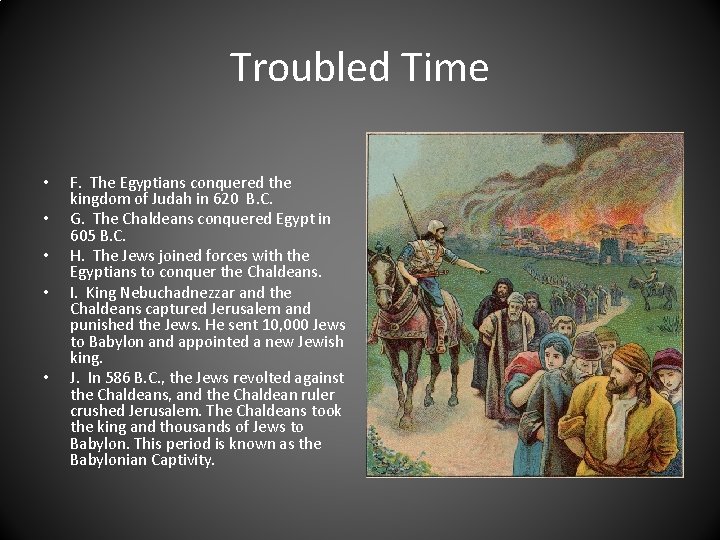
Troubled Time • • • F. The Egyptians conquered the kingdom of Judah in 620 B. C. G. The Chaldeans conquered Egypt in 605 B. C. H. The Jews joined forces with the Egyptians to conquer the Chaldeans. I. King Nebuchadnezzar and the Chaldeans captured Jerusalem and punished the Jews. He sent 10, 000 Jews to Babylon and appointed a new Jewish king. J. In 586 B. C. , the Jews revolted against the Chaldeans, and the Chaldean ruler crushed Jerusalem. The Chaldeans took the king and thousands of Jews to Babylon. This period is known as the Babylonian Captivity.
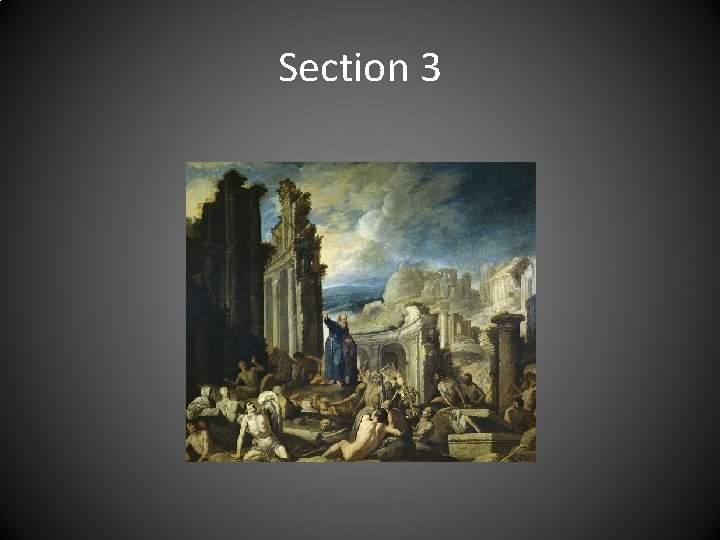
Section 3
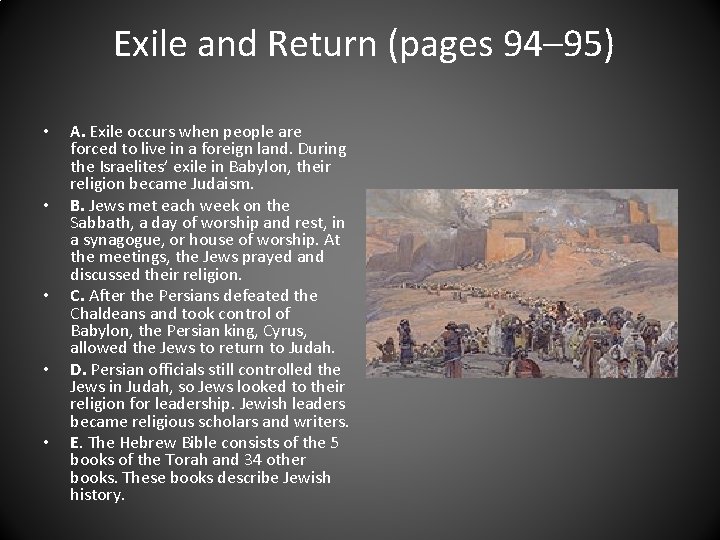
Exile and Return (pages 94– 95) • • • A. Exile occurs when people are forced to live in a foreign land. During the Israelites’ exile in Babylon, their religion became Judaism. B. Jews met each week on the Sabbath, a day of worship and rest, in a synagogue, or house of worship. At the meetings, the Jews prayed and discussed their religion. C. After the Persians defeated the Chaldeans and took control of Babylon, the Persian king, Cyrus, allowed the Jews to return to Judah. D. Persian officials still controlled the Jews in Judah, so Jews looked to their religion for leadership. Jewish leaders became religious scholars and writers. E. The Hebrew Bible consists of the 5 books of the Torah and 34 other books. These books describe Jewish history.
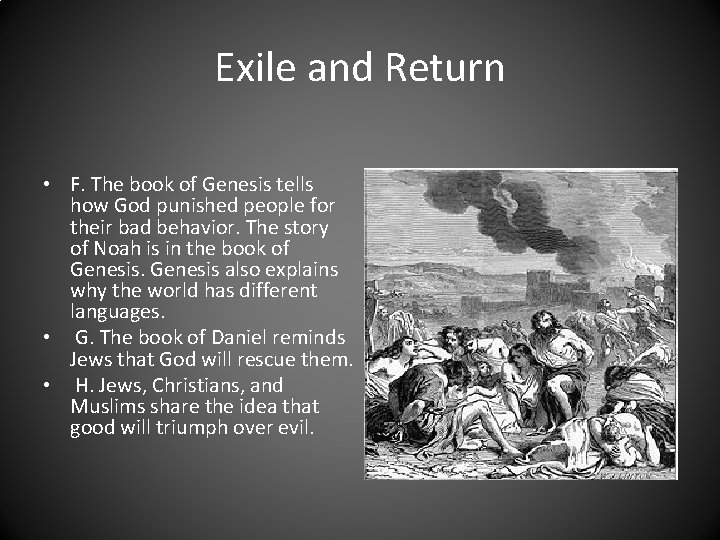
Exile and Return • F. The book of Genesis tells how God punished people for their bad behavior. The story of Noah is in the book of Genesis also explains why the world has different languages. • G. The book of Daniel reminds Jews that God will rescue them. • H. Jews, Christians, and Muslims share the idea that good will triumph over evil.
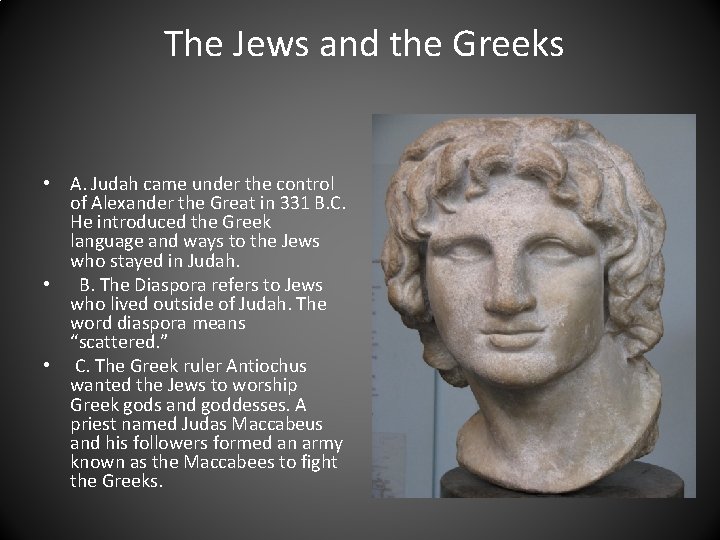
The Jews and the Greeks • A. Judah came under the control of Alexander the Great in 331 B. C. He introduced the Greek language and ways to the Jews who stayed in Judah. • B. The Diaspora refers to Jews who lived outside of Judah. The word diaspora means “scattered. ” • C. The Greek ruler Antiochus wanted the Jews to worship Greek gods and goddesses. A priest named Judas Maccabeus and his followers formed an army known as the Maccabees to fight the Greeks.
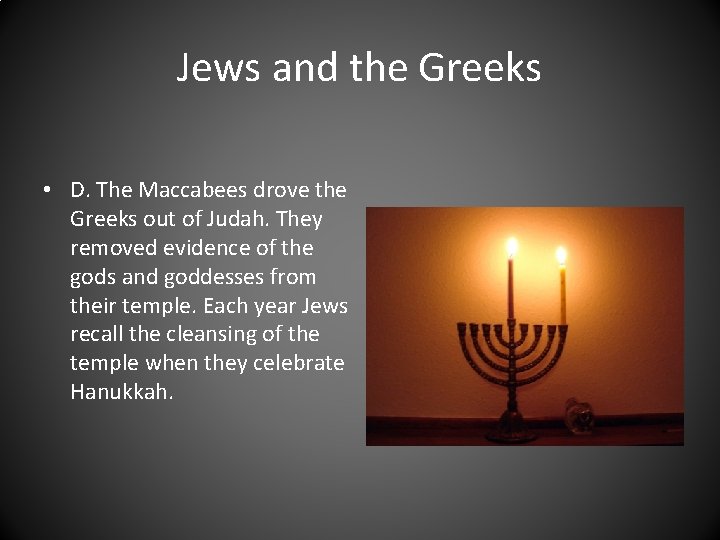
Jews and the Greeks • D. The Maccabees drove the Greeks out of Judah. They removed evidence of the gods and goddesses from their temple. Each year Jews recall the cleansing of the temple when they celebrate Hanukkah.
Jewish Way of Life • A. Jewish laws influenced Jews’ education, food, and clothes. • B. Sons were valuable in Jewish society. Sons carried on the family name and became the head of the family after the death of their fathers. • C. Sons learned how to earn a living and how to worship God from their fathers. They later learned how to read the Torah from religious leaders
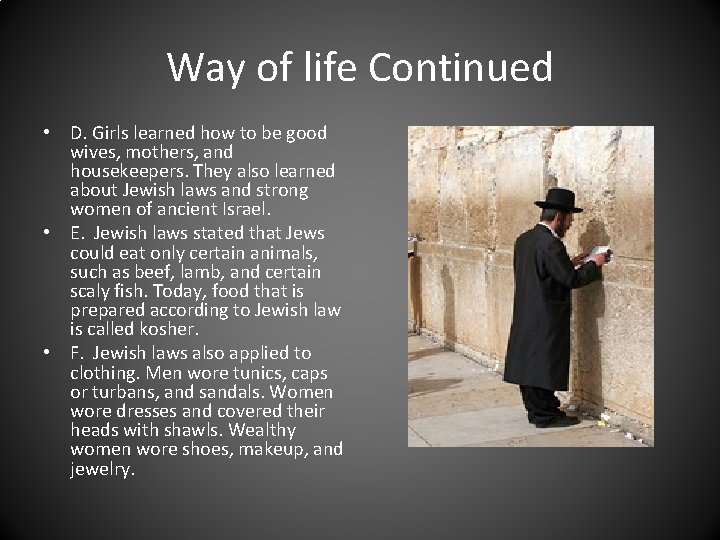
Way of life Continued • D. Girls learned how to be good wives, mothers, and housekeepers. They also learned about Jewish laws and strong women of ancient Israel. • E. Jewish laws stated that Jews could eat only certain animals, such as beef, lamb, and certain scaly fish. Today, food that is prepared according to Jewish law is called kosher. • F. Jewish laws also applied to clothing. Men wore tunics, caps or turbans, and sandals. Women wore dresses and covered their heads with shawls. Wealthy women wore shoes, makeup, and jewelry.
Jews and the Romans
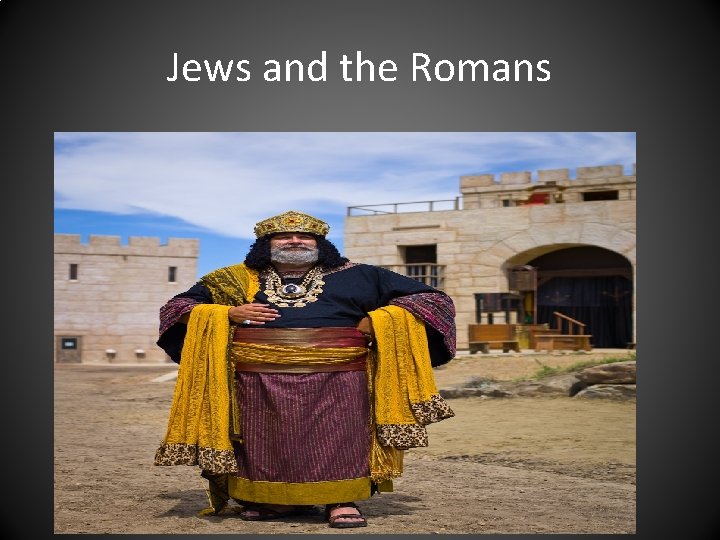
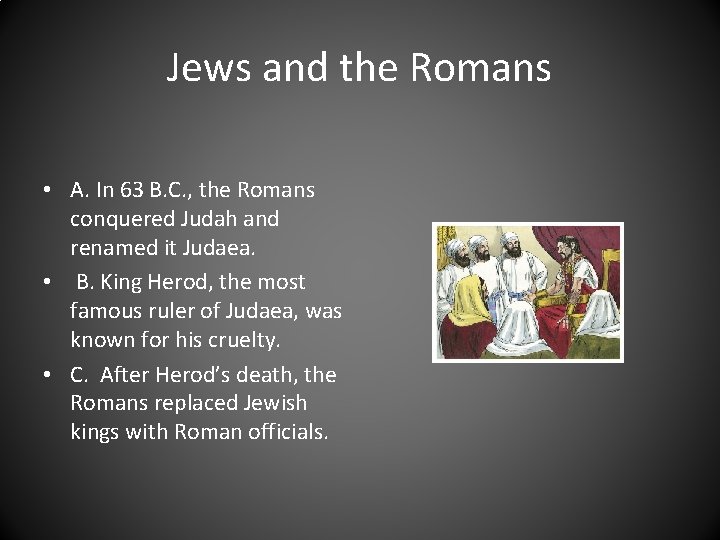
Jews and the Romans • A. In 63 B. C. , the Romans conquered Judah and renamed it Judaea. • B. King Herod, the most famous ruler of Judaea, was known for his cruelty. • C. After Herod’s death, the Romans replaced Jewish kings with Roman officials.
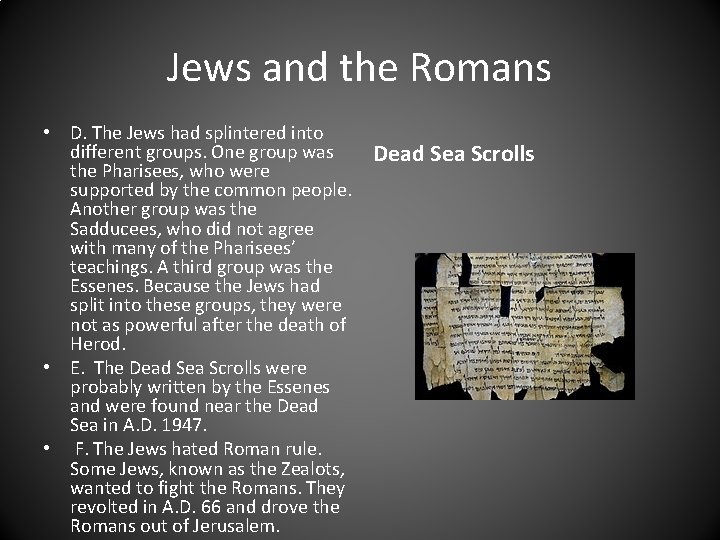
Jews and the Romans • D. The Jews had splintered into different groups. One group was the Pharisees, who were supported by the common people. Another group was the Sadducees, who did not agree with many of the Pharisees’ teachings. A third group was the Essenes. Because the Jews had split into these groups, they were not as powerful after the death of Herod. • E. The Dead Sea Scrolls were probably written by the Essenes and were found near the Dead Sea in A. D. 1947. • F. The Jews hated Roman rule. Some Jews, known as the Zealots, wanted to fight the Romans. They revolted in A. D. 66 and drove the Romans out of Jerusalem. Dead Sea Scrolls