
Ancient India Indian Subcontinent The Indus Valley is
Ancient India
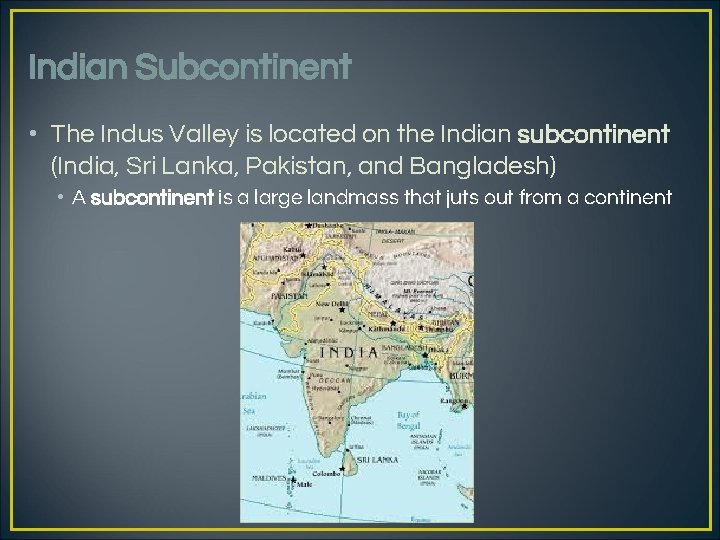
Indian Subcontinent • The Indus Valley is located on the Indian subcontinent (India, Sri Lanka, Pakistan, and Bangladesh) • A subcontinent is a large landmass that juts out from a continent

Indian Subcontinent Climate • Three important rivers flow through this land area: the Indus, Ganges, and Brahmaputra • The yearly monsoons (seasonal winds) are important to the watering of crops, but too much precipitation can lead to flooding • Winter monsoons bring hot, dry air, and the summer monsoons pick up moisture and drench the subcontinent with downpours
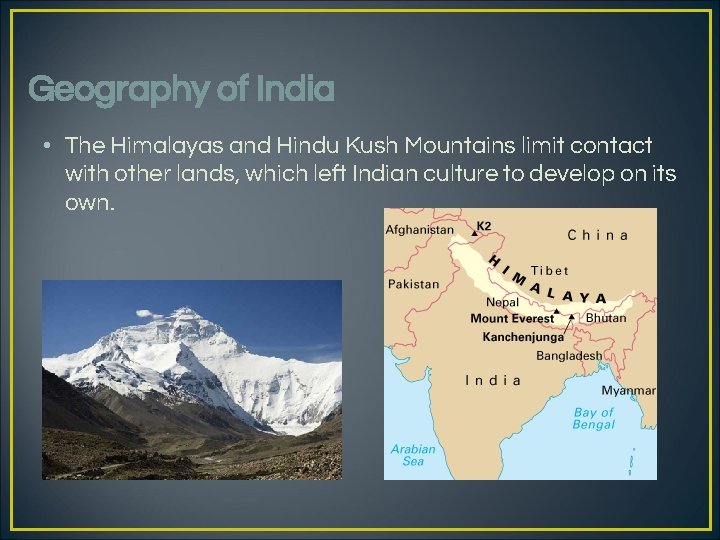
Geography of India • The Himalayas and Hindu Kush Mountains limit contact with other lands, which left Indian culture to develop on its own.

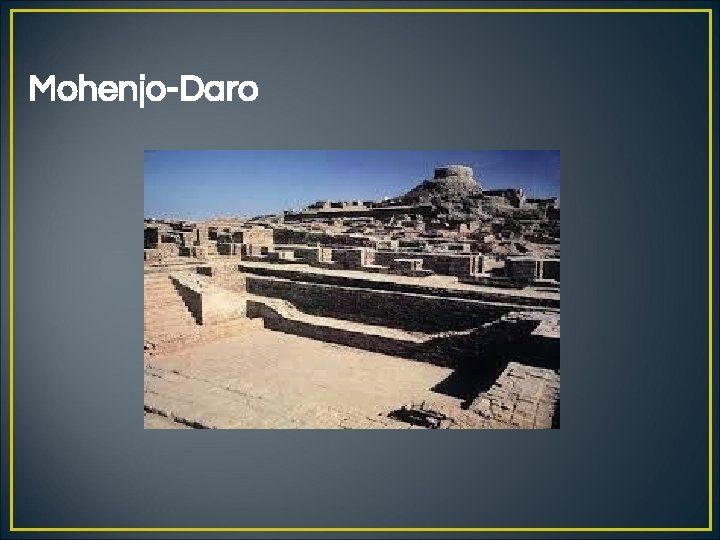
Indus Civilization • Sir Mortimer Wheeler did much of the archaeological work to uncover the Indus Civilization • Much less is known about the Indus Civilization than other ancient civilizations • It is believed that the capital cities were Mohenjo-Daro and Harappa, which were very carefully planned • An abundance of seals have been found with examples of images and writing • Historians speculate on the religious beliefs of the Indus Civilization, but they seemed to have a veneration (special regard for) cattle • After about 700 years, the civilization began to decline for unknown reasons
Mohenjo-Daro
Aryan Civilization • The Aryans left behind no cities and little archeological evidence • What we do know comes from Vedas (collection of hymns, chants, and religious teachings) • Aryans measured their wealth in cows and bulls • Initially the civilization was comprised of nomadic herders but over time become farmers • The Aryans were led by a chiefs known as rajahs • Aryan society was divided based upon occupation
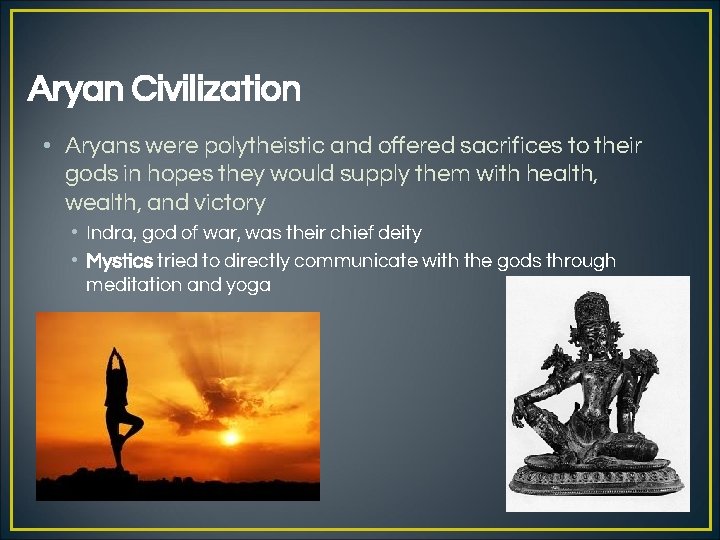
Aryan Civilization • Aryans were polytheistic and offered sacrifices to their gods in hopes they would supply them with health, wealth, and victory • Indra, god of war, was their chief deity • Mystics tried to directly communicate with the gods through meditation and yoga
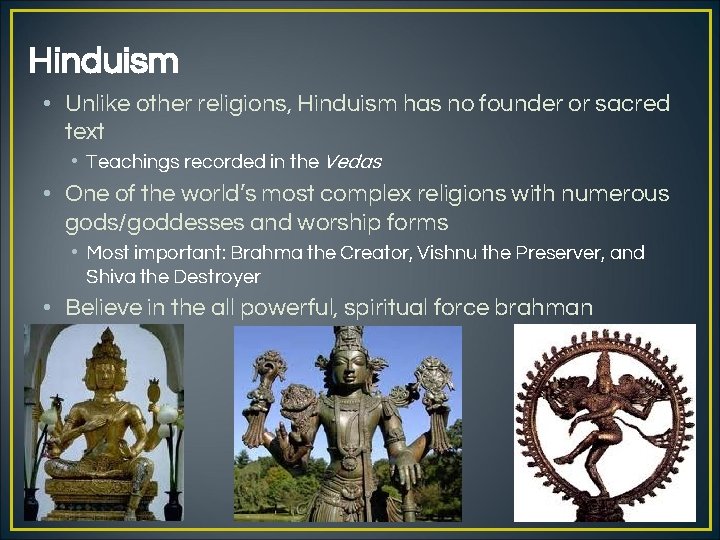
Hinduism • Unlike other religions, Hinduism has no founder or sacred text • Teachings recorded in the Vedas • One of the world’s most complex religions with numerous gods/goddesses and worship forms • Most important: Brahma the Creator, Vishnu the Preserver, and Shiva the Destroyer • Believe in the all powerful, spiritual force brahman
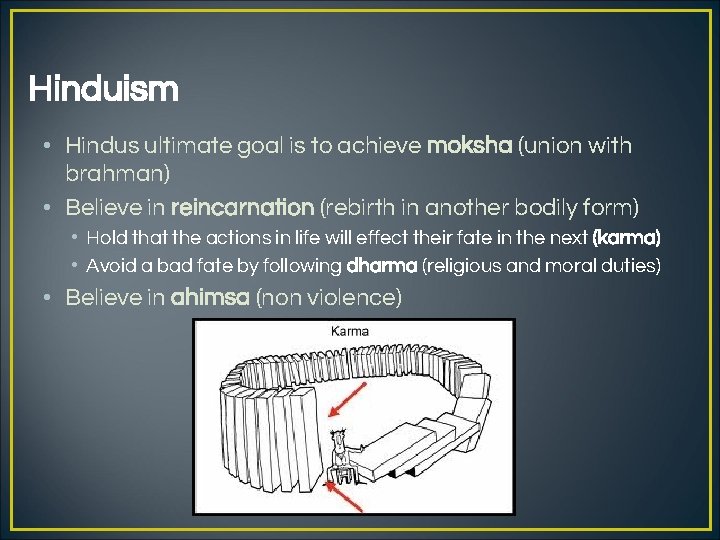
Hinduism • Hindus ultimate goal is to achieve moksha (union with brahman) • Believe in reincarnation (rebirth in another bodily form) • Hold that the actions in life will effect their fate in the next (karma) • Avoid a bad fate by following dharma (religious and moral duties) • Believe in ahimsa (non violence)
Jainism • Grew out of Hinduism • Emphasizes meditation, self-denial, and ahimsa
India’s Caste System • Caste= social groups • A caste system divides a population into social groups which cannot be changed • Cannot marry or socialize outside of one’s caste • At the bottom are the Untouchables (dalits) • Had to live apart and were forced to wear wooden clappers around their necks to warn others of their approach • It does provide social order and a sense of identity • Thousands of castes and subcastes exist today

Buddhism • Siddhartha Gautama is the founder of Buddhism • Born a prince and enjoyed a happy life • Took a ride outside the palace walls and was exposed to sickness and death • While meditating, he became Buddha (The Enlightened One)
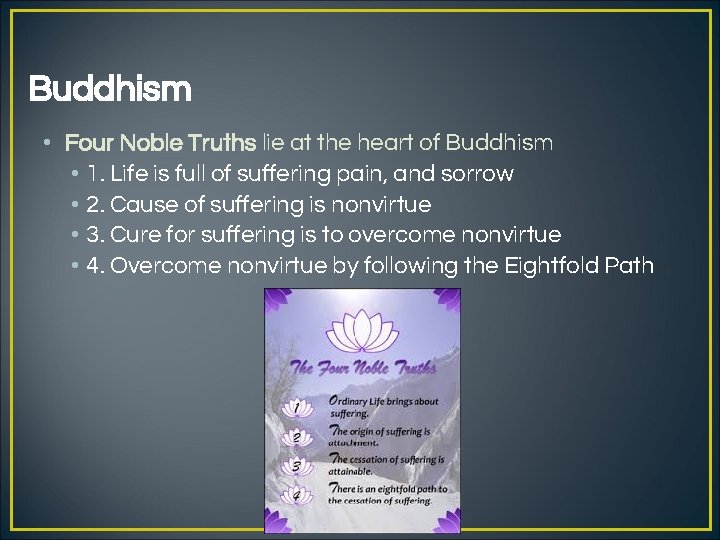
Buddhism • Four Noble Truths lie at the heart of Buddhism • 1. Life is full of suffering pain, and sorrow • 2. Cause of suffering is nonvirtue • 3. Cure for suffering is to overcome nonvirtue • 4. Overcome nonvirtue by following the Eightfold Path
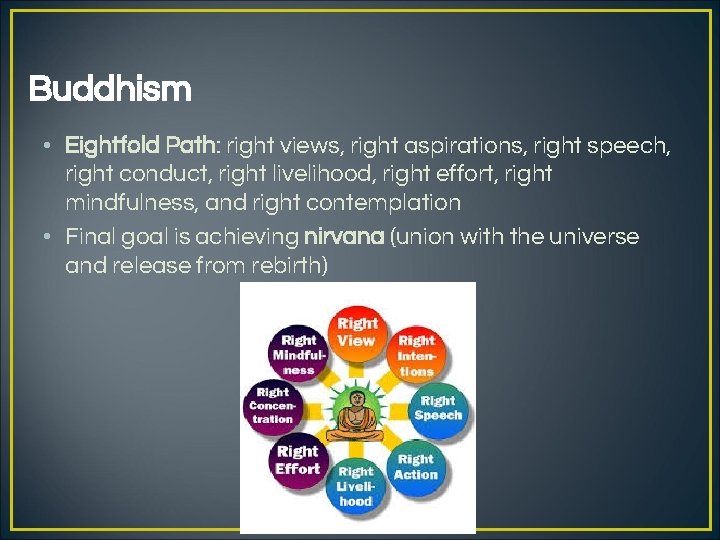
Buddhism • Eightfold Path: right views, right aspirations, right speech, right conduct, right livelihood, right effort, right mindfulness, and right contemplation • Final goal is achieving nirvana (union with the universe and release from rebirth)

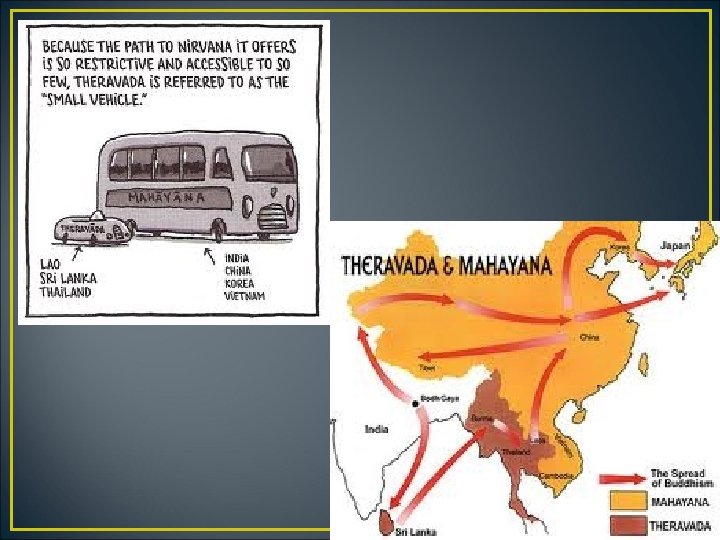
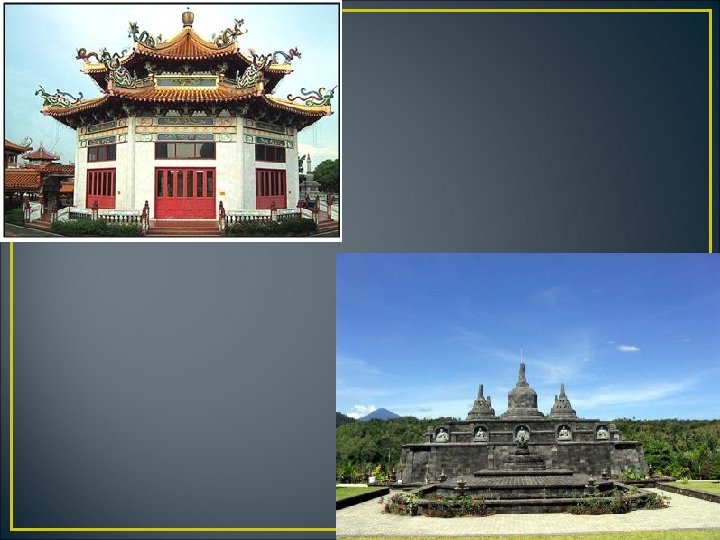
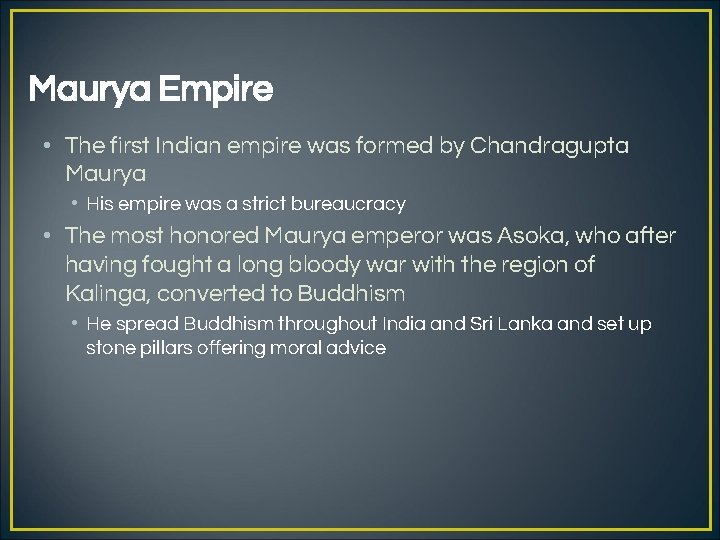
Buddhism • Buddha spread his teachings across India • Monasteries were set up for meditation and study • Buddhism split into two sects (subgroups) • Theravada: closely follows Buddha’s original teaching and only nuns/priests could achieve nirvana • Found in Sri Lanka and Southeast Asia • Mahayana: worshiped Buddha and taught about an afterlife with heavens and hells • Spread to China, Tibet, Korea, and Japan
Maurya Empire • The first Indian empire was formed by Chandragupta Maurya • His empire was a strict bureaucracy • The most honored Maurya emperor was Asoka, who after having fought a long bloody war with the region of Kalinga, converted to Buddhism • He spread Buddhism throughout India and Sri Lanka and set up stone pillars offering moral advice
The Gupta Dynasty • About 500 years after the Maurya empire, the Gupta dynasty united much of India • Under the Guptas, India enjoyed a golden age, or a period of great cultural achievement • Trade and farming flourished, and people lived in peace with one another due to the amount of power left in the hands of the people • Gupta mathematicians developed the system of writing numbers that we use today. The decimal system and the concept of zero were also developed at this time.
Family and Village Life • The ideal family was a joint family which had parents, grandparents, and children in one dwelling • The father or oldest male headed the household • It was important for families to arrange good marriages for their children • In northern India, a bride’s family provided a dowry, or payment for the bridegroom, and paid for the wedding festivities • After the marriage, the daughter would live with the husband’s family
Role of Women • Women were restricted to the home, when they left the home, they were to be covered from head to foot • Women were to be devoted to their husbands • It was a custom for Indian wives to die with their husbands in his funeral fire as a virtuous act and a way to go straight to heaven
- Slides: 22