
Ancient India Indian Geography India is a subcontinent
Ancient India
Indian Geography • India is a subcontinent – Defintion: A very large, self-contained land mass that is part of a larger continent, in this case Asia • India is separated from the rest of Asia by two mountain ranges – The Himalayans, the highest mountains in the world, they separate India from China – The Hindu-Kush Mountains, separate India and Pakistan from Afghanistan
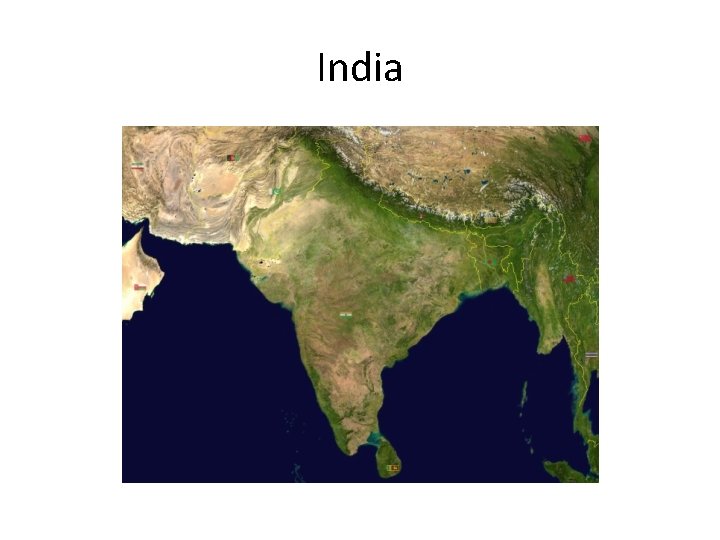
India
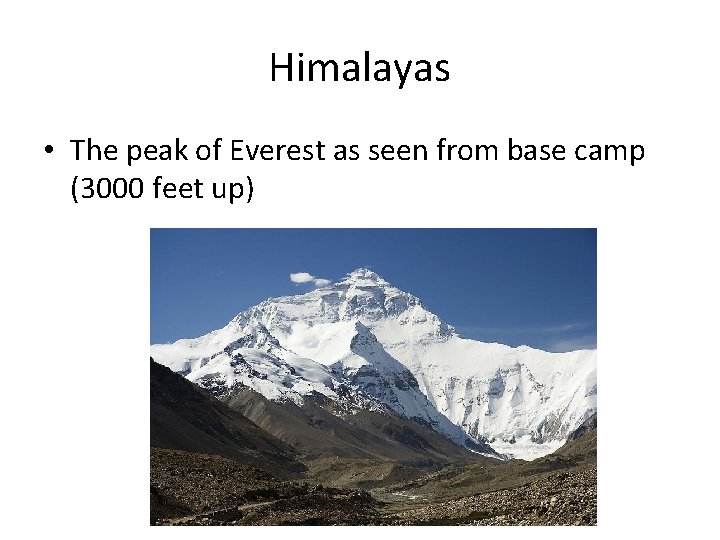
Himalayas • The peak of Everest as seen from base camp (3000 feet up)
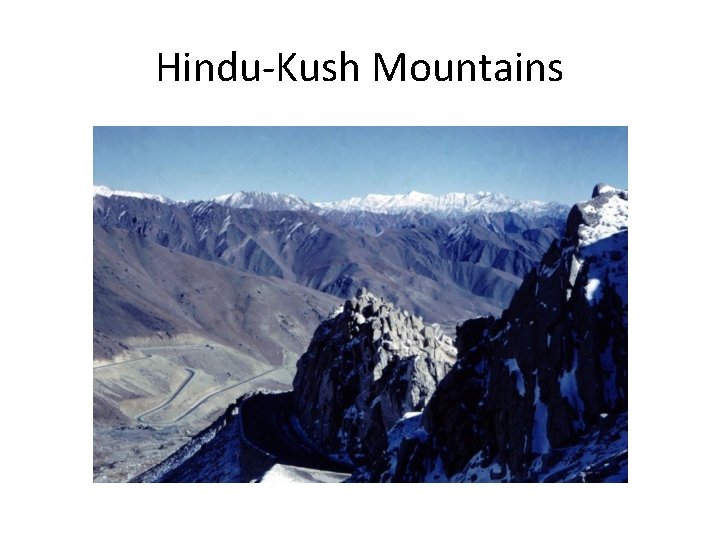
Hindu-Kush Mountains
River Basins • The Himalayas are the source of three large rivers that formed the basis of Indian civilization – The Ganges: Considered the holiest river in the Hindu religion. – The Brahmaputra – The Indus: Center of the first Indian civilizations
Water and Rainfall • Like the Nile, the Indus River regularly floods, leaving silt behind that fertilizes the soil • India also enjoys frequent monsoons – Definition: Periods of intense rainy weather caused by moist air flowing in from the ocean – The regular monsoons create a wet and a dry season in India
First Civilizations in the Indus Valley • The Earliest civilizations grew up in the Indus River Valley – Grew wheat and barley to survive – Built brick houses. • Most houses used the exact same size of brick suggesting that there was organization and planning – Traded with the ancient Mesopotamians
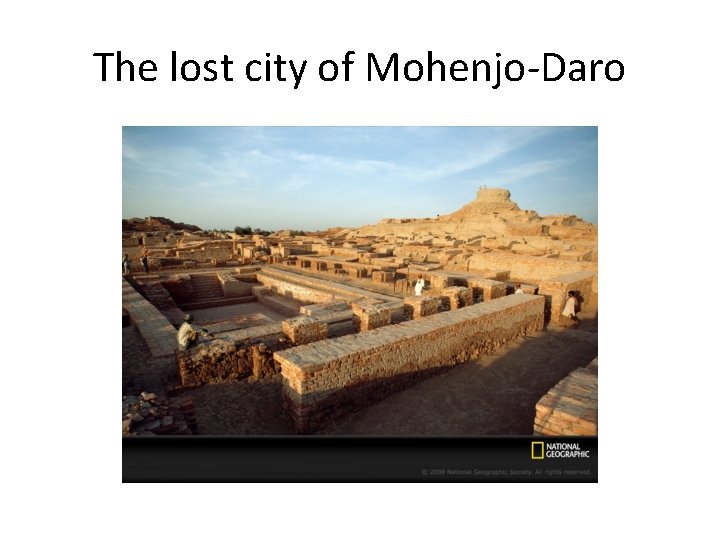
The lost city of Mohenjo-Daro
The Lost City of Mohenjo-Daro • Mohenjo-Daro was believed to be the center of the early Indus Valley civilization – Contained well planned streets and sewers – People had public baths in which to keep clean – Large granaries to store food • It is unclear what happened, but it’s likely Mohenjo-Daro was wiped out by natural disaster – Skeletons found huddled together as if seeking shelter
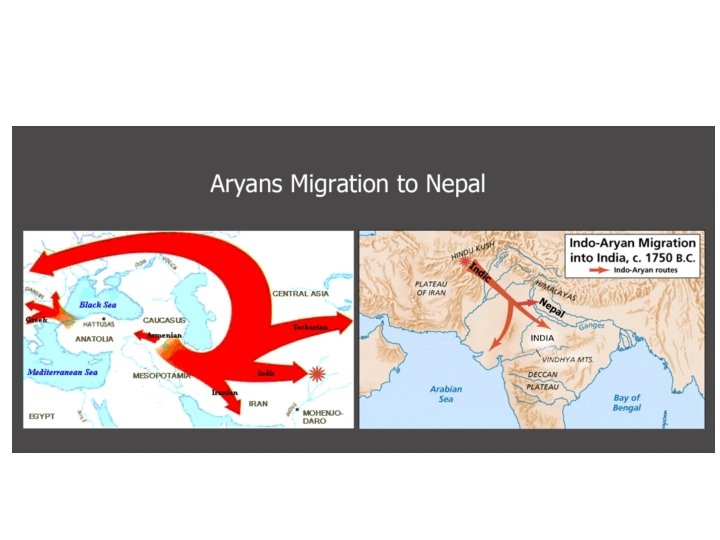
The Arrival of the Aryans • By 1500 BCE, Northern India was invaded by a large tribe of people known as the Aryans – Aryans conquered Indus Valley society and incorporated it into their own – Likely migrated from Eastern Europe, migrated to India across the Hindu-Kush Mountains, either escaping trouble or seeking food. • A migration is a mass-movement of people or animals
Dividing India • India was divided between the light skinned Aryans to the north and the dark skinned Dravidians to the South • These two cultures remained largely isolated for centuries

Aryans and Dravidians
Aryan Culture • Aryans divided their culture into 4 castes or Varnas – Castes are social classes into which you are born and can never leave – The First caste was the Warrior Caste • The leader of the Aryans, known as the Rajah came only from the Warrior Caste – Job was to protect and rule the Kingdom – The Second caste was the Priest Caste • Made offerings to the gods • Wrote the religious texts and histories of the people
Aryan Culture • The Third caste was the Merchants and Peasants Caste – Grew food, crafted clothing and other goods – Supplied tools and materials to the other castes • The Fourth caste was the Servant Caste – Did manual labor – Lowest of the castes
Aryan Culture • Aryans also had an unofficial fifth caste, known as the Dalit, or Untouchables – Did jobs that were considered ritually unclean, such as preparing the bodies of the dead – Considered the lowest of the castes, so low that higher castes could not touch them – Still face discrimination in India today, despite caste system being outlawed.
Aryan Culture • Aryans developed a written and spoken language known as Sanskrit – Sanskrit was a phonetic language • Aryans wrote their most important religious literature in Sanskrit – Known as the Vedas, they told stories of interactions between kings and gods – Because of this, this period in Indian history is known as the Vedic Period
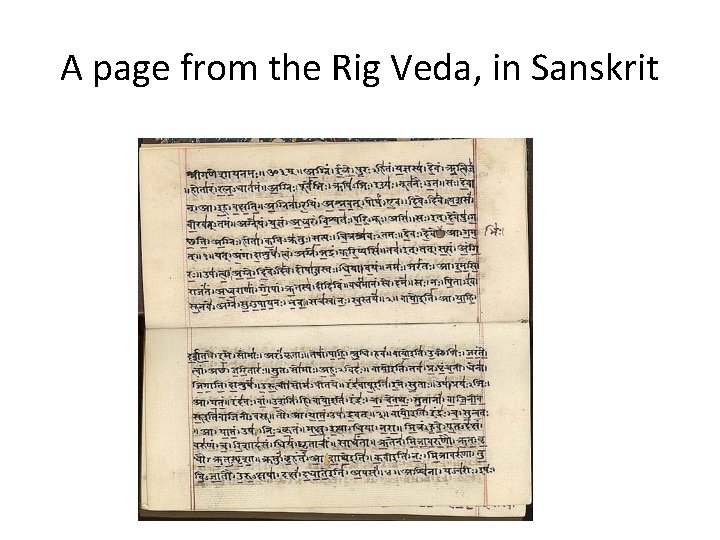
A page from the Rig Veda, in Sanskrit
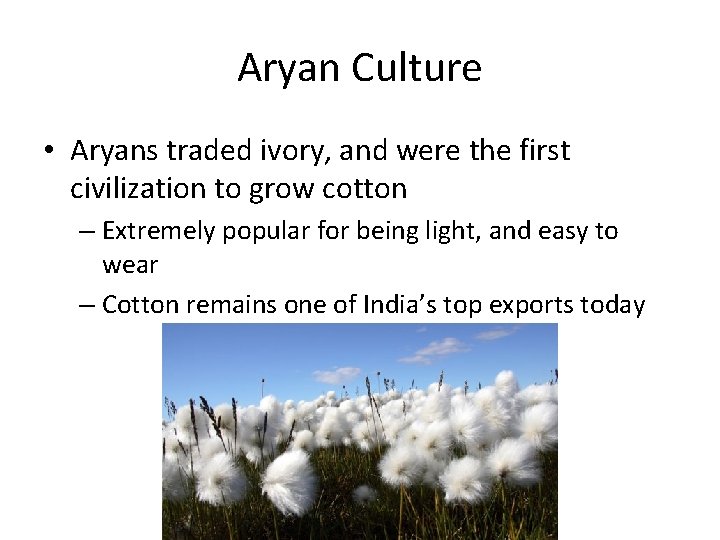
Aryan Culture • Aryans traded ivory, and were the first civilization to grow cotton – Extremely popular for being light, and easy to wear – Cotton remains one of India’s top exports today
Aryan religion • Aryans were polytheistic – Believed in many gods of nature • Strongly believed in the concept of reincarnation – Definition: The belief that upon death, the soul travels to a new body and inhabits it. – Believed that your actions in life determined what you would reincarnate as, known as Karma
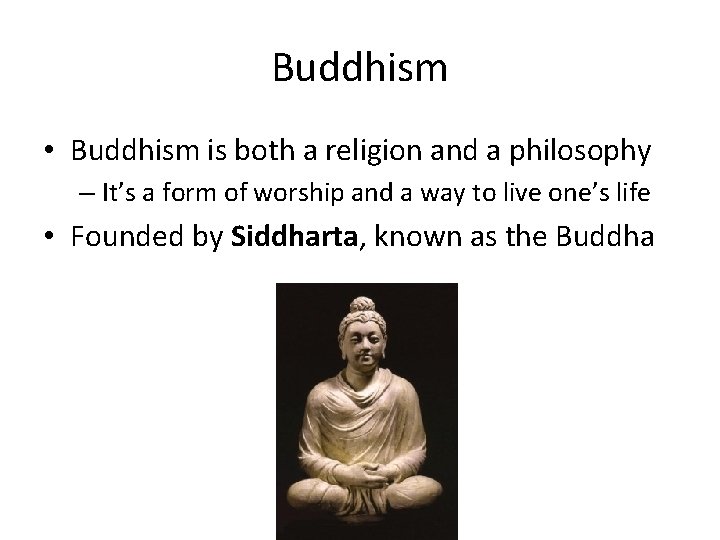
Buddhism • Buddhism is both a religion and a philosophy – It’s a form of worship and a way to live one’s life • Founded by Siddharta, known as the Buddha
Legend of Siddharta • Born the son of a rajah, who didn’t want him to see suffering of any kind – Lived his early life isolated, never knew sickness or hunger – During a chariot race, he saw a dying man and was horrified by the idea of death – Fled into the wilderness – Became an ascetic • Someone who denies themselves the pleasures of life in order to become closer to the divine
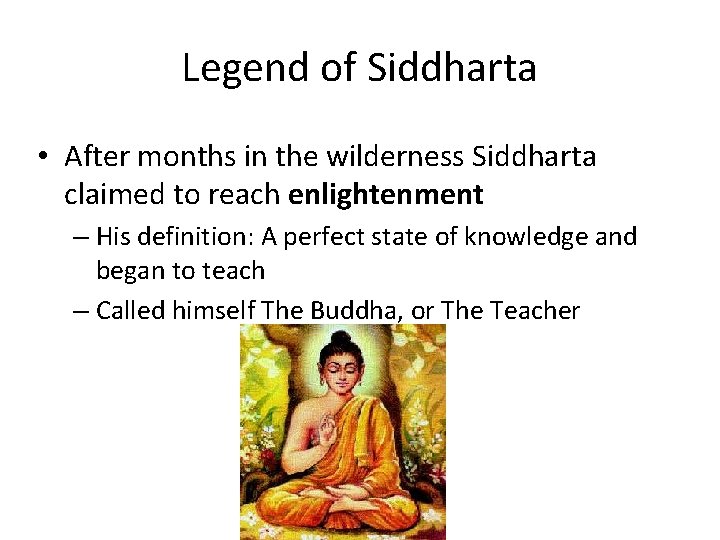
Legend of Siddharta • After months in the wilderness Siddharta claimed to reach enlightenment – His definition: A perfect state of knowledge and began to teach – Called himself The Buddha, or The Teacher
Teachings • Four Noble Truths – Pleasure is an illusion, life is full of suffering and sorrow – Sorrow is caused by people’s desire for possessions and pleasure. – Suffering will only end when people overcome their greed and find inner peace – The only way to free oneself is through prayer, meditation and purification to free the mind from want
Buddhism • Argued that the soul continued to reincarnate as long as it desired pleasure – By freeing the soul, it would be allowed to enter Nirvana, a place of eternal rest • Buddhism became extremely popular in India and later, China and Japan – Did not require regular sacrifices be made to the gods – Taught that everyone was equal, popular with lower castes – Taught that animal sacrifice was wrong
Spread of Buddhism • In 269 BCE, a powerful Aryan Rajah named Ashoka converted to Buddhism • A powerful warrior, after his conversion, vowed to never make war again • Abolished the Caste System in his kingdom • Spent much of his fortune sending missionaries to convert other cultures – Created a powerful empire known as the Mauryan Empire
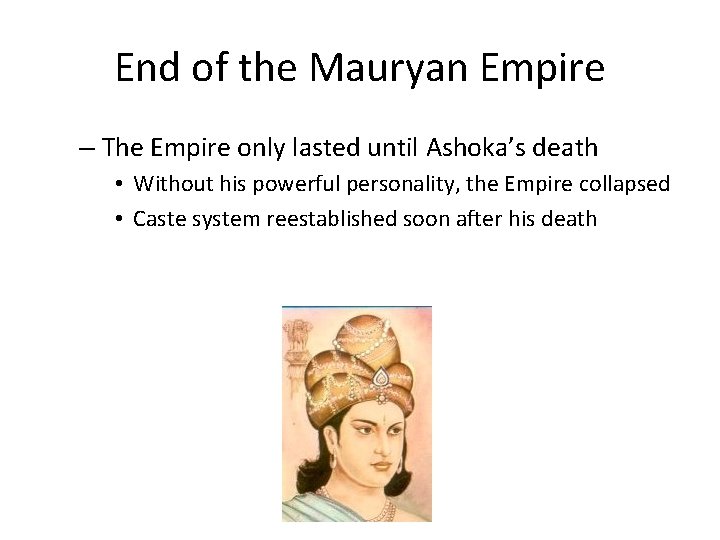
End of the Mauryan Empire – The Empire only lasted until Ashoka’s death • Without his powerful personality, the Empire collapsed • Caste system reestablished soon after his death
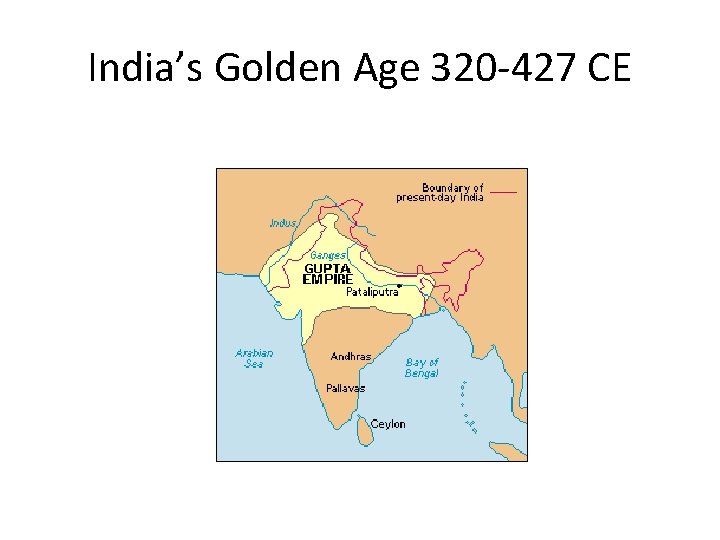
India’s Golden Age 320 -427 CE
The Rise of Hinduism • Currently most popular religion in India • Unlike other religions, the religion of Hinduism does not have a single founder, central organization system, or a single religious text – Hindus are allowed total freedom to worship as they choose
Beliefs of Hinduism • Hinduism believes in a single all-powerful spiritual force in the universe – This being takes three forms Brahma, the creator, Vishnu the Preserver, and Shiva the Destroyer – Believe that these beings interacted with humans in the form of avatars • Definition: Gods taking the bodies of men – Underneath these are a multitude of lesser spirits and gods known as the Devas
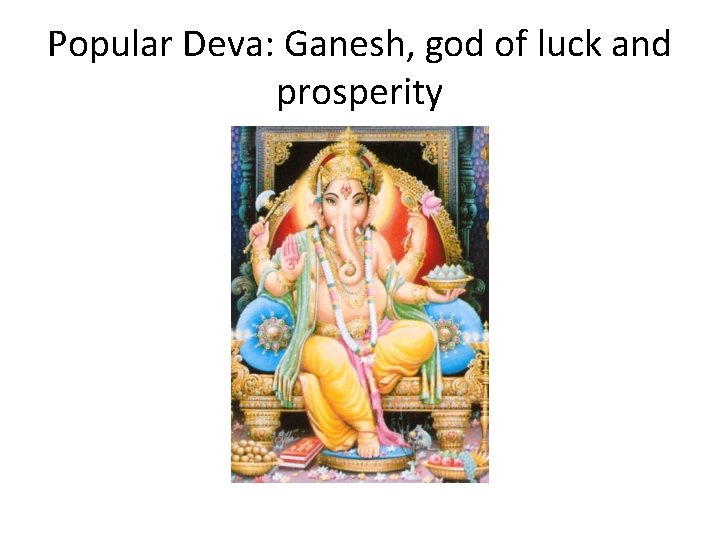
Popular Deva: Ganesh, god of luck and prosperity
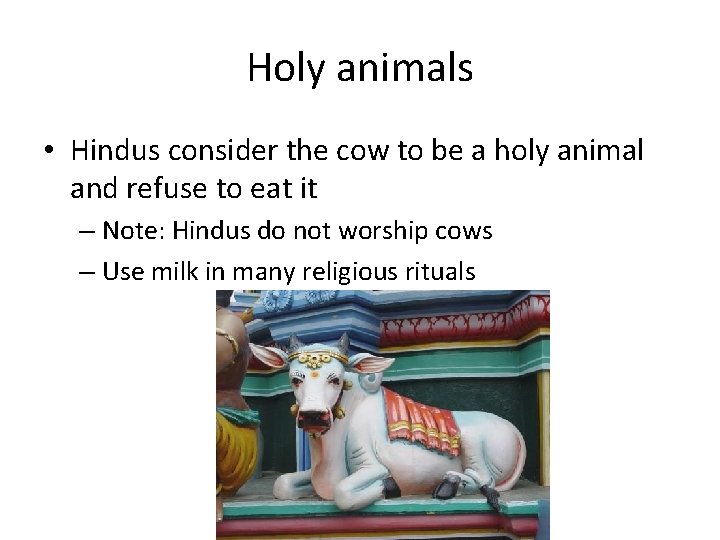
Holy animals • Hindus consider the cow to be a holy animal and refuse to eat it – Note: Hindus do not worship cows – Use milk in many religious rituals
Hindu Texts • Most famous text is the Bhagavad Gita – An epic poem, like the story of Gilgamesh – Tells the story of Vishnu aiding a Aryan Prince named Arjuna, and reminding him of his duty – Used as an example of how Hindus are supposed to live • The spread of Hindu writings led to a huge variety of different Hindu sects all across India
Importance of Hinduism • Hinduism emphasizes duty to the community – Considers the caste system to be very important • Famous teachers of the Hindu religion are known as gurus – Gurus developed a form of exercise known as Yoga • Designed to focus the mind and body in meditation

Yoga positions (sutras)
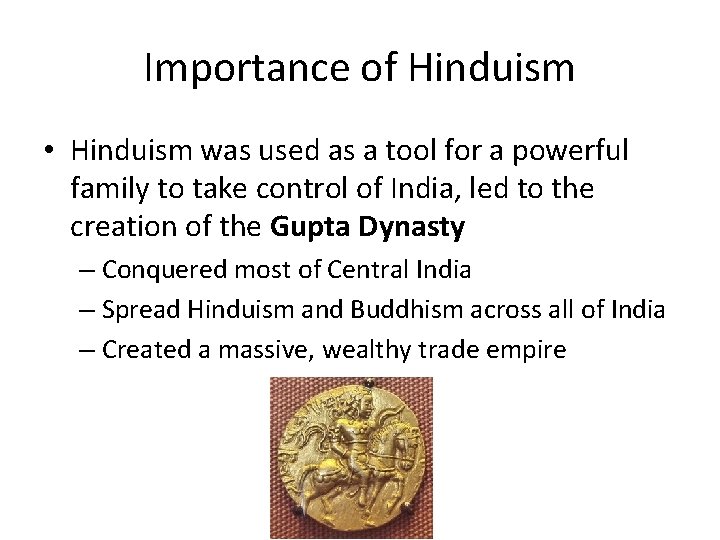
Importance of Hinduism • Hinduism was used as a tool for a powerful family to take control of India, led to the creation of the Gupta Dynasty – Conquered most of Central India – Spread Hinduism and Buddhism across all of India – Created a massive, wealthy trade empire
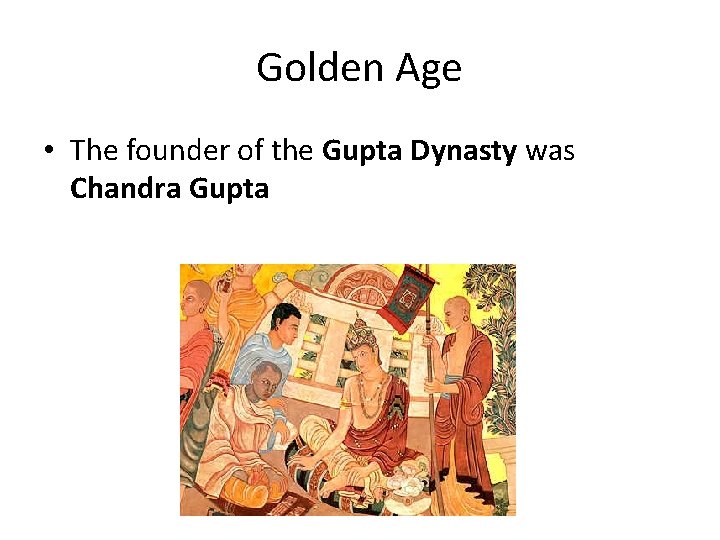
Golden Age • The founder of the Gupta Dynasty was Chandra Gupta
Golden Age • Created trade routes that connected China to Rome – Traded luxury goods including pearls, gems, spices, and fine clothing for gold and salt from Europe and Arabia
Scientific Advances of the Gupta • The Gupta Emperors paid handsomely for scholars and scientists to work at the court • Gupta discoveries – The famous Gupta scientist Aryabhata discovered that the Earth was a sphere and revolved around the sun – Discovered that a year was 365 days long
Gupta Discoveries • Developed the modern number system with 9 digits – Independently discovered the concept of zero – Mastered ironwork • Created the Pillar of Mehrauli, a 23 foot high solid iron tower. – Europeans incapable of a similar feat for nearly 1000 years – Despite facing hundreds of monsoons, the perfectly made pillar shows little signs of rusting
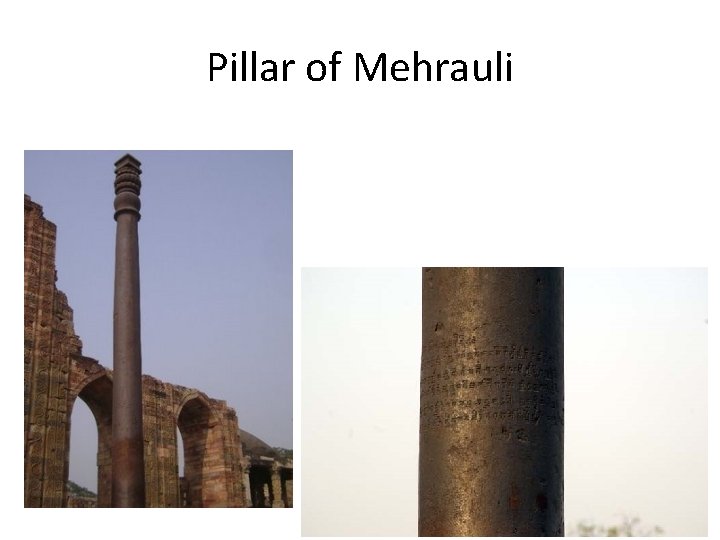
Pillar of Mehrauli
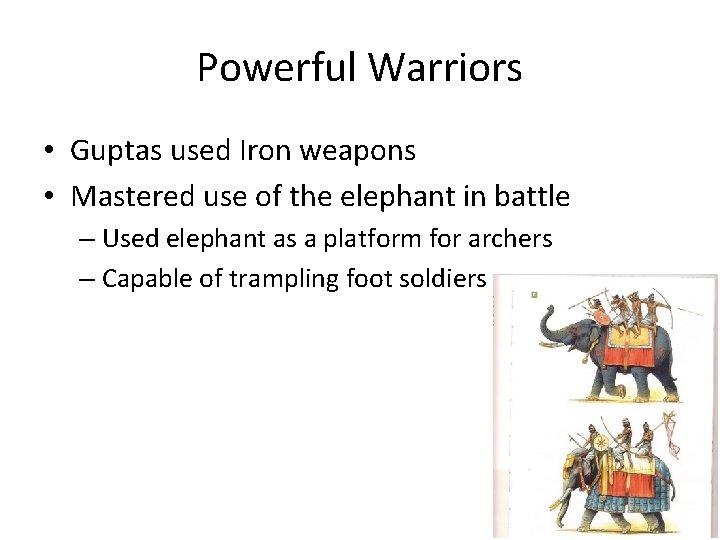
Powerful Warriors • Guptas used Iron weapons • Mastered use of the elephant in battle – Used elephant as a platform for archers – Capable of trampling foot soldiers
Fall of the Gupta Empire • Gupta Empire reached its height by 399 • In 460, the Gupta Empire was invaded from the north and destroyed by the Huns – A group of nomadic raiders – Huns laid waste to Gupta cities – India would not see another powerful empire for over 1000 years
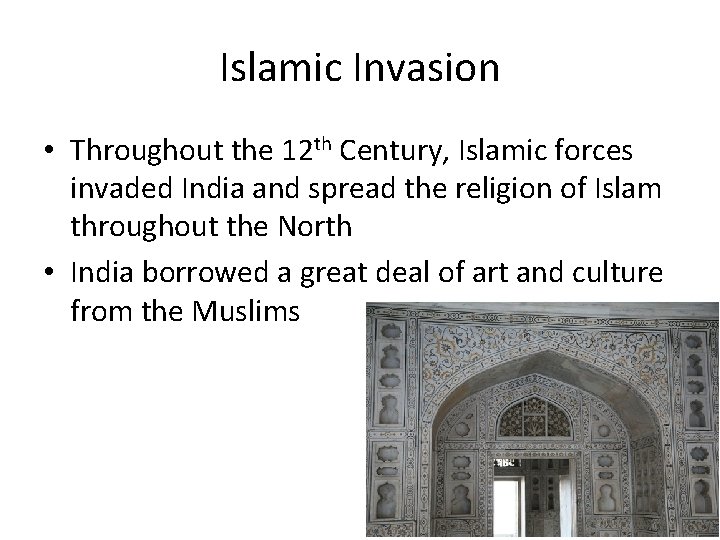
Islamic Invasion • Throughout the 12 th Century, Islamic forces invaded India and spread the religion of Islam throughout the North • India borrowed a great deal of art and culture from the Muslims
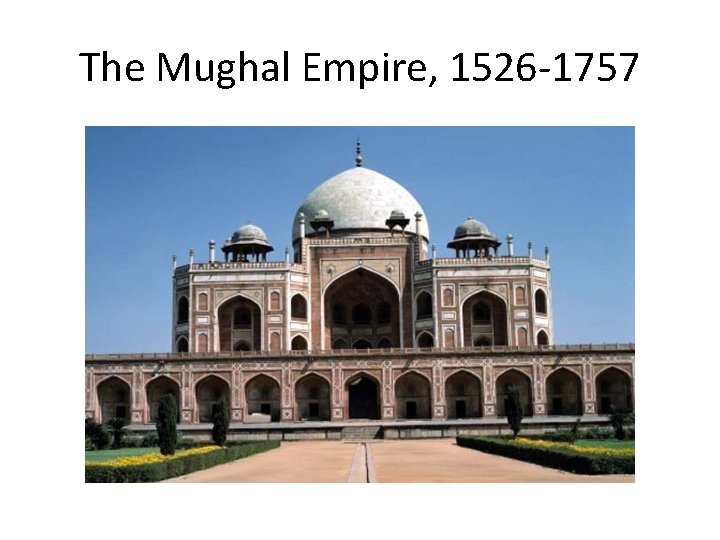
The Mughal Empire, 1526 -1757
Founding the Mughal Empire • Prior to the creation of the Empire, India was split into tiny kingdoms known as Rajputs • 1 st Mughal ruler known as Akbar the Great, created a series of alliances with the Rajputs and used this power to conquer numerous other kingdoms – Eventually conquered most of the Indian subcontinent
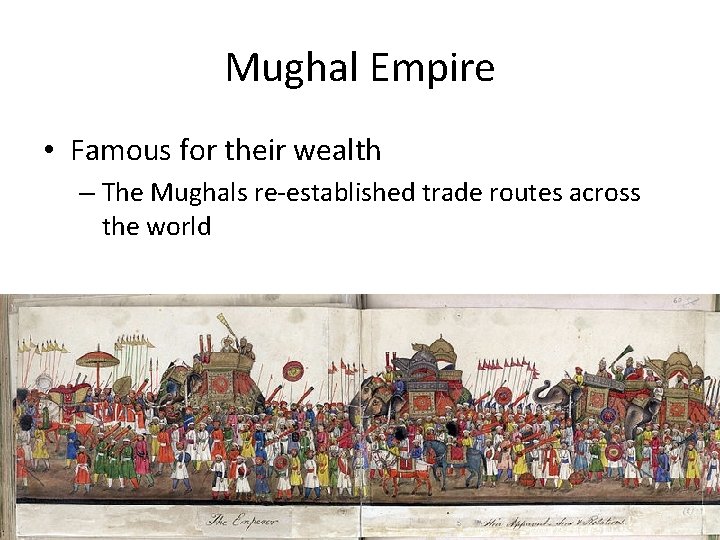
Mughal Empire • Famous for their wealth – The Mughals re-established trade routes across the world
Taj Mahal • Greatest Mughal palace is known as the Taj Mahal (crown of palaces) • Designed by Mughal ruler Shah Jahan as a mausoleum for his beloved wife • Meant to build an identical black palace across from the Taj Mahal, but died before its construction was completed
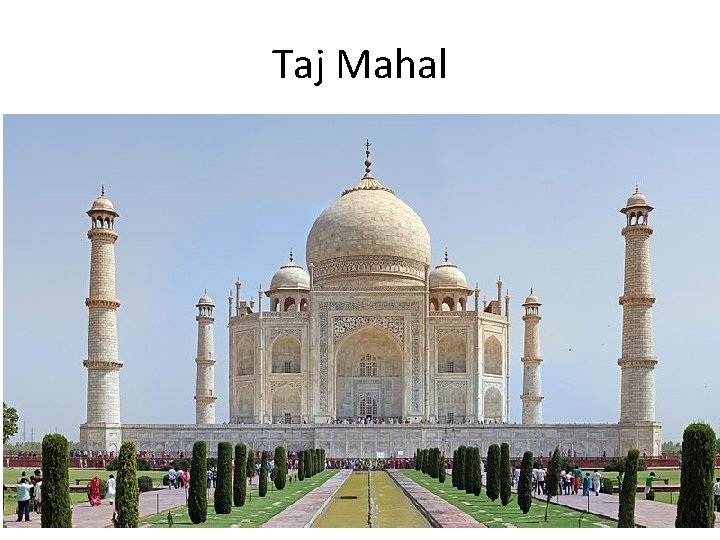
Taj Mahal
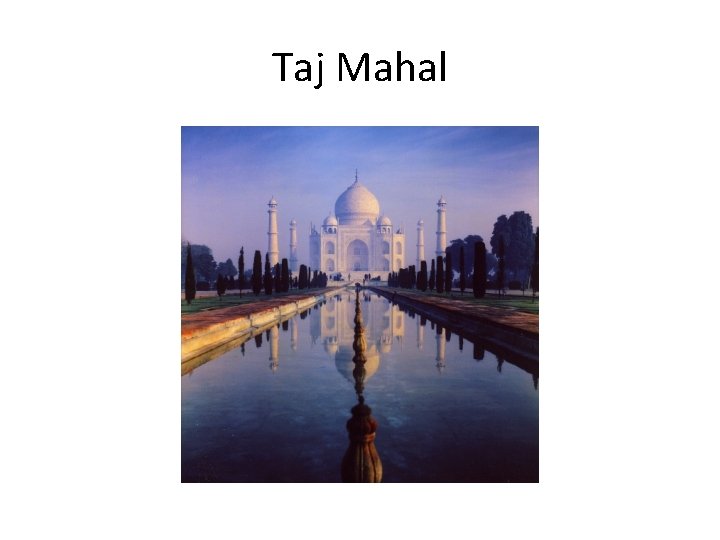
Taj Mahal
Fall of the Mughal Empire • The Mughal Empire was conquered by the British during the 18 th Century • India would not regain its independence until after World War II
- Slides: 52