
Ancient India and China 2600 B C A

Ancient India and China (2600 B. C. -A. D. 550) Lesson 2 The Origins of Hinduism and Buddhism
Ancient India and China (2600 B. C. -A. D. 550) Lesson 2 The Origins of Hinduism and Buddhism Learning Objectives • Describe the origins and central beliefs of Hinduism. • Analyze and summarize how the caste system shaped India. • Describe the origins and central beliefs of Buddhism. • Explore how Buddhism grew and changed as it spread beyond India.
Ancient India and China (2600 B. C. -A. D. 550) Lesson 2 The Origins of Hinduism and Buddhism Terms • Key Atmanthe soul • Moksha- liberation from cycle of reincarnation- union with Brahman • Reincarnation- the cycle of rebirth • Karma- the effect of good or bad deeds • dharma- the religious and moral duties of an individual • Ahimsa- strict nonviolence
• Castes- social groups into which people are born • Siddhartha Gautama- founder of BUddhism • Four Noble Truths- teachings central to Judaism regarding nature of life • Eightfold Path- the actions and steps needed to lead a good life • Nirvana- union with universe; release from reincarnation • Sects- subgroups usually within a religion
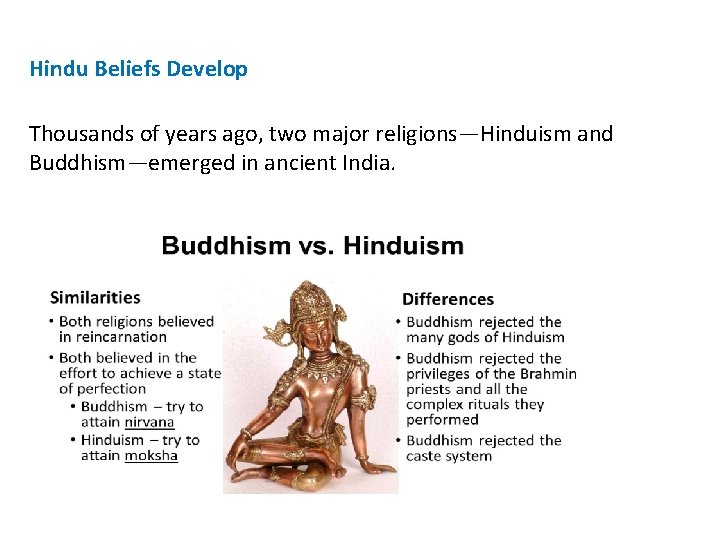
Hindu Beliefs Develop Thousands of years ago, two major religions—Hinduism and Buddhism—emerged in ancient India. The ethical and spiritual messages of these religions profoundly shaped Indian civilization.
Hindu Beliefs Develop • One Force Unites Everything • “God is one, but wise people know it by many names” • Brahman- the unchanging all-powerful spiritual force • Brahman too complex so many dieties worshipped • Hindu Trinity- Brahma- creator, Vishnupreserver and Shiva- destroyer • Sacred Texts Show Hindu Beliefs • Vedas- library of books collecting teachings • Upanishads- most recent section of Vedas • Achieving Moksha Is the Goal of Life for Hindus • Moksha is unity of atman with Brahman/ freedom from reincarnation
• To get there, love and serve God unconditionally- free from selfish desires • According to Hindus, keep reincarnating into different forms until release • Karma and Dharma • Good actions lead to good consequences, and vice versa • Karma at death determines what level you will be reborn • To escape rebirth, follow dharma- carry out moral and religious obligations • Ahimsa- strict nonviolence
• Jainism • Developed from Hinduism, founded by Mahavira • Rejected the caste system, and the priesthood • Stressed meditation, self denial, and extreme ahimsa • Are strict vegetarians, may wear face masks, and carry a broom to sweep insects.
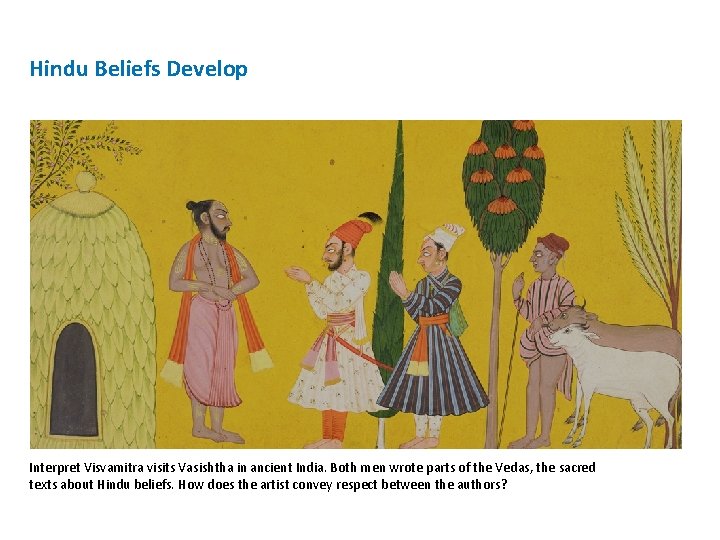
Hindu Beliefs Develop Interpret Visvamitra visits Vasishtha in ancient India. Both men wrote parts of the Vedas, the sacred texts about Hindu beliefs. How does the artist convey respect between the authors?
The Caste System Shapes India The Aryans divided society into four groups. Non-Aryans held the lowest jobs. During the Vedic Period, class divisions moved more toward reflecting social and economic roles. As these changes occurred, they eventually led to a more complex system of castes, or social groups into which people are born and which can rarely be changed.
The Caste System Shapes India
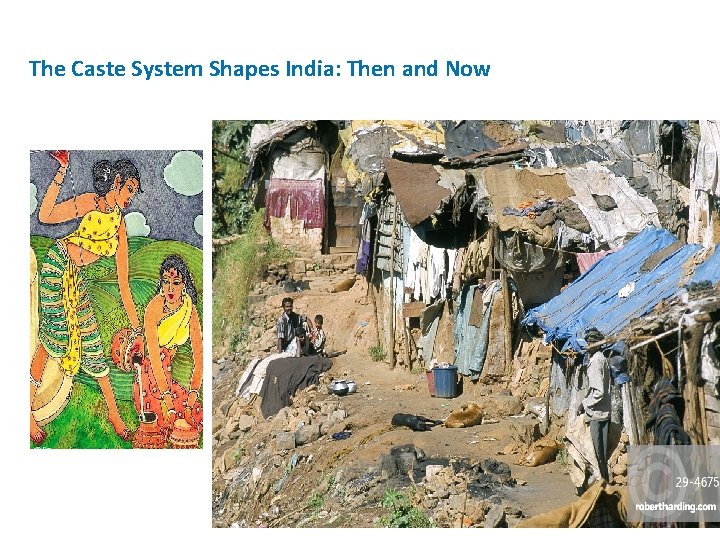
The Caste System Shapes India: Then and Now
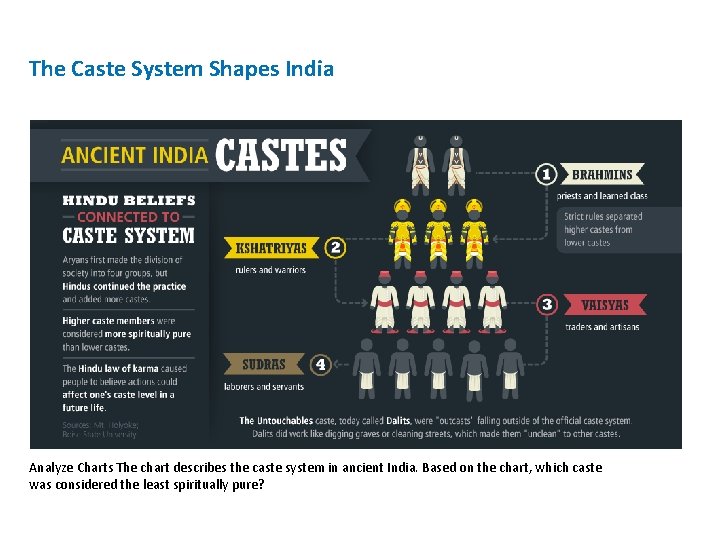
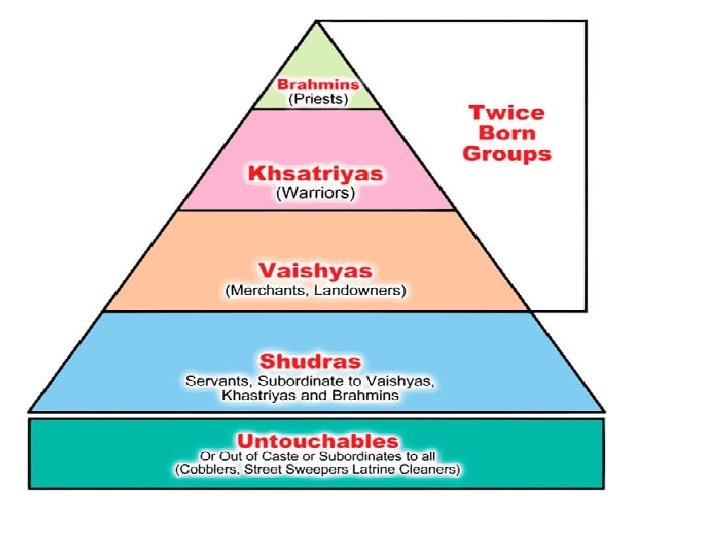
The Caste System Shapes India Analyze Charts The chart describes the caste system in ancient India. Based on the chart, which caste was considered the least spiritually pure?
The Buddha’s Key Teachings More than 2, 500 years ago, warring princes battled across the northern plain of India. During this troubled time, Brahmin priests acquired great power by insisting they alone could perform the sacred rites to bring victory in battle or ensure adequate rainfall. Reformers rejected Brahmin domination and offered other paths to truth.
• From Boy to Buddha The Buddha’s Key Teachings • Siddhartha Gautama is the founder of Buddhism • His religion starts in India but gains popularity in China • Buddha was born a prince, surrounded by luxury, but then he became aware of human suffering • He left home to discover how to end suffering • Gautama Gains Enlightenment • He wandered around, then fasted and meditated. Eventually he reached enlightenment under this tree.
The Four Noble Truths These are the basic beliefs of Buddhism to end desire In order to overcome desire ( root cause of pain) must follow eightfold path 1. LIFE IS SUFFERING 2. SUFFERING IS CAUSED BY DESIRE 3. END SUFFERING, END DESIRE 4. END DESIRE, FOLLOW 8 -FOLD PATH
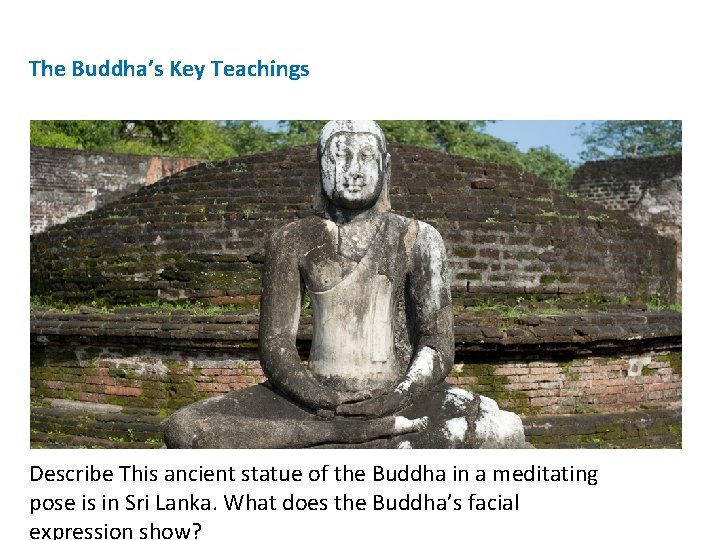
The Buddha’s Key Teachings Describe This ancient statue of the Buddha in a meditating pose is in Sri Lanka. What does the Buddha’s facial expression show?
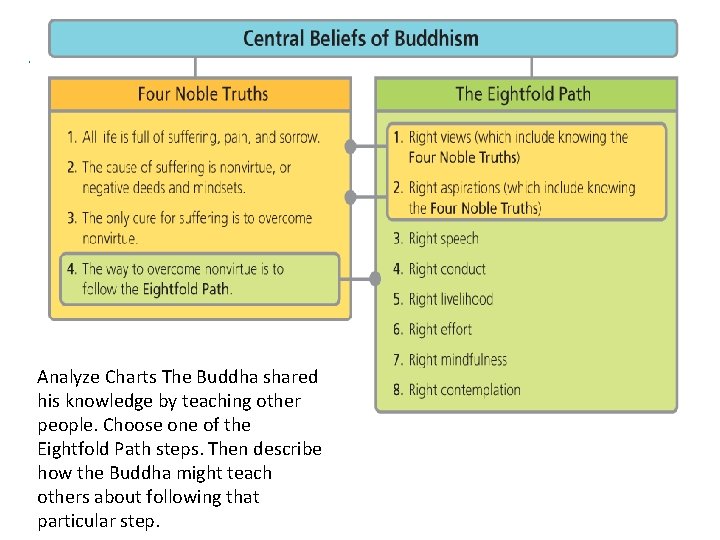
The Buddha’s Key Teachings Analyze Charts The Buddha shared his knowledge by teaching other people. Choose one of the Eightfold Path steps. Then describe how the Buddha might teach others about following that particular step.
Buddhism Spreads The Buddha attracted many disciples, or followers, who accompanied him as he preached across northern India. Many men and women who accepted the Buddha’s teachings set up monasteries and convents for meditation and study. Some Buddhist monasteries grew into major centers of learning.
• Collecting the Teachings of the Buddha Buddhism Spreads • After his death- followers collected teachings in Tripitaka- (three baskets) • Two Branches of Buddhism • Theravada: closely follow Buddha’s original teachings- requires a life of self sacrifice and dedication- minority follow this path. – Do not worship the Buddha • Mahayana- majority follow this- easier to follow – they worship Buddha even though he forbade it
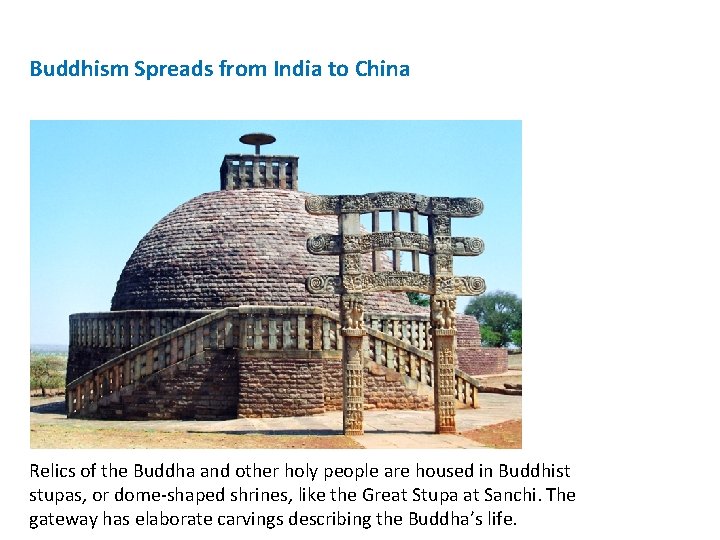
Buddhism Spreads from India to China Relics of the Buddha and other holy people are housed in Buddhist stupas, or dome-shaped shrines, like the Great Stupa at Sanchi. The gateway has elaborate carvings describing the Buddha’s life.
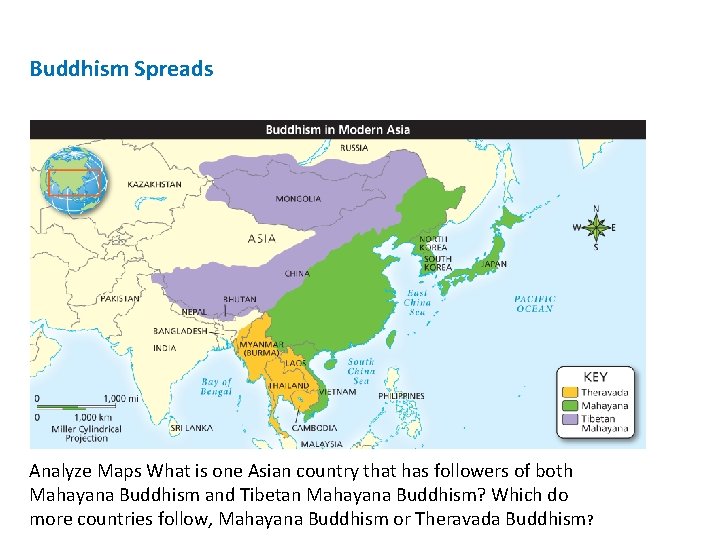
Buddhism Spreads Analyze Maps What is one Asian country that has followers of both Mahayana Buddhism and Tibetan Mahayana Buddhism? Which do more countries follow, Mahayana Buddhism or Theravada Buddhism?
Quiz: Hindu Beliefs Develop What is dharma? A. the rebirth of the soul in another bodily form B. union with Brahman C. an individual's moral and religious duties D. the essential self
Quiz: The Caste System Shapes India What changes took place in India’s caste system over time? A. People are being assigned to new castes in India today. B. India's untouchable caste has grown more powerful. C. Castes merged over time due to new jobs, sacred texts, and customs. D. Over time, additional castes and subcastes were formed.
Quiz: The Buddha’s Key Teachings What is one way that Buddhism differs from Hinduism? A. Buddhism has many different gods and spiritual practices. B. Buddhism recognizes that people are all interconnected. C. Buddhism urges each person to seek enlightenment through meditation. D. Buddhism rejects karma, dharma, and the cycle of rebirth.
Quiz: Buddhism Spreads Why did Mahayana Buddhism have mass appeal in some places? A. It closely followed the Buddha’s original teachings. B. It was easier for ordinary people to follow. C. It required people to worship Buddha and other gods. D. It described an afterlife that hastened rebirth into one’s next reincarnation.
- Slides: 27