
Ancient Greece Early Greek Civilizations Minoans Bronze age
Ancient Greece
Early Greek Civilizations � Minoans ØBronze age civilization founded around 2800 BCE on the island of Crete ØFlourished between 2700 and 1450 BCE ØSeafaring culture (Southern Greece and Egypt) ØKnossos (main port city) ØEnding unknown – speculation by historians Ø Tidal wave caused by a volcanic eruption Ø Invasion of mainland Greeks, Mycenaeans
Early Greek Civilizations Ø Mycenaeans ØMycenae – first Greek state ØThrived between 1600 and 1100 BCE, height between 1400 and 1200 BCE ØAlliance of powerful monarchies ØWarrior culture ØExtensive commercial network (trading) ØMycenaean states began fighting each other and earthquakes damage the states ØCollapsed 1100 BCE – Invaders from the North
Dark Ages of Greece � 1100 to 750 BCE � Few records exist � Transition to the Iron Age � Phoenician Alphabet � Homer epic poet who writes The Iliad and The Odyssey � Iliad – During the Trojan War � Odyssey – Odysseus’ journey home after the Trojan War � Used to educate Greek males in their system of values of honor, courage and arête (the struggle for excellence)
Polis (city-state) � City where people met for political, economic, social, and religious activities � Acropolis- main gathering place on a hill � Agora – open area below for people to assemble and have a market � Sizes varied from a few hundred to several thousand people � Three classes ØCitizens with political rights ØCitizens without political rights ØNoncitizens
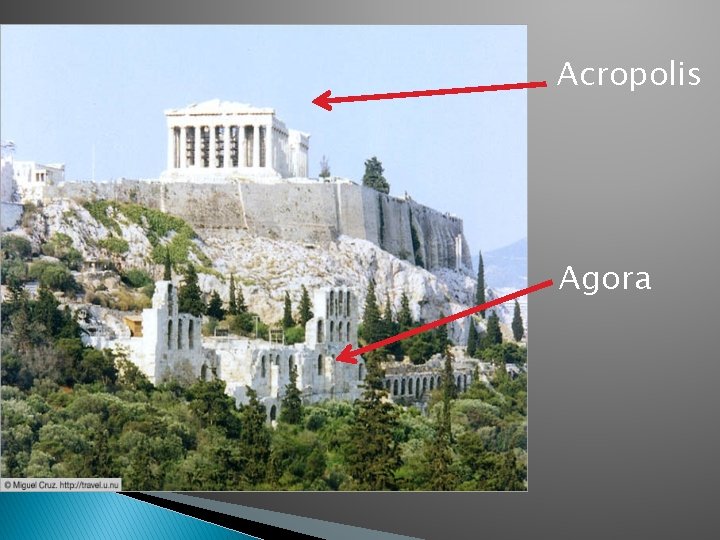
Acropolis Agora
Military System � Developed 700 BCE � Hoplites -Infantry who carried a shield, sword, and spear � Phalanx – Formation where hoplites fought shoulder to shoulder
Greek Colonies � 750 to 500 BCE Greeks began to colonize distant lands ◦ Reasons? � Each colony became a new polis � Most notable was Byzantium (Constantinople then Istanbul)
Different Political Systems � Tyrants - wealthy men who seize power from ruling aristocrats ØNormally supported by peasants ØEventually this type of ruler disappears – their rule contradicts Greek ideals of law ØNew governments emerge Ø Democracy – Ruled by many (Athens) � Oligarchy – Ruled by few (Sparta)
Sparta � Approximately 900 to 146 BCE � Military state that gained land by conquering � Conquered people became Helots - Serfs who worked for the Spartans � Men joined the military at 20 and served until 60 � They could vote in the assembly at 30 and move out of the barracks � Women had more freedom here than in other Greek city states
Spartan Oligarchy � Two kings � Ephors – Five men responsible for education of Spartan youth and citizens’ conduct � Council of two kings and 28 men over 60 decide issues for the assembly to vote on � Assembly only voted, no debates
Beginning of Athenian Democracy � Athens saw various ruling styles early on (monarchy, oligarchy, tyranny) � Athenian democracy gets its start under Cleisthenes (508 BCE) ØCreates a council of 500 to propose laws, supervise in treasury, and foreign affairs ØFree and open debate allowed prior to voting
Age of Pericles � After defeating the Persian army and navy Athens forms the Delian League � Athens – leader of the Greek world � Pericles – prime figure in Athenian politics from 461 to 429 BCE � Empire expands � Direct democracy developed where decisions are made through mass meetings by the general assembly
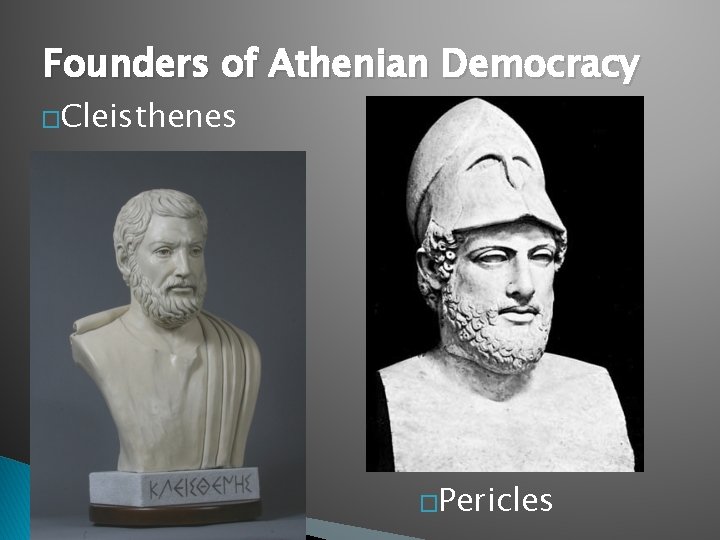
Founders of Athenian Democracy �Cleisthenes �Pericles
Direct Democracy � Every male citizen could participate in general assembly and vote on major issues � Most residents of Athens are not citizens � 43, 000 males over 18 made up the assembly, only 1, 000 attended regularly � To expand democracy, Pericles made lowerclass male citizens eligible for public office � Ostracism – 6, 000 members needed to vote to exile any person from Athens
School of Greece � Athens becomes the center for Greek culture ØArt ØArchitecture ØPhilosophy
Greek Philosophy � Philosophy – organized system of rational thought � Early concern was with the nature of the universe and connecting it under unifying principles � Famous philosophers ØPythagoras ØSocrates ØPlato ØAristotle
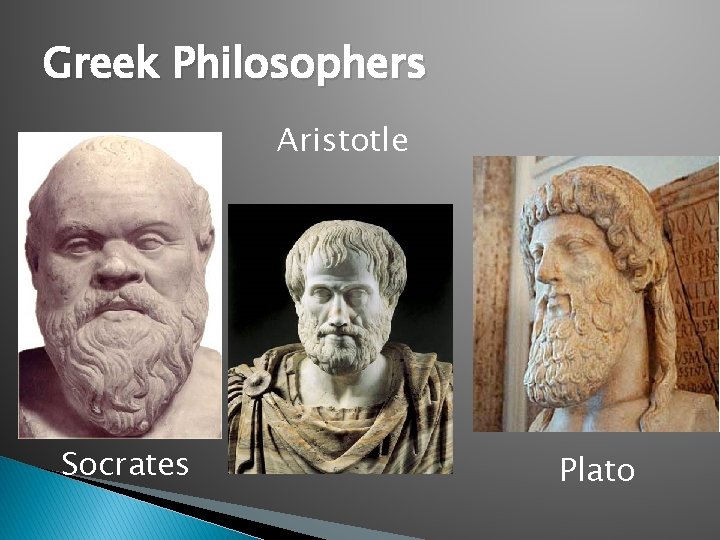
Greek Philosophers Aristotle Socrates Plato
Peloponnesian War � Athens vs. Sparta starts in 431 BCE � Plague breaks out in Athens 430 BCE Ø 1/3 of the people are killed Ø 429 BCE Pericles dies � War goes on until a Spartan victory in 405 BCE � Weakened Greek city-states and ruined cooperation among them � The next 66 years Athens, Sparta, and Thebes fight for the top spot � Macedonia is growing more powerful, but is ignored
Potpourri on Greece Ø Religion ØPolytheistic ØTemples dedicated to major gods and goddesses with frequent festivals to honor them Ø Drama ØTragedies examined universal themes ØComedies developed later – main purpose was to criticize society and get a reaction
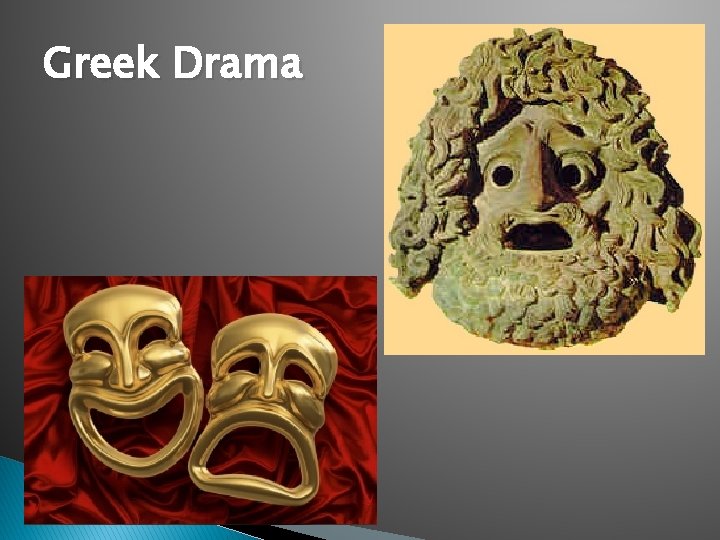
Greek Drama
Potpourri on Greece Ø Writing of History Ø Herodotus - History of the Persian Wars Ø More of a storyteller than historian Ø Thucydides - History of the Peloponnesian War Ø Explained events based on human actions rather than divine intervention Ø Believed studying history was beneficial for understanding the present Ø Art Ø Expressed eternal ideals Ø Chief subject matter - an ideally beautiful human being Ø Parthenon
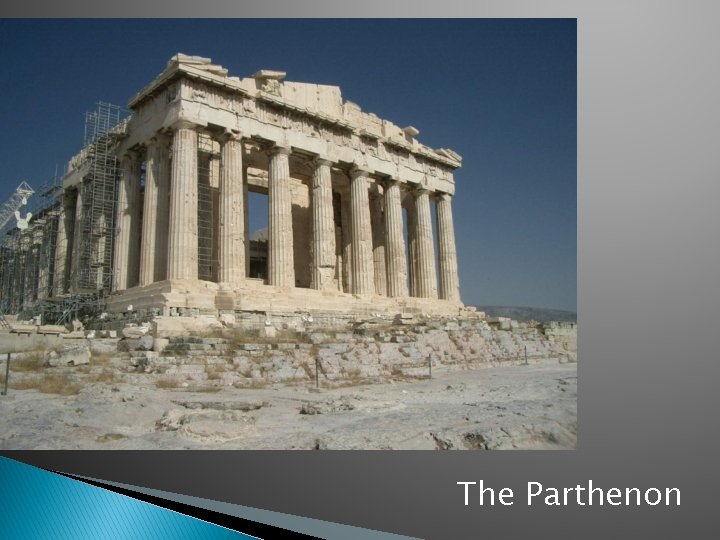
The Parthenon
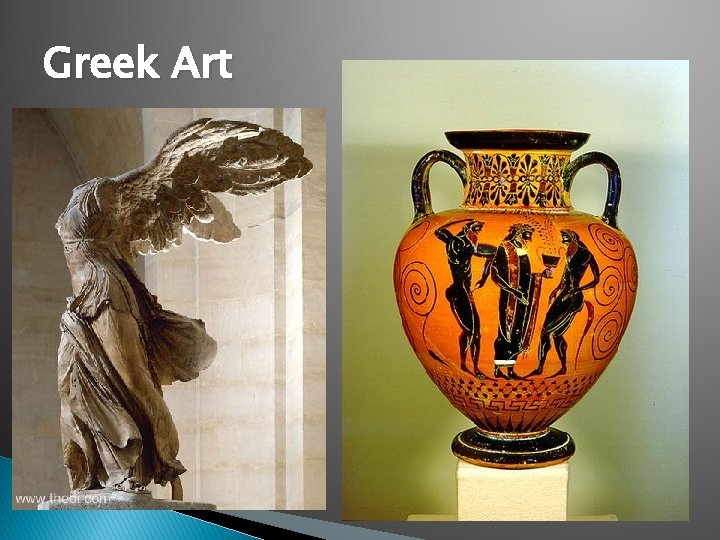
Greek Art
Macedonia � Greeks thought that the Macedonians were barbarians due to lack of city-states (rural) � During the 5 th century BCE they become a powerful kingdom � Phillip II – King of Macedonia ◦ Wanted to unite all of Greece under Macedonia rule ◦ Assassinated before he could unite conquered Greek city-states and Macedonia to conquer Persia ◦ His son, Alexander, takes the throne
Alexander the Great � Educated by Aristotle � Taught military tactics and leadership by his father � by 331 BCE Persia had been conquered by Alexander and the Macedonian/Greek army ◦ City of Alexandria (Egypt) named after him � 326 to 323 BCE He tried conquering India ◦ His men refused to continue ◦ They returned in 323 BCE ◦ Alexander dies in Babylon that same year from wounds, fever, and consumption of alcohol
Hellenistic Era � “To imitate Greeks” � Expansion of Greek Language and ideas to non-Greek world of Southwest Asia and beyond � After Alexander dies – empire falls and his generals fight for power � Four Hellenistic Kingdoms ◦ Macedonia, Syria, Pergamum (western Asia Minor), and Egypt (all later conquered by Romans)
Hellenistic Era � Achievements in science and philosophy � Alexandria the center of scholars � Had the largest library of its kind containing 5, 000 scrolls
Significant People � Eratosthenes ◦ Earth is round and estimated the circumference (almost correct) � Euclid ◦ Textbook on plane geometry, The Elements � Archimedes ◦ Established the value of pi and work with geometry ◦ Invented machines that would repel attackers from a siege on the city
New Philosophies � Epicureanism ◦ Belief that humans were free to follow self-interest ◦ Happiness was the goal in life ◦ Achieved by having freedom from anxiety that comes from a mind at rest � Stoicism ◦ Happiness is gained by living in harmony with the will of God ◦ Life’s problems could not disturb a person, if achieved ◦ Public service is noble
- Slides: 30