
ANCIENT EGYPT Todays Date October 9 th 2018
ANCIENT EGYPT Today’s Date: October 9 th, 2018 Today’s Page Number: 26 Today’s Title: Ancient Egypt Today’s Essential Question: What made Egypt a successful civilization?
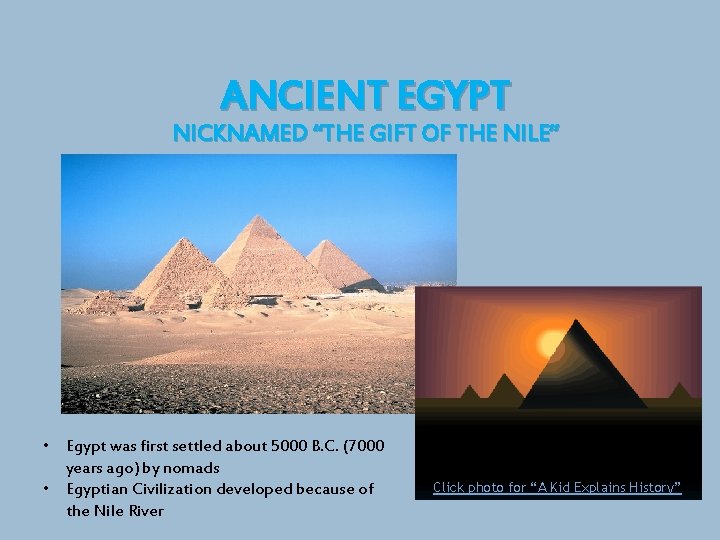
ANCIENT EGYPT NICKNAMED “THE GIFT OF THE NILE” • Egypt was first settled about 5000 B. C. (7000 years ago) by nomads • Egyptian Civilization developed because of the Nile River Click photo for “A Kid Explains History”
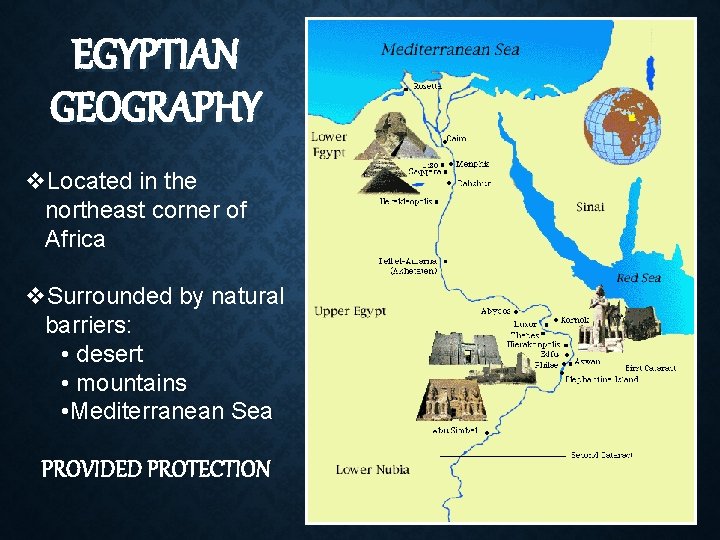
EGYPTIAN GEOGRAPHY v. Located in the northeast corner of Africa v. Surrounded by natural barriers: • desert • mountains • Mediterranean Sea PROVIDED PROTECTION
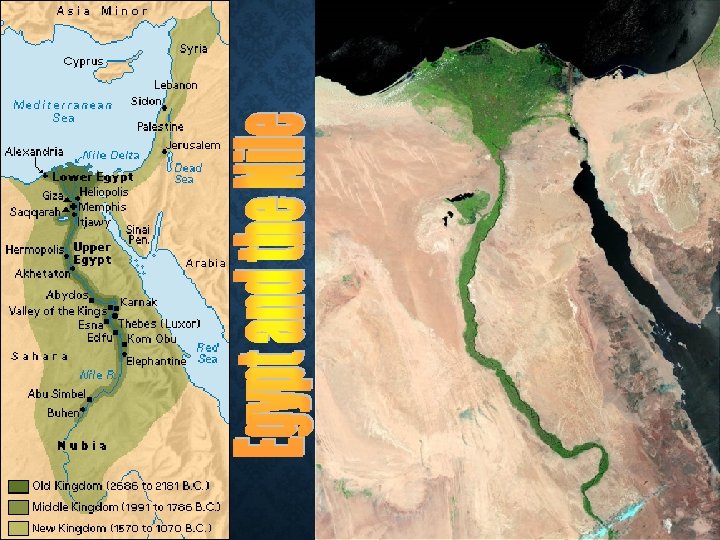
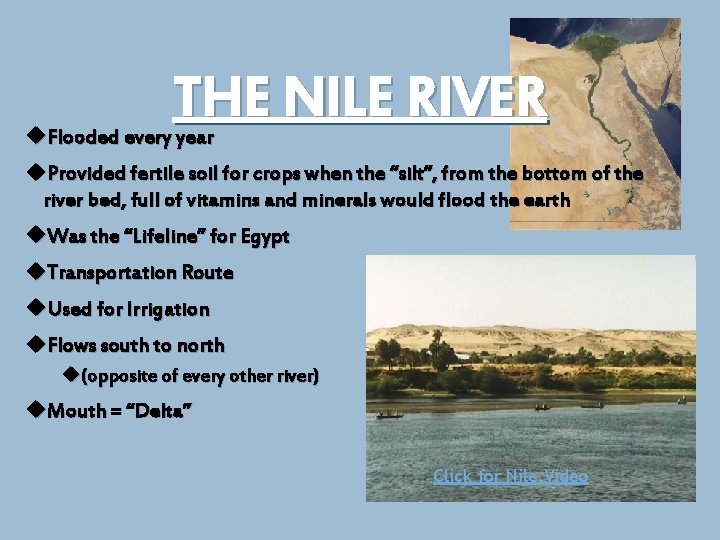
THE NILE RIVER Flooded every year Provided fertile soil for crops when the “silt”, from the bottom of the river bed, full of vitamins and minerals would flood the earth Was the “Lifeline” for Egypt Transportation Route Used for Irrigation Flows south to north (opposite of every other river) Mouth = “Delta” Click for Nile Video
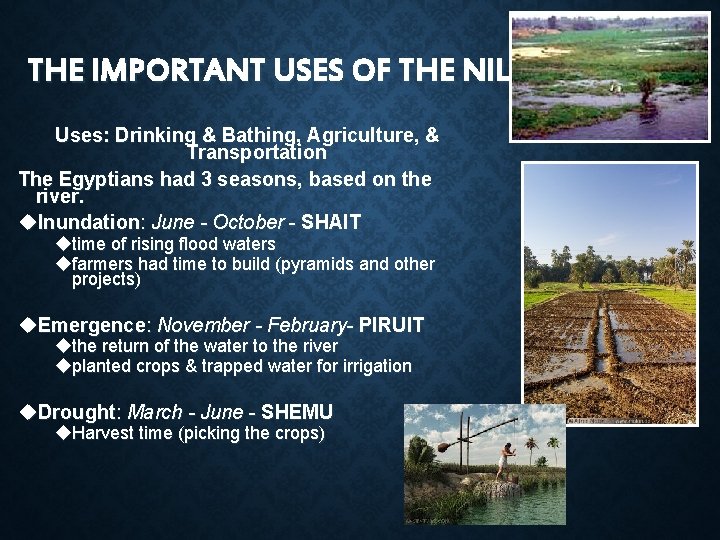
THE IMPORTANT USES OF THE NILE Uses: Drinking & Bathing, Agriculture, & Transportation The Egyptians had 3 seasons, based on the river. Inundation: June - October - SHAIT time of rising flood waters farmers had time to build (pyramids and other projects) Emergence: November - February- PIRUIT the return of the water to the river planted crops & trapped water for irrigation Drought: March - June - SHEMU Harvest time (picking the crops)
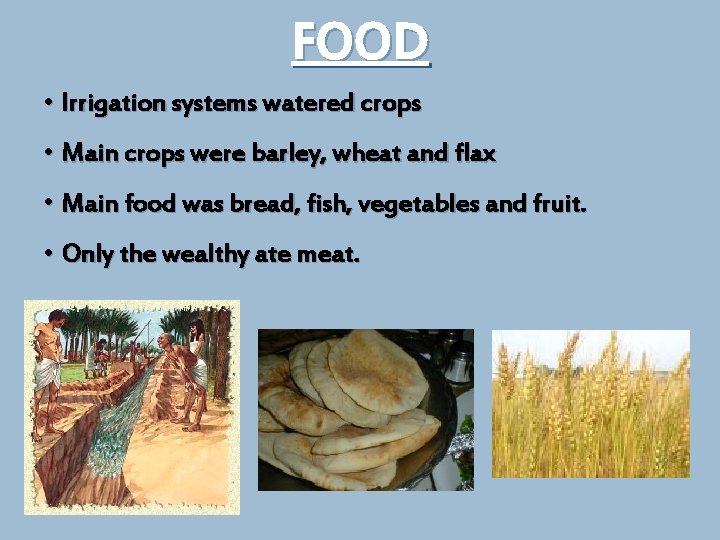
FOOD • Irrigation systems watered crops • Main crops were barley, wheat and flax • Main food was bread, fish, vegetables and fruit. • Only the wealthy ate meat.
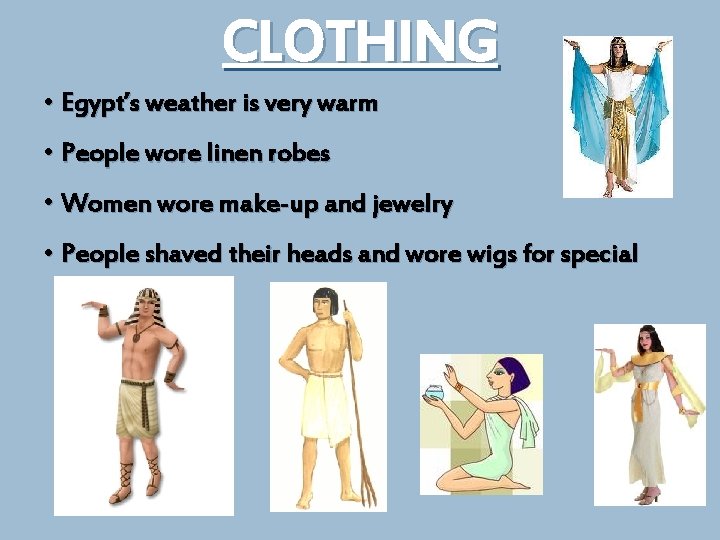
CLOTHING • Egypt’s weather is very warm • People wore linen robes • Women wore make-up and jewelry • People shaved their heads and wore wigs for special occasions.
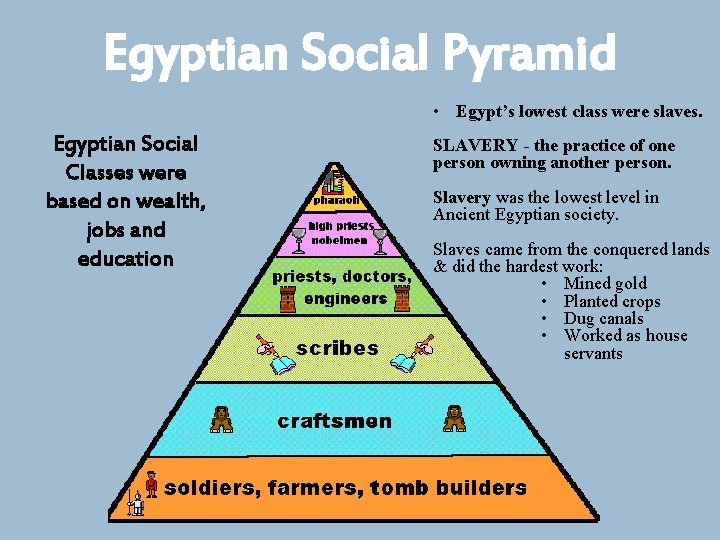
Egyptian Social Pyramid • Egypt’s lowest class were slaves. Egyptian Social Classes were based on wealth, jobs and education SLAVERY - the practice of one person owning another person. Slavery was the lowest level in Ancient Egyptian society. Slaves came from the conquered lands & did the hardest work: • Mined gold • Planted crops • Dug canals • Worked as house servants
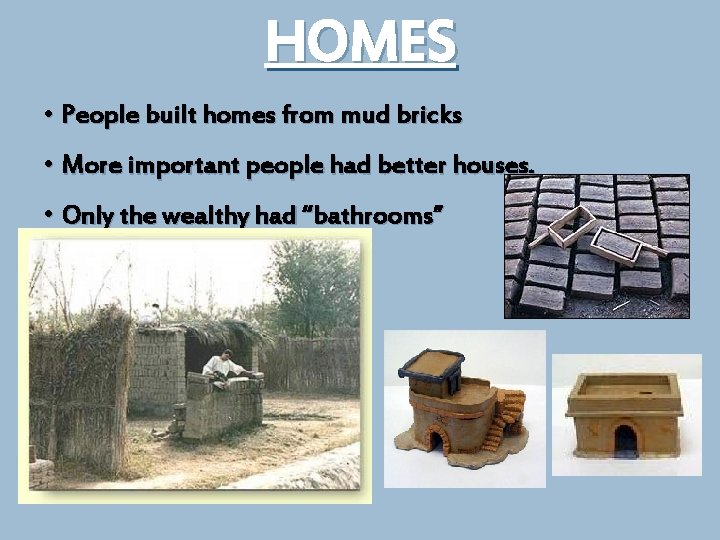
HOMES • People built homes from mud bricks • More important people had better houses. • Only the wealthy had “bathrooms”
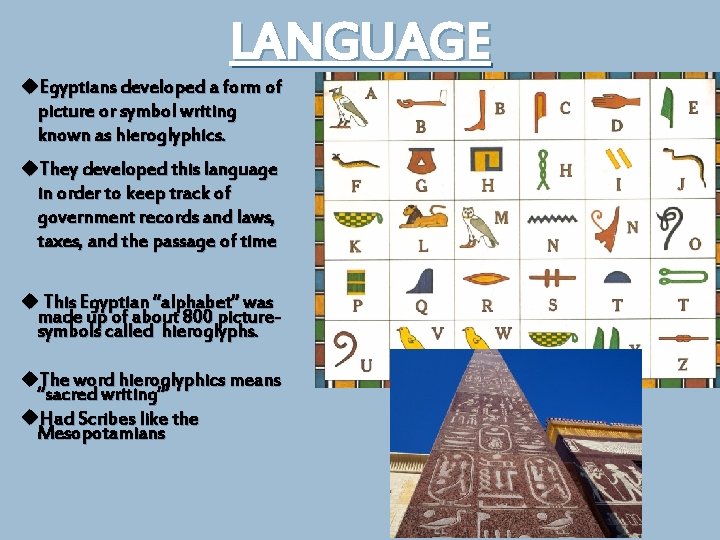
LANGUAGE Egyptians developed a form of picture or symbol writing known as hieroglyphics. They developed this language in order to keep track of government records and laws, taxes, and the passage of time This Egyptian “alphabet” was made up of about 800 picturesymbols called hieroglyphs. The word hieroglyphics means “sacred writing” Had Scribes like the Mesopotamians
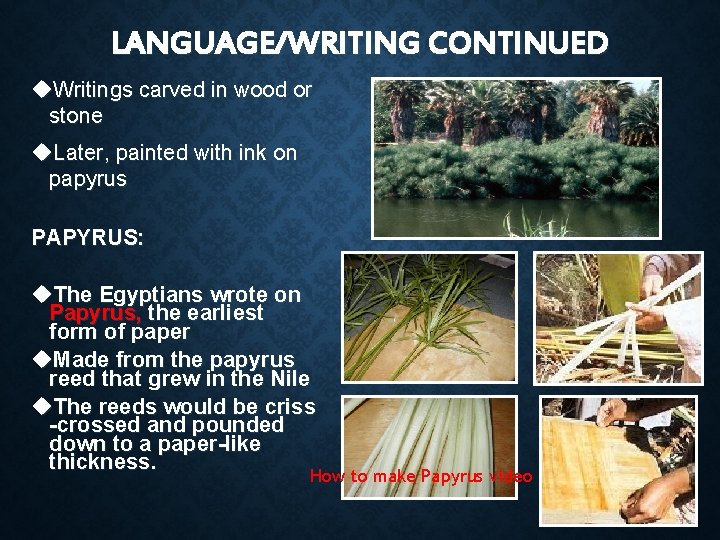
LANGUAGE/WRITING CONTINUED Writings carved in wood or stone Later, painted with ink on papyrus PAPYRUS: The Egyptians wrote on Papyrus, the earliest form of paper Made from the papyrus reed that grew in the Nile The reeds would be criss -crossed and pounded down to a paper-like thickness. How to make Papyrus video
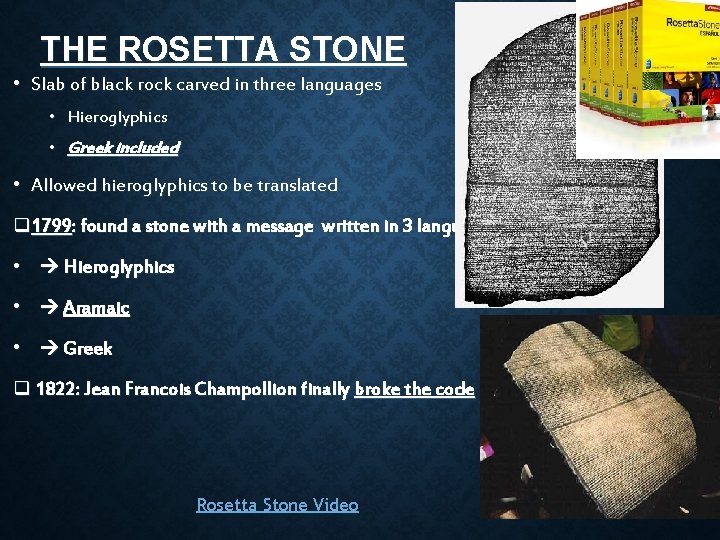
THE ROSETTA STONE • Slab of black rock carved in three languages • Hieroglyphics • Greek included • Allowed hieroglyphics to be translated q 1799: found a stone with a message written in 3 languages • Hieroglyphics • Aramaic • Greek q 1822: Jean Francois Champollion finally broke the code Rosetta Stone Video
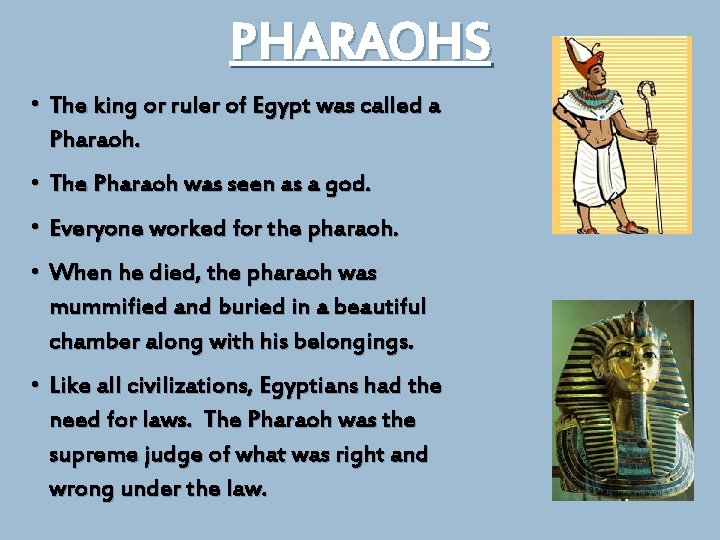
PHARAOHS • The king or ruler of Egypt was called a Pharaoh. • The Pharaoh was seen as a god. • Everyone worked for the pharaoh. • When he died, the pharaoh was mummified and buried in a beautiful chamber along with his belongings. • Like all civilizations, Egyptians had the need for laws. The Pharaoh was the supreme judge of what was right and wrong under the law.
PHARAOHS RULE AS GODS • Pharaohs you may have heard of … • King Menes: United Upper and Lower Egypt • King Tut: Much of what we know today is due to the discovery of his elaborate tomb! q. Pharaohs were in charge of: q. Economy- Pharaoh collected a portion of crops for taxes, Trade was the way in which Egyptians were paid for their services q. Government- Pharaoh appointed powerful local leaders called governors, then the Governors collected taxes and served as local judges, And made sure local flood waters were shared equally q. Religion- believed that the Pharaoh was the child of Ra, the sun-god, that Pharaoh gave life to Egypt & its people, worshipped the Pharaoh q. Pharaohs cause sun to rise, Nile to flood, crops to grow
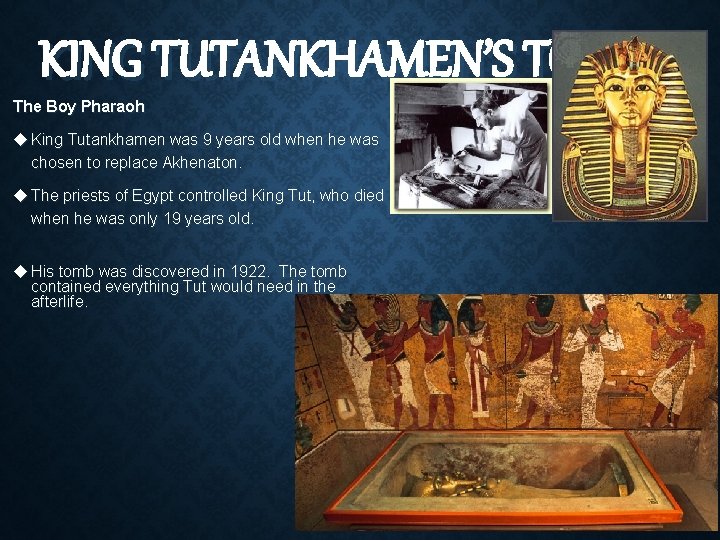
KING TUTANKHAMEN’S TOMB The Boy Pharaoh King Tutankhamen was 9 years old when he was chosen to replace Akhenaton. The priests of Egypt controlled King Tut, who died when he was only 19 years old. His tomb was discovered in 1922. The tomb contained everything Tut would need in the afterlife.
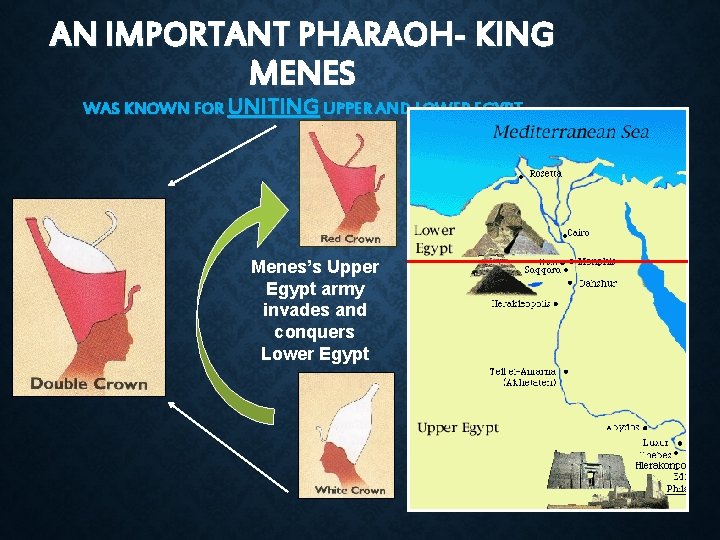
AN IMPORTANT PHARAOH- KING MENES WAS KNOWN FOR UNITING UPPER AND LOWER EGYPT Menes’s Upper Egypt army invades and conquers Lower Egypt
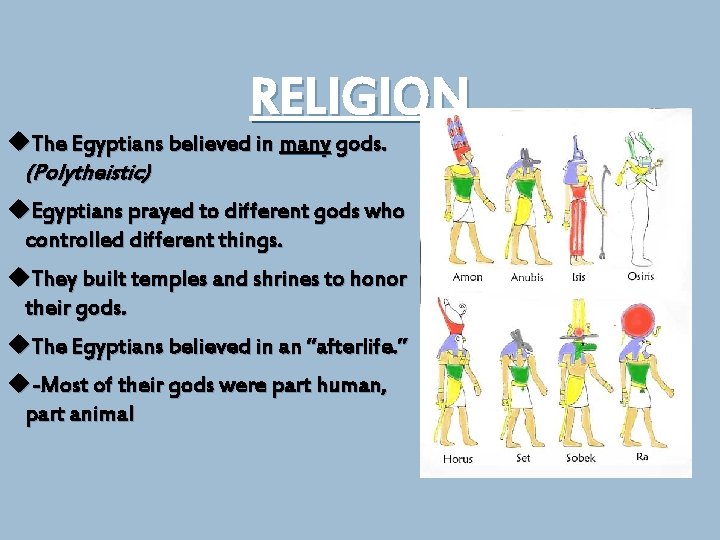
RELIGION The Egyptians believed in many gods. (Polytheistic) Egyptians prayed to different gods who controlled different things. They built temples and shrines to honor their gods. The Egyptians believed in an “afterlife. ” -Most of their gods were part human, part animal
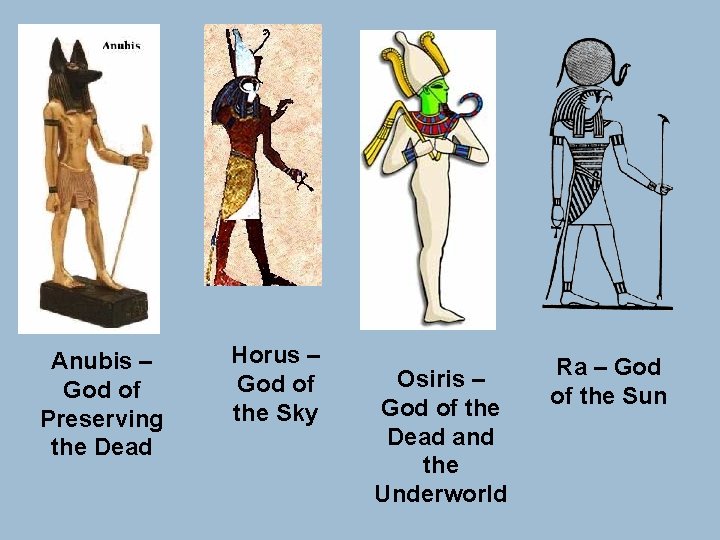
Anubis – God of Preserving the Dead Horus – God of the Sky Osiris – God of the Dead and the Underworld Ra – God of the Sun
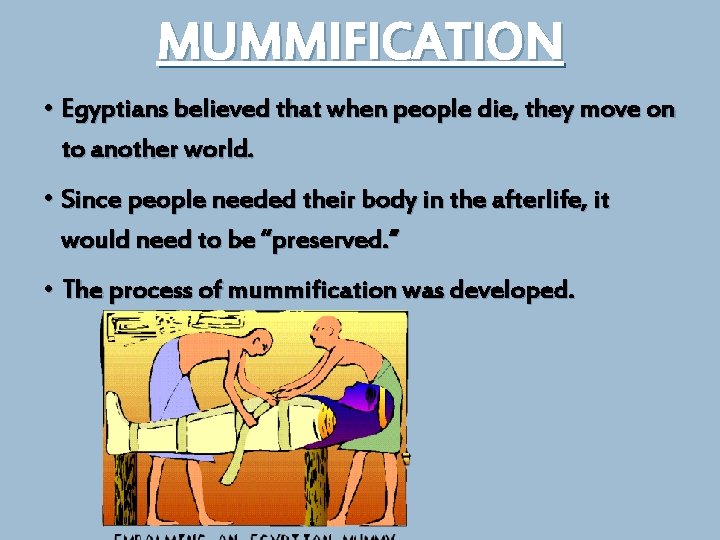
MUMMIFICATION • Egyptians believed that when people die, they move on to another world. • Since people needed their body in the afterlife, it would need to be “preserved. ” • The process of mummification was developed.
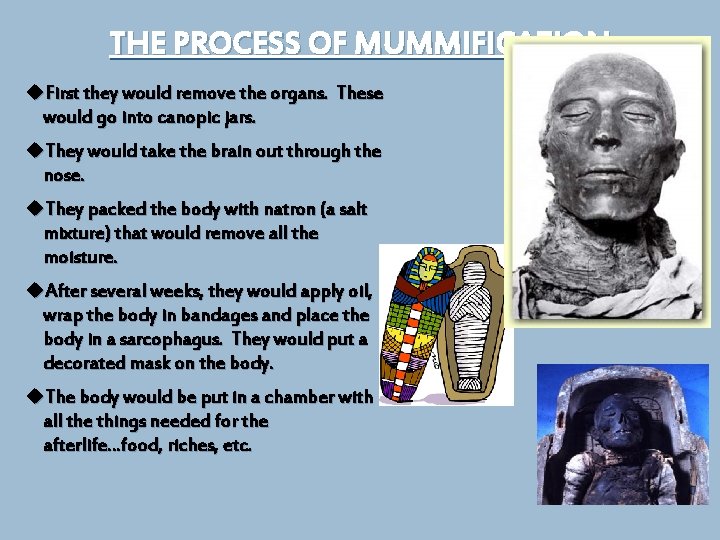
THE PROCESS OF MUMMIFICATION First they would remove the organs. These would go into canopic jars. They would take the brain out through the nose. They packed the body with natron (a salt mixture) that would remove all the moisture. After several weeks, they would apply oil, wrap the body in bandages and place the body in a sarcophagus. They would put a decorated mask on the body. The body would be put in a chamber with all the things needed for the afterlife…food, riches, etc.
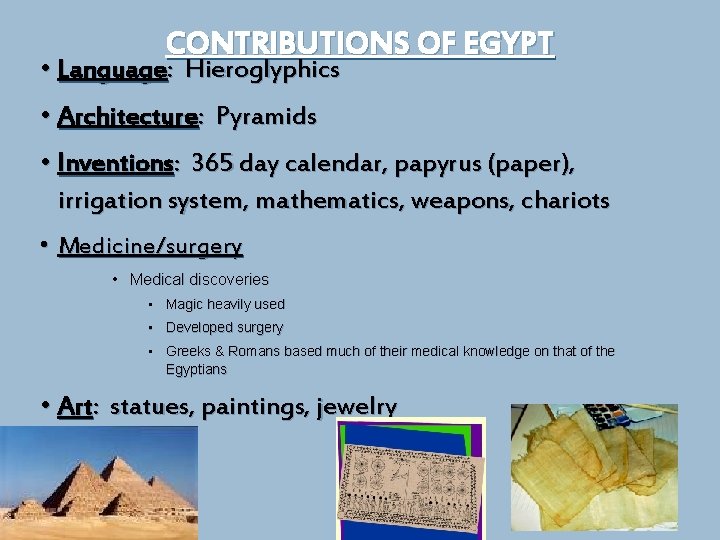
CONTRIBUTIONS OF EGYPT • Language: Hieroglyphics • Architecture: Pyramids • Inventions: 365 day calendar, papyrus (paper), irrigation system, mathematics, weapons, chariots • Medicine/surgery • Medical discoveries • Magic heavily used • Developed surgery • Greeks & Romans based much of their medical knowledge on that of the Egyptians • Art: statues, paintings, jewelry
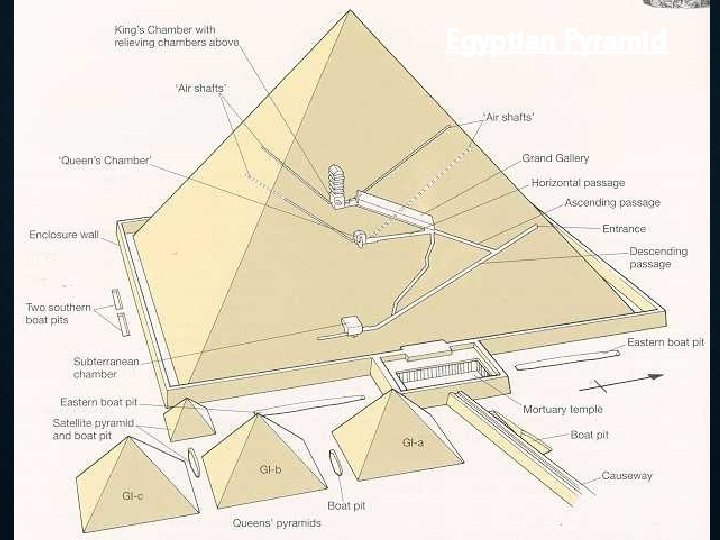
Egyptian Pyramid
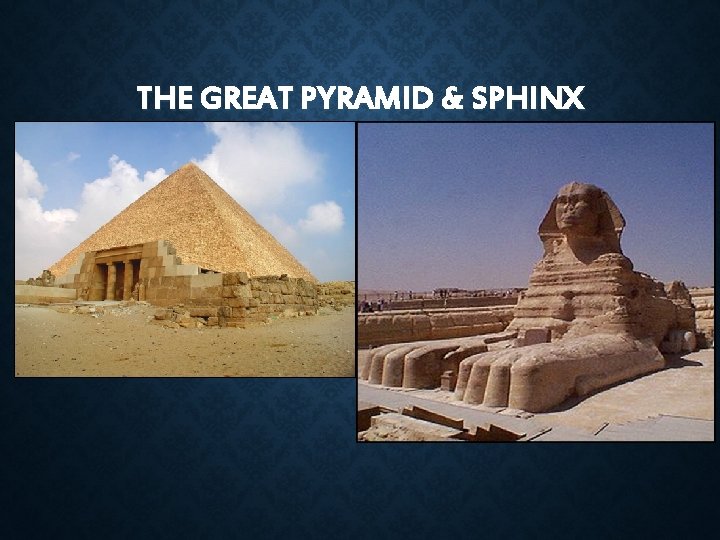
THE GREAT PYRAMID & SPHINX
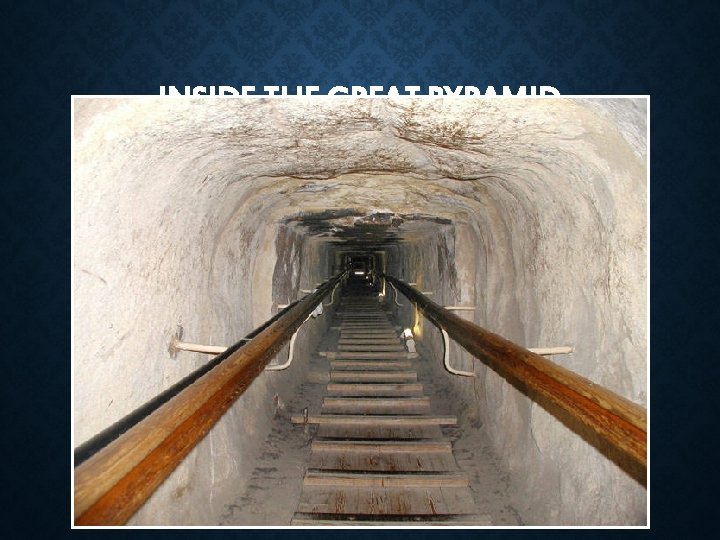
INSIDE THE GREAT PYRAMID
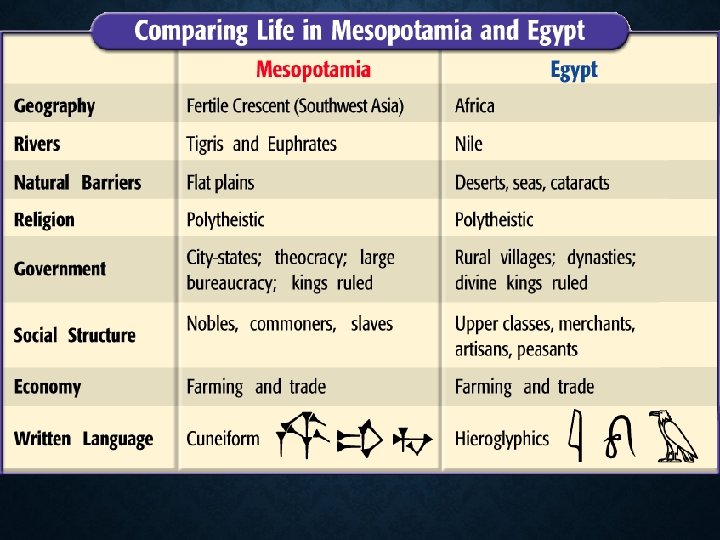
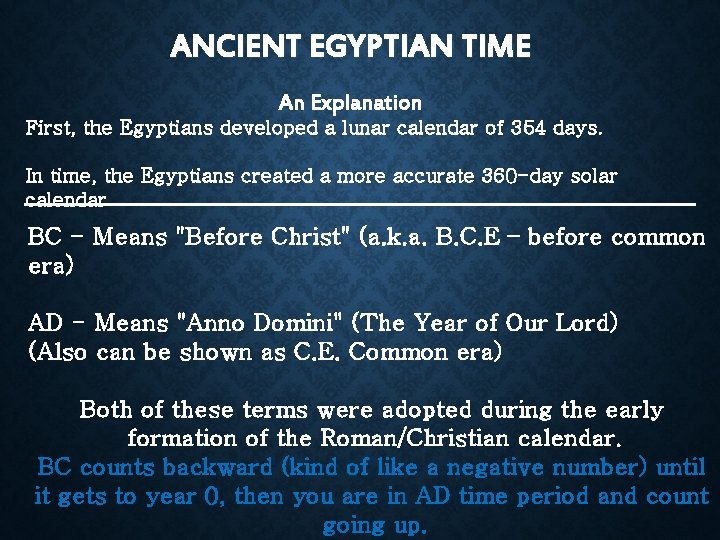
ANCIENT EGYPTIAN TIME An Explanation First, the Egyptians developed a lunar calendar of 354 days. In time, the Egyptians created a more accurate 360 -day solar calendar BC - Means "Before Christ" (a. k. a. B. C. E – before common era) AD - Means "Anno Domini" (The Year of Our Lord) (Also can be shown as C. E. Common era) Both of these terms were adopted during the early formation of the Roman/Christian calendar. BC counts backward (kind of like a negative number) until it gets to year 0, then you are in AD time period and count going up.
- Slides: 27