
Ancient Civilizations ROMANS Mrs Thompson 6 th Grade
- Slides: 21
Ancient Civilizations ROMANS Mrs. Thompson 6 th Grade
Time Period 753 B. C. – 476 A. D.
Language (Verbal & Written) Latin Roman Numerals (numbering system)
Founding of Ancient Rome Many different stories: ~ Mythological – Brothers Remus and Romulus were put in a basket in the Tiber River because born twins of the Roman god of war, Mars, he thought they might try to overthrow him someday. They were found by a she-wolf and was taken care of until a shepherd found them and raised them. After growing up and a king discovering who they were, they killed the king and began to establish their own cities – on top of the hills of Palatine and Aventine. After Romulus started building a wall and was made fun of by Remus – this angered Remus and he Romulus killed Remus, founding Rome ~ Historically – Rome was built on Palatine Hill because it could be easily defended. The neighboring hills were also settled and grew into a city.
Religion believed in gods and goddesses (took believe system from the Greeks) -- military and aggressive like -- wore military clothes and did not pay attention to physical appearance
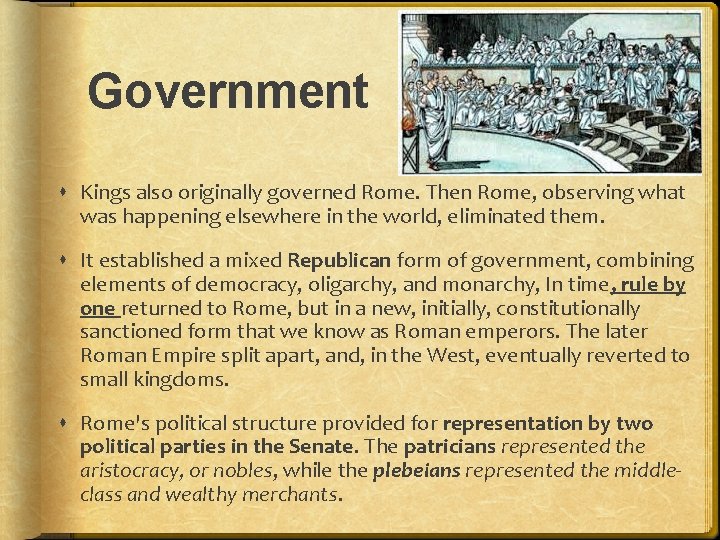
Government Kings also originally governed Rome. Then Rome, observing what was happening elsewhere in the world, eliminated them. It established a mixed Republican form of government, combining elements of democracy, oligarchy, and monarchy, In time, rule by one returned to Rome, but in a new, initially, constitutionally sanctioned form that we know as Roman emperors. The later Roman Empire split apart, and, in the West, eventually reverted to small kingdoms. Rome's political structure provided for representation by two political parties in the Senate. The patricians represented the aristocracy, or nobles, while the plebeians represented the middleclass and wealthy merchants.
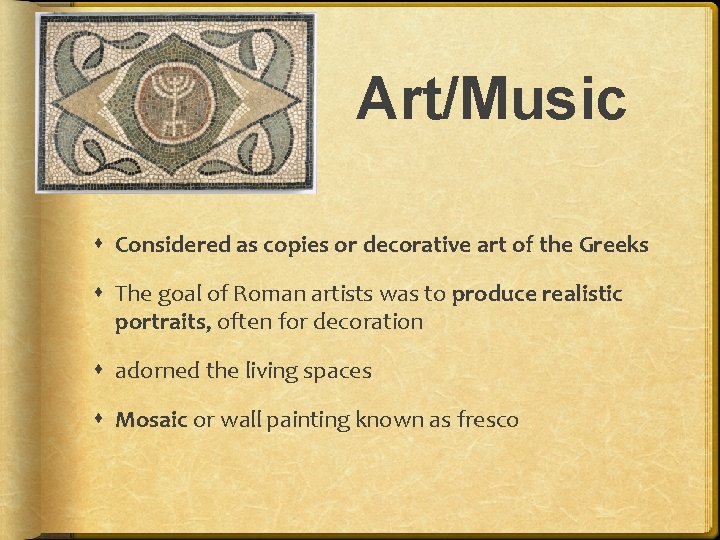
Art/Music Considered as copies or decorative art of the Greeks The goal of Roman artists was to produce realistic portraits, often for decoration adorned the living spaces Mosaic or wall painting known as fresco
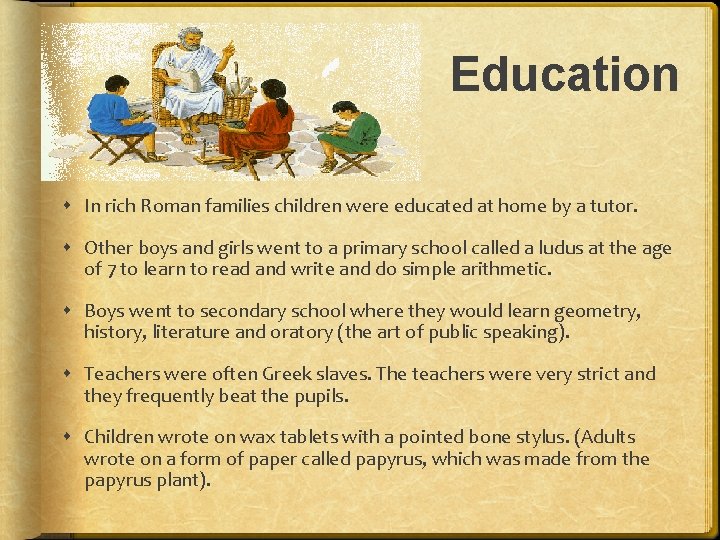
Education In rich Roman families children were educated at home by a tutor. Other boys and girls went to a primary school called a ludus at the age of 7 to learn to read and write and do simple arithmetic. Boys went to secondary school where they would learn geometry, history, literature and oratory (the art of public speaking). Teachers were often Greek slaves. The teachers were very strict and they frequently beat the pupils. Children wrote on wax tablets with a pointed bone stylus. (Adults wrote on a form of paper called papyrus, which was made from the papyrus plant).
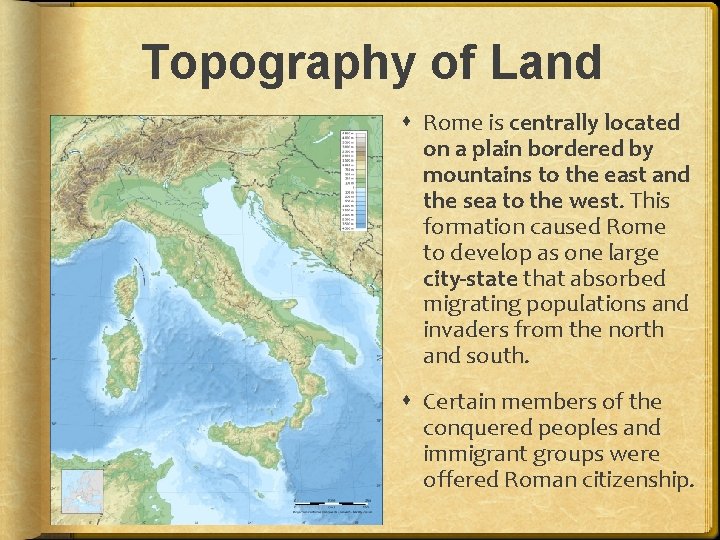
Topography of Land Rome is centrally located on a plain bordered by mountains to the east and the sea to the west. This formation caused Rome to develop as one large city-state that absorbed migrating populations and invaders from the north and south. Certain members of the conquered peoples and immigrant groups were offered Roman citizenship.
Famous Leaders Marius - The great Man of the Army Gaius Marius was the man who organized the army into the most effective fighting machine on earth. Caesar - General, Politician, Statesman Julius Caesar is no doubt the most famous Roman of them all ! He conquered Gaul in a brilliant campaign which is still used in studies for training generals today. Also modified the calendar we have today – July was named after him. Augustus - The first Emperor Augustus was the first emperor of Rome. His real name was Octavian but he was given the name 'Augustus' by the senate as an honour for his great achievements. He avenged the death of Caesar together with Mark Antony, before falling out with him. He defeated Mark Antony together with the famous Egyptian queen Cleopatra and thereafter, together with the senate of Rome, created a new constitution for the great empire. Augustus stood at the head of this empire as the emperor. He used his ruled wisely and built roads, aqueducts and buildings. Not only was Augustus the first, but he was most certainly one of the best emperors Rome ever had. Nero - The Madman of Rome Nero is the most notorious Roman of all times. It is most likely that Nero was insane. He came to power because his mother murdered his step-father emperor Claudius. During his rule much of Rome burnt down in the Great Fire of Rome. Helpless to stop the fire, he is supposed to have sung as he watched Rome burn. After this he built himself a magnificent palace on some of the land cleared by the fire. To quell rumors that he had started the fire himself, he blamed the Christians for it and then had many captured and thrown to the lions in the circus.
Famous Leaders Trajan - The kind-hearted Soldier Trajan is one of Rome's most outstanding emperors. Under his rule the empire reached its largest extent. He famously conquered the rich kingdom of Dacia north of the Danube. Trajan was one of the greatest soldiers among the emperors. But unlike many of the later warrior-like rulers, he was also known for his wisdom and dignity, and his humility when dealing with the senate. Alike Augustus, Trajan's reign was a glittering one, during which many public works, roads and harbors were built. He also set up an imperial fund which should look after the poor, especially the children. Constantine the Great - Unifier of the divided Empire. Constantine the great was the first Christian emperor of the Roman empire. He defeated all the other would-be emperors and re-united the empire, which had been divided between many rulers. He also decided to move the capital of the empire from Rome to a town called Byzantium, which he renamed after himself - Constantinopolis (Greek for: the city of Constantine). He also called together many bishops for the Council of Nicaea at which the exact nature of the Christian religion was defined. It is known today as the 'Nicene Creed'. For his many achievements he is known as 'Constantine the Great' and in the Christian church he is known as 'Saint Constantine'.
Life as a Citizen People were treated differently based on their wealth, gender, and citizenship Clothing: wore toga’s (rich) or tunics (poor) ate little during the day and had big dinners rich lived in luxuries house with much fine art family was very important; head of household was the father (paterfamilias); although mother took care of the money and household after work many men and boys would spend much time bathing and socializing at the bath houses (had to pay a fee) valued leisure time
Role of Women and men over the age of 15 who had ancestors from Rome's original tribes were considered citizens. Women were not permitted to vote or hold political offices. However, women of the upper classes could influence their husbands on politics and could, by arranging marriages, put one of their children in a politically influential position. The Roman was legally subject to the pater familias, whether the dominant male in her household of birth or the household of her husband. She could own and dispose of property and go about as she wished. From epigraphy, we read that a Roman was valued for piety, modesty, maintenance of harmony, and being a one-man woman. The Roman woman could be a Roman citizen.
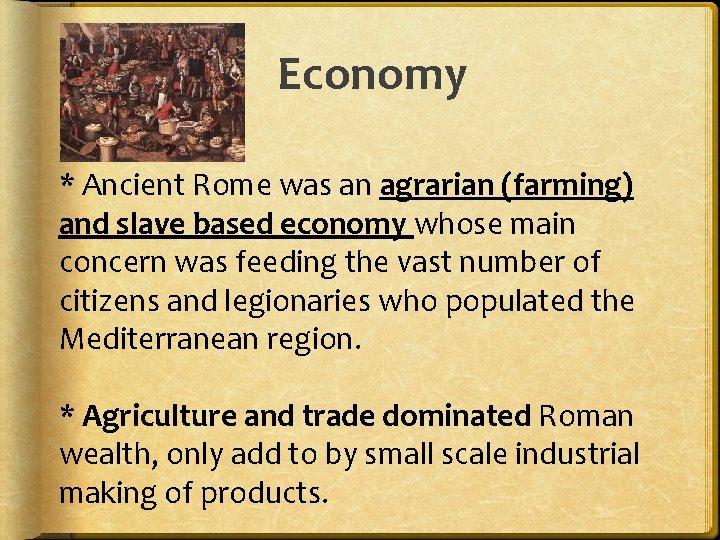
Economy * Ancient Rome was an agrarian (farming) and slave based economy whose main concern was feeding the vast number of citizens and legionaries who populated the Mediterranean region. * Agriculture and trade dominated Roman wealth, only add to by small scale industrial making of products.
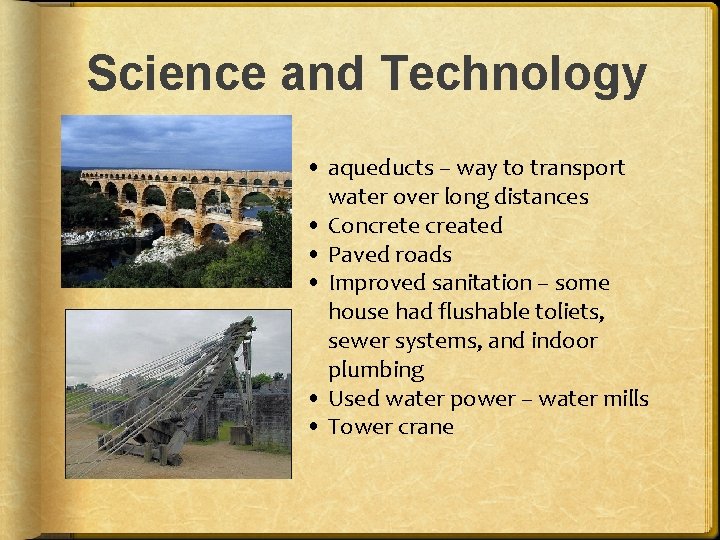
Science and Technology • aqueducts – way to transport water over long distances • Concrete created • Paved roads • Improved sanitation – some house had flushable toliets, sewer systems, and indoor plumbing • Used water power – water mills • Tower crane
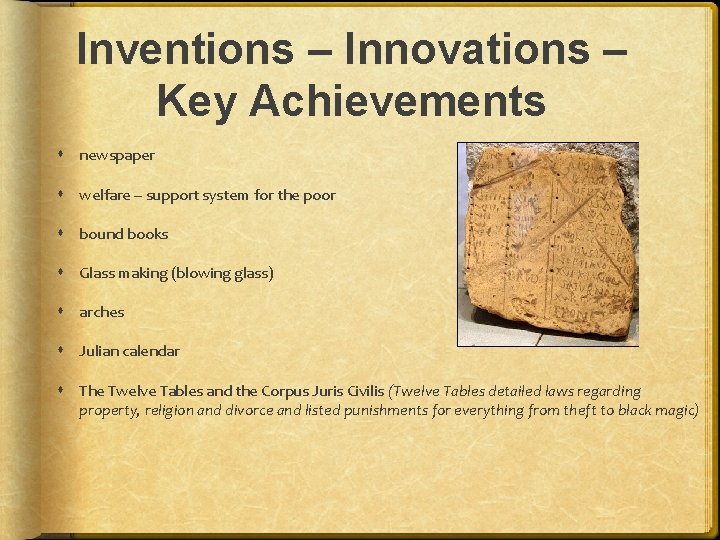
Inventions – Innovations – Key Achievements newspaper welfare – support system for the poor bound books Glass making (blowing glass) arches Julian calendar The Twelve Tables and the Corpus Juris Civilis (Twelve Tables detailed laws regarding property, religion and divorce and listed punishments for everything from theft to black magic)
Important Scientist-Philosophers-Historians Galen was a surgeon and philosopher and once released a piece of writing titled “That the Best Physician is also a Philosopher. ” Among other notable achievements, he was to discover the difference between dark and bright blood. Galen used animal subjects to learn more about the circulatory, respiratory, and nervous systems, among other parts of the body. Claudius Ptolemy studied astronomy, geology, astrology, music, and other arts and sciences. He left behind several works, including Almagest, which includes a list of 48 constellations and a star catalog. In addition to an asteroid, craters on the Moon and Mars have been named in his honor. Vitruvius is another writer whose work has provided us with important knowledge about Ancient Rome. He was also an architect and an engineer, so his writing has a unique perspective. He is sometimes referred to as the first architect, although this is likely due to the fact that his writings have survived. His texts include information about Rome’s machines, building materials, aqueducts, and much more.
FALL of ROME Economic Problems Continuous occurrences of diseases such as Malaria and other plagues caused a decline in the Roman Empire population. During certain regimes, their currency was debased - coins basically didn’t have the actual value; instead, the worth of the currency depended on the amount of silver it contained. Their coins were made up of no more than 1% silver and, as a result, severe inflation followed. Rome depended on its empire for resources originating from mining and farming practices. Rome turned out to be very poor and had trouble managing the economy. High taxation caused distress among many classes in Ancient Rome.
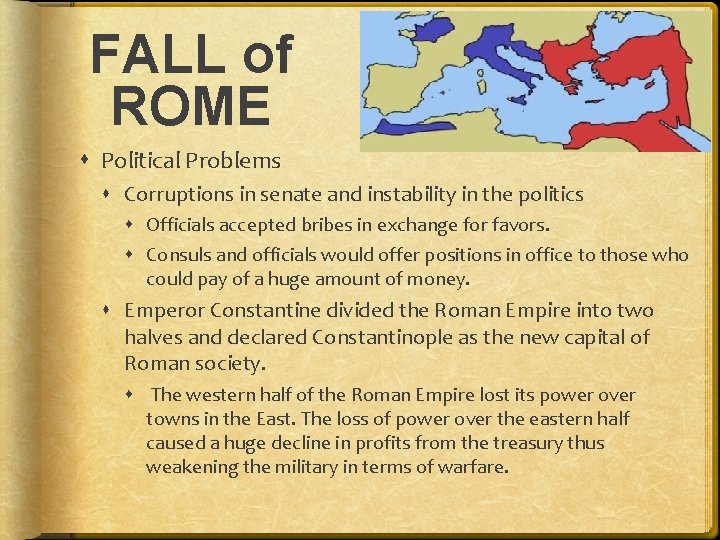
FALL of ROME Political Problems Corruptions in senate and instability in the politics Officials accepted bribes in exchange for favors. Consuls and officials would offer positions in office to those who could pay of a huge amount of money. Emperor Constantine divided the Roman Empire into two halves and declared Constantinople as the new capital of Roman society. The western half of the Roman Empire lost its power over towns in the East. The loss of power over the eastern half caused a huge decline in profits from the treasury thus weakening the military in terms of warfare.
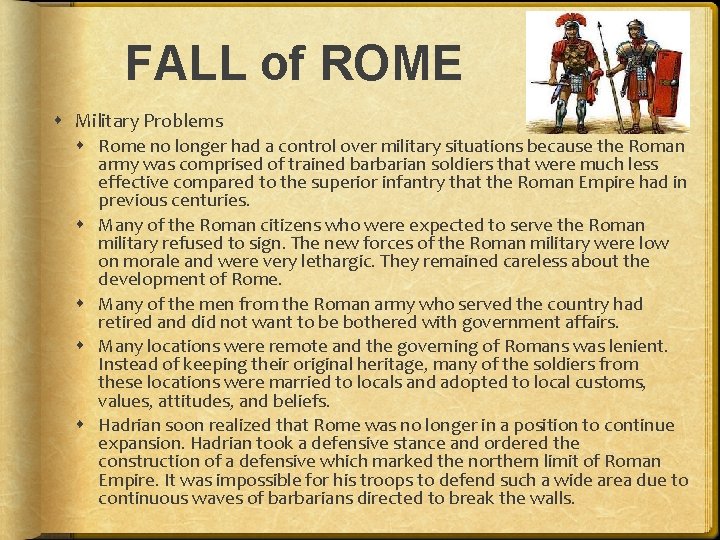
FALL of ROME Military Problems Rome no longer had a control over military situations because the Roman army was comprised of trained barbarian soldiers that were much less effective compared to the superior infantry that the Roman Empire had in previous centuries. Many of the Roman citizens who were expected to serve the Roman military refused to sign. The new forces of the Roman military were low on morale and were very lethargic. They remained careless about the development of Rome. Many of the men from the Roman army who served the country had retired and did not want to be bothered with government affairs. Many locations were remote and the governing of Romans was lenient. Instead of keeping their original heritage, many of the soldiers from these locations were married to locals and adopted to local customs, values, attitudes, and beliefs. Hadrian soon realized that Rome was no longer in a position to continue expansion. Hadrian took a defensive stance and ordered the construction of a defensive which marked the northern limit of Roman Empire. It was impossible for his troops to defend such a wide area due to continuous waves of barbarians directed to break the walls.
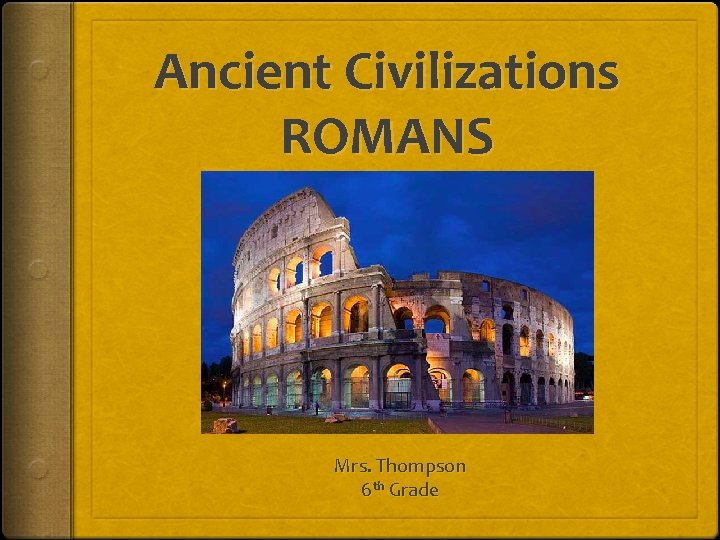
DID YOU KNOW? ? The Romans built such a huge empire and conquered new lands, thanks to their strong army. The Roman army could march up to 40 km a day During battle, a Roman soldier or ‘legionary’ first hurled his spear at the enemy, then he fought him with his sword. To protect himself, he carried a wooden shield and wore a metal helmet and armor. One of the most famous buildings left by the Ancient Romans is the Colosseum - a huge amphitheater in the center of Rome. This is where members of the public would come to watch sporting events and games, including battles between Roman gladiators