
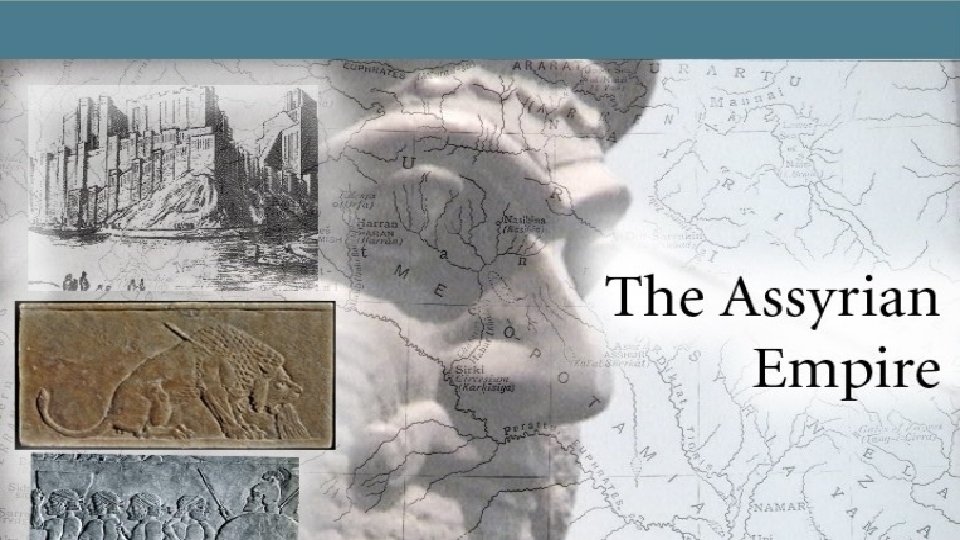
Ancient Civilizations of Mesopotamia Assyrian Empire 2400 612
- Slides: 30
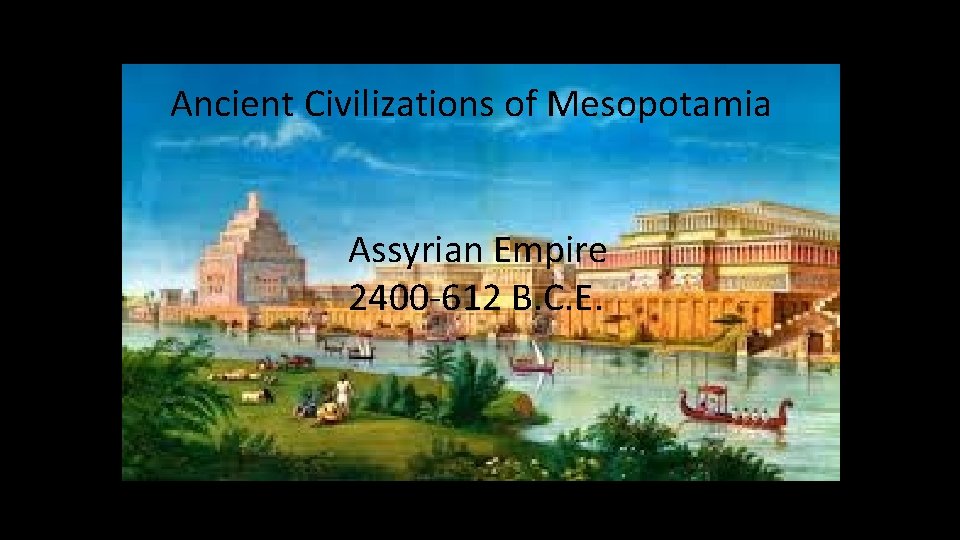
Ancient Civilizations of Mesopotamia Assyrian Empire 2400 -612 B. C. E.
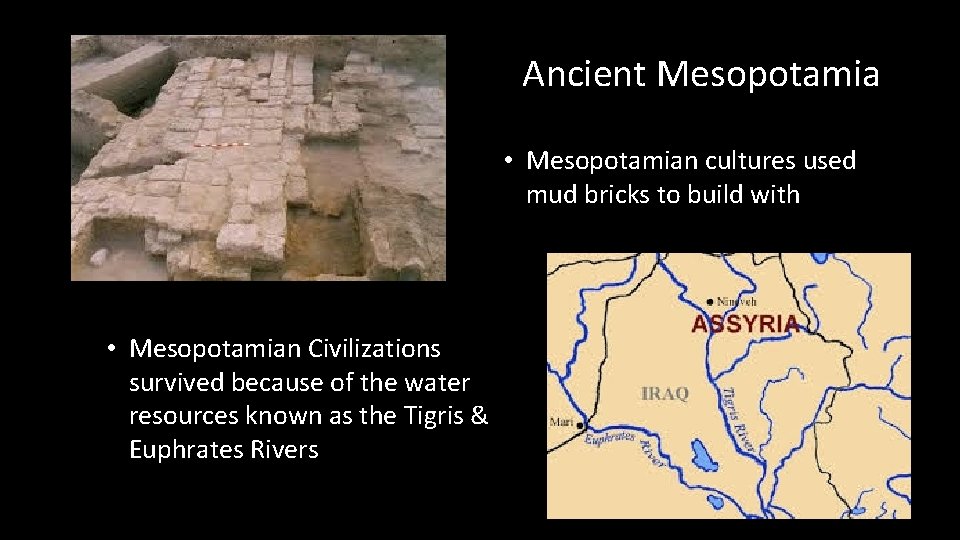
Ancient Mesopotamia • Mesopotamian cultures used mud bricks to build with • Mesopotamian Civilizations survived because of the water resources known as the Tigris & Euphrates Rivers
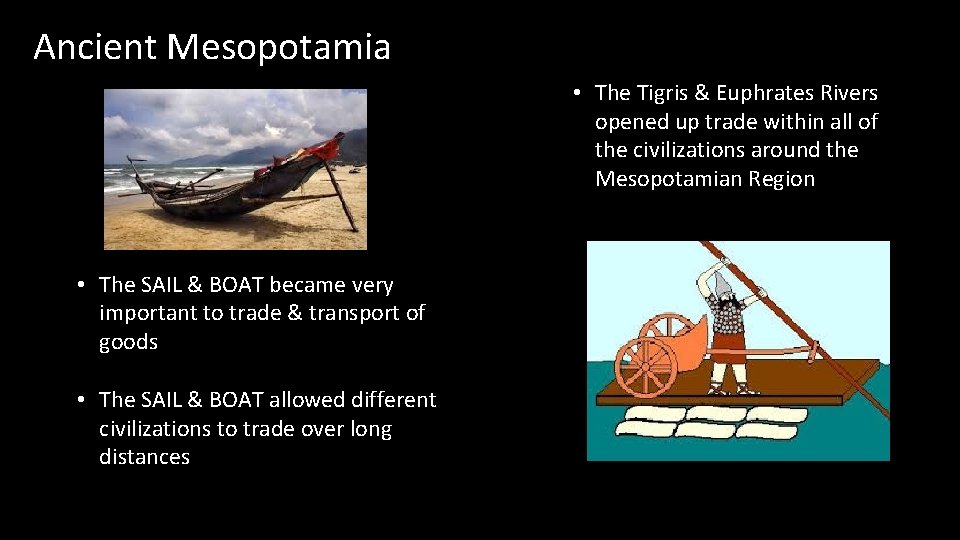
Ancient Mesopotamia • The Tigris & Euphrates Rivers opened up trade within all of the civilizations around the Mesopotamian Region • The SAIL & BOAT became very important to trade & transport of goods • The SAIL & BOAT allowed different civilizations to trade over long distances
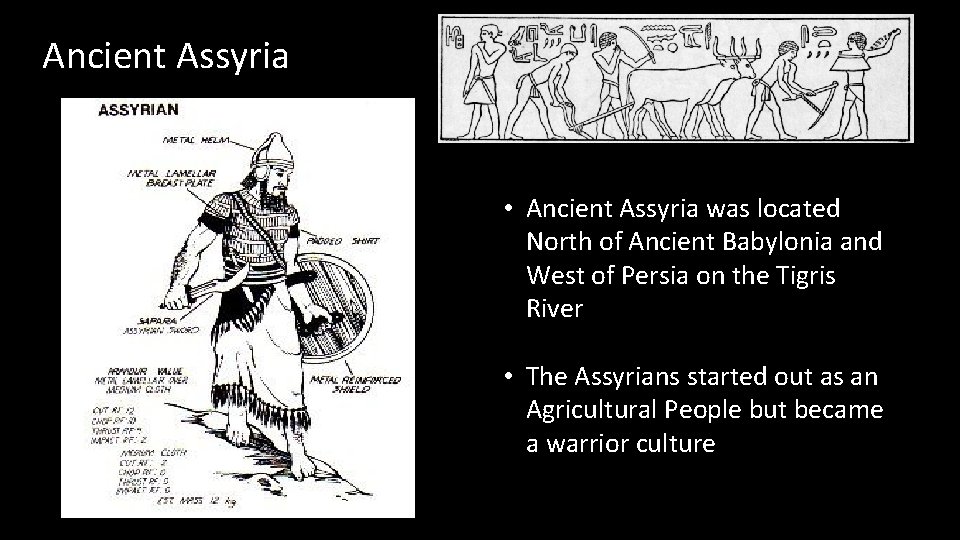
Ancient Assyria • Ancient Assyria was located North of Ancient Babylonia and West of Persia on the Tigris River • The Assyrians started out as an Agricultural People but became a warrior culture
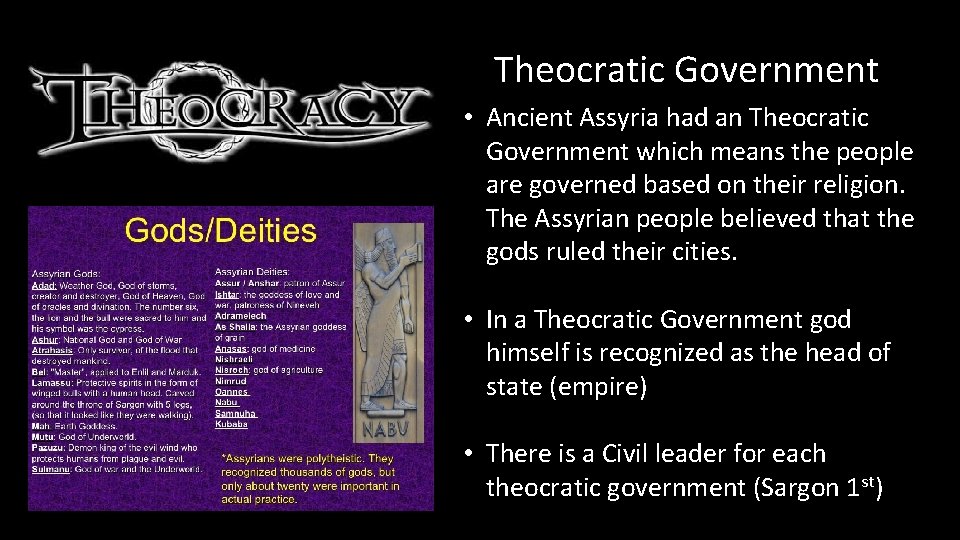
Theocratic Government • Ancient Assyria had an Theocratic Government which means the people are governed based on their religion. The Assyrian people believed that the gods ruled their cities. • In a Theocratic Government god himself is recognized as the head of state (empire) • There is a Civil leader for each theocratic government (Sargon 1 st)
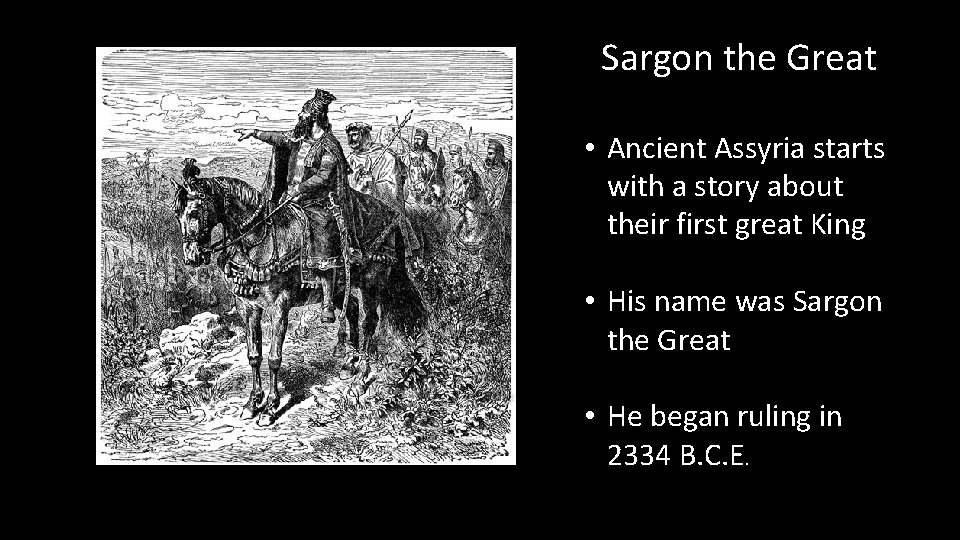
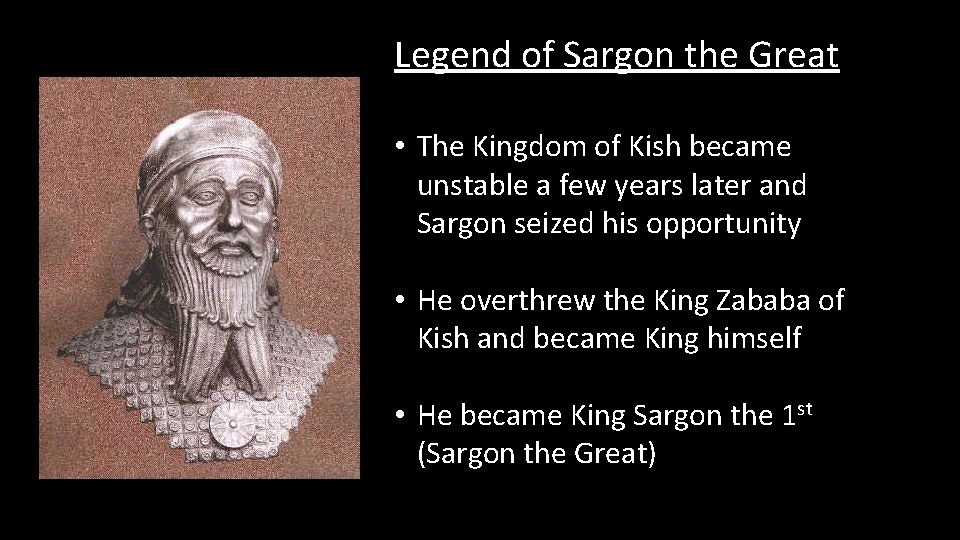
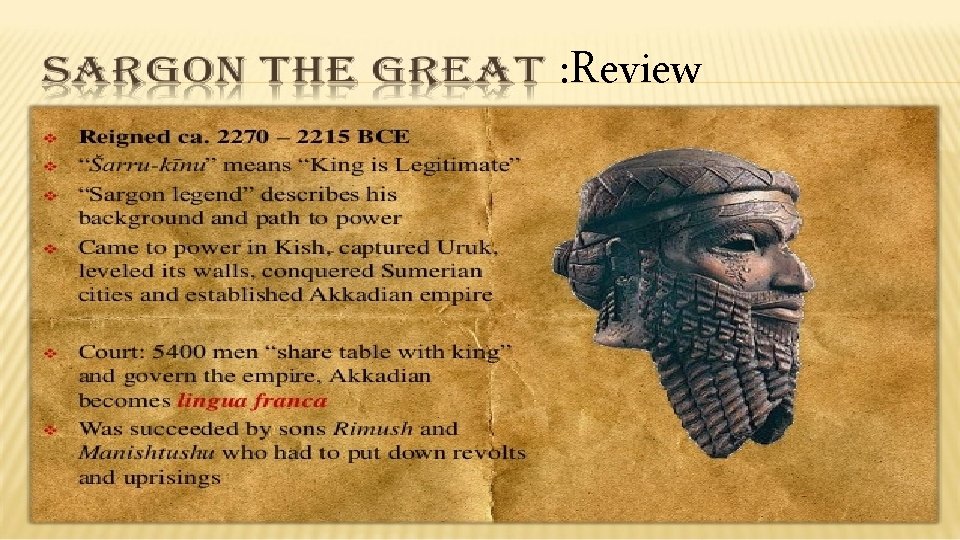
Sargon the Great • Ancient Assyria starts with a story about their first great King • His name was Sargon the Great • He began ruling in 2334 B. C. E.
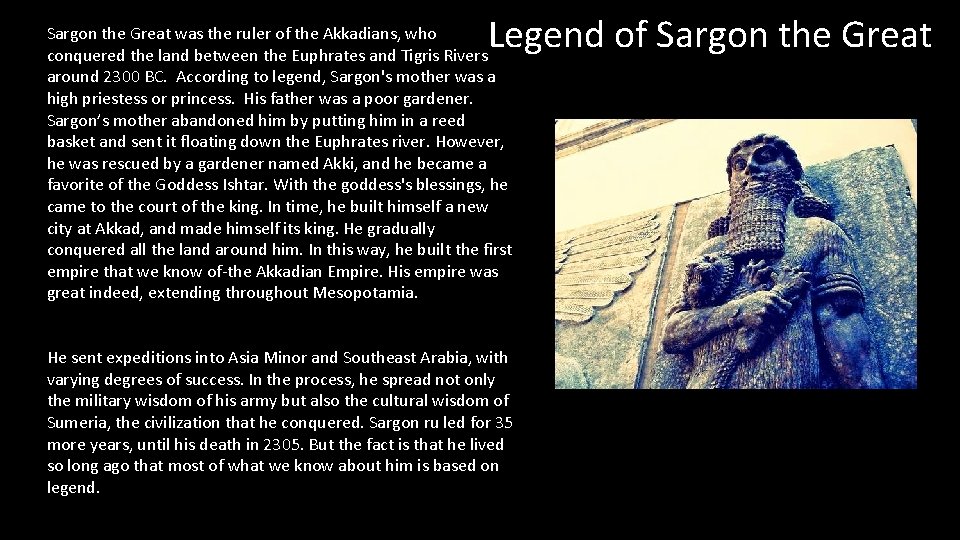
Legend of Sargon the Great was the ruler of the Akkadians, who conquered the land between the Euphrates and Tigris Rivers around 2300 BC. According to legend, Sargon's mother was a high priestess or princess. His father was a poor gardener. Sargon’s mother abandoned him by putting him in a reed basket and sent it floating down the Euphrates river. However, he was rescued by a gardener named Akki, and he became a favorite of the Goddess Ishtar. With the goddess's blessings, he came to the court of the king. In time, he built himself a new city at Akkad, and made himself its king. He gradually conquered all the land around him. In this way, he built the first empire that we know of-the Akkadian Empire. His empire was great indeed, extending throughout Mesopotamia. He sent expeditions into Asia Minor and Southeast Arabia, with varying degrees of success. In the process, he spread not only the military wisdom of his army but also the cultural wisdom of Sumeria, the civilization that he conquered. Sargon ru led for 35 more years, until his death in 2305. But the fact is that he lived so long ago that most of what we know about him is based on legend.
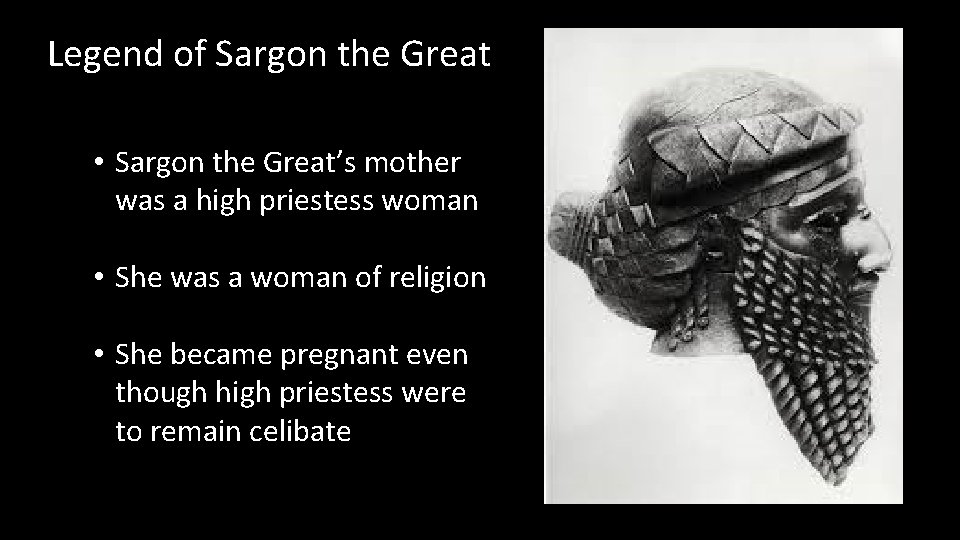
Legend of Sargon the Great • Sargon the Great’s mother was a high priestess woman • She was a woman of religion • She became pregnant even though high priestess were to remain celibate
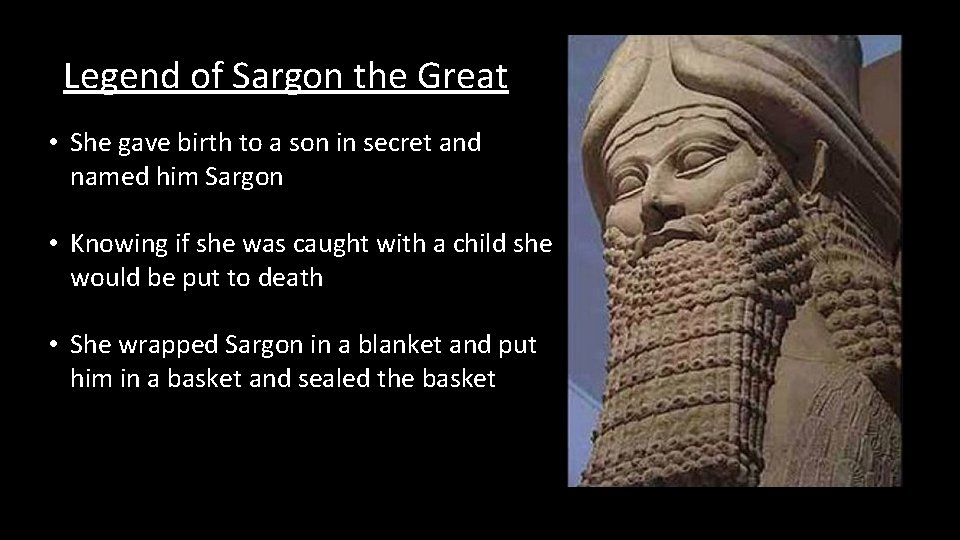
Legend of Sargon the Great • She gave birth to a son in secret and named him Sargon • Knowing if she was caught with a child she would be put to death • She wrapped Sargon in a blanket and put him in a basket and sealed the basket
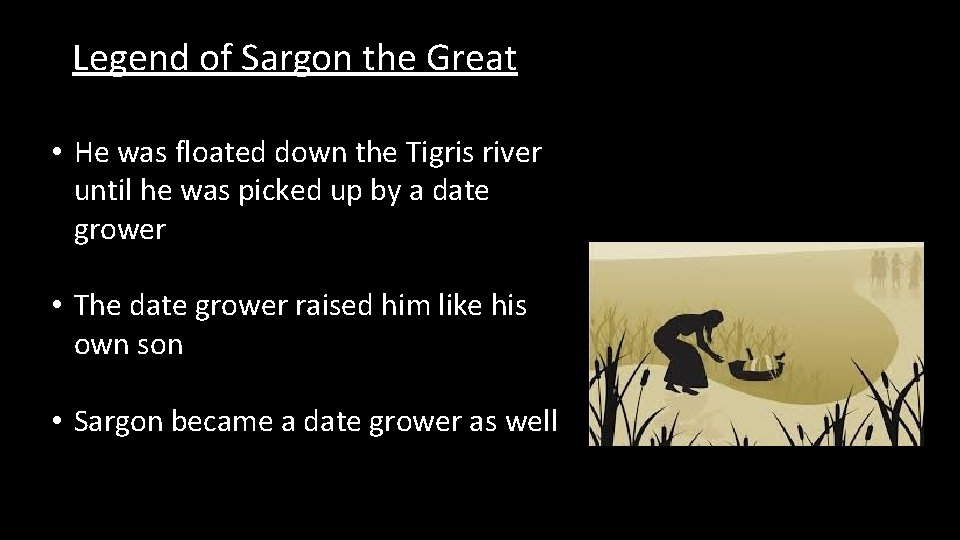
Legend of Sargon the Great • He was floated down the Tigris river until he was picked up by a date grower • The date grower raised him like his own son • Sargon became a date grower as well
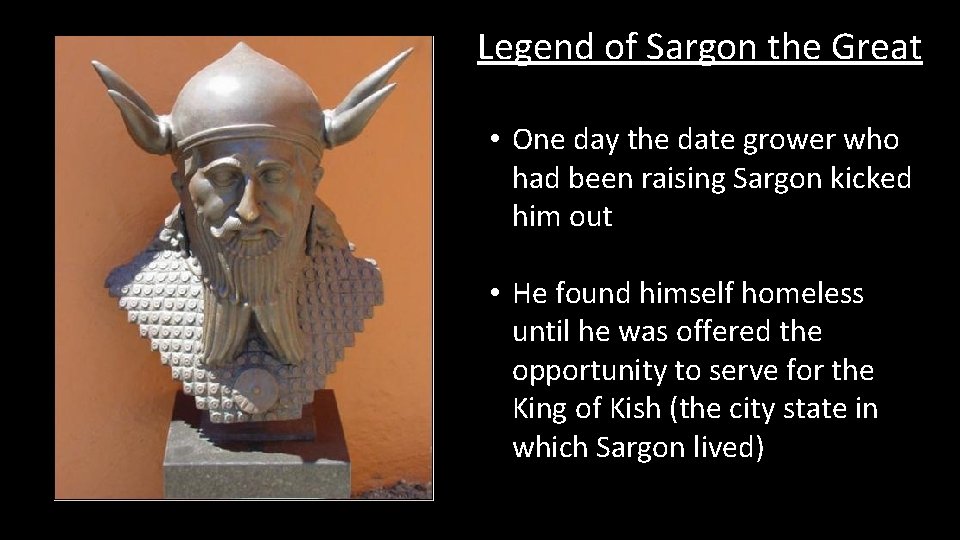
Legend of Sargon the Great • One day the date grower who had been raising Sargon kicked him out • He found himself homeless until he was offered the opportunity to serve for the King of Kish (the city state in which Sargon lived)
Legend of Sargon the Great • The Kingdom of Kish became unstable a few years later and Sargon seized his opportunity • He overthrew the King Zababa of Kish and became King himself • He became King Sargon the 1 st (Sargon the Great)
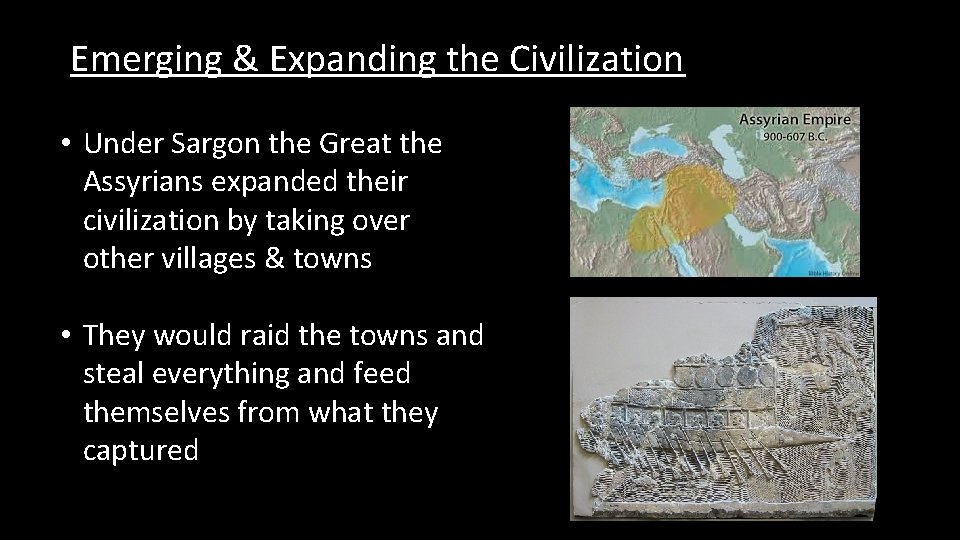
Emerging & Expanding the Civilization • Under Sargon the Great the Assyrians expanded their civilization by taking over other villages & towns • They would raid the towns and steal everything and feed themselves from what they captured
End of Sargon’s Assyria • Under Sargon the Great Each year the Assyrians would go out and defeat other Mesopotamian colonies but there stronghold would not last because of the changes in the seasons • With the changing of the seasons the soldiers would go home to take care of their farmlands so they could yield more crops
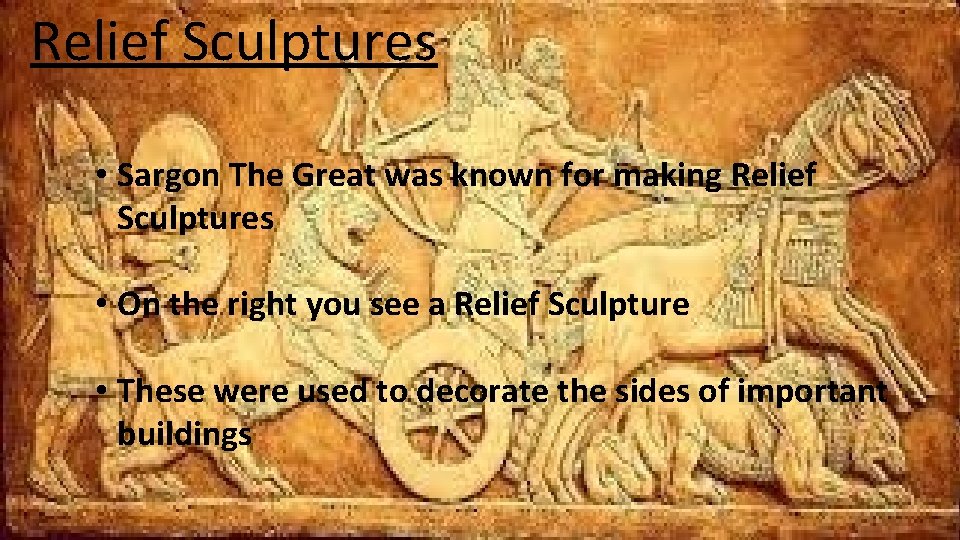
Relief Sculptures • Sargon The Great was known for making Relief Sculptures • On the right you see a Relief Sculpture • These were used to decorate the sides of important buildings
: Review
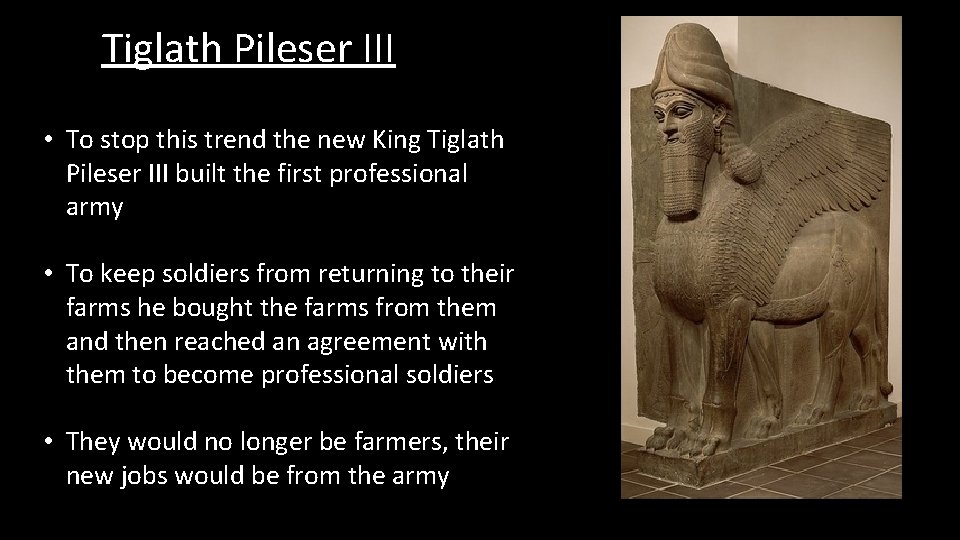
Tiglath Pileser III • To stop this trend the new King Tiglath Pileser III built the first professional army • To keep soldiers from returning to their farms he bought the farms from them and then reached an agreement with them to become professional soldiers • They would no longer be farmers, their new jobs would be from the army
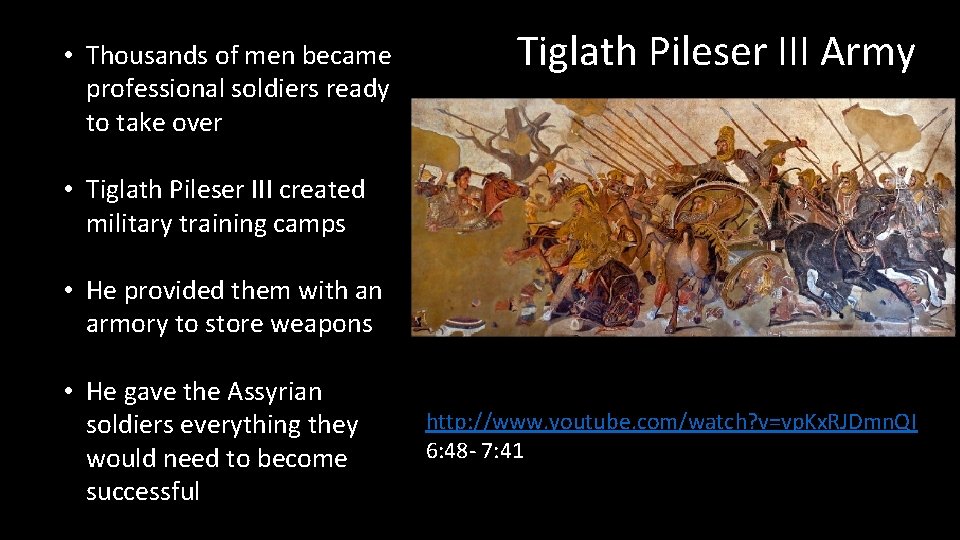
• Thousands of men became professional soldiers ready to take over Tiglath Pileser III Army • Tiglath Pileser III created military training camps • He provided them with an armory to store weapons • He gave the Assyrian soldiers everything they would need to become successful http: //www. youtube. com/watch? v=vp. Kx. RJDmn. QI 6: 48 - 7: 41
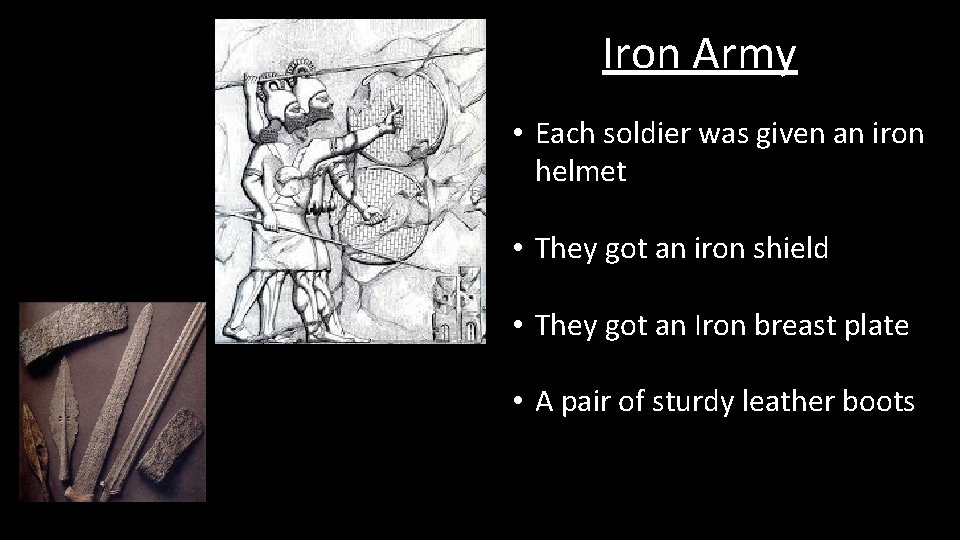
Iron Army • Each soldier was given an iron helmet • They got an iron shield • They got an Iron breast plate • A pair of sturdy leather boots
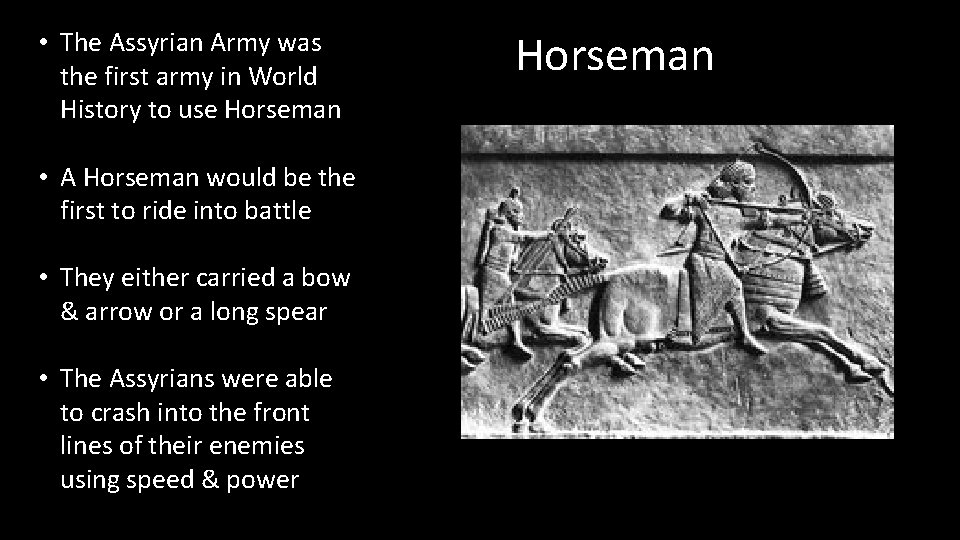
• The Assyrian Army was the first army in World History to use Horseman • A Horseman would be the first to ride into battle • They either carried a bow & arrow or a long spear • The Assyrians were able to crash into the front lines of their enemies using speed & power Horseman
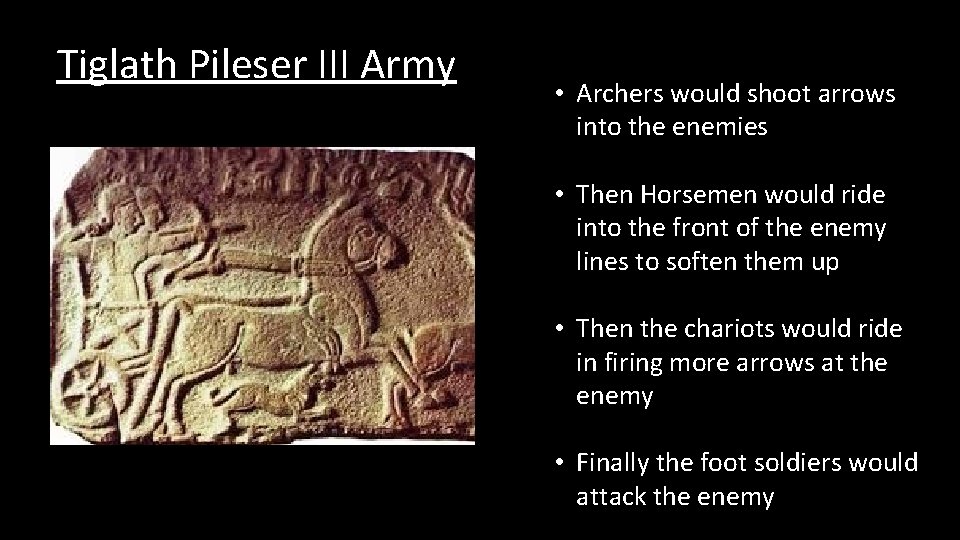
Tiglath Pileser III Army • Archers would shoot arrows into the enemies • Then Horsemen would ride into the front of the enemy lines to soften them up • Then the chariots would ride in firing more arrows at the enemy • Finally the foot soldiers would attack the enemy
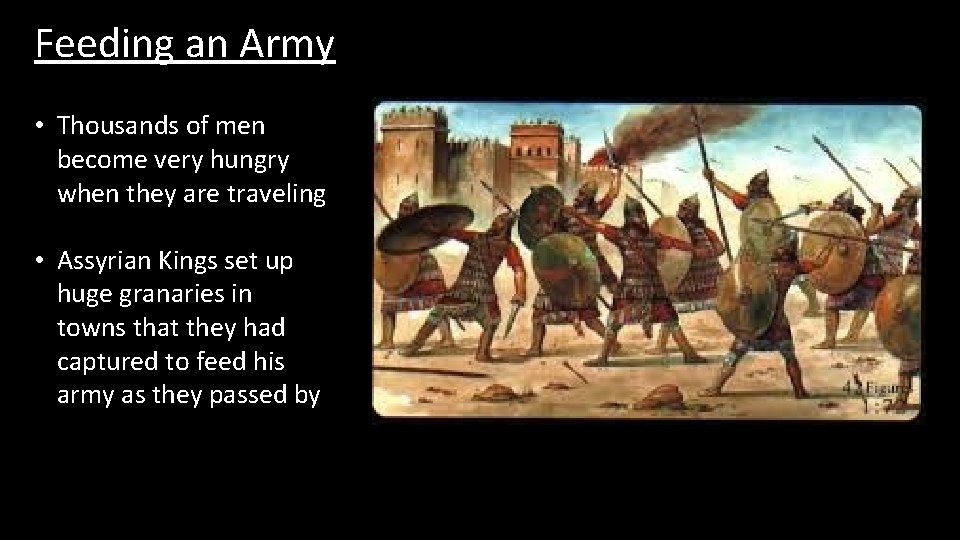
Feeding an Army • Thousands of men become very hungry when they are traveling • Assyrian Kings set up huge granaries in towns that they had captured to feed his army as they passed by
Army opens up Trade • The Assyrian Army became the best in the world at that time period • They wanted to be better • They traded textiles & food to other civilizations • They received: ØHorses (Chariots) ØIron (Weapons) ØTimber (Ships)
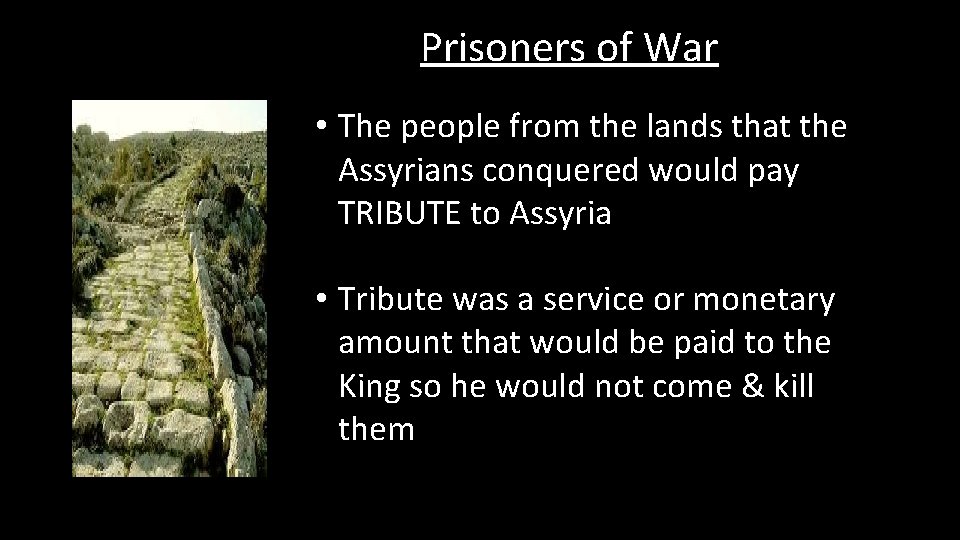
Prisoners of War • The people from the lands that the Assyrians conquered would pay TRIBUTE to Assyria • Tribute was a service or monetary amount that would be paid to the King so he would not come & kill them
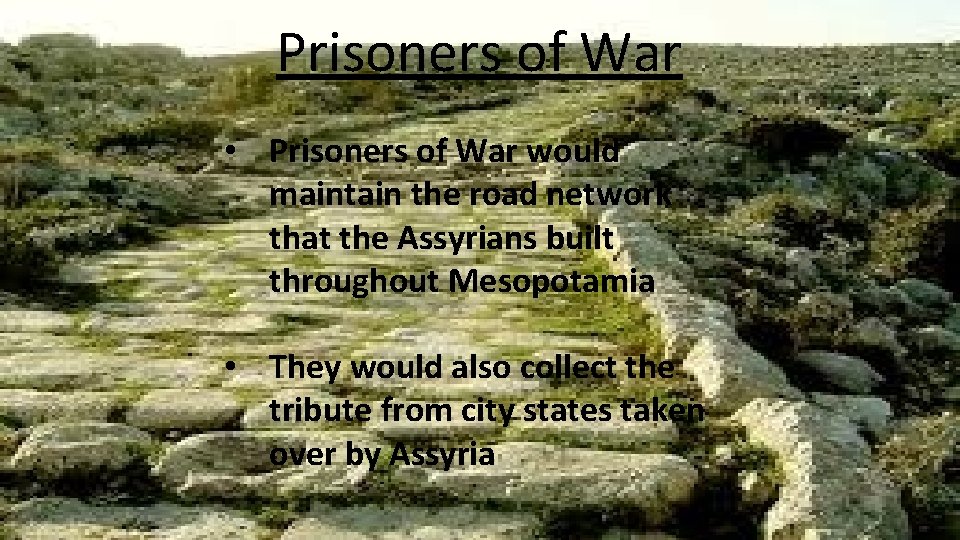
Prisoners of War • Prisoners of War would maintain the road network that the Assyrians built throughout Mesopotamia • They would also collect the tribute from city states taken over by Assyria
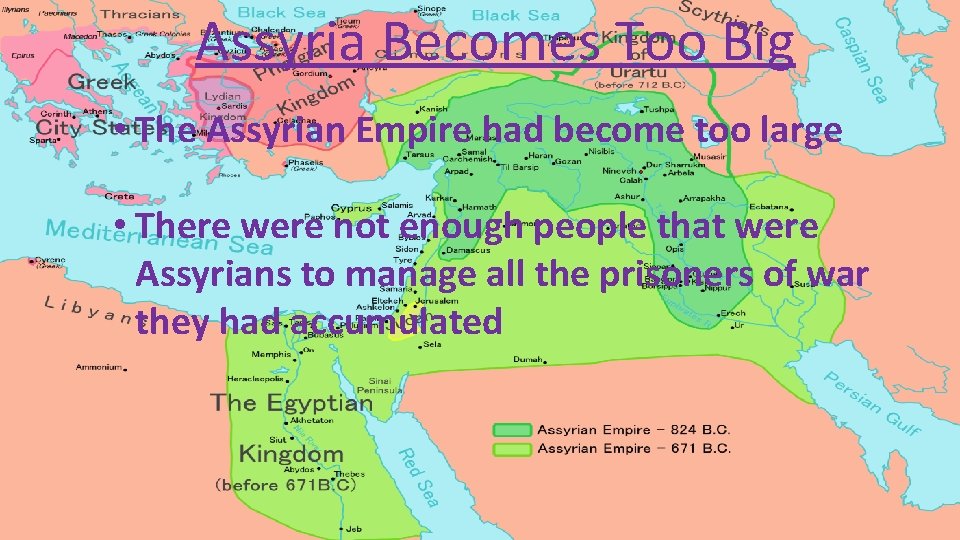
Assyria Becomes Too Big • The Assyrian Empire had become too large • There were not enough people that were Assyrians to manage all the prisoners of war they had accumulated
Nineveh, Assyria • In 612 B. C. E. the Babylonians had enough • Under Nebakanezer II the marched on Nineveh and sacked it destroying the city • Babylonia takes the city for their own
Important Points 6. H. 2. 1. (Invasions, Conquests & Migrations) The Assyrians invaded and conquered almost all of Mesopotamia at some point or another. This led to migrations all over the Mesopotamian Region 6. H. 2. 3 (Weaponry & Transportation) Assyrian prisoners would maintain roads for the army to travel on. Assyrians were the first to use horsemen to utilize speed on the battlefield 6. H. 2. 4. (Key Historical Figures) Sargon the Great was an important historical figure because he emerged & expanded the Assyrians Empire
Important Points 6. G. 1. 1 (Physical Features Why do they live there) Assyrians lived along the Tigris River which allowed them to farm 6. C&G. 1. 1 (Theocratic Government) Assyrians operated under a Theocratic Government that was controlled by religion 6. G. 1. 3 (Distinguishing Physical Feature) The features of the Mesopotamian Region were the Tigris & Euphrates Rivers 6. E. 1. 1. (Unequal distribution of wealth) The Assyrians became very wealthy because they took over other lands and took TRIBUTES from the people of those lands