
Ancient Civilizations Mesopotamia The Start of Mesopotamia Early


- Slides: 19
Ancient Civilizations Mesopotamia
The Start of Mesopotamia • Early humans traveled to find food – When food became scarce, they moved • As they moved they followed the coasts/rivers, to be close to water • Soon they traveled through the area of the Middle East (5000 BCE) – Found a very fertile area known as the “Fertile Crescent” – Present day Iraq • Area was fertile due to 2 major rivers that emptied into the Persian Gulf
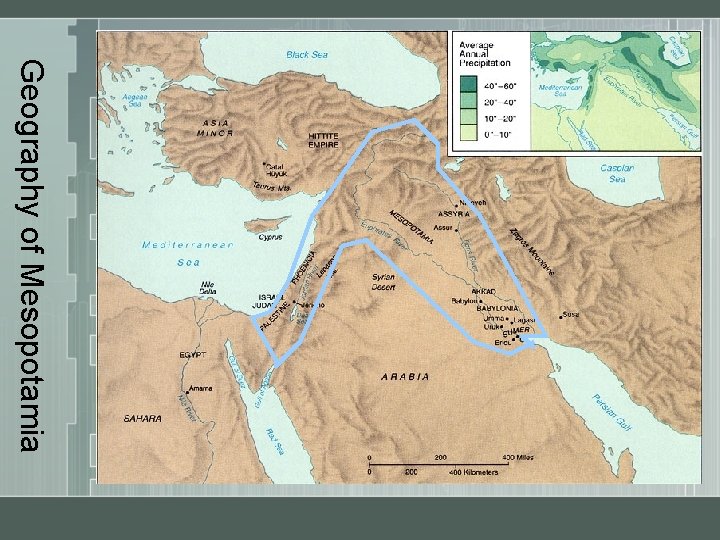
Geography of Mesopotamia
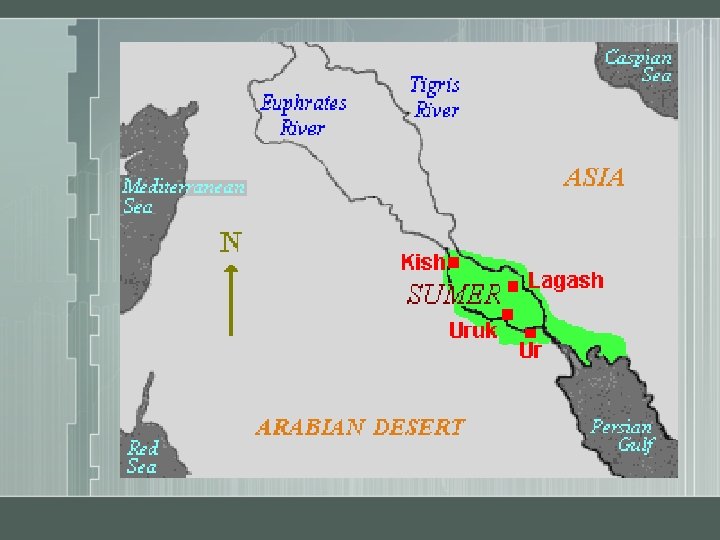
Characteristics of Fertile Crescent • Two major rivers – Euphrates to the West – Tigris to the East • Area between named Mesopotamia (c. 3100 -529 BCE) – Comes from Greek term meaning “between the rivers” • Many small cities form close to the Persian Gulf – They later spread further away due to growing populations
• One of the earliest known cities-states: Sumer Importance of Geography (2900 BCE) – City-states- an area that was ruled like separate states – Early example of an advanced civilization – Strong government, laws, economy • Rivers provided only real water to Sumer – Positives • Fertile land allowed crops to grow • Deposited silt- rich soil from bottom of riverbeds – Negatives • Rivers flooded unpredictably; thousands died • Area of Sumer was small (size of Massachusetts) • Area lacked other vital natural resources
Discussion • What technology did the Sumerians utilize that would help lessen the negative consequences discussed previously?
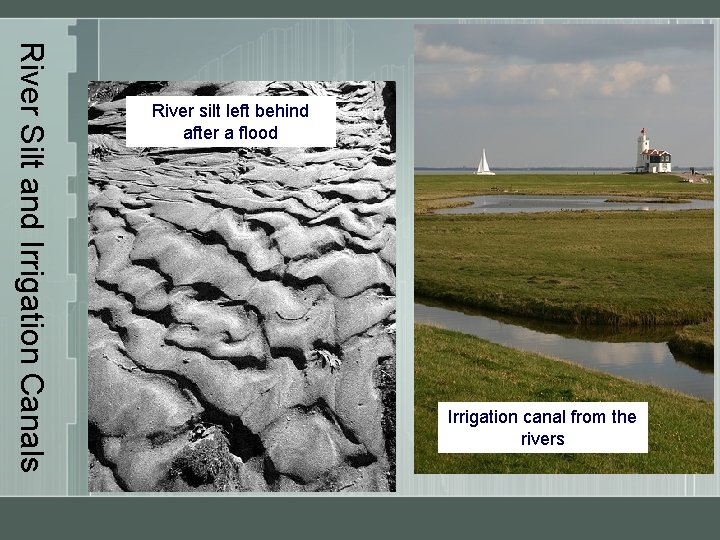
Importance of Geography • Problem Solving at Its Best – People of Sumer utilized new technologies • Dug irrigation canals to control water – Also spread the amount of farmable land • Built walls to protect the cities from invaders • Traded for resources needed w/ other cities – Traded grain and cloth for wood, metal, and tools
River Silt and Irrigation Canals River silt left behind after a flood Irrigation canal from the rivers
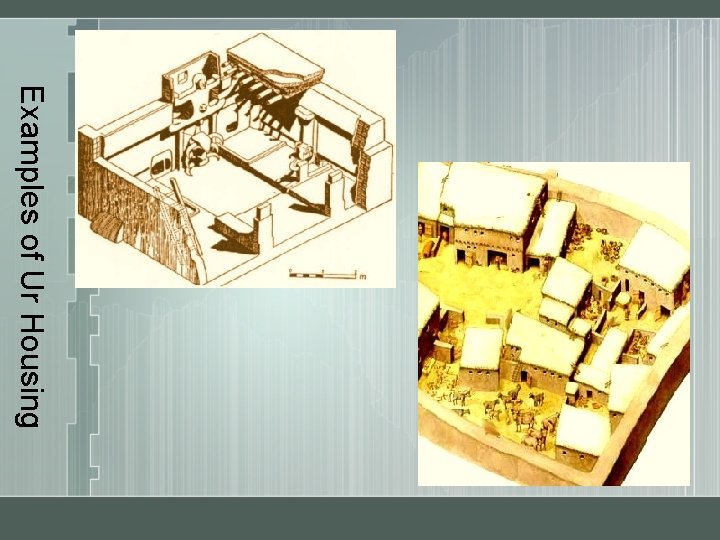
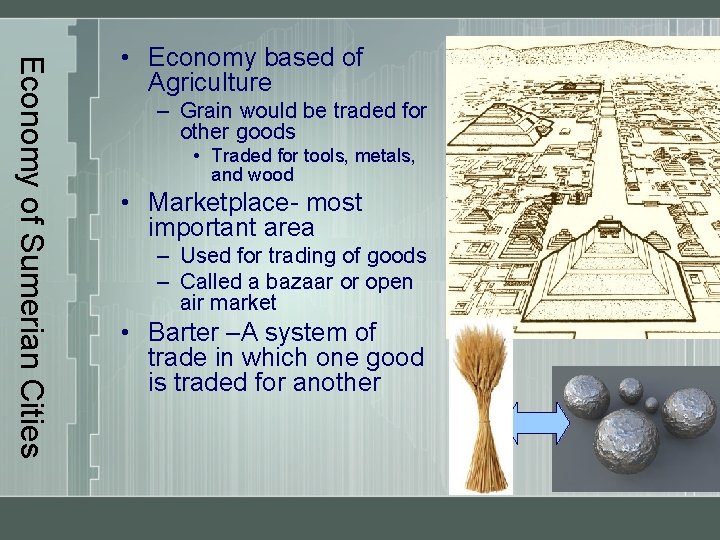
• All cities had their own governments and rulers Sumerian Cities – Ur- the most powerful Sumerian city – Sophisticated city w/ rigid social classes – Buildings made of clay bricks • Regular houses were boxlike w/ no windows • Rich houses were two levels w/ courtyard
Examples of Ur Housing
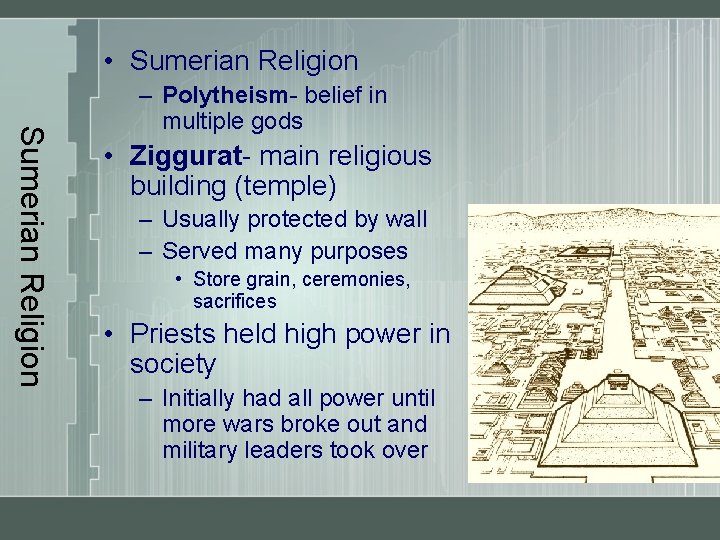
Economy of Sumerian Cities • Economy based of Agriculture – Grain would be traded for other goods • Traded for tools, metals, and wood • Marketplace- most important area – Used for trading of goods – Called a bazaar or open air market • Barter –A system of trade in which one good is traded for another
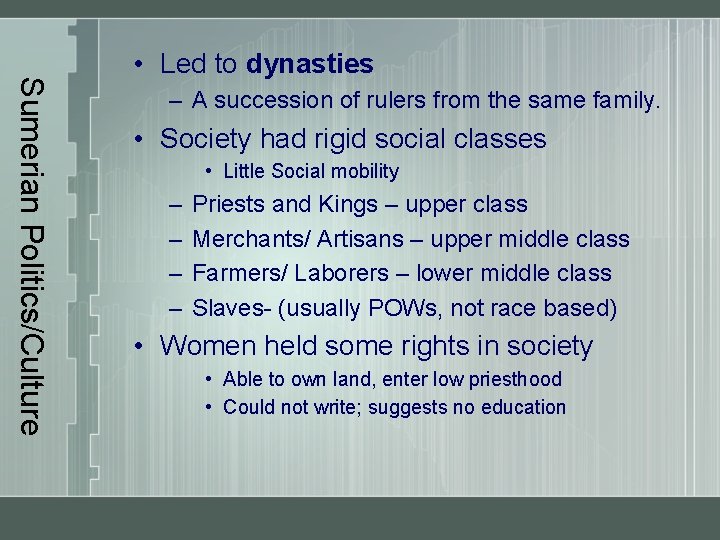
• Sumerian Religion – Polytheism- belief in multiple gods • Ziggurat- main religious building (temple) – Usually protected by wall – Served many purposes • Store grain, ceremonies, sacrifices • Priests held high power in society – Initially had all power until more wars broke out and military leaders took over
Sumerian Politics/Culture • Led to dynasties – A succession of rulers from the same family. • Society had rigid social classes • Little Social mobility – – Priests and Kings – upper class Merchants/ Artisans – upper middle class Farmers/ Laborers – lower middle class Slaves- (usually POWs, not race based) • Women held some rights in society • Able to own land, enter low priesthood • Could not write; suggests no education
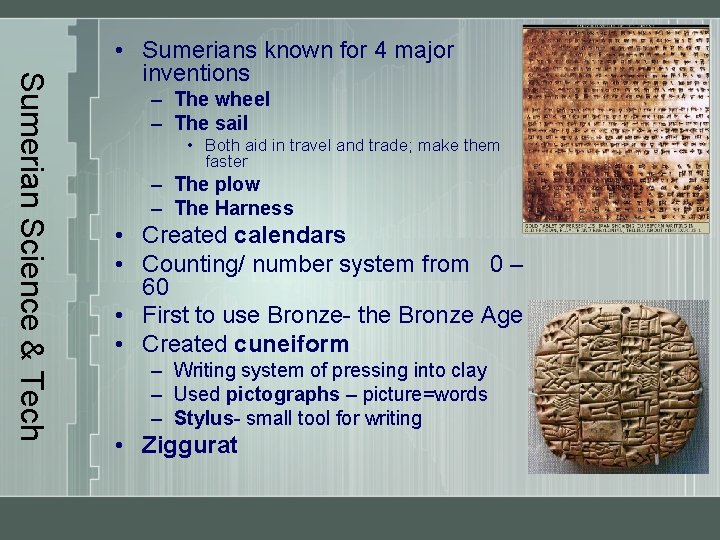
Sumerian Science & Tech • Sumerians known for 4 major inventions – The wheel – The sail • Both aid in travel and trade; make them faster – The plow – The Harness • Created calendars • Counting/ number system from 0 – 60 • First to use Bronze- the Bronze Age • Created cuneiform – Writing system of pressing into clay – Used pictographs – picture=words – Stylus- small tool for writing • Ziggurat
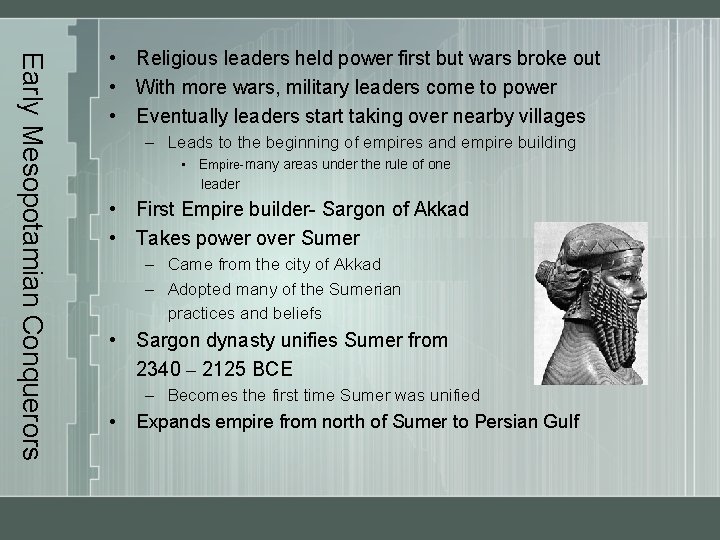
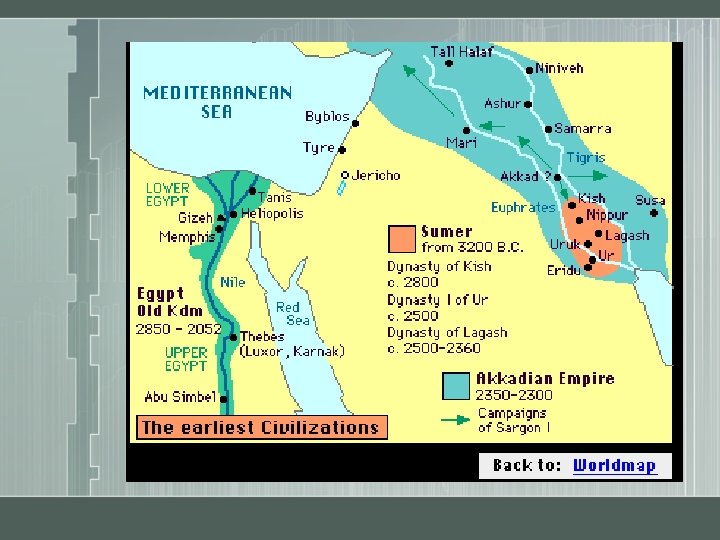
Early Mesopotamian Conquerors • Religious leaders held power first but wars broke out • With more wars, military leaders come to power • Eventually leaders start taking over nearby villages – Leads to the beginning of empires and empire building • Empire-many areas under the rule of one leader • First Empire builder- Sargon of Akkad • Takes power over Sumer – Came from the city of Akkad – Adopted many of the Sumerian practices and beliefs • Sargon dynasty unifies Sumer from 2340 – 2125 BCE – Becomes the first time Sumer was unified • Expands empire from north of Sumer to Persian Gulf
Discussion • Why did Sargon adopt much of the Sumerian culture?
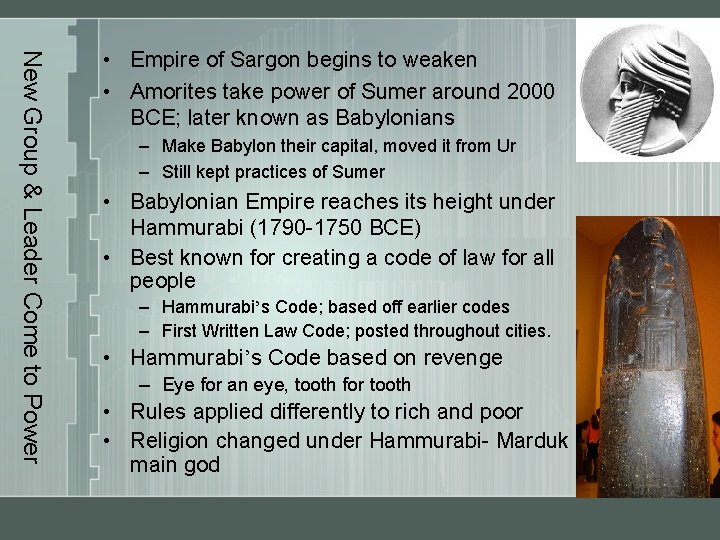
New Group & Leader Come to Power • Empire of Sargon begins to weaken • Amorites take power of Sumer around 2000 BCE; later known as Babylonians – Make Babylon their capital, moved it from Ur – Still kept practices of Sumer • Babylonian Empire reaches its height under Hammurabi (1790 -1750 BCE) • Best known for creating a code of law for all people – Hammurabi’s Code; based off earlier codes – First Written Law Code; posted throughout cities. • Hammurabi’s Code based on revenge – Eye for an eye, tooth for tooth • Rules applied differently to rich and poor • Religion changed under Hammurabi- Marduk main god