
Ancient Civilizations I II Intro Mesopotamia 3000 1000



- Slides: 25
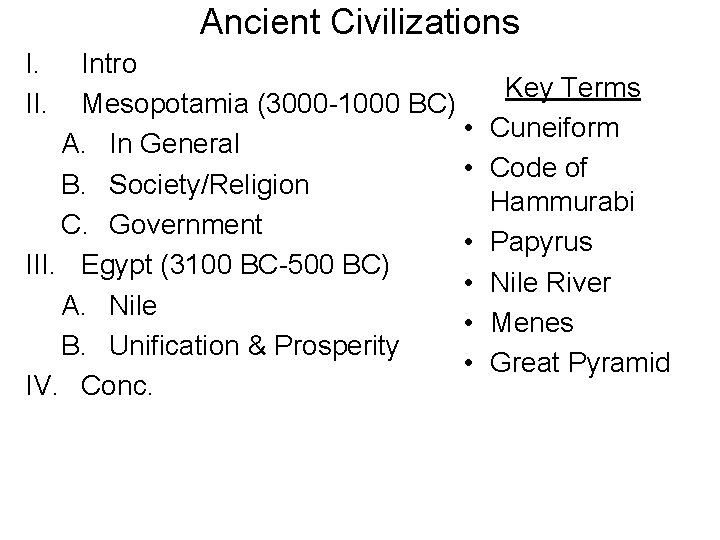
Ancient Civilizations I. II. Intro Mesopotamia (3000 -1000 BC) • A. In General • B. Society/Religion C. Government • III. Egypt (3100 BC-500 BC) • A. Nile • B. Unification & Prosperity • IV. Conc. Key Terms Cuneiform Code of Hammurabi Papyrus Nile River Menes Great Pyramid
Announcements • • • Requirement/Extra Credit Opportunities “Chris Carter’s Student Body Language, ” Friday 9/14 7: 30 PM at WSCC theater Peter Yarrow: Saturday 9/29, 7: 30 at Ramsdell Theater in Manistee For free tickets call WSCC box office: 843 -5507 To do: Attend the event & write a summary (one page, single-spaced, typed, 250 words); due: one week after the event More than one: five points can be added to your discussion grade
Two Important Civilizations Mesopotamia & Egypt Why here? Access to water!
Mesopotamia 1. Mesopotamia = a Greek word meaning “between the rivers. ” 2. Rivers: Tigris & Euphrates – The Rivers flooded periodically & flood control was important.
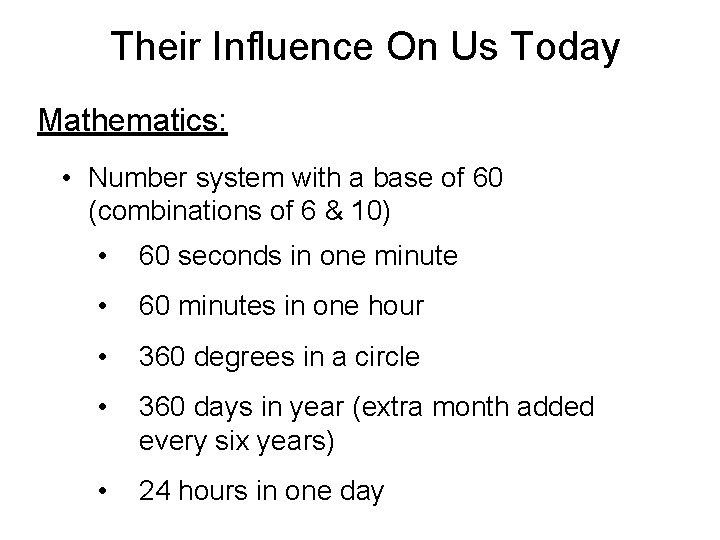
Their Influence On Us Today Mathematics: • Number system with a base of 60 (combinations of 6 & 10) • 60 seconds in one minute • 60 minutes in one hour • 360 degrees in a circle • 360 days in year (extra month added every six years) • 24 hours in one day
Their Influence On Us Today Writing: Sumerians invented “Cuneiform” which was the first efficient system of writing. • It was partly pictographic and partly an alphabet.
Sumerian Cuneiform Tablet (ca. 2121 BC)
Society & Religion • Religion dominated daily life & people constantly tried to placate the gods. • This was reflected in their architecture.
Ziggurat (At the top was a temple for a god)
Religion 1. They were polytheists. 2. A major role/function was to explain “natural events. ” – “Gloomy” & vague afterlife; no reward for virtuous living. 3. Enlil-An important god who influenced success or failure of crops by controlling weather. Enlil
Mesopotamian Society • Slavery was practiced; one could be enslaved due to debt or prisoner of war. • About 80 -90% of the population farmed. • Marriages were typically arranged by parents.
Government in Mesopotamia 1. There were 10 -12 separate city-states in 3000 BC; each was led by a “king. ” 2. Leadership was very unstable; rulers rose & fell based upon their popularity (usually based on success of crops). 3. Kings acted as representatives of the gods; no separation of church & state.
Hammurabi (Babylonian King) (1792 -1750 BC) Hammurabi was able to unify all of Mesopotamia under his rule Hammurabi and the law code
Code of Hammurabi (ca. 1750 BC) • If a man commits robbery and is captured, he shall be put to death. • If the robber is not captured, the man who has been robbed shall, in the presence of the god, make a list of what he has lost, and the city and the governor of the province where the robbery was committed shall compensate him for his loss. – Insight: Protection of Private Property
Code of Hammurabi (ca. 1750 BC) • If a man accuses another man of murder but cannot prove it, the accuser shall be put to death. • If a man bears false witness in a case, or cannot prove his testimony, if that case involves life or death, he shall be put to death. – Insight: Honesty
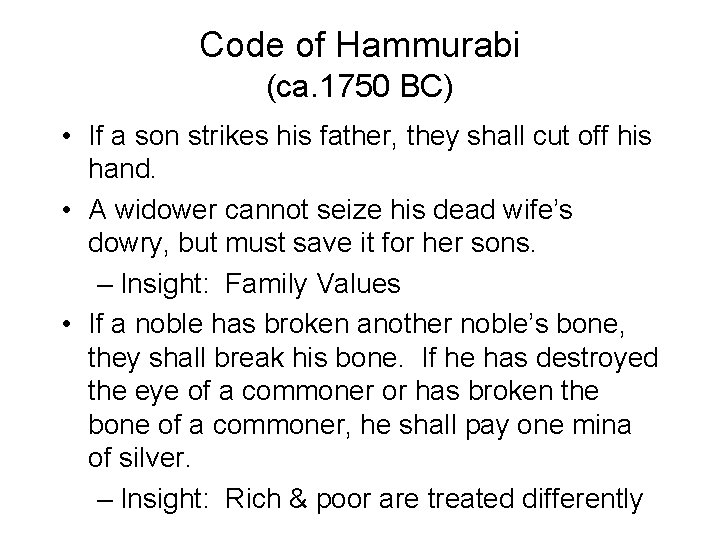
Code of Hammurabi (ca. 1750 BC) • If a son strikes his father, they shall cut off his hand. • A widower cannot seize his dead wife’s dowry, but must save it for her sons. – Insight: Family Values • If a noble has broken another noble’s bone, they shall break his bone. If he has destroyed the eye of a commoner or has broken the bone of a commoner, he shall pay one mina of silver. – Insight: Rich & poor are treated differently
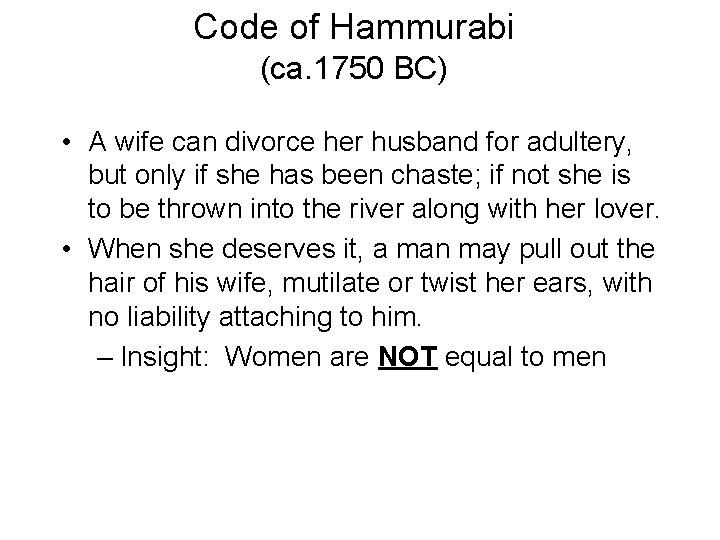
Code of Hammurabi (ca. 1750 BC) • A wife can divorce her husband for adultery, but only if she has been chaste; if not she is to be thrown into the river along with her lover. • When she deserves it, a man may pull out the hair of his wife, mutilate or twist her ears, with no liability attaching to him. – Insight: Women are NOT equal to men
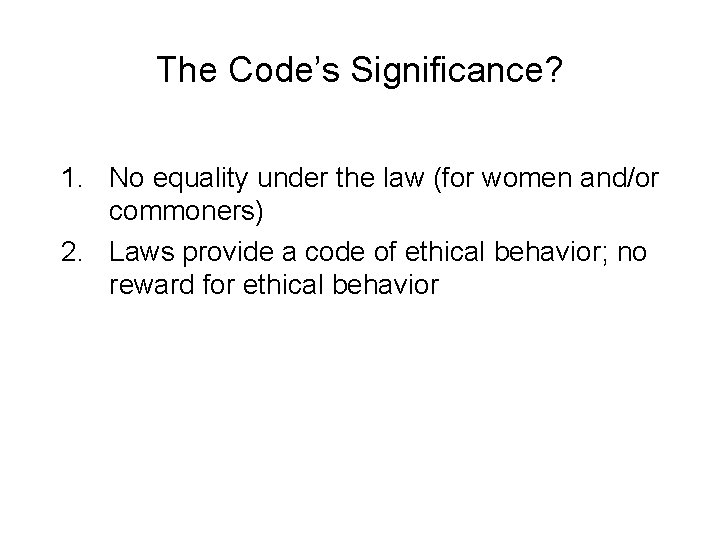
The Code’s Significance? 1. No equality under the law (for women and/or commoners) 2. Laws provide a code of ethical behavior; no reward for ethical behavior
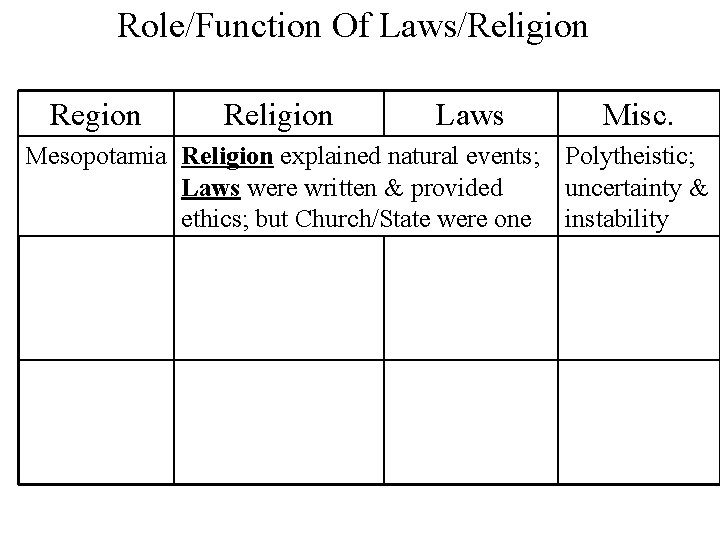
Role/Function Of Laws/Religion Laws Misc. Mesopotamia Religion explained natural events; Polytheistic; Laws were written & provided uncertainty & ethics; but Church/State were one instability
Egypt’s Influence On Us Today 1. A new, less clumsy writing tablet: Papyrus 2. Toothpaste! a) Ingredients: lead, powdered flint, incense, and honey (ca. 1500 BC)
Rosetta Stone • Discovered in 1799; deciphered 1822 • Included writing in hieroglyphics, demotic script, and Greek
The Gift Of The Nile Most of Egypt is a desert, but the Nile. . . 1. flooded every year which added nutrients to soil. 2. made the land “livable; ” 5 -15 miles on either side of the River. 3. created a dependable and efficient transportation system. In contrast to Mesopotamia’s instability, the Nile provided stability and prosperity to Egypt.
Unification Brings Prosperity Egypt was believed to be first unified between 3100 -2850 BC by… Menes He was also known as Narmer
Statistics & the Great Pyramid • • • Built about 2600 BC 480 feet high and 750 feet long Built with 2. 3 million limestone blocks Each block weighed about 2. 5 tons Each block was hand-chiseled to fit in place perfectly • Built with a labor force of about 100, 000 men working for 20 years
Ancient Civilizations I. II. Intro Mesopotamia (3000 -1000 BC) • A. Society/Religion • B. Government III. Egypt (3100 BC-500 BC) • A. Nile • B. Unification & Prosperity • IV. Conc. • Key Terms Cuneiform Code of Hammurabi Papyrus Nile River Menes Great Pyramid