
Ancient Civilizations Egyptian Civilization Table of Contents Egyptian
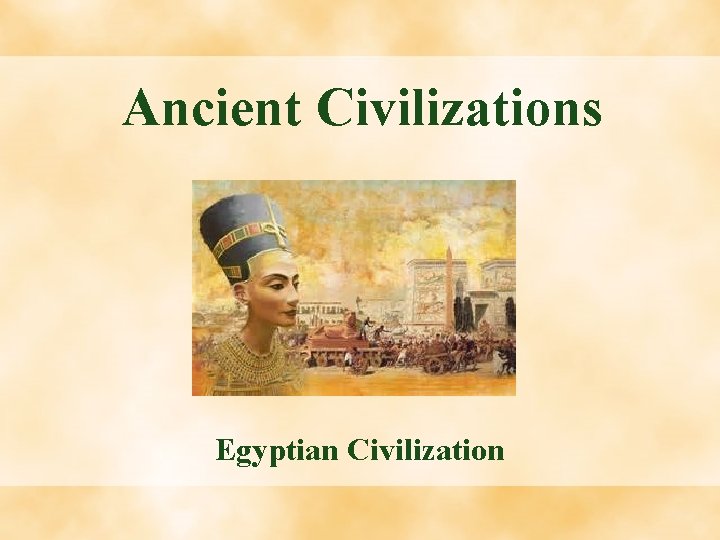
Ancient Civilizations Egyptian Civilization
Table of Contents • • • Egyptian Civilization Introduction Map of The Nile Delta The Nile River Three Kingdoms The Pharaohs The Tombs at Giza Administration The People Egyptian Social Pyramid • • • Women Knowledge & Learning Religious Beliefs Afterlife End of Presentation
Introduction • The land of Egypt is defined by the Nile River, the narrow green strip of land on either side of its banks, and the fertile Nile delta area. • The rest of the country is barren desert, the unfriendly “Red Land” that contrasted with the “Black Land, ” which was home to the vast majority of the Egyptian population. • Egypt was traditionally divided into two areas: Upper Egypt, along the southern part of the Nile as far south as the First Cataract, and Lower Egypt, the northern delta area. • The climate was good for agriculture, but with little or no rainfall, farmers had to depend on the river for irrigation.
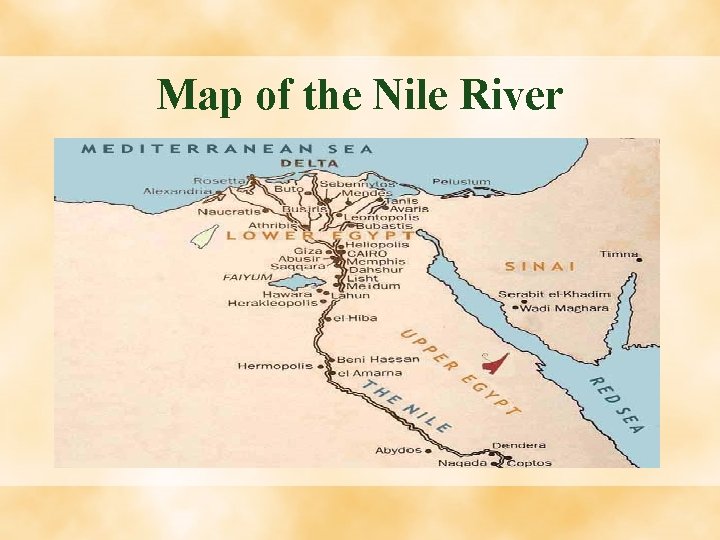
Map of the Nile River
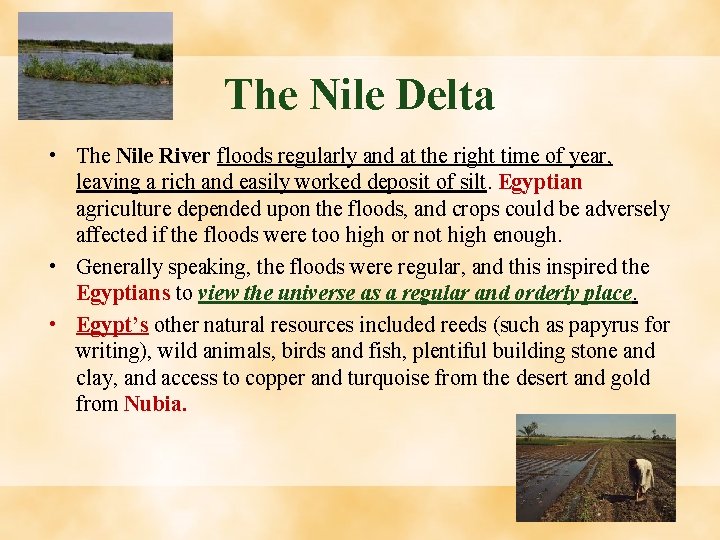
The Nile Delta • The Nile River floods regularly and at the right time of year, leaving a rich and easily worked deposit of silt. Egyptian agriculture depended upon the floods, and crops could be adversely affected if the floods were too high or not high enough. • Generally speaking, the floods were regular, and this inspired the Egyptians to view the universe as a regular and orderly place. • Egypt’s other natural resources included reeds (such as papyrus for writing), wild animals, birds and fish, plentiful building stone and clay, and access to copper and turquoise from the desert and gold from Nubia.
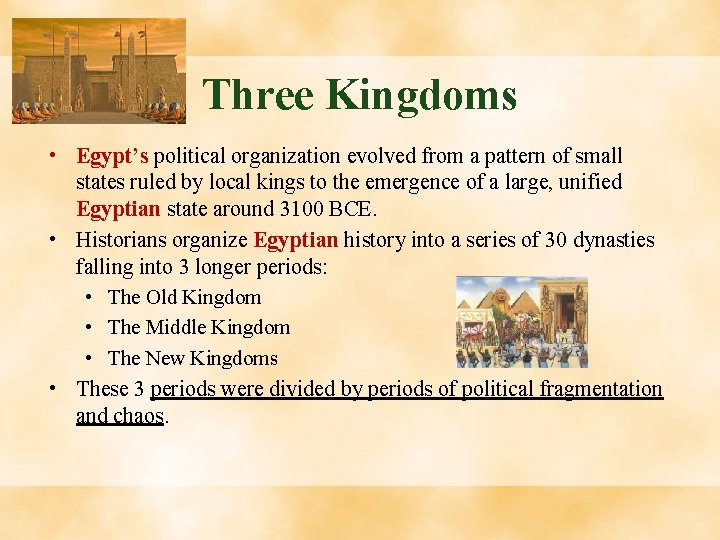
Three Kingdoms • Egypt’s political organization evolved from a pattern of small states ruled by local kings to the emergence of a large, unified Egyptian state around 3100 BCE. • Historians organize Egyptian history into a series of 30 dynasties falling into 3 longer periods: • The Old Kingdom • The Middle Kingdom • The New Kingdoms • These 3 periods were divided by periods of political fragmentation and chaos.
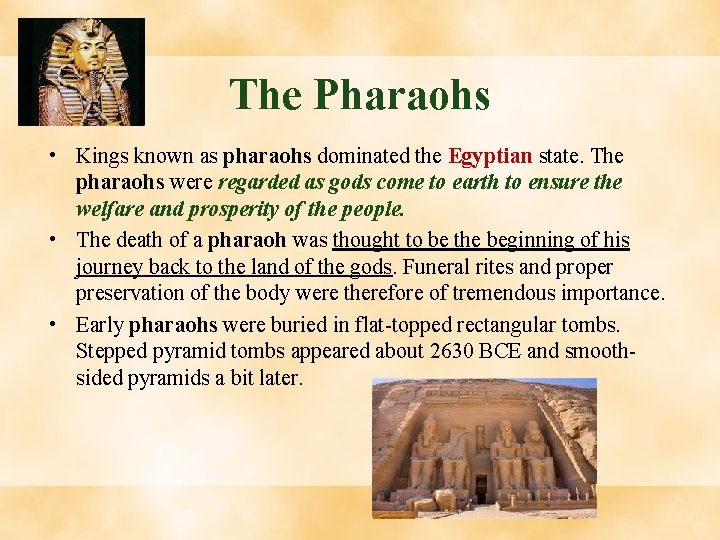
The Pharaohs • Kings known as pharaohs dominated the Egyptian state. The pharaohs were regarded as gods come to earth to ensure the welfare and prosperity of the people. • The death of a pharaoh was thought to be the beginning of his journey back to the land of the gods. Funeral rites and proper preservation of the body were therefore of tremendous importance. • Early pharaohs were buried in flat-topped rectangular tombs. Stepped pyramid tombs appeared about 2630 BCE and smoothsided pyramids a bit later.
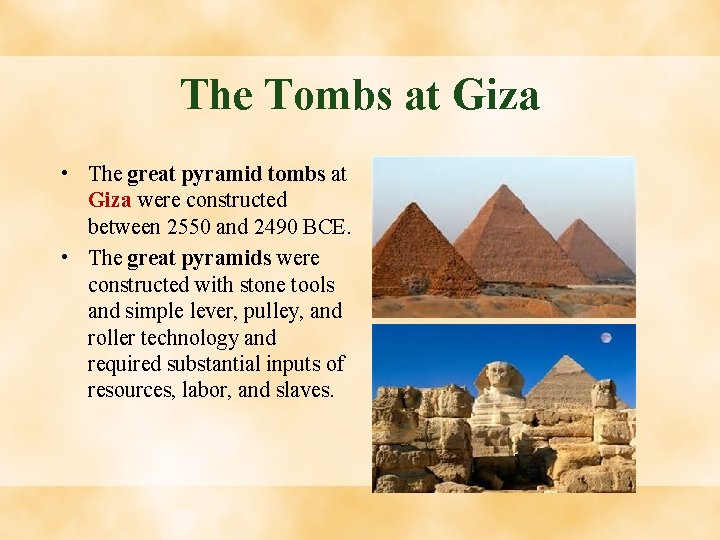
The Tombs at Giza • The great pyramid tombs at Giza were constructed between 2550 and 2490 BCE. • The great pyramids were constructed with stone tools and simple lever, pulley, and roller technology and required substantial inputs of resources, labor, and slaves.
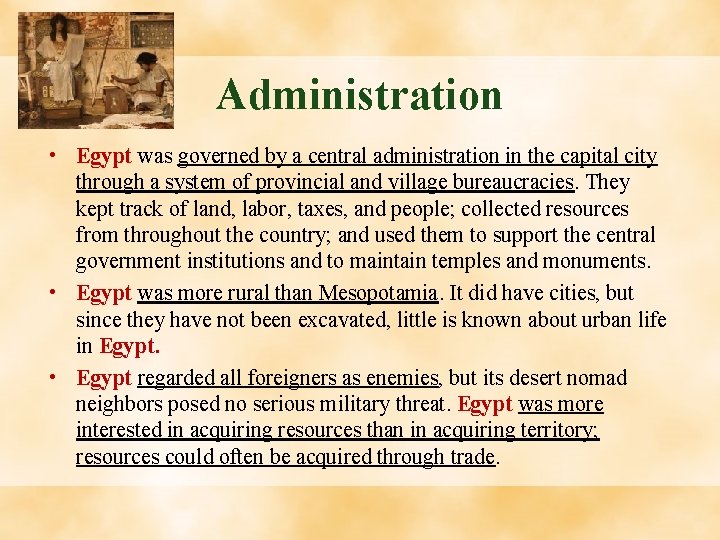
Administration • Egypt was governed by a central administration in the capital city through a system of provincial and village bureaucracies. They kept track of land, labor, taxes, and people; collected resources from throughout the country; and used them to support the central government institutions and to maintain temples and monuments. • Egypt was more rural than Mesopotamia. It did have cities, but since they have not been excavated, little is known about urban life in Egypt. • Egypt regarded all foreigners as enemies, but its desert nomad neighbors posed no serious military threat. Egypt was more interested in acquiring resources than in acquiring territory; resources could often be acquired through trade.

Writing Systems • The ancient Egyptians developed two writing systems: hieroglyphics and a cursive script. • Egyptians wrote on papyrus and used writing for religious and secular literature as well as for record keeping.
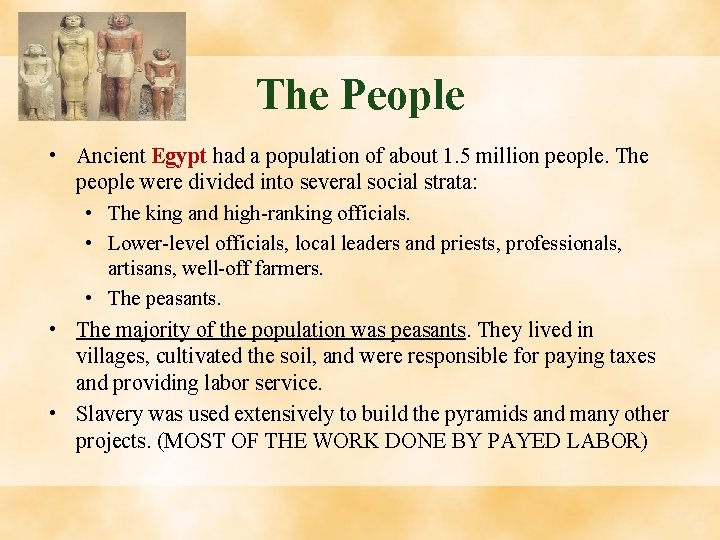
The People • Ancient Egypt had a population of about 1. 5 million people. The people were divided into several social strata: • The king and high-ranking officials. • Lower-level officials, local leaders and priests, professionals, artisans, well-off farmers. • The peasants. • The majority of the population was peasants. They lived in villages, cultivated the soil, and were responsible for paying taxes and providing labor service. • Slavery was used extensively to build the pyramids and many other projects. (MOST OF THE WORK DONE BY PAYED LABOR)
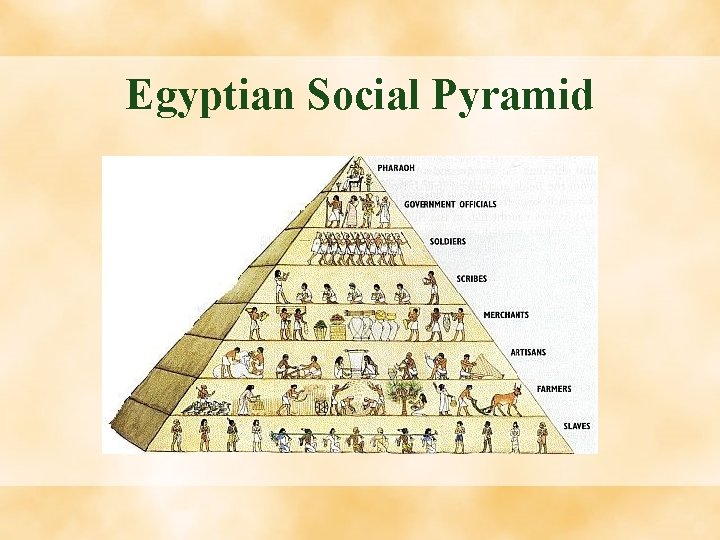
Egyptian Social Pyramid
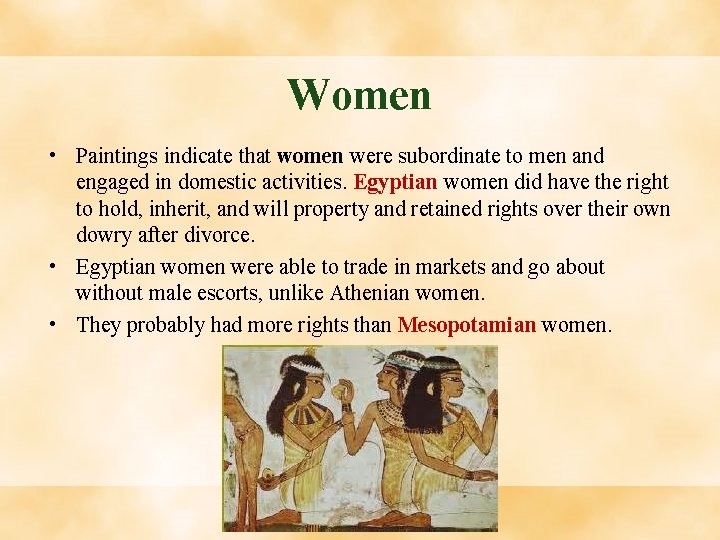
Women • Paintings indicate that women were subordinate to men and engaged in domestic activities. Egyptian women did have the right to hold, inherit, and will property and retained rights over their own dowry after divorce. • Egyptian women were able to trade in markets and go about without male escorts, unlike Athenian women. • They probably had more rights than Mesopotamian women.
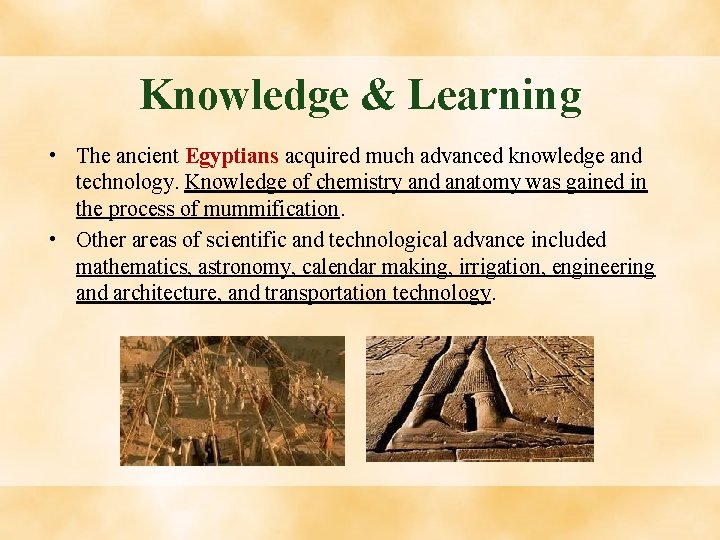
Knowledge & Learning • The ancient Egyptians acquired much advanced knowledge and technology. Knowledge of chemistry and anatomy was gained in the process of mummification. • Other areas of scientific and technological advance included mathematics, astronomy, calendar making, irrigation, engineering and architecture, and transportation technology.
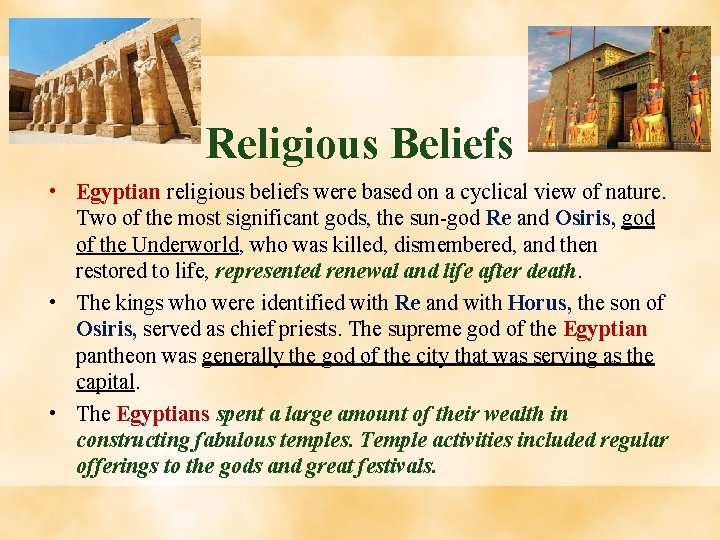
Religious Beliefs • Egyptian religious beliefs were based on a cyclical view of nature. Two of the most significant gods, the sun-god Re and Osiris, god of the Underworld, who was killed, dismembered, and then restored to life, represented renewal and life after death. • The kings who were identified with Re and with Horus, the son of Osiris, served as chief priests. The supreme god of the Egyptian pantheon was generally the god of the city that was serving as the capital. • The Egyptians spent a large amount of their wealth in constructing fabulous temples. Temple activities included regular offerings to the gods and great festivals.
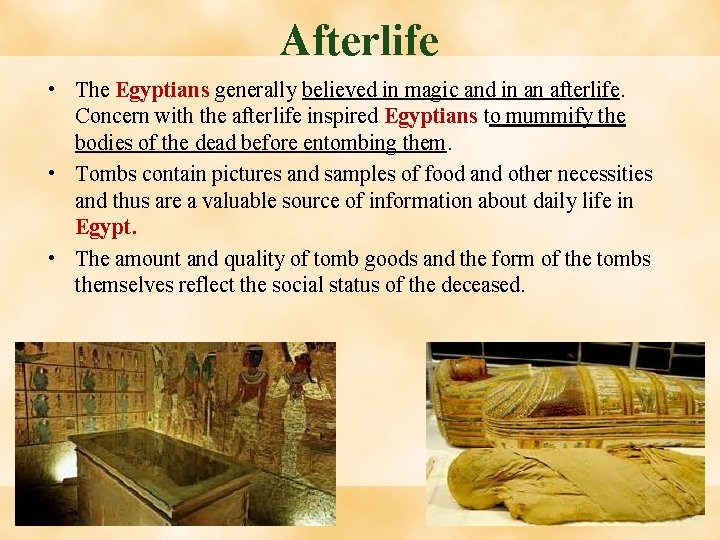
Afterlife • The Egyptians generally believed in magic and in an afterlife. Concern with the afterlife inspired Egyptians to mummify the bodies of the dead before entombing them. • Tombs contain pictures and samples of food and other necessities and thus are a valuable source of information about daily life in Egypt. • The amount and quality of tomb goods and the form of the tombs themselves reflect the social status of the deceased.

End of Presentation
- Slides: 17