
Ancient Civilizations 3500 B C E to B
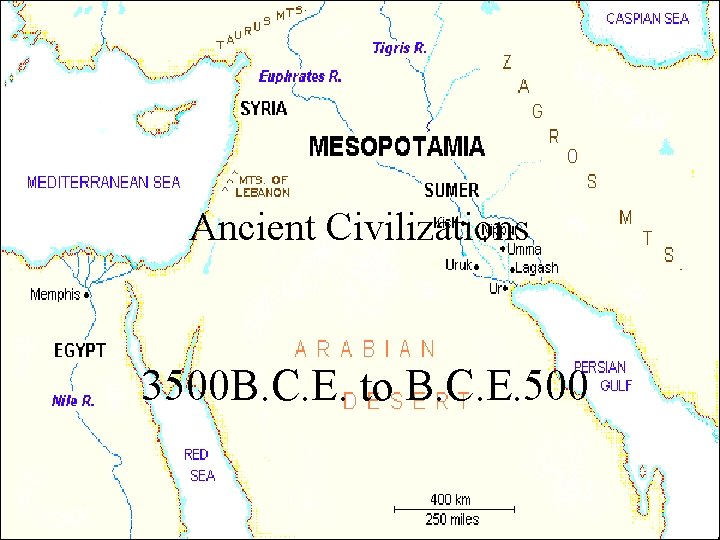
Ancient Civilizations 3500 B. C. E. to B. C. E. 500

• A piece of land stretching from eastern Mediterranean sea to the Persian Gulf • Between Tigris & Euphrates Rivers • Soil is rich, great for farming. • Area is shaped like a crescent. • Mesopotamia (Land between the rivers) to the east • Mediterranean section to the west

Sumer (3500 B. C. E. ) • First People in the Fertile Crescent • Skilled Builders & Artists • Army is supplied with weapons • Metals, stones, & wood were obtained by trading • Kings were treated as gods • Developed cuneiform(writing) • Studied math & science ( a year has 360 days) • First to use a wheel in farming, trade, and warfare

Egypt (3000 B. C. E. ) • Only civilization to continue to today • 2700 -2100 Old Kingdom: Great Pyramids & Sphinx are built • 2100 -1800 Middle Kingdom: Irrigation & canals built; conquered by invaders • 1600 -1100 New Kingdom: conquered many lands, became a great empire, begins to decline
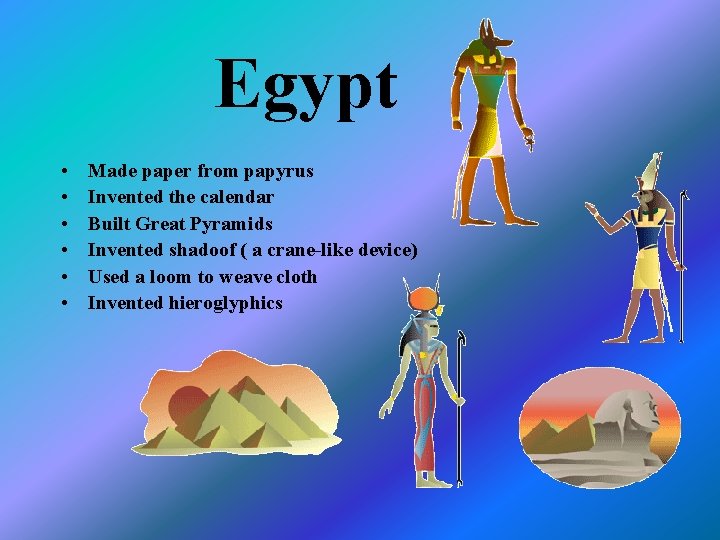
Egypt • • • Made paper from papyrus Invented the calendar Built Great Pyramids Invented shadoof ( a crane-like device) Used a loom to weave cloth Invented hieroglyphics
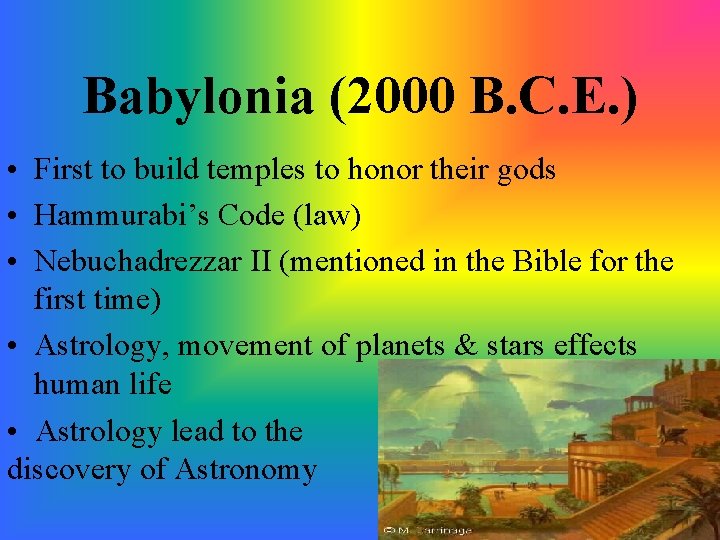
Babylonia (2000 B. C. E. ) • First to build temples to honor their gods • Hammurabi’s Code (law) • Nebuchadrezzar II (mentioned in the Bible for the first time) • Astrology, movement of planets & stars effects human life • Astrology lead to the discovery of Astronomy
This Code of Hammurabi reveals: 1. A stern sense of justice - proclaiming the principle of "an eye for an eye" and demanding severe punishment for crimes - bribery, theft, dishonest weights and measures, and damage to another's property. 2. A sharp division of classes - providing harsher punishment for an offense against a noble or priest than for the same offense against a common person - an artisan, merchant, farmer, or slave 3. A fair treatment of women - permitting them to own property and engage in business. However, the code strictly regulated the behavior of women. It expected a woman to remain in her husband's home and be dependent on him. A husband, however, had a legal duty to support his wife. The code also gave a father nearly unlimited authority over his children. The Babylonians believed that an orderly household headed by a strong father was necessary for a stable empire. 4. An advanced business society- establishing regulations for protecting property and business contracts, limiting interest on loans, and setting wages for workers.
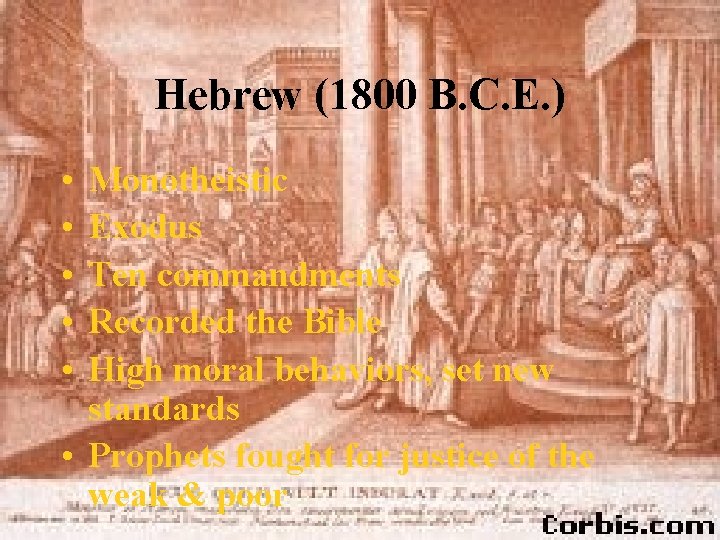
Hebrew (1800 B. C. E. ) • • • Monotheistic Exodus Ten commandments Recorded the Bible High moral behaviors, set new standards • Prophets fought for justice of the weak & poor
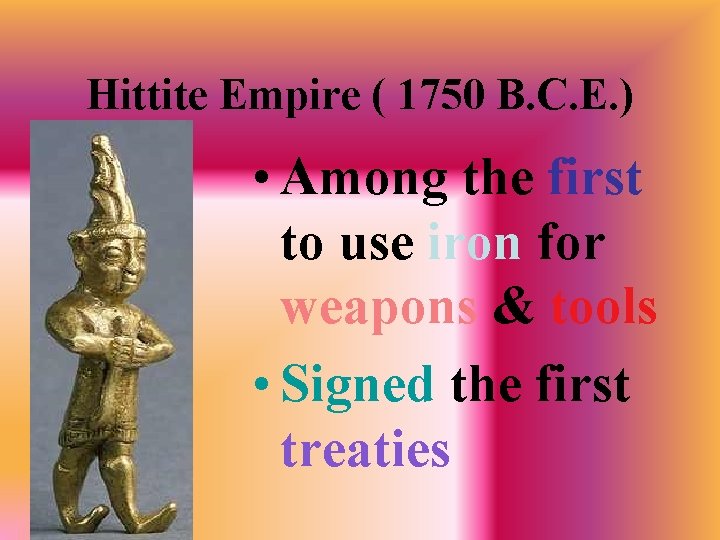
Hittite Empire ( 1750 B. C. E. ) • Among the first to use iron for weapons & tools • Signed the first treaties

Assyria (1350 B. C. E. ) • Bilt first sistem of roads • Began provintial goverments • Established first libary

Bibliography • Akurgal, Ekrem - The Hattian and Hittite Civilizations; Publications of the Republic of Turkey; Ministry of Culture; 2001; 300 pages; ISBN 975 -17 -2756 -1 • Trevor R. Bryce, "Life and Society in the Hittite World, " Oxford (2002). • Trevor R. Bryce, The Kingdom of the Hittites, Oxford (1999). • C. W. Ceram, The Secret of the Hittites: The Discovery of an Ancient Empire. Phoenix Press (2001), ISBN 1 -84212295 -9. • Hans Gustav Güterbock, Hittite Historiography: A Survey, in H. Tadmor and M. Weinfeld eds. History, Historiography and Interpretation: Studies in Biblical and Cuneiform Literatures, Magnes Press, Hebrew University (1983) pp. 21 -35. • J. G. Macqueen, The Hittites, and Their Contemporaries in Asia Minor, revised and enlarged, Ancient Peoples and Places series (ed. G. Daniel), Thames and Hudson (1986), ISBN 0 -500 -02108 -2. • George E. Mendenhall, The Tenth Generation: The Origins of the Biblical Tradition, The Johns Hopkins University Press (1973), ISBN 0 -8018 -1654 -8. • Erich Neu, Der Anitta Text, (St. Bo. T 18), Otto Harrassowitz, Wiesbaden (1974). • Louis L. Orlin, Assyrian Colonies in Cappadocia, Mouton, The Hague (1970). • The Hittites and Hurrians in D. J. Wiseman Peoples of the Old Testament Times, Clarendon Press, Oxford (1973). O. R. Gurney, The Hittites, Penguin (1952), ISBN 0 -14 -020259 -5
- Slides: 11